
Category: MEDIA

  • Shailesh Kapoor: T20 Cricket: India’s ‘Second Sport’?


    By Shailesh Kapoor


    This Republic Day, India beat Australia in the first T20 International of the ongoing series. Earlier the same day, the Indian women beat the Aussies too, in a record run chase. Thus started a long season of T20 cricket for the Indian viewers; a season that will go all the way till May end, when the IPL concludes.


    India finishes three T20s in Australia, then plays another three with Sri Lanka, followed by the T20 World Cup in India in March, and the IPL in April-May immediately after. More than 80 T20 matches will be aired this period, not counting the women’s T20 World Cup, which is also scheduled for March.


    For those whose initiation into the sport of cricket was through Tests and ODIs, this may come across as a crazy cricket schedule, almost an off-putting one. But for a wide section of sub-25 audience, this is the cricket they enjoy seeing the most – the three-hour entertainment show, over the eight-hour or five-day drag.


    I may have made this point in this column a couple of years ago, but it’s worth saying again that the sport a person (and by extension, a country) grows up to love is the sport he (or she) grows up to watch (and possibly play) when he’s a teenager. Typically, 12-17 years is the age band when the mind is most impressionable regarding the sporting taste of a typical urban Indian.


    Times are changing, though. For many in the 12-17 age group, the “entertainment” that sports provided has been replaced by social options, loosely grouped under the generic category of activities (including the virtual ones) called “hanging out”. Hence, the challenge to engage them will continue to get tougher by the year.


    In the pursuit to find the ‘second sport’ in India after cricket, broadcasters and sports marketers have launched every possible sporting league. Some of these leagues have done genuinely well, while others are merely projected media successes, despite low viewership and financial losses to most stakeholders. A dozen leagues later, India has not got any closer to finding that second sport.


    But even as that effort continues, the sport of cricket is virtually getting split into two. Cricket 1 is the old cricket – Tests & ODIs – attracting a small section of 25+ male audience (40+ for Tests) and increasingly becoming a niche proposition, unless there’s a big event like the World Cup once in four years.


    Cricket 2 is T20, be it nation vs. nation or leagues (IPL primarily, for now, for the Indian audiences). Cricket 2 is entertainment first and sports later. It’s more gender-inclusive for that reason. It targets 15-30 as its core constituency, though the national team playing T20 would tend to get Cricket 1 audiences into it too.


    Year-on-year, the proportion of Cricket 2 audiences will grow, as the 15-30 year olds get older. A decade from now, Cricket 2 will address a much wider 15-40 audience, and be perhaps the only cricket that gets ratings.


    To that extent, India seems to have found its second sport (or the new first sport, more appropriately). Call it Cricket 2, Call it T20, it’s a new sport alright. And its strength will be on display, all the way till end May this year.

     

  • ZenithOptimedia and Google to host Zoogle Day on Feb 4

    By A Correspondent


    ZenithOptimedia Group and Google have partnered to present Zoogle Day, a first of its kind event on digital and mobile marketing. The event will unfold on 4 February 2016 at Le M’eridien, Gurgaon.


    The ZenithOptimedia leadership, along with top executives from Google will share learnings, insights and case studies where brands have taken the lead in a mobile inevitable world. Some of the subjects that the summit will focus on includes how mobile commerce is shaping up sectors such as banking insurance and telecom, how data driven planning driving programmatic, top trends in ecommerce, the success story of Alibaba and other future-facing business models that are reaping the benefits of a digital economy.


    The conference will also have a key address by Craig Greenfield, Chief Operating Officer of Performics Worldwide. Since 2005, Craig Greenfield’s expertise in scaling large client programs and developing company-wide processes and this has helped Performics successfully transition into the first truly global performance marketing agency. In his current position, Craig leads global technology and innovation; a dynamic network of change agents focused on identifying, evaluating and developing new products, services and systems to ensure competitiveness and improved operational efficiency.


    Craig works in tandem with Performics’s worldwide leadership, client teams and external partners to help clients identify and capture new business opportunities, negotiate strategic partnerships and enhance operational efficiency.


    Anupriya Acharya, Group CEO, ZenithOptimedia said, “ZenithOptimedia and Google host Zoogle Day in many top markets around the world and we are very excited to bring this premier event to India. Given the way mobile is increasingly shaping consumer behavior and commerce, we felt this is an opportune time for us to hold this event. Both ZenithOptimedia and Google are leaders in mobile marketing and have valuable lessons and insights to share on the transformation that India is witnessing.”


    Tanmay Mohanty, Managing Director of Performics and Resultrix says, “We share a long fulfilling relationship with Google and this event cements this relationship further. They, like us, are driven by the Live ROI philosophy, and have unique data driven insights that help clients derive sizeable share.”


    Punitha Arumugam – Director Agency Business India and SEA, Google says “With an estimated 5mn smartphone users being added very month, India’s online populations is expected to cross 500MN by 2018. The Zoogle day chapter we are extending to India is tailored to this reality and will address the mobile and commerce future of this market.”


  • Kotak partners Google to unveil Querimetrix

    By A Correspondent


    Kotak Institutional Equities, a division of Kotak Securities Limited, in collaboration with Google launched Consumer Querimetrix — a tool that demystifies and predicts near-term Indian consumer behaviour by analyzing Google Trends data.


    Using machine learning techniques and merging big data from Google Trends, the first edition of Consumer Querimetrix provides consumer insights into India’s evolving car buying journey. Using Google Trends data, the tool enables ‘nowcasting’ (near-term predictions) on consumer activity, capturing inflection points earlier than traditional forecasting tools to give a complete picture — on car launches, last mile hiccups, cannibals and competition.


    Each edition of the Consumer Querimetrix series will focus on consumer behaviour in a different industry.


    Launching the report, C Jayaram, Joint Managing Director, Kotak Mahindra Bank said, “The digital wave is challenging conventional business practices across industries. Ground rules are evolving rapidly along with the consumer and those in the business of business intelligence need new tools to keep up with the changing landscape. Consumer Querimetrix is our step in that direction. Today, the sheer volume of consumer-centric search data available presents a tremendous opportunity to analyze and throw up actionable insights. These takeaways would be useful to both companies and investors. KIE research is highly valued by our clients and the launch of Querimetrix will further strengthen our ability to cover the Indian markets in a holistic manner.”


    The first edition of Consumer Querimetrix which focuses on the passenger car segment highlights the extent to which the Internet is altering the ground rules for vendors of cars and allied products/services. With growing access to easy information online, the Indian car buyer’s journey from a whim to final purchase has changed dramatically. More than 75 per cent of car buyers are researching online for reviews, comparative specifications, financial products and used car markets before making a purchase. The first edition of Consumer Querimetrix also explains how the traditional ‘funnel’ model is giving way to a more complex purchasing path where ‘initial consideration’ may not always guarantee sales.  Although higher auto-related searches correspond to higher demand for cars, this does not hold true on a brand-wise basis.


    Speaking about the trends for the passenger cars industry captured by analyzing Google Trends, Vikas Agnihotri, Industry Director, Google India said, “With over 300 million Internet users online and growing, India today has a sizeable population which accesses the Internet on a daily basis, making search queries as the most dynamic data input to arrive at consumer insights through machine learning as illustrated by Kotak’s research. If we look at the search trends related to car finance and car purchases, we’re seeing a 40% year on year growth in car purchase queries on Google in India. Over half of the people who evaluate car purchases change their consideration set during their research phase – adding two to three new car models in their consideration, the only non-negotiables are price and color of the car. This alone proves the growing complexity for car OEMs in the country. With this report we’re attempting to demystify this changing consumer behavior into actionable insights for the industry.”


    Saifullah Rais, Quantitative Analyst at Kotak Institutional Equities and the architect of Consumer Querimetrix said, “In the absence of conventional rules, traditional decision-support systems are not very effective. They fall short on scalability and adaptability. Machine learning algorithms learn from data and do not rely on explicit rules, making them the most effective method of dealing with data explosion.”


    The Consumer Querimetrix report outlines the influence of digital marketplaces and calls for carmakers to reassess conventional business practices. The effect is visible as car loans are increasingly being sourced outside dealerships. This trend can eat into financing margins earned by dealers and hurt profitability. On the other hand, carmakers with captive finance arms can use this opportunity to innovate and differentiate themselves during the evaluation process.


    The first issue of Consumer Querimetrix establishes that Google search volumes can be used as a gauge for assessing new car launches. The report underscores the linear relationship between search interest and advance bookings during a car launch. Interestingly, higher traditional media spends do not always guarantee higher search interest.


  • Ranjona Banerji​: How News TV rules with ​social issues

    ​By Ranjona Banerji​


    Just as television news was my target last week for its various sins, I have to applaud it for taking some issues head on. Gender equality, whether the rights of women to be allowed into temples and mosques or the discrimination inherent in menstruation taboos, the needless criminalisation of homosexuality in Indian law and police brutality against students were some of the subjects which were debated on most English news channels.


    In all cases, the TV anchors and reporters on the scene stood against the entrenched views of patriarchy and discrimination. As is as their wont, they gave more than ample space to the various regressive elements in our society in an attempt to appear “fair” – why is this gentleman Rahul Eshwar everywhere? But ​​they also brought to public attention a wide variety of new voices to speak about women’s rights and the sexual rights of Indians.


    Perhaps I am being unfair to our TV debate shows. Perhaps allowing these regressive voices to share their views only reiterates the irrationality and hatred in their positions. It is also very amusing to watch them squirming – the ubiquitous Eshwar for instance – when menstruation, bleeding and sanitary pads are mentioned. It is even funnier to watch them running for justification when asked to explain why religion discriminates against women.
    Unfortunately there are deeper points in all these subjects which TV debates, discussions and screaming matches cannot cover. This is where print comes in and print seems more focused on the various political shenanigans going on, which have their own need for ample space! Websites luckily will give you a bit of both.


    So should TV news debates have focused on the Supreme Court asking the Gujarat government if it was planning to secede from the Indian Union? Or on The Case of President’s Rule in Arunachal Pradesh, which is getting curiouser and curiouser?
    All things considered, social issues are well-suited to TV. As we saw with the khap panchayats or when the 2012 gang-rape case shocked the nation, TV worked extremely hard and effectively to expose and rigorously question the worst ideas and elements that thrive in society. The nuance of politics unfortunately gets lost in TV debates which as we all know and have mentioned often enough, become nothing more than slanging matches.


    **


    Since Delhi is the centre of the universe for Indian news television (barring Times Now), the thrashing of students protesting the treatment of Dalits after Rohith Vemula’s suicide by the Delhi police, got national coverage. The Delhi police is run by the Union Home Ministry which of course means the BJP-led government at the Centre. Thus even pro-government journalists were full of outrage – a staple of a media-driven world.


    Meanwhile, in Mumbai, the same problem prevailed of political sympathy versus public need. The killer smog that has engulfed the city over the past few days and the fact that some members of the municipal corporation were on a junket to the Andamans which Mumbai spluttered took up much TV time. Both the state government and the municipal corporation are controlled by the BJP and Shiv Sena, in various combinations of power.


    It is too early to come to any conclusions but seemingly, lathis and smog in big cities may sometimes outweigh political loyalties?


  • Rediffusion Y&R relocates office in Mumbai

    By A Correspondent


    Rediffusion Y&R is relocating its Mumbai Corporate office to Lotus Corporate Park in Goregaon (East). The new office is built on 27,000 sq ft area on the 18th floor. It will bring the offices of entire group companies together namely Rediffusion Y&R, Everest Brand Solutions, Sudler & Hennessey (S&H) and Rediffusion Wunderman. This bigger space only means latest facilities for the employees, enhanced services for the clients and enormous room for growth for the agency.


  • B4U transitions global operations to Amagi’s Cloudport broadcast platform

    By A Correspondent


    Amagi has announced that B4U Television Network has chosen Amagi’s Cloudport 2.0 channel playout platform for its global operations following the successful implementation in India last year.


    Utilizing the next-generation channel playout platform, B4U Television Network is now delivering its popular B4U Movies and B4U Music TV channels in the United States, Canada, Caribbean, U.K., Mauritius, and APAC regions as well as its B4U Aflam and B4U Plus TV channels in the Middle East. Cloudport provides B4U with an efficient, reliable, and cost-effective cloud-based TV broadcast infrastructure that integrates well with satellite and fiber-based delivery models used in certain geographies of the TV network’s operations.


    “The traditional playout approach we were using was not only expensive but also restrictive in terms of the lack of ability to scale, accessibility across locations, frequent technology upgrades, and disaster recovery safeguards. We needed a playout solution that would reduce costs without compromising broadcast quality,” said Ashok Shenoy, Head of B4U International Business. “Transitioning from a traditional playout model to a next-generation cloud infrastructure powered by Amagi’s playout platform has allowed us to be at the forefront of cutting-edge technology adoption. Cloudport increases the flexibility of our broadcast workflow, making it easy for us to deliver content relevant to each region while reducing OPEX and CAPEX.”


    B4U Television Network has migrated all of its content assets previously hosted in legacy data centers to the cloud. In addition to remote asset management and playlist scheduling, Amagi’s Cloudport platform supports advanced dynamic graphics capabilities, enabling B4U Television Network to provide a rich viewing experience to subscribers. This feature is especially useful for B4U’s music and movie channels that feature advanced digital video effects.


    “Amagi is proud to be B4U Television Network’s global playout partner. We are delighted to extend the efficiencies, cost savings, and flexibility that Cloudport offers to B4U’s bouquet of channels,” said K.A. Srinivasan, co-founder of Amagi. “As B4U looks to monetize and expand into new geographies in the future, Amagi will enable new feeds to be launched in less than four weeks, supporting multiple delivery models of cloud, satellite, and fiber with a natural extension to OTT multiscreen experience. This is precisely why Cloudport is a future-ready playout platform.”


  • dittoTV unveils ‘before TV’ feature for viewers

    By A Correspondent


    dittoTV, India’s first OTT platform created by Zee Digital Convergence Limited has announced its ‘beforeTV’ feature focused on giving consumers freedom in their entertainment consumption experience. This feature aligns with brand’s aspiration to provide entertainment content anywhere, anytime. Borne out of extensive research on the changing consumption patterns and preferences of viewers, this feature will allow viewers to view their favorite content from the Zee Group channels hours before it showcases on television.


    Debashish Ghosh

    Debashish Ghosh, CEO – ZDCL underlines; “The fact that more and more people are finding it easy to cut away from appointment viewing and watch their chosen entertainment anytime, anywhere, has only driven consumer expectations higher and upped the ante for OTT platforms the world-over. While, original content will remain one of the key drivers and focus of dittoTV’s global operations, serious innovations will help give our consumers something new and engaging all-the-time, every time.”


    This endeavor is in line with the company and group’s continued focus on content and service innovations that consumers find value in. In line with this vision, other recent initiatives such as ‘Life Is Music’, the first show under its original content creation strategy.


    The ambition is also to take dittoTV to newer markets and offer local content in those markets. Currently, it is focusing on markets like the US, UK, Europe, Australia, New Zealand, Middle East, Asia Pacific and some parts of Africa.


    Further, a key differentiator is the fact that dittoTV is not just an India-focused OTT platform; it will also carry non-Indian content shortly in the markets where it has been launched. For example in the Middle East, it will carry third-party Arabic content. The idea is to make dittoTV a product that is not just for Indian expats, but can also be consumed by any Diaspora of the population.


  • Mukund Sharma Joins Lukup Media as EVP

    By A Correspondent


    Lukup Media, India’s first converged TV and Internet access provider has appointed Mukund Sharma as its Executive Vice-President.


    At Lukup, Mukund will be heading the content, services and commerce verticals. Mukund is an industry veteran with over fifteen years of experience in the field of content management, business development, advertising, sales and strategy. Mukund is well-known for spearheading the content management team at Tata Sky. He started his career with Sahara India and has been associated with leading broadcasters like CNBC TV18, Ten Sports, and Tata Sky.


    Commenting on this appointment, Kallol Borah, Founder & Chief Executive Officer, Lukup Media said, “Mukund is an extremely valuable addition to our team at Lukup Media. Since ours is an IP platform,  we won’t be just delivering TV channels. We plan to go beyond that and offer services such as education, gaming, home security and other transactional services. With Mukund’s wide experience in content management, we are confident of creating interactive and engaging experiences for our customers across the country.”


    Mukund is an MBA graduate from University of Lucknow, and holds a Master’s degree in International Business from Indian Institute of Foreign Trade.


  • Mobile net users to be 371 mn by June ’16

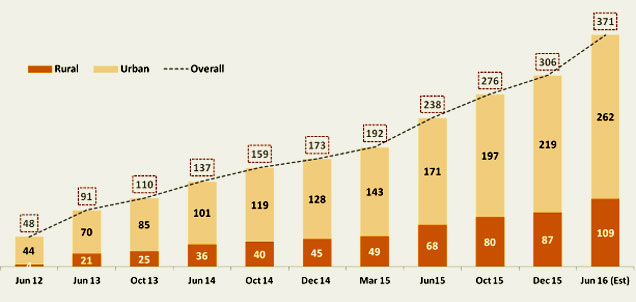
    Figure: 1: Mobile Internet Users


    By A Correspondent

    The number of mobile internet users in India is expected to reach 371 million by June 2016. There were 306 million mobile internet users in India in December  2015. Of the 306 million internet users, 219 million users are from Urban India, which registered a Y-o-Y growth of 71 per cent, while the user-base in Rural India has gone up by 93 per cent from December 2014, to reach 87 million in December 2015. These are the major findings of a report titled ‘Mobile Internet in India 2015’, released by the Internet and Mobile Association of India (IAMAI) and IMRB International, recently.

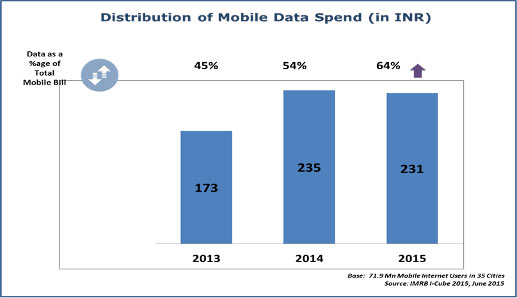
    The report also finds that the share of mobile internet spend out of average monthly bill has increased to 64 per cent in 2015 as compared to 54 per cent in 2014. The average monthly bill has reduced to the extent of 18% compared to last year.


    Figure 2:


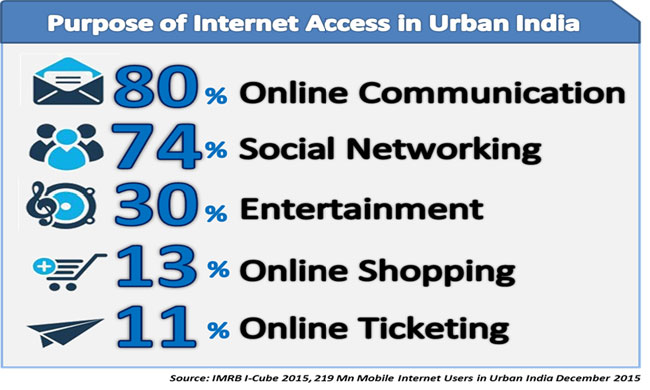
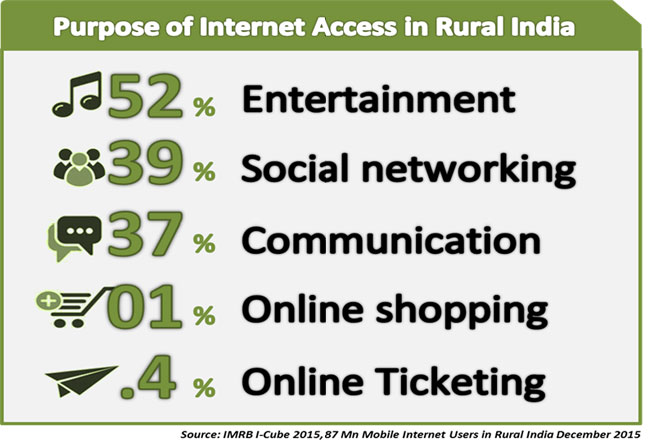
    For the first time “Online Communication” has surpassed “Social media websites” to top the purpose to access mobile internet list. 80 per cent of the urban users use mobile internet for communication whereas 74 per cent access social networking sites using their mobile internet. In Rural India however, majority of the users access Mobile Internet for Entertainment. This is followed by Social Networking & Online Communication.


    Figure 3:

  • Dentsu Webchutney wins digital mandate of Red Bull

    By A Correspondent


    DentsuWebchutney has been awarded the digital mandate for Red Bull. The agency’s Mumbai office will be leading the account services. The agency won the account following a multi-agency pitch.


    Sidharth Rao

    Commenting on the win, Sidharth Rao, Chief Executive Officer and Co-founder, DentsuWebchutney, says, “We are delighted to partner with Red Bull. The brand as well as the category are pretty dynamic – something that will certainly help us push the envelope and come up withsome refreshing work!”


    DentsuWebchutney is the digital agency from the Dentsu Aegis Network with offices in New Delhi, Mumbai and Bengaluru. Its clientele includes Flipkart, Airtel, Unilever, MasterCard, and Coca Cola.


  • Shailesh Kapoor: Kapil Sharma And The Loss Of Innocence

    By Shailesh Kapoor


    Till about two-and-a-half years ago, not many knew his name. Kapil Sharma had been on TV since 2007, when he featured on the third season of The Great Indian Laughter Challenge. But his real brush with fame and success came when he got a show with his name in it: Comedy Nights With Kapil (CNWK).


    Face recognition to name recognition is a critical leap every actor in showbiz aspires for. It’s a good barometer of “having arrived”. Lot of TV stars, and even film stars, don’t have name recognition after years of being around. TV stars are generally known by the name of the most famous character they played in their career. Till today, many know Boman Irani as “Maamu”. And we routinely meet consumers who refer to Dalip Tahil as Madan Chopra as a matter of fact.


    I had been following Sharma’s work on Comedy Circus for a couple of years before CNWK happened. He was the stand-out comedian on that show, head and shoulders above the rest, in his spontaneity as well as a unique touch of innocence he brought to his performances. His freshness stood out. There was an unmistakable sense of “common man” to him.


    When Colors gave him a show with his name in it, and even got him to produce it, they were placing their bets on a man who had the ability to deliver the goods. And he delivered them indeed. Enough has been written about the phenomenal success story of CNWK, including on this column. It seemed like a match made in heaven. A top channel and a top talent, with a show in his name. What could go wrong?


    But things indeed went wrong. Today, Sharma is off-air, putting together a show that is rumoured to be going on-air on Sony in the near future. CNWK itself didn’t have the best year in 2015, as ratings flattened out. Colors has a replacement show on-air, but without a titular hero this time.


    A small-town struggling actor-comedian comes to Mumbai, achieves success, has a huge tryst with fame, builds a fan base most top Bollywood stars will be enviable of, and then begins to lose his bearings. That’s a classic story, right? Wait, we have even seen the female version of that. The movie was called Fashion.


    Talent management is a tricky business, and all channels and production houses encounter celebrities who can give them a pain in their backsides at some point or the other. Petty squabbles over vanity vans, flight tickets for hair and make-up crew, hotel room class, costume selection, etc. are commonplace.


    But illusions stardom brings with it can go beyond such squabbles. By all accounts, official and off-the-record (I have never met Sharma), it’s apparent that Sharma had a tough time managing success, and didn’t have the best people around him to advise him either. Over time, that innocence of Comedy Circus, and the first two years of CNWK, was giving way to a certain swagger of success. He even started building his stardom it into his lines (a terrible thing to do), almost sub-consciously perhaps.


    But the camera can expose you. The weakening of innocence reflected on screen. May be he was not working on the show as hard as before, maybe he didn’t want success as badly as before, having achieved it already. Whatever the reason, the Kapil Sharma of 2015 was a less endearing version of the Kapil Sharma till 2014. Bollywood aspirations also took their toll (they often do for big TV stars) in the same period.


    The channel which airs his show has its task cut out. Sharma is a comedian of immense talent, the best mainstream Indian media has seen ever. But it’s not his talent they have to harness. They have to make the man find himself again. If they manage to do that, it would be like the last act of Madhur Bhandarkar’s Fashion. When one rediscovers innocence and the hunger to excel. All over again.


  • Ranjona Banerji: What the edit pages wrote on Rohith Vemula

    By Ranjona Banerji


    Reading opinion pages in newspapers about events in the nation can sometimes be very different from what you see and hear on television news. The reactions by columnists and commentators to the suicide of Rohith Vemula and caste discrimination in institutes of higher education has been more or less the same: dismay, distress and non-delusional about the continuing domination of the upper castes.


    The exceptions therefore stand out. Bestselling author Amish wrote a convoluted piece in The Times of India with some half-baked idea of history and Hindu texts and tried if not to justify caste discrimination then to at least put out the message that caste was not always a bad thing. Of course, it is vital that any edit page put out a variety of contradictory opinions for readers to sample. But sometimes – having worked on edit pages – you have to be able to assess whether your contributor is making sense or not before you carry him or her. Amish, sadly, was not making a lot of sense even if he showed slightly more academic ability than Chetan Bhagat, India’s other best-selling writer and also a columnist on the Times of India’s edit pages.


    The Indian Express carries the most intriguing edit pages however. The opinions of their columnists are often at total loggerheads with their edits which makes for intriguing reading. While it is very entertaining to read Tavleen Singh every Sunday, looking for a new person to blame for Prime Minister Modi’s shortcomings, some variety would not be amiss here.


    The Hindu remains one of the best when it comes to edit pages, though, with its writers showing depth, insight and scholarship. And the Readers’ Editor S Panneerselvan is always readable as he assesses how The Hindu covered the news and deals with complaints. The Hindu’s commitment to an ombudsman (person?) is exemplary however sadly no other journal in India seems to have followed suit.


    **


    The changes to firstpost.com after its change of management and newsroom are immediately evident. The most striking is that opinion, which was at the forefront of firstpost’s initial success, appears to have taken a backseat. Instead the website concentrates on news and is often on the ball with that. However, opinion is a vital part of the internet’s inherent character and firtspost would be wise to reincorporate it. All the best to the new team. How many of you miss those “Five things Modi should do Yesterday” columns by the way?


    **


    One of every editor’s biggest fears is the reporter who lies. Or should be anyway. Sadly, this is more common than anyone thinks or knows. There are some cases which are well known and others which are hidden from the newsroom and the public. Indian newsrooms as a rule do not acknowledge such mistakes and do not share them with the reader. Apologies therefore are almost never made.


    Yet, we have all worked with people who walked on that thin line between fact and fiction and we all know those who went over to the dark side. One gentleman I knew – senior to me – wrote his articles first and then went out and got the quotes and the facts to fit his writing. Another, much later, was known to go to Google and plagiarise material and yet he was supported by several colleagues and editors.


    Therefore it takes great courage to do what this editor did: apologise to readers for the actions of a reporter who had been manufacturing quotes.

    https://theintercept.com/2016/02/02/a-note-to-readers/.