Category: MEDIA

  • Ranjona Banerji: Tennis Travails

    By Ranjona Banerji


    The world around tennis appears to be in turmoil over match-fixing allegations. Or is it? The BBC and Buzzfeed broke a story on January 18 on “secret files” about match-fixing at the top levels of international tennis. Offenders include Grand Slam winners and players in the top 50 of the rankings of the game.


    The story is especially explosive since the first Grand Slam tournament of the year, the Australian Open, has just begun in Melbourne on Monday, January 18. The story is serious but the revelations are not new. These “secret files” refer to the scandal that came to public light a decade ago. The most notable allegation then was against Nikolai Davydenko, then number 4 in the ATP rankings, who was suspected of “tanking” or throwing a match in 2007. The match was highlighted because online betting company Betfair found “irregular activity” on the match as suspended all bets, reporting the matter to the ATP. Davydenko, since retired, was suspended pending investigation but as cricket investigators have found, proving match-fixing is notoriously difficult. According to the BCC and Buzzfeed story, at least eight players flagged by the Tennis Integrity Unit, set up after the match-fixing scandal, are due to play in Australia this fortnight.


    Interestingly, a respected tennis writer on CNN wondered if the timing of the story was its main significance – to get maximum readership mileage out of the Australian Open, when viewership increases substantially over that of diehard, year-round tennis fans. Since the reports names no new names and most of the investigations are against low-ranked players – most not even in the top 100 of the ATP rankings, the story remains more speculative than constructive.


    This is where the media runs into legal and ethical brick walls. Without names and without big names, there is no story. But if you do not mention the story at all, you are doing the public and the game a disservice. In fact, what the media needs to show is greater vigilance so that tennis can hold itself to a high standard. But there is an intrinsic problem here. Most sports reporting tends to be personality driven and increasingly, with hero worship thrown in. Under the circumstances, objectivity becomes a rare commodity. Some tennis writers prefer to limit themselves to analyses of the games themselves and playing styles. This leaves larger issues in tennis untouched. This problem can be seen in just about every sport. Does it bear repeating that almost no regular cricket correspondent appeared to have any clues about the extent of the 2000 match-fixing scandal that almost broke the game, in spite of (or because of?) close proximity?


    There are in fact several problems that affect tennis but few of them get enough coverage. Journalists – and the tennis authorities – shy away from reporting extensively on drug use or violations of tennis rules by players. The fact that top players – especially in the ATP tour – are often fined for breaking time rules or coaching violations are papered over. Journalists appear to have almost forgotten how a much-respected umpire is not permitted to chair a certain player’s games because of personal differences. That players like Richard Gasquet, Marin Cilic and Victor Troiki were suspended for drug use is almost forgotten but a player lower down the pecking order like Wayne Odesnik is much reviled. By contrast, one rather rare loss of control by Serena Williams with a linesperson during the US Open is still referred to.


    Clearly tennis authorities are too much in awe of their players to take stringent public action against them. Some burden therefore falls on the media. But, in this story, the allegations perhaps do fall short. We need more details and more investigation, not less, if tennis is to keep its reputation intact.


  • DDB MudraMax executes innovative outdoor campaign for PNB Housing Finance

    By A Correspondent


    With the intent to familiarize audiences with the revamped image of PNB Housing Finance Limited, the brand along with DDB MudraMax has initiated a multi-media campaign.


    The strategy behind the campaign is to communicate the ease with which a consumer can avail home loans from PNB Housing and the convenience it provides in fulfilling their dream of owning a home. Thus, the key message of the campaign is – the door to your dream home opens easier with PNB Housing. Launched in January 2016, the campaign is spread over many cities, both Tier I and Tier II. It has been directed towards the social economic class A and B, especially the audience in the age group of 30-45 years.


    Bringing into use an extensive visual show of exotic birds and animals in their unique dwelling, this campaign draws parallel between animals and human beings. It attempts to establish the fact that Mother Nature has not made provisions for a rented accommodation and thus animals make their own homes, but human beings tend to live in rented homes. PNB HFL believes that every human being has the right to own a home and this can be made easier with the hassle free and easy service of PNB Housing.


    Using the Weaver Bird’s nest as the key element to draw focus on the concept, innovations around key strategic OOH formats – billboards, installation in airports and malls have been created. The agency fashioned a real nest formation and a weaver bird for the OOH medium. Everyday, one piece of the nest is added to the structure to show the gradual development of the nest over a period of time. The medium has been strategically placed on roads which is frequented by the same set of commuters. Touch points like arterial roads, major junctions, market places, malls, airports, metro and offices and other commonly visited areas have been chosen to execute the campaign. Recently to spread the campaign further, the nest was also hanged in prominent malls across India. The agency also created an installation at Mumbai Domestic Airport which experiences one of the highest footfalls amongst airports along with creating contextual branding on security doors at the key malls across India.


    Apart from OOH, this concept is also being amplified using TV, Radio, Digital and Print across all the major Indian cities. The agency has brought in several digital innovations to play to enhance the brand recall.


    Quoting on the campaign, Shaji Varghese, CMO, PNB Housing Finance Limited said, “In the socio-economic backdrop of the Indian society, the decision to purchase a house is a carefully constructed emotional decision. This makes it even more imperative for the home loan provider to make the right connect with the customer. Besides being trustworthy and transparent, it is important that the financial institution providing the home loan brings in ease and convenience to the customer throughout the loan journey. With this campaign, we want to drive a single point message: door to your own home opens easier with PNB Housing.”


    Added Amita Karwal, EVP-Media, DDB MudraMax, “Through this campaign the effort has been to create a differentiated imagery for PNB Housing Finance in the category. The media strategy has leveraged the brand insights across key touch points that will result in buzz and word of mouth.”


  • MTV partners with Vizeum to drive conversations around #DunkThatJunk

    By A Correspondent


    Vizeum in partnership with MTV has launched ‘The Junkyard Project’ with the objective of stirring an important awakening in the minds of citizens across, especially the youth.


    Commenting on the project, Sumeli Chatterjee, Head – Marketing, Media & Insights, Youth Entertainment, Viacom18 Media Pvt. Ltd. said, “MTV started with a basic question how can we make conversations around do-not-litter cool and interactive. #DunkThatJunk is gamification of the concept that junk should be dunked inside the dustbin. The simplicity of the concept coupled with interactive presentation is the key reason why these videos spread like wild-fire.  And, also drew heavy participation by Bollywood and TV celebrities. It is just a game, but with a serious message in it. We have driven 1.5 Mn + interactions in a fortnight of launching this campaign on social media. And, this is just the beginning.”


    Samarjit Rajkumar, Executive VP, Vizeum India, commented: “True to its spirit of being in the forefront of trend-setting, it has been an exciting journey together with MTV in re-defining the Swacch Bharat initiative leveraging MTV’s partner celebs attracting as many as 6000 user-generated videos in the first 2 weeks itself. We are now creating platforms for our audience to live this trend and subsequently, more platforms for them to share with their friends once they choose to be the advocates.”


  • Kotak partners Google to unveil Querimetrix

    By A Correspondent


    Kotak Institutional Equities, a division of Kotak Securities Limited, in collaboration with Google launched Consumer Querimetrix — a tool that demystifies and predicts near-term Indian consumer behaviour by analyzing Google Trends data.


    Using machine learning techniques and merging big data from Google Trends, the first edition of Consumer Querimetrix provides consumer insights into India’s evolving car buying journey. Using Google Trends data, the tool enables ‘nowcasting’ (near-term predictions) on consumer activity, capturing inflection points earlier than traditional forecasting tools to give a complete picture — on car launches, last mile hiccups, cannibals and competition.


    Each edition of the Consumer Querimetrix series will focus on consumer behaviour in a different industry.


    Launching the report, C Jayaram, Joint Managing Director, Kotak Mahindra Bank said, “The digital wave is challenging conventional business practices across industries. Ground rules are evolving rapidly along with the consumer and those in the business of business intelligence need new tools to keep up with the changing landscape. Consumer Querimetrix is our step in that direction. Today, the sheer volume of consumer-centric search data available presents a tremendous opportunity to analyze and throw up actionable insights. These takeaways would be useful to both companies and investors. KIE research is highly valued by our clients and the launch of Querimetrix will further strengthen our ability to cover the Indian markets in a holistic manner.”


    The first edition of Consumer Querimetrix which focuses on the passenger car segment highlights the extent to which the Internet is altering the ground rules for vendors of cars and allied products/services. With growing access to easy information online, the Indian car buyer’s journey from a whim to final purchase has changed dramatically. More than 75 per cent of car buyers are researching online for reviews, comparative specifications, financial products and used car markets before making a purchase. The first edition of Consumer Querimetrix also explains how the traditional ‘funnel’ model is giving way to a more complex purchasing path where ‘initial consideration’ may not always guarantee sales.  Although higher auto-related searches correspond to higher demand for cars, this does not hold true on a brand-wise basis.


    Speaking about the trends for the passenger cars industry captured by analyzing Google Trends, Vikas Agnihotri, Industry Director, Google India said, “With over 300 million Internet users online and growing, India today has a sizeable population which accesses the Internet on a daily basis, making search queries as the most dynamic data input to arrive at consumer insights through machine learning as illustrated by Kotak’s research. If we look at the search trends related to car finance and car purchases, we’re seeing a 40% year on year growth in car purchase queries on Google in India. Over half of the people who evaluate car purchases change their consideration set during their research phase – adding two to three new car models in their consideration, the only non-negotiables are price and color of the car. This alone proves the growing complexity for car OEMs in the country. With this report we’re attempting to demystify this changing consumer behavior into actionable insights for the industry.”


    Saifullah Rais, Quantitative Analyst at Kotak Institutional Equities and the architect of Consumer Querimetrix said, “In the absence of conventional rules, traditional decision-support systems are not very effective. They fall short on scalability and adaptability. Machine learning algorithms learn from data and do not rely on explicit rules, making them the most effective method of dealing with data explosion.”


    The Consumer Querimetrix report outlines the influence of digital marketplaces and calls for carmakers to reassess conventional business practices. The effect is visible as car loans are increasingly being sourced outside dealerships. This trend can eat into financing margins earned by dealers and hurt profitability. On the other hand, carmakers with captive finance arms can use this opportunity to innovate and differentiate themselves during the evaluation process.


    The first issue of Consumer Querimetrix establishes that Google search volumes can be used as a gauge for assessing new car launches. The report underscores the linear relationship between search interest and advance bookings during a car launch. Interestingly, higher traditional media spends do not always guarantee higher search interest.


  • One Digital achieves new landmark in India

    By A Correspondent


    One Digital Entertainment recently crossed the 1200+ YouTube channels mark, further consolidating its position as the leading multi-channel network in the country. The company that started around three years ago today boasts of an undisputed 20 billion minutes of content that has been consumed on its network so far,


    One Digital’s presence ranges from music, entertainment, lifestyle, food, comedy and more. The company is also credited with identifying new talent and creating Internet sensations like Prajakta Koli, who has crossed 37,000 subscribers in less than 10 months on her channel Mostly Sane. The largest content network for YouTube in India and also distributes content across multiple other content publishers and partners. 2016 will also see One Digital foray into original web programming with a line-up of 12 different formats to be launched.


    Commenting on this success, COO and Co-founder of One Digital Entertainment, Gurpreet Singh said, “Driving reach & viewership for online video has been a challenge for a lot of entities in this space but One Digital Entertainment has developed its secret sauce to ensure we are able to deliver each creator their due. We are also humbled by the support and the talent of our creators and channels and only look to make this business more meaningful for them”.


  • Red Polka unveils revamped website

    By A Correspondent


    Online fashion discovery portal, Red Polka, has unveiled an upgraded version of its website. The new website comes loaded with features like personal profile page, wish list creation, colour code for every category. This is the company’s attempt to offer personalised curation services to women shoppers who have given thumbs up Red Polka’s curated line of fashion and lifestyle products.


    Red Polka is one of its kind interactive e-page, a podium, which curates fashion and lifestyle designs and tell unique stories behind the brands they showcase. The company has been credited with discovering more than 150 upcoming designer brands and opening up a whole new market segment for them. Vishakha Singh, Founder and CEO, Red Polka says, “When we launched last year, we went live with a simple website which enabled shoppers to surf and check out curated products. With this new website, we aim to personalise curation for every shopper so that they discover exactly what they are looking for.” The feature, which enables them to follow designers of their choice, will automatically showcase new launches of those designers on their personal profile page, which one create via Facebook sign in, she adds.


    The new site has been categorised into three verticals — Fashion, Lifestyle and Kids — which are colour coded for enabling ease of navigation on the site. In addition to this, users will have access to Red Polka’s weekly-curated fashion editions of up to last four editions. In addition, Red Polka has issued a Merchants Login feature to enable the designers to increase their reach and have a better business management. The site has been designed on global new material design guidelines while the colour scheme has been inspired from the latest UI/UX. The site has been developed on PHP platform.


    Vishakha Singh, Founder & CEO, Red Polka says, “We are not only excited about the new graphical and enhanced content to our website but also about the fact that we have created it with a responsive design and a display for optimal viewing on any size/resolution screen. With our revamped shopping cart one can now create Wish Lists – lists which are not only for one’s own shopping, but gifts that you want to buy for others, gifts that you would want others to buy for you. The redesign is intended to ensure that the site remains effective and user-friendly.”


    Red Polka raised a round of angel funding of $2,50,000 from a clutch of investors for technology upgradation and enhancing brand visibility, last year. The company is also working on launching a mobile app too.


  • Rediffusion Y&R bags creative dutiesof Amplifon

    By A Correspondent


    Amplifon, a leading hearing care service provider has appointed Rediffusion Y&R to handle its creative mandate.Amplifonis present in 22 countries and has more than 5,500 clinics all across the globe.


    Founded in 1950, is the largest hearing care service provider in India as well, with presence in more than 76 cities with more than 200 clinics. Amplifon has a team of over 200 highly qualified audiology professionals, trained as per international protocol to provide the best service on hearing impairment, rehabilitation, prevention, latest technology and after-care.


    Samit Varma, Chief Executive Officer, Amplifon said;“We’ve been through an intense evaluation process and have decided to award the business to Rediffusion Y&R, on the strength of understanding our business, and having the right direction on concepts and strategy. Our criterion for shortlisting our agencies have been purely on the compelling passion & love displayed by the agencies for our brand.”


    Shveta Paul, Director Marketing, Amplifon added; “Hearing Care category is small but growing very rapidly, awareness amongst urban consumers is rising and hence the customer is now savvy enough to understand the advantage of going to a global brand like Amplifon. It is this rise in awareness and our leadership position that we at Amplifon have to maintain and take the brand to new heights. We found the pitch from Rediff to be very detailed and made with a lot of passion. Their communication ideas are surely going to impact and influence our customer very soon when our advertising campaign hits the media. We have full faith in Rediff and its team to take this partnership further, and to firmly establish Amplifon as the first brand choice of our customers.”


    Dhunji S. Wadia

    On winning the account, Group President Rediffusion Y&R Dhunji Wadia said, “It’s an honor to be associated with Amplifon. Our team is excited to work on this account. We look forward to creating great work together.”


  • Digital Content Marketing holds promising future for brands, reveals BBC Works study

    By A Correspondent


    BBC Story Works, the content marketing arm of BBC Advertising, is pioneering new ways of understanding the emotional impact of content-led marketing by measuring consumers’ subconscious reaction to campaigns on BBC.com. In a study published today titled ‘The Science of Engagement’, its in-house insight team, in partnership with facial coding experts CrowdEmotion, has combined traditional research metrics with facial coding to understand how brands can use content-led marketing to effectively engage with consumers. BBC Advertising plans to offer this insight to premium clients as part of its campaign reporting to ensure they understand the full impact content-led marketing can have on consumers and the value of it to their brands.


    According to the research, well executed and clearly labelled content-led marketing is considered trusted and persuasive in quality environments, and has a powerful emotional impact for the brands involved. Exposure to content-led marketing can significantly improve consumers’ positivity towards the advertising brands (with a +77 per cent increase in explicit positivity between pre and post exposure). In addition, the study measured the second-by-second facial movements of people as they experienced the content to measure true engagement and the respondents’ implicit reaction. The results showed that exposure can also lead to a 14 per cent increase in subconscious positivity.


    Richard Pattinson, SVP Content, BBC Advertising and Head of BBC Story Works, said: “In a time when advertisers are increasing their spending on content-led marketing, it is important that they also feel confident in its effectiveness, and understand the significant positive impact this kind of content has on their brand. We believe that this study will enhance advertisers’ understanding and confidence in these campaigns, and in the value of high quality content-marketing delivered in premium environments.”


    Other key findings from the research include:

    :: Transparency and quality were revealed to be the most important factors in engaging the audience.
    :: 64 per cent were happy to read content-led marketing so long as it is clear which brand it is presented by and 64per centwere happy to read as long as it is clearly labelled.
    :: Among those who already have a high awareness of the medium, this increases to 82 and 83per centrespectively. From that group, 80per centagreed they would share it and 80per centthink it plays a complementary role to editorial content.
    :: In the facial coding study, rejection for fully labelled brand-presented content was 7per centbelow the average benchmark, while rejection for non-labelled content was 18per centabove the average.
    :: 63per centof respondents were happy to see the content as long as it mirrored the quality of the provider’s editorial content. In addition, 59 per cent found the content informative, 55per centfound it interesting and 57 per cent said they would share it.
    :: Consumers are 30 per cent more likely to believe content-led marketing on premium news providers will be more informative and accurate than on non-premium news providers.
    :: Integrating the brand drives a greater emotional response and referencing the brand within the content narrative works harder for the advertiser. Integrated content drives a +109 per cent increase in explicit and a +32 per cent uplift in implicit brand positivity. Integrated content also increases key call to action measures of recommendation and consideration.


    The month-long study was conducted in October 2015, following the insight that while traditional performance metrics offered a partial story of campaign success, combining them with the measurement of both conscious and subconscious consumer reaction to branded content offered a more rounded view of the effectiveness of content-led marketing campaigns.

    On the decision to explore emotional recognition techniques, Pattinson commented: “BBC StoryWorks has used the innovative facial coding methods offered by CrowdEmotion to prove that when made transparent and properly executed, brands can use content-marketing to heighten emotional engagement and enhance brand perceptions with consumers.”


  • Spidey to cast his web on Sony PIX for the entire day

    By A Correspondent


    The entire series of Marvel comic’s superhero Spider-Man will be shown in the form of a movie marathon as part of Sony PIX’s Spidey PIXathon. Spider-Man, Spider-Man 2, Spider-Man 3, The Amazing Spider-Man and The Amazing Spider-Man 2 will play back to back from 10:00 am onwards on Tuesday 26th January on Sony PIX.

     

    Apart from the telecast, Sony PIX has also arranged to bring a copy of ‘Daily Bugle’ a fictional New York City tabloid newspaper from the Spider-Man world to India. This is the original copy of the newspaper used in the movie Spider-Man 3 and PIX is going to make it available for viewing across multiple cities in India.The newspaper will be making its round across Hard Rock Café outlets in Mumbai, New Delhi, Bangalore and Hyderabad starting 15th January, 2016.


    A robust marketing plan has been put in place to promote the PIXathon with special focus on social media. Apart from an exciting contest, where in winners canwin exclusive Spider-Man merchandises, PIX will do an all India tour with the original ‘Daily Bugle’ engaging with fans and followers of Spider-Man. The Sony Pictures Networks will be utilised to the fullest to promote the PIXathon.


  • Eros Now partners LeEco for video content

    By A Correspondent


    Eros International Plc announced a strategic business alliance between ErosNow, its cutting edge digital OTT platform, and LeEco, multinational internet and technology company and one of the largest online video companies in China.


    LeEco has launched their flagship super phones,Le Max & Le1s, in the Indian market recently. As their preferred partner, ErosNowwill be integrated within the Le ecosystem of internet enabled smartphones and smart televisions, showcasing ErosNow’sextensive repository of Bollywood films, musicand Originals.Devices will include aone year premiumsubscription to ErosNowservice pre-bundled with the purchase of the phones.


    With a focus on maximum user engagement and satisfaction, the Eros Now service will be seamlessly integrated into the user interface of Le devices purchased in India, such that users can always be close to their favorite entertainment.


    Jyoti Deshpande, Group CEO & MD Eros International commented, “Content consumption is surging across consumers with patterns changing rapidly and internet entertainment networks becoming increasingly popular. At Eros International, as market leaders in the film business, we have always strived to bring to our users the best of Indian entertainment, offering them the same unified experience across screens and we also believe in being platform agnostic. Our partnership with LeEco is part of our philosophy to provide consumers entertainment whenever and wherever they want it. We are delighted to partner with LeEco who believe in offering an online environment complete with content, devices and applications. When content owners and platforms come together like Eros and LeEco, we provide a compelling consumer proposition. We are confident the LeEco range will be able establish its success in the attractive Indian market bundled with our premium content that consumers will love”.


    Tin Mok, CEO APAC, LeEco commented, “We are excited to be entering the attractive and vibrant Indian market and partner with some great companies here like Eros who is a proven market leader in Indian entertainment. We sold 4 million phones in China last year and our target this year is 15 million and we hope to replicate that success in India and wow the Indian consumer with our super phones and televisions packed with features. We are pioneers and innovators in the technology world and creating a seamless ecosystem has worked for us very well in China. We believe the Indian consumer will get great value and user experience from our cool phones at compelling prices with annual subscription of Eros Now built into the price.”


  • Shailesh Kapoor: ChaubeyJi: The New Face Of Patriarchal Patrakaars

    By Shailesh Kapoor


    Unless you are living under a stone, you would be aware of a certain Bhupendra Chaubey having interviewed Sunny Leone on his CNN-IBN show ‘The Hot Seat’, and the consequent social media wrath he had to face. While the television and print media have chosen to ignore the said interview, it’s been fodder for digital media over the last week.


    I have not seen much of Chaubey’s work. He’s not been an “in-the-news” journalist who begs to get noticed, for right or wrong reasons. In fact, the said interview was the first time I actually watched any long-form content featuring him.


    From the name, I assume that ‘The Hot Seat’ is a grill-the-guest format, much like Karan Thapar’s show ‘The Devil’s Advocate’ that used to air on the same channel not too long ago. But how do you grill an entertainment industry personality who has no topical controversy around her? You do what Chaubey did: Take a vicious line of questioning about one aspect of her life. That she has been a porn star. Give it an Indian culture spin and you have a ‘story’.


    One could say, what’s wrong with that after all? A few things.


    To begin with, I think it’s highly unlikely that Leone knew the format of the show (I’m assuming it has one). The Hot Seat is no KBC or The Newshour, so when you come on it to promote a film, it’s just another promotional interview.


    Chaubey came across as unprepared. I don’t think she has seen any of Leone’s film work, even songs or promotional videos, or tracked the box-office of her films, to know what her Bollywood impact has been. Leone has got a lot of press at the time of Jism 2 and Ragini MMS 2 releases, so research on her recent career would have been just a few clicks away. (Some other interviewers these days do the other extreme, where every other question starts with: “In a recent interview, you said…”)


    He was also unprepared on his material in general. Those PornHub stats he rattled out seemed to be a text message from a confused intern sent during the interview’s filming.


    But more than anything else, Chaubey came across as blatantly misogynistic. He applied a culture and values framework to steer the interview. A framework that probably exists in his head, and but was presented as if it was India’s official culture and values framework. Our politicians do this all the time. But Chaubey is a journalist, and should have known better.


    In a subsequent blog, he defended himself, including a disclaimer that he hasn’t ever watched Leone’s porn work, and can’t even if he wanted to, because he has kids at his home (Never attended Logic 101?). Another page of that value framework on display!


    Leone has gained significant support from various quarters, but this story is not about her. It’s about the existence of patriarchal mindset in our journalism, even if it’s in minority. (There are others in the Hindi media who have been guilty of similar misogyny in the past).


    I’m not sure if the News Broadcasters Association has guidelines on moral conduct of journalists, especially in context of gender sensitisation. It may be time to consider the idea. Because it was embarrassing to see a male journalist tell a woman guest he has invited on his show, at a filming location of her choice: “I am wondering whether I’m getting morally corrupt because I’m interviewing you.”


  • ‘This is the best time for innovations’


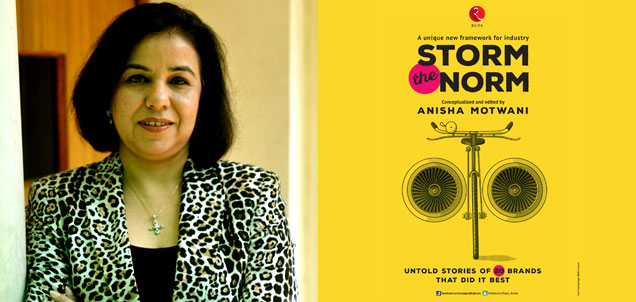
    Drawing from her rich experience with brands in India, marketing consultant Anisha Motwani has written and edited a book of 20 stories of brands that have been successes in more ways than one.  With a foreword by insight specialist Santosh Desai and an afterword by innovation specialist Ranjan Malik, Anisha Motwani speaks to Pradyuman Maheshwari as ‘Storm the Norm’ makes its way to leading bookstores and e-commerce sites. Read on…


    Your book cover says that it carries the ‘untold stories of 20 brands that did it best’. Many of these stories, or case studies, are known in the industry; some even discussed in B-schools. So how are these ‘untold’ stories?

    These are known brands [but with] partially-known stories and some completely untold details. The brief to the business owners — and my subsequent interactions with them — led to certain revelations that you won’t find in whatever has been shared till now. The stories are as much about strategic manoeuvres as they are about human endeavour: Stories about ordinary people pursuing extraordinary dreams and achieving them. It has details of not just what they did, but also why and how.


    We have 20 stories in the book… any brands that you would’ve liked to look at, but weren’t able to?

    These 20 stories are the final set that went into publishing. I did also want to look at brands like BookMyShow, Himalaya and Maggi.


    Having studied the 20 brands and various more while shortlisting these, would you say there’s anything common to all of them and their success stories?

    After having written these stories, Ranjan Malik and I decided to take a perspective-building step back and noticed something really interesting. There was a pattern in the way these brands had gone about ‘storming the norms’ of their respective industries.  So if there’s one truth that these success stories prove beyond doubt, it is that industry ‘storms’ aren’t purely accidental. They can be made to happen by design and, perhaps, at will. There is a method to the magic.


    While researching the success stories, we discovered a factor that economists have known for long but businesses don’t: The issue of Total Surplus. One big secret behind most business successes is the stormer’s ability to spot the invisible, sub-optimal in the industry, and conceive a breakthrough that unlocks new total surplus.


    Tell us more about the ‘unique new framework for the industry’ that your book promises…

    Most organisations just go from one project to the next, or are too busy celebrating their success to pause and look at what lead to that success. We’ve did just that, across 20 brands. And hindsight offers some amazing insights. We’ve tried to decode the method in retrospect, and to help organisations apply it by design in their most high-challenge projects. We have outlined a five-stage methodology called the Storm the Norm Framework.


    Clearly innovation and thinking out-of-the-box is something everyone wants to do, but is it easier said than done?

    This is the best time for innovation. We will see more innovations in the next decade than we did in the last century. And there are two reasons for it.


    First, we have hindsight so we now know what has helped organisations succeed with innovation in the past. Thanks to these learnings, the strike rate of innovation in the future will be much better than it has ever been in the past. Our reason for developing the Storm the Norm Framework was just that, to develop a methodology after studying different kinds of organisations: legacy, challenger and entrepreneur


    Second, every sector has evolved well and has developed amazing technologies. There is enough cross-industry inspiration available. Today you simply have to imagine a fantastic scenario, and someone somewhere has already cracked the solutions needed to realise it. You often only need to create creative combinations. Organisations often don’t look beyond their own industries. Our aim with this book is to trigger cross-industry learnings and inspiration.


    Do you think global giants find it tougher to be nimble and adapt to the times because they have to follow a certain way of doing things compared to homegrown players who are less rigid?

    Both kinds of organisations have their own strengths and their own ways of succeeding with innovation. Constraints aren’t always bad; they force you to unlock new value within the defined boundaries. We have included both kinds of organisations in the book. Every organisation must find its own unique way. That’s why this book – to get a more nuanced understanding of what stormers do differently, and initiate your own storm the norm strategy.


    If you had to identify one brand (from among the 20) that has achieved more than the others, which one would that be?

    Each brand in the book has had its unique context and unique challenges. Each one of them has been amazing in its own way. They achieved the extraordinary and ended up surprising, not just the world but their own selves too. I can’t pick just one.


    This interview first appeared in dna of brands on January 18, 2016


    The Story of Success


    Extracts from ‘Storm the Norm’, a new book that recounts the ‘untold’ stories of 20 leading brands


    By Anisha Motwani


    A diverse assortment of stories that give insight into what kind of levers can be used to create a winner brand. Take for example chocolate maker and market leader, Cadbury. Everyone has savoured the taste of Cadbury Dairy Milk, and nearly every marketer worth his/her salt would be aware of the brand’s successful integration into the traditional-sweet-eating habit of Indians. But what strategies and actions went into achieving this? The Cadbury story documents how it all began with a big shift in thinking about business and growth. It is a lesson at many levels: a lesson on how a large and potent target audience can slowly become a roadblock for future business; a reminder that the path to growth need not always be through growing market share; a story of how it is possible for a foreign brand to become part of the cultural fabric without localizing the product too much. Equally the story showcases the magic that ensued when the brand adapted itself and created new codes that fitted more seamlessly with category and culture.


    Let’s change gears to a challenger brand now. When you think of great products, bathing soap is hardly the first thing that comes to mind. However, that is exactly what the Indian Tobacco Company (ITC) aimed to do, when it decided to penetrate the category with Fiama Di Wills. A really late entrant into one of the oldest categories in the country, the brand was clear that its foremost intent was to challenge the typical soap and create a sensational new product–one that was differentiated not merely by form, colour or fragrance, but also a concoction of ingredients and technology that Indians had never witnessed before. The Fiama di Wills story illustrates how some companies are clear that first it is critical to create a hero product. The bells and whistles and propositions and campaigns can come much later. In its endeavour to deliver a new, unmatched experience to consumers, there were so many stumbling blocks that the Fiama team had to face, so many occasions when it could have given up and created a me-too product and just used the ITC muscle to push sales. But it didn’t. It persisted every time it was tested, to ultimately emerge with a winner.


    Moving to another league of brands altogether–the young entrepreneurial businesses. While there are plenty of such success stories in India today, I have selected a few that have made a mark in more ways than one. These are businesses whose success is not simply measured in terms of business valuation or the fact that they are media darlings, but those whose start-to-date journeys hold vital lessons in doing business for everyone. For instance, Make My Trip. This is an extraordinary story of pursuing the dream of forever changing the way Indians researched, planned and booked their travel. From the days where vacation planning was a tedious project and life without travel agents and long ticketing queues unthinkable, to now, when online travel planning and purchasing is common practice, this brand has had a pioneering role in shaping the change. By riding emerging trends, taking sensible decisions when a large bulk of the market was not ready for their dream and fostering deep relationships with allied partners, Deep Kalra and his team strategised their way to success. Like a great movie, the journey had several twists and turns and a few occasions when the founder was tempted to sell or shut shop but chose to keep faith instead. What adds to the excitement is that the Make My Trip story is packed with not one or two but so many innovations across product offerings, service standards, technology, marketing and operations that one is constantly looking out for what next they did differently!


    Such remarkable lessons continue across other entrepreneurial brands as well. What these kinds of brands do best is to open up refreshing ways of thinking and going about their business, so they naturally offer many valuable lessons along the way. Like PVR, where Ajay Bijli turned the whole expectation from cinema theatre upside down. Until the 1990s, cinema theatres were mostly just a destination, and movies were the real deal. The theatre itself was just a venue for stories to unfold. But he changed all that. Not only did he introduce the country to the multiplex, he created a new era in movie watching, where choice, comfort, luxury and entertainment all came together to take the movie-goer’s experience to a new high.


    There are several more examples of such category transformation. Radio Mirchi, for instance, is a story of a turnaround of the radio medium itself; of how a boring medium from which expectations had remained unchanged for decades, turned cool and irreverent; and how entertainment found a new source. It is also a great lesson on how you can win many fans by experimenting all the way through.


    Many of you may not know this, but Raymond’s ‘The Complete Man’ broke the conventions of fashion advertising in its time. Then there is Honda two wheelers–a fabulous story of storming the norm in scooters and making Activa a resounding success, and then of how it carried with it its winning strategies post its joint venture with Hero coming to an end. On a completely different note is the story of Sprite, a brand built on communication, on strongly marrying youth insights with product truth, of turning an absolutely niche lime category into a mass brand.


    Similarly, there are Ford Ecosport, Axis Bank, Kissan, MTR Foods, Saffola, Real Juices, Sensodyne, Tata Tea and Mahindra XUV500. Each of their growth stories provides insights into creating a storm in their respective categories and achieving outstanding results. Some successes are based on distribution, some on product, some on communication, while others are based on core business models. There are stories of reinvention, of strategies on market expansion, and some even of using weaker siblings in the brand portfolio to fortify overall business. 


    Published with the permission of the Author/Editor

    Storm the Norm: Untold Stories of 20 Brands that Did it Best

    Written and Edited By Anisha Motwani

    Hardcover, 320 pages

    Published by Rupa Publications India

    Â