Category: MEDIA

  • Ranjona Banerji: Hyper-nationalism UnLtd

    By Ranjona Banerji


    The fallout of the Pathankot attack appears to remain at the top of the news cycle in India which is hardly surprising. Although I have written last week about our sycophantic media, unable by instruction or inclination to show the BJP and the Central government in bad light, one has to salute courageous publications like The Telegraph, Calcutta for instance. Not only has it called the entire operation “Pathanblot”,(http://www.telegraphindia.com/1160106/jsp/frontpage/story_62434.jsp#.Vo5IXfl97IU) , the newspaper has also written a very strong editorial arguing against the “martyr” status given to every fallen soldier. This is a common practice by India’s most well-known TV anchors who have absolutely no concept of the meaning of the word “martyr”, inasmuch as they understand concepts at all.


    In the hyper-nationalistic atmosphere that prevails in India now, where words like sedition and treason are thrown around very lightly, you have to admire a newspaper which can question the actions of a slain officer during a terrorist attack. Yet, the concerns raised here are pertinent and need to addressed urgently. http://www.telegraphindia.com/1160107/jsp/opinion/story_62467.jsp#.Vo5JVvl97IU


    The website thequint.com also carried a letter by Lt General HS Panag (retired) to Major General Pradyot Mallick (retired) on the Pathankot attack. It is a scathing analysis of what happened at the Air Force Base in Punjab.

    http://www.thequint.com/opinion/2016/01/06/the-pathankot-attack-was-a-disgrace-for-us


    There is some hope for the media if at least some media houses, old and new, are willing to look for facts rather than toe some party line. The last two years have shown the most abysmal standards in Indian journalism for all that everyone who is not pro-BJP is sought to be presented as a Congress stooge. The evidence at the moments points in quite another direction.


    What India needs very urgently is TV programmes which analyse the way news is presented. I write this sitting here in the UK where there are any number of shows, serious and funny, which examine newspapers and television news. Personally, the shows which mock the news are top of the list. Of course, Jon Stewart’s Daily Show in the US, now fronted by South African comedian Trevor Noah, set the standard. And John Oliver is also superb – if you have not watched his take on Indian television news, Narendra Modi in America and how the American media ignored the Indian general elections, you should do so at once.


    The All India Bakchod has taken on the news on Youtube and now on television. And there’s always The Week That Wasn’t. But neither of them is as strong, as confrontational and as in-your-face as they need to be. India has a tendency to get stuck in morass of over-baked notions of self-respect and we need to be taken down frequently. Journalists are no exception and some are far too full of themselves.


    **


    Having said that, the illness of concentrating on the trivial and fluttering past the substantial is a worldwide media disease. The often mindless and meaningless potterings of the latest pop star are far more important than any world even unless you count US presidential hopeful Donald Trump, who may qualify as both.

     

  • Colors ends year on a high in BARC ratings

    By A Correspondent


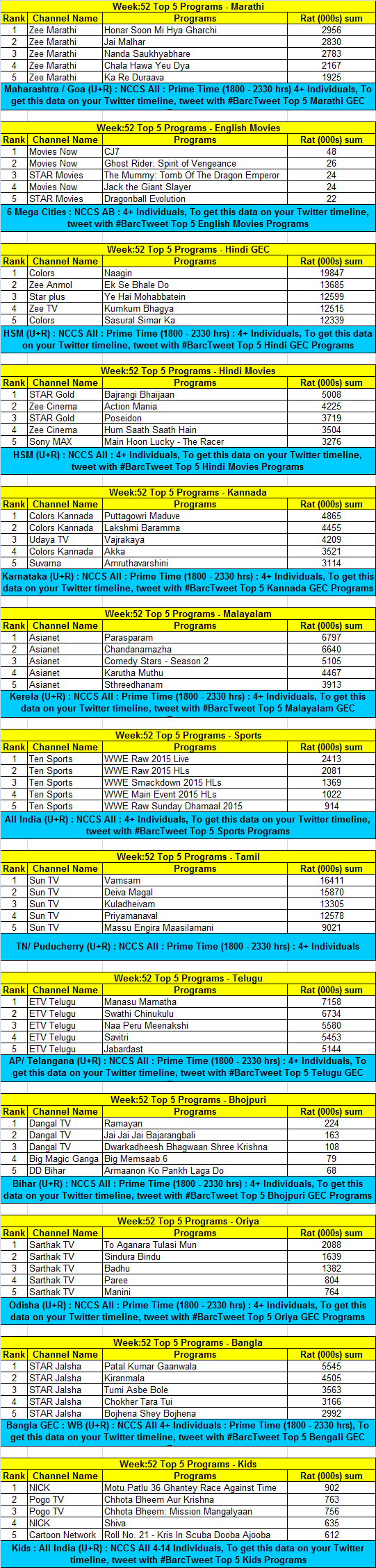
    The Week 52​ ratings from BARC​ for ​Saturday, December 26 2015 to Friday, January 1, 2016) sees a lot of the old and some new. And Colors continues to be #1, followed by Zee Anmol and Star Plus amongst Hindi GECs.


    Note these numbers are combined for urban and rural audiences, and subscribers to the data will know how the rankings are dramatically different for urban audiences.​ And ditto for rural or free-to-air audiences.


    Enjoy!​​​


  • BARC’s watermarking technology achieves new milestone

    By A Correspondent


    Broadcast Audience Research Council (BARC) India has achieved a significant milestone within the very first year of its operations: the subscriber base of TV channels who have signed up for its Watermarking Technology has crossed the 400 mark. If one takes into account the various language feeds of channels, that number actually climbs to 457, as BARC India is watermarking 28 language feeds separately.


    BARC India started rolling out viewership data in end-April with 277 channels signing up for its Watermarking Technology: and in the short span of last 8 months, it has witnessed a rapid acceleration of broadcasters adopting the technology, which is the starting point for BARC India’s future-proof audience measurement system.


    The technology has been adopted by not just broadcasters with an all-India market, but also by regional broadcasters across the spectrum. Of the 429 channels that have adopted the watermarking technology, 195 are ‘All India’ channels and HSM (Hindi Speaking Market) channels.


    131 channels are from the South comprising markets of Tamil Nadu & Puducherry (42), Andhra Pradesh & Telangana (39), Karnataka (27) and Kerala (23).


    Of the other key TV markets in India, 18 channels are of West Bengal and 17 of Maharashtra & Goa.


    BARC India contracted Kantar Media’s team (previously part of Civolution) to supply the watermarking technology that underpins the world’s largest audience measurement system.


    “We are happy to have partnered with BARC India to deploy our watermarking technology. With so many new ways of distributing and consuming TV and video content, Kantar Media’s solutions enable BARC India to detect content wherever and whenever it’s consumed,” said Jean Michel Masson, Global Director of Watermarking Solutions, Kantar Media.


    Partho Dasgupta

    “We have been able to cross the 400 channel mark in a short span since our launch. This is an achievement and the team at BARC India has done a great job to achieve this target. I am thankful to Civolution and Cineom for their support and technology,” added Partho Dasgupta, CEO, BARC India.


  • Big Magic Ganga rebrands to Big Ganga

    By A Correspondent


    BIG Magic Ganga, the regional channel of Bihar and Jharkhand under Reliance Broadcast Network Limited has been re-branded as BIG Ganga. This change is in line with the brand refreshment exercise done for the network’s television and radio channel BIG Magic and 92.7 BIG FM, respectively. BIG Ganga, which recently became available to DD Free Dish viewers (Channel No. 16) adopted the new logo across all its channel programming and marketing collaterals from 1st January, 2016 onwards.
     

    Speaking on this new development, Ashwin Padmanabhan, Chief Operating Officer, Reliance Broadcast Network Limited said, “The essential regional flavor and the ethos of the channel remains the same with this change. Our focus is to continue exploring new opportunities and deliver quality original content, to give brands a bigger platform to garner more visibility.”


    With this move, the channel attempts to enhance the authentic regional flavour through locally shot programs, derived from local insights such as establishing self-identity and preserving local culture. BIG Ganga has a deep understanding of the socio-cultural fabric & reflecting the pride of people from the region. It has consistently offered entertainment and meaningful content which can be watched by the entire family.


    Apart from the popular shows, there are a number of new shows in the pipeline this year namely Makar Sankranti, Rasoi Ki Rani, BIG Memsaab Season 7, Mele Ka BIG Star, Shaurya Samman, Ganga Bhojpuri Cine Awards amongst others. BIG Ganga offers exquisite and dynamic content for family viewing which resonates well with the masses. With more unique shows to look forward to, BIG Ganga is poised to engage, enrich and entertain new audiences across the country.


  • Shailesh Kapoor: Top 5 Channels that made the Maximum Impact in 2015


    By Shailesh Kapoor


    In a new annual feature, here is my choice of five channels that made the maximum impact in 2015, standing out in a crowd of 500+ channels as true success stories.
     

    This list is not based on ratings alone, though it is one of the inputs. Channels that ended 2015 with significantly higher position of strength vis-à-vis where they stood at the start of the year have been considered as prime candidates for this list. To that extent, we could call them the broadcasting success stories of 2015.


    5. Times Now: It has its share of detractors, but Times Now continued to dominate the English news genre in 2015, first in TAM and then in BARC India ratings. But it makes it to this list not just for that reason. Today, Times Now has set the rules for television news in India. Its competitors are routinely seen as promoting “less noise” and “more news” as their unique offerings. With many spoofs, funny videos and jokes centered around it, the channel, and its principal (and only) face Arnab Goswami, has gone beyond being a news brand to one that defines the discourse around the Indian media, good or bad.


    4. Nick: Kids television in India has been a low-key category, with not much media attention. In a commoditised category where each channel is driven by one or two animated properties that are wallpapered on the FPC, Nick managed to stay ahead of its competition all of 2015, and by a wide margin too. The channel has seen huge success with homegrown animation, first with Motu Patlu and recently with Shiva. With a 50% lead over competition, Nick is set to have a great 2016 too.


    3. Zee Anmol: No one cared about this channel much, till rural ratings were released by BARC India from Week 41. The free-to-air channel rules the rural markets, widening its lead in recent times to almost 100 GRPs. It has also been ahead of Star Plus and Colors in many weeks at a national (Urban+Rural) level. Even as the media industry is getting used to BARC India ratings and its implications on trading, the introduction of rural ratings has been the big step forward in 2015. And Zee Anmol has been the big beneficiary.


    2. Colors: The channel was the challenger to Star Plus for much of early 2015. But as the year progressed, it came into its own, backed by high-power weekend launches. Comedy Nights Bachao did well, but it was the blockbuster success of Naagin that took the channel ahead of Star Plus on a consistent basis as 2015 drew to a close. More importantly, Colors had a year of consistency in its fiction content for the first time since 2009-10. So much so that Bigg Boss did not get its usual 9pm slot on weekdays, where high-performing fiction was retained. Bigg Boss may have suffered as a result, but Colors continues to flourish.


    1. Hotstar: The no. 1 “channel” of 2015 in this list is not a conventional TV channel, but a platform that came as a new, almost niche, idea but managed to become a lot more mainstream by the end of 2015. Sports content is one of the drivers of Hotstar, and this was the year of the Cricket World Cup, helping the brand grow. But Hotstar continued to do well beyond sports too, with properties like Badtameez Dil and On Air With AIB that did not do too well on TV finding acceptance among the OTT audience. 2016 is set to be a year of OTT overkill in India, and Hotstar is everyone’s target to beat, including the just-launched Netflix India.


  • Digital start-ups need specific incentives: IAMAI

    By A Correspondent


    To implement the Prime Minister’s twin vision of ‘Stand-up India’ and ‘Digital India’, the industry body Internet and Mobile Association of India (IAMAI) has come up with specific fiscal and non-fiscal measures required by the internet industry. According to the association, the digital start-up ecosystem in India should be systematically encouraged by focussing on specific fiscal interventions.


    On the fiscal incentives, the association has suggested the following:

    1.   Improve Investment Environment:

    India’s entrepreneurs need early stage venture capital – but the domestic venture capital sector needs to develop further. In the US, the VC industry took off when their government allowed the large pension funds to put 5-10 per cent of their assets into VC firms.

    1.1 Angel Tax: Angel Tax under Sec 56 (2) of the Income Tax Act has not been actually tailored to restrict start-ups funding but it has put start-ups under the Income tax scanner, questioning the valuation by domestic individual investors. The criteria to qualify as an angel fund are stringent and need to be eased to support the start-up ecosystem in the country.


    The association suggests that there should be tax breaks and incentives for individuals supporting start-ups with capital.


    2. Incentivize Internet Services Start-ups:

    These are the largest chunk of internet companies in India. This sector, which comprises of aggregators, digital advertisers, online classifieds, bring in a lot of efficiency, and are the largest employment generators. They are either enabling businesses, or they are creating lot of employment in the country, resulting in many people are earning a lot of money than they should otherwise have.

    2.1 Service Tax: Unfortunately, Start-ups have to pay huge amount over the first three years in way of service tax. It is not that they don’t want to pay, but they have survival issues and this takes a back seat and penalties just make a struggling start-up’s life harder.


    The association recommends that for the first three years, the service tax could be waived off or incentivizes the start-ups, if they pay their service taxes on time.


    3. Streamline taxation for e-Commerce marketplace Start-ups:

    Online market places are changing the way businesses are done in India. Small players are setting up niche businesses in India and are attracting lot of investments in India. Online marketplaces bring in a lot of efficiency in the entire retail value chain from customer experience to payments and delivery.


    3.1 Taxes on e-commerce Transactions: The e-commerce marketplace industry is being subjected to onerous VAT demands from several states. They should be recognized as marketplaces and exempt from VAT demands in states. As market places they provide a service to online sellers and pay the service tax on that account. The State of Rajasthan for example treats e-commerce players as market places.


    4. Boost FinTech Start-ups:

    FinTech plays a significant role in serving those underserved or not served by formal institutional mechanisms. They are also likely to play a significant role in various financial inclusion programmes of the government. Various forms of FInTech services such as pre-paid instruments, wallets and others create efficiency, transparency and wider reach in financial transaction.


    4.1  P2P lending and crowd-funding need an impetus and clarity from Government: While some early inroads have been made in the P2P lending segment in the country, individual efforts have not translated into a policy from the government. The lack of clarity of rules and regulations has meant the industry is shooting in the dark. In the absence of dictated policy or scriptures, it is quite plausible that misguided individuals may fall prey to unscrupulous operators that may look to make a quick buck.


    4.2 Easy KYC through aadhar will allow innovators build new services which in turn will help bring more people under the ambit of financial services: Various forms of digital payments such as pre-paid instruments, wallets and others create efficiency, transparency and wider reach in financial transaction.


  • Ranjona Banerji: Net emerging clear winner in UK news media

    By Ranjona Banerji


    Two things strike you immediately about the way journalism is perceived in the UK: everyone complains about the media all the time and yet no one appears to read mainstream newspapers.


    That sounds like a contentious and dichotomous statement. But there is little doubt now that the old-style newspaper is now an old world product. Instead, you have that other creature: the free newspaper which is now a regular if not a mainstay. The free newspaper sometimes could be the Evening Standard, which is read by commuters on the Underground who are not addicted to Candy Crush or staring vacantly into space.


    And there is the neighbourhood paper which has local ads and local news which could be as diverse as a baby born on Christmas Day at a nearby hospital, a theatre personality with a gambling addiction and odd goings on at a local prison. These papers require a lot of hard work and ought not to be sneered at. How many reporters with a mainstream newspaper would climb up to the roof of a building to interview a prisoner who had escaped to the roof of the prison?


    However, the influence of the media remains. Obviously the internet and television are the main sources of news but sooner rather than later the internet is going to be the clear winner. Every media house which is investing in mobile app technology is looking at the cash register going ka-ching and I cannot see TV keeping pace unless it runs down the same road.


    It is also true that the UK at least benefits from not having nonstop hysterical and any number of 24-hour news channels. Plus, although people here do not stop making fun of the media for exaggerating issues and asking silly questions, can you imagine how anyone else in the world would react if they were subjected to our prime-time “debates”? Perhaps we should have a time-sharing scheme with international news channels and export some of our savers of the nation so that they can go save the world? How peaceful life would be even if it put me out of a job…


    **


    Meanwhile back in India as far as I can see, we are still seesawing between Pathankot, Malda and Arvind Kejriwal. Even the fact that Malini Parthasarathy resigned as editor of The Hindu in one more Kasturi family carousel ride could not keep the media engaged. Off everyone went on to the other roller-coaster ride: “you covered this but did not cover that, this news item is more important than that and you are an anti-national.”


    **


    The internet and international media is in a tizzy over actress Jennifer Lawrence’s treatment of a reporter at a post-Golden Globes press conference. The video doing the rounds shows the actress, who had just won an award, mocking a reporter for looking at his phone while asking her a question. It does seem clear that English was not the reporter’s first language and that is why he was possibly looking at his phone.  Although there was some support for Lawrence on the internet, most people seem to find her needless nasty. The video does show some of the nonsense which reporters who deal with famous people have to put up with.


    Interesting, the Golden Globes are given by the Hollywood Foreign Press Association. Go figure.


    Mashable has rounded up the story:

    http://mashable.com/2016/01/11/jennifer-lawrence-globes-reporter/?utm_cid=mash-com-Tw-main-link#BnrJUe4W_gqr


  • Will Sony ESPN make a dent?


    By A Correspondent


    UEFA Euro 2016, 2018 FIFA World Cup La Liga BBVA, Serie A TIM, Emirates FA Cup, UEFA European Qualifiers for 2018 WC, FIFA Futsal World Cup 2016, Australian Open, Hopman Cup, Mubadala World Tennis Championship, Champions Tennis League, UFC, NFL, ATP 1000, ATP 500, ATP 250 and ATP World Tour Finals… what do all these sports events mean to you? Exciting? Or unappetising?


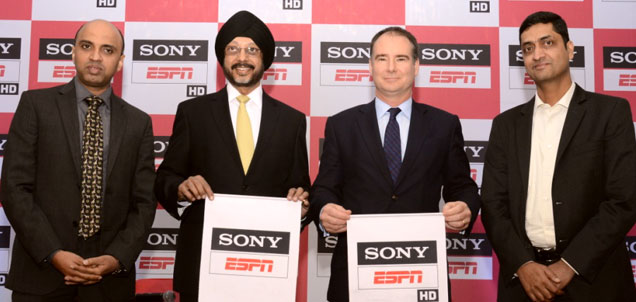
    Well, that’s the programming line-up on Sony ESPN channels that was unveiled to the media yesterday when Sony Pictures Networks India (SPN), in collaboration with ESPN, announced the launch of its two new channels, SONY ESPN and SONY ESPN HD, set to go live next week – January 17, to be precise. With this, SPN has expanded its sports cluster to four channels – Sony ESPN, Sony ESPN HD, Sony SIX and Sony Six HD, thereby widening its footprint in sports entertainment in India and the sub-continent. Meanwhile, Sony Kix has been dispensed with.


    So will the entry of ESPN make a dent in the market? Well, for Sony Pictures Network which is experiencing some rough weather in entertainment, it surely increases bragging rights. But, remember, sports is all about another kind of rights. While ESPN is a huge brand, just being a well-known name doesn’t mean much. And even a Baba Ramdev can start a channel if he has the monies and can manage to comply with all the eligibility requirements, and by ideally buying an old sports channel.


    The various tournaments Sony ESPN has are good, but are they the kind which will NOT kill competition. The Australian Open timings aren’t really India-friendly, nowhere like Wimbledon and the French Open. The FIFA World Cup is two years away.


    There’s only the IPL that Sony has and none of the other key ICC tournaments are with the group. Even EPL and the Formula 1 encounters aren’t in the kitty.


    There is no Golf to talk about and UEFA Euro 2016 is the only one with a huge draw this year. Other than the IPL of course, but that’s already being aired on Sony Max and Sony Six and their respective HD versions. It’s possible though that some IPL encounters may well air on Sony ESPN.


    Meanwhile, the launch of these new channels represents the first steps in the collaboration between SPN and ESPN to power content, across both, the television and digital platforms.


    The benefit will be from SPN’s powerful existing portfolio of sports and content, plus ESPN’s leadership position in sports and more than 1000 hours of programming per year from its portfolio of sports rights, original programming, award-winning sports documentaries and studio programmes.


    Later this year, the collaboration between SPN and ESPN will also see the launch of a new multisport digital website and app that will complement the SONY ESPN channels, as well as the existing leadership of ESPNcricinfo and Sony LIV’s digital offerings.


    Said NP Singh, Chief Executive Officer, Sony Pictures Networks India: “As a network, SPN is focused on becoming the first choice in television and digital entertainment. Our collaboration with ESPN is a targeted step in that direction as it helps us ink another milestone in our growth trajectory. Not only that, the launch of the SONY  ESPN cluster of channels validates our intent to provide stylized, high-quality and insightful international sporting content to viewers in India and across the Indian sub-continent.”


    Added Prasana Krishnan, EVP & Business Head, Sports Cluster, Sony Pictures Networks: “ESPN has always had a strong connect with Indian audiences. Our partnership with ESPN will further strengthen our Sports bouquet with four channels SONY ESPN, SONY ESPN HD, Sony SIX and Sony SIX HD. Our programming line-up starts with the Australian Open followed by marquee football properties like Liga BBVA, Serie A TIM and FA CUP leading to UEFA EURO 2016 will give every sports fan a reason to celebrate our extensive offering clubbed with analysis presented by expert panelists.”


    Said Mike Morrison, Vice President & General Manager, ESPN Asia Pacific: “For more than 35 years, ESPN has been known for its quality, personality and authority. The launch of these channels, and the complimentary digital properties in the months ahead, creates a world-class multi-media stage on which the combined expertise and resources of our two companies can deliver amazing content and products to Indian fans.”


  • Azim Lalani elevated as Business Head, Firstpost

    By A Correspondent


    Azim Lalani, National Sales Head, Firstpost, has been elevated as Business Head. In the new role, Azim will drive overall strategy and revenue growth for Firstpost.


    Azim has an experience of over 15 years in the media industry and has worked across print and digital media. Azim joined Firstpost in its start-up phase and has helped in scaling up the revenue manifold in the past two years.


    Prior to joining the Network 18 group, Azim was working with Reddiff.com as the Director advertising sales. He has also worked with India Today as a Senior Manager – Media Sales. He started his career at Indian Express as a Senior Executive.


  • Katalyst Creates executes channel packaging for Nick HD+

    By A Correspondent


    The Creative arm of Sri Adhikari Brothers, Katalyst Creates has curated the channel packaging for ‘Nick HD+’.


    The packaging and idents were curated considering Indian sensibilities while also aligning to international standards and brand guidelines of Nickelodeon. The endeavor with the engaging packaging was to provide children watching Nick HD+, a feeling of homeliness and sense of belonging such that they instantly establish a strong connect with the channel.


    Parthsarthi Iyer, Creative & Business head at Katalyst Creates says, “At Katalyst Creates our attempt is always to provide creative services & quality output to our client. Our association with Nickelodeon has been incredible and the packaging for Nick HD+ is yet another innovative work by our team that curated keeping in mind the sensibilities of Indian kids.”


    Manav Dhanda, Group CEO of Sri Adhikari Brothers says, “We at SAB Group are expanding our horizon from broadcast and films to also providing creative solutions for external clients. Nick HD+ packaging is another eminent project bagged by our creative division, Katalyst Creates. Going forward, we aim to expand our footprint in the advertising and media fraternity through crafting standout creative solutions.”


  • BARC gets media-neutral-ready. Rat’000 to be called Impressions’000

    Some eight months after it launched its TV Ratings service (on April 29, 2015, to be precise), the Broadcast Audience Research Council (BARC) has rechristened its popular viewership measurement metric Rat’000 as Impressions’000.


    Going forward (that’s with effect from today, Thursday, January 14 when data for Week1/2016 is released) the current Rat’000s will be referred to as Impressions ‘000s. “Users of BARC India data may note that the new terminology does not imply any change in the way television viewership is measured. Nor will the introduction of Impressions’000 have any impact on past data BARC India has released so far,” notes a communique. BARC India would also like to inform its subscribers that the metric Rat% will continue to be used as it is, and will see no change.


    The decision to usher under this new terminology in the new year has been taken to avoid confusion in the marketplace  and as BARC India gears up for its digital measurement initiative. “We are preparing for the future. When we get into digital measurement, viewership will be measured in Impressions and in order to maintain uniformity and avoid confusion we decided to rename Ratings ‘000s to Impressions ‘000s,” said Partho Dasgupta, CEO, BARC India.


  • WPP integrated marcom firm PPR Worldwide launches India ops


    Professional Public Relations (PPR) Worldwide has announced the launch of its India operations. A part of WPP, PPR is a full service consulting firm and has been in the public relations and strategic marketing communications business for more than 45 years. The consultancy is building on this experience as it establishes offices in Delhi NCR, Mumbai and Bengaluru.


    “With a heritage of 45 years as Australia’s leading PR agency, and accolades such as ‘The Top 10 Fastest Growing PR Agencies’ by The Holmes Report as well as consecutively awarded the PR World Awards ‘World’s Most Innovative PR Agency’ in 2014 and 2015, we are incredibly excited to launch PPR’s South Asia presence. India is an important milestone in our international expansion given the potential for future growth in the marketing and communications industry here. We are confident that we will continue to build on our promise of being a creative and an integrated specialist that finds the right solutions for our clients,” said Richard Lazar, Managing Director and CEO of PPR Asia-Pacific.


    The core start-up team at PPR South Asia comprises seasoned professionals – Vandana Sandhir, Country Lead; Bhuvnesh Chawla, Business Lead; and Mona Puri, Managing Partner – North.  Prior to taking over the PPR South Asia role, Vandana was the India Practice Chair, Corporate & Financial, at Genesis Burson-Marsteller wherein she led key client relationships across financial services, infrastructure, consulting, defence and aviation, travel, healthcare, loyalty programmes, manufacturing, automotive, energy, oil and gas and education.


    “As a strong believer in the power of insights-based communications, we are excited to introduce PPR in India. We have the heart of a start-up: We are entrepreneurial in our culture and passionate about our clients’ business. We are putting together a mix of integrated communication capabilities that can deliver the right stories, to the right people, in the right places and at the right time,” said Sandhir.