Category: MEDIA

  • Nielsen’s India Book Market Report 2015 predicts double-digit growth

    By A Correspondent


    Nielsen’s study of the India Book Market pegs Indian Publishing sector at INR 306.6 billion currently, making it the sixth biggest publishing market globally. The study titled ‘India Book Market Report 2015’ estimates a CAGR of 19.3 per cent for the industry in next five years. The report, among other interesting facts, also highlights that India is the second largest English-language print book publisher in the world.


    The Nielsen study is a comprehensive assessment of the Indian book industry conducted in association with Association of Publishers in India (API) and the Federation of Indian Publishers (FPI) to evaluate the opportunities and challenges facing the industry, as well as where its future lies. The report will enable the industry to meet the needs and demands of a well-educated nation that continues to grow. Before the release of this report India’s book industry estimates were mostly unverifiable estimates.


    Speaking of the India Book Market Report 2015, the newly appointed President of the Association of Publishers in India, Vikas Gupta said “The report offers invaluable insights into the books market that will help not just the publishing industry but also the Government and Educators to make plans for a fully literate and educated nation.” He added “The report illustrates the contribution of publishers in the schools and higher education domains, as also in trade and general interest categories.”


    Vikrant Mathur, Director of Nielsen Book India, commented: “There is enormous potential in the India Book Market which has been highlighted by the report, enabling publishers, booksellers and libraries to gain a deeper understanding of the market, pin-pointing areas that can be developed and those pinch points that need to be addressed in order to bring more efficiency and cost savings to the India Book Market and its supply chain.”


    Some prominent factors that drove the growth of the industry include:

    The Growth of Indian Book Market:

    Government’s focus on digitization, a growing literacy rate, government spend on education along with increasing outsourcing of book publishing services to India are strengths of the Indian publishing industry and will continue to sustain the industry growth.


    Indian Publishing Sector is a dynamic industry:

    Further, books have emerged as an instrumental category for e-commerce business, accounting for 15 per cent of the overall e-commerce trade, just trailing behind electronics (34 per cent) and apparel & accessories (30 per cent).


    The study revealed that “general and literary fiction” was ranked the #1 genre in the trade books segment while “test prep” was the most sought after genre in Academic books.


    Government policies and implications for the Publishing Industry:

    Allowance of 100 per cent foreign direct investment in the publishing industry along with various initiatives of the Government in promoting reading habits by strengthening the library movement, organizing book fairs and making subsidized books available are positively impacting the publishing industry. The rising literacy rate and concurrent efforts of the government in reducing school drop-out rate presents publishing industry an immense opportunity to play a direct role in the development of the country through the creation and dissemination of quality educational content.


    The Indian book consumer and the digital opportunity:

    As digital content becomes mainstream and new channels of marketing open, the manner in which consumers engage with books and reading is continuously changing worldwide. A survey of 2,000 consumers, representative of the urban population aged 18+ during the Nielsen study provides deep insights into changing consumer preference for books in India.


    The consumer data survey shows that on average people read books 2.1 times a week while nearly two-thirds read the book occasionally; interestingly, 56 per cent of the respondents bought at least one e-book a year and nearly half of these bought at least 3-4 e-books a year indicating a growing demand for digital books.


  • MSM rolls out campaign for Pro Wrestling League

    By A Correspondent


    Multi-Screen Media (MSM) which has bagged the broadcast rights of the ‘Pro Wrestling League’ for the next five years,  is all set to roll out its marketing campaign ‘Khel Fauladi’ for the inaugural edition of the Indian wrestling tournament across its three channels – Sony MAX, SIX and PAL. Touted as the first home grown league in the realm of wrestling in India, ‘Pro Wrestling League’ (PWL) is a partnership between the Wrestling Federation of India (WFI) and Pro Sportify Private Limited (PPL). The league will air on the above specified channels of the MSM network from December 10th to December 27th.


    Sony MAX’s PWL campaign builds the league as the one true, tough sport that has fascinated audiences for years on-ground and now will be see on television featuring the best wrestlers not only from the Indian soil but from across the world. The campaign comprises of two 15 seconder and two 40 seconder TVCs featuring both male and female wrestlers and taps into the insight that male audiences are fascinated and drawn to true strength, toughness and endurance. The multi-media campaign comprising of television, print, radio and outdoor promotions will be taken across all Hindi speaking markets and will have key players such as Sushil Kumar, Yogeshwar Dutt, Babita Kumari, Geeta Phogat, Vinesh Phogat, Amit Dahiya, Narsingh Yadav, Bajrang Punia, Mausam Khatri and Rahul Aware amongst others fronting the campaign.


    Neeraj Vyas

    Neeraj Vyas, Senior EVP, Sony MAX & Sony MAX2 said: “This is the first time a league like this has been organized to promote one of the oldest sport rooted in the ethos of Indian culture and a sport that has helped India bag the gold, silver and bronze medals at the Olympics. By gaining the broadcast rights to ‘Pro Wrestling League, we consider it an honor to help popularize this sport and in turn give its due recognition and glory.”


    Vaishali Sharma

    Vaishali Sharma, Senior VP, Marketing & Communications, Sony MAX & MAX2 added: “With the campaign Khel Fauladi, our intent is to laud the toughness and endurance that the sport of wrestling demands of its players. The campaign positions wrestling as the most brutal strength of mind and body and promises a never before viewing experience.  Wrestling as a sport has its roots well set in India and with this league; there is an opportunity to make it aspirational and larger than life”.


    PWL will see six teams fight it out to win the champion’s title. Witnessing a total of 18 ties including 2 semi-finals and the grand finale based on best-of-nine bouts, the tournament which will be contested in accordance with Olympic wrestling rules will travel to six venues, namely, Bengaluru, New Delhi, Mumbai, Uttar Pradesh, Punjab and Haryana.  Each team will comprise of nine wrestlers – five men and four women – with a maximum cap of four foreign wrestlers on the team roster.


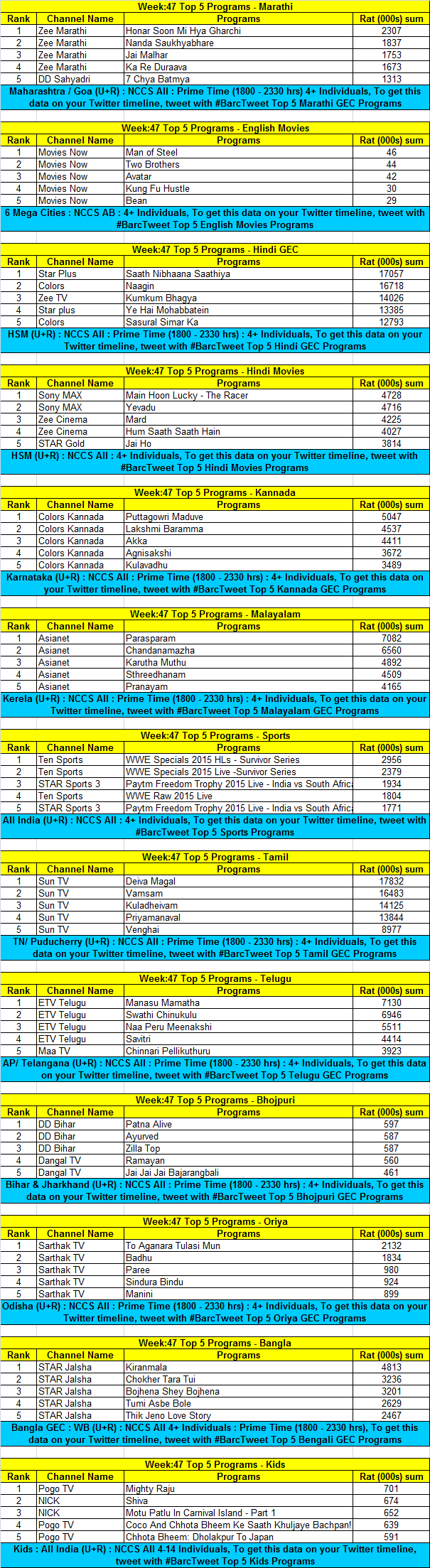
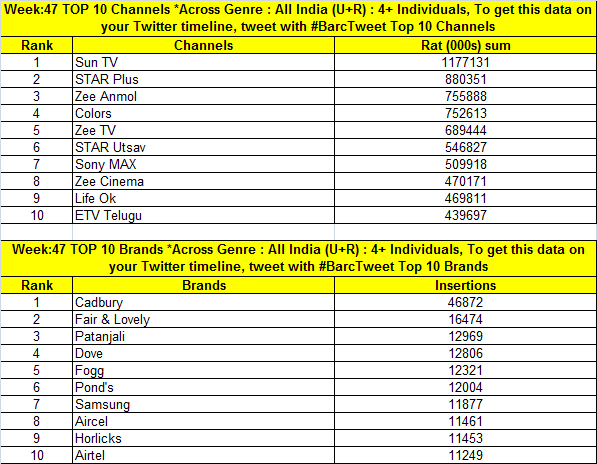
  • Star Plus, Zee Anmol & Colors rule Week 47

    By A Correspondent


    The Week 47 ratings from BARC (for Nov Nov 21-27, 2015) sees a lot of the old and some new. But the all-hyped Hindi GEC rankings of the Top 3 continue to be the same.


    Note these numbers are combined for urban and rural audiences, and subscribers to the data will know how the rankings are dramatically different for urban audiences.​ And ditto for rural or free-to-air audiences.


    Enjoy!​​


  • Ranjona Banerji: Thankfully, the national media woke up to Chennai’s plight in December

    By Ranjona Banerji


    Tamil Nadu has been battered by rain for most of November. The city of Chennai has been particularly ravaged. Close to 150 people died from rain-related crises in November. But for the national media, especially television, all we saw was raging and fury over why Delhi chief minister Arvind Kerjiwal hugged former Bihar chief minister Lalu Yadav and how dare actor Aamir Khan’s wife express an opinion.


    It is unfair to claim this was just a north-south divide that we have seen in the media for decades. There was something more on display here. It was that sort of hysterical mindless race to find the subjects that could generate the most sound and fury that seems to have become the rule these days. It also demonstrated an obsession with politics and playing upon the political divide. When people’s lives and homes are being destroyed by unprecedented rain, you cannot really have a good noisy debate of Sambit Patra versus Sanjay Jha.


    One can grant them that many other things were happening. Paris suffered one more terrorist attack. The prime minister was travelling and meeting his overseas fan clubs. The climate was visiting the global stage once more. Election results had to be discussed threadbare. Artists and intellectuals continued to express distress. Rain, no matter how much damage it caused, was obviously not exciting enough.


    Thankfully, the terrible surge in rainfall in Tamil Nadu in December suddenly got the media’s attention. Newspapers had it on their front pages and news channels gave us 24 hour coverage. All of them were relatively sober in their coverage and until Thursday night had not descended into a political blame game. Massive efforts were made to coordinate with rescue services and to highlight the efforts being made by voluntary organisations and concerned citizens to help affected people in any way possible.


    Full marks must be given to all those reporters and camerapersons who braved rain and flood water to bring us their stories. It is they who are the backbone of this celebrity-driven TV media we are now surrounded by. TV has changed the dynamics of a newsroom to the extent that viewers cannot see beyond the anchors and young wannabe journalists only aim for that perceived fame and glory without realising background work that goes into making a story a success. Yeah, end of lecture and please watch Network (the film) if you haven’t already.


    But you have to feel for newsrooms here, even when it comes to getting politicians to comment on just about everything. We in India appear to have a shortage of experts who are well-known enough or articulate or can be easily located. It sounds odd to write this but it is something experienced firsthand when I was part of several edit page teams. We have partitioned our lives in such strange ways that academia is often aloof and also unwilling to communicate in a manner than non-experts will understand.


    Especially now when it comes to the environment and climate change and technology, we need public intellectuals to come forward and explain and share. If they don’t, we’re going to be stuck with Sambit Patra holding forth on everything…


    **


    December 1 was World Aids Day. There was cursory coverage in most newspapers and the horror story is that India, having done so well, is now back to the edge of disaster in controlling HIV/Aids, government funding having been cut and foreign funding having dried up. The best coverage of this impending horror came from the comedy group AIB, on their new very watchable show on Star World. Ya I know, but really. Go figure.


  • Two views on news on Chennai


    Shailesh Kapoor: For our Media, Chennai is no Mumbai or Delhi


    By Shailesh Kapoor


    Call it nature’s fury or a man-made calamity, or indeed a combination of the two, Chennai is reeling under one of the most severe crises a big city in India has seen in many years. And it doesn’t seem to be getting over in a hurry, despite great support from various constituencies, ranging from the Army to the social media.


    News of incessant rains in Chennai began to come in about two weeks ago itself. It was given the status of an also-ran headline, getting 30-second coverage in non-primetime, or a cursory mention in the inside pages of national newspapers.


    Earlier this week, when it became clear that the crisis is only deepening than solving itself out, media reluctantly began to cover Chennai. It was still outside the main hours and the front pages. Only about Wednesday (just two days ago) did Chennai become the main story in the Indian media. Ironically, the social media had taken up the subject at least two days before that.


    Chennai is no North-East. It’s not that obscure part of India that people have barely heard about, and have no social or commercial connect with. It’s a big city, traditionally classified as one of the four metros in India.


    But the media treatment of Chennai rains would make you believe something happened in Nagaland or Lakshadweep (not to say that these places do not deserve media coverage). It was news from the outside, through the lens of a media that operates out of Delhi and Mumbai, and looks at rest of India as if it’s only a matter of completion.


    Remember July 26, 2005? One day of rains and the resultant situation made the media follow the story full-throttle, for at least a week. Even this week, Delhi’s pollution story has competed with Chennai for coverage on most Hindi news channels.


    When it comes to showing and seeing Tamilian (or “Madrasi”) characters as caricatures in our entertainment content, most of us don’t bat an eyelid. But when it comes to covering a big story from Chennai, another section of the same media can develop cold feet. And “forced” to cover it, they carry headlines like “India stands united with Chennai”. What does that even mean? Chennai is a part of India. Why does India have to show its unity for one of its own?


    I call this the ‘Head Office (HO) Bias’. The editorial team tends to give naturally high weightage to stories from the city it is based in, or runs major operations from. There are two reasons for this. One, you see the story around you, e.g. if you are based out of Delhi, you can feel the pollution in the air. Two, you have some of your best journalists placed in these cities, especially the HO. So you are likely to get better stories and exclusives from there.


    Some would even give the ratings argument, such as Hindi news channels not being watched down South, and the story being of limited public interest in the rest of India. I would normally support that argument for a conventional political story, but when it comes to national crisis, a different lens can surely be applied. Or is that too much to ask for?


    Ranjona Banerji: Thankfully, the national media woke up to Chennai’s plight in December


    By Ranjona Banerji


    Tamil Nadu has been battered by rain for most of November. The city of Chennai has been particularly ravaged. Close to 150 people died from rain-related crises in November. But for the national media, especially television, all we saw was raging and fury over why Delhi chief minister Arvind Kerjiwal hugged former Bihar chief minister Lalu Yadav and how dare actor Aamir Khan’s wife express an opinion.


    It is unfair to claim this was just a north-south divide that we have seen in the media for decades. There was something more on display here. It was that sort of hysterical mindless race to find the subjects that could generate the most sound and fury that seems to have become the rule these days. It also demonstrated an obsession with politics and playing upon the political divide. When people’s lives and homes are being destroyed by unprecedented rain, you cannot really have a good noisy debate of Sambit Patra versus Sanjay Jha.


    One can grant them that many other things were happening. Paris suffered one more terrorist attack. The prime minister was travelling and meeting his overseas fan clubs. The climate was visiting the global stage once more. Election results had to be discussed threadbare. Artists and intellectuals continued to express distress. Rain, no matter how much damage it caused, was obviously not exciting enough.


    Thankfully, the terrible surge in rainfall in Tamil Nadu in December suddenly got the media’s attention. Newspapers had it on their front pages and news channels gave us 24 hour coverage. All of them were relatively sober in their coverage and until Thursday night had not descended into a political blame game. Massive efforts were made to coordinate with rescue services and to highlight the efforts being made by voluntary organisations and concerned citizens to help affected people in any way possible.


    Full marks must be given to all those reporters and camerapersons who braved rain and flood water to bring us their stories. It is they who are the backbone of this celebrity-driven TV media we are now surrounded by. TV has changed the dynamics of a newsroom to the extent that viewers cannot see beyond the anchors and young wannabe journalists only aim for that perceived fame and glory without realising background work that goes into making a story a success. Yeah, end of lecture and please watch Network (the film) if you haven’t already.


    But you have to feel for newsrooms here, even when it comes to getting politicians to comment on just about everything. We in India appear to have a shortage of experts who are well-known enough or articulate or can be easily located. It sounds odd to write this but it is something experienced firsthand when I was part of several edit page teams. We have partitioned our lives in such strange ways that academia is often aloof and also unwilling to communicate in a manner than non-experts will understand.


    Especially now when it comes to the environment and climate change and technology, we need public intellectuals to come forward and explain and share. If they don’t, we’re going to be stuck with Sambit Patra holding forth on everything…


    **


    December 1 was World Aids Day. There was cursory coverage in most newspapers and the horror story is that India, having done so well, is now back to the edge of disaster in controlling HIV/Aids, government funding having been cut and foreign funding having dried up. The best coverage of this impending horror came from the comedy group AIB, on their new very watchable show on Star World. Ya I know, but really. Go figure.


    Image courtesy: Press Information Bureau


  • ZenithOptimedia forecasts adspend to grow 12% in 2015, 10.7% in 2014


    The rise of mobile advertising and social media, and the transition to programmatic buying of digital display, will help the global advertising market grow 5%-6% a year over the next three years.


    According to ZenithOptimedia’s new Advertising Expenditure Forecasts, global adspend will grow 4.9% to reach US$545 billion in 2015. The global economy is expected to improve (the IMF predicts 3.8% global GDP growth in 2015, up from 3.3% in 2014), but advertising faces a tough year-on-year comparison after the Winter Olympics, World Cup and US mid-term elections in 2014. Adspend growth will therefore be slightly below 2014’s 5.1%.


    The year 2016 will be a quadrennial year – with the Summer Olympics, US Presidential elections and the UEFA European Football Championship – and ZO expects these events to propel adspend to 5.6% growth that year, before it slips back to 5.2% in 2017 in their absence.


    India Commentary – Insights & Trends

    The new Narendra Modi government seems to have captured the collective consciousness of the country, a ZO communiqué notes. Falling food prices as well as oil prices have contributed to a reduction in the Consumer Price Inflation to a historic low of 5.52% in October. IMF and World Bank have forecast an identical 6.4% growth in 2015, up from 5.6% in 2014. The stockmarket index has crossed 28000, up from 20000 in November 2013.


    “We enter 2015 with a strongly positive consumer and business sentiment, albeit recognising that consistent on-ground delivery and reforms will be needed to keep this sentiment up. Hence, cautious optimism, though with way more optimism than same time last year, is still the right expression,” it adds.


    We expect consumption to continue picking up, with passenger car and utility vehicle sales turning positive, credit card spending on the rise, loans for durables growing. From an ad-expenditure point of view, FMCGs will continue their dominance but given the weak monsoons, some categories might stay flat or have slow growth. High growth is expected from Telecom, e-commerce, Mobile phones, Cars and two wheelers, retail, realty and the BFSI sector. 2015 will also be the year of ICC Cricket World Cup, which will also be a trigger to growth in ad expenditure.


    The new TV measurement system is scheduled to launch in 2015, as is the much-awaited Phase III expansion of FM Radio. Regional media, across Print, TV and all other media continues to drive growth in media consumption. With internet base increasing to 250 million, smartphone ownership expected to reach 200 mn by 2014-end, and the country awaiting the launch of 4G services by telecom operators, online and mobile will continue to see the maximum growth rate. Digital advertising however, has become dearer as the government decided to re-impose service tax this.


    Given these factors ZenithOptimedia expects the AdEx to grow by 12% to Rs 40,307 crore, at an overall level in 2015, as against 10.7% in 2014 (over 2013). This growth will be primarily fuelled by print at 12%, TV at 10% and online and mobile at 25%. Other media are expected to grow between 5 – 10%.


    Transition to mobile plays to the strengths of social

    Mobile is by some distance the main driver of global adspend growth, and we forecast it to account for 51% of all new advertising dollars between 2014 and 2017. We expect mobile advertising to grow by an average of 38% a year between 2014 and 2017, driven by the rapid spread of devices, innovations in ad technology and improvements in user experiences.


    However, mobile’s share of adspend remains well behind its share of media consumption. Mobile will account for 6.2% of all adspend in the US this year, while eMarketer estimates it will occupy 23.3% of media consumption time. This is partly because a lot of conventional display advertising does not work well on mobile. Compared to desktop display, mobile banners take up more screen space, are considered more intrusive, and are more likely to annoy consumers than engage them. Because mobiles don’t accept cookies, retargeting and tracking from the ad to the purchase is usually impossible.


    There’s one area, though, where digital display has proved very successful on mobile, and that’s social media. Facebook and Twitter have rapidly restructured their operations for mobile consumption and advertising, and between them are on track to capture 33% of all mobile adspend in 2014. This is well above their 10% share of all digital adspend. Their ads are designed to blend seamlessly into the content feed – they look native rather than intrusive. They can track all their users’ media consumption within their apps, and can tie that into their desktop activity through their login details. Social media provides a great example of how to adapt to mobile.


    Transition to programmatic has given a sharp boost to traditional display

    Agencies are swiftly adopting programmatic buying, which allows them to target display ads accurately and efficiently. The technology has recently evolved to deliver better premium, brand-building experiences. This has provided a sharp boost to ‘traditional’ digital display, as well as video and social. Growth in traditional display leapt from 14% in 2012 to 18% in 2013, and we estimate it at 26% in 2014, its fastest rate of growth since 2007.


    Around half of all display is bought directly by advertisers, most of them small local companies spending only a few thousand dollars a year. These currently have little access to the programmatic marketplace. Most programmatic technology has been designed for large-scale campaigns, and while a few companies are trying to adapt programmatic buying for small businesses, these attempts are at early stages. As technology evolves to bring the advantages of programmatic buying to small businesses we can expect another boost to traditional display spending.


    Eurozone slowly improving – periphery growing again – held back by the core

    Global adspend growth is being restrained by weakness in Japan and the Eurozone. Japan’s seemingly intractable economic problems limit its ad market to 2% to 3% annual growth, and we don’t expect it to improve over our forecast period. The Eurozone, however, is poised to end 2014 with its first year of growth since 2010, with further improvement likely over the next few years.


    Adspend across the Eurozone fell by 15% between 2007 and 2013. The worst hit markets were at the periphery – Greece, Portugal, Spain and Ireland lost 49% of their adspend over this period – France and Germany held their ground, shrinking by just 3%.


    However, Greece, Portugal, Spain and Ireland all began to make strong recoveries in 2014, and over the next few years we expect them to substantially outperform the Eurozone average, growing at 5.4% a year through to 2017. Their recovery will help Eurozone adspend grow 0.8% in 2014, a substantial improvement on its 2.9% decline in 2013. Meanwhile the core economies of France, Germany and Italy (which together account for about two thirds of the Eurozone economy) are stagnating. We forecast adspend in France to shrink at an average rate of 0.3% a year between 2014 and 2017, while Germany grows by just 1.3% and Italy by 1.5%, below the Eurozone average of 2.0%.


    Falling oil prices exacerbate conflict in Russia and Ukraine

    The Ukraine crisis has disrupted advertising in Eastern Europe. Russia has had trading sanctions imposed on it, and has retaliated with its own. International investors have withdrawn their capital, and the government has imposed restrictions on foreign involvement in the economy. This has coincided with a sharp drop in the price of oil, Russia’s main export. After many years of double-digit adspend growth, Russia’s ad market is forecast to grow just 1.8% this year and 1.1% in 2015, followed by 4.6% growth in 2016 and 9.2% in 2017.


    The crisis has unsurprisingly had a much greater effect in Ukraine, where violence has disrupted distribution chains and frightened away foreign investors, including big advertisers. We expect adspend in Ukraine to fall 49% this year and 10% in 2015, followed by 6% recovery in 2016 and 2017 from a greatly reduced base.


    “Mobile technology is creating new opportunities for brands to build relationships with consumers, while programmatic buying is making brand communication cheaper and more effective. Social media provides a strong example of how to advertise effectively on mobile platforms, and we expect mobile marketing to develop further as other media learn from this example,” said Steve King, ZenithOptimedia’s CEO, Worldwide.

     

  • Amagi expands network to other continents

    By A Correspondent


    Amagi has announced the expansion of its India ad network to key international markets – North America, Canada, Africa, Australia and Asia. Amagi will now offer an advertising platform to Indian advertisers with B4U Network and Zee Bangla in these international markets. The company’s landmark move will now enable Indian advertisers to reach more than 200 million viewers onthese channels.


    Amagi’s global ad network allows advertisers to target audiences across regions, while optimizing ad budgets and increasing their return on investments. Advertisers can buy ad spots through Amagi across its international network and target consumers across markets.


    The company’sad network will now be extended to Zee Bangla and the entire B4U network including B4U Movies, B4U Music, B4U Plus and B4U Aflam. This opens up doors for several brands within India to expand their advertising footprint across the globe in markets of their choice. While this will instantly help in expanding the consumer base of Indian brands, television networks will also benefit from increased ad revenues.


    One of the first Asian channels to pioneer Bollywood entertainment worldwide, B4U Network caters to the Asian diaspora worldwide and covers some of the important markets including USA, Canada, Middle East, and North Africa. The network’s collaboration with Amagi will attract several Indian brands to its platform. Zee Bangla, the first Bengalisatellite channel, will also allow Indian advertisers to target the channel’s viewership base in Bangladesh through Amagi’s network.


    KA Srinivasan, co-founder and head of global operations at Amagi,said, “Our endeavor is to serve as a global TV ad platform for brands within India, helping them to penetrate and capture international markets essential for business growth; and collaborating with widespread networks like B4U and Zee Bangla, who are our long-standing partners, allows us to do just that. Indian advertisers, who were earlier restricted to Indian audiences alone can now advertise worldwide and reap the benefits of global exposure. Amagi hopes to see more such partnerships with TV channels and continue to bring more Indian brands on board for international advertising.”


  • Visual strategy & content distribution company VNR MediaWorx launched

    By A Correspondent


    Riding on the emerging trend of ever-increasing visual content consumption, a specialist visual strategy and content distribution company, VNR MediaWorx has been launched. VNR MediaWorx aims to draw on the collective viewership of the 200 odd regional news channels in India to provide a more captive and receptive audience to these marketers.


    VNR MediaWorx is the brainchild of communication veteranPrasun Peter who has spearheaded the communication mandate for innumerable Indian and international corporates over the past 18 years. VNR MediaWorx will be India’s first visual strategy company that will harness the changing media consumption habits of the masses – by shifting the focus from text-based communication to video and visuals based communication. The biggest beneficiary of this service will be MNCs, big corporate houses and the PR & corporate communication industry. This will be a very potent tool in the hands of the marketing professionals, greatly enhancing their consumer outreach and radically changing the rules of the game. VNR (video news releases) would be the company’s primary offering to its prospective clients.


    Prasun Peter

    Speaking on the occasion Prasun Peter, Founder and Chief Strategist of VNR MediaWorx said, “There is a seismic shift in the way video is being consumed. News channels have proliferated across the country. Better and ever-present internet connectivity coupled with the tremendous growth in the number of personal viewing devices (TV, laptop or desktop, smartphones) is leading to  people consuming all content –  including video — at an all-time high and ever-increasing rate. VNR MediaWorx is our effort to tap the potential of these changing trends of increasing video consumption to reach new audiences for our customers.”


    It is noteworthy that India is one of the top three video consuming markets. Over 60 million users watch online videos on their computer. And almost the same number of videos on mobile. On an average, around 5 billion videos are watched every month.


    Prasun further added, “We aim to empower communication through effective use of the visual medium. If a photograph is worth a 1000 words, imagine the impact when the photograph is replaced with a gripping video messaging.” Talking about the germination of the idea and its incubation, Prasun added, “This is an amalgamation of our communication understanding with visual content expertise. We have been working on this idea for the past 4 years, putting together the various cogs in place. We have established a network of associates across the country, to ensure a seamless service offering.”

  • Ranjona Banerji: How PIB made a fool of itself but also made the PM the butt of jokes on social media

    By Ranjona Banerji


    Why the Press Information Bureau did this boggles the imagination and contravenes every idea of good sense. PIB is the government’s official media wing; we understand and accept that. It is not the most exciting media organisation but it is vital as it chronicles government history and therefore in a sense, the history of contemporary India.


    But when the prime minister did an aerial survey of the Chennai floods, someone in PIB decided to be dramatic and creative on social media. As a result it made not just a fool of itself but also made the prime minister the butt of jokes on social media.


    For those who came in late, what happened is this: Narendra Modi went on an aerial survey of Chennai. PIB put out a picture of him on Twitter, on the plane, looking out of the window. As anyone would expect, the scene of the ground below, through the window, was hazy and blurry – rain, clouds, floods. A few hours later, the same picture was re-released on Twitter. This time, the view from Modi’s window was crisp and clear, there were no clouds and no blurring.


    Twitter was quick to realise that some computer wizardry had been used to manipulate the view from the window. And a whole series of memes crowded the internet.


    PIB put out an apology: “Out of the seven pictures released, one picture used the technique of merging of two pictures. This is being referred to as “Photoshopping” in sections of media. This happened due to error of judgment and the picture was subsequently deleted. PIB regrets the release of the above mentioned picture. The inconvenience is regretted.”


    The apology is as is obvious written in the worst sort of bureaucratese. The mention of reactions in “sections of media” (Twitter) and the sort of umbrage to the word “Photoshopping” only demonstrates that this apology was wrung out of PIB because of the ridicule it had to suffer, which clearly stung. The only inconvenience to be regretted is that caused to PIB itself because everyone else had a good laugh.


    Members and supporters of political parties and the general public are well-known for “using the technique of merging pictures” (since the term “photo-shopping” is seen as offensive!). Stations in China mysteriously show up in Gujarat, bullet trains from Japan arrive on Indian platforms and marooned United Airlines planes, complete with snow machines around them, materialise on the tarmac of Chennai airport.


    But the Press Information Bureau is not a nutcase on Twitter. Enough said. The inconvenience is regretted.


    This is from scroll.in:

    http://scroll.in/article/773697/government-apologises-for-altered-picture-of-modi-in-chennai-but-twitter-cant-stop-laughing

    **


    Talking of the technique of merging two pictures, here’s a report of how the Tej news channel merged picture of their reporter with rushing flood waters, to demonstrate the technique of sending a reporter to a site without moving out of the studio:

    Chennai floods and India media, why social media users are incensed!


    Now PIB can be “forgiven” for the “inconvenience” because it is part of the government. But media organisations which resort to such outright lies cannot make any excuses at all. This is not an error of judgment. This is a deliberate attempt to mislead.


    More shame on us.


  • IIMB announces 3-day EEP in M&E

    By A Correspondent


    Indian Institute of Management Bangalore has announced a three-day Executive Education Program in Media and Entertainment. The program is targeted at potential leaders in an existing entertainment or media business or new media entrepreneurs, content creators, media and entertainment industry executives, financiers, marketing executives, consultants, talent managers, vendors, production house managers and directors, executive and line producers, distributors and exhibitors.


    Starting 14 December, the program involves 3-days of classroom workshops, exposure to various case studies and work-based assessment. The program has been conceived and designed by Prof. S Raghunath, faculty, Corporate Strategy & Policy, IIMB. DrRaghunath also offers an elective course on Strategic Management in Film and Television Entertainment Industry in the Executive Post Graduate Program. He has written case studies on topics that include leadership and management challenges in film, TV, animation, gaming and entertainment business. “The program is designed to provide insights into the strategic issues facing the media and entertainment industry, help participants build business plans and raise finance for new projects and give them an opportunity to network with other media and entertainment professionals,” says Prof. Raghunath.


    Ashwin Parulkar, media professional, observes: “A high impact program like the one offered by IIMB effectively imparts a granulated understanding of business cases into strategic management of media. It is a well-balanced program that creates excellent networking opportunities and focused learning.”   The 3-day program, starting Dec 14, aims to help participants cope with the challenges and access opportunities based on changes in technology.


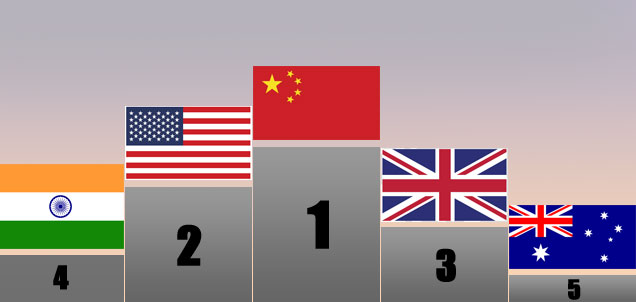
  • India #4 in EY’s Most Attractive Nations for M&E Investment


    By A Correspondent


    It’s India Shining in the world order. At least for the Media and Entertainment sector. According to consulting firm EY (eka Ernst & Young), India ranks fourth in the most attractive nations for investment. This coupled with the fact that espite the usual industry challenges and downside risks, the media and entertainment (M&E) sector has a high level of confidence in the global economy. EY recently survey senior executives from global M&E companies for the 13th Global Capital Confidence Barometer which was released on Monday.

    Specifically, this is what the EY report says on India:

    Even as the outlook for many emerging markets turns negative, investor sentiment toward India is seeing a significant recovery. The Indian Government’s pro-business stance and an increasingly promising economic outlook are fostering a more attractive investment landscape for inbound investment.

    Several government initiatives, including the digitisation of cable television, the Phase III auctions of FM radio spectrum and an increase in FDI limits, are expected to drive growth in traditional media. India is also the second largest internet market after China with over 300 million internet users. Although digital content consumption is currently tempered by low smartphone and broadband penetration, a surge in broadband adoption is expected with the rollout of 4G services and the government’s Digital India initiative.

    While the ubiquity of media consumption has not yet translated into significant industry revenue – by 2016, India’s online advertising market is forecast to be a little more than  US$1 billion, while the forecast for China is in excess of US$23 billion –  India is expected to become the third largest economy in the world by 2030 after the US and China.

    With a triple fold increase in GDP expected over the next 15 years, M&E industry revenues and their contribution to the GDP are expected to increase significantly.

    India has seen some big M&A deals in M&E in 2015. The key ones being:

    Deal Type

    Announced Total Value (USD Mn)

    Target Name

    Acquirer Name

    M&A

    417

    MAA Television Network Star India

    Pre-IPO

    273.4

    Videocon d2h Silver Eagle Acquisition Corp

    Private equity

    166.5

    Prime Focus – Reliance Mediaworks merger

    M&A

    110.8

    Reliance MediaWorks -BIG Cinemas Carnival Films

    M&A

    (Closure pending)

    78.1

    DT Cinemas PVR

    When asked their perspective on the state of the global economy, 81% of executives said it is improving, up from 52% one year ago. Executives surveyed maintained an overall positive attitude, indicating an improving level of confidence in corporate earnings (64%), short-term market stability (83%), credit availability (77%) and equity valuations (56%).


    Says John Harrison, Global Media & Entertainment, Transaction Advisory Services Leader at EY: “Media and entertainment executives are more confident about the global economy and key market indicators than 12 months ago. However, short-term headwinds, such as foreign currency volatility and earnings pressure from digital transformation are tempering enthusiasm. As the industry learns to better harness digital adoption and fully exploit the multiplatform distribution environment, companies are becoming more confident about expanding their offerings and making strategic acquisitions that will improve their competitive advantage.”


    When assessing economic risks to their businesses, executives indicated increased volatility in currencies to be the greatest, (36%), followed by slowing growth in key emerging markets (23%), the economic and political situation in the Eurozone (20%), increased global and regional political instability (14%) and timing and pace of interest rate rises in the US (7%).


    Executives surveyed overwhelmingly expect the global mergers and acquisitions market to remain strong in the year ahead, with 73% indicating it will improve (up from 49% last year), 24% saying it will remain stable and 3% saying that it will decline. When asked if they expect to actively pursue acquisitions in the next 12 months, 59% responded favorably, which is more than double from two years ago when only 25% indicated they were going to actively pursue acquisitions. While the number of M&E companies expecting to pursue an acquisition in the next 12 months is the highest it has been in two years, only 44% of respondents are optimistic about the likelihood of closing acquisitions. This is possibly a result of the perceived valuation differential between sellers and buyers increasing in the past six months.


    Target deal sizes are moving higher, with 22% of respondents indicating that their largest planned acquisition size in the next 12 months will be greater than US$250m. While a majority of acquisitions are expected in the US$250m or less area, the trend since last year is toward more substantial deal sizes.


    Confidence in corporate earnings is more measured, possibly a result of foreign currency volatility as well as structural challenges facing the M&E industry from digital transformation.


    Other key findings of the report include:

    • Digital continues to have the greatest impact on M&E companies’ core business and acquisition strategies.
    • Foreign exchange volatility is causing concern as a lot of costs are US-dominated and revenue is increasingly international.
    • Structural challenges related to digital adoption persist, which, along with foreign exchange fluctuations, is having a near-term impact on corporate earnings.
    • Respondents are most likely to invest in China, the US, the UK, India and Australia.
    • 58% of executives said that their company’s focus during the next 12 months will be cost reduction and operational efficiency, followed by growth at 28% and maintaining stability, 14%.
    • Strategic divestment and other potential portfolio actions are moving higher on the boardroom agenda as media and entertainment companies seek to optimize capital allocation to thrive within a fast-changing world


    The report is a survey of senior executives from large M&E companies around the world that gauges corporate confidence in the economy, identifies boardroom trends and provides insight into companies’ capital agenda.


  • Ramesh Kumar, Sambit Bal take on expanded roles for ESPN in India

    By A Correspondent


    As ESPN expands its presence in India through the recently announced collaboration with SONY for co-branded SONY ESPN channels and digital media, Ramesh Kumar and Sambit Bal are taking on expanded roles in the ESPN’s business in India and beyond.


    Kumar will take on the new role of Vice President, Head of ESPN India and South Asia. In his new role Kumar will oversee all day-to-day operation of ESPN’s multimedia future in India and help drive the strategic growth of ESPN in India and the subcontinent. That includes oversight of ESPN’s leading digital properties including ESPNcricinfo, ESPN FC and the forthcoming local edition of multisport ESPN site and app in India. He will report to Russell Wolff, Executive Vice President, ESPN International and will continue to be part of ESPN’s regional Asia Pacific leadership team, working for Mike Morrison, Vice President, ESPN Asia Pacific.


    “Ramesh has been a strong business leader who understands the richness and complexity of India and the competitive marketplace and product dynamics across the subcontinent,” said Wolff. “Under Ramesh’s leadership, our business in India has continued to evolve and grow, serving Indian fans in new ways, while also becoming an important part of ESPN’s business regionally and globally.”


    Kumar, who joined ESPNcricinfo 15 years ago, has most recently been Head of ESPNcricinfo and ESPN India, overseeing the ESPNcricinfo.  In that role he oversaw the operation of ESPNcricinfo, the world’s leading digital cricket destination, globally – collaborating with ESPN teams in multiple regions and business units. Kumar also played an important role in developing ESPN’s agreement with SONY.


    Sambit Bal has been, arguably, the leading cricket journalist in the world for years, serving as Editor of ESPNcricinfo since 2003. In his new, broader role, Bal will now serve as Editor-in-Chief, ESPN India/South Asia. In the role, he will continue to be responsible for all ESPNcricinfo editorial content (written, video and audio) while also overseeing all editorial content for the new India multisport ESPN.com site and app (launching June 2016). Bal will also take a leading role in growing ESPN’s global coverage of tennis.  He will report to both Kumar and Patrick Stiegman, Vice President and Editorial Director, Digital and Print Media.


    “Sambit’s strong editorial background, voice and journalistic distinction, combined with an acute eye for great talent and content, make him a perfect fit for this role,” said Stiegman. “He has been instrumental in establishing ESPNcricinfo as the most trusted and comprehensive source for news, commentary and information around cricket, and will now be instrumental in delivering the same level of excellence to our coverage of multiple sports for fans in India and beyond.”