
Category: MEDIA

  • MediaSENse by Indrani Sen: To cap it all

    By Indrani Sen


    During the last month, the News Broadcasters Association (NBA) and others sought adjournment of the court case challenging the advertising cap of 12 minutes per hour twice in the Delhi High Court. The hearing scheduled on September 8 was first adjourned to September 23 on the ground that lawyers were on strike, which again got adjourned to November 27 on the ground that the matter was under discussion with the Information and Broadcasting Ministry (I&B). The earlier order by Supreme Court that the Telecom Regulatory Authority of India (TRAI) will not take any legal action against any channel violating the norms will stay put till the Delhi High Court case is heard and resolved. As per the reports published by the TRAI on a quarterly basis, very few channels are adhering to the limits set by TRAI.

    Based on consumer complaints, TRAI has been trying to regulate the quantity of commercials on TV channels since 2012. When the regulation on Ad Cap was announced in 2013, ( http://www.thehindu.com/   August 18, 2013).  Manish Tewari, I&B Minister in the UPA government said in an interview “TRAI should introspect and reconsider its current stance till carriage fees don’t mitigate further and subscriber revenue doesn’t stabilize for the sake of the healthy growth of the industry.”  Subsequently, Prakash Javadekar, the first I&B Minister in the BJP Government  indicated to media that the government was considering an amendment that free-to-air (FTA) channels should be exempt from the restriction of the 12 minutes ad-cap, while for pay channels the existing limit of 12 minutes per hour of advertisements would continue. (http://www.livemint.com/ October 8, 2014). After Arun Jaitley took over as I&B Minister, he made a statement that there should be no ad cap in the print or electronic media, but did not give any such instruction to the Ministry. (http://www.indiantelevision.com/ )

    While the I&B Ministry and TRAI are mulling over the issue, it would be informative to do a quick look around the world and survey the norms related to ‘TV Ad Caps’ practised in developed countries. In Europe, the Audiovisual Media Services (AVMS) sets the regulatory framework setting a limit for all channels of 12 minutes on the amount of advertising shown in one hour.  The similar rules which apply in the UK, are set out in the Code on the Scheduling and Amount of Advertising (COSTA) prepared by Ofcom, Independent regulator and competition authority for the UK communications industries. With our colonial hangover, we seem to have adopted the regulation prevailing in UK.

    The Australian model is very interesting. The Australian Communication and Media Authority (ACMA) categorises the time bands into two slots and stipulates that on the main channels, commercial television licensees may schedule

    1) Average 13 minutes per hour of non-programme matter between 6pm and midnight; and

    2) Average 15 minutes per hour on non-programme matter at other times.

    However, the maximum that can be scheduled in any given hour is:

    1) 15 minutes from 6pm to midnight – with no more than 14 minutes scheduled in any four of those hours; and

    2) 16 Minutes at other times.

    The definition of non-programme matter includes paid advertising but excludes short programme promotions and pop-up programme promotions in the middle of programmes. Additional allowance is given during election periods to accommodate the broadcast of ‘political matter’. Since 2014, the leading channels have been lobbying with the government for raising the bar to 20 minutes of non-programme matter every hour. The pros and cons of the same are still being debated.

    Canada had the stipulation of ad cap of 12 minutes per hour based on individual licence agreements till 2007. In May, 2007, CTRC (Canadian Radio-television and Telecommunications Commission) announced a phased relaxation of the rule bringing the free to air conventional TV channels more closely in line with their counterparts in US. So, from 2009, there is no cap on the quantity of commercials per hour on the free to air Canadian channels while the specialty pay channels are still subject to the ad cap of 12 minutes per hour.

    American TV hour-long programmes typically run for 42 to 43 minutes, leaving 17 to 18 minutes per hour for commercials. Federal Communications Commission (FCC) has a special regulation for controlling loud commercials, but has not introduced any cap on the quantity of time used for the commercials per hour. In 2014, a new study from Nielsen, the ratings measurement firm of US, showed that the number of commercials had grown steadily over 2009 to 2013. In 2009, the broadcast networks averaged 13 minutes and 25 seconds of commercial time per hour which grew to 14 minutes and 15 seconds in 2013. The growth was more significant on cable television. A typical American home had 189 channels to choose from yet only watched 17.5 on a regular basis. That figure was the same in 2009, when the average home received 129 channels. According to Nielsen, use of shorter commercials became more common (http://www.latimes.com/entertainment   May 16, 2014). Recently, I read online that Viacom is planning to find out if they can get more value for TV commercials by running fewer them on the network. (http://variety.com/2015/tv/news/viacom-primetime-tv-advertising-cuts-1201598646/  September 21, 2015).

    Ad clutter has been a major hindrance for TV viewing over many years. To cap it all, now an exodus of consumers from TV to streaming video, mobile devices, etc. have started across the world. On TV, appointment viewing has been changing to scattered delayed viewing. Our TV channels, who are fighting against the TRAI regulation on ad cap for protecting their revenue, should remember that their ratings followed by revenue may be better protected with less time devoted to ad breaks.

    The  I&B Ministry and TRAI should consider the scope of adopting the Australian model with variable options across different time bands including additional allowance during Central and State elections. As we have almost 50 percent of our licensed channels in the news genre, the news and non-news can also be put in two different buckets apart from the FTA and Pay channels. In my view, we need to come out of the practice of holding UK as the role model and look around for better alternatives while framing our media rules and regulations.

    Indrani Sen is a veteran media agency and marketing services professional. She is currently an Independent Consultant and Adjunct Faculty, Media Management at Symbiosis Institute of Media & Communication, Pune. This column MediaSENse will appear fortnightly. The views expressed here are her own.

     

  • Mumbai edition of The Hindu takes off

    By A Correspondent


    The launch of the Mumbai edition of The Hindu was announced by Kasturi & Sons Limited on November 28, 2015. The Mumbai edition will add to 40 editions of The Hindu that are already published from 17 major Indian cities across India.


    Announcing the edition, The Hindu Editor Dr. Malini Parthasarathy said: “We realise our core brand strength is the credibility and integrity of our reporting. This brings authenticity to our perspective. At the same time, we acknowledge Mumbai’s great transformation into an upwardly rising global city. Our edition has eight pages uniquely catering to Mumbai. We hope to capture both the buoyant and the poignant stories emanating from here.”


    The concept of the Mumbai edition is unique, incorporating special pages on each aspect of India’s ‘Maximum city’, as the financial and corporate headquarters of the country, as well as a film and fashion hub. The Mumbai edition marks many firsts for The Hindu, which is credited with breaking some of India’s biggest news stories, and at the same time its in-depth coverage of developments and issues otherwise ignored in the mainstream press. At 137 years, The Hindu is one of India’s oldest newspapers, with a net paid daily circulation approaching 1.5 million copies.


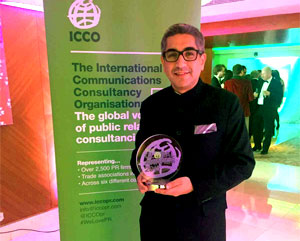
  • Nitin Mantri & Avian Media conferred top honours at ICCO Global Awards 2015

    By A Correspondent


    Nitin Mantri

    Avian Media has clinched the ‘Independent Consultancy of the Year (APAC)’ title at the ICCO Global Awards 2015 in London on November 26. The company’s CEO, Nitin Mantri, who is also the President of the Public Relations Consultants Association of India (PRCAI), was adjudged Global PR Leader of the Year Award for displaying great leadership and achieving excellent results in moving the industry forward in one of the most challenging markets in the world. Mantri is the first Indian to have won this award.


    Nitin Mantri, CEO, Avian Media, said: “We are a homegrown, independent agency and we are proud of our heritage. This gives us the freedom and nimbleness to deliver result-oriented campaigns for our clients. Hence, it is a matter of great honour to win the ‘Independent Consultancy of the Year’ award. This has been a milestone year for us. We have won the ‘Indian Consultancy of the Year’ Award at the 2015 Sabre Awards in September, and now these prestigious awards on a global platform like ICCO, reiterate our belief that Avian Media is on the right path. We owe our success to our hard-working team of employees, our partners who support us, and our clients who trust and encourage us to scale greater heights. These awards will further motivate us to achieve our goal to become ‘The Most Trusted Advocacy Firm in India’.”


    Nikhil Khanna, Managing Director, Avian Media, said: “There is no doubt that Nitin is an outstanding professional, but I have always maintained that he should first be viewed as a remarkable leader. His novel approach to PR has set the roadmap for Avian Media’s success. And, the results – two agency of the year awards in the span of two months – are here to see. Nitin has not only charted Avian’s growth, but has been a leader for the profession. As President of the PRCAI, he has championed the cause of PR both at home and at global platforms. I cannot think of a more suitable Global PR Leader of the Year. I am extremely proud and happy for both my agency and its CEO.”


    The ICCO Global PR Awards benchmark the finest excellence in PR, and is globally recognised by 33 PR trade associations across the world. This is an internationally recognised awards programme purely based on effectiveness, measurement, results and impact for the global PR industry.


  • Ranjona Banerji: This “selfie” craze only takes this perversion of journalism integrity to a newer level of nuttiness

    By Ranjona Banerji


    The spectacle of journalists crowding Prime Minister Narendra Modi during his “Diwali Milan” or meeting with journalists in the national capital on November 28 was one of the most unedifying of recent times. Journalists looked like fanboys and fangirls as they mobbed the prime minister in order to get a “selfie” with him. It happened last year too but we knew that after these so-called journalists posted their selfies with the PM and other ministers. This year round, we saw the melee for ourselves. And so did everyone else.


    I write “so-called” journalists and I can see bristles rising. I had an interesting discussion with a young TV journalist on Twitter. He felt there was nothing wrong with taking selfies with famous people as long as it didn’t interfere with your work. And further, that you should be judged on your work and not on your fan tendencies.


    Is he right? Am I being too much of a stickler here? It is common sense that a journalist has distance himself or herself from the people and events that are being covered. We have all seen too many colleagues who have strayed from that path with most unfortunate consequences. We are not friends with the people we interview, write about, observe. We may be friendly, they may be friendly. But unless we are aloof, we fail our readers and viewers. This rule is the same regardless of whether you’re a political or a glamour journalist. You become too close, too awe-struck, too star-struck and you lose the ability to criticise or be sceptical. You become the event rather than the observer.


    This “selfie” craze only takes this perversion of journalism integrity to a newer level of nuttiness. It is not that it has not existed before. We have all known colleagues who were too close to politicians and political parties or business houses or gangsters or film stars. We have all known journalists who had more cars than they should have or took free flats from quotas in return for favourable stories or had shares in companies they shouldn’t have. Some paid the price and lost their jobs. Others were kept on by managements who felt that they could leverage this closeness for their business interests. It was wrong then, it is wrong now.


    Some years ago, the well-known journalist and author Katherine Boo had told me that this closeness, this loss of journalistic distance is why she avoided “source” journalism and found that it was better to get as much information as possible through “Freedom of information” acts like the RTI. This demonstrates a level of journalistic ethics which we rarely see and even less rarely applaud. Yet it is much-needed – this finely tuned awareness that you have to practise your craft without being compromised.


    Just how much bad journalism was on display during this “selfie” craze is made clear by this piece by Mayank Mishra who was present at the prime minister’s event. He writes in the Business Standard: “The PM stayed at the venue for nearly 45 minutes. It does not happen often that we get a chance to interact with the PM. But not a single question was asked. We did not get to know the PM’s perspective on important issues of the day. Isn’t it a huge loss of opportunity? Will the selfie brigade please explain?”

    http://www.business-standard.com/article/opinion/why-selfie-journalism-is-very-bad-news-115113000093_1.html#.VlvMPGsAexY.twitter
    My answer to the young man on Twitter is simple. There is nothing wrong, as a journalist, if you forget your dignity to get a good story or a god quote. But there is everything wrong if we forget that this job is not about our personal collection of experiences. It is about the reader and the viewer. And what did the reader or viewer gain from this “selfie” exhibition except a perfectly justified sense of disgust for our profession?


  • YuppTV makes it to Top 100 in Red Herring list

    By A Correspondent


    Red Herring recently announced the ‘Top 100 Global awards’ that honors leading private companies from North America, Europe, and Asia. YuppTV is among the chosen companies, recognized as a disruptor in the volatile media and entertainment industry.


    Red Herring’s Top 100 Global list has become a mark of distinction for identifying promising new companies and entrepreneurs. Red Herring editors were among the first to recognize that companies such as Facebook, Twitter, Google, Yahoo, Skype, Salesforce.com, YouTube, and eBay would change the way we live and work.


    “Choosing the companies with the strongest potential was by no means a small feat,” said Alex Vieux, publisher and CEO of Red Herring. “After rigorous contemplation and discussion, we narrowed our list down from hundreds of candidates from across the globe to the Top 100 Winners. We believe YuppTV embodies the vision, drive and innovation that define a successful entrepreneurial venture. YuppTV should be proud of its accomplishment.”


    “When we were recognized as one of the top 100 North American companies earlier this year, we were absolutely thrilled with the distinction especially given that there were so many great companies,” said CEO and Founder, Uday Reddy. He continued, “However, to have been selected as one of the top 100 global companies really confirms our belief that we have a service that our customers love and that so many new customers around the world will want.” Red Herring’s editorial staff evaluated the companies on both quantitative and qualitative criteria, such as financial performance, technology innovation, management quality, strategy, and market penetration. This assessment of potential is complemented by a review of the track records and standing of startups relative to their peers, allowing Red Herring to see past the “buzz” and make the list a valuable instrument of discovery and advocacy for the most promising new business models from around the world.


  • Saare Jahaan Mein Achcha… Happy Dent humaara!


    By A Correspondent


    In these intolerant times, playing with the lyrics of an ever-so-popular nationalistic song, may be the wrong thing to do. But, heck, this is celebrating what appears to be a significant achievement for India. The McCann Erickson Mumbai creative for Happy Dent Teeth Whitening Gum titled “Happy Dent Palace” is in Gunn Report’s 20 Best Commercials of the 21st Century.


    The results were based on a public pulled on who voted on a list 30 candidates with provision made for other nominations, The Gunn Report has been able to select the Reel of The 20 Best Commercials of The 21st Century So Far (here!). The reel complements the much-viewed Gunn Report collection of The 100 Best Commercials of The 20th Century.


    Sharing the honour equally, the 20 ads (from 2000 to 2015) and their creators are:


    BGH Silent Aircon, “Dads in Briefs”, Del Campo Saatchi & Saatchi, Buenos Aires

    Budweiser, “Wassup/True”, DDB, Chicago

    Cadbury’s Dairy Milk, “Gorilla”, Fallon, London

    Canal+, “Closet”, BETC Euro RSCG, Paris

    Canal+, “The Bear”, BETC Euro RSCG, Paris

    Chipotle, “Back to the Start”, Creative Artists Agency, Los Angeles

    Dove Self Esteem Fund, “Evolution”, Ogilvy & Mather, Toronto

    Guinness, “noitulove”, Abbott, Mead, Vickers, BBDO, London

    Happy Dent Teeth Whitening Gum, “Happy Dent Palace”, McCann Erickson, Mumbai

    Honda, “Cog”, Wieden & Kennedy, London

    Honda, “Grrr”, Wieden & Kennedy, London

    John West Salmon, “Bear”, Leo Burnett, London

    Metro Trains, “Dumb Ways to Die”, McCann, Melbourne

    Nike, “Tag”, Wieden & Kennedy, Portland

    Nike, “Write The Future”, Wieden & Kennedy, Amsterdam

    Old Spice, “The Man Your Man Could Smell Like”, Wieden & Kennedy, Portland

    Peugeot 206, “The Sculptor”, Euro RSCG MCM, Milan

    Sony Bravia LCD TV, “Balls” Fallon, London

    Volkswagen Golf DSG, “Kids On Steps”, DDB, Berlin

    Volvo Trucks, “Epic Split”, Forsman & Bodenfors, Gothenburg


    Needless to say, Prasoon Joshi, chairman, McCann Asia-Pacific, and CEO, McCann Worldgroup India is ecstatic. Really feels good, he said in response to a text.


    Commenting on the 20 Best Commercials of the 21st Century So Far, Donald Gunn, Founder of The Gunn Report says, “We’re delighted that the participation was high, the result of which is a reel selected by our industry of iconic, game-changing and much loved commercials produced during the last 15 years.”


    “Not only do these commercials stand the test of time, but they have also influenced changes in brand communications. As such, we hope that they will bring inspiration and learning taking our industry to new creative heights,” added Donald Gunn.


  • CNN, IBN/TV18 bhai-bhai, again!

    By A Correspondent


    TV18 and CNN International have announced the extension of their collaboration on CNN-IBN. Earlier this year – in end-June to be precise, the two broadcasters had announced their decision to part ways with effect from January 2016. There were very active rumours of CNN inking a tie-up with Zee Media Corporation Limited. In fact, soon after this development, Zee even announced the English news channel and appointed an Editor-in-Chief. While Zee Media never confirmed the possibility of a tie-up with CNN, according to sources talks were on at an advanced stage.


    The fact remains that by using the CNN prefixing the channel, IBN gained much credibility in the early days to ward off competition from NDTV,  in later years, other than the name of the channel, IBN really hasn’t gained much from the alliance. Save the children’s entertainment genre, the Turner/CNN network has had a mixed record in India.


    Announcing the extension, Adil Zainulbhai, Chairman, Network18 said, “We are delighted to announce the renewal of this extremely cherished partnership between two most respected brands in journalism. In this second term of our collaboration, we aim to present a brand new CNN-IBN that will bring news with even greater speed, accuracy, clarity and credibility and keep the viewers tuned in to the latest news and developments much ahead of others. We also intend to cut through the noise and clutter that is currently present in the Indian television news space and offer best practices of journalism that will lead to better understanding of issues. The channel will organize meaningful debates and raise issues that touch the lives of our viewers. With this renewed partnership, we will enhance the process of newsgathering and delivery to our viewers in an informative and enlightening manner.”


    Speaking on the occasion, Rani Raad, Chief Commercial Officer, CNN International, said, “We are really excited about the future of CNN-IBN and together with the new management at TV18, are going to build upon the success we have already achieved. I look forward to the brand continuing its lead in the dynamic Indian news industry and am delighted that CNN IBN is staying in our family of CNN-branded channels around the world that include CNN Turk, CNN Chile, CNN Philippines, CNN Indonesia and CNN Greece.”


  • Star partners HBO for exclusive programming content

    By A Correspondent


    Star India and HBO have announced an exclusive programming agreement that will take HBO Original content to a wider audience via both, the hotstar digital platform and the English channels on the Star India network.


    Star India is again set to redefine the viewing experience on one of the world’s fastest growing digital content platforms namely hotstar and for its viewers across India, with the very best of HBO’s Original programming including series like ‘Game of Thrones’ and ‘True Detective’.


    Uday Shankar

    Commenting on the deal, Uday Shankar, CEO, Star India, said, “Star is delighted to partner with HBO to bring world class HBO Originals programming for Indian viewers. Star will become the exclusive destination for screening HBO content in India – once again resetting the benchmark for quality and depth of content offering for its viewers. Fans will be able to watch their favourite HBO Original programs on hotstar on the same day as the telecast in the United States. Viewers will also be able to see the HBO Original programming on Star’s English channels.”


    Jonathan Spink, HBO Asia CEO, said “HBO is delighted to enter this new chapter in India with Star. Through the first release of our shows on Hotstar, Indian Audiences will now have unprecedented flexibility in how they consume HBO’s much loved premium programming.”


    Forthcoming series of popular HBO Originals that fans can look forward to include the popular Game of Thrones; True Detective; Silicon Valley; Veep; and Leftovers as well as new HBO  Original series in the forthcoming season which will include the Scorsese series Vinyl scheduled to air on 14 Feb and Westworld. In addition library favourites such as Entourage, Band of Brothers, The Sopranos and Curb Your Enthusiasm will also be available.


  • Dentsu Webchutney creates new brand thought for Payback

    By A Correspondent


    PAYBACK, a multi partner loyalty program which rewards points for shopping, has joined hands with Dentsu Webchutney for the online and digital marketing of their new brand thought.


    On the new brand thought and brand strategy, Gaurav Khurana, CMO, PAYBACK India said, “The new brand thought comes as a logical next step in PAYBACK’s brand evolution journey. It marries the core PAYBACK product proposition with the evolving customer’s need for getting more from every transaction.”


    Explaining the role of social media for marketing, he added, “As part of our strategy, social media has played and will continue to play a significant role for us. We received a tremendous response for our campaigns from all our customers and even non customers. With the kind of work that Dentsu Webchutney has done in the recent past, we are confident that we will be able to accomplish some great work together.”


    Sidharth Rao, CEO, Dentsu Webchutney said, “We are privileged to work with PAYBACK India. It enhances our credentials as the leading full service digital marketing agency in India. It is an interesting and a challenging category to work on and we are looking forward to do some great work together which will stand out on the digital stage.”


    In a bid to showcase their wide portfolio of partner brands and redemption options, PAYBACK came up with a new tagline which promises consumers that nothing is pointless at PAYBACK. It was led in with teaser campaign #PointKyaHai which trended on Twitter on 1st spot for first few hours and garnered over 180 million impressions.


    Moosa Khan, Creative Director, Denstu Webchutney said, “We had a lot of fun conceptualising and executing #PointKyaHai for PAYBACK. The campaign was one of those rare instances where the communication and the product fit together extremely well.”


  • TimesOfMoney assigns digital mandate to Isobar

    By A Correspondent


    TimesofMoney (Remit2India and Klinnk) has appointed Isobar, the full-service digital agency from the Dentsu Aegis Network, as their digital agency. The agency won the account following a multi-agency pitch.


    Achal Shah

    Sharing his thoughts on the association, Achal Shah, Senior Vice-President & Head – Marketing at TimesofMoney said, “We have been in the pure-play digital cross-border business for 15 years now. Given our objective of reaching out to global ethnic communities, digital has always been our primary medium of communication. With our services now catering to newer audiences like the Chinese, Filipinos etc in the US, UK and Australia, it was imperative for us to get the right digital media partner who had a global presence combined with the local expertise.”


    Shamsuddin Jasani

    Shamsuddin Jasani, Managing Director, Isobar India, “We are very happy to be associated with TimesofMoney. We are always looking at experiences across different sectors and different types of clients and this win adds a very important category of money remittance to our ever expanding repertoire.”


    “We recently instituted a focused business development unit to go after interesting brands. This win is just the beginning of many more to come. TimesofMoney is an interesting category and teams are excited to create innovative and creative work for them,” he added.


    TimesofMoney is the leading digital payments and remittances service provider catering to retail and institutional clients in India and across the globe. TimesofMoney’s bouquet of services includes retail online remittances (Remit2India & Klinnk), white-labelled remittance platforms (Payce), customized mobile wallet solutions (Movit) and online payment gateway solutions (DirecPay).


  • Madhouse announces new senior appointments

    By A Correspondent


    Leading mobile marketing solution provider, Madhouse India, recently announced the appointment of Vishal Agarwal as the Head of Product and Platform and Akila Jayaraman as the Head of Performance Business. These appointments are a significant step towards building Madhouse’s vision of being a data driven mobile marketing company.


    Vishal Agarwal

    Vishal Agarwal, who joins the team as Head of Product and Platforms will be responsible for creating new products and platforms focusing on assisting brands in sales awareness and engagement; and also creating brand reach opportunities through technology partnerships. Vishal comes with over a decade of experience in IT, research and product development; he moves to Madhouse India from IMRB International where he lead the Digital Business. Vishal has also worked in the past with Sapient and Patni computers in the US.


    Akila Jayaraman

    Akila Jayaraman, has been associated with the mobile industry for over a decade and will now be heading the mobile performance marketing business unit at Madhouse India. As a part of her new role, she will help lead and expand the business across various e-commerce, BFSI and other mobile-first companies for all mobile performance marketing activations. Prior to this, Akila was the Business Development Head for Bharti Airtel at Mahindra Comviva.  In her earlier roles, Akila has handled multiple portfolios in consumer research, consulting and mobile technology sales and has also been a research analyst with Ericsson for their mobile domain.


    Speaking on the team expansion at Madhouse, Milind Pathak, COO, Madhouse South Asia, said “We are happy to have Akila and Vishal on board.  Both of them have a great understanding of the mobile ecosystem and bring with them with years of experience and industry knowledge. While Akila’s key area of focus will be growing the performance business, Vishal’s focus will be on expanding the product profile for us. We welcome them to the team and look forward to them joining us in setting new milestones for Madhouse India and creating products and solutions so that ‘we make brands love mobile’.”


  • Star India can now officially say ‘Meri Maa’

    By A Correspondent


    Star India has announced that it has successfully completed the integration of the broadcast business of Maa Television Network. With this integration, Star India enhances its outreach to South India markets, specifically Telugu-speaking viewers.


    With a bouquet of four channels, namely maa, maa Music, maa Movies and maa Gold, the Maa TV Network has a formidable presence in Andhra Pradesh and Telangana. However, it may be noted that as per BARC Week 47 ratings, ETV Telugu is a clear numero uno in the Telugu GEC genre. Maa is second with Zee Telugu a close #3.


    Said Star India CEO Uday Shankar in a statement: “We are pleased to announce the completion of the integration of the broadcast business of Maa Television Network, a journey that we had embarked upon in February, earlier this year. We are very impressed by the solid creative core and quality and depth of the management team at Maa Television Network and are delighted to welcome them to the Star family. The acquisition fills a critical gap in our portfolio and will allow our advertisers targeted access to the large Telugu speaking population. We plan to invest further in this important market to fundamentally change the content quality paradigm. I am confident that team Maa under the leadership of K. Madhavan will transform the content experience for Telugu viewers.”