Category: MEDIA

  • Ivor Soans takes charge of Editorial Services at Spiral Content

    By A Correspondent


    Ivor Soans

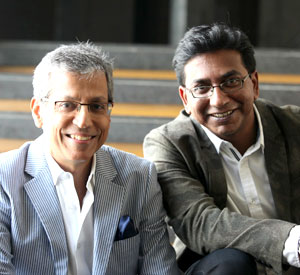
    Spiral Content has appointed Ivor Soans to lead its Editorial Services offering. He comes from Network18, where he was Managing Editor (Enterprise Technology) and Senior Editor, Firstpost.com.


    Ivor has been a business journalist for more than 17 years, with experience across Print, Television and Digital. He has been a key correspondent for several top technology media brands, with several high-impact news and analysis pieces to his credit. He was also involved in Network18 television shows on CNBC-TV18/CNBC Awaaz, besides being an industry speaker at leading events.


    As Editorial Director, Ivor will work closely adding his expertise to marketers and their brands digital content needs. Spiral Content CEO Rajan Srinivasan says “By bringing together the best of technology and people, Spiral Content is even more geared to meet the marketer’s content requirements. Ivor brings considerable experience in the branded content genre and is an asset to this new age engagement business.”


    Spiral Content is building tools and adding expertise to help brands become publishers. They launched a content marketplace – Scatter – in end January 2014.


  • Digitisation Dhamaka in 3 years


    By Megha Mandavia


    Rating agency Crisil said the next two phases of digitisation of television distribution that is expected to extend until 2018 fiscal end would be best so far for all stakeholders in the industry.


    DTH and MSOs to gain Rs 4,800 crore after investing Rs 22,000 crore

    Government and broadcasters to gain Rs 10,000 crore sans investments


    Excert from the executive summary of the CRISIL report:

    The next two phases of digitisation of television (TV) distribution, which we foresee extending all the way to fiscal 2018-end, should be the best so far for all the stakeholders.


    CRISIL analysis shows stakeholders would benefit by Rs 14,800 crore:

    > Of this, direct-to-home (DTH) operators are expected to garner as much as Rs 3,300 crore

    > Multi-system operators (MSOs) are expected to receive Rs 1,500 crore

    > Broadcasters are estimated to receive Rs 3,900 crore

    >Incremental tax revenues of Rs 6,100 crores are estimated to accrue to the government, thanks to increased disclosure of revenues by local cable operators (LCOs) and increase in overall subscription base. Of this, around 80% will accrue to the central government through licence fee and service tax, and the rest to state governments through entertainment tax


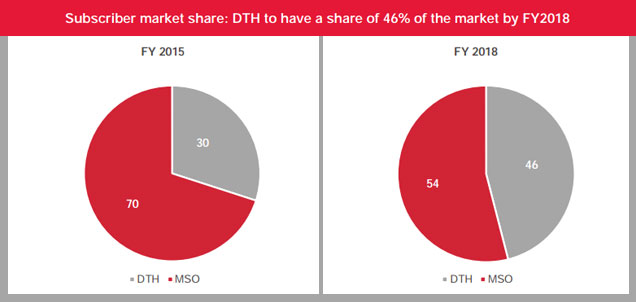
    CRISIL estimates that given their already stretched balance sheets and high capital expenditure (Capex) requirement in these phases, MSOs will be able to garner only 45% of the incremental digital market in the next two phases of digitisation. The balance will go to DTH service providers. This is in contrast to the previous two phases of digitisation wherein MSOs garnered 67% of incremental digital market together with LCOs.


    DTH’s upper hand in ‘cable-dark’ and sparsely populated regions will aid its market growth. And while incremental revenues will be on similar lines for both, profit share will be significantly more for DTH firms as they have complete access to subscription revenues unlike MSOs, which share a large part of their revenues with LCOs. While MSOs will continue to benefit from carriage revenues from broadcasters, CRISIL believes they are unlikely to receive incremental carriage revenues after digitisation.


    The only catch for the DTH operators is that they need to invest around Rs 13,700 crore over the implementation period. For MSOs, capital expenditure (capex) need is around Rs 8,300 crore. The capex requirements will be insignificant after the digitisation phase.


    LCOs, who had hitherto been disclosing only an estimated 20% of their analog subscription base, are the only stakeholders who will lose in this phase of digitisation.


    CRISIL believes the increase in overall market share and higher profits combined with promoter backing to part-fund the capex will benefit the credit profile of DTH operators. On the other hand, MSOs will have to increase their revenue share with LCOs to nearly 60% to prevent deterioration in their credit profile.


    Furthermore, while easing of foreign direct investment (FDI) norms will support fund raising plans for both DTH and MSO operators, the ability of MSOs to attract FDI funding will remain contingent on  improving their revenue share with LCOs.


    Direct-to-home (DTH) operators are expected to garner as much as Rs 3,300 crore, multi-system operators (MSO) Rs 1,500 crore, broadcasters Rs 3,900 crore and government Rs. 6100 crore in taxes, according to Crisil.


    “CRISIL estimates that given their already stretched balance sheets and high capital expenditure (capex) requirement in these phases, MSOs will be able to garner only 45% of the incremental digital market in the next two phases of digitisation. The balance will go to DTH service providers,” the report said.


    This is in contrast to the previous two phases of digitisation wherein MSOs garnered 67% of incremental digital market together with local cable distributors (LCOs), it added.


    Crisil said DTH’s upper hand in ‘cable-dark’ and sparsely populated regions will aid its market growth. “While incremental revenues will be on similar lines for both, profit share will be significantly more for DTH firms as they have complete access to subscription revenues unlike MSOs, which share a large part of their revenues with LCOs,” it added.


    The Indian television industry is the second largest television market of the world, after China, with television penetration in the country exceeding 165 million households in 2014, according to ICRA.


    Source:The Economic Times

    Copyright © 2015, Bennett, Coleman & Co. Ltd. All Rights Reserved

    Licensed to republish


  • Ranjona Banerji: How the media stopped being Modi-managed and was kicked into thinking for itself

    By Ranjona Banerji


    It’s that time of the year when the calendar takes over. And in the minds of us ever-chasing-the-obvious-cliche journalists, it’s countdown time! Why should I be any different? So how did we do this year, with sixteen calendar days left till we end with 2015 and start on 2016?


    Politics and the central government continued to dominate the media, with Prime Minister Narendra Modi taking centre stage. But unlike 2014 where traditional media was in full cheer-leading stage, taking several cue from the BJP’s and Modi’s own massive social media army, in 2015 some journalists and media houses discovered some other clichés of their own. That there are two sides to every coin, every story and such self-evident truths.


    By the first quarter of 2015, the honeymoon period for the Central government was over. The Delhi assembly results, where the Aam Aadmi Party won 67 seats, leaving just three for the BJP and allies and none for the Congress or anyone else, started the process. At the end of 2014, it had become clear that the promises of “good days” to come were a bit of an exaggeration.


    In February 2015, BJP president Amit Shah told the media that the promise of black money coming back to India within three months of the BJP’s victory and the Rs 15 lakh to be delivered to every bank account was just an election “jumla”. This was a remarkable event not just for introducing the word “jumla” (sentence, claim, meaningless?) to our everyday lexicon but also for the honesty of admitting that all election promises are not meant to be fulfilled.


    As public resentment against the Centre’s empty promises started rising slowly but surely – as is inevitable for any elected government – a series of events made even a benevolently disposed media sit up and take notice. There was the lacklustre budget, the constant foreign tours by the prime minister which seemed only to benefit Indians who chose not to live in India.


    The protests by retired armed forces personnel for a better pension system were a massive wake-up call, especially for a media which saw the happy armed forces as singularly pro-BJP. However the anger against the government for half-baked promises and solutions was palpable and could not be ignored. The embarrassing spectacle of veterans sitting in public protests, the horror of watching them being beaten up by the police was a public relations disaster that no country, no society and no government wants.


    The government was too slow to respond and the results were there for everyone to see. BJP spokespersons appeared on TV with the Manmohan Singh defence: the prime minister cannot comment on everything. But if that defence did not work for Singh, it could not be made to work for Modi either. The iron curtain of media love and protection was getting a tad rusty by now.


    The monsoon failed, which brought its own miseries and once again, the Central government moved like molasses.


    But it was the lynching of Mohammed Akhlaq in Dadri, a small town in Uttar Pradesh, on the rumour that he had eaten beef or had beef stored in his refrigerator that set off a course of unstoppable comments. Akhlak was Muslim, the mob was supposedly Hindu, several BJP politicians descended on Dadri to “protect” cows and Hindus, as many objectionable remarks on religious grounds that could be made were made.


    Media frenzy started building. And then writers and intellectuals began returning old awards and protesting against an atmosphere of “intolerance” caused by proponents of Hindutva. This caused a massive problem for the pro-BJP section of the media. It could not ignore the protests completely, although many journalists had no qualms in admitting that they had never heard of many of the writers – to no one’s surprise. But then the film world also got into the act and all hell broke loose.


    writers Or, perhaps I should not use my words so loosely. The Bihar state elections were pushed as a referendum for the Central government by the media and by some politicians. TV journalists gushed as they so often do every time the prime minister addressed a rally in Bihar. Other journalists concentrated on the divisive language used by the prime minister, the BJP president and other BJP politicians. But it was a five stage election and mid-way through, the air changed.


    Yet, on the day the results were announced, our news channels could not believe what was about to happen. They tried to set the agenda by declaring a win for the BJP. Within two hours, the truth that emerged was something else altogether.


    That loss for the BJP ended that honeymoon with the media effectively. You could see it in the coverage of Modi’s subsequent public interactions. Although people like actor Anupam Kher have tried very hard to blame the evil secular and liberal media for all kinds of crime, it is no longer possible for the media to pretend that cheer-leading for Modi is the only way to practise journalism.


  • Senthil Kumar is JWT Chief Creative Officer

    By A Correspondent


    Senthil Kumar has been appointed Chief Creative Officer of J Walter Thompson India


    Announcing the development, Tarun Rai, CEO, J. Walter Thompson South Asia said, “It’s a new world of communication. Creativity is no longer only about the 30-second TVC but has to work across various platforms. For this New World of communication, I needed a New Age creative chief—someone who thinks Digital First. “Senthil is extremely talented, is focused on work and always leads from the front. His passion for excellence and his boundless energy is infectious. He will partner me in raising the bar of our creative product, building our clients’ brands and attracting the best talent in the industry,” he added.


    “I am thrilled to lead J Walter Thompson India as its Chief Creative Officer,” said Senthil on stepping on to the new role, adding:  “The opportunity to partner Tarun in steering India’s largest agency into the future, challenges and motivates me. [I] am proud of our current creative firepower across the country and our collective ambition will be to spearhead marketing success stories for our clients with world beating ideas. The way forward is not just language neutral and media agnostic ideas, but to invent platform specific creative solutions that solve business problems.”


    Said Matt Eastwood, JWT’s Worldwide Chief Creative Officer,  on the appointment: .”Senthil is the definition of a modern ideator and leader who thrives on constantly exploring the power of new technologies and platforms to create truly pioneering work,  Senthil will be working closely with Matt Eastwood and is on the J  Walter Thompson Global Creative Council.


  • IAA Mentorship Webinar Series to be held in Mumbai

    By A Correspondent


    International Advertising Association (IAA) India Chapter has invited Anish Shah, Group President (Strategy) for the Mahindra Group for its next webinar on Google Hangout on 17th December 2015 between 3 and 4 pm. Anish Shah’s key focus areas are strategy development with focus on digitisation and analytics, driving international growth especially in the US and Africa. The Group Strategy office also enables synergies across Group companies. Anish was earlier President and CEO of GE Capital and has had a stint with Bank of America, Bain & Company, and Citibank. Anish is a PhD from Carnegie Mellon’s Tepper School of Business and is alumni of IIM–A.


    Srinivasan K Swamy

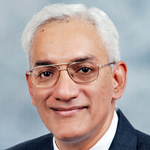
    Srinivasan Swamy, President, IAA India Chapter & Vice President-Development, IAA Asia Pacific said, “With the changes in technology and growth in digital, major business houses have to adopt and evolve rapidly. This webinar series will have Indian and international experts take us through their brand/company journeys and offer insights for others to learn and adapt from”.


    Abhishek Karnani

    Abhishek Karnani, Director, Free Press Journal said, “Creativity and storytelling must now be paired with algorithms to capture the attention of consumers in the era of high decibel digital communication. Navigating this landscape can be daunting. Anish’s experience with global digital initiatives will explain the omnichannel approach needed to win and retain consumers. This is the first mentorship webinar we have added to the IAA platform.”


    Charulata Ravikumar, CEO, Razorfish  said, “True Business Transformation happens when the organization changes itself from the core with a vision to always lead the path of Innovation for life impact. The IAA has always carried out initiatives to bring such Transformation to the forefront so that the larger audience can be inspired by it”


    You can also submit questions for Anish Shah through the IAA India Chapter facebook page – https://www.facebook.com/IAA.IndiaChapter/


    The hangout will be broadcast live on our YouTube channel https://www.youtube.com/user/IAAIndiaChapter on 17th December, 3pm IST.


    The webinar series has already hosted industry stalwarts like Sanjeev Kapoor, CMO, Citi (India); Ashish Hemrajani, Founder and CEO, Bookmyshow.com; Rajan Anandan, MD, Google (India); Nishant Rao MD, Linkedin (India); Ajit Balakrishnan, Founder, Rediff.com and Julie Roehm, Chief Story Teller, SAP; Tushar Vyas, Managing Partner, GroupM South Asia; Sanjay Mehta & Mr Hareesh Tibrewala Joint CEOs, Social Wavelength et. al.


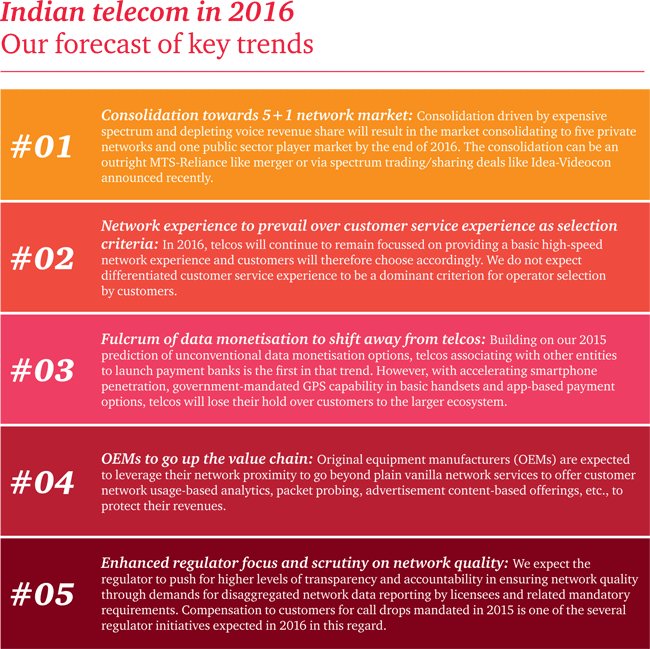
  • 5 trends to watch in Telecom in 2016: PwC


    While traditional media cannot be wished away, given the growing sales of mobiles – especially smartphones and the internet – fixed or mobile, the world of advertising and marketing is getting influenced considerably by telecom.


    We present a trends report (and forecast) on telecom presented by leading consulting firm PwC (eka PricewaterhouseCoopers).


    Here goes the forecast for 2016.


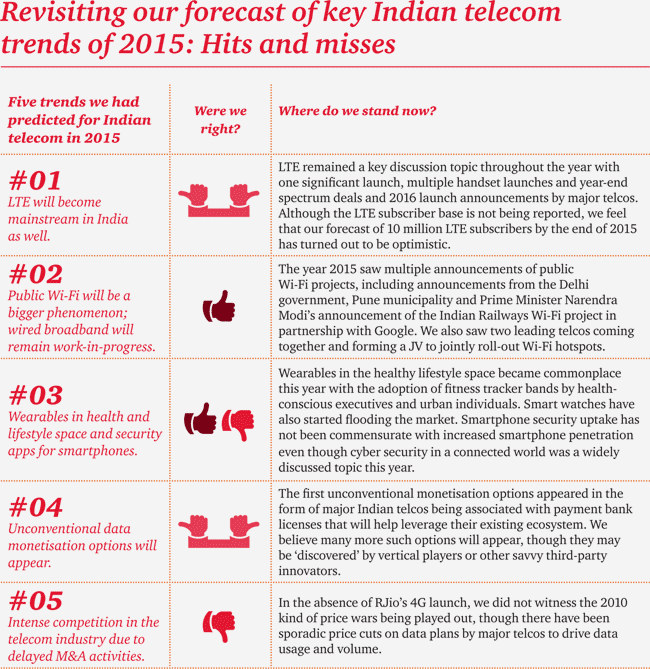
    Interestingly, PwC has also revisited its forecast for 2015 and what’s worked and what hasn’t. Here goes:


  • Viacom18 adopts ‘Daughters of Mother India’ documentary

    By A Correspondent


    In a first for the network, Viacom18 has adopted Daughters of Mother India, the award winning documentary that explores the aftermath of the Nirbhaya rape incident in 2012.


    Produced by Academy Award winner Maryann Deleo and directed by National Award winner Vibha Bakshi, Daughters of Mother India is a 45 minutes documentary that explores the effect of Nirbhaya’s brutal gang rape on the collective psyche of India. The documentary has been adopted as a training film by the Indian police academy and various education institutes in India, to sensitize on treating women with respect.


    Sudhanshu Vats

    Recognizing media as a powerful tool for propagating social behavioral change, Sudhanshu Vats, Group CEO said, “Viacom 18 takes pride in building an ecosystem of relevant and impactful content creators, platforms and communities. Media firms are best placed to act as force multipliers in India’s endeavour to bring about women empowerment. It is also important for us to be objective and ensure that all sides of a story are shared. ‘Daughters of Mother India’ does this is many ways: it is objective, compelling and thought provoking. Kudos to the team. Hopefully, we’ll see a lot more of this kind of content coming into the mainstream. And hopefully, we as a company and as an industry, will continue propagating this message of change.”


    Filmmaker Vibha Bakshi commented, “Viacom 18 is not just a media company. It’s clearly a disrupter. When we approached Viacom 18 with the proposition of screening a documentary they instantly understood. They were sensitive to the immediate need to raise awareness and take responsibility as a carrier of content to bring about social behavioral change. It’s the media that plays an important role in shaping minds and mindsets and can deliver huge on ground impact in bringing mass awareness for the critical issues pertaining to women empowerment, gender violence and actions needed there off. I encourage all of you to join me in saluting Viacom 18 for taking this bold step to adopt a documentary and dedicate air time for such an important issue of awareness. It is truly commendable and indeed a benchmark for the industry to follow.”


  • United Mediaworks-K Sera Sera merger to fuel growth in in-cinema advertising

    By A Correspondent


    With the decision to have K Sera Sera (KSS) Digital Cinema Private Limited and United MediaWorks (UMW) joining hands and becoming the the third largest digital cinema player in the country, in-cinema advertising as well as using multiplexes real estate for promoting products and services are poised for faster growth.


    Ashish Bhandari

    The two companies have decided to integrate their full operations and technology and use their combined energies to develop and consolidate their market position. Post the merger across content, technology and operations, the new venture will serve their existing 600 digital cinema theaters across the country. KSS’s Satish Panchariya will be Chairman of the new company and UMW’s Ashish Bhandari will be Managing Director.


    Both companies plan to invest Rs 100 crore over the next two to three years to fuel expansion plans. This investment will be used to build state-of-art and scalable digital cinema technology and on ground servicing, while assisting in digital content security and distribution of the films. Over the next two years, the joint venture is aiming to capture 25 percent market share with presence in 2000 screens across India.


    As part of their growth strategy, the two companies aim at reaching out to advertisers, targeting both, national and regional players and offer them pan-India reach.


    United Mediaworks has a strong presence in Bihar, Jharkhand, UP, Gujarat, West Bengal and Karnataka. Whereas K Sera Sera is present in the entire Hindi belt including Delhi, UP, Punjab, Haryana, Uttarakhand, Gujarat, Maharashtra, Himachal Pradesh, Chattisgarh, Madhya Pradesh and Andhra Pradesh.Going forward the new venture will look at capturing more markets across southern and eastern India.


  • Zumi Army arrives to popularise ‘MyVodafone App’

    By A Correspondent


    India’s popular TV entertainment property, the IPL is still some months away but a character that’s familiar with the sport and has its origins there, has arrived much ahead of it this year. ZooZoos, or the Zumi Army is back again to woo the audience of the latest offering from Vodafone – MyVodafone App.


    Developed on a state-of-the-art platform with intuitive and customised interface, the MyVodafone App provides a personalized experience to postpaid and prepaid customers as well as non-Vodafone customers. The app enables a customer to see his/her usage, plan details, pay bills, buy recharges and bonus cards, get best offers, access their M-Pesa account, recharge/pay bills for friends and family and so much more, giving him/her the power to manage their Vodafone number with their fingertips!


    The new television campaign will be supported by rich presence on social media, prominent and a series of on-ground activations will communicate the app’s various features and benefits.


    Speaking about the feature rich MyVodafone App, Kavita Nair – National Head – Retail and Digital, Vodafone India said, “Customers are gaining comfort with apps and are using them to shop, subscribe to services and access news/information. Keeping these evolving needs of customers in mind, the MyVodafone App is designed to provide them at their fingertips, a personalised interface of everything that is Vodafone. From accessing their services to managing their accounts or transacting or even getting their problems resolved, the app is a manifestation of Vodafone, on the smartphone.”


    Speaking about the theme of this marketing campaign, Siddharth Banerjee, National Head – Brand Communication & Insights, Vodafone India, said “The new MyVodafone App campaign aims at citing feature-led benefits of adopting and using the app, thereby driving home the key point that one can avail of Vodafone services, now on one’s phone. Accordingly a 360 campaign has been designed that clearly establishes MyVodafone App as a one-stop shop for all Vodafone related services. The much loved Zumi army will engage with customers through different mediums, showcasing key features of the all new MyVodafone App.”


    The MyVodafone App is available to all Android users and is free to download from Google Play. The app will be made available for other user interphases sequentially.


  • Key Trends in Digital and Analytics: PwC


    Although these are not specific trends for Media and Entertainment, but given the reasonably significant role of telecom and digital and analytics in the media, we bring you this trends report by PwC India (eka PricewaterhouseCoopers).

     

    By Sudipta Ghosh


    Key trends in 2015

    Real-time Customer engagement/interactions – There is shift from determining the proactive offers / next best offers from simple cookie based or click stream based analytics to more valued, analytical, data enriched analysis. This integrates the customer behavior patterns coming from other data sources / historical transactions. There is a wave of technology adoption for responding customers in real-time with more meaningful offers. The trend needs powerful processing platform with capability to handle high volume of data with very high velocity. Enterprises are either evaluating or adopting the big data platforms for the same. We will see more adoption of the big data platform in 2016.


    Cashless payments and related analytics – There is a great adoption of cashless payment methods (online, payment wallets, etc.) in India. The adoption will improve over time. Most of the cashless payment methods have ability for further improve the customer acquisition by extending appropriate offers. Analytics will play a great role in determining the offers that can be extended to these methods.


    Telecom transformation due to 4G – Introduction to 4G services will cause disruptive adoption of mobile internet in India. Companies like Bharati and Reliance are geared up to swipe the 4G market. The introduction of the 4G services provide a great challenge to the service providers to handle the generated huge volume of data effectively. It is estimated that there will be around 30-40 TB of data that will get generated on daily basis. Telecom service providers need to gear-up to manage and handle this data and use it for their benefits. The QoS parameters and analytics will also play a great role from regulation perspective to ensure the quality of service.


    Shift from ‘Data as a Service’ to ‘Analytics as a Service’ – The trend started with off-loading the data processing services to the private cloud or to the hosted environment and then derive the intelligence in local data center using Analytics solutions. Customers are now looking to avail the analytics as a service solutions. Niche companies or the companies with rich domain expertise are now providing analytics as a service in collaboration with IaaS vendors.


    Adoption of Big Data platforms – During past couple of years many customers evaluated the new/emerging technologies/platforms required to handle the structure and unstructured data. During second half of 2015 we observed that many customers start adopting the big data solutions/platform. The trend will continue and grow further in 2016. Many customers also have adopted the ‘Data Lake’ strategy for starting the Big Data initiatives. Customer are taking the staggered approach to build the data lakes and at the same time identifying the analytics initiatives that can be derived out of data collected in the data lake.


    IoT Devices, Human and Machine Interface – There were many enquiries and evaluation happening on adoption of data generated through IoT devices like Fitbit, Nike Fuelband, Apple Watch, Heat Sensors, etc. The blueprints are getting defined for integrating the IoT data into generic Analytics platform and derive meaningful intelligence out of it. Customers are also evaluating the scope KPO automation through Human and Machine interfacing solutions. The solutions use the technology for audio, video, images, text and other unstructured data analytics.


    Key Trends in 2015: Retail Analytics

    Retailers are increasingly using omni channel marketing to improve the customer experience as they shop across various channels like store, web and mobile platforms. There has been a huge growth in cross channel data volume and now Retailers have access to variety of data which include not only the demographic information but also past purchases, call centre interaction, social media interaction etc. Retailers are leveraging analytics tools to enhance customer loyalty by creating a personalised shopping experience that customises coupons and offers to match customers’ needs. Retailers are increasingly using segmentation based on purchase patterns, price sensitivity and customer lifestyle to identify the most relevant customers for targeting, which results in more relevant offers. Segmentation helps focus marketing on the customers who will most likely buy the products or services and avoid markets which will not be profitable. Retailers are adjusting their product mix from store to store-based on the preferences of their customers. This  help retailers improve their inventory allocations by understanding customer demand and their choice patterns resulting in increased revenues and margins


    Using analytics, retailers are able to determine the optimal pricing of products and services. The price elasticity not only help in only finding identifying the products that are most and least price sensitive but can also be used with optimisation to identify the optimal pricing. Increasingly number of companies are adopting open source analytical tools to provide descriptive, prescriptive and predictive analysis of the fast increasing volumes of data which are both structured and unstructured in nature in order to reduce the total cost of ownership


    More retailers are introducing mobile apps for integrated loyalty programs. Consumers no longer have to clutter their wallets with physical cards anymore. Instead, they can use their smartphones to track and redeem their rewards through mobile applications.


    Emerging Trends to watch out for in 2016: Retail Analytics

     Fraud detection and prevention will be an important concern for retailers  looking to build security and preserve consumer trust. Using analytics, retailers can identify unusual patterns of product and inventory movement.

     Radio-frequency identification (RFID) tags and readers will increasingly provide substantially more data on product movements and locations for retailers to analyse. Retailers will be using analytics to optimise their inventory and reduce their transportation costs.

     Workforce analytics will help organizations effectively plan their future workforce needs to increase labour efficiency and improve schedule effectiveness. Analytical tools would be used for workforce acquisition and labour scheduling based on when customers are most likely to visit a store.

    ï‚· Retailers will increasingly adopt multiple IoT technologies in the coming years to reshape the customer experience, to drive loyalty and to focus on inventory. The use cases in retail will include sensors on products, interactive consumer engagement, automated store lighting, shopper intelligence, perishable tracking, fleet operations tracking etc.

    ï‚· There will be an increase in video analytics as powerful processors are becoming available at affordable price points to video surveillance manufacturers. Video surveillance with analytical models can be used for effective in store promotions, stock out analysis and tracking customer movement inside the store.


    Rise and growth of e- commerce or digitisation of retail has been one of the key trends in the retail sector. As this digitisation continues in the new year, companies will turn to analytical solutions to both manage and make sense of the huge amount of data being churned from these transactions. Companies will require insights into the consumer behaviours to try and personalise user experience as competition will hot up between various e-commerce retailers. These companies are already investing in significant social media management to promote their services and will also turn to analytics to gain insight from that data regarding their product perception and target market. App based analytics solutions will be at the forefront of this growth as the market will shift from laptop to smart phone based solutions. New age analytics solutions like using CCTV for eyeball tracking, Planogram optimisation, single view of customer to create shopper profile and anticipate needs better, analysing supplier and employee performance and compliance (attrition analytics, workforce planning),  are all seeing an uptake in the Indian market.


    Sudipta Ghosh is Partner, Data and Analytics at PwC

     

  • MEC is GoDaddy’s Global Media AOR

    By A Correspondent


    GoDaddy Inc has appointed media agency MEC as its global media agency-of-record. This includes India.


    GoDaddy has worked with MEC in India and in the UK since March 2014, and this new agreement expands their relationship to include all global markets. The business will be led out of MEC New York, with support from its San Francisco office.


    “Our decision to move GoDaddy’s media business to MEC is a natural step as GoDaddy expands our business globally. We looked for a strong partner with local media expertise and global technology and tools to help drive forward our efforts to reach small businesses at the right time with the right medium. MEC shares our passion and vision for delivering locally-relevant, targeted messaging to connect with people worldwide,” said GoDaddy Chief Marketing Officer and Executive Vice President of Digital Commerce Phil Bienert.


    “GoDaddy is a brand that has been bold in both its approach and determination to reach and engage its customers. We are energized by the company’s ambitious drive globally and excited by the challenge to deliver creative media solutions built for today’s digitally-enabled world,” said CEO of MEC North America, Marla Kaplowitz.


  • Demographic shifts, ecommerce, digital space to reshape FMCG: BCG

    By Ratna Bhushan


    Over the next decade, India is expected to see a 70% increase in income levels, leading to the emergence of a new middle class, urbanisation and emergence of new cities, with about 100 million being added to the workforce, a study by the Boston Consulting Group (BCG) and CII predicts. The combined impact of these demographic shifts, along with the emergence of new channels like ecommerce, proliferation of Internet connectivity and consumption of digital media, will reshape the FMCG sector, it forecasts.


    By 2020, close to 150 million consumers are expected to be digitally influenced in FMCG and these digital consumers alone would spend about $40 billion on FMCG categories, says the national FMCG summit report released by BCG and CII on Monday.


    “FMCG has to be re-imagined for a future world, owing to the varied changes and opportunities seen in this sector,” the report quoted PepsiCo India Chairman and CEO D Shivakumar as saying.


    BCG Senior Partner and Director Abheek Singhi said though the growth opportunity provided by this shift would be massive, the shape of it would be very different in the future. “We expect greater premiumisation, tier 2-4 towns to be the drivers of growth. The impact of digital would be profound.”


    The report, ‘Re-imagining FMCG in India’, assesses the impact of these trends and imperatives for consumer goods firms.


    According to the report, households with less than Rs 10 lakh annual income would account for close to 50% of the spending in the category, which would lead to premiumisation across categories – from unbranded to branded and “luxuriating” of products.


    While the digital space is attracting a lot of private equity and venture capital funding, most firms are unclear on the opportunity. The report suggests that FMCG companies need to examine how they can use digital to disrupt the way they do business.


    “The single most important challenge will be multiple usage of channels by shoppers and consumers,” Nestle Chairman and Managing Director Suresh Narayanan said in the report. “Ecommerce platforms will jostle for share of wallet traditionally going to unorganised and organised trade banners.”