Category: MEDIA

  • Dentsu Webchutney wins the digital mandate for Roland-Garros French Open Grand Slam

    By A Correspondent


    The French Tennis Federation (FFT) has appointed Dentsu Webchutney as their digital agency in India for Roland-Garros, the premier clay court tennis championship. The agency won the account following a multi-agency pitch.


    Speaking about the association, Sam Primaut, director of developmentRoland-Garros said, “We wish to share worldwide the unique and amazing French Open atmosphere and to bring our Grand Slam closer to its worldwide fans. India being among the most promising countries in terms of tennis potential around the globe, Roland-Garros is now looking at engaging with the Indian tennis fans on the digital platforms. We really are looking forward to this cooperation with Dentsu Webchutney in the hope to have an impact for the development of tennis and red clay courts in India”.


    Tanvi Jain

    Commenting on the win, Tanvi Jain, VP- Dentsu Webchutney, said that it underlined the agency’s credentials as the leading 360-degree digital marketing solutions provider in India. “We are honoured to partner with a sporting event as prestigious and global as the French Open.”


    She added, “The recent success of Indian players notwithstanding, tennis viewership is still in its infancy in India. We look forward to enabling Roland Garros to own the category in India with innovative technology and ideas that will take tennis to the masses.”


    Dentsu Webchutney will partner the FFT in promoting its recent initiatives to further the sport in India. These will include programmes such as the cooperation agreement with the All India Tennis Association (AITA) to develop clay courts, and Rendez-Vous à Roland Garros in partnership with Longines, a worldwide under-18 tournament for boys and girls that will culminate in wildcard entries for the winners to the Roland Garros Junior tournament.


  • WATConsult launches SocialCRM247TM for digital crisis management

    By A Correspondent


    WATConsulthas created a state-of-the-artsocial media command center for real time social monitoring and social crisis management. To be called SocialCRM247TM, the command center has been set up inside the agency’s Mumbai office. SocialCRM247TMwill not only track web conversations around brands but also measure sentiments and impacts of the same. SocialCRM247TM tries to encourage brands to invest in digital media by providing security with social crisis management.


    SocialCRM247TM works with keywords and hashtags which are already pre-set for a brand within an online tool. A set of 6 screens monitor the most intricate details of every tiny conversation that takes place around individualbrands and if the conversation exceeds the average level, a notification is sent to the brand’s social media manager. This gives the brand an opportunity to respond to the thread of conversations before it becomes unmanageable, thereby preventing any kind of social media crisis.


    Speaking on the need for developing SocialCRM247TM, Rajiv Dingra, Founder and CEO, WATConsult said, “Social media management is a 24 X 7 job. Our social media managers keep an eye on all the conversations happening around all our clients. SocialCRM247TMis a command center that ensures that the best talent in social CRM istracking, analyzing and replying to social chatter in realtime. We believe in the era where Social Media Crisis or insights can make or break a brand. SocialCRM247TM is a much needed service across all brands.”


  • Tata Sky expands its global news channel offerings in India

    By A Correspondent


    Tata Sky announced the launch of Channel NewsAsia International on its platform.  The pan-Asian channel is now available to Tata Sky subscribers on channel number 535.


    Ranked among the top three most preferred English news channel in Asia*, Channel NewsAsia International’s launch on Tata Sky will enable the channel to reach over 14 million households in India. The channel was established in March 1999 by MediaCorp, the leading media organisation headquartered in Singapore and is an English language Asian TV News channel.  It is now available in over 58 million households across 27 territories in Asia.  It offers news every hour on the hour, business programmes, current affairs, documentaries and lifestyle programmes, showcasing Asia from within Asia.


    “We are delighted to be entering the DTH market in India exclusively through Tata Sky, and I would like to take this opportunity to welcome all our new viewers to Channel NewsAsia International.  Over the years we have devoted more resources to cover India, not only through the news, but through hard hitting investigative documentaries which have won international acclaim.  India is key to the present and future of Asia.  We believe we are well placed to understand, present and interpret how India’s role in the global economy will depend on changes in its political and economic climate.  But more importantly, the channel is about Asia, and helping to foster understanding and insight across Asia.  We look forward to offer our unique, content to all viewers across the country through our partnership with Tata Sky,” said Debra Soon, Head, News Segment, with the Channel’s parent company, MediaCorp.


    Paolo Agostinelli, Chief Content & Business Development Officer at Tata Sky added, “We have always believed in offering a wide range of global news content and are delighted to offer our subscribers the award-winning Channel NewsAsia International. With a significant mix of both international and India-specific news, we are certain that our subscribers will continue to enjoy our latest addition to the news genre.”


    Beyond news and current affairs programmes, viewers of Channel NewsAsia International on Tata Sky can enjoy the channel’s popular travel & lifestyle shows, for example a taste of the travel, food and culture of the renowned destinations of Japan and Taiwan, in ‘Japan Hour’, and ‘Welcome 2 Taiwan’;and ‘Luxe Asia’, for an exclusive look inside the intriguing worlds of Asia.  Business programmes such as ‘Asia Connect’keeps people who live and work in Asia updated on the latest  in news and the financial movements and trends; and ‘Money Mind’ tells you how to make the most out of your money and connecting your financial goals.


    With the introduction of Channel NewsAsia International, Tata Sky has now expanded its bouquet of news channels to 96, which include 14 English news channels, 22 Hindi news channels and 57 regional news channels.


  • E-commerce traffic during Diwali surged 75.5%

    By A Correspondent


    UCWeb, India’s leading mobile browser with an over 54% market share, said e-commerce traffic during the Diwali shopping season surged a whopping 75.5% this year.


    “The number of users who visited e-commerce sites Flipkart, Amazon and Snapdeal via UC Browser in the month leading to Diwali 2015, increased over 75% compared to last year,” Kenny Ye, Managing Director of UCWeb India, said Thursday.


    Parent UCWeb Inc, which is a leading provider of mobile internet software and services, is a business within Alibaba Group’s mobile division.


    “Indians are increasingly embracing shopping on-the-go, splashing out on various items through mobile shopping during festive sales. There’s no doubt m-commerce is prospering,” he added.


    A big portion of users eventually placed orders on Amazon via UC Browser through the campaign, the company said in a media statement.


    Popular items including lifestyle products such as electronics, ethnic and fashion apparel as well as household products that received most visits contributed to the vast majority of total page views.


    According to UCWeb India, the traffic upsurge reflected the public perception of Diwali in the age of e-commerce. “As e-tailer giants rolled out sales promotions to usher in the festive season, UC Browser and Amazon India also joined hands distributing coupons and vouchers to users through a #HarGharUCDiwali campaign launched exclusively on UC Browser,” the company said.


    The two-week long shopping carnival eventually saw over 17 million users coming on board trying their luck for coupons and vouchers.


    According to latest reports by IAMAI and IMRB, mobile Internet users in India are roughly at 306 million, up from 276 million in October this year. The number of mobile users who shop via their smartphones has also seen a steady rise, with 75% increase in e-commerce traffic throughout Diwali shopping season.


  • The New Hindi GEC Fad: Supernaturally Yours


    What started as an experiment about a year ago has now gained in size and momentum. Hindi GEC fiction, often criticized for being behind times, is going through a phase that’s taken the viewers by surprise. It’s a phase when some of the top serials are relying on the supernatural – ghosts, spirits, black magic – to drive eyeballs.


    Now, this should not make much sense. Till not too long ago, the genre was understood as one that connects the ordinary Indian women to the world outside, giving her the confidence to learn what she otherwise can’t. What was routinely called “regressive” in the media was termed positive and confidence-building by the target audience. Shows that helped women navigate their relationships better were runaway hits. Where does supernatural even feature in all this? Channels may choose to put it on-air, but why is it actually working?


    Simply put, I believe the consumer is “compensating”. She’s compensating herself for having watched one type of content for almost 4-5 years now, which is based on broad constructs of navigating relationships. After a while, you are bound to get a feeling you have seen it all, and every new show is a version of an existing one or a fairly recent hit. Most new launches have not worked and shows launched in 2009-12 continue to rule the roost (an earlier column on this topic is here).


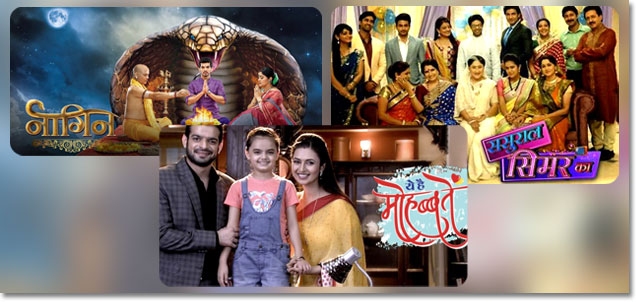
    The consumer is looking for variety;for something that she hasn’t seen before. That’s an eternal human need. When Sasural Simar Ka (SSK) first put supernatural content on-air, the viewer saw it with a mix of skepticism and intrigue, sometimes even as unintentional humor. Other shows have tried it subsequently, and recently, none less than Yeh Hai Mohabbatein (YHM), the epitome of contemporary Indian fiction for many audiences, took the supernatural route.


    Then we have Naagin, which launched recently as a weekend show and has gone on to become a blockbuster hit in its first three episodes. The snake theme has always interested Indian audiences, be it through cinema, television or cinema on television. Naagin is one of the best-produced Indian content pieces on this subject. With a full-throttle promotional campaign backing it, Naagin’s success is a rare case when all the right boxes get ticked together.


    But Naagin is a weekend show and weekend content promise escapism and relaxation. But on weekdays, the infestation of supernatural content is bizarrely interesting. Consumers don’t even know what to call this sub-genre of sorts. They are beginning to assign the word “horror” to it, which captures the ridiculousness of it all.


    But if it’s working, it’s working, right? That’s where the note of caution comes in. Both the big shows where it has been used (SSK and YHM) were on-air as regular fiction shows without a supernatural element for almost two years before they experimented with this sub-genre. Some new shows have tried going the supernatural route early in their life stage and it has not worked.


    What does this tell us? That if you have characters who are already popular, and the program has built a sizeable audience base around their popularity, a supernatural track can help manage viewer fatigue by providing the unknown element. But it will not help build a viewer base from scratch, unless it’s a show like Naagin, which delivers what it promises – unabashed snake-y entertainment.


    Am I suggesting that all hit shows with popular characters will benefit from a supernatural twist? Not really. It’s a fad, and another show or two go this route, we would begin to see viewer rejection instantly. She’s already not impressed, but watching it as something off the beaten path. If it becomes the beaten path itself, then this mini-trend could die a rather abrupt death.


  • Ranjona Banerji: These bizarre news media appraisals (and variable pays)

    By Ranjona Banerji


    Anyone who has ever had to fill up management-created appraisal forms for journalists knows what a terrible job it can be. Almost nothing in those forms, created by too-clever-by-half bureaucrats with fancy degrees or perhaps just by paper-pushing clerks with regular degrees, these appraisal forms often bear no connection with the job of a journalist. They are also unable to distinguish between the many jobs in a newsroom which put a journal together or bring out a news programme on TV.


    The Times of India, ever the innovator waiting for the other ducks to walk in a straight line behind it, has now come up with a new idea. The “target variable pay”, which in the old days was known as a good old salary hike or sometimes increment, is now linked to how well you “break news” on Whatsapp groups. Earlier, TOI journalists were asked to give up their Twitter and Facebook passwords to the company. Their social media profiles had to be linked to the journal they worked for. If they had personal accounts, their posts could not be news-related.


    Imagine the effort that goes into tracking all this. You probably have to set up some cyber hacking cell to spy into what your employees are up to on social media (Hello, NSA!). And plus, if you are an editor who has staff which reports to you, your life is hell from now on. Not only do you have to assess how well people do their actual work, you have to also watch them on social media. Of course, algorithms can do some of the job but that’s more money spent of course.


    Decades ago, a magazine I worked for set up a system where someone counted all the words that everyone had written and hikes were based on that. The problem was the most obvious: not all journalists write so what do you do with the sub-editors? Secondly, how do you distinguish between a journalist who rewrites press releases and therefore generates plenty of copy compared to someone who goes out into the field and produces perhaps one story per edition, but a truly excellent story?


    The system was thus abandoned when mediocre reporters did better than the stars! But as the media has become more and more corporatized, the appraisal system has become more complicated and moved further away from reality. Incidentally, when I worked with Times of India over a decade ago, I had to do enormous arithmetical calculations with my staff and sit with each one individually explaining why I had given them the marks I had. They had a right to protest and this was taken into account. However, often the amount of money given to them had no connection with my assessment. Also, no one ever assessed me in the same way. I received some extra money every year, with no corresponding explanation. God knows who assessed me either. I faced the same problem with my staff in DNA. My reason for putting this down here is that the reality of a newsroom found no expression in the appraisal system and there was no uniformity in how it worked.


    The problems are manifold. The people who set down the parameters have no idea how a newsroom functions and who does what. Senior editors are all too eager to kowtow to managements who do not trust journalists. Earlier, such editors were known as management stooges; now they are known as, well management stooges. I have worked with some and seen the rise of some. Unfortunately, they almost never get their comeuppance because they have learnt how to manipulate the system.


    And when it comes to Whatsapp, anyone can manipulate that system too. It doesn’t mean that you are a good journalist. It just means you are a good player.


  • Amith Prabhu: Notes from Nairobi from the World Conference on PR in Emerging Economies

    By Amith Prabhu


    I was in Africa this past week on my maiden visit to the continent to attend the first World Conference on Public Relations in Emerging Economies organised by the Public Relations Society of Kenya in partnership with the Global Alliance of Public Relations and Communication Management. While the event title had World Conference mentioned it was largely an African affair with a spattering of representatives from other continents. I was the only Indian and one of two Asian speakers. There was only one other Asian delegate. There were about 20 individuals in all from outside the Middle East and Africa region.


    The highlights of the conference were the inaugural keynotes by Lord Chadlington and Paul Holmes. Interestingly, both were keynote speakers at Praxis in the second and third edition. They both shared interesting insights. Apart from these two gentlemen, most other speakers were about average. The conference was about how communications is evolving in the emerging economies in the light of realities that include terrorism and sustainable development.


    All in all, it was an eyeopener to a continent with immense potential and endless possibilities. I presented a series of Indian case studies on fund raising and cause communications in a breakaway session which went down well with the audience. It was a great opportunity to discover the sights and sounds of Nairobi, the capital city of Kenya.


    These gatherings are good but would do well with a healthy mix of speakers and delegates from every continent and every emerging economy. Brazil, China and Russia were not represented and that was not a good sign. It may be a good idea for Indians and the Chinese to come together to create a Regional Conference to share notes between the two economies.


    The world is moving at a rapid pace. As this frantic movement takes place India and China are going ahead at breakneck speed. It will be interesting to learn from each other at the next World Conference on Emerging Economies, if there is one.


  • Content, not display ads to rule on Mobiles


    By A Correspondent


    As more mobile consumers across Asia-Pacific embrace practices like multi-screening and video watching, marketers expect an eventual shift away from display advertising towards innovative content.


    Annual research conducted by Warc in association with the Mobile Marketing Association (MMA) – State of the Industry: Mobile Marketing in Asia survey – found that while 70% of marketers currently use display advertising, only 44% plan to use it in five years’ time. Content, in contrast, is set to speed ahead during this period and take the pole position, with adoption rising from 33% today to 49% expected in 2020.


    This corresponds with the marketers’ perception of video’s rising significance in mobile platforms. The study found that watching video was now considered by 51% of respondents as an important mobile consumer behaviour, up 15 percentage points compared to 2014 and 23 percentage points from 2013. Multi-screening, meanwhile, continues to be seen as the most significant consumer trend for the second year running, with 68% indicating its importance.


    Rising consumer expectations present emerging challenges

    Given mobile consumers’ increasing sophistication, more marketers now see content and consumer concerns over privacy as critical challenges, at 31% and 33% respectively – about the same proportion as those who are concerned about budgets (32%) and reliable metrics for measuring success (33%). The latter two concerns were ranked higher than the former in previous years, with budgets being the chief concern in 2013.


    “Confidence in the channel’s importance continues to rise and the investments speak for themselves,” said Edward Pank, Managing Director at Warc Asia Pacific. “The ongoing challenge now is that today’s consumers expect much more of their mobile content and experience. So in order to keep up, marketers need to hone their skills further and innovate strategically.”


    While more attention is being paid to consumer-focused issues, the biggest barrier to the growth of mobile marketing in Asia-Pacific remains the skills gap and lack of understanding within the industry, as identified by 40% of the respondents. Although this proportion is slightly lower than last year (45%), the consistency indicates a sustained struggle to deploy the appropriate advanced capabilities to engage consumers through mobile in such a fast-moving landscape. This is despite the fact that the number of marketers assigning over 10% of their budgets to mobile has risen from one in five (20%) in 2013 to one in three (34%) now.


    Conducted between March and May 2015, the study involved 287 respondents from 17 countries in Asia Pacific. This is the third iteration of research designed to gauge the attitudes of clientside advertisers and marketing services agencies towards mobile marketing.


    In the study, Singapore was named the most innovative market in mobile, with 41% of respondents highlighting it as such. Appropriately, the 2015 study’s findings were released at the 2015 MMA Forum in Singapore, taking place at the Grand Hyatt today. The definitive industry event brings together technology pioneers, business leaders and experts to discuss new capabilities in the mobile toolbox – programmatic, location, video – and new ways to acquire and reach consumers.


    “The increasing focus on the consumers and what they want – which is compelling, refreshing content on the go – is important because mobile’s distinct advantage lies in its immediacy and proximity to the consumers. It puts power in the consumers’ hand wherever they go, giving them the choice to be social, to share, capture, augment, and purchase – all at the touch of a button,” said Rohit Dadwal, Managing Director, MMA Asia-Pacific. “The findings from this third study with Warc signal that brands and marketers must continue riding on the momentum of mobile by sustaining an integrated approach and challenging creative boundaries.”


    The previous iterations of the survey showed that despite rising awareness of the power and potential of mobile, brands and marketers had been grappling with rapid technological changes, budget considerations, and measurement of outcomes, struggling to develop cohesive mobile strategies. While these challenges remain to varying extent, the latest study indicates that more attention is being paid to consumer-focused innovation.


    Among the study’s other findings:

    • Mobile wallet and location-based marketing set to play key role going forward

    o While only two in five (40%) plan to use mobile wallet technology this year, this adoption rate is expected to rise strongly to 64% in 2020.

    o Location-based marketing is shown to be well entrenched in mobile marketing strategy in the region, with a significant majority of marketers (84%) planning to use the technology this year and 85% in 2020.

    • Programmatic buying of ads is gathering pace

    o Programmatic adoption appears to be improving: 79% of respondents have some familiarity with the buying mechanism, a sharp increase from 48% last year

    o The importance of real-time buying is also well-recognised, with 62% expecting it to be ‘very’ important to their marketing strategy in 2020

    • More attention is being given to mobile strategy

    o Half of brand owners (54%) state that they do have a formal mobile strategy, up from 44% last year

    o Just under a quarter (24%) of the agencies surveyed said that the majority of their clients had a formal mobile marketing strategy this year, up from 20% in 2014

    • Mobile is well integrated with other marketing initiatives

    o Overall, 88% of mobile marketing strategies in Asia-Pacific are connected to wider marketing activities. 40% of respondents use mobile to measure interest and/or engagement in ad campaigns across other media

    o 84% of respondents currently find social media to be a good complement to mobile marketing, with online search following closely at 60%, a 12 percentage points increase from 2014. Traditional media – print, outdoor, radio – seem to have lost out as a result

    • The top mobile innovators

    o Travel, Transport and Tourism was recognised as the most innovative product category for mobile marketing in Asia-Pacific for the second year running

    o Unilever, recognised for its scale across the region, is also regarded as the most innovative brand in Asia-Pacific, a risk taker in the mobile world. Samsung, which had been at the top in 2013 and 2014, came fourth this year, lagging behind Apple. CocaCola, meanwhile, took the second position, with favourable comments on its engaging mobile content.

     

  • Tyroo eyes global expansion

    By A Correspondent


    Tyroo Technologies, a part of SVG Media, announced its renewed focus to strengthen its retargeting business in India and regional markets like Japan, South-east Asia and Middle-east. Tyroo also aims to expand its retargeting business to other international markets like Europe. The company said that its retargeting business has influenced Gross Merchandise Value (GMV) of nearly US$ 100 million for its clients in 2014-15; and has been driving re-engagement with over 90 million unique users during the same period.


    Tyroo is an industry leader in mobile-focused performance marketing and its mobile-focused retargeting business helps advertisers re-engage their visitors on mobile apps and mobile web. The company is working with several clients in ecommerce space across various countries, including one of the largest e-commerce companies in Japan and largest fashion commerce company in South-East Asia; besides a strong clientele in India and Middle- east.


    Tyroo has devised a two-pronged strategy to grow its retargeting business – generate more business and relationship value by influencing higher GMVs with existing clients and win new clients in countries of current operations and newer markets like Europe.


    Siddharth Puri, CEO, Tyroo Technologies, said, “Our retargeting business performance over the last few quarters has encouraged us to double our efforts in expanding our reach and taking a greater share of the market. We have invested a lot in building a consumer-friendly retargeting platform and growing our reach globally and are able to offer advertisers an unbeatable proposition in growing their sales through retargeting.”


    Retargeting is a critical marketing tool for performance marketers as it is used to capture consumer’s attention at any stage of consumer purchase funnel. Globally, e-commerce companies are estimated to generate over $1.7 trillion GMV through marketing activities including retargeting.


    Tyroo’s retargeting solutions are mobile-first and are a direct result of the company’s focus on building mobile publishers and integrations across mobile supply ecosystem. The solution also promises higher cart value as a USP, as Tyroo’s retargeting algorithm segregates user segments based on cart values and other inputs, which allow dynamically controlling the Cost of Acquisition (CoA) of a user, based upon its lifetime value for the brand. The ads served through Tyroo’s retargeting solution are highly personalized with high capacity to create unique offers specific to each user or segment.


  • ‘Upgrade’ takes a new meaning in OLX’s latest ad

    By A Correspondent


    A step forward in life is usually symbolized with an upgrade in physical goods that come at a price. But often an upgrade in mindset brings about a change which reaps benefits without compromising on your dreams or your wallet. This is what OLX’s new TVC depicts – live a contented and independent life without compromising on your dreams by borrowing snippets from everyday life situations of modern working couples in mid-level corporate jobs. Giving its successful campaigns, ‘Bech De’ and ‘Keemat Bhi, Kuch Keemti Bhi’, a new outlook, OLX has released a television Ad, ‘Aadhe Tere, Aadhe Mere’ continuing with the successful punch line “keemat bhi, kuch keemti bhi, OLX pe Bech De”.


    Said Amarjit Singh Batra, CEO, OLX India, “As a consumer-to-consumer (C2C) platform OLX believes in bringing people together for win-win exchanges, and improving their lives. The ‘used car’ segment on OLX witnesses exceptionally fast transactions and offers great cars and value for both  buyers and sellers on making us the most preferred platform for used cars. The desire to upgrade comes most naturally to consumers making selling of used cars relatively more established as a behavior. Through this TVC we are trying to highlight how OLX plays a role in the daily life of people, allowing them to take decisions that bring loved ones even closer and also make their lives easier. Since car is a big-ticket purchase, we try to make the experience stress free. Thus we took the lead in offering inspection of cars which is a value-added service for the buyers.”


    Conceived by Lowe Lintas, the TVC depicts the story of a modern working couple getting ready to leave for their respective offices. While the husband’s getting ready, the wife is waiting outside their car looking at her watch since she is getting late for work. He drops her off at her office and reminds her that he will pick her up at 6.30 in the evening. After a hectic day at office, she gets a text from her husband saying that he will be late by an hour. She waits for him while the rest of her colleagues have left. Finally she gets a text saying that he won’t be able to make it and she should grab a taxi and head home. While she is pondering over the day’s events, the husband reaches home and they have a conversation where she expresses her concern. She tells her husband that she used to be more independent before she got married compared to what she is now. The husband thinks about it and decides to sell his car. He uploads an ad on OLX app and sells the car after meeting the buyer. The next scene shows the wife leaving for office, when she is surprised to find two smaller cars instead of the previous sedan of her husband. The husband then asks the wife to choose her own car which leaves her happy and surprised. The TVC ends with the tagline, “keemat bhi, kuch keemti bhi, OLX pe Bech De”.


    Said Shayondeep Pal, Executive Creative Director, Lowe Lintas, “Under the umbrella of Keemat Bhi, Kuch Keemti Bhi, OLX has managed to blend in seamlessly the societal issues and behaviors that people can relate to. Our task was to take the thought forward and strengthen the proposition with a new lens. The story is about a modern working couple who have mid-level corporate jobs. It challenges the traditional aspects of an upgrade, and talks instead of an upgrade in mindset. The idea was to resonate with young couples, for whom self-reliance and independence are important aspects in relationship building.”


  • Indian Express Group announces investments in emerging companies

    By A Correspondent


    The Indian Express Group has announced a undisclosed round of investments in emerging companies such as Envoged, PayMango India Private Limited, Mister Homecare Services Private Limited and Spiral Content Solutions Private Limited. The group believes that investing on growing platforms is a natural extension of its strategic business model.


    Anant Goenka, Director, The Indian Express (P) Limited, says: “Our first investment was in Chaldal – Bangladesh’s largest online grocery delivery company. Today, after tasting success in our own digital growth story, we at the Express are excited to be associated with such brilliant ideas and passionate entrepreneurs. These digital initiatives are promising and we believe they just need a little support to grow to their full potential.”


    Gurgaon-based startup PayMango was founded by two IIT Delhi graduates in June and has already raised upwards of Rs 1 crore. Founders Gajinder Singh & Ram Singla had earlier launched a couple of mobile and marketplace plays.


    “In the transformation of #DigitalIndia, The Indian Express is playing a pivotal role. The Indian Express through its quality coverage has become the most shared voice amongst the youth on various social networks. PayMango shares the same vision of Digital Empowerment of the Local Commerce by providing local stores an m-commerce platform to satisfy the demand of the consumers,” says Gajinder Singh, Founder & CEO PayMango.


    “For the country to reap benefits of internet we need a Yumist, Groffer or UrbanClap in each locality. That’s how PayMango is providing local commerce wings to fly,” adds Goenka.


    Mister Homecare Services Private Limited is a professional on-demand maintenance services organisation for consumers and businesses alike. “The Mr. Homecare family is very happy to have Indian Express on board as one of our investors. We look forward to engaging & working closely with the group as we look to build out a strong backend to service the aggregators in the on-demand home services space,” said Rushabh Vora Co- Founder & CEO.


    Brothers Rushabh Vora and Sahil Vora launched the on-demand Home Services Company catering initially to Mumbai, Pune and Bangalore. Mr. Homecare is going to expand its operations to Delhi and other markets in the country soon.


    Envoged is a “re-commerce” platform that allows owners of luxury goods like handbags, footwear and accessories to easily sell items that they no longer need. The platform takes care of collecting the items, consigning them, checking for authenticity, determining the ideal resale price and then finally helping sell them online.


    “Envoged makes luxury fashion affordable for the aspirational consumers in India. It is a pleasure to have The Indian Express Group invest in us given their reach and connect with a huge class of Indian population aspiring to own luxury in their closets. We’re excited to learn how they’ve achieved their exponential and sustained digital growth over the past few years,” says founder Anandita Singh.


    “India hasn’t even scratched the surface of the online luxury fashion market. We’re impressed with the passion and focus that this very young team brings to the table,” says Goenka.


    Spiral Content Solutions Private Limited is a content marketplace that curates Indian and international content and makes it available for brands to use on social media and other digital platforms.


    Rajan Srinivasan, Founder & CEO, said he was very excited about the strategic investment by The Indian Express Group. “Our goal is to build tools and platforms to help brands become publishers. This relationship adds tremendous heft to us as we power ahead to build out a content marketplace of the highest quality,” he said.


  • Ranjona Banerji: How dare you tell the media what to do: we solved the Sheena Bora case!

    By Ranjona Banerji


    We’re back then to the Sheena Bora murder case. All right, I’ll accept that. The CBI charge-sheet is ready, naming Indrani Mukerjea, Sanjeev Khanna and Shyam Rai for the murder of Bora. And the CBI threw in a whammy by arresting Peter Mukerjea, husband of Indrani and questioning him on his role.


    Well, whammy because Indian news television broke into such a massive melodrama over this. Did the Mumbai cops favour Peter Mukerjea, how dare you speak when I’m talking, the media has no business in claiming to solve this case, how dare you tell the media what to do… And here we are in TV LaLa Land again.


    CNNIBN was the most circumspect on the day the news broke, with Mumbai bureau chief Smitha Nair Rasquinha doing a proper reporter’s job with fact triumphing over editorialising. Quite admirable when you consider how often TV confuses fact with opinion. That day, NDTV decided to concentrate on the terrorist attack on Radisson Hotel in Mali and is thus out of this reckoning. The most high-decibel were NewsX (perhaps to scrub all memories of earlier connections with the Mukerjeas in the public mind?) and of course Times Now.


    The target of both news channels appeared to be former Mumbai police commissioner Rakesh Maria. Arnab Goswami was particularly enraged with Maria, although as Rasquinha had pointed out earlier in the day that the CBI charge-sheet was substantially the same as the Mumbai Police’s case.


    One guest was seen going from news channel to news channel saying that it was the media and the particular channel she was on which had helped solve the murder. Thus one keeps one’s chances of being re-invited alive again! The usual suspects were out in full force after that, each giving us their worthwhile 2-pice bit. I use that old-fashioned phrase deliberately. You can work out for yourself in today’s inflationary terms what 2 paise is worth right now.


    The funniest was India Today TV which took us back to the life and times of Indrani Mukerjea’s career, full of the reporter’s own ideas of how a life should be lived and plenty of moral judgments. Of course, to be fair it is very easy to make moral judgments about Mukerjea’s past and present.


    **


    The other major causes for excitement on TV this week were Robert Vadra, son-in-law of Sonia Gandhi, Mulayam Singh Yadav’s birthday party and how dare Arvind Kejriwal hug LaluYadav.


    **


    The rest of the world meanwhile was concentrating on the challenges of terrorism, the Islamic State, the situation in Syria, the search for terrorists in Belgium, the connections between past policies and present problems and so on. Nowhere close to as important as whom Arvind Kejriwal hugs.


    **


    While on international news channels, my beef (yes, I used that word) with BBC World’s weather forecast continues. November Rain in Mumbai is an oddity, precipitation not the song which plays for more often! It happens, but it’s an oddity. The monsoon ends by October, although it sometimes rains a bit longer. It needs to be remarked upon. We do not need to be told that Mumbai city has had “drought conditions” this year. You can say that the monsoon was weak this year. As a meteorologist, you need to at least have some idea of the climate of the area you are providing information for. And perhaps, you might also like to comment on climate change…