Category: MEDIA

  • 2015 ARRIS Consumer Entertainment Index throws up interesting trends

    By A Correspondent


    The 2015 ARRIS Consumer Entertainment Index (CEI), launched recently reveals that consumers demand Wi-Fi without limits, and highlights a growing disparity between expectation and reality when it comes to Wi-Fi at home. The findings also point to a connection to the expanding ecosystem of devices and growing popularity of streaming services.


    Worldwide, the average home now has six media devices connected to its Wi-Fi network, and the average household spends almost 6.5 hours each week streaming a subscription service. Moreover, four out of five (81 percent) of those who stream now do so at least weekly, up from 72 percent just last year. There is a clear connection between Wi-Fi and mobile TV too, with nearly three-quarters (73 percent) of people who watch mobile TV at least once a week, using Wi-Fi to do so.


    These trends are a likely culprit of the Internet issues that nearly two-thirds (63 percent) of global consumers experience, as well as their renewed interest in high-speed Internet in every room of the house – a service that 72 percent indicated was either very important or vitally important.


    The research underscores new qualifications for the rise of both mobile TV and binge-viewing. While the popularity of mobile TV continues to increase—more than half (59 percent) of consumers are now watching TV on-the-go—the potential for growth is greatest in older demographics, where barriers of inconvenience and cost continue to challenge broader market adoption. Meanwhile, binge-viewing has evolved into a very personal and solitary activity for 60 percent of binge-viewing consumers.


    The good news for service providers is that these trends represent a number of opportunities to make it easier for consumers of all ages to download or stream content, to customize content and services to the individual consumer experience, and to solve connectivity issues by giving consumers a high-speed wireless connection where it is needed—all over the home—through better Wi-Fi equipment and training.


    Key findings from the 2015 ARRIS (NASDAQ: ARRS) Consumer Entertainment Index include:

    1. Good quality Wi-Fi has become a necessity in homes: 72 percent of consumers consider a high-speed Internet connection in every room of their house either vitally important or very important. And, more than half (54 percent) state that it is vitally important to have high-speed Wi-Fi that works outside of its current range. Service providers have a tremendous opportunity to solve connectivity issues for consumers by providing reliable, high-speed connections throughout the home.

    2. Popularity of mobile TV is maturing among younger demographics, but future growth will rely on older generations: More than half (59 percent) of all people now watch mobile TV, rising to 72 percent of 16-24 year-olds. However, while young people watch the most mobile TV, there has been no increase in the number of viewers. For 65+ year-old consumers, the number of mobile TV viewers has increased by a remarkable 11 percent, up from 19 percent last year. This demographic presents an excellent growth opportunity for operators if they can help consumers overcome barriers of inconvenience and cost, and make it easier to download or stream content.

    3. Consumers prefer to download vs. stream mobile content: Nearly three-quarters (72 percent) of downloading consumers say it is important to be able to download content to a device so they can watch it on-the-go without an Internet connection, rather than having to rely on cellular connections to stream. Also, 73 percent of the respondents who watch mobile TV use Wi-Fi to do so. This presents an opportunity for service providers to facilitate content downloads to mobile devices.

    4. Binge-viewing has gone solo in 2015: 60 percent of binge-viewers do so alone, and the average binge-viewing consumer now watches for three hours in each sitting. Thus, service providers have an opportunity to personalize content and services for the individual and deliver a more tailored customer experience.

    5. Slow Growth in OTT Fails to Draw Broadcast TV Users: The past year has seen a nominal increase in OTT users (from 93 percent to 94 percent) and a similarly nominal decrease in broadcast TV users (from 97 percent to 96 percent). This highlights a disparity between industry expectation of these services and their actual rate of acceleration and suggests that Broadcast TV remains king for now.


    Sandy Howe, Senior Vice President, Global Marketing, ARRIS, commented: “The ARRIS CEI research offers our customers invaluable insight into the evolving consumer interaction with entertainment technology and content. It underscores four major trends: 1.) consumer dependence on Wi-Fi and consequent frustration with its quality, 2.) the concurrent growth and hindrance of mobile TV adoption, 3.) the growing preference for downloading vs. streaming mobile content, and 4.) the increasingly personal nature of binge-viewing.


    “All of these trends point to a tremendous opportunity for service providers and programmers to customize their offerings to these new consumer trends and to ensure the quality of the home’s Wi-Fi network, which increasingly is bearing the weight of this evolution in services.”


    Reliable Wi-Fi evolves from a convenience to a necessity in every room

    Reliable Wi-Fi has become a necessity in homes as the average global household now has an average of six media devices connected to its Wi-Fi network. However, two-thirds (63 percent) of consumers have experienced significant issues around slow Internet speeds that affect streaming and downloading of large files and video. Service providers have an opportunity to solve connectivity issues by giving consumers a high-speed wireless connection where it is needed – all over the home.


    • 72 percent of consumers say having a high-speed Internet connection available to use in every room of their house is either vitally important or very important.
    • On average, 54 percent of respondents say it is vital to have high-speed Wi-Fi that works beyond its current range, it is even higher in some countries, most notably in Asia-Pacific:
      • South Korea (68 percent)
      • China (67 percent)
      • India (61 percent)
      • Issues with streaming and downloading content varies by country:
        • Four out of five (80 percent) of Chinese Internet users experience issues – the highest reported
        • A third (38 percent ) of Japanese Internet users experience issues – the lowest reported
      • Respondents are disappointed with Wi-Fi quality in multiple rooms in the house:
        • Living room: 13 percent
        • Master bedroom: 13 percent
        • Kitchen: 10 percent
        • Toilet and bathroom: 10 percent
      • While on average, 29 percent of global respondents use a Wi-Fi range extender, it is even higher in some countries:
        • More than half of people in India (52 percent) use a Wi-Fi range extender
        • 47 percent in Brazil
        • 42 percent in Russia
      • And while on average 19 percent of global respondents are considering getting a Wi-Fi range extender, again, this trend is even higher in some countries:
        • 32 percent in Mexico
        • 29 percent in Turkey
      • The bedroom has become even more popular as a place to stream TV and movies:
        • 35 percent of those who stream a subscription service do so in the bedroom (up from 22 percent in 2014)
      • Of course, not everyone even has or uses Wi-Fi at home:
      • 9 percent of global respondents do not have or use Wi-Fi at home
      • 17 percent in Russia do not have or use Wi-Fi at home
      • 28 percent in Japan do not have or use Wi-Fi at home


    Popularity of mobile TV is maturing among younger demographics, but future growth will rely on older generations

    The popularity of mobile TV is maturing among younger demographics, 59 percent now watch TV on the go. However, future growth will rely on older generations. The industry must help consumers overcome barriers of inconvenience and cost, and make it easier for consumers to download or stream content.


    • This year, consumers are 7 percent more likely to watch mobile TV away from home, and 6 percent more people watch TV in that manner every day
      • Most surprisingly, in 2015 mobile TV grew the most among 65 year olds and over (11 percent increase)
      • However, the younger people are, the more they watch mobile TV:
      • 72 percent of 16-24 year-olds watch mobile TV
      • 53 percent of 45-54 year-olds watch mobile TV
      • 42 percent of 55-64 year-olds watch mobile TV
        • Mobile TV consumption varies by age group, for 25-34 year-olds, specifically:
        • One in five (21 percent) watch mobile TV daily
        • More than half (57 percent) watch mobile TV at least once a week (up from 53 percent in 2014)
        • Although, 27 percent never watch mobile TV (down from 29 percent in 2014)
      • Not everyone wants their TV to be mobile:
        • 41 percent of global respondents never or rarely use a laptop, smartphone or tablet to watch TV outside the house
        • This rises to three-quarters (75 percent) of respondents in Japan, followed by 62 percent in Australia, and 60 percent in Canada
      • High costs are holding back younger people from watching mobile TV. For older people, the screen is the main reason
      • The majority of mobile TV consumers use Wi-Fi:
        • 73 percent use free Wi-Fi
        • 50 percent use 3G/4G/5G


    Consumers prefer to download rather than stream mobile content because of patchy coverage while on-the-go

    The majority of respondents prefer to download vs. stream content for mobile viewing. 72 percent of downloading consumers say it is important to be able to download content to a device so they can watch it on-the-go without an Internet connection, rather than having to rely on cellular connections to stream.

    • Consumers mostly prefer to watch mobile TV while travelling:
    • 44 percent watch on public transport (highest in South Korea at 68 percent and Singapore at 67 percent)
    • 41 percent while waiting to meet someone (highest in Brazil at 54 percent)
    • 31 percent watch in the car (highest in India at 52 percent and in the US at 44 percent)
    • 31 percent while waiting to receive a service such as at the doctor’s or a repair shop (highest in Brazil at 46 percent)
    • 30 percent at restaurants, cafes, bars or pubs
    • 27 percent while out walking
    • 24 percent at a hotel
    • 14 percent while shopping
      • 68 percent of respondents said they are interested in a service that allows them to watch any TV program at any location
      • Rising to 75 percent for 16-24 year-olds


    Binge-viewing is a solo activity

    Expanding on binge-viewing trends uncovered last year, binge-viewing has gone solo in 2015 – service providers have an opportunity to personalize content and services to the individual for more tailored customer experiences 

    • 60 percent of binge-viewers in 2015 said they do so alone
    • Solo-binging is most popular in the Asia-Pacific region:
    • Four out of five (80 percent) of binge-viewers solo-binge in Japan
    • 77 percent in China
    • 72 percent in South Korea
      • And is lowest in Latin America:
      • Mexico solo-binges the least with only 40 percent of binge-viewers doing so
        • More young people binge-view, and they do it for longer:
        • 89 percent of 16-24 year-olds binge-watch globally
        • On average, they watch for 4 hours each time
        • 70 percent of 16-24 year olds binge-view at least once a month (the same as last year)
          • People prefer to binge-watch on a TV, but mobile-binging is also rising:
        • 69 percent binge-viewers use a TV (up from 61 percent in 2014)
        • 21 percent use a mobile device (up from 16 percent in 2014)
          • Binge-watching is a monthly occurrence for most people:
        • 33 percent of all respondents binge-view at least once a week
        • 56 percent binge-view at least once a month
        • 54 percent of people in Brazil binge-watch weekly though (up from 39 percent last year)


    Slow Growth in OTT Fails to Draw Broadcast TV Users

    Results reveal disparity between industry expectation of OTT/catch-up TV services and its actual rate of growth and suggests that Broadcast TV remains king for now. 

    • 1 percent growth in OTT users since last year (from 93 percent to 94 percent)
      • Rising to 12 percent in the 65+ year-old age group (from 70 percent to 82 percent)
    • 1 percent drop in broadcast TV users who have access to OTT (from 97 percent to 96 percent)
    • The average consumer spends 11.8 hours per week watching free broadcast TV
      • Compared to:
        • Subscription paid TV: 10 hours/week
        • Internet stream via on-demand TV service or catch-up TV service: 6.4 hours/week
        • Internet TV with / without attached box: 6.3 hours/week
        • Internet stream via paid subscription TV service: 7.6 hours/week


  • Ranjona Banerji: Teesta Setalvad & Yakub Memon cases expose lack of institutional memory in newsrooms & laziness of today’s journos

    By Ranjona Banerji


    Two recent stories in the news, connected as it happens, demonstrate not just the impossible divides between Indian media persons but more importantly and dangerously, the lack of institutional memory in most newsrooms today.


    The first story is the slew of cases for financial impropriety and fraud, not to mention promoting social disharmony, against activist Teesta Setalvad. The second is the decision to hang Yakub Memon, one of the accused in the 1993 Bombay bomb blasts.


    Let’s take Teesta Setalvad first. Soon after the 1992-93 post-Babri Masjid demolition riots in Bombay (as it was then), Setalvad and her husband Javed Anand (both journalists), started the Sabrang Trust and a magazine called Communalism Combat. Helping riot victims and taking the conversation about communalism and secularism forward was their main agenda.


    Being journalists both helped and hindered Setalvad and Anand. They got support from some friends, colleagues, well-wishers and like-minded journalists. But equally, there were mumblings about them rising above their so-called given status and rumblings about money coming from Dubai. The links to the mumblings were easy to find. In those days, it seemed that Dawood Ibrahim, Bombay gangster and mastermind of the bomb blasts lived in the Gulf. He was often seen at cricket matches. And who else would fund an NGO that fought for Muslim riot victims?


    I am not discussing the general public here. But the attitude of journalists, all of whom at the time had access to information about the riots and later to the Justice BN Srikrishna Report, which named the Shiv Sena and its members as directly to blame. Some of these journalists even knew how the then NDA government at the Centre and the Sena-BJP government in Maharashtra squashed and then ignored the report. As did the subsequent Congress-NCP government.


    The current government harassment of Setalvad however only began after she took on the case of the riot victims of Gujarat 2002. Setalvad has been far more successful here than she ever was in Bombay and Mumbai. So the anger directed against here is even stronger. It says a lot for our society than when you speak out against communalism by state actions or fight for justice, you are seen as “spreading social disharmony”. Once again, it is the attitude of journalists that is being discussed here.


    That journalists can be so wilfully ignorant is one matter. The other is the lack of professionalism in the community. Of course media gossip is a thriving institution and it is a feeding trough that we all contribute to and eat from. But sharing media gossip is not the same as exercising professional judgment. And in Setalvad’s case there are too many unprofessional people running wild with their allegations.


    Some of it has to do with institutional memory. Today’s journalists are too young to remember either the Bombay riots or bomb blasts. And apparently too lazy to do any research. They are also easily swayed by popular opinion and culture. I have met several who did not know that the riots preceded the bomb blasts.


    Which brings us to the case of Yakub Memon, an accused in the 1993 bomb blasts and subsequently sentenced to death for his role. All reports at the time made it clear that Memon, brother of Tiger, one of the chief accused in blasts, came back to India of his own accord and it was based on his testimony that the case was cracked.


    All kudos to rediff.com for running an unpublished piece by the late B Raman of the R&AW, with an explaining intro by Sheela Bhatt. He had written it after Memon was sentenced to death:

    “The cooperation of Yakub with the investigating agencies after he was picked up informally in Kathmandu and his role in persuading some other members of the family to come out of Pakistan and surrender constitute, in my view, a strong mitigating circumstance to be taken into consideration while considering whether the death penalty should be implemented.”


    Details of the Memon case were known at the time. However I see that journalists today are unable to distinguish between “mitigating” circumstances and innocence. The arguments being made by those who know about the case are about whether Memon deserves the death penalty, not about his innocence.


    Yet I see journalists frothing at the mouth and screaming for blood. Again lack of institutional memory and laziness are at work.


    I am, to be honest, appalled.


  • The Science of Choice. By Mathew Willcox


    Matthew Willcox, EVP, global planning director of FCB West and founder and executive director of FCB’s Institute of Decision Making has intertwined more than two decades of advertising and marketing experience with the findings of decision-science researchers from around the globe to create a marketing book that suggests a different approach to influencing people’s decisions.


    In The Business of Choice: Marketing to Consumers’ Instincts, Willcox makes sense of the brain’s decision-making systems and how to apply them to today’s marketing challenges. Laced with entertaining examples, Willcox illuminates how the brain’s decision-making systems have been evolving for millions of years and shape consumer choices about everything from toothpaste and clothing to smartphones and retirement plans. Here’s more from the book in an excerpt, published with permission of the author


    By Matthew Willcox


    We’re getting a lot better at understanding how people make decisions, thanks to advances in behavioral science and neuroscience.


    We are learning more about how people choose and learning it faster than we have ever done before. I am very fortunate to be writing this book at a time when we are in the middle of a golden age of decision sciences.



     

    In spite of the wealth of knowledge about human behavior and the future potential of the decision sciences to tell us even more about how humans decide, it is important to understand that, like life on earth, science is in flux and continually evolving.


    Decades ago, the study of the brain was just “neuroscience.” These days we see the emergence of specialized fields like “decision neuroscience,” “cognitive neuroscience,” and “social neuroscience.” The science of decisionmaking is more precise today than it was decades ago because of the natural progression of science (refining your questions and experiments based on previous results) and because of advances in technology—researchers today have access to non-invasive technologies that allow the human brain to be studied in real-time as choices are made. But, even though we have many answers about how humans behave and make choices, there remain many outstanding questions. This fragmentation of expertise is an indicator of the complexity that science has found in our minds. Neuroscience is doing for our understanding of the brain what the Hubble Telescope and its successors are doing for our understanding of the universe. We are learning more than we have ever known, but at the same time revealing how much we have still to learn. Be wary of anyone telling you they have figured out how the brain works or that they have located the “buy button.”


    Three big trends are driving the golden age of decision science, leading to an explosion of learning from behavioral and social sciences. The first is an intellectual revolution which prompted the acceptance that intuitive processes, rather than rational ones, drive human choices. Theories based on the importance of intuition in decision-making started to gain traction about two decades ago and inspired entire new research fields, such as behavioral economics and more recently, neuroeconomics.


    Many of you will have heard of behavioral economics. It is a wonderfully fascinating area, and I say without exaggeration, it should lead to one of the biggest changes to marketing thinking in the history of marketing. But, from a practitioner perspective, I don’t think it is particularly well named.


    Behavioral economics , as a name, comes from the origin of the field, which was when experimental psychologists studying behavior started investigating economic choices (and indeed, collaborating with enlightened economists).


    Hence behavioral economics. 1 But I think this makes it sound much more about economics and fiscal policy than about human behavior.


    My lay-person’s description of behavioral economics is this:

    Behavioral economics is an area of psychology that explores how humans behave and make choices by studying the differences between how we should act from a rational, economic perspective and how we really behave. In so doing, it reveals many of the nonconscious processes that drive human decision-making.


    I’ll use the term behavioral economics in this book, but I will also use related terms like “judgment and decision making” or simply “behavioral science.”


    By dissing its name, I hope I am not diminishing the importance of behavioral economics. It should be considered game-changing thinking for marketers. Its gift to marketing, though, has much less to do with economics and much more to do with revealing deep insights into human behavior and, in the process, providing the evidence to displace conscious, rational, or deliberative thinking as the lynchpin for how people make choices.


    Readers familiar with advertising agency structures may see a comparison withthe origin of the term behavioral economics and origin of the term account planning, the creative strategy discipline which was named from the merging of some skills from account management and some from media planning . Although this reflects the discipline’s origins, it doesn’t intuitively describe it. I feel the same about the term behavioral economics.


    The second trend is one of resource and capacity—a sort of human brainpower version of “Moore’s Law.” Gordon Moore’s observation suggests that the number of transistors on an integrated circuit doubles every two years, which enables a step change increase in computer processing power.


    We have seen a dramatic increase in the number of minds, and thus brainpower, focused on understanding human behavior and decision-making.


    Behavioral and social sciences have become the hot ticket in leading academic institutions across the world, and an estimate based on the sizes of the leading faculties and academic societies suggests that more than 5,000 professors and graduate students 2 are today involved in conceiving, carrying out, and analyzing experiments relating to behavior and decision making. The popularity of behavioral and social science research has led to large, interconnected communities of discussion and collaboration, the output of which is peer-reviewed papers (I estimate that the leading five journals 3 and conferences that cover human decision-making have yielded 1,500 papers over the last two years that are of at least some interest to marketers) and, of course, books like this one, jostling for space in the non-fiction section of airport bookshelves. Countless blogs on the subjects exist, and scientists like Dan Ariely have amassed Twitter followings that approach rock star proportions.


    The third trend is more like the real Moore’s Law, because it is one facilitated by technology. Behavioral and social scientists benefit from the decreasing cost and increasing availability of technology to perform experiments that were inaccessible to decision science greats when they made their landmark contributions—scientists like Kahneman, Amos Tversky, George Lowenstein, Paul Slovic, Richard Thaler, Paul Glimcher, and Bill Newsome, to name just a few. The field of neuroeconomics, for example, relies on functional magnetic resonance imaging (fMRI) scanners that were not available outside of medical schools until the first decade of this century.


    2. Estimate based on combined membership of relevant societies.


    3. Some examples are Nature, the Journal of Consumer Psychology, the Journal of Consumer Research, Cognition, the Journal of Judgment and Decision Making, and the Journal of Advertising Research. There are many, many more—the SCImago Journal Rank Indicator counts 5,000 active journals in the broad field of social sciences. A list of conferences I have found useful is in the appendix.


    4. Well, maybe not rock star proportions, but @danariely seems to lead the pack of behavioral scientists with 72,900 followers as of September 2014, and he had significantly more followers at that time than institutions and brands like Carnegie Hall (52,000), the Nissan Leaf (41,000), Samuel Adams (51,000), and 7Up (54,000).


    Now most leading business schools have MRI scanners in their basements (you will learn more on what these machines have revealed so far and their future potential in Parts II and III). Also, we can see the application of crowdsourcing to behavioral science experiments: Amazon’s Mechanical


    Turk, a service that distributes Human Intelligence Tasks (HITs) to online workers, enabling inexpensive and fast fieldwork for experiments; the use of everyday technology like smartphones and webcams records behavior and choices in natural environments; and the data trail from the Internet and mobile web reveals actual behavior rather than stated preferences and intentions.


    This third movement also presents the opportunity for huge learning in the social sciences but especially in marketing. The organizers of the Conference on Digital Experimentation (CODE), a conference at MIT that brings the worlds of social science and computer science together, introduced their inaugural event with the statement: “The ability to rapidly deploy microlevel randomized experiments at population scale is, in our view, one of the most significant innovations in modern social science.” Enabled by the ability to track real behavior in real-life digital environments, this approach allows randomized controlled tests (RCTs) to be conducted with a robustness of scale that would have been prohibitively expensive to previous generations of researchers. These massive RCTs can also be implemented with a speed that makes them significantly more useful for marketers than most research conducted to academic standards.


    Studies that take this approach have the potential to help us understand human nature at a macro level, in a way that avoids something that bedevils nearly all research—whether academic or commercial. Whether study participants are lying in an fMRI scanner; are taking part in a behavioral test and being rewarded with coffee mugs, pens, or course credits; or are in a focus group room answering questions about whether packaging design may lead them to buy a particular brand of yogurt on their next trip to the supermarket, virtually all research has to make methodological compromises that remove it from the real world, and therefore from the real behavior and outcomes it seeks to predict. Behavioral researchers refer to this phenomenon as concerns about ecological validity.


    While real-world RCTs of the type advocated by CODE hold great promise, marketers need to tread a little warily, as potential exists for ethical criticism


    ~~

    The Business of Choice is about how marketers can embrace what science has revealed about how people choose. It is not a science book, and I don’t believe that marketers need to become scientists. (I’m not sure that scientists becoming business people is a good idea either, but that might be simply a result of seeing too many villains following that course in movies like Spider-Man.)


    The Business of Choice includes practical examples of where good work has already started. I write about some intentional uses of decision science and other areas where marketers and their agencies have intuitively landed on ideas that leverage the science of human intuition.


    The book also highlights research that might make you think differently about how to change behavior, and I would be delighted to hear whether it inspires any ideas that actually do. More than anything else, my aim is to demystify decision science. I want to enable marketers to see this wonderful and fascinating area as compatible with a practical and ethical approach to marketing. It is possible to leverage knowledge from decision science in a way that doesn’t just help brands get chosen but can also create positive brand equity by helping the people who choose them.


    The Business of Choice: Marketing to Consumers’ Instincts is available as a Kindle ebook for Rs 532 (Search at amazon.in/kindle)


  • 120 Media Collective appoints Sandeep Naug as VP, Business Development

    By A Correspondent


    The 120 Media Collective has announced the appointment of Sandeep Naug as the Vice President, Business Development. He will be responsible for driving revenue and integrated new business including branded content and other properties, for the company and its verticals – Jack in the Box Worldwide, Sniper and Sooperfly. Naug will report to Roopak Saluja – Founder & CEO, The 120 Media Collective, and will be based out of both Mumbai and Delhi.


    A seasoned media professional with over eight years of experience in content solutions, Sandeep’s specialization lies in branded content and sales, strategy, planning and implementing paid, earned and owned media. Armed with an ISB&M post graduate degree, he has previously worked with CNBC TV18, Bloomberg UTV and Disney, and most recently with Culture Machine as Lead- Revenue for North and APAC through digital video content and channel management. Sandeep’s holistic exposure across sectors, namely, BFSI, Mobile, Automobile, FMCG, Information Technology/Information Technology Enabled Services (IT/ITes), Small and medium-sized enterprises (SMEs), enables a more in-depth understanding of the dynamics of content and its implications for brands.


    Speaking about the development, Roopak Saluja, Founder & CEO, The 120 Media Collective, said, “Entering our ninth year of existence, we’re not just creating content and communications but are now engaging with specific audiences in a strategic manner.  Bringing our diverse offerings together to create integrated solutions for brands is therefore paramount. Sandeep’s broad and deep experience in Branded Content across traditional and digital media, his solutions-oriented approach towards brands and advertisers and his profound understanding of where the industry is headed, make him the perfect fit for this role, which will be pivotal in taking The 120 Media Collective to the next level as an integrated next generation media company.”


  • Mindshare expands emerging markets group under Ashutosh Srivastava

    By A Correspondent


    Ashutosh Srivastava, Chairman Asia / CEO Emerging Markets Group Mindshare, has added the Middle East and Africa to his remit.


    The change comes as Helen McRae is appointed Mindshare UK CEO, a role she will combine with her responsibility as Chair of Mindshare Western Europe, representing Europe on the GroupM Europe board. Helen’s Africa responsibilities will now pass to Srivastava, who’s extended remit will cover APAC, Russia, the Middle East and Africa.


    Nick Emery, Global CEO, Mindshare said: “Ashutosh continues to broaden his scope and influence as all our best people do.  I’m delighted that his influence will now have a direct effect on Asia, Africa and the Middle East. We will be all the richer for it.”


    Ashutosh Srivastava, Chairman Asia / CEO Emerging Markets Group Mindshare, said: “The intent of this is to more strongly connect the growth markets together in the same way that many of our clients have organised themselves and so helping them unlock that growth through a strong, joined up network of resources.”


    At the same time, Christof Baron will take on the role CEO of Central and Eastern Europe (CEE) to drive Mindshare growth in the region and oversee the international development of German based clients. Christof will also continue his role as non-executive Chairman of Mindshare Germany.


  • Madison OOH innovates to launch ‘Dailycious’

    By A Correspondent


    Madison OOH has executed an innovative outdoor campaign to launch Mother Dairy’s Dairy whitener Dailycious in Guwahati.


    The brand has the tag line “A Spoon Full of Magic” and the objective of the campaign was to reach out to the maximum TG, generate highest response and conversion into sales. The month long campaign, executed by MOMS created maximum impact by the effective use of a very innovative execution where the swirling of milk was shown with the help of an LEDand the cup and the saucer were made as a cut-out so as to give a 3D effect. These were installed at key areas were the T.G. frequented; i.e major market areas and bus shelters at the major nodal points of the city.


    Dipankar Sanyal, COO MOMS, says “At MOMS, we look at solving our client’s business needs using innovative, disruptive Outdoor strategy and execution to create high level engagement for consumers.”


  • psLIVE conceptualises on-ground activation for Giovani

    By A Correspondent


    psLIVE, the experiential division from the Dentsu Aegis Network, has conceptualised and executed an on-ground event for Giovani – the premium fashion brand for men and women from Future Lifestyle Fashions – to help expand its brand reach.


    Held in Mumbai, Giovani chose the Fall Winter collection launch event as the key platform to announce Fawad Khan as its brand ambassador.


    Future Lifestyle Fashions relaunched the brand through a glamorous fashion show. Models walked the ramp wearing quintessential Giovani Fall Winter 15 Collection, which was then followed by unveiling of Fawad Khan as the brand ambassador of Giovani.


    Talking about the association Rachna Aggarwal, CEO, Indus League, brand division of Future Lifestyle Fashions, added, “Fawad Khan is the perfect Giovani man. He is sophisticated and charming, with an inborn sense of effortless style. He is the one man I’ve seen who wears a Bandhgala like no one else can. He truly personifies the brand and we believe that this association with Fawad Khan will elevate the brand image and help Giovani to reach out to a wider customer base.”


    Shibani Mishra, Chief Marketing Officer, Indus League, “A consumer is always trying to personify a brand and thereby linking it to a certain kind of persona that characterizes the brand personality best. Now given the class and élan that Fawad Khan carries himself with, he is natural fit for becoming Giovani’s brand ambassador.”


    Added Sidharth Ghosh, Vice President, psLIVE, “We have had a long association with FLF (Future Lifestyle Fashion) and I am glad that we are part of the brand’s journey once more and at a time when it’s rearing up to launch a new story for itself with a new brand face.”


  • Raj Nayak to lead India at AdAsia 2015

    By A Correspondent


    Raj Nayak

    Veteran mediaperson and CEO, Colors Raj Nayak has been appointed leader of the Indian contingent to AdAsia 2015 to be held in Taipei. The event will be held from November 22 to 25.


    The announcement was made by Pradeep Guha, Chairman of the Asian Federation of Advertising Associations (AFAA), in the presence of AFAA vice-chair Raymond So and captains of the media and advertising fraternity.


    Commenting on the appointment, Guha said: “I am very pleased that Raj Nayak is leading the Indian delegation to AdAsia Taipei. It is a great opportunity for professionals from marketing advertising and the media to participate in Asia’s premier advertising event.”


    Commenting on the announcement, Nayak, said, “AdAsia serves as the ideal platform to bring together like-minded professionals to meet, network and share ideas on a global scale, helping in the overall growth and development of the community at large. I would urge my friends from the industry to try and send as many delegates from their organisation to represent India in its full strength.”


  • Mindshare bags mandate for ‘Make in India’ & Grofers

    By A Correspondent


    Mindshare has bagged the media mandate for the “Make in India” initiative, along with WPP’s Kinetic Worldwide. Both Mindshare and Kinetic Worldwide have been signed on for a period of three years. The “Make in India” campaign is a government initiative, which aims to encourage manufacturing within the country and promote India as an investment destination.

    The agencies will look into the media planning, strategies and media audits for this campaign while the Department of Industrial Policy & Promotion (DIPP) will buy media in India and overseas directly through the Directorate of Advertising and Visual Publicity.

    Prasanth Kumar, CEO of Mindshare South Asia, said, “It’s a privilege to be working with the government of India and we will be pulling in our collective experiences from all counterparts to deliver value on this campaign.”

    The DIPP campaign is likely to tap into other regions like South Africa, Middle Europe, the US and Africa in the near future.

    Meanwhile, Mindshare has also media duties for Grofers, a local e-commerce platform. Commenting on the win, Prasanth Kumar said, “We are extremely glad to partner with Grofers and look forward to collectively building the brand. With the rapid growth in the ecommerce and digital industry, we are channelizing our services and talent towards frameworks and tools that include adaptive and real- time marketing, giving our clients the edge in an ever-evolving media market.”

  • Bang in the Middle bags IndiaMart’s creative mandate

    By A Correspondent


    IndiaMART, an online marketplace connecting buyers and suppliers has announced the appointment of Bang in The Middle as its creative agency. The agency would be responsible for driving integrated marketing communication for IndiaMART, which would involve formulation of brand strategy and brand communication and management across traditional and digital media.


    Sumit Bedi

    According to Sumit Bedi, Vice President, Marketing, IndiaMART said, “IndiaMART has had an exciting growth journey since inception in 1996, and we are looking forward to further fortify our position in the market through unique and innovative branding approach. We were looking for a partner who could understand both, traditional and digital mediums and deliver a seamless brand experience to our audience. With Bang in the Middle, we got exactly what we were looking for. We are delighted to be associated with them and are confident that they would help us craft the ongoing journey of growth.”


    Naresh Gupta

    Naresh Gupta, Managing Partner, Bang in the Middle said, “IndiaMART was one of the earliest businesses to harness the power of Internet in the industry, and is a leading player in the online space today. Being their creative agency, we are committed to deliver best-in-class creative solutions, which are in perfect congruence with their overall business objectives. It is an extremely prestigious assignment for us and we look forward to add value.”


  • Dainik Bhaskar takes off in Bhagalpur, Bihar

    By A Correspondent


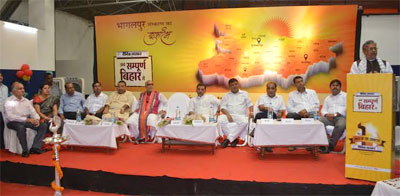
    Dainik Bhaskar, Divya Bhaskar and Divya Marathi announced the launch of Dainik Bhaskar’s new edition from Bhagalpur in Bihar. With this launch, DB Corp Ltd reinforces its presences in Bihar – a region which is of high strategic importance for the company where Dainik Bhaskar has already established a very strong brand equity and a leadership position through the launch of its edition in Patna in January 2014. Dainik Bhaskar now publishes six newspapers with 39 editions in 14 states across India.


     

    Over the next 20 days, Dainik Bhaskar is also set to launch two other main editions from Muzaffarpur and Gaya in August Beginning, with, in between launch of 7 district editions in Hajipur, Purnea, Biharsharif / Nalanda, Arrah, Chhapra, Samastipur and Darbhanga. This will complete Dainik Bhaskar’s full foray in Bihar.


    The Bhagalpur launch was implemented along a similar strategy as that of Patna driven by a well – strategized research and reader-centric survey that was also supported by an aggressive marketing and sales campaign which has once again proved its exceptional execution strength. A region with formidable peers, the Bhagalpur launch success was led by Dainik Bhaskar’s most differentiated content quality, its credibility and a highly un-biased approach as India’s leading media conglomerate.


    Commenting on the launch, Sudhir Agarwal, Managing Director, DB Corp Limited, “We are very encouraged with the overwhelming response to our launch in Bhagalpur. We have been studying the Bihar market for long and while we sensed and explored high market potential in Patna, we were also excited with the economic potential of Bhagalpur. Over the next few weeks we are set to complete our full roll-out in two other main editions and 7 district editions to accomplish our Bihar foray which will make a strong impact on our ability to provide a much deeper reach to advertisers and readers.”


    “Our growth strategy is well aligned to the exciting prospects we find in Bhagalpur where we could establish a leadership position and create a marked impact in terms of readership and circulation. We are very encouraged by the fact that even in a much demanding environment our readers across diverse categories in this region have received the product with great appreciation and confidence. Trust and integrity are uncompromising principles for us and we are fully committed to deliver a superlative product to our readers in Bhagalpur addressing their local news needs as well as emerge as a vehicle of choice for the State’s growth.”


  • Hariharan Vishwanathan to head South at MediaCom

    By A Correspondent


    Hariharan Vishwanathan

    MediaCom has announced the appointment of Hariharan Vishwanathan (Vishi) as the Head – South. He will report to Rathi Gangappa, COO, MediaCom India. Vishwanathan takes over from Sriram Sharma who is moving to another role in Mindshare.


    Vishwanathan started his career in JWT (then HTA) as a media planner in 1994. Since then he has worked across categories, agencies and roles in GroupM. Most recently he was part of the CTG team in GroupM.


    Debraj Tripathy

    Commenting on his appointment, Debraj Tripathy, MD MediaCom India, says “We are happy to have someone with Vishi’s experience and caliber on board. Our business in the South has seen fantastic growth in the last few years under Sriram’s leadership. I am confident Vishi will bring renewed energy and focus to our business. I wish Sriram all the best in his new role.”