Category: MEDIA

  • India Shining for Mobile Internet


    By A Correspondent


    India is projected to have 23.6 crore mobile internet users by 2016, and this will leapfrog to 31.44 crore by 2017. This was reavealed in a report by the IAMAI & KPMG “India On The Go – Mobile Internet Vision Report 2015”.


    The report also points out that India will have over 50 crore internet users by 2017. As of June 2015, internet users in India stood at over 35 crore. According to the report, 2G user base in India is projected to decline in the coming years as more and more customers are expected to migrate from 2G to 3G. The 3G user base in India is rapidly gaining market and is projected to grow at a CAGR of 61.3 per cent from 2013-17. There were approximately 8.2 crore 3G subscribers in India by the end of year 2014 and the number is projected to reach 28.4 crore by end of year 2017.


    Commenting on the release of the IAMAI-KPMG report, Ashvin Vellody, Partner – Management Consulting, KPMG in India said, “With more than 30 crore internet users, India has the second largest internet user base in the world. But the internet penetration at 19 per cent (approx) is poor and limits the potential. The next wave of growth in penetration of internet will driven by adoption of mobile internet. The mobile internet growth story would be written by the large population in the hinterland and meaningful and compelling content/ use cases would enable adoption of mobile internet.” He further stated, “It is imperative to connect Indians through internet of which the mobile internet will play a key role since reliable accessibility will be the killer app that will bind the internet ecosystem together, increase adoption and enable innovation in business models around voice and data services.”


    Speaking at the launch, Dr Subho Ray – President IAMAI reiterated that growth in the internet space will come from the non-metro and rural areas. He said, “While the urban market has not reached its saturation point, it will be non – metros and rural India that will be driving internet growth in India. And this is where mobile internet will be playing a pivotal role. The advent of low cost smartphones coupled with low mobile tariffs has empowered consumers in the hinterland to use data connectivity and we will seeing more usage of internet from these areas in the months to come.”


    As per the Report, rural India is steadily moving towards a more Internet friendly and exploratory mind-set. As of 2014, the Active Internet User (AIU) base in rural India was 6.7 per cent of the overall rural population of 90.5 crore and accounted for 61 million users. 4.4 per cent of the total rural population used a mobile device to access the Internet; a figure that stood at a meagre 0.4 per cent in the year 2012.


    The Report has found that the rural growth story in the coming years will likely be written by 2G technologies. 3G and 4G may continue to be primarily an urban phenomenon for the next few years. Increased Internet enabled device penetration, decreasing handset prices and data plans tariffs are helping to create a suitable environment for a rapid growth of Mobile Internet in India, with rural India set to take the lead. As of June 2014, nearly 50% of the AIU in rural areas accessed Internet using mobile phones, Community Service Centers (CSC) and Cyber Cafes. 38% of the Active Internet Users use Mobile phone as the main access point.


  • #TVBuddy showcases TV viewing habit of Indians

    By A Correspondent


    dittoTV has rolled out its new campaign ‘#TVBuddy’ which showcases the Indian TV viewing habit that even if they are separated by geographies, Indians always like to watch the same TV content together and sometimes, even discuss and share it.


    Based on this insight, in the campaign, the term ‘TV Buddy’ was coined. TV Buddies could be your mom, dad, relatives, childhood friend or just about anyone. And they could be living in any part of the world. All this is made possible by dittoTV, the OTT TV platform that offers Live TV and videos on all internet-enabled devices.


    The film has been conceptualised by Scarecrow Communications and directed by Bosco Bhandarkar of Good Morning Films.


    It’s a montage film showcasing various characters as TV Buddies. They are watching different content across genres like TV series Jodha Akbar, reality show Dance India Dance and the movie Transformers, at the same time, no matter what the time zone is.


    In the storyline, it’s subliminally established that dittoTV lets people watch the same content across time zones, through connected devices such as smartphones, tablets and laptops.


    The film opens with a narration by the young and emotive voice of Imaad Shah, son of the legendary film and stage actor Naseeruddin Shah.


    TV Buddies have to just download the dittoTV app and install it on their connected smart devices. Then, they can just play and watch Live TV, anytime, anywhere.


    Talking about the campaign #TVBuddy, Manish Bhatt, Founder Director, Scarecrow Communications Ltd. said “Indians are like flamingos. They flock together, even virtually while watching TV. As this insight has a strong connect, we kept the film simple to demonstrate dittoTV’s role in the lives of Indian viewers”.


    Debashish Ghosh, CEO, ZDCL said, “ZEE has always been an innovator in the media industry over the period of 22 years. Its content has always resonated with the audiences and now we have taken it a notch higher with dittoTV. We believe that India is a country where we celebrate every occasion together; with #TVBuddy campaign we are aiming to lend TV viewing experience a personal touch where you can watch your favorite movie, TV show or a match with your TV buddy who may be miles apart from you. The essence of Indian audiences who have evolved with just one TV set today now have TV at the tip of their fingers!’’


  • How social media has impacted the world for marketers, politicians & even journalists!


    Hate it or be hooked to it, social media has revolutionised the communications industry. While some people say for the better, others point out its various flaws. We bring together expert views from a cross-section of influentials – actor Gul Panag and social media strategist Hareesh Tibrewala, brand expert Harish Bijoor, former Member of Parliament Milind Deora and journalist-columnist and MxMIndia Consulting Editor Ranjona Banerji — to tell us more. Dyanne Coelho listens in


    Do you think social media has really revolutionised the communications industry?

    Amith Prabhu: Social Media has impacted a lot of areas in an individual’s life, includinginterpersonal communications. We often see people expressing their strongest feelings and views personally or otherwise on social media. This behaviour has also transformed the way the communications business functions in a big way. Unlike in the past, a customer-brand relationship is not a one-way communication anymore. Social media has enabled consumers to voice out their opinions to brands directly which helps them grow. They take the customer feedback seriously and act accordingly. Social Media is a healthy support system in a brands communication chart which ensures a vigorous growth of a company if this medium is applied and used intelligently.

     

    Gul Panag: For starters, it’s two-way communication, which was missing earlier, because you had people talking at you. Now you have people who talk, and those who speak back to you. That’s the one big change social media has brought in, and it’s revolutionary.


    Hareesh Tibrewala: Communication in the pre-social media days meant a monologue: the brand talks and the consumer listens. Now, communication has become a dialogue. This monologue-to-dialogue transformation has been the biggest impact of social media on communication.


    Harish Bijoor: Social media is a revolution for sure. Media, which was hitherto owned by publications, television and radio channels alike, is today open to all. Everyone can broadcast. My tweets are read, liked, re-tweeted, even massacred, by thousands in an instant. In the era before social media, this was not the case.


    Milind Deora: Social media has really democratised the ability to communicate. Most of it is free, which also makes it extremely attractive. It’s a new, accessible way of communicating with friends and with people you want to reach out to, if you’re a politician or an entertainer. Social media has disrupted traditional mediums [of disseminating news] such as newspapers, magazines, television.



    Ranjona Banerji: I was an early sceptic about Facebook and Twitter, and only tried them out to confirm my reservations. Since then, however, I’ve been hooked. Twitter is now the top way to get news first (often, along with some outrage and hysterics). The Arab Spring – or whatever happened to it along the way — would not have had any success without Twitter. This, more than Facebook, has truly broken down barriers of language and distance, and allowed people to get in touch, like never before.


    Would you say it has been a gamechanger in influencing public discourse in India?

    Amith Prabhu: The last Lok Sabha and Delhi Assembly elections are a fitting proof of this phenomenon. We saw Mr. Kejriwal winning the election with a record breaking number of seats even after he was widely criticised for his resignation. His campaign is a perfect of example of how social media was used intelligently. Similarly, the success of Mr. Modi in winning the national elections can be attributed to the smart use of social media to a large extent.


    Gul Panag: Political discourse has gained a lot because of social media. Never before in our history have so many people, and across socio-economic strata, discussed politics as they did during the 2014 General Elections. Also, people and issues that never got attention earlier, now have more of a chance of this. For instance, the North East was never a part of mainstream public discourse. But thanks to social media, the Manipur blockade from a few years ago, got attention. It was already in its third week when some of us posted about it on Twitter, but once it started trending, it made it to the front pages of most newspapers as well.


    Hareesh Tibrewala: Indian society is a very communicative one. We have an opinion on everything. Till now, public discourse was limited to views expressed by celebrities or the media. Now social media has made everyone “the media”, and the collective opinion of a large majority starts influencing public discourse.  At times, it may lead to mobocracy, where half-baked ideas find emotional resonance with a majority and subsequently force public opinion. But that is the price to pay for democracy


    Harish Bijoor: Public discourse is public today in the true sense of the word. There is a democracy in social media that was not visible in the pre-social media days. Though there is anarchy as well, of course.


    Milind Deora: It has made not just politicians, but the government and even corporations more accountable. Today, if people are outraged over the Maggi issue, the company has to respond. Even journalists, who hold stakeholders like politicians and businesses to account, have been kept in check by social media. It really is the ultimate accountability tool.


    Ranjona Banerji: In India, although there is a vast nation outside the world of social media, there is no doubt that social media dictates conversations. The fact that politicians and the police get upset about Facebook posts, and the more savvy try to have Twitter accounts, only underlines social media’s reach and importance. Both newspapers and news TV are forced to keep an eye out for what’s happening on social media. Though you could also argue that sometimes they forget that there is a world beyond hashtags as well.


    And while social media has given new voice to people, how do you think has it changed the way brands, marketers, politicians and journalists communicate with their stakeholders?

    Amith Prabhu: As pointed out earlier, social media if used intelligently is a big advantage to brands. It gives brands a ready platform to engage with its audience and take their feedback to alter their products and services as per the needs of the customers. Brands are now more interactive with their audience which hugely works in their favour.


    Gul Panag: Brands need to realise that it is not just a one-way conversation where they talk at consumers. It is not only about talking to your target audience, but getting your target audience to talk about you. Brands like Redbull don’t employ direct marketing. They sponsor an F1 team, or an aerobatic flight squad for air shows, and that makes people think Redbull is cool. It is rewarding for a brand to have people talk about it, rather than it talking to people, because that also comes at a very large cost.


    Hareesh Tibrewala: The best example of how social media has influenced consumer behaviour, is TripAdvisor. If you are in the hotel business and don’t get good reviews on TripAdvisor, you might as well shut shop. It no longer matters how you ‘market’ your brand. All that matters is the opinion of consumers who have used your product. Social media is now about building brand advocacy among consumers.


    Harish Bijoor: Marketers, who are essentially used to marketing to the ‘patient’, need to embrace this quick and decisive media for their brands. Time to wake up, smell the social media and learn the art, science and philosophy of marketing to the ‘impatient’. Social media management is a different skill altogether. Marketers cannot hide behind the cloak of their PR outfits anymore. They need to be hands-on and quick in this medium.


    Milind Deora: I use it as a good way to get feedback on issues. The current joke on social media is that the Prime Minister tweets to wish Algeria on its national day, but won’t tweet about scams in the government. But sooner or later, this will build up to a crescendo where he’ll have to say something. Social media makes you, as a politician, more accountable. It is all about a viral communication strategy and it’s different and more interactive than any other medium.


    Ranjona Banerji: I think the corporate world has not yet fully understood how to exploit social media. The internet community is averse to intrusive advertising and many companies have not yet understood this. However, Twitter is a great way to complain to service providers and in my experience you often get a far prompter and more effective response from social media handles than you would if you had the courage to take the call centre ‘press 1 to be ignored, press 2 to be insulted’ route.


    Conversations have now moved from the coffee table to a social media platform. What do you envision for the future of the communications industry?

    Amith Prabhu: Communications business in India has a lot of potential and social media is a big part of it. A couple of years ago a PR conference was born thanks to a conversation on a social network. PRAXIS was born on twitter basis a single tweet. Similarly there are innumerable things that one can do with the help of social media. Social media opens up new ideas, infinite avenues and amazing possibilities for people who are ready to explore its power. I even secured a job at the global co-headquarters of the world’s number one PR firm using social media.


    Gul Panag: In the future we’re going to see periodic, disruptive changes. For example, the first round of disruption came with Twitter, then Pinterest and Snapchat. You will always find a disruption the moment we settle into a status quo, and you can either evolve yourself, or you will be forced to evolve because of the disruptions that will happen. Instagram began as a photo-sharing medium, but it also has videos now and that’s enabling people to put their stories across in a manner like never before. So that’s disruptive change.


    Hareesh Tibrewala: Mass communication in its current form will remain. However communication strategies going ahead need to have active social listening (to understand public chatter), social engagement strategy to engage in one-on-one conversations as well as influencers and advocates strategy as something integral to any communication architecture.


    Harish Bijoor: Yes, discussions which were one-on-one in the physical world are today all about one-to-many in the virtual world. This is a trend. On social media, your friends are those you have never met, but seem to know well.


    Milind Deora: I think the future of media will really be a hybrid of social media and television. Back in the day, if I was an artiste, a fan would write to me and I would respond. Now the fan is not writing to you privately, but in a public forum, letting the whole world know what he thinks of your music, and you are responding to his comments publicly. So one has to be very careful about using it. But it’s definitely opened up individuals, corporations, governments to greater standards of transparency.


    Ranjona Banerji: Perhaps people sitting at the dining table tweeting to each other instead of talking? The methods of communication keep changing. Who knows, if you ask me these questions 10 years later, we might be saying: “Wow, I’d forgotten all about social media!”


    First appeared in ‘dna of brands’ dated July 20, 2015
     

  • Ranjona Banerji: Face it. If you’re not a journalist you don’t know how a newsroom functions. You only think you do.

    By Ranjona Banerji


    There is a commonly held belief that Indians as a society are permanently craving for heroes, heroines, idols. Therefore, we make role models of just about anybody and then damn and excoriate them when they don’t live up to our expectations. One can understand sports stars, film stars and even politicians. But this old adage must be true because we have also made the most ridiculous heroes and villains out of our star television anchors.


    With due respect to everyone, it is not possible to fully understand how a newsroom functions unless you have worked in one, as a journalist. No matter how closely you follow the media and how many journalist friends you have, you cannot know. This is not because journalism is some magical unknowable quantity or newsrooms are like Hogwarts protected by Dementors. It’s because unless you are one, you don’t know how a chartered accountant’s office works or a science lab works and so on.
    But of course, when it comes to journalism, everyone’s an expert. And television, by bringing journalists into your homes, by carrying “citizen journalist” shows and by reporters and anchors mentioning “sources” all the time, has made many members of the public feel that they are part of the process.


    I read a rather sweet if desperate blog the other day by a young man who was very upset that he had been “blocked” on Twitter by Barkha Dutt and Rajdeep Sardesai. He was also upset with Arnab Goswami though I am not aware that he has a Twitter account or if he is active on Twitter. These there TV anchors are known together as “BAR” by the way, by those who are obsessed with them and usually hate them. However the blogger pointed out that he had “blocked” these people first because he didn’t care about their opinions or disapproved of them. But he was clearly upset that they had “blocked” him. So upset in fact that he wrote paragraph after paragraph on how he didn’t care.


    One of the conclusions you can reach here is of a strange obsession with the doings of the media by people who do not fully understand the doings of the media. Talk to a young student who wants to be a journalist and you will find that it is all determined by what he or she has seen on television. Grunt work is not on the agenda because the assumption is that there is no grunt work at all. It’s all glamour and creating public opinion. I met a young journalism student a while ago who reacted with horror when I said that early on in my career I opted to be a sub-editor rather than a reporter. She asked, astounded, “You had the chance to be a journalist and you decided to be a sub-editor?”


    I had no choice but to react with miserable silence.


    But as usual, I am amused at the terrible anger that “BAR” and other TV anchors generate – most of course for falling on the wrong side of the angered person’s political spectrum. The actual work that goes on even in a TV newsroom remains hidden and that is why you, as a media person, have to sift through the views of both admirers and detractors. I often get lectures from people on what the media should or should not do from people who are well-meaning but ignorant.


    And as usual, what amuses me is when people within the media feign ignorance and point fingers for all sorts of transgressions at people who work in other newsrooms but are so delightfully silent on their own faults. Now those are the ones who need to feel the hatred directed at “BAR”, in my book…


    Meanwhile, I suggest people look for heroes outside our noble and ignoble profession.


  • B4U to transform content delivery and playout operations with Amagi

    By A Correspondent


    Amagi has been signed on by B4U Television Network India for a range of end-to-end cloud-based playout services. Through its flagship channel playout platform, CLOUDPORT 2.0, Amagi’s services will include playout, 24/7 monitoring, conditional access, and measurement systems leveraging satellite distribution from AsiaSat, Asia’s premier satellite operator.


    The development marks a significant step in the adoption of cloud-based managed playout services by TV networks in India and Amagi’s growing expertise in this area. It also demonstrates increasing adoption of the Amagi’s next-generation channel playout management services by TV networks worldwide to monetise their content delivery and distribution.


    “Amagi’s playout services offer us improved flexibility, transparency, and channel control at very cost-effective rates. We are also delighted with the excellent technical support delivered by Amagi in transitioning from our earlier playout infrastructure in just under two months,” said Sandeep Gupta, Chief Financial Officer, B4U Network. “With all our content assets on the cloud, we are in a position to efficiently expand to new geographies and target specific markets as the business demands. It also makes us future-ready, as Amagi’s platforms are extendable for content regionalization, ad monetization, and OTT platform integration.”


    The content and playlist is contributed by B4U in Mumbai, India, and the United Kingdom, while playout is uplinked in Hong Kong via AsiaSat. The entire workflow is stitched through Amagi’s cloud infrastructure and monitored by Amagi at its headquarters in Bengaluru.


    “CLOUDPORT is rapidly becoming the preferred platform of choice for channel playout and management as TV networks look to leverage new efficiencies available through virtualized playout models,” said Srividhya Srinivasan, co-founder, Amagi. “By supporting multisite workflows and collaboration, our CLOUDPORT platform dramatically enhances playout and distribution efficiencies for B4U Television Network India while enabling them to deliver a world-class entertainment experience to customers.”


  • Media agencies battle it out at the BBC World News Football Connect 2015

    By A Correspondent


    Mumbai’s leading media agencies were involved in a pitch with a difference last week as they took part in the BBC World News Football Connect 2015 tournament.


    The 2nd annual 5-A-side competition took place at Mumbai’s Cooperage Football ground and saw 18 leading media agencies battle it out. More than 250 guests attended the event with agency heads, senior planners and CEOs present.


    The tournament kicked off with a round robin format. Six teams then qualified for the super six stage from which the top two teams from each group made it to the finals. The final was contested by OMD-PHD ‘Chargers’ and Lodestar ‘Tigers’ with the Chargers winning the hard-fought final 2-1. There was also a ‘Reach The Target with BBC Sport’ Cross Bar Challenge with all 18 teams nominating a player to represent the team. The tournaments winners were:


    • Best Goal keeper – Ritwik Yadav – Lodestar ‘Tigers’
    • Top goal scorer – Selig Baptista – Madhouse ‘Sonics’
    • Player of the tournament- Selig Baptista – Madhouse ‘Sonics’
    • Winners of the crossbar challenge: Harshil Shinde – Mindshare ‘Ninjas’ and Kieran Baptista – DDB Mudra ‘Knights’
    • Runner up team – Lodestar ‘Tigers’
    • Winner of the BBC World News Football Connect 2015 – OMD-PHD ‘Chargers’


    Vishal Bhatnagar, Sales Director Asia – BBC Advertising said “We are overwhelmed with the response. All the teams played with a lot of spirit and determination and they demonstrated some very high quality football. BBC World News Football Connect offers us a great platform to share with our associates our brand values and share and showcase our various offerings across World News, .com, mobile app and other platforms.”


    The main action on the football field was complemented with a unique VIP fan zone where guests had the chance to engage with the brand in an innovative experiential marketing campaign the BBC World News ‘Be Everywhere’ oculus experience. Using the latest in virtual reality technology, BBC Global News Ltd recently launched a dramatic new interactive trade campaign to showcase how it delivers personal, portable and on-demand news for the digital age. The 360 experience gave guests a behind the scene experience with Babita Sharma as she showcased the leading news brand’s digital products and the advertiser benefits, highlighting the BBC’s international news services’ position as a leader in digital innovation.


  • Big Magic Ganga announces Season 6 of BIG Memsaab

    By A Correspondent


    BIG Memsaab is set to return with season 6 on BIG Magic Ganga. Starting in August 2015, the show will be anchored and judged by celebrities as famous Bhojpuri actress Smriti Sinha, Hindi TV actor Sumit Vats and renowned folk singer - Malini Awasti. The 26 episode series will be telecasted twice a week and is sure to enthrall and entertain audiences with its unique content.


    BIG Memsaab is one of the popular talent-based reality shows of the region which enables participants to showcase their talent through unique rounds. Participants have to qualify for the three stages of audition -Talented Memsaab, this round will focus on various talents that the participants can showcase, few shortlisted contestants will move to the next stage - Khubsoorat Memsaab, where they will be judged on their grooming capabilities. Qualifying in the second stage, the semi-finalists will reach the third audition round which will be -Kitchen Ki Memsaab where they will have to showcase their cooking skills. The battle for the title does not end here; the contestants who will qualify for the third stage will compete in the finale.


    Speaking on BIG Memsaab’s Season 6 launch, Ashwin Padmanabhan, Executive Vice President and Business Head, Reliance Broadcast Network Limited said, “After receiving an enormous response for our last five seasons, we have come up with a brand new season of the show.  Being the No1 regional channel of the heartland, we only strive to provide original content which is entertaining and can engage maximum viewers. To make this platform available for maximum number of women in the region, we are once again back bigger and better this season.”


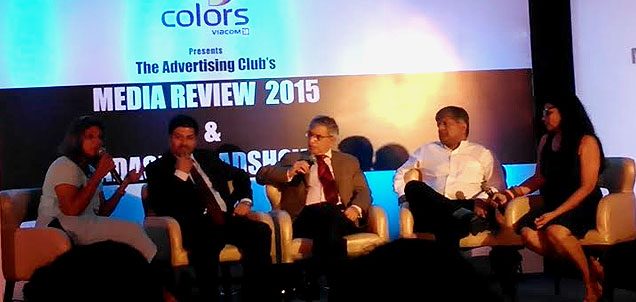
  • ‘Is Anyone Listening?’ @ Media Review 2015


    By A Correspondent


    On a day that threatened to be washed out thanks to a heavy downpour, the Advertising Club hosted its annual event, Media Review 2015, on Tuesday in Mumbai. The speakers included Shashi Sinha, Chief Executive Officer, IPG Mediabrands India, Meenakshi Menon, Founder and Chairperson, Spatial Access; Pradeep Dwivedi, Chief Corporate Sales & Marketing Officer, Dainik Bhaskar Group, and Punitha Arumugam, Head of Agency Business (India & SEA) at Google.


    Each speaker spoke on the topic ‘Is Anyone Listening? How Did Ad and Media Industry Combat The Challenge Of Continuous Partial Attention of Audiences.’


    “The ad model cannot continue to behave like an ostrich,” Meenakshi Menon said stressing that clients want to see the model changed. Most agencies today have launched a digital unit, but have no idea what to do with it, she added. “Companies live quarter to quarter, clients are restless and CMOs want to change the set up,” Menon said.


    Pradeep Dwivedi painted a colourful portrait of the print medium in India. The challenge is of how to get your attention back, he said talking about how we ought to rediscover print. It is not true that print isn’t emotional he said, print can be just as emotional as TV he pointed out highlighting a few print ad campaigns that were much talked about. “Print continues to evolve, and it takes up social issues as well more than any other medium,” Dwivedi said. Marketers need to get out of this metrocentricity, step out of the metros and figure out what people want, he said.


    Shashi Sinha, dwelled on the topic of managing media in a continuous partial attention world. He quoted Lord Kelvin, ‘If you cannot measure it, you cannot control it’, he said stressing on the importance of having a reliable measurement system in place. The core reason for the well-being of the industry is measurement, he pointed out. “Programmatic is the buzzword these days and we ought to link digital, TV and print measurement,” he said.


    “Big egos have little ears,” Punitha Arumugam said talking about the importance of paying attention to the consumers. “We have to listen to the consumer in this moment, now, not tomorrow,” she said. Arumugam cited examples of advertisements that have paid attention to the needs of the consumer no just on a product level but beyond. She spoke about Dabur’s ‘Brave and Beautiful’ ad campaign as well as Dove’s ‘Be Beautiful’ campaign. She also discussed the thought behind the Horlicks’ ad that set out to prove that Horlicks mixes in milk before you can skip the ad.


    Sam Balsara, Founder and Chairman, Madison World led the panel discussion with the four speakers next. The panellists discussed the changes taking place with the dawn of the new media and whether this changes the traditional values in this space. “The pivot is no longer the medium, but the consumer. The industry this needs to change pivot,” Menon emphasised.


    Very soon, agencies are going to be independent data providers, Arumugam said. “Tomorrow there’ll be data available in plenty; it’s about how you use the data.”


    The evening also witnessed a presentation on AdAsia 2015, Taipei to be held from November 22 to 25, 2015.


  • Colors Infinity to launch on July 31

    By A Correspondent


    The permissions have been got. The line-up is in. The marketing plans have been stitched up. The Viacom18 English general entertainment channel Colors Infinity will launch on July 31. To be available across all major DTH and digital cable platforms in standard and high definition, the launch line-up of the channel includes fare like Better Call Saul, The Flash, Orange Is The New Black, Fargo, TheBig C and My Kitchen Rules amongst others.


    A significant, clutter-breaking innovation the channel has announced is the three back-to-back episodes of a show every weeknight, at 9pm.


  • Onads wins creative and digital duties of Gadre

    By A Correspondent


    Onads has won both the creative and digital duties of Gadre Marine. The account is estimated to be in the range of Rs 10 crore.


    Speaking on the win, Onads founder Jignesh Maniar said, “We are absolutely delighted to work on this business especially because it gives an opportunity not only to build a brand but a new category. Crabsticks is very popular around the world and our mandate is to make it popular in India.”


    Gadre has also signed on renowned Michelin Chef Vikas Khanna to endorse the brand.


    Gadre Marine, established 1978, is the leading Surimi manufacturer and exporter of highest-quality and best tasting marine products the world over. Gadre Marine is the largest exporter of Surimi Paste made from fish and of value added products made from Surimi. Gadre Sea Food is also the largest exporter of crab sticks in India.


    The company has made grand plans to market this product in the Indian markets as they see a strong potential in the product. The product has already garnered a great response in the soft release done at select retailers across India. The vision is now to make this product popular.


  • Gerard Jayaranjan to head creative at FCB Ulka Digital

    By A Correspondent


    Gerard Jayaranjan

    FCB Ulka Digital, the digital arm of FCB Ulka, has appointed Gerard Jayaranjan as Creative Head – Digital. Prior to this, Gerard was with iContract, the digital division of Contract Advertising where he worked as the Senior Creative Director. He will report to Satbir Singh, CCO, FCB Ulka.


    Gerard has done stints with Havas Worldwide, TBWA, DDB Mudra and Mcann Erickson. With a blend of mainline and digital advertising, he has a strong understanding of brands and creative solutions irrespective of the medium used.


    Commenting on the appointment, Satish Ramachandran, Senior Vice-President, FCB Ulka Digital, says, “We have been growing way ahead of industry, this has been possible due to fact that we have been consistently investing in talent and technology. Gerry is a perfect addition to the team with his passion and experience in the space.”


    Satbir Singh

    Satbir Singh, Chief Creative Officer, FCB Ulka, says, “Gerry is one of those handful of creative guys out there who can think compelling ideas and have a firm grasp on the role of technology. He just had to be in our team.”


  • Pramod Sharma returns to Rediff as ECD

    By A Correspondent


    Pramod Sharma

    Rediffusion Y & R has announced the appointment of Pramod Sharma as Executive Creative Director. He joins the agency from Soho Square (Ogilvy). This is his second stint in the group.


    Pramod comes with over 15 years of work experience across agencies like Ogilvy, Dentsu, Percept-Hakuhodo, Everest and DDB Mudra. During his career he has worked on brands such as Parle Products, Sony Sab TV, Sony Pal, Pantaloons, Maxx Mobiles, Fedex, ICICI, Reliance Communications, Readers Digest, Cisco,Tata Housing, Raymond Apparels.


    Dhunji S. Wadia

    Speaking on his appointment, Dhunji S.Wadia, President, Rediffusion Y & R says, “We welcome Pramod’s return to our agency. He understands our clients, brands and our work style. We appreciate his work ethic and calibre. And everyone can expect sparkling creative work.”


    Rahul Jauhari

    Speaking on the appointment, Rahul Jauhari, Chief Creative Officer, Rediffusion Y & R says, “It’s great to have Pramod back in the team. His passion for creativity is very well balanced with his understanding of business issues. Pramod comes as a shot in the arm for the creative team in Rediffusion YR Mumbai.”