Category: MEDIA

  • MTV’s Splitsvilla will uncover what women want

    By Dyanne Coelho


    MTVis back with its premier property MTV Splitsvilla 8 seeking to uncover ‘what women want’ with show hosts VJ Rannvijay and Sunny Leone. The creators of the show aimed to have more fun at the boys’ expense by changing the format of the show. To show the boys what women want, eight celebrity boys will be pitted against 8 regular boys to woo 14 girls.


    Speaking at the launch Aditya Swamy, EVP and Business Head, MTV said, “Both Sunny and Rannvijay are heartthrobs in their own space. For them to come together is something new on Season 8. This new combination has given the show a whole new flavor. We have a record number of brand partners as well and we are looking forward to the launch.”


    Sunny Leone returns on Splitsvilla 8 after a successful Season 7. “I’m thoroughly excited to be back on the show and I’m intrigued to find out what the boys will come up with to woo the women they like. I’ve had a lot of fun shooting and Rannvijay is just a big ball of energy,” she said.


    The show that has been shot on the beaches of Goa, will have the boys going to any and every extent to make the woman of their choice happy. From pampering, to cooking and cleaning and showering some love, the boys have to win over the girls by hook or by crook. The eight boys include Zaan Khan, Paras Chabra, Utkarsh Gupta, Prince Narula, Ishaan Chibber, Viren Singh Rathore, Amaad Mintoo and Yash Pandit.


    Season 7 of Splitsvilla saw a viewership of 100 million and the channel is looking at a higher number this season, Swamy said. “For the first time we’re doing Splitsvilla as a biweekly. So there’s more of everything. I think the audience wants more and we’re happy to give it to them,” he said.


    Digital is leading the way for promotions and marketing activities, Swamy reveals. “We’ve built exclusive digital content around the show that we’re distributing on our platforms. This was the first time we launched with a music video. You’ll notice that we’re not very active in print, as young people are moving to digital and so are we, we’re very active digitally. More than a third of our activities are on a digital platform,” he said.


    The question that runs through the minds of many is whether parts of the storyline are scripted. Shalini Sethi, Programming Head, MTV denied it saying that none of it is true and that the drama that occurs on the show is natural of tensions between boys and girls living under one roof, just like in a college hostel. “There is the drama, the jealously and it’s very natural. I think people have to realise it is reality. It’s just that people can’t believe that the shows can be done well, that’s why everyone says it’s scripted,” she said.


    Splitsvilla 8 is set to premier on July 4, 2015 at 7pm on MTV.


  • HolidayIQ.com launches mobile-only holidays marketplace

    By A Correspondent


    HolidayIQ has launched the mobile-only vacations marketplace ‘Holidays’, dedicated to activity based leisure travel. The marketplace , incorporated within the HolidayIQ android mobile app, showcases 1000 plus activity based packages and allows travellers to customize their holiday using various filters including: budget, duration, vacation type and activity. The app also provides comprehensive itinerary details within each listed holiday package. The feature has various options ranging from day-activities of just 1 hour to offbeat, all-inclusive holiday packages of up to 15 days, with prices from Rs. 100 to Rs. 1.6 lakhs.


    Hari Nair, Founder & CEO, HolidayIQ, said, “There are two major shifts in the way Indians plan holidays today. Over 70 per cent of holidays planned on HolidayIQ are through mobile devices. Secondly, we are moving from destination-led holidays to experience-led ones.  And so, we have aggregated the first ever mobile-only activity-led vacations marketplace. We have associated with some of the best players in the industry including Giftxoxo, Tushky, Exploita & Padharo to provide a vast range of experiential holidays for Indian travellers. People can also review all these holidays individually on the app helping other travellers plan better.”


    These vacations include over 1000 activities ranging from cycling to hiking, zorbing to river rafting, Bollywood inspired walks to culinary trails. They can suit varied budgets starting with holidays such as ‘6-hour Vineyard trail at Grover Zampa Vineyards in Nasik for Rs. 400’ to a ‘9-day holiday in the Andamans including swimming with elephants at Rs.1.6 lakh.’


  • Viacom18 to launch English GEC ‘Colors Infinity’

    By A Correspondent


    Viacom18 has announced the launch of its English general entertainment channel – to be called Colors Infinity. The channel will have a standard definition and HD version. Although Viacom18 has not revealed the date, trade sources inform that it could well be launched later this month (July).


    The network has entered into major multi-year deals with Warner Bros. International Television Distribution, NBC Universal, Sony Pictures Television, Twentieth Century Fox, Lionsgate, MGM, BBC and Endemol Shine amongst others.


    The channel will be co-curated by film-maker Karan Johar and popular actor Alia Bhatt, both of who profess to be passionate viewers of international content.


    Sudhanshu Vats

    Said Sudhanshu Vats, Group CEO, Viacom18: Today, we are the world’s second largest English-speaking population and live in an environment where English is seen as a ladder to personal progress. English is an extremely important space for us and with this move, we will further strengthen our share in the category.”


    The channel will see scripted and unscripted content that will span genres such as Drama, Superheroes, Comedy, Fantasy, Crime and Thrillers. Additionally, there will be a special focus on reality television with some of the world’s biggest shows across dancing, singing, cooking, and other lifestyle interests. The channel will also play home large format live events and awards.


    Ferzad Palia

    Talking about the channel, Ferzad Palia, EVP, Viacom18 and Head, English Entertainment said: “With its sheer breadth of offering and carefully selected content from across global markets, Colors Infinity will be the definitive platform for the best in English language entertainment across genres. Our objective is to grow the category by broadening the appeal and reaching to a wider base.”


  • Havas India elevates Mohit Joshi, announces senior level promotions

    By A Correspondent


    Havas Media Group India announced a slew of senior level promotions across the group in India.


    Mohit Joshi

    Mohit Joshi currently Managing Director, Havas Media India, has been named Managing Director, Havas Media Group India. Uday Mohan, Executive Director, Havas Media-North is being promoted to Managing Partner, Havas Media-North & East. Soumya Sarkar, General Manager is being given additional charge as General Manager & Branch Head, Havas Media-West.


    Included in the promotions roster are – Abhishek Jain as Executive VP Investments, earlier VP Investments. Mitesh Desai, Head-Creative, UX & UI is now National Creative Director and Gregory Phillip has been named Associate VP-Operations for Arena Media.


    Anita Nayyar

    Speaking on the appointments, Anita Nayyar, CEO, Havas Media Group India & South Asia, said, “Havas Media Group in India has been growing at a rapid pace, last year we grew 42 per cent. It has been a straight line graph going upwards since we started operations in 2006 and we have aggressive plans ahead. Companies don’t grow on their own, they need – people. As we scale, we would like to elevate the passionate people who helped us reach where we are today and we count on them going forward.”


    The team has also been further strengthened with the joining of Tarranum Alam as Executive VP Investments and Chandana Chakravartti VP at the Delhi office and Saurabh Jain who is currently handling the Bangalore operations.


  • Who’s Afraid of ASCI?


    By Sanjeev Kotnala


    Normally communication is not given high enough an importance and it’s common to point out that it is just a small part of the whole system. Right. But when it comes to brand image and perception, suddenly all fingers starts pointing at it. In case of an erroneous advertisement called to attention by the media or a consumer, communication and the stakeholders in the process become direct scapegoats. It is a situation that could be avoided with proper planning and sensitising people involved in the process.  Unfortunately, we have a whipping boy ASCI; the designate self-regulatory body – the Advertising Standards Council of India, which keeps low, and no one is afraid of.


    There are many things that go against ASCI, including their own processes and lack of willingness to be in focus other than infrequent press reporting in some remote page position. It fails to have an effective impact in brand and consumer life.


    The Time Trap or Time Warp. ASCI suffers because of its dependence on processes that were designed for a non-digital, non-instant and highly non-intrusive era. These processes designed to create fairness in hearing of a complaint and the gap between council meetings creates buffer that are more than sufficient for the brand-at-fault to take advantage of.


    Though ASCI has been at it and has done wonderful work in streamlining the processes, I submit they have been inadequate. Even an ‘express’ system is not fast enough for current times.


    There is a need to have council members who are passionate about ASCI’s role. Have rules that allow council members to consider, remarks and vote from a remote location. Maybe create a larger bank of council members so that not much pressure is exerted on their time and always there are available a set of members that will complete the quorum.  How nice it would be to get a direction and a verdict within 48 hours of complaint submission!


    If the brand has willingly strategies to create the ad, that has been produced, the background support should be available at the flick of a button or a click of the pad. Time we did away with that long time given for brands to reply.


    The Soft Velvet Touch treatment. No smart Brand manager is afraid of ASCI. When the max penalty for releasing a misguiding advertisement is just withdrawal, it makes life so simple. It’s easy to take advantage of this window between complain and resolution. In fact some brands can even plan the release to increase the window of opportunity.


    What needed is to give ASCI the power it deserves. At least the penalties awarded must be complied with before re-evaluation in legal system is entertained.  And during this readdressing of verdict, the default communication must remain caged.


    The wish to have ASCI as nodal autonomous body with final verdict may be far-fetched and full of legal loopholes. In current digital era when so much rides on communication, it should not be left to chance.


    May be it’s time we went a bit rough on defaulting brands. On first default, the brand should be asked to withdraw the communication. This is also the current practice. For a second default by Brand (even if a different communication), it must be forced to run a corrigendum in same size, duration in three main media. Vehicle used for the misguiding communication. For the third such act, the brand should run a corrigendum and be debarred form advertising in the media where the misguiding communication had appeared.


    Meanwhile like DND phone numbers, ASCI should create an easy to access archive of defaulting communication and brands. It must get its member media access and power to deny releasing a defaulting brand communication. May be in addition to the RO, brands must also provide a statement of ownership and confirm that the claims are not objected by ASCI or there exist sufficient data or reports to support the claim.


    Media B2B Communication: Something that is very near to the ASCI governing members. And maybe for media B2B communication a directional advice can be given to the brands through remote voting without waiting for defending the brand’s answer.


    I would want to see a situation where a brand is prevented from lodging any fresh complaints for a pre-decided time period if the last two complaints by it have not been upheld. Also, a brand against which complaint has been upheld should not be allowed to advertise for some period. I know this will never happen.


    Creative Agencies Becoming Mini-Regulators: There is a definite need to sensitise creative and media agencies. They must willingly and as ask their client clarification or detail in case the claims and supports do not match.


    There is even a pre-release checking facility at ASCI, where the brands can get an initial non-negative check done wrt the claims and representation. I am not sure how many are aware of and how many have availaed fo the service.


    Trust me, the era of taking things for granted is over. The offended brands are not going to remain silent. The common man – the ultimate consumer – now knows his/her rights and is willing to challenge brands on their promises. Social media is acting as a sword with twin edges.  Time to cultivate habit of self-regulation at every possible checkpoint. Time to have sub-regulatory teams in client office, in agencies and in media. Time to be far more transparent and vocal against the offending brands and to give ASCI decisions and progress a wider reach.  Or let us be ready for the alternate, which is a terrifying thought.  A new nodal agency thrust upon this industry. Then we know nothing will remain impossible.


    Sanjeev Kotnala is Founder and Head Catalyst at Intradia. A Brand, Marketing and Management Advisor. He conducts specialised workshops in the area of IDEATION (Harvest and Liberate) and Innovation (InNoWait). His focus energy in enhancing client’s internal team’s potential and capabilities. In process decreasing their dependence  on external resources. To contact email sanjeev@intradia.in  or tweet at s_kotnala visit www.intradia.in  www.sanjeevkotnala.com.


  • Ranjona Banerji: Does anyone remember what the Lalit Modi escapades are about any more?

    By Ranjona Banerji


    For what seems like years but could just be under a month, TV news has been going hammer and tongs at the NDA government at the Centre over the Lalit Modi escapades. Every night hapless BJP spokespersons, once masters and mistresses of The Smirk and then emperors and empresses of Arrogance in Victory, are pulverized, pummelled and made to look pitiful by TV anchors in their element.


    The facts of the case – whatever they were – have long been lost. We jump from new allegation, revelation and expose night after night and have possibly gone so far from where we started that there seems to be no way back. Is the issue Lalit Modi, former darling of the IPL, and money-laundering and other cases against him? Is the issue lack of propriety and probity by Sushma Swaraj and Vasundhare Raje? Is the issue the silence of the prime minister who excoriated his predecessor for his silence when the going got tough for UPA II?


    By now, I can bet the reader has forgotten what everyone is fighting about. If our news channels would like to continue with this until they get what they want, they need to run little refresher courses about what has happened so far. From what one has seen so far, the Centre would like to brazen this out or take its chances once the monsoon session begins. If TV thinks the story is still worthwhile, then some hard investigation may serve it better than nightly high-decibel hysterics. O lord, do I even know what I’m saying?


    **


    Is international news television more adult than India’s or just more boring? The last week has been Greece Greece Greece IS IS IS. Oddly, though, if you go to the home nations where these channels broadcast from then the main stories there are as local and often as piffly as ours. Which suggests that international viewing audiences are extremely aware, intelligent and interested in important world events. Or, they like to snooze with the TV on…


    **


    The Times of India, god bless its soul, seems to have lost its bearings a little. I must put in a disclaimer here: I worked for TOI for almost four years and had hardly any bad moments there. But lately, the paper has lost focus and sharpness. Its editorial page is one of the worst in the country and its choice of news and presentation is more questionable than it has been in a long while.


    The Mumbai edition, which had improved so much to make the citadel impregnable some 10 years ago, now resorts to some very sensationalist and cheap tricks. Take this front page headline from this week: “5 women held in 3 weeks for driving drunk.” The peg (!) of course is the Jahnvi Gadkar case, where a lawyer with Reliance had an accident which killed two people. However, the headline about the drunk women links to a story on an inside page where says that 824 people were booked for driving drunk in Mumbai in three weeks. For those with weak arithmetic like me, that’s 819 men to five women. So is driving drunk a gender issue? A gender problem? Are women behind the wheel (five to 819) a more significant statistic? Do the numbers correspond with the ratio of male to female drivers? Or is this pure sexist sensationalism?
    I wonder.


    **


    Last week saw the death of one of India’s most erudite, prolific and respected journalists, Praful Bidwai. He was only 66 and died of a heart attack in Amsterdam. His politics was emphatically left but his cogent and incisive analytical style and his scholarship made him and should make him an icon for all journalists. An irreparable loss.


  • Weekend Extra!: From full-time Journalist to full-time Yoga/Fatema Rajkotwala

    Some readers of MxMIndia may be familiar with Fatema Rajkotwala’s byline. She was an excellent writer, but journalism didn’t interest her much. She tried her hand at instructional design, went gallivanting a bit, tried to organise a marathon, until she was sure that Yoga was her calling. On the occasion of International Yoga Day, we asked her to provide a few exercises that people in the media can do given their long hours at work. Instead, she wrote this first-person account. Read on, in the first of our new weekend extras.


    By Fatema Aliasgar Rajkotwala


    They say, you can’t quit the media world. What they don’t say is that it will seep into you. It’ll make a cosy cacoon within the centre of your being and keep whispering beautiful, exciting stories – stories that you witnessed, of characters that you knew or knew of. It’ll then start growing into your system in a way that your veins will be full of it, your ears will tune out the rest of the world, your eyes will zero in on trending news and your mind will be a database of stories and profiles.


    They say you can’t quit smoking either. Or resist the double-edged sword of marriage. Or adventure sports. Or any addictions, right? There are so many things to get high on as a kid these days, why not get high on excitement and glamour, you say. Sure, I wholeheartedly agree. But…


    When I joined a publishing house in 2007, I was freshly out of college, had stars in my eyes about journalism and wanted to see my name in print. We were a team of three girls, all summer interns and a senior who was just a year older. It was a blast! We unhesitatingly spoke of periods and boys, make up and diets, till our middle-aged editorial coordinator would get embarrassed and skulk out of the tiny room. Our magazine did well for the company so we were sort of privelaged. We were the ‘girls’ who would waltz into press conferences “like a boss” and be all snooty and prim. And busy. Oh, we were always busy. Busy is your social currency that lets you boast about how good you’re at your job without having to say so. We were always running from this interview and back to office or from this five star ballroom to the next or from home to office because it was about to be mid-day and half a day’s pay would be cut. We always had a change of clothes, heels and cellphone chargers in office. Hell, we had a spare of half our make up in office. Food delivery restaurants knew us by name, PR interns tried. Parents and kind editors reminded us to eat. Family was surprised when they saw us home. There were Goafests. CEOs and celebrities were on speed dial. 9pm was early evening. I was always broke. It was absolutely fabulous.


    Why then, am I talking in retrospect? Why is this not my current reality? Why, or how did I quit? Why did I want to? This last question always makes me cringe a little. “Wow, you were a journalist! Why do you want to switch?” I’d tell you, stranger/interviewer but then shall I ask you why you chose to get married or don’t have a child yet or work as an HR? Pfft, anyway since you’re reading so far, I’ll tell you. Because I didn’t want to pay the toll anymore. The long nights and hard work was never a problem. It was the emotional tax it levied. The constant irritability, sleep deprivation, hotel buffet food which tasted the same, coffee to sleep, coffee to stop from falling asleep on your laptop, alcohol enthusiasm, the apathy, cynicism, gossip, power games, the constant sense of urgency, as though your life is one big, looming deadline… I could go on but you know. May be you’re rolling your eyes but you know. I knew too and I couldn’t ignore it.


    Let me give a disclaimer, albeit an obvious one. Not everyone has to have the same sordid experience I did. Or, from an enlightened perspective, the same brilliantly, exhilarating, life-altering, coming of age experience I did. Journalism taught me to be brave, to be prepared, to be inspired, to run after life. For many, it is a life well-spent. Me though, I knew I was at the wrong place. I had the aptitude, I’m repeatedly told, I had the ‘works’ but I never felt like I belonged. I often felt like an imposter, playing a role, talking like a journalist is supposed to.  I barely remembered names of people or companies I was to track, leave alone the murkier details. I was always laughably idealist, foolishly naive, gullible and unnecassarily moralistic. After four years in journalism, I thought it’s time to let the dream go. Last year, I decided to take a year off. In the media world, they call it a sabbatical but I was not in the media world either. I was sort of just wandering around. Writing, that used to be a love, a form of expression and creativity, had lost its sublimity for me. And when I was out of a job last year for a long time again after the 2008 recession without the urge to even start the tedious process of applying, I decided to use this time and join the seven-day camp at the Yoga Institute at Santacruz in Mumbai.


    Funny how things work out because  they don’t. I had found this institute while at work a year ago and thought, the commute would be too taxing. And a week or month’s camp as a prerequisite! These people didn’t have jobs, obviously, I had thought. A year before that I had inquired at Kaivalyadham for their teachers’ training course but that very year the course wasn’t conducted. My brother has been an Iyengar student since years so Yoga was a part of my home. My father would do pranayams and a few simple asans and a headstand every morning after praying. I was a brown belt in Karate and my sansei used to make us do a 45 minute intense asana session as a warm up routine without calling it Yoga. So when the 7-day back to back routine began, I was more atuned to the discipline and philosophy of where I was than I knew. Those 7 days were all I needed to make a permanent switch. I knew I wanted to learn more.


    If you’re fortunate enough, there are a few turning points in life you come at and you never look back from there. I never felt more belonged. Samkhya philosophy, Bhagwad Gita sessions, a study of the Yoga Sutras, the history and background of Yoga, anatomy, book discussions, practical meditation and mindfulness techniques, simple, light food and vegetation and trees with scampering squirrels all around. I was always a good student and a teacher had arrived.


    I know what you’re thinking though – what does doing Yoga have to do with philosophy or any of this! Yoga is for hippies or thin people or movie stars who have to be bodily obsessed or senior citizens who have the patience for something that boring. Right? Or maybe you love your job and even exercise every once in a while. You need to gym – to lose weight. Or build muscle. Etc. Sure, may be you do need to shed weight. But why then are all our friends stressed in general? Why are Vipassana centres booked for two months in advance? Why is the age for diabetes, obesity and cardiac disorders falling alarmingly low? Why are we walking depressed to work every Monday? Why are we earning and yet feeling like we don’t have enough?


    If you’re still with me, you’re listening. You’re listening because you have felt this but don’t want to think about it. You think you’ve fallen short somewhere, made those mistakes, done that wrong, need to keep working to right it. Me and many other campers felt our first shocking realisation during the 7-day camp was that we’re postponing our happiness. To that promotion, or life eventuality that is anything other than our today. We’re running behind a tomorrow, away from a yesterday while constantly ignoring our real now. We want to find quiet and calm but we don’t want to close our eyes for a minute and be with ourselves. We want inner peace but we don’t have all day. We’re sharp and snarky but our egos bruise easily. We want constant stimulation in the form of mindless entertainment but we don’t have time to listen to nature. We want to drink and legalise marjuana but we scoff at an exercise buff. I did too. That was before I discovered how lovely it is to be pleasantly tired.


    That to me, is Yog. Not Yog-ah. This article is not for firangis who know they’re refered to as ‘firangis’ because sadly, they know more about our heritage and culture than we bother. This article is not to preach about the benefits or lifestyle corrections that Yog entails. To me, it was a means to find myself in the process of knowing myself, reconcile with expectations and realities, accept and forgive, correct perspectives and restore a faith long lost. Today, with the rising awareness and cool quotient attached to joining a Yoga class, I hope we realise that it is only through the mind’s acceptance and flexibility that we achieve physical health too.


    From discovering Yoga through Shavasana as Yoga Nidra as an iPad podcast to training to be a Yoga teacher, I’ve only learnt to respect this ancient wisdom more and more by the day. Even if you think it’s an exercise to be fit or if you think it’s hocum – experience it once. If you’re ready, you’re teacher will be there. There’s only forward from there on. See you in class!

     

  • Indiamart strengthens leadership team

    By A Correspondent


    Mudit Khosla

    IndiaMART has announced the appointment of Mudit Khosla as Senior Vice President, Brand Solutions Group. As an integral part of the company’s leadership team, Mudit will be a visionary for devising innovative strategies and managing effective implementation of the same for smooth functioning of the Big Brands associated with IndiaMART.


    With over 16 years of rich experience in building e-commerce companies from scratch and scaling them up rapidly, Mudit has played a key role in setting up of Indiatimes Shopping. He was also a part of the core founding team of Yatra.com and has served as CEO at reputed organizations like Seventymm.com and Tradus.com (ibibo Group).


    Speaking on the new appointment, Dinesh Agarwal, Founder & CEO, IndiaMART said, “I am extremely pleased to announce the appointment of Mudit Khosla to our leadership team. Mudit would play a pivotal role in driving the company’s strategy to cater to the sourcing and selling requirements of the big organizations. He brings with him rich, varied and elaborate knowledge in the domain of Business Development and Brand Building which will be instrumental in taking IndiaMART to the next pedestal. His wealth of experience in transforming online marketplaces will prove to be an asset for IndiaMART.”


    Commenting on his roles and responsibilities at the organization, Mudit said, “I am excited to be a part of the country’s leading online marketplace which is poised to ride upon a stellar growth gradient by catering to the specific requirements of buyers and suppliers, encompassing individuals, SMBs as well as larger enterprises. I am looking forward to being a part of the inspiring journey that lies ahead for IndiaMART and add value at each stage.”


    Over the years, IndiaMART has been a boon to the burgeoning MSME sector of India, providing them a platform to promote the growth of their businesses.


  • Tata Trust & Google team up to launch ‘Internet Saathi’

    By Dyanne Coelho


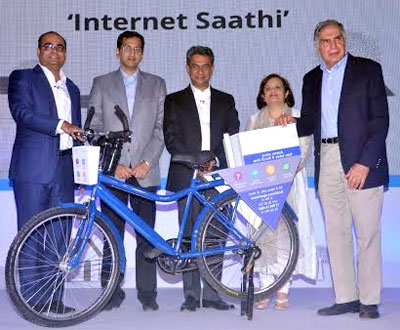
    Sandeep Menon, Country Marketing Director, Google, R Venkataramanan, Executive Trustee, Tata Trusts, Rajan Anandan, VP and Managing Director, Google South East Asia, Debjani Ghosh, Vice President SMG, Managing Director – South Asia, Intel & Ratan Tata, Chairman, Tata Trusts

    There was a time when one had to wait at least seven years to get a phone. Ratan Tata, Chairman of Tata Trusts, certainly remembers that time, and also acknowledges how far we’ve come today with the use of technology. Tata brought this up at the launch of ‘Internet Saathi’, an initiative put together by Tata Trusts and Google, and aimed at empowering rural women and their communities to use the internet to enable development. In fact, the initiative aims to bridge the rather large gender divide as well, when it comes to the use of technology.


    Studies show that only 12 per cent of internet users in rural India are women, according to Sandeep Menon, Country Marketing Director, Google.  said. He highlighted a study carried out in rural India to understand what it is that stops women from using the internet. The key findings were trouble knowing how to use it, the question of what’s in it for them, and lack of a point of access. “While women in the urban areas are making rapid progress using the internet, women in rural areas are getting left behind,” Rajan Anandan, VP and Managing Director, Google South East Asia pointed out.


    With enough statistics in hand to understand the urgent need of women empowerment in the rural areas, vis-à-vis technology, the team has designed a cart, built on the back of a cycle – akin to India’s traditional distribution system which is used to carry everything, from ice-cream to industrial supplies. The cart is fitted with internet-enabled Android One devices, tables and portable chargers, keeping in mind power cuts in many villages. Women will be trained to use these devices, but Menon highlighted that that is the most important thing as the women are curious to know more. “We’ve realised that all we need to do is spark curiosity, and then the women automatically take an initiative to learn the rest themselves and to teach others in the village as well,” he added.


    Debjani Ghosh, Vice President SMG, Managing Director – South Asia, Intel, quoted a UN report which said that across the world, about 25 per cent fewer women than men are using the internet, and the biggest reason for this is that women believe that it is not meant for them. Incidentally, Intel has been a long-term partner of Google India’s Helping Women Get Online (HWGO) initiative.


    Internet Saathi is set to kick off from Gujarat, Rajasthan and Jharkhand, and will eventually be rolled out across the country. It plans to reach 4, 500-odd villages and five lakh women and rural communities over the next 18 months. The internet cart will be available in the village for a minimum of two days every week for over a period of four to six months. It is aimed at creating awareness and will provide adequate training for using the devices. Once the cart has completed the training in a cluster of three villages, it will be moved to the adjoining cluster to complete a similar cycle. The initiative has roped in local self-help group federations and NGO members to help with the training programme.


    While many women in the rural areas still cannot read the language they speak, they use the internet to watch cooking videos or other such material that they find interesting, Ghosh explained, talking about previous initiatives undertaken in the rural areas.


    Asha Devi and Vimla Devi belong to a village called Varkheda in Rajasthan, and were present at the event. Clearly excited about the initiative, they said: “We will be able to get information that earlier we had to go to the city to get.” Added Vimla: “Even after they leave, we teach the other women [how to navigate the internet] and we try to spread the word.”


    “We have a commitment to educate [people] and create prosperity in the villages of India, and we will address it through education and expanding the knowledge base,” Ratan Tata said. “Philanthropy has changed in India over the years. Today, India is a different nation and people demand self-respect and want to be capable of enabling their own livelihood. There is a keen desire to be a part of the world that is today, not the world of yesterday. Digitisation is not only about opening up [a new] India to people, but it’s about connecting them to the rest of the world.” What better way than with the Worldwide Web.


  • Shailesh Kapoor: Are Reality Show Judges too Eager to Please?


    By Shailesh Kapoor


    The season of reality shows has well and truly taken off. It’s a typical phenomenon every year after the IPL concludes, but there seems that much extra on-air this year. Star Plus has Nach Baliye, and there will soon be Dance+. Colors had India’s Got Talent and there will soon be Jhalak Reloaded. One variant of DID on Zee has given way to a new season of the main DID show. Indian Idol Junior on Sony and The Voice on &TV complete the GEC reality list. So, if you have been tracking the category, eight reality shows have been in the mix, either on-air or in promotional stages. Not to talk about half a dozen others on youth channels.


    All the eight mentioned above have a format that needs a jury. So, we are talking of more than 20 different judges across these shows. Now, that’s an industry in itself. Choreographers, film directors and actors typically dominate the list.


    Watching a typical episode of one of these reality shows will make you feel there’s immense pressure on this lot of 20 to ‘perform’. It’s like a mini-competition on the sidelines of the larger channel battles. Everyone is out there to make an impact, without an understanding of the respect and awe that should accompany a jury chair.


    It’s cue-a-gimmick judging, where interspersed between performances (all eight are talent shows, though two of them are about celebrity contestants), a judge would take off on a journey that’s ridiculously disconnected with the show. Reading shaayri is the latest favorite. What Anu Malik and Navjot Sidhu started has now become everyone’s domain.


    Then there’s this sudden urge to hug contestants on stage that about a dozen judges should be medically treated for. It takes about 30 seconds of footage and barring rare exceptions, you don’t feel a speck of emotion watching it.


    The new favorite that’s emerging can be called ‘Let’s pull each other’s leg’. Admittedly, it’s a lot more entertaining than the shaayri and the hugs. But when it happens every seven minutes, you begin to wonder whether you should call it a talent show.


    Reality shows have been a core area of our work over the last seven years. There are three essential ingredients of what a good jury member should have, irrespective of the format of the talent show.

    1. Should be an expert in the field.
    2. Should encourage and motivate participants.
    3. Should come across as humble and rooted.


    The first one may seem obvious on the face of it, but go through the list of 20 and you would know there are at least five crosses on it. But it’s the second and the third where the real gap would lie. Fans of MasterChef Australia would know what these three points mean. The jury of that show embodies them. And yet, there is no trace of gimmick and showmanship on the screen. It’s a natural, free-flowing format that delivers emotions and entertainment within itself. Nothing needs to be ‘cued’.


    The original Dance India Dance jury (Geet Kapur, Terence Lewis & Remo D’Souza) met this brief very well. They had no star value at that time, and yet, would count in my book as the most successful jury combination in the two-decade history of reality television in India.


    The India’s Got Talent jury for the last two seasons (Kirron Kher, Karan Johar & Malaika Arora Khan) top the current set of juries. There was a lot of free flow in the judging process, especially aided by Kher’s disarming persona, and the gimmicks, while they were present, rarely interfered with the format.


    But at a larger category level, it’s time for producers and channels to question their penchant of ‘over-writing’ reality shows. Let the ‘reality’ prevail, and we may have better content!


    And a note to the hosts: When you ask for state capitals to test a contestant’s knowledge, it is not called an IQ Test.


  • Yoga Day earns big dividends on news channels: TAM data

    By A Correspondent


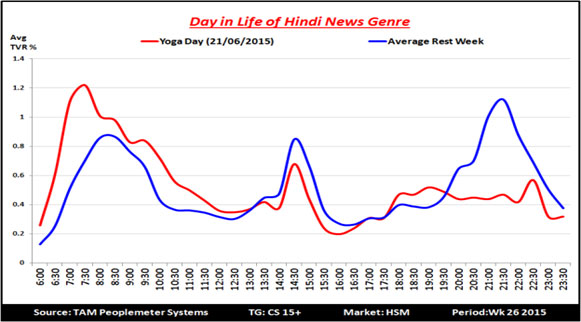
    Both Hindi and English news channels covered Yoga Day on June 21 extensively, as per S Group, the analytical arm of TAM Media Research.


    The news channels took the opportunity on International Yoga Day to give viewers a break from the Lalit Modi case which had been dominating the coverage since the previous week.


    Celebrated on June 21, the event was also covered outside the news genre, on various Doordarshan regional channels along with DD National, which garnered the rating of 0.09 at an All India level. (All 4+)


    Among the Hindi news channels, Aaj Tak witnessed maximum viewership for Yoga Day coverage which devoted 50% of its content time to the same on June 21. However, it was IBN 7 which covered this story most heavily with 9 hours content.


    The viewers entered the genre earlier than usual on Yoga Day.


    Times Now was the leading English News channel to gain viewership from Yoga Day coverage, which garnered 47% of the overall viewership of this news within the English News Genre.


    Both Aaj Tak and Times Now maintained their leadership position in the respective genres in week 26.


  • The Indian Express launches edition in Jaipur

    By A Correspondent


    With a view to cater to a wide spectrum of target audience and expand its readership base, The Indian Express Group launched the Jaipur edition of its flagship brand, the Indian Express on July 5th 2015. This is the national daily’s tenth edition in the country.


    The paper is priced at Rs 4 on all weekdays and will be a 20 page edition, with both an up-country and a city edition. The Jaipur edition of The Indian Express brings with it the trademark brand of ‘Journalim of courage’ that the newspaper espouses. With a focus on unbiased news delivery, the newspaper will offer exclusive investigative stories and opinion pieces written by some of India’s best minds. The newspaper will offer the Pink city residents 20 pages of high quality news, containing all that a reader would need to know.  With customized pages, dedicated to new ideas across governance, opinions and explanations, war-torn conflict zones, relationships, skilling and education among others, The Indian Express Jaipur edition will bring more daily life to the daily.


    The launch will be supported with an extensive marketing campaign, both ATL and BTL programmes.


    Commenting on The Indian Express’s entry in Rajasthan, Pavita Puri, Group Head – Brand, The Indian Express Group says, “We are thrilled and excited with an overwhelming response to our launch in Jaipur. This is an important region, emerging fast on the national footprint of development. We are committed to making The Indian Express the preferred newspaper of the discerning reader who seeks credible news, knowledge and an incisive point of view.”