Category: MEDIA

  • Ranjona Banerji: Do we fight or do we bend and crawl to ensure our salary cheque every month?

    By Ranjona Banerji


    Forty years ago, the nation of India faced its toughest test. Its young democracy was attacked from powers within. The declaration of a national emergency by the then prime minister Indira Gandhi was a shocker and the beginning of some of India’s darkest days. Society however struggled to respond. It is hard for people today to imagine how different India was then. We had no 24 hour media. Most of us did not even have television. Newspapers were staid and conservative. Radio news broadcasts were still important. And Indira Gandhi was a towering figure, striding over the subcontinent, controlling us all.


    Or so we thought. In some ways, we did not even understand the importance of our fundamental rights and the freedom of the press until they were taken away. Although the JP movement calling for internal revolution against Gandhi and her policies excited students across India, we were still a conservative, status-quo society. Many people in fact welcome the Emergency because of the “discipline” it imposed on what was perceived as a lazy, good-for-nothing people. It was only later when the excesses of government policies, notably enforced sterilisation and slum clearance, became common knowledge that public anger started growing. The slogan “Nasbandi ke teen dalal: Indira, Sanjay, Bansilal” used to greet sterilisation trucks (Sterilisation has three brokers: Indira, Sanjay and Bansilal). And when everything is forbidden, as always happens, we were full of jokes and back humour about what was going on.


    But this is about the media. And what happened there was largely more shameful than the way Congress politicians acquiesced to the murder of democracy to save their careers. Most large newspaper groups felt it easier to give in than to fight. Interestingly, it is not far different from the way corporate and managers hold sway over newsrooms today. Or am I jumping the gun?


    Celebrated lawyer Soli Sorabjee wrote this about the Emergency in the book India 50: The Making of a Nation, co-edited and authored by senior journalist Ayaz Memon and myself: “The role of the national press in this was disgraceful. In the memorable words of LK Advani, when the press was asked to bend it chose to crawl. Leading newspapers and their editors fully realised both the absurdity and the illegality of the Censor’s action but were unwilling to challenge it in a court of law…”


    The Times of India, the Hindustan Times and the Hindu abandoned the most principles to play it safe. The Indian Express and The Statesman were far braver and therefore shone. Most memorable were the smaller, independent journals like Minoo Masani’s Freedom First, Rajmohan Gandhi’s Himmat and Astad Gorwala’s Opinion, who stood up to both Indira Gandhi and the Censor. Several language newspapers also held on to their rights.


    Sorabjee in the same article, quotes from the Bombay High Court’s judgment of February 1976, in the case of Binod Rau versus Minoo Masani: “It is not the function of the Censor acting under the Censorship Order to make all newspapers and periodicals trim their sails to one wind or to tow along in a single file or to speak in chorus in one voice. It is not for him to exercise his statutory powers to force public opinion into a single mould or to turn the press into an instrument for brainwashing the public… Merely because dissent, disapproval or criticism is expressed in strong language is no ground for banning its publication.”


    The Gujarat High Court called the censorship directives “a mask of suffocation and strangulation”.


    Indira Gandhi got her comeuppance in the elections of 1977.


    But what lessons has the media learnt from the Emergency? Do we still bend when we are asked to crawl? Have we fought enough for our rights – which amounts to the rights of the people to know – or have we decided it is easier to take a salary cheque than to fight for freedom of expression? Do we oppose transgressions on the rights of others or we calibrate our responses to suit our corporate masters and managers?


    Over the years, we have seen business and glamour journalism falling to market forces and done nothing. We now see political journalism being coloured totally by personal beliefs. The onus remains on individual journalists to stand up to newsroom pressures. Is that enough?


    I met Binod Rau, the Censor during the Emergency, in the 1990s. He was a broken man then, both apologetic and defensive about what he had been asked to do and what he did. An abject lesson in the dangers of giving in when you should stand firm no matter what you have to give up.
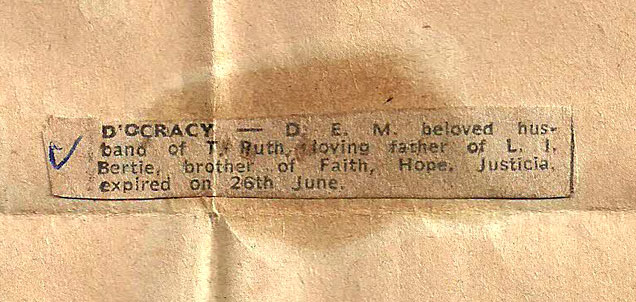
     

  • How Ashok Mahadevan innovated in his protest against the Emergency


    Forty years back, veteran journalist and former Editor of the Indian edition of Reader’s Digest was incensed with the Emergency and what it meant for free India. Then Deputy Editor of the Digest, Mahadevan was inspired by an ad in a Sri Lankan newspaper and inserted in The Times of India, which has now become one of the most enduring examples of how the country fought back the draconian government led by an ill-advised Prime Minister. On the eve of the forty years of that Dark Day, Dyanne Coelho interacted with Ashok Mahadevan who responded to her questions and also asked her to pick up some accounts from an article he wrote in the Reader’s Digest in 2010.


    The Q&A:

    What was the situation like especially for journalists during the days of the Emergency?

    For more than a year, the Prime Minister had been besieged by a nationwide movement against her led by her father’s old friend, the venerable Gandhian Jayaprakash Narayan (JP). Now, as she had done so often, Mrs Gandhi hit back ruthlessly. On June 25, she declared a state of “Emergency.” The press was muzzled, civil rights were abolished and tens of thousands of political activists, including JP, were arrested. In effect, India became a dictatorship. These momentous events—40 years ago this month—also enabled me to prank my way into becoming a small footnote in the history books. When I learnt the news on the morning of the 26th, I was incensed. India no longer a free country? As acitizen, even more as a journalist, it was intolerable. I had to do something. But what? Fear was spreading like an infection. When I asked a friend, who’d just flown in from the US, how it felt coming to a dictatorship, he told me to shush. People were too scared to jump queues at bus stops! I wasn’t exempt either; some of my politically active friends had been incarcerated and although I visited them in prison, I had no desire to join them there


    Was the idea of the obituary you published your idea? Tell us something about it.

    I remembered an item available for publication in Reader’s Digest—I was then this magazine’s deputy editor, based in Mumbai— about the “death” of democracy. It had originally appeared in a Sri Lankan paper when an emergency had been declared in that country. The ingenious item dealt with the demise of “D.E.M. O’Cracy,” who left behind several relatives, including a son named L.I. Bertie. Why not put this item in the obituary column of the Times of India? I copied it down and made my way to the office of the Times nearby. The clerk in the classified advertisements department there told me he couldn’t accept it because it was too long. I began arguing with him; then, fearful that he might suddenly realise what I was up to, I shortened it. “Are you Bertie?” the clerk asked me. It took few moments to understand what he’d meant. “Oh, yes,” I bluffed. The obituary advertisement was accepted. I paid the small fee and left. Would the item appear? I spent an anxious night, and made sure I was the first in the family to grab the Times the next morning. And there it was! O’Cracy, D.E.M., beloved husband of T. Ruth, loving father of L.I. Bertie, brother of Faith, Hope and Justicia, died on June 26. I was overjoyed. But for it to have any impact, a lot of people—and not just those who read the obituary columns regularly—had to see the item. So I called up a friend in the Times and, disguising my voice, asked him if he’d read the day’s obituary column. “Who’s this?” he asked suspiciously. “Never mind,” I said. “Take a look at it.” He began grumbling, but obeyed, and I heard his voice rising in excitement as he read the ad aloud. “Make sure you tell everyone about it,” I said, hanging up. Word about my ad spread fast. Those who were against the Emergency loved it. Many people sent clips of it to everyone they knew. Among them, I later learnt, was the advertising director of the Times of India! (After the Emergency, he told me so himself.) The ad was even reproduced in foreign newspapers.


    Were you scared of a backlash from the government following its publication? Is that why you withheld your identity and changed your physical appearance?

    The police were called in to find out who had placed the ad. But they got nowhere. This may have been partly because I took some precautions. Shortly after the ad appeared, my wife Jessica and I were scheduled to appear in a Doordarshan programme featuring couples. Since there was a chance that the Times clerk would watch the show— Doordarshan was the only TV channel in those days—I shaved off my beard to look less like “Bertie.” (Several people grew beards to protest the Emergency; I was the only one to have removed his!) Naturally, there were all kinds of rumours about who’d placed the ad. In fact, one Digest reader who dropped into our office even told me a lurid story about how the perpetrator had been caught and tortured by the police! Of course, for all the publicity the ad received, it did not have the slightest effect on the Emergency. That was lifted only 19 months later when Mrs Gandhi, for reasons scholars still speculate about, announced that Parliament was to be dissolved and elections held. To everyone’s astonishment, her party was routed—she even lost her own seat—and the Janata Party formed India’s first non-Congress central government in mid-1977.


    The gutsy obituary drew attention to the situation in India even in the foreign media. What was the reaction when you finally revealed yourself as the person who published it?

    Apart from my friends who congratulated me for publishing the ad–I outed myself in the magazine Debonair, then edited by the late Vinod Mehta–the Times of India clerk who’d accepted the ad called me to say that he’d been punished by the Times for accepting it. Since I knew Mr Thirumalai, the then ad director of the TOI, I complained to him about penalising the clerk. Thirumalai angrily denied that any action had been taken against the clerk and revealed that that he’d been personally delighted by the ad (see article) etc. He then called the clerk and gave him a firing in my presence for lying to me!


    Do you think journalism today has evolved to an extent that we can be protected from such happenings in the future?

    I wish I could foretell the future and reassure you that journalism today has evolved enough to ensure that another Emergency is not possible. However, I think that, thanks to TV, and most importantly, the social media, I think there will be much more opposition to any attempt to impose dictatorship in India.


    In your opinion is the government today strong enough to prevent history from repeating itself?

    Power tends to corrupt, so the stronger a government, the more likely it is to rule dictatorially. All citizens, and especially journalists, should always be on guard against strong governments and fight dictatorial rule (non-violently) if it is imposed.


    Ashok Mahadevan photograph courtesy Reader’s Digest


  • LinkedIn reveals most influential brands for 2015

    By A Correspondent


    LinkedIn has revealed the most influential brands among its 364 million members worldwide, as well as the most influential among LinkedIn India’s 30+ million members.


    The rankings are based on LinkedIn’s Content Marketing Score, which is calculated by measuring a brand’s unique engagement and dividing it by a brand’s audience. LinkedIn has used this data to identify the behaviors and activity that boost content engagement. The most effective brands use a mix of reach, frequency and engagement to boost engagement on LinkedIn.


    Globally, technology companies emerged as winners this year with the number one slot going to Microsoft. Other technology companies included IBM,Hewlett-Packard, Google and Salesforce – all brands which have adopted an always-on strategy that is rooted in the quality of content. This is true in India too. The rankings show that technology companies are succeeding at content marketing efforts on social media with TCS, Wipro and HCL leading the way.


    The top ten most influential brands among LinkedIn members in India for 2015 are:

    1. TCS
    2. Wipro
    3. HCL
    4. Infosys
    5. Tech Mahindra
    6. Housing.com
    7. ICICI Bank
    8. Tata Communications
    9. Axis Bank
    10. Biocon


    Commenting on the rankings, Ashutosh Gupta, Director, Marketing Solutions, LinkedIn India said, “Content along with the right context is the essential way to engage, educate and inspire an evolved consumer base. With consumers becoming more discerning about the quality of content and lives getting busier, content must be educational, yet original. In India, technology brands seem to be getting this right by focussing on subjects that people are eager to hear about.”


  • RBNL’s Big Magic goes for a new look and identity

    By Dyanne Coelho


    Comedy in India is a serious business and as a genre is picking up at a fast pace. Keeping this in mind, Reliance Broadcast Network Limited has rebranded its comedy entertainment channel Big Magic with a fresh new look and channel identity. Viewers can look forward a renewed focus original content, sitcoms, non-fiction shows, among others.
     

    Speaking at the unveiling of the new brand identity, Tarun Katial, CEO, Reliance Broadcast Network Limited said, “It’s going to be topical, it’s going to be contemporary, it’s going to be refreshing. We believe that comedy as a factor will predominantly factor in males and we believe that male entertainment is starved from anything but news and sports. Our attempt with the new identity is largely to be able to capture urban India and to make India laugh.”


    The logo unveiling earlier this week at the Canvas Laugh Factory witnessed the presence of popular Big Magic stars including Kiku Sharda who plays the role of Akbar in Akbar Birbal, Dalnaz Irani aka Rani from the same show and Saloni Daini, Ami Trivedi, Iqbal Azad, Dharmik Joisar and Sushant Mohindra of Tedi Medi Family as well as Upasana Singh and Gaurav Sharma from Total Nadaniyaan.


    “The plan is to make Big Magic the ultimate comedy destination of India. We’ve been getting a great response from viewers, and hence we’re moving to better sets etc, to improve our content. ‘Tedi Medi Family’ is an adaptation of the Warner Brother’s show ‘The Middle’, Akbar Birbal has also received a lot of praise, and we have many more shows planned for the future,” Paritosh Painter, Network Creative Director, RBNL expressed.


    Shalini Gupta, CMO, Big Magic TV Network, RBNL revealed the marketing mix behind the channel, “Comedy is a relatively new genre in India, at the same time it is extremely popular and is growing. Our marketing strategy targeted areas where people don’t laugh, because we wanted to make people laugh. Hence we do a lot of BTL activations. Digital marketing is increasingly becoming a very important part of our strategy. Earlier it was a meagre two to three percent, and it has now grown to about six to seven percent of the budget and will be improving a lot more.”


    The channel was a light entertainment channel a year ago, but the team at the front wanted to sharpen the position of the channel to a comedy network. “There is a definite vacuum in the comedy space in India aside from a few shows on Colors and &TV. We wanted to cater to the absolute comedy market, to the audience that loves comedy. So we’re making sure that all our shows even in the future have got a lot of LOL moments,” Painter explained.


    The content offered on Big Magic will be platform based agnostic with a large play in the digital and mobile medium. The channel is available across all DTH players including Tata Sky, Videocon, DD Free Dish, Dish TV, Reliance Digital TV and with all cable operators as well.


  • MediaCom wins media mandate of Welspun

    By A Correspondent


    MediaCom has won the media mandate of Welspun following a multiagency pitch. Welspun Global Brands Ltd—Retail Division is India’s largest speciality company in the home furnishing segment.


    Dipali Goenka, Managing Director, Welspun Global Brands Ltd. And Executive Director, Welspun India Ltd said, “We are happy to be associated with MediaCom as we were looking for a media planning and buying partner who has a deep understanding of our sector and could support us strategically to meet our business goals.”


    This is MediaCom’s eight win in 2015. Since Jan 2015, MediaCom has added billings worth USD 80 mn from new wins, well on its way to beat the 2014 number of USD 100 mn. The 2015 wins include SAB Miller, Urban Ladder, Subway, Bose, Mango, Dainik Bhaskar, Mydala and now Welspun.


    Commenting on the win, Debraj Tripathy, Managing Director, MediaCom said, “ I and the team are delighted to partner Welspun. We have had a good year till date and I am thankful to our clients who have trusted us with their brands and media investments. The team is excited about Welspun and are looking forward to do some great work.”


  • Star Sports unveils ‘Le Panga’ campaign to promote Pro-Kabaddi League

    By A Correspondent


    Star Sports has launched the marketing campaign for Star Sports Pro Kabaddi, titled Le Panga (#LePanga). The campaign created to inspire people to overcome personal limitations and barriers, endearingly portrays life situations where the protagonist(s) go through a transformational change on exposure to Kabaddi.


    Talking about the campaign a Star Sports Spokesperson said, “As a sport, Kabaddi is unique in the nature of the challenge undertaken by the players. A raider is alone and almost always faced with insurmountable odds with the defenders waiting to pounce on him and use their collective physical might to overpower the raider and stop him from accomplishing his objective. The campaign, #LePanga, cites real life situations as in the sport that people can relate to.”


    The first film of the series, marking the debut of well-known radio jockey Malishka as Inspector Laxmi Peter, went on air during the third ODI between India and Bangladesh.


    The ad-film, full of Bollywoodesque drama, revolves around an ambitious female police officer, Inspector Laxmi Peter who can only be described as ‘the unlucky one’. The idea centres on Laxmi Peter getting inspired to change while watching a Pro-Kabaddi League match, having resigned herself to her fate. Inspector Laxmi Peter, in the climax, manages to finally capture the group of criminals and her elusive target Rakka all her on own.


    The advertisement has been styled to include all major elements of a Bollywood film – the flashback to her childhood where she expresses her dream of becoming a police officer, the scenes where Rakka escapes her grasp after a chase and the climax where she ultimately overcomes her limitations to accomplish her goals, inspired by Kabaddi. The storyline highlights the many attractions of the Star Sports Pro Kabaddi League and builds towards the excitement of watching the sport.


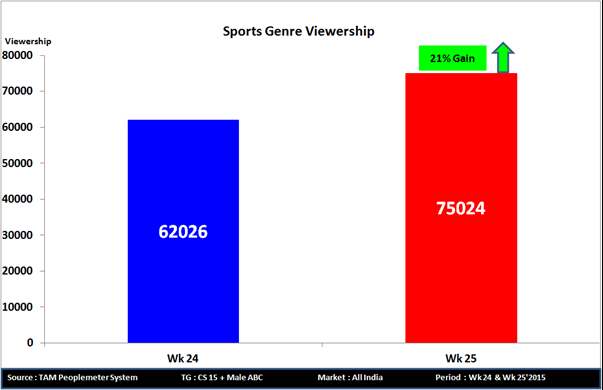
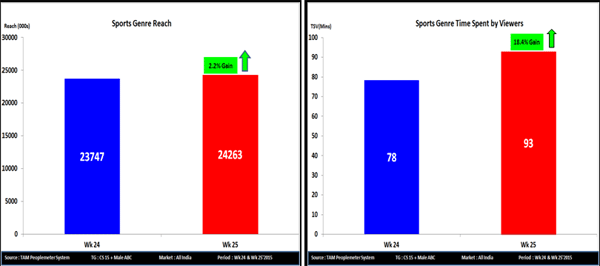
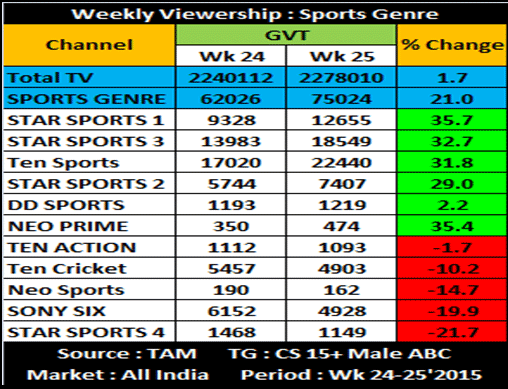
  • TAM DataCheck: Sports genre gained 21% viewership in Wk 25,2015

    By A Correspondent


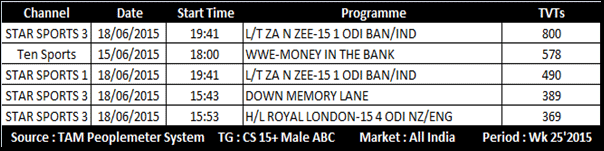
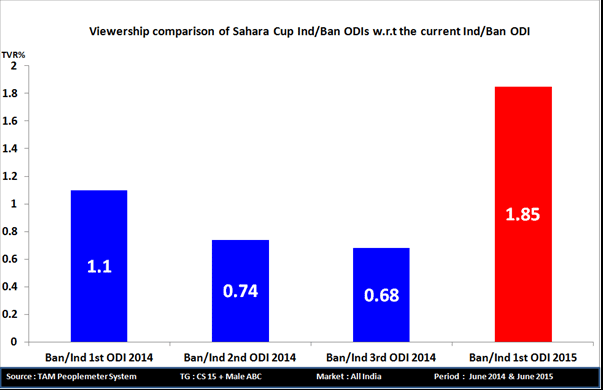
    The sports genre has seen a 21% viewership gain in Week 25 of 2015, as per analysis conducted by S-Group, the analytical arm of TAM Media Research. The recent India-Bangladesh first ODI saw a viewership growth of approx 120%  with reference to the previous India-Bangladesh encounters in 2014.


    • The increase in viewership levels is majorly because of increase in TSV levels in the current week
    • Star Sports 1, Star Sports 3 & Ten Sports have seen a major growth in the week 25 2015.
    • Ind vs Ban 1st ODI & WWE- Money in the bank feature in the top programme list in wk 25 2015

    • Current Ind/Ban 1st ODI has seen a viewership growth of approx 120%  w.r.t previous Ind/Ban encounters in 2014.
  • Payment startup Oxigen to sponsor SA’s T20 team

    By Harsimran Julka


    Delhi-based Payment wallet Oxigen has sponsored the South African Cricket Team for the upcoming T20 cricket tournament this month.


    With the sponsorship, Oxigen joins a spate of Indian start-ups such as Snapdeal, Paytm, YepMe  and CarTrade who have either advertised in international cricket matches or sponsored global teams. Delhi based YepMe had sponsored West Indies team for the ICC Cricket World Cup for about Rs 30 crore, earlier this year.


    The Proteas T20 squad will walk onto the field against Bangladesh the match on July 5, 2015, with Oxigen brand as the sponsor backing the team.   Oxigen was originally started in a partnership with two South African investor/entrepreneurs and Delhi based former Motorola India President Pramod Saxena in 2004.


    Johannesberg-based Blue Labels Telecom continues to hold a stake in Oxigen India. The Oxigen Proteas will feature in twelve T20 matches against Bangladesh, New Zealand, India, England and Australia before next year’s ICC World Twenty 20 Championships in India.


    “Technically, this is not a new sponsorship, but rather an exciting initiative by Blue Label Telecoms to create added value to their diverse organisation,” said Cricket South Africa’s Chief Executive, Haroon Lorgat. “The Proteas are a globally recognised brand with huge support in India. This exciting initiative by Blue Label Telecoms is both unique and a first for Cricket South Africa, as having an international based company as the team sponsor is a pioneering step.”


    “Oxigen is a brand born and bred in India, and we expect that Oxigen’s sponsorship of the Proteas T20 team will resonate closely with the Indian community,” added Mark Levy, joint CEO of Blue Label Telecoms.


    Source:The Economic Times

    Copyright © 2015, Bennett, Coleman & Co. Ltd. All Rights Reserved

    Licensed to republish


  • Can CNN-IBN survive (and thrive) minus CNN?

    By A Correspondent


    One still recalls the euphoria about the first Gulf War coverage on CNN in 1990-91. Or the coverage of the Babri Masjid demolition of 1992. Both channels had a headstart in independent television news journalism in India. A World This Week and news on Zee TV or Aaj Tak and Tonight hadn’t started by then. Doordarshan news had its star anchors, but it was a government mouthpiece.


    If both channels had got their act together, we wouldn’t have the half-dozen English news channels in existence today.


    While BBC still has some India-centric programming, CNN has hardly any of it. Even though it’s had a full-time bureau here and several desi names across the world.


    So when Rajdeep Sardesai quit NDTV to team with up Sameer Manchanda and later with Raghav Bahl, stitching up a licensing agreement with CNN made sense. Although NDTV was an independent operator and Bahl had earned his stripes with CNBC-TV18, a CNN prefix gave their new channel the push for it to speed ahead. The fact that it was CNN-IBN and not IBN-CNN indicated that there was a sentiment that the CNN connect will give the channel an upper hand.


    It did, but we soon realised that save on occasions when there was an American election or some other major developments, there wasn’t much of Made by CNN coverage on CNN-IBN. In recent times, we had some Farid Zakaria interviews – including one with Prime Minister Narendra Modi – but they made no impact.


    Clearly, IBN didn’t need CNN.


    For the channel, the exit of Rajdeep Sardesai last year was a bigger setback. The primetime bulletins aren’t bad, but the channel is no longer counted among those that matter.


    So TV18 and CNN have announced the concluding of their 10-year licensing arrangement in January 2016. The conclusion of the arrangement will enable each company thereafter to chart its own growth trajectory independently.


    Said A P Parigi, Group CEO, Network18 in a statement: “The last decade has seen a lot of momentum in the Indian media industry and has been particularly exciting for us. During this time we witnessed two media houses coming together to redefine the way news is presented to a demanding audience; we at TV18 have benefited from this relationship with CNN. At the launch of the channel, TV18 was a relatively small organization; that has changed now.  Network18 has grown from two news channels in 2005 to 17 news channels in 2015. Today, we have the largest footprint in the current affairs, regional and business news space in India.  The TV18 line-up of channels today are well established and highly regarded in this dynamic, complex and challenging environment.”


    Now, let’s interpret this. What Parigi obviously means is this:  “Ten years back, both media houses needed each other to present an offering to a demanding audience. We were a small organisation then, but that has changed.”  And of course this: “We don’t need CNN.”


    As for CNN, talks with the Zee group are reported to have reached an advanced stage and this could well result in an all-new English news channel from the Zee Media Corp stable.


  • Ranjona Banerji: Fair, upright, always objective, never biased columnists to the PM’s rescue

    By Ranjona Banerji


    The recent attacks on journalists in Uttar Pradesh and Madhya Pradesh and the deaths of two, Jagendra Singh and Sandeep Kothari, have shocked many and started a small conversation between journalists. But the fact remains that the conversation is small. There is an undoubted divide between English language and regional journalists and the clout is largely concentrated in the hands of the English media.


    The divide is understood and accepted but it is not breached. On the whole, English language journalists are better paid and are seen as more professional. Language newspapers are often owner and agenda driven and journalists are used to do far more than report, sub and bring out a journal or produce news bulletins. Sadly, instead of the “professionalism” moving to local and regional journalists, English journalists are more and more opting to act as brokers for their owners and managers.


    We all know all this but are unable to give ourselves a voice and think and act as one. The outrage lasts for a while, dies and out and we are back to where we started. Thanks to cross-ownership patterns and television, some regional and local journalists are paid decent wages but not all and not enough. The wage board concept seems archaic and anachronistic but for many journalists it is the only safeguard to give them some wage at all.


    The plight of the local journalist is best explained in this op-ed piece by Omar Rashid in The Hindu:

    http://www.thehindu.com/opinion/op-ed/for-regional-journalists-its-a-fight-for-survival/article7364281.ece


    **


    There has been a lot of muttering on social media that “the media” has not been doing enough on the “Vyapam” scam in Madhya Pradesh. The allegation is the admission and selection processes to government jobs and colleges were rigged by the Madhya Pradesh Professional Examination Board. The numbers run into 1000s. The problem appears to go back to 2008. Investigations began in 2013. Over 1800 people were arrested. Oddly, somewhere between 25 and 40 witnesses and suspects have died since 2013. The state government insists that these are “natural” deaths but logic belies that argument.


    Stories, reports and opinions about this scam and the spate of deaths have all appeared regularly in local and national newspapers. The perceived problem in today’s India is that no issue is an issue unless it appears on television debates with plenty finger-pointing and defensive yelling. As we have seen in the Lalit Modi case.


    Unfortunately for the dead suspects and witnesses, prime time debates have not seen fit to take on the government in this particular instance. The Lalit Modi saga continues to excite although it may well die out soon.


    **


    One of the funniest aspects of the Lalit Modi case is the number of “expert”commentators coming out in support of the former IPL commissioner Lalit Modi, now in self-imposed exile in Mayfair, Montenegro, Portugal, Venice and such like tough places to live and party. Many of these belong to the category which tends to moan and bemoan the tremendous damage done to cricket by the short format game and the high glitz of the Indian Premier League. From Indian Express to New Indian Express to firstpost.com to The Times of India and more, they tell us how Lalit Modi is misunderstood and misjudged. He was wickedly hounded by the former UPA government and the BCCI for nothing.


    It does not take much to see that these fair, upright, always objective, never biased columnists, known for their slight tilt towards the BJP (unlike ghastly paid media unspeakably evil anti-Hindu anti-India secular dynasty hacks), are in fact trying to protect prime minister Narendra Modi from any and all possible muck from this case which has embroiled his external affairs minister and the chief minister of a BJP-ruled state.


    Looking forward to more efforts to sanctify Lalit Modi on the road to saving Narendra Modi…


    **


    The Press Institute of India and the International Committee of the Red Cross announce their annual competition for the three best articles and three best photographs on a humanitarian subject. This year’s theme is “Reporting on the fate of victims of natural/manmade disasters”. The awards carry cash prizes of Rs 50,000, Rs 30,000 and Rs 20,000.


    Reports and photographs need to have been published between April 2014 and March 2015 in any language or English journal.


    Please visit www.pressinstitute.in for further details.


  • Discussion on emergence of Twitter in storytelling

    By Dyanne Coelho


    Popular microblogging platform Twitter hosted an interactive and informative conference entitled #RiseWithTwitter highlighting the future of mobile storytelling in India and the emerging uses of the platform. Held in Mumbai on Tuesday (June 30), the event saw a cross-section of mediapersons and well-known personalities talking on the rise of the platform.


    For instance, Meghna Pant, Indian literary fiction writer and financial journalist shared an inspiring tale of how she tweeted the Mahabharata in just 100 tweets.


    Times Now Editor-in-Chief, Arnab Goswami  joined Rishi Jaitley, Market Director, India and South East Asia in an engaging session to discuss the applications of Twitter in the world of journalism. The Lalitgate hashtag (#Lalitgate) coined by Times Now after the recent expose, has earned 43.2 million tweets in a six-day period, Twitter revealed. “Television gets me an audience five times bigger than digital,” Goswami said but added that both mediums are now working in a complementary fashion. “We’re six years away from a digital explosion,” he said of research and he advised that if you are working in the field of digital, hang in there, things are going to explode with change.


    Balu Nair, the creator of the Twitter handle @BloodDonorsIn explained how Twitter as a medium is being used for a cause. If any patient is in dire need of a blood transfusion, the family or friends can tweet at the handle with the requirement. Nair explained that kind souls have even travelled cross city to donate blood to those in need thanks to the handle.


    MN Reddi, Commissioner of Police, Bengaluru in the session ‘The Mobile Microphone’ moderated by Mid-Day Editor Sachin Kalbag pointed out the advantages of Twitter for himself as a person of authority and responsibility. People feel safer because they feel connected to the Commissioner and they get immediate responses to their queries and/or complaints, however rumours are still a huge issue in the world of social media, he said. Henry Jenkins, American media scholar and professor of communication and journalism at USC, brought to note that many scandals would not have hit as hard as they did if it depended only on the media. It is the people who have created the buzz on social media and brought issues to light he said. He cited the example of the hashtag #CNNFail a few years back that trended on Twitter, and which was created by the public to express their disappointment of CNN’s coverage of the aftermath of the Iranian election coverage. Sunil Chhetri of the Bengaluru FC football team highlighted the negativity a platform like Twitter brings to him as a player and to sportspersons in general. “When we lose a match, I dread looking at my phone, because the fans tweets are further depressing. So I check them only a day after once I have calmed down,” he explained.


    While people like sportspersons or celebrities can afford to wait a day to respond to tweets, brands don’t have that luxury, Deepali Naair, CMO, Mahindra Holidays said. For brands what is important to engage in conversations that matter to people, she said.Abu Mathen George of the Ministry of External Affairs discussed how his team handles multiple Twitter handles to cater to various needs of Indian citizens. Twitter was used extensively to carry out the evacuations of Indians from Yemen, he explained. People could tweet at the handle about their whereabouts and the Ministry would respond with nearest ports or planes for them to get to. A similar strategy was used during the Nepal earthquake. The importance of engaging the audience on a mobile global platform is key, the panelists Manan Mehta, VP, Yash Raj Films, Abu Mathen George of the Ministry of External Affairs and business journalist Shaili Chopra discussed in a session moderated by Anant Goenka, Director of the Indian Express group.


    Nitish Tipnis, Director Sales and Marketing, Hover Automotive India, Deepali Naair, and Shivnath Thukral, Group president, Corporate Branding and Strategic Initiatives at Essar engaged in audience  in an interesting discussion on humanising brands on social media. Whether you are a relatively formal brand like Essar, or a fun brand like Mahindra Holidays, it’s all about keeping the conversation casual on a social media platform, yet getting your word across to the right target audience.


    “India is one of the leading markets in terms of user base,” Taranjeet Singh, Country Business Head, Twitter India, said. “Growth in India has been phenomenal. We work with over 600 brands and we have recently launched TV targeting as well because we realised that many people tweet about the content they are watching. Twitter India is way ahead of the business plan in terms of revenue,” Singh revealed.


  • Times Network launches MN+, an HD-only English movie channel

    By Dyanne Coelho


    The Times Network, which includes channels like Times Now, Zoom, ET Now, Romedy Now and Movies Now, has announced the launch of MN+, a premium movie channel, available only in HD. The channel is a complete rebranding of Movies Now Plus, which will cease to exist post this launch, Vivek Srivastava, Senior VP and Head English Entertainment Cluster announced.


    The prominence of Hollywood movies in India has gone up, Srivastava pointed out, and MN+ will cater to the intelligent aspirants, the ones who believe their time is valuable, he said. “The channel has been hand-crafted not just for the informed, intelligent and discerning movie lovers, but for the cineastes as well. It is designed to give viewers a Gold Class Experience of Hollywood.”


    Vivek Srivastava

    MN+ and Movies Now will co-exist, showcasing two entirely different sets of movies. It is not a simulcast, Srivastava stressed. Movies that will be available on the newly launched channel include Argo, The Shawshank Redemption, The Hurt Locker, Sherlock Homes, The Bourne Supremacy and the like. Advertising duration on the channel is set to be at six minutes per hour while on Movies Now it is 12 minutes per hour.


    “The MN+ extension of Movies Now comes at a time when viewers across our markets have responded extremely positively to the Movies Now brand. The rapidly growing reach and ratings of Movies Now over the past year bears testimony to this,” Srivastava said, adding, “Movies Now leads the category in BARC ratings. The channel commands a 26 percent market share and has the highest reach in the category.”


    The network is focusing on both metros as well as Tier II and Tier III cities. “Consumers are ready to pay a premium for HD because of the quality and if you give them what they want and the content is easily accessible, then they are likely to avoid resorting to illegal downloads to catch their favourite movie,” Srivastava said. The network is confident that MN+ will add to viewer and advertiser numbers. The implementation of DAS in Phase 3 and 4 is eagerly awaited and will help in terms of subscription revenues and availability, Srivastava added.


    The MN+ library comprises must-watch movies across genres that are universally celebrated and are discussed extensively in social gatherings of people who have an opinion.  The channel will not only showcase great titles, but will also package them in interesting on-air properties like Center Stage, Great Adaptations, Opening Night and Hollywood Select, among others.


    Discussing the target audience of the channel, Srivastava said, “MN+ is for those premium audiences that have the temperament to be choosy about what life has to offer and have evolved to value only the best.”


    Speaking about advertiser endorsement, he said, “Not just viewer delight, we are also pleased and humbled by the strong and enthusiastic response from advertisers and marketers. Over the past year almost all the major brands have been present on Movies Now and we are increasing that count every day.”