Category: MEDIA

  • iTV Network seeks to ‘Connect Dots’ via new identity

    By A Correspondent


    iTV Network has launched a mega brand campaign for the first time since its inception covering all its media brands namely NewsX, India News (National and its four regional channels) and its two print publications-The Sunday Guardian and Aaj Samaj. Starting March 16th, Monday iTV Network will also reveal a fresh look.


    Themed as ‘Connecting Dots…’, this new brand campaign will replicate the channel’s vision and editorial ethos. Every dot has a story. They are often the links to the bigger patterns of the universe and life. But these are often so tiny that we miss it literally and metaphorically. iTV Network will find the invisible and connect them with what is known and discover what is still a possibility.


    Speaking on the launch of this campaign, Kartikeya Sharma, Managing Director, iTV Network, said, “This is the first time we are launching a brand campaign for the entire network since its inception. This will take the network’s philosophy to the next level.”


    Savvy Dilip, Group CMO, iTV Network, said, “We are confident that this new look of the network complemented by this brand campaign will be highly appreciated and bring in a breath of fresh air to the brand. This campaign will be supported by a robust 360 degree marketing campaign.”


  • Grey releases another TVC promoting Swachch Bharat initiative

    By A Correspondent


    GREY group India has rolled out a new film for the Swachch Bharat Mission. The 60 second film is launched for the Ministry of Information & Broadcasting that is leaving no stone unturned to support Prime Minister Narendra Modi’s dream of a litter and garbage-free India.


    Although the idea of keeping surroundings clean has always been alive, there is a need to evoke the feeling of accountability within every citizen to bring the thought of cleanliness into action. Hence, it is required to fight this battle for cleanliness on many fronts. While the first TV spot, also conceptualized by GREY group India, used the idea of ‘slow clapping’ to shame the offenders for not keeping their areas clean, the central idea of the latest film is to get people take ‘ownership’ of public places.


    Malvika Mehra

    GREY group’s National Creative Director and EVP, Malvika Mehra said, “If each of us take the responsibility of keeping even just ‘our area’ or ‘apna ilaka’ clean, the dream of a Swachh Bharat can come true, sooner than we imagine. Through this film we have tried to inculcate a ‘pride of ownership’ amongst the citizens of India, so famous landmarks like ‘Chandni Chowk’ automatically become ‘Chandni KA Chowk’, ‘Azad KA Maidan’, ‘Marina KA beach’ and so on and so forth. With the message and hope that ‘if you own it, you will look after it.”


    The landmarks shown in the film are from the four cities in India –Mumbai, Delhi, Kolkata and Chennai.


  • Hot, happenin’ and most wanted!


    By N Shivapriya


    Last week, early talks were reported between Google and ad tech firm Inmobi for a possible valuation of over Rs 12,000 crore. Inmobi founder Naveen Tewari later told employees that he was not looking for such a deal. The same day, it was also reported that e-commerce firm Snapdeal was looking to acquire Komli Media, another ad tech firm, for a potential valuation of over Rs 1,800 crore. Flipkart acquired Adiquity earlier this month.


    All this comes in the backdrop of a squeeze in the US. After an early flurry in 2013 and the first half of 2014, the number of ad tech initial public offerings have now dried up. But that hasn’t deterred new firms and existing ones from aiming for a slice for huge spends that are on stake as online ad spend continues to grow on the PC and mobile. It could also very soon enter the universe of wearables.


    inMobi: Going After Mobiles

    CEO: Naveen Tiwari, Employees: 900


    Last month, inMobi said it reached 1 billion unique mobile devices. This is precious real estate in the ad targeting world.


    inMobi connects those that want to sell ad space, like content sites, apps or game developers, with those that want to advertise on the mobile platform. Its technology helps to serve the right ad to the right user. For instance, when you are in your newspaper app you could be shown an ad for a bag you were planning to buy earlier on an e-commerce app. This is a simplistic scenario.


    inMobi builds audience personas and uses various targeting capabilities such as appographic targeting (based on a user’s app preferences) to determine the right user for the right ad.


    When the user engages with the ad by clicking on it, inMobi gets paid. Cost per click or cost per mille (mille referring to a thousand ad impressions) are some commonly used metrics.


    In addition to guaranteed engagement, there could other payment metrics such as guaranteed outcomes. For a game ad, the outcome could be a download, for an auto ad, it could a test drive query.


    A game developer who is an advertiser can also specify the goal of the campaign to be a certain number of high lifetime value users, who download the game and play it frequently by purchasing features such as lives and coins.


    “So as our ad network gets bigger, our knowledge about user behaviour gets better,” says Richard Sullivan, vice president and general manager, who attributes this and analytics and data sciences to better ad targeting and performance.


    To improve engagement, inMobi also innovates on how the ad is delivered. Native ads, where the ad looks and feels like the rest of the content on the page, although it is called out as an ad or sponsored content, is one such innovation that’s been found to increase user engagement.


    Komli Media: Helping marketers squeeze more value

    CEO: Amar Goel, Employees: 300


    It started as an ad network bringing together ad supply and demand for India and South East Asia. Today, Goel says part of its business is a demand-side platform and part of it is an ad network. The company is mostly about helping advertisers and marketers drive value through its offerings, such as the re-marketing demand-side platform, RevX, that is has developed.


    RevX is programmatically driven and is used by almost all the leading e-commerce firms in India and South East Asia, Goel says. The platform also integrates with customer relationship management data.


    The programmatic capabilities it is building are becoming a larger share of its business. It also executes rich-media campaigns and crossdevice campaigns, which are hard to do programmatically.


    Media.net: Money in Targeting at Scale

    CEO: Divyank Turakhia, Employees: 500+


    It is positioned as a contextual targeting specialist. Contextual targeting serves ads relevant to the context of the page as opposed to what the user was doing a while ago or a few days back. For instance, a user may have been on makemytrip.com to check out some flights. But if the user is currently reading an article on used cars, then contextual targeting will analyse the content of the page real-time to show ads relevant to it – an ad for a second-hand cars website, for example.


    “As of now the user may not be interested in seeing an ad about flights because he is researching cars,” says Turakhia. Most ad tech firms start with one niche and then expand to other areas, he adds.


    Media.Net gets a cut from what the advertiser pays the publisher. “Publishers will come to us only if we are able to offer them good rates and advertisers will pay more only if they get the desired results. So our targeting has to be really good,” says Turakhia.


    Source:The Economic Times

    Copyright © 2015, Bennett, Coleman & Co. Ltd.

    All Rights Reserved, Licensed to republish


    Future of Ad Tech Firms

    Globally, companies spent about $140 billion on digital advertising last year. One or more ad tech firms have a role to play in every one of these dollars spent. Going forward, ad tech will continue to play a crucial role in targeting ad spends precisely at the right consumers.


    “The key shift we are seeing is in making marketing personal again,” says Kirthiga Reddy, MD, Facebook India. She compares it to the convenience of a kirana store that can predict what you will buy and also suggest something new you may like, but with the scale of mass media.


    Facebook along with Google is leading the charge of ad tech with precise targeting and measurement capabilities in ways that weren’t possible earlier with a number of their products. They are the giants in the field. Every ad tech firm competes with them in some way but also collaborates with them because the size of the pie is so big.


    Of the $ 50 billion US digital ad spend, for instance, over 35% is with companies that are not household names like Google, Facebook, Microsoft and AOL, points out Divyank Turakhia, CEO of Media.net, an ad tech firm that runs the contextual ad programme for the Yahoo-Bing network. His firm serves ads on websites that are part of the Yahoo-Bing network.


    Ad tech firms – both big and small – are re-writing the rules of advertising, changing how online campaigns are created and priced and setting goals so precise that shopping for customers is no different from say, drawing up a grocery list.


    For instance, an advertiser may want to target, say, only South Korean men between the ages of 25 and 40 years and who have a taste for Indian food. The advertiser can also specify the purse: $100,000. After the campaign, the ad tech firm will return measurable results and any remaining dollars as well.


    The simplest kind is search targeting, where a person searches for a particular term. Here, the intent of the person and what he or she is looking for is clear. So the ads that come up are related to the search keywords. But a person searching for pizza delivery in Mumbai wouldn’t want to see an ad for a pizza delivery place in New York. This is where geo-targeting comes in, explains Turakhia.


    “Similarly, there is demographic targeting based on what your age group is or whether you are male or female. These are conventional ways of targeting that advertisers used for their campaigns. But today there are multiple mechanisms of ad targeting in so many complex forms, which combines all the data signals that are available,” he adds.


    A pizza delivery chain based only in New York can set a goal of 20 pizza deliveries for every $100 spent and the ad tech firm will try to get the results by optimising the ads to a suitable audience.


    Sophisticated ad buyers such as eBay India place several millions of ad bids a day based on multiple variables and parameters to get the best bang for its advertising buck. “On a daily basis, we place about 40-50 million bids. When you’re working with such large numbers there is no way it can be done manually,” says Shivani Dhanda, head – marketing, eBay India.


    It uses a bid management system that evaluates how much to bid for a particular user and if eBay wins the ad impression, the appropriate ad is dynamically put together. For instance, if the user is searching for a keyword ‘mobile phones’, the bid management system will consider various parameters such as if the user visited eBay, which phones he searched for and how likely he is convert before deciding how much to bid. The entire process from placing the bid in a realtime auction to when the ad is dynamically put together takes about 100-150 milliseconds and happens even as the user is entering a url.


    The tools that help advertisers do this are also supplied by ad tech firms. eBay, for instance, uses software from Pune-based firm Sokrati, founded by former Amazon executives, to manage its bids, along with an in-house bid management system.


    “Display (advertising) has risen from the ashes. Programmatic (real-time bidding) technology allows bidding for each of display unit on a one-to-one basis, recognising who the user trying to access the website is, what the context of the page is, and what the size of the ad unit is,” says Subra Krishnan, vice-president (products) at Vizury, a Bengaluru-headquartered ad tech firm, which has raised $27 million so far from multiple investors and has a presence in China, Japan, Korea and emerging markets such as India.


    Players are Evolving

    The industry has become so complex that most firms are reluctant to label themselves as anything more specific than ad tech players as they venture into areas that can add more intelligence and help in more relevant targeting of customers.


    Vizury, for instance, is known in India for its ad re-targeting products on the mobile and desktop. But it is now venturing into proprietary data and the kind of work that large software companies typically do with business intelligence software. Its newest offering integrates multiple customer data such as call centre and loyalty programmes to provide better market segmentation and targeting of the customer.


    “There are probably 100 different types of ad tech companies. It’s a kind of battlefield where various entities are trying to optimise various parts of the business and yet ultimately, there is the consumer who takes the final call,” says Tamara Gaffney, principal analyst, Adobe Digital Index, which provides research and insights on digital marketing.


    Adobe also has offerings in ad tech, which integrate a number of technologies.


    “It’s hard to explain but there would be players around targeting, optimisation, analytics… a good analogy would be the financial services industry where are buyers and sellers but many intermediaries,” says Amar Goel, CEO, Komli Media, which started off as an ad network bringing buyers and sellers together but is now building a lot of programmatic (realtime-bidding) technology and leveraging data.


    He declined to comment on reports of Snapdeal acquiring Komli. The driver for such ad tech deals, says Anupam Mittal, CEO of People Group and angel investor, is the access that large e-commerce firms like Flipkart and Snapdeal have to customer shopping patterns and behaviour. “These ecommerce firms have billions of page views. They know people’s shopping habits and what they are looking for, so they have some level of context just like Facebook and Google. They also want to acquire good teams that can help to build their own ad proposition to customers,” he says.


    Still, many listed ad tech firms have seen their market value fall on Wall Street. “Ultimately, there are two kinds of ad tech: one captures the intent of the user, and Google does that.


    The second is when you know so much about the user that you can present the relevant ads. Facebook does that. Everything in between is a promise of something that will be built. Margins are wafer-thin if at all they are there.


    Google and Facebook own their audience so their margins are much better because they are not sharing the outgo with the publisher,” adds Mittal (see table).


    However, it’s equally true that there are smaller firms building smart capabilities that the likes of Google, Facebook and Twitter are interested in. “The very fact that Google buys companies nearly every year shows that they are getting beaten at their own game,” points out the CEO of an ad tech firm, requesting anonymity.


    Google’s mobile ad platform, AdMob, was through an acquisition in 2009. Similarly, Twitter bought MoPub, a startup helping mobile publishers manage their inventory


    Consumer is The Sweet Spot

    Fashion e-tailer Myntra, which uses both Vizury and Komli, says it has translated to higher revenues. “Our pain point as an e-commerce player is we create the intent but the average conversion rate (people who buy after visiting the site) is only two out of 100,” says Priyanshu Kumar, digital marketing manager, Myntra.


    On January 3, when Myntra held its ‘End of Reason’ sale, it notched up a record Rs 100 crore in eight hours. At least 3% of that revenue could be attributed to the re-marketing campaigns run by Komli and Vizury on that day as they brought back potential customers who had visited the site but dropped off, says Kumar. “They were very aggressive going after the users who had visited our site but not converted,” he says. Myntra saw a conversion rate of 6% on that day as compared to the e-commerce industry average of 0.8% – 2.5%.


    The most reliable data about users online is first-party data, which is collected by the site you are browsing, says Gaffney. Second-party data is obtained from exchanges which, in turn, get the information from participating sites that sell their information to the exchange for a fee.


    Such success stories are also helping ad tech win new following among companies in manufacturing, consumer and other industries in India. “Three years back, only internet companies were the most visible users of our ad offerings. But since then we have seen traditional industries like auto, FMCG and the government take it up signficantly,” says Nitin Bawankule, industry director (Ecommerce, Local, Technology), Google India.


    Ford India has hiked its digital ad spends from 5% of its ad budget to 15%-20% in less than four years, says Anurag Mehrotra, director (marketing, sales and service). Tushar Vyas, head digital (South Asia) at advertising agency, GroupM, says digital ad spends are growing three times faster than the overall ad growth.


    The mobile is the next frontier in advertising with its ability to identify the user location as well as predict user behaviour based on the device being used.


    This could be the next level of evolution for ad tech firms. With the mobile, for instance, advertising technology can even find out if the user is standing or sitting, says an ad tech executive.


    “If the advertising landscape is complex, the mobile landscape will make it more so. When you combine the advertising technology landscape with the mobile technology landscape, you could end up with this almost supernova of advertising targeting and data collection opportunity,” says Gaffney. The launch of Apple’s smartwatch and other smartwatches could take that to another level. Ad tech is here to stay and grow.


    Source:The Economic Times

    Copyright © 2015, Bennett, Coleman & Co. Ltd.

    All Rights Reserved, Licensed to republish

     

  • The Hindu affirms seriousness with ‘Genuine News, Genuine Readers’ proposition

    By A Correspondent


    Chennai’s leading publication The Hindu has unveiled a campaign ‘Genuine News, Genuine Readers’ that is aimed at making readers and advertisers make a wise choice.

     

    Over the last few years, advertisers, the media fraternity and most importantly, newspaper readers have been plagued by a series of claims and counter-claims by various news publications vying for the top slot. Some of these claims are a blatant subversion of the truth, putting the media fraternity in a spot: they are no longer sure whether they are placing their bets on perception or on reality.


    The campaign, which The Hindu rolled out recently in Chennai, is supported by advertisements with simple, straightforward messages. With a primary objective of establishing the truth in an arena where claims of figures are rife, the campaign communicates a two-fold message – to advertisers that The Hindu is interested in genuine readers, and to readers that The Hindu stands for credible journalism – packaged in the tagline ‘Genuine News. Genuine Readers.’


    The Chennai-specific campaign, which will continue for a month, includes print, digital, and outdoor promotions.


  • Rediff bags creative duties of Tata Power

    By A Correspondent


    Rediffusion Y&R has bagged the creative duties of Tata Power. The account was won following a multi-agency pitch.


    Tata Power accomplished 100 years of operation on February 9, 2015. The integrated campaign to commemorate  100 years of Tata Power will be handled out of  the agency’ s Mumbai office.


    The commemoration of centenary year celebrations were kicked off with the unveiling of logo and theme depicting the Company’s 100-year service of ‘Invisible Goodness’ to the nation by Chairman of Tata Power and Tata group Mr Cyrus Mistry in an event at Khopoli on February 9.


    Speaking about the development, Shalini Singh, Head-Corporate Communications,  Tata Power said:  “It is with extreme pride, joy and honour, that we would like to ring-in celebrations for our centenary year celebration. The Company will continue to announce various initiatives being undertaken for various stakeholders and we are happy to have partnered with Rediff as our creative partner. We are confident that Rediff with their innovative approach and creative solutions will enable us to drive impactful media presence across our audience segments this centenary year.”


    Commenting on the win, Neville Medhora, Vice President-Rediffusion Y&R Mumbai said, “A 100-year celebrations is a momentous occasion and we are very proud to be part of it. Tata Power has a strong value system and our job will be to upfront and celebrate that.”


  • Ranjona Banerji: Stand-outs in the world of selfie-taking journos

    By Ranjona Banerji


    The conversation continues to be about internet sites which provide a higher class of journalism than many mainstream newspapers. This is mainly because so far they run on investor money and not advertising or corporate pressures say the cynics and cynics are usually right. The focus for all journalists therefore has to be how to find a better mean between money and good journalism. The money is necessary, no point pretending that it is not and taking a Commie-leftie position on it. A state-sponsored media is no media at all (I leave aside for now all jokes about how many senior journalists and media houses have become de facto PR agencies for the current government).


    Meanwhile, congratulations to Supriya Sharma of scroll.in for winning the prestigious Chameli Devi award for an Outstanding Woman journalist for 2014-15. Sharma is the first online journalist to win this award and has done some ground breaking work for scroll on election coverage, the “ghar wapsi” programme of Hindutva rightwing outfits and workers’ security. Scroll.in has been praised here and elsewhere for the excellent job it has done in promoting old-fashioned journalism based on hardcore reporting. The future is here.

    http://scroll.in/article/713959/Scroll.in’s-Supriya-Sharma-wins-prestigious-Chameli-Devi-Jain-award


    **


    The Indian Express stands out as a newspaper which has been doing great stories, sticking to news gathering and taking difficult positions. This is not new for the Express which has a long reputation of being effectively and consistently anti-establishment. But the recent months have seen the paper step up the ante when others have succumbed.


    One understands that journalists based in Delhi are under tremendous pressure, almost as much as bureaucrats are. But is this enough reason for the sort of sycophancy and cowardice some of these journalists display? It is particularly disappointing to see middle level journalists – those ready to handle the reins – falling to the level of autograph hunters. How else would one describe this trend of taking “selfies” with politicians?


    The poor Aam Aadmi Party must be wondering however why it can never get that level of “luurrrve” which Narendra Modi and Amit Shah of the BJP manage to garner. AAP, having built up expectations in the media and with the people of Delhi is under very close scrutiny from journalists. Modi, Shah and the BJP however have been given a comparatively longer rope.


    The tragedy which these middle-level journalists have not understood yet is that eventually, the rope will win. And all those selfies may not be quite so useful then.


    I decided when I started writing this that I would not either take on or mention Arnab Goswami of Times Now. But I do it now to agree with him – the cosy club of Delhi journalists is one which needs to be challenged and taken on by all those in the media who live and work in the rest of this vast and wonderful nation.


    **


    Having started off by praising internet sites for the new blood and enthusiasm they have transfused into traditional journalism, I end with a complaint. Those websites which expect people to write for free and those journalists and columnists who succumb for the sake of publicity are doing a great disservice to the profession as a whole. They are the equivalent of scabs which are brought in by the management to break strikes and trade unions. I don’t mean to sound like a Commie-leftie so I’ll end like a good right winger instead: they are traitors to the profession. To loosely translate a good old desi phrase, they are kicking those who write for a living in the stomach.


  • How Coca-Cola has stayed relevant over 128 years


    In this age of reduced attention span, how does a 128-year-old brand like Coca-Cola stay relevant for young, restless minds toggling between several screens? Venkatesh Kini, President, India & South West Asia, of the company presents a stock-take of marketing, media and advertising in 2014-15 along with some crystal ball-gazing at an International Advertising Association (India Chapter) programme in Gurgaon. Shruti Pushkarna captures highlights from the review. MxMIndia had carried a short report on the event last week, but this is a more detailed account as stated by Mr Kini.


    What’s the secret formula of Coca-Cola? The secret formula is its consumers and the Coca-Cola’s ability to stay relevant to changing consumer trends. The world of media, advertising and marketing is changing, and marketers and advertisers like us need to adapt to this change in order to stay relevant to the consumer.


    So how does a 128-year-old brand like Coke stay relevant?


    There are fundamental shifts that are occurring today. There is a shift from people watching one screen, to people watching many screens. What we see is not just a fragmentation of media, but also a fragmentation of attention. This fragmentation and shortening of people’s attention span, is the biggest seismic shift that we are seeing in the industry. Today, people watch more YouTube videos every day than they drink cans of Coke — or even all beverages put together. There are more cellphones in the world than there are people. And over 60 per cent of people in leading markets engage with social media on their phones. That means the world of communication is essentially shifting to a 2×4 screen. What does that signify for advertisers or marketers? We are moving away from the world of one-way communication — with television at the centre of it — to a world of conversations that start through social media and also occur on TV and other digital platforms. It all boils down to having conversations.


    Another interesting shift happening in the industry is the concept of the ‘target audience’ vanishing. Marketers always thought of the target audience as the destination. But now there’s no longer a single target audience. Earlier, the only way of consumers turning into networks was through word of mouth. Today, every consumer has a global audience.


    Marketers and advertisers have got to get into the business of consumer experiences because the rules of engagement are changing. The new rules start, first, with stories. Stories that are share-worthy; stories that people tell or brands tell and stories that will spread, with or without you. Today’s consumers don’t just consume brand messages, they get into conversations with each other. And the pace at which these conversations spread is unbelievable.


    The best way to get your message out there is to get people talking about it. And for it to be share-worthy, it needs to be provocative. Provocative sometimes means taking a few chances. A good example of this would be a campaign done by Coke on a sensitive issue like India-Pakistan. Coke put vending machines in Delhi and Lahore, and both vending machines had cameras that could display and communicate all that was happening on the other side. Coke did not spend a rupee to advertise this video. It was put on YouTube and people simply shared it. The reason people shared it was because it was a nice story and it was provocative.


    Apart from being provocative, one has to be able to break the status quo. One good example of this would be what Coke has managed to do with Coke Studio. This has created, by itself, a complete genre of music that is neither film nor folk. It has popularised music and musicians that would otherwise never have had an audience. This would be an interesting example of how to build a connect with today’s youth, where you bring them new experiences, and these experiences get them together. It’s not just a television commercial, it’s something more; it’s a consumer experience.


    It’s also important to keep your message simple. Today, if you can’t grab consumers’ attention in five seconds, then you’ve lost them. That’s the world we live in today. Just 140 characters is all it takes to get worldwide audience. So be simple, be short, be succinct.


    In the past 128 years, Coke has constantly reinvented itself. The one thing it hasn’t reinvented, is its logo, its product and the color of its packaging. So how does a brand like Coca-Cola stay contemporary? To cite another example, Coke took the most successful campaign from 1971 and contemporised it. The original campaign was called the hilltop ad and Coke partnered with Google to create a 21st century version of it. The hilltop ad was produced in 1971 and aired at a time when there was a lot of opposition to the Vietnam war, especially in the US. There was a desire to create peace and harmony, and Coke gave voice to that movement through this ad, where it assembled young people from all over the world on a hilltop in Italy to sing, “I’d like to buy the world a Coke…because it’s the real thing”. To contemporise that message, Coke partnered with Google, where the latter came up with the idea of ‘actually’ buying a bottle of Coke for a stranger across the globe. It was about connecting the world through technology, where technology is just a tool to make the world a little smaller, a little happier and hopefully a little more peaceful.


    When brands first started 150 years ago, they stood for a trademark that promised you a better product. Then as brands evolved, they said this brand doesn’t just make a better product, it promises a better you. And for a long time, it was all about creating emotional and personal benefits. But 21st century branding has become about a better world. Since social media has made consumers far more connected and conscious, they want to know if their brands and companies are making the world a better place. And brands that can connect to a higher purpose, find themselves connecting with consumers far more effectively.


    Ultimately, the world is becoming more complex and marketers and advertisers have to think of themselves as being part of a network. Through a collaborative model, they can spread a message or sell a service. Change is going to happen and change will be disruptive. So it is important to be adaptable, flexible and contemporary, as well as appeal to a higher purpose.


    This story first appeared in ‘dna of brands’ dated March 16, 2015


    Big Story imaging by Rafiq Barak


  • Suresh Eriyat: Message is key for Brand Connect


    By Suresh Eriyat


    A recent conversation with a friend from the industry got me thinking about the concept of responsibility in advertising. As soon as one uses the words ‘responsible’ and ‘advertising’ in the same sentence, one associates it with ‘corporate social responsibility’ or children. I decided to Google it and check, thinking I might be wrong. But to my surprise, I was not. This, then, begs the question: Should responsible advertising not be the baseline of all storyboards? In a world where intense competition drives brands to employ tactics that help them stand distinctively from others, they tend to forget that for them to achieve that status, they need to strike a chord with the audience. Today there are many brands that claim to be responsible, but do not really express it through their communications or product offerings.


    Think about it. There was a time when advertising was not a prime medium of communication for brands, but we still connect with some products and brands of that time, today. A cupboard at home is referred to as a Godrej; washing powder is Surf, a four wheel drive is Jeep, and biscuits are Parle G. They are no longer the only brands that manufacture these products, but have become an identifying symbol for the product itself for a lot of us. While I understand the older generation’s connect due to the sheer nostalgia of association or memorable ad campaigns, but younger consumers also trust these brands blindly. The prime reason is these brands have come to signify responsibility, without really talking about it. The art lies in subtle messaging that stays with the consumer for a long time.The most compelling campaigns are the ones that successfully elicit a personal response or emotion from the consumer, as well as turn profit for the brand.


    The recent Budweiser campaign entitled ‘Friends are waiting’, nails this thought to the core. The ad draws on the bond between a man and dog to encourage people not to drink and drive. As the tagline goes: ‘For some, the waiting never ended. But we can change that’. Here is a brand that, for a change, did not tell people to alter a habit because it will do them harm. But it subtly urged them to drink in moderation as their loved ones are waiting for them back home. The commercial changed the game for beer advertisements to produce a message that resonates with the audience and inspires real change. That, in a nutshell, is responsible advertisement.


    Today, buyers want to tell themselves that they are doing the right thing, and need a brand to give them the affirmation that they part of something good and positive. That has never been easy; brands have always resolved to tie up with social causes. Brands like Sanifresh, Clinic Plus and P&G have initiated various movements, but have failed to carry it forward beyond a point. That’s because they did not connect with their immediate audience, and it came across as a marketing gimmick.


    While we have understood that the message of responsibility comes more with action than words, the question is who should be accountable for it. The brand, the creative agency or both? While common belief dictates it should be the brand, I strongly believe it is the agency which plays a key role in this. In conceptualising messages, it should aim at working closely with the brand as a partner, rather than a mere executor of the brand’s ideas. The two together must ensure that they critically analyse the brief from a third-party perspective and create a balance between showcasing the brand’s intent and meeting their end objective of bringing profits through sales.


    It is time that creative heads ensure that campaigns not only attract attention, but call for action and effectively fulfil the objective of the campaign. So condom ads definitely attract attention, but do they spread the message about safe sex? While it is believed that consumers can be sold any product as long as it is legal, it is integral that we do not compromise on the core message, as it will have a lasting impact on the consumers’ impression about the brand and its offering. In today’s times of religious intolerance and sexual assaults, I think the media as a whole and advertising in particular, since it has more penetrating power than cinema, should emphasise a bit more devotedly to their ideation side towards creating a more tolerant society.


    The writer is Founder and Creative Director at Eeksaurus. This article first appeared in ‘dna of brands’ dated March 9.


  • Nickelodean unveils The Big Green Change Project

    By A Correspondent


    Answering the Prime Minister’s clarion call for Swach Bharat and taking it a step further, Nickelodean has announced the Big Green Help, a pioneering pro-socio environment initiative that will empower and encourage kids to save the planet and its resources.


    The Big Green Help will provide information and tools to kids to understand the various environmental issues like conserving energy, preserving nature and fighting pollution hazards, amongst many others. Nick will make this serious topic very relevant and kid friendly with the adorable Nicktoons spreading the key message of saving the planet.


    Commenting on the initiative, Nina Elavia Jaipuria, EVP & Business Head, Kids Cluster said, “Nickelodeon continuously engages with kids on issues that affect their lives and encourages them to take action. With The Big Green Help, we aim to provide them with the necessary knowledge so they can become part of the environmental solution and ensure a brighter future for themselves.”


    Post the roaring success in the last couple of years, the Big Green Help initiative by Nickelodeon has now made its way into the digital space through an exclusive microsite (nickindia.com/BGH). The microsite will allow kids can to learn more about the environmental issues and proudly be the “Agents of Change” to make the world a healthier place The on air campaign further resonates this message and showcases  kids taking the higher ground and encouraging adults to walk the right path.


    Nickelodeon has also launched a new chapter in their environmentally friendly challenge by opening up an online game – The Big Green Game with a goal of kindling real-world action for environmental change. The very popular Motu Patlu Nicktoons will be featured wherein they will be on a mission to clean Furfuri Nagar and make it garbage free. The new online kid’s game seeks to use social media as a tool to help educate today’s children about global environmental concerns.


  • Google partners with brands to launch #TogetherOnline initiative

    By A Correspondent


    In its efforts to gather support for more women to get on the Internet, Google India announced an initiative #TogetherOnline in association with Snapdeal, Axis Bank, HUL and GSK to encourage Internet users to step up and help a women get on the Internet and understand how she can use the web to get ahead in life.

     

    The nine week along initiative, will see a number of activities across India, starting with a concert with Farhan Akhtar to raise awareness amongst the youth in metro cities. Axis Bank, will host special digital literacy workshops for women customers in their branches across India. And Snapdeal will run awareness campaigns amongst its shoppers and educate women on the entrepreneurial opportunities on their platform. To take the initiative to interiors of India, Google will also launch custom designed 500 Internet carts that will reach out to 5000 locations to engage women in towns and villages across India.


    On the launch of this initiative, Sandeep Menon, Director Marketing, Google India said “Internet has completely transformed the way we live our lives. Everyday people are discovering new opportunities and finding newer and better ways of doing things on the web to get ahead in life. We want to encourage all these users to extend this power of the web to women in India. #togetheronline is an effort to empower women in India with the knowledge of Internet and how they can use it to do different things in their daily lives. We along with our partners will host a number of initiatives to play our part and we invite all Internet users to play their part and help get more women online.”


    In addition, to this Google has partnered with PopXo to cover easy to know & follow steps for day to day living for various categories. The aim of this partnership is to promote digital literacy amongst women.


    Rajiv Anand, Group Executive & Head – Retail Banking, Axis Bank said, “As Axis Bank, progress is a part of our identity, our DNA. And we believe that empowering women is integral to the progress of our society.With the Indian woman today transforming from being a key influencer to a decision maker, it is important for her to be empowered with information. We are proud to be championing this cause in association with Google, to bring knowledge at the click of a button and help get more and more Indian women online.”


    Prashant Pandey, Marketing Head, GSK Consumer Healthcare India said, “The bond between mothers and daughters has always been a unique and everlasting one. From 1896, Horlicks has been helping mothers make their daughters tall, strong and sharp. Today we are delighted to partner Google for their ‘Helping Women Get Online’ – an initiative that encourages daughters to help their mothers go online to stay aware and connected. This is yet another way of saying #LoveYouMaa like our recent digital film celebrating the universal truth that ‘only mothers can give what they don’t have.”


    Google has already introduced a number of initiatives to help get more women online through partnerships with various state governments and outreach efforts in the states of Madhya Pradesh, Tamil Nadu, Maharashtra, Uttar Pradesh and more recently in Andhra Pradesh. Under the initiative, Google has imparted basic Internet training across 950 educational institutes training over 45000 girl students and over 5000 teachers who can continue to educate and inform more girl students across India.


  • Digital growth takes a 53% leap over last year


    By A Correspondent


    There was always talk of digital surging ahead of the others in its quest to be the fastest growing medium. But never was this trend more visible than in 2014-15 where a host of e-commerce players put up some never-seen-before action and beat industry expectations on the parameter of growth and excitement.


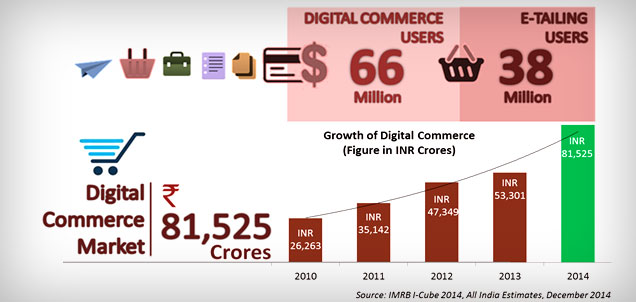
    According to the latest Digital Commerce Report by IAMAI and IMRB International, the digital commerce market was valued at INR 81,525 crores by the end of December 2014, and registered a growth of 53 per cent over 2013. The report further states that the industry is estimated to grow further at a rate of 33 per cent and cross INR one lakh crores by the end of 2015.


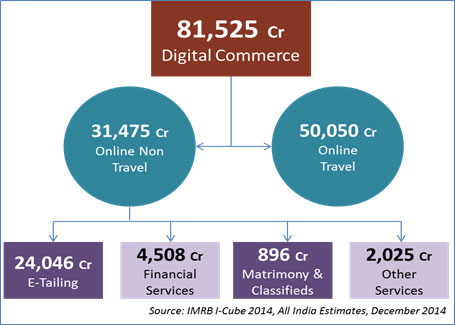
    The report also finds that online travel comprised a majority 61 per cent of the whole Digital Commerce pie. Significantly, e-Tailing has grown by around 1.4 times over 2013 and constitute nearly 29 per cent of the overall share.


    According to the findings of the report, Mobiles & mobile phone accessories contribute the most, i.e., 41 per cent (INR 9,936 crores) to the e-Tailing segment followed by apparels, footwear & personal items which contribute 20 per cent (INR 4,699 crores). Consumer Durables along with Kitchen Appliances contribute another 14 per cent (INR 3,404 crores). Out of the remaining 25 per cent, Laptops/Net Books/Tablets, Home Furnishings and Books contribute another INR 2,780 crores, INR 1,059 crores and INR 648 crores respectively.


    The report also finds that 45 per cent of the Online Shoppers prefer Cash on Delivery as a mode of payment. 21 per cent prefer payment through Debit Card and 16 per cent via Credit Card. The other modes of payment include Internet Banking (10 per cent) and other payment modes viz. prepaid cash cards, mobile wallets etc (8 per cent).


    According to the report, the Financial services market has grown at a CAGR of 20 per cent since 2010. In December 2014, this market was valued at INR 4,508 crores. The Classifieds markets have seen a significant growth and are valued at INR 896 crores by Dec 2014.


    Other online services market has grown with a CAGR of 73 per cent since 2010 and was valued at INR 2,025 crores by December 2014. This segment includes emerging service categories like Online Entertainment Ticketing, Online Commuting, Online Food and grocery Delivery. Online Food Delivery market has seen the maximum growth (40 per cent) over the last year in this segment and it is now valued at INR 350 crores by the end of 2014.


  • BN Kumar is PRCI national president

    By A Correspondent


    B N Kumar

    The Public Relations Council of India (PRCI) has appointed Concept PR Executive Director B N Kumar as its next national president.


    The Governing Council and the national executive of body of PR, advertising, HR and media professionals and academicians, has appointed BNK, as the journalist-turned-PR professional as the new president to lead the functioning of pan-India organisation with 25 chapters.


    Earlier, BNK led the Mumbai chapter of PRCI and was the national vice president. He has close to four decades of experience in mass communications as a journalist and PR professional.


    Announcing the appointment, M B Jayaram, Chairman Emeritus and Chief Mentor of PRCI, said: “BNK has been taking active interest in furthering the cause of our oganisation and he led two successful Global Communication Conclaves at Mumbai. As the programme committee chairman of the just concluded ninth Conclave, he played an exemplary role in ensuring its success. Under his leadership, we are sure PRCI will scale newer summits.”


    Acknowledging the new assignment, BNK said: “It is a huge responsibility and I sincerely hope that I will be able to live up to the faith and confidence that PRCI reposed in me.”


    On the future programmes of PRCI, he said: “We will launch several indicatives like guest faculty pool for journalism schools and advanced skill development modules for new corporate communication professionals in both private and public sector companies.”


    PRCI also elected Vijay Lakshmi as a Director on the organisation’s Governing Council, apart from appointing Bharathi Singh as the new Secretary General of the national executive.