Category: MEDIA

  • Exclusive! BARC in talks to buy TAM?


    By A Correspondent


    Entertainment television is all about twists and turn in the fictional serials. Cricket, as you would’ve heard several times over, is a game of glorious uncertainties. So why then should there be surprise over the possibility of BARC buying up TAM.

    Okay, let’s cut the tease. Broadcast Audience Research Council (BARC) has indeed been in discussions to buy the television audience measurement business of TAM, the firm jointly owned by WPP’s Kantar Media Research and Nielsen. And, yes, it’s March 12 today, not April 1.

    According to reasonably reliable sources, there have been a detailed dialogue between the joint industry body-managed BARC and TAM owners Kantar and Nielsen. The talks haven’t concluded yet and the mid-point formula that was suggested by a WPP representative has been reportedly rejected by BARC bosses.

    Both BARC and TAM were unavailable for comment, but from what one learns, BARC was seriously considering the buy.

    So why gobble up TAM when the audience research measurement activity of the measurement body was under question? Well, even as doubts were being raised, there is no denying that broadcasters, advertisers and media agency use TAM as the currency for their buying decisions. Also, as industry analyst told us, TAM comes with a ready 12,000-odd panel, established processes and teams and archival data.

    And from TAM’s point of view, why sell out to BARC? Given that all stakeholders have contributed to the BARC kitty, it’s evident that sooner or later all TAM subscribers will exit the system or want to renegotiate. Given this, it’s best to sell the existing well-oiled measurement machinery to BARC which would find it of use, said the analyst we spoke to earlier.

    TAM has already made it known to subscribers (and the media) that it will continue operations even as there is a significant number (in billings at least) of subscribers who have said they would like to unsubscribe. If TAM continues to exist, there will be several comparisons made with the new measurement system, and those subscribers who may be rated poorly by the BARC system vis-a-vis TAM may quote the latter. This could even lead to advertisers questioning the BARC data and hence cause a confusion in the marketplace.

    As reported on MxMIndia earlier, the ghost of the Indian Readership Survey has raised anxiety levels in the industry. For, MRUC and RSCI, the bodies running IRS are jointly run and owned by various stakeholders in the industry. And despite it being an industry association, print players are up in arms against the new IRS.

    BARC, meanwhile, is said to be only in the discussion with the television audience measurement business of TAM. Other divisions such as the Strategy or S Group which offers advisory service on measurement, AdEx India, RAM for radio audience measurement, Eikona for measurement of earned media and PR activity and TAM Sports, which offers special analysis of sports ROI will not be part of the deal if it goes through.

    So where do things stand now? At the time of writing, the talks have been suspended. But as the date approaches for the launch of the system, and the stakes for both BARC and TAM grow higher, the deal could well be inked. Like on television, be ready for the climax.

     

  • Triton Communications launches digital arm DIGIMO

    By A Correspondent


    Triton Communications has launched its digital agency DIGIMO. Contrary to existing practices, the planning teams of both digital and mainline will co-author the brand and communication strategy from inception. This approach will help clients reach their TG with the optimum mix of their content consumption platforms. Whilst the brand proposition is broadcasted via mainline. a return path on digital will ensure consumer interactivity in a bi-directional mode on various digital and mobile platforms. Thereby enabling marketers maximize their ROI.


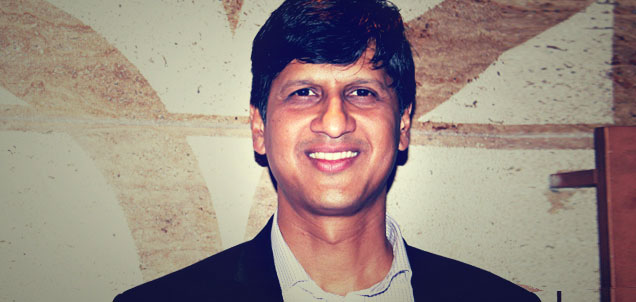
    Triton India has appointed Rohit Kaul as CEO, to head their 360 degree equipped Digital Mobile arm DIGIMO. He moves in from Mobilox Innovations where he spent the last three years as their COO. Prior to Mobilox, Rohit has worked in leadership positions across Netcore Solutions, HT Media, STAR India and ZEE Television. Scholastically a B.TECH and MBA in Marketing from Mumbai University, he brings over 15 years of experience in multimedia, new media sales and start ups.


    Commenting on the latest endeavour, Ali Merchant, Director Triton quoted, “The continued, symbiotic evolution of technology and consumer expectations is fuelling on-demand marketing. Hence digital marketing is entering more unchartered and challenging territories. And with digital marketing becoming integral to our clients’ marketing mix, we decided to enter this domain not with a baby step but with a giant leap. I welcome Rohit on board and am sure given his overall rich multimedia experience of being a business leader, especially on Digital Rohit will make this venture a great success”.


    Incorporated in 1991 by Ali Merchant and Munawar Syed, Triton is one of the largest privately held Indian communications agencies and has enjoyed a successful run of over two decades in partnering some of the leading and most successful brands in Indian advertising.


  • Dainik Bhaskar joins Tata Steel, Ranbaxy to hire UK firm to attend to whistleblowers

    By Sachin Dave


    Indian companies are increasingly roping in specialists to manage their whistle-blowing mechanisms at a time when employees don’t hesitate to vent out their frustrations on social networking sites or to rush to regulators in case of a suspected fraud or an irregularity.


    While the Companies Act makes it mandatory for the listed firms to have a whistle-blowing mechanism, some companies such as Tata Steel, Ranbaxy Laboratories and DB Corp have gone a step ahead to hire the UK-based InTouch MCS to attend their whistle blowers through a specialised BPO facility in Bengaluru.


    “As Indian companies aspire to go global, whistle blowing is something they cannot afford to ignore. While setting up call centres inside the company do work, but it’s not as effective and a whistle blower may not always get the confidence to report to them, on a fear of being identified,” said John Wilson, managing director at In-Touch, which has set up independent whistle-blowing mechanisms for about 15 Indian firms.


    InTouch has 40 people working at its Bangalore facility to deal with whistle blowers who either call on the hotline or mail them. These complaints are then forwarded to the concerned to the senior official in the company who may or may not investigate the matter. InTouch has tied up with Ernst and Young recently where the latter could take up the investigation in the frauds in case the company wants them to do so.


    Girish Agarwal

    “We wanted to boost employee confidence, so we decided to include a multi-channel option for whistle blowers. The employees were provided with several options, which range across a 24×7 hotline, website reporting and email,” said Girish Agarwal, director at DB Group.


    According to industry insiders, hiring is the toughest part for the specialists as convincing the whistleblower to share all the details may not be easy. Psychiatrists and trained councillors are in demand to handle nervous whistle blowers.


    Industry trackers say that often Indian companies have been looking to just “tick the box” by setting up whistle blowing mechanisms in house. Insiders say that many Indian companies tend to get worried about the whistleblowers and often don’t want the allegations to backfire on the company.


    “Often Indian companies are worried that if a proper whistle blowing mechanism is set up it can backfire on them. However, the risk of having none is worse, as the whistleblowers can then go to regulators or take it to the social networking platforms,” said a senior official who is currently investigating a whistle blowing case in a multinational based in India. In the case, initiated after a whistle blower had shot emails alleging fraud, the investigations are now being carried out by one of the big four audit firms, the person said.


    Globally, independent whistleblowing firms get about 2.4 complaints per 1,000 employees. While 50% of the total complaints are made on phone, the remaining are made through email and a miniscule 5% through post.


    “It is tough to say how many of the concerns raised by the whistle blowers are genuine. But companies tend to investigate the more serious ones, especially around sexual harassment and fraud or bribery allegations,” said Arpinder Singh, partner and national leader, fraud investigation & dispute services (FIDS), EY India.


    Research says that about 60% of the whistle-blowing complaints are about HR issues like sexual harassment and about 10% are about corporate governance issues. Going ahead, it is expected that even Sebi may have to set up a whistleblowing mechanism.


    Source:The Economic Times

    Copyright © 2015, Bennett, Coleman & Co. Ltd.

    All Rights Reserved, Licensed to republish


  • We’re seeing a fragmentation of attention: Venkatesh Kini


    By Shruti Pushkarna


    The India Chapter of International Advertising Association hosted its annual review of marketing, media and advertising at the Westin in Gurgaon on March 12. The annual review, titled IAA Retrospect and Prospects, was presented by Venkatesh Kini, President, India & South West Asia, Coca-Cola.


    Mr Kini started his presentation by citing the major shifts occurring in the world of media, advertising and marketing today. Through a series of audio video presentations, he pointed out the change in consumer trends and how Coca-Cola has tried to stay relevant for the past 128 years. “The secret formula of Coke is staying relevant to consumers and consumer trends,”  Mr Kini said.


    One fundamental shift according to Mr Kini that is occurring today is fragmentation of attention. He said: “There’s a shift from many people watching one screen to one person watching many screens. We don’t just see fragmentation of media but a fragmentation of attention. This fragmentation of attention and shortening of attention span is the biggest seismic shift that you are going to see in the industry going forward.”


    Among other changing trends taking place today, Mr Kini pointed out, the shift from one-way communication to conversations that take place on social media and other digital platforms. He said: “The concept of a target audience is gone. There is no one target but a network of people. And the best way to get your message out there is to get people talking about it.” For the message to be share worthy, it needs to be provocative, he added. He shared the example of a campaign by Coke on a sensitive issue of India and Pakistan, where they put vending machines in Delhi and Lahore, and both vending machines had cameras that could display and communicate what’s happening on the other side. He shared that Coke did not spend a rupee to advertise the campaign and just put it on YouTube where people shared it. The reason, he said, it got shared was because it was a nice story and it was provocative.


    Another change Mr Kini talked about is what brands have to stand for, today. “When brands first started 150 years ago, all it stood for was a trademark that promised you a better product. Then as brands evolved, they said this brand doesn’t just make a better product, it promises a better you. And for a long time it was about how brands create emotional benefits and personal benefits. But 21st century branding has become about a better world.” Mr Kini explained brands that can connect to a higher purpose connect to consumers far more effectively, because consumers are more socially aware and conscious today.


    Marketers and advertisers need to take note of the changing trends in consumer behaviour and consumer experience in order to communicate and get their ideas across, he said, adding: “The world is becoming complex and we’ve to think of ourselves as part of a network and through collaboration, we can sell anything we want or communicate any idea we want.”


    The event opened with a welcome address by Srinivasan K Swamy, President, IAA India Chapter who introduced the subject and the key speaker for the evening. He also listed out some of the upcoming events planned by IAA for this year.


  • Ranjona Banerji: News or Entertainment?

    By Ranjona Banerji


    This is a story which I heard the other day. A friend who lives abroad went to a restaurant in Mumbai one evening to get some food packed. He found that the TV screens were all on Arnab Goswami and Times Now. He asked the owner how he could bear it. The owner laughed and said, “But sir, this is more entertaining than any soap or serial.”


    I write this as several media commentators have made some very succinct, incisive and well-argued comments on the damage done to journalism by Goswami in his crusader mode, especially when he fought for India’s image with his #NirbhayaInsulted hashtags, railing against the India’s Daughter documentary.


    However, I might want to argue that in many ways TV in India has gone beyond journalism. There is almost no space for the boring, anodyne, journalistic stuff any longer. It’s now all hysterics, outrage, anger, reaction and provocation. And finally, you just have to laugh. I would argue that Goswami is a pioneer in India who has redefined TV news. There was a time when I compared him to Howard Beale in Sidney Lumet’s 1976 classic Network. But Goswami has gone beyond Beale and created a distinct and enviable persona of his own. The mood at dinner time or in drawing rooms rises and falls to the cadences of his voice as he builds up his case for the night.


    And whether they admit it or not, half the news anchors in India either emulate, copy or want to be like him. There are a few who are hanging on to their shreds of sanity. And there are some star TV anchors who bemoan what TV has done to journalism. But those are just the last remnants of a lost civilisation.


    News is now entertainment in India and it will take a revolution to change that.


    **


    The most intriguing love-hate relationship in India is between TV journalists and the Aam Aadmi Party. When it was the India Against Corruption movement, TV loved it. TV cameras exaggerated crowd figures as did reporters. TV anchors made us believe the whole country had come to a standstill. Even I believed it and dragged a friend interested in politics to Azad Maidan with me to watch this phenomenon. It was sorely disappointing to watch a straggling crowd of a few hundred when I had been led to believe it was thousands. Luckily, the Mumbai Press Club and cheap Old Monk is close enough to drown all sorrows and outrage at TV, er, lies.


    That was 2011. Since then it was been a very rocky relationship between TV and Kejriwal and clan. No other political party in India, and this is in spite of all the efforts of Sanghi trolls and Congi agents, has been under such close scrutiny as the AAP. Every move it makes or doesn’t make is analysed in high decibel theatrics.


    The AAP has been peculiarly obliging to the media too, letting itself and its supporters down with clockwork regularity. All its shenanigans seem to be made for TV too, with sting operations and press conferences and public dissent and revolution. AAP and TV media are now involved in one of those symbiotic or parasitic relationships you read about in nature, where one organism cannot survive against the other.


    All the established parties can spend millions and try as much as they like to win PR battles. AAP has figured out the publicity game perfectly even if it is often to its own detriment.


  • Turner names new head for English entertainment portfolio

    By A Correspondent


    Rohit Bhandari
    Siddharth Jain

    Turner International India has announced the appointment of Rohit Bhandari as Senior Director and Network Head for its English entertainment portfolio that includes leading channels HBO and WB in South Asia.


    Bhandari will report into Siddharth Jain, Turner’s Senior Vice President and Managing Director for South Asia. Commenting on the appointment Jain said, “We’re really pleased to have Rohit on board in this key position as we continue to grow our leadership in the English entertainment genre. With his well-established expertise and industry experience, I am confident he will help us build upon our success in the India and South Asia region.”


    In this role, Bhandari will be responsible for the growth strategy, planning and execution of all network functions including content acquisition, communications, marketing and brand building.


    Bhandari’s appointment is effective immediately and he will be based at Turner’s office in Mumbai. He has over two decades of experience in television and advertising including overseeing business operations for AXN and Animax in India, as well as advertising sales in both India and Singapore. He previously led the media and entertainment vertical at Sahara India Capsac Limited.


  • AEGON Religare launches digital campaign #NothingWillHappen

    By A Correspondent


    AEGON Religare Life Insurance (ARLI) has launched a campaign – #NothingWillHappen, for its flagship protection plan iTerm. As a pioneer in online life insurance, ARLI has launched this campaign in an exclusively digital format. The campaign consisting of four long-format films looks at the way in which Indians view life and death. Partnering with well know stand-up comic Atul Khatri AEGON Religare is taking a step into uncharted communication territory with these online only films. The idea behind them is to get the audience who is aware of life insurance but not buying it, to start thinking about and considering the category.


    On the launch of this campaign, Yateesh Srivastava, Chief Operating Officer – ARLI, said, “At AEGON Religare we have always tried to be different and explore new territory. In this campaign we leverage on the very Indian insight that ‘bad things happen to others’ and hence the use of the hashtag #nothingwillhappen. In Atul Khatri we found the perfect protagonist, with a culturally relevant take on protection. The only difference in this campaign is that it is being released only through digital media and will not have a television release. While the campaign is product specific, we also expect a positive impact on our overall brand awareness. In insurance, the treatment of life and death has been predictable so far. With this unconventional take on protection, we hope to change the communication paradigm within which insurance operates.”


    The films were ideated and conceptualized by ARLI’s advertising agency, Infectious. Mr Ramanuj Shastry, Co-founder – Infectious, says, “The #NothingWillHappen web series from AEGON Religare is a new voice in the Life Insurance category, rife with cloyingly emotional advertising. Using humour and an unlikely spokesman in stand-up comedian Atul Khatri, the campaign pokes fun at people, in a state of denial about death, while gently reminding them to protect themselves. Needless to add, behind every ‘new’ communication stands a truly brave client – the AEGON Religare Marketing Team in this case, who have been unflinching in their support and trust. It was a singular pleasure working on these films.”


  • Shailesh Kapoor: Hindi GECs: There’s Space For More… &More

    By Shailesh Kapoor


    March 2 saw the launch of &TV, the second mainstream GEC from the Zee stable (not counting the highly differentiated Zindagi and the rerun-based Zee Anmol). The first ratings yesterday confirmed that the channel has managed to make its presence felt within its first week. It launched at 42 GRPs, making it one of the best channel launches in the last decade, close on the heels of Colors, Life OK and Imagine.


    The ratings universe has widened since 2008. &TV’s 42 GRPs would easily have been 55+ in a pre-LC1 environment, in which other GECs mentioned above launched. Also, the ratings are based on five-and-a-half days of content, which means a natural growth next week is expected anyway. We should see the channel comfortably crossing the 50-mark next week, and with a sizeable reach potential still untapped, it may be looking at the century over the next quarter.


    What interested me even more was to see if &TV got its initial numbers from other GECs or if it could grow the category. The top six GECs lost only 21 GRPs this week combined, which &TV got exactly half its viewership by growing the category. Its early days yet, but one could safely assume that in a more stable state, at least 30% of &TV’s ratings would be category growth, which could mean that channel would have managed to grow the already dominant Hindi GEC category by 3-5% by the time it crosses the 100 GRP mark.


    Yet, there has been persistent talk around there being no space available for one more Hindi GEC. Every time someone comes up with the idea of launching a new Hindi GEC, promoters or investors treat the thought with immense skepticism.


    It’s not a surprising response, however. You won’t expect most investors to be core GEC viewers themselves, and from the outside, it would indeed seem that all the GECs are essentially dishing out similar programming. I have voiced my concerns regarding lack of innovation on the GECs over the last two years, but lack of variety has never been an issue. The consumers see genres and sub-genres in what the non-viewers can just pass off as “daily soaps” or “saas-bahu serials”.


    Identifying strategic need gaps in the Hindi GEC space can be a tough ask today. But tapping the right genres and creating new sub-genres within them can indeed push the category viewership ahead. The size of investment may also be a deterrent, but for someone with deep pockets, a well-planned GEC business has a far lower risk than, say, a news or a niche channel today.


    The rise-and-fall stories of 9X and Imagine have often been used as an example of how a GEC business is high on risk. But there have been the success stories in Colors and Life OK too, the former a lot more significant than the latter. I hope the early success of &TV encourages more GEC launches. Sound business models can ensure good profitability at even 80-120 GRP levels.


  • Eric Salama slams MxM report. Says no selling TAM to BARC. MxMIndia stands by story

    By A Correspondent


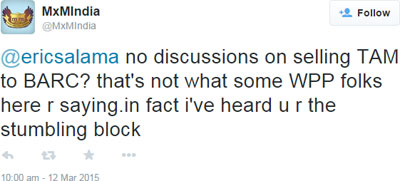
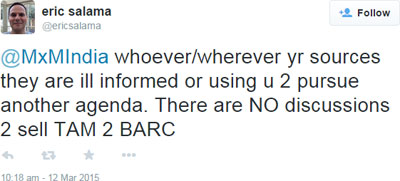
    Kantar Media CEO Eric Salama tweeted us back Thursday evening saying: “Whoever/wherever your sources, they are ill-informed or using you to pursue another agenda. There are no discussions to sell TAM to BARC.”


    This followed an earlier tweet where he said: “Happy to cooperate with BARC to improve ratings but no discussions for us to sell TAM to BARC.”


    This was reacting to our tweeting the link to the story to Mr Salama and other industrypersons.  We responded to this tweet by saying: “No discussions on selling TAM to BARC? That’s not what some WPP folks here are saying. In fact I’ve heard you are the stumbling block.”


    We are normally not so direct or rude, but in this case, we’ve heard from more than one source – on the WPP and the industry side – that the counter-offer made by the Kantar CEO was unacceptable and hence a potential deal-breaker. In fact, some industry sources even told MxMIndia in confidence, that it was because of some statements made by someone senior at WPP (suggesting Mr Salama, but not confirming it) that the talks with Kantar fell through in the early days of the BARC contract finalisation.


    One senior industryperson associated with BARC was even told that BARC will not be able to run its business without the intervention of Kantar. In fact the senior industryperson feared the future of his career because the offensive was pretty strong, he told us.


    Meanwhile, MxMIndia strongly stands by the story it published yesterday. The fact of the matter that a deal is being looked at. This could also mean that TAM will publish its ratings every week and hand over the data to BARC which will then use it for its purpose or club it with its panel size and present to its consumers.


  • DDB Mudra wins creative mandate for Sony MAX and Pepsi IPL 2015

    By A Correspondent


    DDB Mudra West has recently won the creative account of Pepsi IPL 2015. The agency handles the creative mandate for Sony MAX further to which it got the Pepsi IPL 2015 account.


    In order to rejuvenate the cricket viewers’ interest for Pepsi IPL 2015 and prepare them for a different level of excitement, Sony MAX and DDB Mudra West have crafted a three staged campaign called ‘India Ka Tyohaar.’


    India is a land of festivals and cricket is a multicultural religion uniting every Indian. Just like every religion, cricket also has its festival – the Indian Premier League. Based on this thought, the idea for this year’s Pepsi IPL 2015 campaign – India Ka Tyohar talks about the tournament as a festival which not only unites India but also brings together cricket players from across the world, uniting as clubs, battling for the winning cup of Pepsi IPL 2015.


    The first phase of the campaign that kick-started on Feb 24, 2015 included teasers showcasing people from various walks of life gearing up for ‘India Ka Tyohaar’. Spun around one of the key messages of Pepsi IPL 2015; erasing differences (social classes, occupation etc.) between people, the three teasers have a fun-filled tonality to them.


    The recently released second phase of the campaign is the Pepsi IPL 2015 anthem. Penned by Sonal Dabral and his team at DDB Mudra West, the anthem is composed by the music artist brothers Salim-Suleiman. The anthem will further be followed by three more creatives around the theme of the anthem ‘Isme hai dilon ka pyaar, yeh hai India ka tyohar’.


    The TVCs will go on air closer to the tournament’s start and will continue through the event marking the third phase of the campaign. The campaign would be spread across electronic, print and digital mediums.


    Neeraj Vyas

    Commenting on giving the creative mandate to DDB Mudra West, Neeraj Vyas, Senior EVP & Business Head, MAX, said, “For Pepsi IPL 2015, we wanted to have a campaign that brings people together in celebrating a much loved sport like cricket. DDB Mudra West has the talent, creativity and expertise to deliver a promising campaign such as ‘India ka Tyohaar’ which invites people to partake in this fun and festivity by putting aside their differences. We believe the agency will help make the Pepsi IPL 2015 a national rage and strengthen the emotional affinity towards the tournament.”


    Rajiv Sabnis

    Quoting on the account win, Rajiv Sabnis, President, DDB Mudra West said, “It’s a great feeling to partner the biggest sporting campaign of India- the Pepsi IPL 2015. The focus is back on celebrating the sport, limited overs cricket, and celebrating the enormous fan-following that it has not just in India but around the world. Cricket unifies, it brings joy, it infuses optimism and it even rejuvenates the economy. Cricket has the power to bring Indians together as one nation and one people.  “India ka Tyohaar” is Sony MAX and Sony Six’s initiative to celebrate Pepsi IPL 2015 as the largest, unifying festival of India.”


    Sonal Dabral
    Sonal Dabral

    Quoting on the campaign, Sonal Dabral, CCO and Chairman, DDB Mudra Group said, “If Cricket is a religion in India, Pepsi IPL 2015 is its only true festival. Unlike any other sporting event in the world, it’s a microcosm of the passion, fervour and madness that envelops our country whenever cricket is played, uniting hearts and minds in its wake. And unlike any other festival in India, this is one festival that every Indian celebrates. It’s got the colours of Holi, the festivity of Diwali, the brotherhood of Eid and the joy of Christmas. What else can you call it but one amazing ‘India Ka Tyohaar’? It’s been a privilege and an honour to create this big idea for Pepsi IPL 2015. Here’s to Sony! Here’s to India Ka Tyohaar!”


  • It’s an appy world for kids!


    By A Correspondent


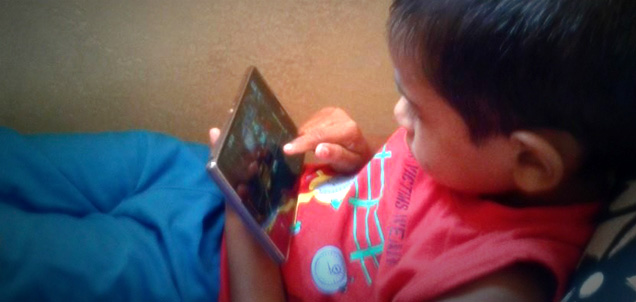
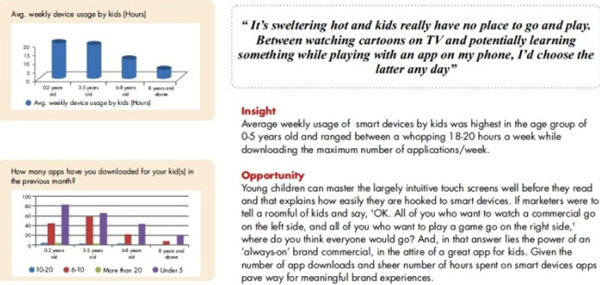
    Your toddler may be more hooked to your mobile phone than you realise. A study conducted by digital media firm Pulp Strategy has found that children in the age group of 0-5 years are using mobile apps for a whopping 18 to 20 hours a week. The study, which spoke to over 2,000 parents across six metros, has found that increasingly, younger children are embracing smart devices for entertainment purposes.


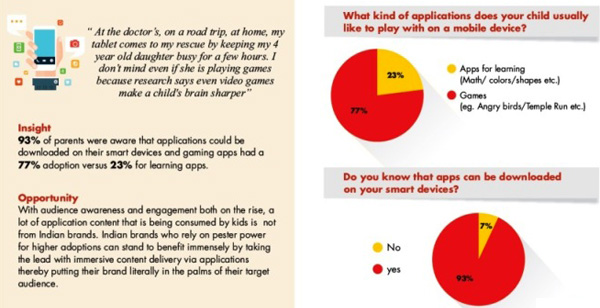
    It’s perhaps not surprising, then, to learn that by the age of 8, an estimated 97% of children have already used a smartphone, tablet or similar device. The study, which was conducted during January and February this year, found that mobile app use among very young children is growing rapidly. Unsurprisingly, gaming apps have a 77% adoption versus 23% for learning apps. Not only are more children using tablets and smartphones, they’re using them for longer periods of time, reveals the study.


    Young children can master the largely intuitive touch screens well before they can read, and that explains why they are hooked to smart devices so easily. Parents, too, don’t mind letting their kids use smart devices to keep them busy.


    This has certainly been a windfall for app developers and providers. “Companies had not created smart phones and tablets for kids, but the access to instant play, learning opportunities and potentially quiet time for the parent, all contributed towards creating this secondary user, children, who have seeded an app-revolution of sorts,” says Ambika Sharma, MD, Pulp Strategy Communications.


    India is witnessing a revolution in mobile data and an increase in smart devices. The current research is a first in series of studies of consumer behavior in relation to mobile applications, and has focused on a very significant consumer segment which isn’t the primary owner of a smart device. But kids’ ‘pester power’ is turning out to be a formidable force for brand preference and product adoption and sales.


    The opportunity to tap this young, enthusiastic market of children is enticing, and technology can help create tighter bonds between brands and kids. These are times for great transition as kids move from laptops and fixed devices, to mobile ones for staying entertained. The potential to engage with these young consumers early has never been as big. Clearly, marketers are sitting on an amazing, untapped opportunity for building brand engagement.


    Here are some of the key findings of the study

    :: Children in the age group of 0-5 years are using mobile apps for a whopping 18-20 hours a week

    :: Gaming apps have a 77% adoption versus 23% for learning apps.

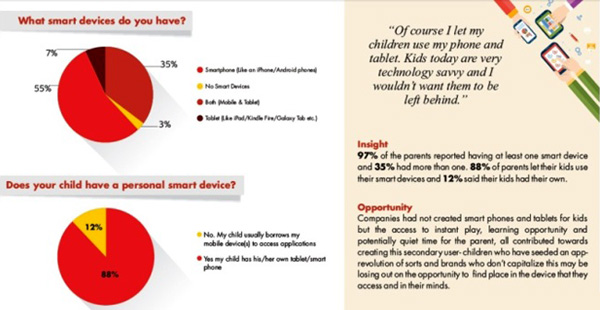
    :: About 97% of parents reported having at least one smart device, and 35% had more than one.

    :: About 88% of parents let their kids use their smart devices, and 12% said their kids had their own

    :: High usage of apps/ smart devices is opening opportunities for marketers whose core TG is young children.


  • ZEEL sources deny news on Shailja Kejriwal heading Zee Smile revamp

    By Sandeep Puraname


    One wouldn’t expect an IndianTelevision.com news to be incorrect. Its sources are impeccable.


    So even as Zee Entertainment honchos dismissed the IndianTelevision.com report that programming veteran Shailja Kejriwal was to head Zee Smile’s revamp, we wouldn’t rule it out completely. It’s perhaps work in progress, it’s possible that she will lead the effort on the channel’s revamp and may not be the business head. Currently, Priyanka Datta heads Zee Smile along with Zindagi and the rest of the free-to-air Hindi cluster.


    Watch this space for more.