Category: MEDIA

  • O&M unveils campaign for Android One

    By A Correspondent


    As part of a larger initiative to bring high-quality smartphones to as many people as possible, Google launched the first family of Android One phones in India on September 15, 2014 in New Delhi. The Android One phones offer a high-quality experience, running the latest version of Android (4.4 KitKat). They will be some of the first phones to get the new Android L release – an update that will offer Google’s new material design, improved battery life, enhanced security features, and smarter notifications. The Android One devices will launch across the world with the initiative starting in India with Micromax, Spice and Karbonn phones.


    Sandeep Menon – Director, Marketing, Google India said, “We are very happy to partner with Ogilvy for this initiative. The anthem film for Android One is an integral part of our campaign as it showcases our key message for this initiative. Through this anthem we want to highlight that the Android One is meant for Indians from all walks of life. The team at Ogilvy has developed a great concept and we are very excited to see how people react to the anthem film.”


    Android One phones will have access to over one million apps that allow people to message friends, make video calls, socialize, check news and weather, and play games. Google apps such as Gmail, Google Maps, YouTube, Google Search, and Google Translate will come pre-loaded on the phones. The Android One platform will empower people to access information and get to a high quality smartphone with an affordable price.


    Abhijit Avasthi

    Abhijit Avasthi – National Creative Director, Ogilvy India said, “While working on the campaign our endeavour was to translate this powerful platform philosophy into a message that everyone could connect with. The campaign drives the message that everyone now has equal opportunity and access to experience the best in the world.”


  • Cairn India awards brand-comm mandate to Leo Burnett

    Samir Gangahar

    By A Correspondent


    Cairn India Limited, one of the world’s fastest growing upstream oil & gas company has appointed Leo Burnett as their agency on record for their branding communication requirements in India.


    Cairn India is one of the largest independent oil and gas exploration and production companies in India.  Through its affiliates, Cairn India has been operating for close to 20 years playing an active role in developing India’s oil and gas resources. The company is a global player that has been rated as the fastest-growing energy company in the world, as per 2012 & 2013 Platts Top 250 Global Energy Company Rankings.


    Samir Gangahar, Executive Director, Leo Burnett, Delhi adds, “We feel privileged to be entrusted with the opportunity of playing a crucial role in the branding communication strategy of Cairn India. It further reinforces our belief in our guiding tenets of ‘Purposeful Brands’ whose message is delivered through ‘Integrated Solutions’. We along with our partners Indigo Consulting, MSLGROUP and Zenith Optimedia look forward to working with Cairn India to devise a programme that utilises all possible communication platforms available.”


    At Leo Burnett, the integration drive is a strong and emphatic one given that stories happen across channels and are media-agnostic. Leo Burnett will craft and execute integrated campaigns for Cairn India.


    The account was awarded in a pitch process that attracted some of the best-known and largest agencies in the country.


  • What Ticks for Indian Consumers/ Women – Raj Nayak and Sathyamurthy Namakkal

    Continuing with our extracts from the second edition of the MxMIndia Annual, we present contributions by Raj Nayak and Sathyamurthy Namakkal


    ‘You can engage with women through content’ 


    By Raj Nayak


    There is absolutely no doubt that women today form a critical mass for GECs. But if you look at the television viewing audience, we’re still primarily a single TV household country despite urban India undergoing a paradigm shift in its preferences. So whilst there is a skew towards women, it’s not that women viewership is 90 per cent and male viewership just 10 per cent. It’s a 55- 45 ratio. But, the remote control is in the hands of women.


    It’s the truth, unless when it comes to major sporting events and news, the remote control, invariably is with women. So how do you engage with women? It has to be with content. The way we have structured our channel is – our fiction programming primarily targets women, exception to the rule being ’24’. And that’s not true for us only; it’s true for all GECs. Fiction, to a large extent targets women.


    The womeniya of today


    By Sathyamurthy Namakkal


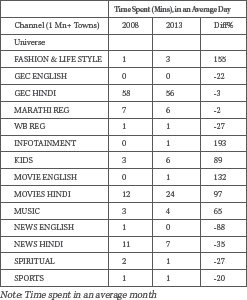
    A comparison of current media consumption habits with those about five years ago, of women in HSM markets, reveals the following interesting trends:


    • She continues to spend substantial time watching her serials and soaps on TV.

    • However, she has begun topping it up with other content on TV like reality shows, infotainment programmes, music etc.

    • Her time spent watching kids programmes has gone up substantially, indicating that she wants to spend more time accompanying her kids watch their favourite programmes…

    • Watching news on TV, be it in English or the regional languages, has come down. However, her time spent reading newspapers and magazines has marginally increased by 5- 8 minutes a day.

    • Also, more women are reading newspapers and magazines, especially special interest magazines on health, lifestyle etc. She has begun to spend more time watching sports content on TV.

    • Percentage of urban women accessing internet at home has tripled in the last six years.

    • On the other hand, the rural counterpart continues to spend more time watching TV and reading magazines.


    What a non-fiction entity does for you is it brings different kinds of audiences to the channel…like it brings in a lot of young audience, primarily male and of course, even women love to watch non-fiction shows. Not that they only watch fiction. We engage with our audiences off-air at times by engaging in doing tactical stuff; things like branding a lady’s compartment train and similar such initiatives. For GECs, if you’re doing off-air promotion, you have to go mass, you cannot segregate too much unlike channels that air premium content.


    So in our strategy, women are very much part of that mass. Another point to note here is that women are ever-evolving – they’re changing. For instance, if you go to Dadar railway station in Mumbai, you will find men buying vegetables. A few years back when I was selling a news channel, I happened to discuss with a marketing head of a bank. They said we want to target women, why should we do it with a news channel? The fact is that women have evolved.


    Today, women have a bank account, they too buy cars, they hold credit cards etc. So the definition of women has changed completely. Women have come of age, they have evolved. So when you’re a mass platform and when you have a skew for a particular target segment, you got to have a mix because you can’t run a GEC channel with only women as your target audience. Coming back to the moot point, you have to cater to a wider audience. You can’t narrow down and say – this is the audience. If you have compelling content, the time slot doesn’t matter.


    So, what does this changing trend tell us – women today, want to be an integral part of the society, and more importantly, her family wants to be “well informed”. This is probably her way of interacting better with her male counterparts. She no longer wants to be restricted to her own zone but wants to liberate herself and play an increasing and improved role. This of course is helped in no mean measure by the plethora of media options now available to her.


    Next: Monday, September 22: Teens – Kiran Khalap and Siddhartha Mukherjee


  • What Ticks for Indian Consumers/ Teens – Kiran Khalap and Siddhartha Mukherjee

    Continuing with our extracts from the second edition of the MxMIndia Annual, we present contributions by Kiran Khalap and Siddhartha Mukherjee


    Engaging teens in Middle India: 2014 to 2020′


    By Kiran Khalap


    In 1993-94, when I had just shifted roles in Clarion Advertising from National Creative Director to NCD and General Manager of the Mumbai office, we had the privilege of having Dr Pradeep Kakkar (UCal; Wharton School, Cornell, Columbia World Bank) on board as COO.


    Clarion needed some thought leadership ideas, and Pradeep proposed using the Delphi technique to predict the future of Indian society (and hence mass media communications).


    He roped in some of the finest brains in marketing, anthropology, research and HR and distilled their responses (remember that none of them knew who the others were) to two simple questions, “What was the biggest change in the last decade?” and “What effect will it have on the next?” into two simple answers, “TV” and “Social unrest.”


    Earlier, feature films also sold dreams but they were ‘bought’ in the darkness of a cinema hall, where disbelief was easy to suspend. In the 90s, TV screens brought the dreams into the living rooms of middle class homes. Result? A seething anger against less qualified ‘other’ Indians making it big…and social unrest as the safety valve that let off this subterranean anger.


    Youth relations start with listening


    By Siddhartha Mukherjee


    At a time when India continues to bask under the feat of housing the largest population of garam khoon (read: youth) demography, what very few communicators or marketers talk about, however, is the complexity of relating with this public segment.


    The reasons are basic yet prominent challenges for all of us custodians – marketers, researchers, social observers, policymakers, politicians, educationists…and even parents.


    Does the youth listen?
    Ask a parent or even an (senior) employer, the answer will be an emphatic NO! Quite a cliché now! Well, if they don’t listen, we certainly can. Youth wants to be heard. Generations on, youth has reacted at the drop of a hat and always been the catalyst of a reaction! However, the question that arises here is that how often do Public Relations professionals spend time on actual listening? Today, there are some amazing mechanisms and research methodologies that offer interesting amenities for us to listen. As marketers or communicators, well before we push out our messages, we should make it compulsory to listen to every action or reaction of the youth. For a firm, long term Youth Relations campaign, brand stakeholders need to be clear on a) How often they should listen? b) Is listening holistic? c) Should listening be in spurts or continuous?


    As I sit down to do the impossible and possibly foolhardy task of trying to predict the next five years in an era of nanosecond change, I am struck by the almost total reliability of that earlier Delphi prediction. Instead of five wise men to predict, let me invite you to three different windows to the future.


    Window One: The past is prologue, said William Shakespeare. Our past influences what we value in the future. My father’s past included living under the Portuguese in Goa, so he valued political freedom above all else. My past included a nation that was considered poor (“Where in Ethiopia is India?” was a question asked in the US), so I value economic certainty.


    What is the past of the teenager in 2014? A nation that is at the centre of the worldstage because of its ‘soft power’: India is exporting yoga, Bollywood films and dances, Indian weddings, sarees, English fiction, software engineers, VCs…so this teenager is most likely to value his own freedom of expression rather than the rest of the world’s!


    Window Two: What else will middle India value in the next five years? Thankfully, I have research rather than grey hair to support what I say. In 2011, Chlorophyll was asked to adapt an online group dating US brand to India. Our initial hunches were proved right by research in middle India: the ‘night’ in the brand name was guaranteed to scare away teenage girls; ‘dating’ was unknown and ‘group dating’ sounded terribly confusing and risque;-)


    What was most welcome instead was an opportunity to meet new people for new experiences! That is what middle India wanted: new experiences. Just as the TV of the 90s had created a need for new opportunities, the web of the 21st century had created an inexhaustible thirst for new experiences from around the world: a wonderland etched in pixels by photographs, opinions, objects, stories, self-made films…


    Window Three: When Chlorophyll worked on defining a telecom brand, one of the big insights we got validated the one from Window One: in middle India, the mobile phone is the every teenager’s secret door to a bigger, starrier, exciting global neighbourhood. Far away from her grungy surroundings and most important, totally shielded from the prying eyes of her parents! Between 2011 and 2013, the biggest change in India has been the web: smart phone-based web access overtook PC-based web access in May 2012!


    India is about to reach the magical 10 per cent figure of smartphones as a percentage of overall phones in numbers. Apparently, in other emerging markets, after 10 per cent, the conversion goes ballistic. Smartphones are growing at 150 per cent because 85 per cent of the market is still feature phones, whose owners are upgrading at a furious pace.


    To every individual who owns a Smartphone, Facebook and Tumblr and Instagram and Pinterest (80 per cent are women; why? search me!) and Twitter are doors to an ever-expanding universe where your opinion is published and responded to! This is a genuine high…like an online bungee jump, especially if you are in a small town!


    Now come closer and put your face against all three windows to the future simultaneously (yes, it is possible to do such things in a thought experiment!) and tell me what you see. That’s right: accessibility to a world of infinite new experiences from all over the world…specifically, experiences that allow selfexpression. Any brand that facilitates this need will be able to engage middle-India. If you are a brand that can thrive in Mumbai you don’t need to engage Middle India.


    Why do I say that? Out of a total of 204 countries on earth, only the first 60 have a population higher than Mumbai (1.6 official; 2 crore plus unofficial)! But if you are a brand that dreams of a market of billions, your path to middle Indian teenagers goes through the smartphone and begins with a platform where the teenager is the hero! No, there is no shortcut.


    Youth’s opinion

    What makes it interesting for brand stakeholders is that for youth, no opinion is permanent or long term for that matter. It can be changed, moulded or influenced. They are one of the few demographies that traverse through multiple touchpoints…right from the time they wake up till they sleep at night. Which is why, what can make brand stakeholders overcome this challenge is by constantly listening to them.


    Media consumption

    Well, rarely do we come across visuals where a youth is static, literally motionless (not fidgeting…), paying attention to one thing at a time. An exact depiction of this is when he is asked to, expected to or required to read. The reality is that the youth has drifted far, far away from consuming print. If at all Print, best if the brand’s communications is largely through pictorials. That primarily leaves us with TV channels, Radio, Online or Experiential.


    Today’s youth will be tomorrow’s revenue and GDP generators for marketers and the economy. Might as well focus on them and keep telling them your brand story…starting now. However, for that, you have to constantly listen to them to realize what kind of story they want to be told and how! The PR industry can do wonders with Youth Relations for their clients…the question is how many of us start with “Listening”?


    Tomorrow: Tuesday, September 23: Children – Ashwin Padmanabhan and Divya Radhakrishnan


  • The Impact of Social Media on Luxury Goods


    Presenting excerpts from Deloitte Touche Tohmatsu Limited (DTTL)’s  1st annual report on ‘Global Powers of Luxury Goods’


    Controlling all aspects of business has been the hallmark of luxury brands. From product design to sourcing of raw materials, to distribution and marketing, luxury brands have kept tight control, thus guaranteeing brand-appropriate quality and service levels. While companies serving the mass channel took to outsourcing manufacturing and sourcing of materials to support more rapid growth, purveyors of luxury goods continued to do it the old-fashioned way, satisfied with their healthy profit margins, although perhaps with muted revenue growth.


    The internet has changed all that, forcing executives to rethink the tight control typical of luxury brands. The internet leveled the playing field, putting more power in the hands of the consumer with a platform that enables them to shop on their terms, when and where they want, while providing price transparency. Consumer expectations regarding price, value, and brands have all been elevated by increased information and access, and this ubiquitous access undermines one of luxury’s core tenets-exclusivity. The lack of intimacy in the virtual world can diminish brand loyalty, and the ease of comparison shopping and the fluidity of pricing further exacerbate the control issue. What follows is a closer look at the challenges and opportunities that this digital revolution presents to luxury brands.


    The Indian luxury goods market appears to be on a lower growth trajectory as pointed out in the Deloitte Touche Tohmatsu Limited (DTTL) 1st annual report on ‘Global Powers of Luxury Goods’. In 2012, India once had the fastest growing luxury markets in the Asia pacific region. India grew much faster than China but lost steam due a lack of sustenance of the growth which once made the country an attractive market.


    “The entire luxury goods market in India has seen a significant dip in the growth rate and is likely to see a couple of more turbulent years. However, the long term outlook remains positive and India’s luxury market is expected to rise with a strong performance. To supplement this long term growth trajectory, holistic implementation of new reforms and initiatives by stakeholders and regulators would only facilitate the vision,” said Gaurav Gupta, Senior Director, Deloitte in India.


    ‘Global Powers of Luxury Goods’ highlight the fact that along with Indian markets, many emerging markets like China, Brazil and Russia have seen deceleration of growth in the past year. This follows a period of rapid growth that was driven by several factors. Going forward, the emerging world is likely to have a year or two of disappointing growth while imbalances are unwound.


    In the last five years, the expanding global middle class in the emerging markets has supported growth in the luxury sector and is continuing to grow through 2018. According to Euromonitor the emerging markets like Asia Pacific, Latin America, Middle East and Africa combined together accounted to 9 per cent of the luxury market in 2008 these figures spiked to 19 per cent in 2013 and is expected to leap up to 25 per cent in 2025.


    The developed economies like U.S. and Europe benefits from the emerging markets. Over the 2012 to 2017 Euromonitor projects China to lead the tourist expenditure growth followed by India and the other emerging Asian countries. The appetite for American and European brands in the underpenetrated markets is strong and growing many luxury companies to expand its international presence hence creating opportunities in emerging markets like India.


    Ubiquity versus exclusivity

    E-commerce is the fastest growing retail channel, accounting for up to 20 percent of a retailer’s or brand’s total volume. According to WWD (December 16, 2013), industry sources estimate Amazon’s fashion business at $95 billion in global revenues in 2013; it is considered one of Amazon’s fastest growing businesses, with an expanding portfolio of aspirational brands. Luxury brands, however, were late to e-commerce, with many assuming that the aesthetics of their selling experience in the designer’s atelier or the flagship ‘maison’ would be difficult, if not impossible, to replicate on the internet.


    The potential loss of exclusivity and the prestige associated with luxury brands’ bricks and mortar locations are hurdles that can be difficult for luxury brands to overcome, but they are surmountable, and some brands have clearly embraced the technology-one can shop Louis Vuitton’s website for selected handbags, accessories, and shoes and its social media tab connects the user with Louis Vuitton on Facebook, YouTube, Google+, Twitter, Instagram, Pinterest, and Foursquare.


    Ultimately, luxury brands, like most consumer-facing brands, need to deliver an interactive, exciting and efficient shopping experience to all their customers regardless of channel, from flagship to mobile and everything in between. Many luxury brands reluctant to sell online have begun to use their websites to house brand stories, fashion shows, celebrity product sightings, and the like.


    Social media

    With the advent of social media, consumers had a new voice, increasing their individual and collective power, and communities of both brand advocates and critics sprang up. While this erodes message control for luxury brands, the internet, along with mobility and e-commerce, is one of the most effective means to introduce new products globally and provide instant gratification to shoppers in any part of the world. Moreover, social media can be used effectively as a vibrant storytelling medium for luxury brands, communicating brand heritage and iconography to a new audience of potential clients.


    The visual nature of Instagram, the social photo and video sharing app purchased by Facebook in 2012, makes it a natural platform for luxury and fashion brands. Users have been known to spend hours tracking their favorite brands, looking for a particular fashion silhouette, or posting pictures. With 150 million monthly users, Instagram is a powerful new social media platform: according to Pew Research, most of its users are between the ages of 18 and 29, and about 17 percent have incomes of $75,0001 and above.


    Michael Kors ran the first company sponsored advertisement on Instagram on November 1, 2013 and, according to Nitrogram, which ranks the most popular brands on Instagram, the brand’s increase in followers was 16 times more than it would have been following a non-sponsored post. Nike, Gucci, and Louis Vuitton all have official Instagram presences and each company has millions of followers on the platform.


    Omnichannel

    As retailers and mass brands have adopted omnichannel or channel agnostic distribution strategies to keep pace with consumer expectations, luxury brands would be wise to acknowledge that the internet has radically altered the path to purchase with shoppers nimbly navigating from cyberspace to store visits in pursuit of their desires. The virtual world is vital in the discovery and path to purchase. According to a recent Deloitte U.S. study, during the 2013 holiday season, omnichannel shoppers- defined as consumers who shopped online, on their smartphones, and in-store-spent 76 percent more than store-only shoppers in total2.


    Consumers are spending increasingly greater portions of their day online and are connected with smart phones and tablets. As uncomfortable as this change may be, for luxury players, it is participate or perish. While an entire brand’s assortment needn’t be available for sale on the internet, a luxury brand can offer, for example, a select group of accessories that help promote its brand story and keep the customer happy.


    To remain relevant, luxury brands have to go where their consumer and new consuming audiences are-social communities. Consumers have extremely high expectations for luxury brand sites, from design layout, functionality and ease of navigation, to brand iconography, and strength of overall brand presence. A brand strategy that encompasses the internet holistically can be successful generating interest, brand affiliation, and, ultimately, evangelism, where a customer feels compelled to share ‘brand good news’ with others through social media or word of mouth. Aspirational or premium brands such as Coach, Kate Spade, Michael Kors, and Tory Burch have been quick to adapt to the internet, as well as to social media and omnichannel strategies, and increasingly we see the most exclusive luxury brands joining the ranks.


    **


    The internet has created new distribution channels for luxury fashion brands to keep up with consumer demand for the latest fashion at a value price. In addition to ebay.com, where individuals and businesses bid on used and never-worn fashion items, flash sites such as Gilt.com provide discounts up to 60 percent off original prices, while Rent the Runway allows for temporary ownership of designer apparel and accessories, and TheRealReal.com is an online consignment shop of designer and luxury products.


    Custom and bespoke initiatives

    Luxury brands can retain exclusivity while still broadening their client base with the expanding market for luxury goods with custom made products, limited editions, and exclusive assortments for the internet, wholesale and flagship locations. These efforts create demand, drive store/site traffic, and elevate exclusivity while sustaining the distance between a luxury brand and a mass fashion brand. Moreover, client involvement in product design, from Van’s and Nike’s $100 sneakers to a Louis Vuitton bag for $60,000, creates an emotional attachment with the brand, driving loyalty and brand advocacy.


    From communication to conversion

    According to Elizabeth Canon, founder and president of Fashion’s Collective, luxury brands have spent the last few years exploring the risks and opportunities that existed for them on social media and e-commerce: “should a luxury brand have a Facebook page? How should they collaborate with bloggers? How should brands translate their offline store experience to an immersive web store?” It is likely that going forward such brands will increase their focus on how big data can increase conversion and on tracking global consumers, with return on investment and data metrics supporting branding and marketing decisions.


     

  • Lakshmi Narasimhan to lead mobile & data offering at Crayon Data

    By A Correspondent


    Big data company Crayon Data has appointed Lakshmi Narasimhan to lead, and further enhance the company’s mobile and data transformation offering. In his new role, Lakshmi will be advancing Crayon’s advertising, FMCG, media vertical along with its Mobile First initiative.


    With close to 20 years of media marketing experience, Narasimhan was previously the CEO of Network18 digital (previously known as web18). Prior to Network18 digital, Lakshmi was leading GroupM’s Central Trading Group during the company’s early days in India.


    Srikant Sastri, co-founder, Crayon Data said “Lakshmi brings with him extensive and in-depth knowledge of the data analytics and media spectrum which will add a new dimension to Crayon’s overall offering. As the company steps into one of the most exciting phases of growth, we look forward to having Lakshmi on-board to supplement and accelerate our efforts.”


    Lakshmi Narasimhan speaking on his new role shared, “The future of marketing lies in being mobile and digital, Crayon Data in a very short time has shown eminent growth within this space. I am delighted to come on-board and deliver on the company’s vision of being the most valued business partner for all its customers.”


  • What Ticks for Indian Consumers/ Children – Ashwin Padmanabhan and Divya Radhakrishnan

    Continuing with our extracts from the second edition of the MxMIndia Annual, we present contributions by Ashwin Padmanabhan and Divya Radhakrishnan


    ‘Marketers should be aware of the changing dynamics of kids in India’


    By Ashwin Padmanabhan


    According to Census 2011, the total number of children in India is 164.5 million, roughly about 30 per cent of India’s total population. Given this statistic, it is inevitable that companies will target kids – using various tools and strategies (most common in the marketplace being pester power and peer pressure) to sell their products and services. Also, today’s kids are tomorrow’s consumers, employees and community members. Kids between the age bracket 4-12 and 12-18 have a higher affinity for radio than the older consumer segments.


    They love to turn the radio on their mobile phones (yes, most kids do own mobile phones and even tablets today) and listen to RJs, they do like music and they absolutely love it when they get a chance to come on air and speak about things they like, about their school/college lives, best friends and hang out places etc. Radio stations that have come up with initiatives engaging with kids have invariably got a good response – depending on the popularity of the station.


    Advertisers targeting kids are aware that radio is an effective medium than television when it comes to engaging with kids. To give you an example, Birla Sun Life Insurance launched a campaign with us on Children’s Day. The initiative was called ‘Not Jobs but Passions’. We encouraged kids to share their passions with us and the shortlisted entries were given a chance to become radio professionals for a day (on Nov 14, Children’s Day) in Mumbai, Delhi, Kolkata and Chennai.


    Engaging kids – busting a myth


    By Divya Radhakrishnan


    All along, in every forum kids have been defined by a parameter called age and sometimes filtered through gender in some categories But, what was classically defined as 4-14 years is actually two different worlds and two different identities in the span of 10 years. It therefore is very important to define focus and be true to it. The core of this group is the 8-14 year old who is very different from the 4-7. The 8-14 seeks to be able to differentiate themselves through achievement of any sorts… academic or otherwise.


    Junior Indian Idol as much an inspiration as coming first in class is. Under pressure from teachers, parents and peers to prove their mettle. Any source that makes this journey smooth is sought for actively. They adulate the source that empowers them to do so more so if the tools of “Amazement” and “Wonderness” is used. If they are left wide-eyed and gaping, they embrace it immediately. If there is any such role model who helps them explore, keeps them engaged and entertain them, then they are immediately lapped up.


    As a result of their quicker adaptability to technology, they are “Young” but want to be treated as “Adult” and hence “The new Young adult”. They therefore wish to be included in: choice making – gadgets, vacations, weekends, and solving day to day challenges through technology of which very often they make better masters than their adults.


    It is observed that kids love mythological content and consume a lot of that on TV. We did Ramayana on radio and invited kids to enact various characters of the Ramayana. The initiative was carried out by kids, for the kids and of course the parents were also involved. Children are often friendly, highly observant and aware of their surroundings, spontaneous and quick to respond. They enjoy talking to people and do not have inhibitions. They posses talent that sometimes parents are not aware of. For kids to express their talent in front of the world, we initiated the Big Junior RJ Hunt.


    The property got tremendous response from both – kids at the consumer end and advertisers at the business end. While you engage with kids on radio, one should also not miss out on digital media as kids spend a lot of time on social networks, games on mobile and PC, interactive websites etc. Last but not the least – today’s kids are much smarter.


    We must treat them as adults and not as kids. They are knowledgeable, they have an opinion and possess a far greater understanding of technology, products and services available in the market place. Marketers should be aware of the changing dynamics of kids in India and tweak their strategies accordingly.


    Their contact points range from kids TV, select shows on GECs, internet, apps on tablets, some print of the variety where learning meets fun.


    To quote the Smarties campaign, “Smarties have the answers” would capture the essence of the new “Young adults”. So to engage with this lot, marketers need:


    # Agility, the learning curve is very sharp and adaptability is swift as they have nothing to unlearn


    # Drop prototyping as the evolution is rapid


    # Adopt heroes quickly and be open to drop them as quickly


    # Innovative media planning as they are very impatient


    # Have the skill to assess promotions so need to exercise caution


    # Beware of typecasting so that the other group is put away, eg for boys only


    # Draw the line between entertainment and education spaces to communicate


    # Avoid single window syndrome – strategies based on kids at home.


    Tomorrow: Wednesday, September 24: Family – Apurva Purohit and Shalini Rawla


  • India TV’s Salaam India Awards 2014 presented

    By A Correspondent


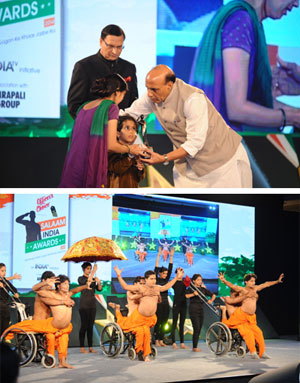
    India TV honoured bravehearts of the country through the second edition of the ‘Salaam India Awards’.

     

    The awards were presented in New Delhi on Sunday, September 21with Union Home Minister Rajnath Singh as Chief Guest. Several other political and social luminaries were present, including Ravi Shankar Prasad, Salman Khursheed, V K Singh, Kalraj Mishra,  Janardan Dwivedi, Maulana Mahmood Madani, Ram Gopal Yadav, Amar Singh, Kiran Bedi,  Rajyavardhan Singh Rathore, Kishore Chhabria, Ghulam Ali, Manoj Tiwari and Dr Naresh Trehan amongst others.


    The selection of the final 14 awardwinners was done by a high powered jury comprising India TV Chaiman & Editor-in-Chief Rajat Sharma, Kiran Bedi, Deepak Kapoor, Rajyavardhan Rathore. The Jury was chaired by former CEC Dr  SY Quraishi.


    Addressing the gathering, Rajnath Singh highlighted, “Salaam India Awards is a great “point of reference” initiative by India TV. Our society that is fast transforming, needs many more similar initiatives. This will surely motivate all of us to rise above of our selfish motives for the larger societal good.”


    Congratulating the winners, Rajat Sharma observed, “These bravehearts are the real heroes. It’s an honour for all of us present here to be able to honor such heroics.” Said Ritu Dhawan, MD & CEO, India TV, said, “India TV will be working on more such initiatives and further our humble attempt as a responsible news channel to not only honour the extraordinaire but also motivate the society at large.”


    This year’s initiative was presented by Officer’s Choice packaged drinking water in association with Amrapali Group. Dainik Bhaskar & Pioneer Publicity were the media Partners. The event was executed by Showtime events.


    Winners’ List for Salaam India Awards 2014


    Bravery Awards

    1. Payal Senani

    2. Late Nitin Yeolekar (posthumous)


    Gallantry Awards

    1. Gunjan Sharma

    2. Late Aryan Raj Shukla (posthumous)

    3. Rosy Ara


    Jyoti Singh Awards

    1. Fatima Khatun

    2. Sakshi Vidhyarthi


    Special Awards

    1. Inspector Gaurav Godbole

    2. Constable Sunil Kumar T.P.

    3. Late Sepoy Vikram (posthumous)

    4. Nathu Singh Uttam Adhikari (QA)

    5. Late Lt Cdr Manoranjan kumar (posthumous)

    6. Aadesh Kumar Sea I CD III

    7. Riffat Abdullah


  • Ogilvy Bangalore launches CarWale campaign

    By A Correspondent


    CarWale has launched its first ever mass media campaign, spearheaded by a television commercial that makes a strong point with a tinge of humour.


    The strategy, as articulated by Ogilvy Bangalore, was to inextricably link CarWale to the car-buying process. This came to fore through consumer research which showed that there is a low awareness for the portal, and CarWale is still not the first point for them to gather information in their car buying process. In this digital age, consumers instead visit multiple car showrooms and seek opinions from people around them.


    Steven Hough, Executive Creative Director, Ogilvy Bangalore said, “It is a common insight that car buyers, especially in India, take everybody’s opinion before deciding on a car. We decided to capitalize on this and highlight the dilemma of the Indian car buyer in a series of amusing vignettes.


    Mohit Dubey, Co-founder and CEO, CarWale added: “We are extremely excited about our first foray into building brand CarWale with mass media advertising. We have timed this campaign keeping in mind buyer sentiment at this time of year, when pre-Diwali car research is at its peak, and the response we have received from both buyers and the industry is humbling.”


  • SMG India bolsters its senior team with key appointments

    By A Correspondent


    Starcom MediaVest Group (SMG) India has announced that it has bolstered its senior leadership team with the hiring of two key executives. Natasha Kapoor joins the agency as VP, SMG Mumbai and Gautam Surath as VP, Strategic Planning.

     

    In a newly created role Natasha will be responsible for client service, product delivery and growth for the Mumbai market. Natasha has more than 15 years of media experience. Her last job was at Samsung India, where she handled investment, brand activation and strategy for its media procurement and process audit division. Prior to that, she was a media purchases director at Mediacom where she handled television buying for the Procter & Gamble team. She also has worked on the Unilever business at Fulcrum and Mindshare.


    “I believe SMG offers a unique opportunity in the market for staff and clients alike. Nowhere else in India can you find a world class Digital and Data and Analytics practice coupled with great media tools, systems and thinking resulting in a great all round product. It is a wonderfully challenging assignment and I am looking forward to it,” said Natasha.


    Gautam Surath also joins the agency as VP, Strategic Planning Director at a national level and will be responsible for strategic planning, training and guiding the digital transition of SMG’s clients across its offices. Surath is an SMG veteran having worked for the company from 2003 in both India and China. For the past four years he has been a Business Director at SMG China in Guangzhou, where he was strategy lead on multiple categories of the Procter & Gamble business.


    “Quite frankly, having started my career at Starcom and having worked here ever since, moving back to the India office from China was a bit of a no-brainer. Having seen the company evolve with evolving consumer trends, I have no doubt that our vision is the right one. Exposure to the global marketplace has only strengthened my belief in this regard. Exciting times in India and it’s great to be back home!” said Surath.


    “Natasha and Gautam bring key skillsets to complement and enhance our offering to clients in India and both Malli and I look forward to working with them.” said Hanley King, Chairman, SMG India.


  • TheSmallBigIdea promotes interactive application Dil Se

    By A Correspondent


    ANDPictures’ digital agency, TheSmallBigIdea roped in stand up comedians Ashwin Mushran and Amogh Ranadive to promote their interactive application Dil Se. In a one of a kind interactive campaign, the audience’s tweets were converted into videos within minutes of them being posted.


    ANDPictures, the interactive movie channel from the stable of Zee Entertainment Enterprises Ltd (ZEEL) recently launched an interactive application called Dil Se, which allows people to record and upload messages for their favorite celebrity. The recorded messages are then sent to celebs for them to reply with personalized messages for their fans.


    The audience had to tweet to the channel, the extent to which they would go to catch the attention of their favourite star. While audiences flooded AndPictures timelines with crazy ideas in the form of tweets & posts, Ashwin Mushran, Amogh Ranadive and the agency was busy converting the tweets into video sketches. The gags told the audience how their ideas of impressing their stars might not to be the best, by mocking the idea itself. The videos were hilarious and that attracted more than 6 lakh impressions on twitter alone.


    Harikrishnan Pillai, Founder-Director, TheSmallBigIdea shared, “Our route was twisted and twisted works. People didn’t expect their version of celeb-love to come out in such funny manner, and that too within minutes of them tweeting. Good part is that people were OK to laugh at themselves. The giggles ended at 6 lakh impressions, validating the efficacy of the idea too.”


    Deputy Business Head – Hindi Movie Channels, Ruchir Tiwari added, “The end objective was to make people aware of this application. The core message was beautifully weaved around the social activity, giving us dual advantage of creating great online content and marketing the digital property.”


  • Quikr appoints Vineet Sehgal as Chief Marketing Officer

    By A Correspondent


    One online classifieds major Quikr has announced the appointment of Vineet Sehgal as the company’s Chief Marketing Officer. Vineet will be responsible for marketing strategy and plans across all areas including brand building, performance marketing, partnership and alliances at Quikr.


    Vineet brings to the company more than 18 years of experience in marketing and business strategy across diverse industries such as telecommunication, FMCG, banking and management consulting. He has helped scale several operations from start up to maturity in some of the world’s leading organisations such as Nokia, Nestle, Accenture, Cadburys and HSBC.


    Commenting on his appointment, Pranay Chulet, Founder & CEO of Quikr said, “We are delighted to welcome Vineet to Quikr. Quikr is made in India and for India, and Vineet has built his career scaling consumer businesses in the country so there was natural chemistry here. Vineet knows the Indian consumer and he knows the Indian consumer on mobile. His arrival was particularly well timed with our own plans, as the fun is just beginning.”


    Prior to joining Quikr, Vineet headed Nokia’s programs and planning portfolio. He led large scale launches of some of the most used mobile devices in India. He also founded the Nokia Money start up team and drove its growth from conception to market roll out. He began his career in consumer marketing with Nestle.