Category: MEDIA

  • Kumar Mangalam Birla may sell minority stake in India Today group

    By Arijit Barman & Arun Kumar


    Two years after making a personal investment in the Aroon Purie-controlled Living Media India – widely known as the India Today Group – for a minority stake, Kumar Mangalam Birla may be planning to cash out. Multiple sources aware of the development said Birla, the chairman of the diversified Aditya Birla Group, has roped in Bank of America Merrill Lynch to help him find a buyer for his minority stake.


    In May 2012 Mr Birla picked up a 27.5 stake in the New Delhi headquartered company that straddles the entire media chain, from television to magazines and a tabloid. Living Media Ltd is the holding company and also owns 57.2 per cent in TV Today Network – a listed company that controls the group’s broadcasting assets such as Aaj Tak and Headlines Today – besides the publishing ventures, including flagship India Today.


    As per the 2012 agreement, Mr Birla’s holdings were not frozen but were linked to certain financial milestones that the group had to achieve. Currently, the sources cited earlier said, Mr Birla owns a larger equity stake, believed to be around 34-35%. They add that discussions with both strategic and financial investors like private equity funds have been ongoing for a while now. Several leading business groups now have investments in domestic media corporations and more are keen to get a foothold, making this an interesting opportunity.


    The option of selling the stake back to the Purie family is also a possibility. Neither Mr Birla nor the India Today Group have ever disclosed the quantum of investment. While some say so far Mr Birla has pumped in Rs 700 crore, others speculate that the amount is half that, around Rs 350-Rs 400 crore. A Birla Group spokeswoman refused comment on what she termed as “market speculation”. The Bank of America Merrill Lynch spokesperson also declined comment.


    Even though Mr Birla’s decision has come as a surprise to many, people familiar with his thinking say Mr Birla feels that the government might impose restrictions on media ownership by corporate houses. “Owning media assets can be a double edged sword for corporates.


    Governments or political parties can misconstrue the strategic intent of the investment and any criticism or critical coverage can get the corporate owner in trouble. So even if a corporate gets into it, in most cases it would be either through indirect ownerships or personal investments as they would want to derisk the main businesses,” said a person familiar with the thinking behind Mr Birla’s investment. He spoke on condition of anonymity because of the sensitivity of the matter. “It was always a personal investment and there was no business angle to it. There was never any interference into editorial matters or with the management,” added another person, aware of Mr Birla’s investment philosophy with regard to Media.


    Mr Purie’s publishing empire, controlled through Living Media, also includes Business Today, a business magazine, and a clutch of licensed magazines such as Cosmopolitan, Good Housekeeping, Men’s Health, Harper’s Bazaar, Travel Plus and Harvard Business Review, among others. It also has a joint venture with German media house, Axel Springer AG, for an auto magazine and an online shopping portal: Bag it today. Additionally, a joint venture with UK-based Daily Mail brings out the tabloid Mail Today.


    TV Today has four news channels – Headlines Today, Aaj Tak, Tez and Delhi Aaj Tak – and radio stations under the brand Oye FM. In the June FY14 quarter, TV Today posted a profit of Rs 32.7crore on revenue of Rs 137 crore. It’s current market capitalisation is Rs 908.7 crore.


    Interestingly, the Anil Ambani controlled Reliance Capital has been selling down its 7 year old exposure in TV Today.


    From a peak equity holding of 14.9%, it has slowly reduced its stake, the latest such sale being in the first week of this month, when it offloaded nearly 4,80,000 shares for Rs 7.38 crore in the open market. With this, R-Cap’s stake in the company has fallen to five per cent.


    Source:The Economic Times

    Copyright © 2014, Bennett, Coleman & Co. Ltd. All Rights Reserved

    Licensed to republish


  • What Ticks for Indian Consumers/ Children -Lara Balsara and Nabendu Bhattacharyya

    Continuing with our extracts from the second edition of the MxMIndia Annual, we present contributions by Lara Balsara and Nabendu Bhattacharyya.


    Stay truthful and honest about brand attributes


    By Lara Balsara


    TV is the lead medium today when it comes to targeting kids and their moms. Kids and their moms love to watch serials, cartoons and movies in that order. Cinema, shopping malls, computer games are key media touchpoints that marketers must consider. Book reading being a popular habit in metros, bookstores could be used as a touchpoint. Internet as a medium is growing in importance with the number one activity being playing games, followed by searching for information and social networking online.


    Do children notice OOH advertising?


    By Nabendu Bhattacharyya


    Children are increasingly the target of advertising because of the amount of money they spend themselves, and because of the amount of money they influence their parents to spend – their pester power. Studies show that by age 12 children have developed their behaviour as consumers, effectively recognise advertising in its various forms and are able to adopt critical attitudes towards it. Advertisers recognise that brand loyalties and consumer habits are formed when children are young and vulnerable and will be carried through to adulthood.


    The most important thing is to stay truthful and honest about the brand attributes and promises made. No one likes being cheated or mis-communicated to.


    Today, children are bombarded with marketing every moment that they are awake via television, radio, print, OOH, internet as well as other electronic media. Like most adults, even children spend majority of their time outdoors – going to school, classes, recreational activities etc. With the advancement of media and technology, the future of OOH (Out-of-home) is brighter than ever. Yes, children notice OOH advertising, amongst many other forms of advertising and it plays a substantial role in their decision making. Children are very observant, and also have an established mind-set of their own.

    The use of relatable characters, heroes, icons, celebrities, vibrant colors, free coupons and free gifts are all common ways in which brands connect with children. Viral marketing, special programmes, contests and activities run in schools, malls, amusement parks etc are some other ways brands capture the children’s attention. TV channels like Cartoon Network, Disney etc. have child-centric advertising focused on the impulse buy and junk foods category. Brands like Cadbury, Kellogg’s, HUL, Colgate, Maggi, and Britannia are heavy spenders for television spots. Children are also exposed to out-of-home advertising on their way to school via bus shelters, bus branding, billboards etc. During weekends, children are exposed to advertising in malls, multiplexes, game centres and movie theatres. Majority of children today are tech-savvy; at an early age they get exposed to technology via the internet, TV video games, iPad’s and smartphones. It is a known fact that children are great influencers in decision-making processes and this includes decisions around food, technology, vacations, car etc. Also, marketing in schools and within specialized kids clubs, organised by brands have also proliferated in recent times.


    Child-targeted marketing earlier was concentrated on sweets and toys; it now also includes clothes, shoes, a range of fast foods, sports equipment, computer products and toiletries etc. To get children to notice their campaigns, brands adopt an entirely new communication strategy targeted to these evolving consumers. In India, brands like Cadbury, Britannia, McDonalds, HUL, Lays amongst others have focused products targeting children. Children are a large consumer segment for a variety of brands. The communication strategies are carefully crafted after observing the receptiveness of a product across numerous groups of children. Cartoon characters launched as movies will be followed up by television series and then be merchandised on hundreds of products from t-shirts to toys.


    To conclude, children are an important TG for brands while planning their communication strategy as they do play a substantial role – directly or indirectly in the decision making processes of the household. The market for children’s products and food is enormous. Thus, they represent an important demographic to advertisers because in addition to their own purchasing power they influence their parents’ buying decisions and are the adult consumers of the future.


    Tomorrow (Aug 19): Family – Vijay Bobby and Avik Chattopadhyay


  • Business India appoints Fourth Dimension Media

    By A Correspondent


    Business India Publications has appointed Fourth Dimension Media Solutions as its sales concessionaire to strengthen its existing sales team and increase its strategic reach with clients and media houses.


    The collaboration with Fourth Dimension will enable Business India to effectively engage with advertisers in India and amplify their presence across the country along with developing widespread and integrated relationships with leading national advertisers.


    Said Fourth Dimension Media Solutions CEO Shankar B: ” We are extremely honoured and privileged to represent an iconic brand like Business India and it will be our commitment to fulfil the expectations.”


  • Achche Din Aane Waale Hain: GroupM revises adspend growth to 12.5% from earlier 11.6%

    By A Correspondent


    If leading media services conglomerate GroupM revised annual advertising expenditure (AdEx) estimates for 2014 are to be believed, the ‘achche din’ are surely set to come. The AdEx estimate is revised to 12.5% from 11.6% released earlier this year. The AdEx revision is part of the global report called the This Year, Next Year (TYNY) 2014. GroupM globally also released its revised estimates, India, Brazil and Russia remain among the faster-growing ad markets.


    Speaking about the industry sectors contributing to the revised growth, CVL Srinivas, CEO, GroupM South Asia said, “After a cautious start to the year, the overall sentiment in the country is positive following the general elections and a new stable government. One of the sectors that is adding to the growth story in India is retail. Specifically e-commerce players that are investing heavily in above the line advertising along with digital media. Industries like FMCG, auto, telecom and BFSI are expected to increase spends given competitive pressures and clear policies.”


    Medium-wise, television spending is set to grow to 14.8% as against the previously predicted 12%. Digital media continues to show the maximum growth with 35%. In the print medium, regional publications and local advertisers are projected to lead the growth for dailies. Government spending and retail will continue to increase spending in print.


    This Year, Next Year, is part of GroupM’s media and marketing forecasting series drawn from data supplied by holding company WPP’s worldwide resources in advertising, public relations, market research, and specialist communications.


  • Fotocorp turns 10!

    By A Correspondent


    Mumbai-based Fotocorp News Photo Agency completes its tenth anniversary today, August 19. Launched on this day, which is also World Photograph Day, Fotocorp has announced a  new website design (www.fotocorp.com) with additional search features. * See Disclosure.


    Founded by senior photojournalist Shailesh Mule, the agency has notched up a collection of 3 lakh editorial images since its inception.


    Fotocorp is a subscription-based agency, which also undertakes commissioned photo assignments for editorials, advertising agencies, corporate houses, PR agencies and entertainment events, both locally as well as internationally. “To mark the occasion, we have launched a Retro section with vintage images of Bollywood, politics and other segments,” says Mr Mule, adding that thousands of images are uploaded every month on the agency’s website. The Retro section has rare archival images, providing original content and greater choice to the subscribers. “The dynamic new features that have been introduced on www.fotocorp.com provide better navigation, easier access to pictures and faster downloading,” says Mr Mule.


    *Disclosure: MxMIndia often sources photographs from Fotocorp and is it subscriber


  • What Ticks for Indian Consumers/ Family – Vijay Bobby and Avik Chattopadhyay

    Continuing with our extracts from the second edition of the MxMIndia Annual, we present contributions by Vijay Bobby and Avik Chattopadhyay


    Regional publications must have a unique identity of their own
    By Vijay Bobby


    In my opinion, there are three very important factors by which regional publications can be relevant to the 18+male and female readers.


    First, regional publications must take all efforts to speak to the TG in their language.By this I mean that, rather than trying to emulate English dailies in editorial delivery,choice of content including selection of headlines and even presentation of news,regional dailies must communicate in a way that is most comfortable to the readers. After all, regional publications have the advantage of communicating in the readers’ mother tongue through an Indian language and this advantage must be fully taken advantage of.


    Concept of relevant disruption could do it for ads
    By Avik Chattopadhyay


    Advertising is a means and not an end. It has a purpose and therefore a deliverable. The more measurable the deliverable, the more potent is the advertising. Therefore if any piece of advertising does not deliver, it is a waste and cannot be termed ‘innovative’ in anyway. For an innovation, by its very nature, presupposes a positive impact.


    Regional publications must have a unique identity of their own and change with the times in all aspects and not look like translated versions of English publications. In fact, going one step further, one can even try different editorial and layout presentation styles depending on the editorial content. The language used to convey film news can be different from that used to convey business news and so on.The best example one can think of to substantiate this observation is the film industry. Over the years, English movies have remained the same (except in use of technology) in terms of dialogue delivery, body language, vocabulary and continue to run successfully whereas if one looks at the regional language movies, the difference between movies released a few decades back and the ones being released now is striking.Can you imagine today’s movies being made like the ones that were made even about ten years back?.


    Secondly, in today’s context when updatedheadlines are made available round the clockthrough mobiles, tablets and other devices,regional publications must do much morethan just report news. Analysis, statistics, expert opinions, graphic illustrations, photographs capturing vital event-related moments and lot more should be included in the editorial content. The reader must feel that he is getting a lot more than he has already learnt through TV or other updates.


    Last but not least, engaging the reader in interactive exercises is very important.Applications like Augmented Reality can be effectively used to create a good rapport with readers and such exercises will increase reader loyalty as well as create goodwill. Just imagine news coverage of a one-day match wherein a reader can scan the article and watch a video of all the wickets that fell! Orthink of a recipe in the weekend cookerycolumn wherein one can scan and see theactual dish being prepared. Such featureswill especially be attractive to the youth andwomen readers.


    An innovation, in the context of advertising, is a deliberate communication intervention that overturns convention. It could very well be called a ‘disruption’. In fact, I prefer the term disruption. Or better, relevant disruption. One that makes the target sit up, take notice and react positively.The concept applies to all target groups – be it men, women or the youth of India.


    Both Messrs Boby and Chattopadhyay have moved on from their previous jobs

    Tomorrow (Aug 20): Men- Rohan Bhansali and Devendra Chawla


  • R K Arora elevated to Group CEO, ITV Network (From Yesterday)

    By A Correspondent


    R K Arora has been elevated to Group CEO, ITV Network where he will continue to lead and drive the organization and take it to the next level.  In this role, he will assume overall responsibility of strategic and operational management of the ITV Network and will oversee the group’s diverse portfolio of assets spanning news broadcasting.


    A chartered accountant by profession, Mr Arora joined the ITV Network in 2012 as CEO Broadcasting. Mr Arora has extensive experience spanning over 20 years in the field of distribution, finance and profitability of companies. Prior to ITV Network, he was the Chief Executive Officer with BAG Network (News 24, E24 and Darshan 24). He was also associated with Independent News Service Pvt. Ltd. (India TV) since its inception.


    “I’m delighted to announce Mr. Arora’s well-deserved promotion,” said Kartikeya Sharma, Managing Director, ITV Network. “I am confident that with his deep industry knowledge and collegial working style, he’ll continue to strengthen ITV Network’s position in the marketplace. He has been instrumental to the highly positive momentum which ITV Network enjoys today and has in the past two years, in his capacity as CEO Broadcasting, worked towards attaining leadership position for ITV network and taking it to greater heights. His astute business acumen and expertise has helped ITV Network solidify its position in the news genre. Under Mr Arora’s tenure all our products have become market leaders and as a group we have worked hard to deliver value for our advertisers. Not only have we fulfilled our commitments, but have also delivered more than what we had targeted. With this thought process, I am sure Mr. Arora will achieve many more milestones. Our company’s objective is to become India’s largest TV news network and the most profitable one as well. I am sure that ITV network will definitely achieve its objectives under his leadership.”


    “I am humbled to lead ITV Network as Group CEO,” said Mr Arora. “In spite of challenging and demanding environment both our brands NewsX and India News have been able to carve a niche for themselves. I firmly believe that with Kartikeya’s support and ITV Network’s formidable talent, we are well poised to continue to deliver superior results in today’s increasingly competitive market and take the Network to greater heights. India News and NewsX is now a preferred choice for advertisers as they are delivering strong performance week on week. In a short span of time, NewsX and India News have carved a value proposition in the mind of the advertisers and have been consistently over delivering”


  • HDFC Bank is India’s Most Valuable Brand


    By A Correspondent


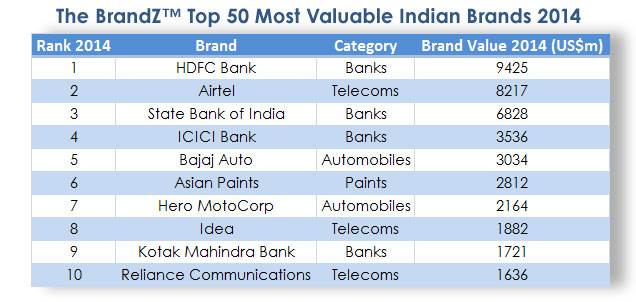
    The combined Brand Value of all the brands in the inaugural BrandZ Top 50 Most Valuable Indian Brands ranking is almost $70bn BrandZ. HDFC Bank is India’s most valuable brand with a value of $9.4bn. Carried out by marketing and brand consultancy Millward Brown in conjunction with WPP, the valuation is the only one in India that takes into account consumers’ opinion of brands to calculate the contribution that product brands make to business success.


    The BrandZâ„¢ India study shows that India’s unrestricted ‘right to play’ for businesses has nurtured great diversity amongst brands in the ranking. The Top 50 come from 13 different categories. Seventeen are multinational corporations (MNCs), 26 are private Indian brands and seven are state-owned brands. This indicates that India is an open, fertile market for building valuable brands, irrespective of age, origin, structure, category, ownership or even price range.


    HDFC Bank, the No 1 brand, has a network in more than 2,100 cities. It is popular with its 28 million customers for launching mobile apps designed to make banking easier, and running literacy, education and skills training programmes in rural areas. The No 2 brand, Airtel, is the fourth largest mobile operator in the world with nearly 300 million customers, while India’s largest commercial bank, State Bank of India, is at No 3 in the ranking.


    Services businesses (Banking, Telecoms and Insurance), which are the nerve centre of today’s Indian economy, are prominent in the ranking. Seven of the Top 10 brands, and 30% of the Top 50 brands, come from the service sector. Financial services stand out, with the 12 banks and insurers in the ranking holding the largest proportion (37%) of total Brand Value. Analysis shows these brands have built value by successfully achieving scale – both in geographical reach and the diversity of their offerings. Telecoms, Personal Care, and the Food and Dairy sectors also feature strongly in the Top 50. The data shows that these brands – along with the other FMCG brands in the ranking – excel at connecting with Indian consumers.


    The average Brand Contribution (a measure of the impact brand alone has on value) of the Top 5 brands is far higher than the overall average of the Top 50, illustrating the positive impact that building a strong brand has on the financial valuation of the brand. These brands create powerful connections by being meaningful to consumers, and differentiating themselves from others.


    Key findings highlighted in the BrandZ Top 50 Most Valuable Indian Brands include:

    :: Being meaningful and different builds value – India’s most valuable brands are highly relevant to consumers and differentiate themselves through service, new offerings and brand experiences. One such example is personal care brand Colgate (No 28) – even after 70 years in India the brand has successfully remained relevant and continues to differentiate itself from the competition.


    :: India has evolved into a brand powerhouse – India’s Top 50 most valuable brands have as much Brand Power (consumers’ predisposition to choose that brand over another) as the global Top 50, and are ahead of the other emerging economies.


    :: Private sector players and multinational corporations dominate – together these contribute around 85% of total brand value. They have succeeded by nurturing a strong relationship with Indian consumers.


    :: Megabrands lead the game – like other fast growing economies, India is dominated by a handful of big brands or companies that own stables of brands: the Top 5 account for 45% of the ranking’s total value. Their tremendous scale and ability to cater to a wide spectrum of the population has translated into financial gains.


    :: ‘Balanced brands’ is the mantra – brands that are able to build both strong connections with consumers and business scale that leads to the creation of financial value are contenders for entering or rising up the BrandZ ranking. Three out of the Top 5 Indian brands demonstrate this balance.


    :: Consumer technology is ‘the category waiting to happen’ – there are currently no homegrown consumer technology brands in the Top 50, but this category is on the verge of emergence. The presence of Indians working in the sector globally is high, and consumer-facing technology brands founded by young entrepreneurs have already started to gain ground.


    :: ‘Indianizing’ products and services is important – the many successful international brands in the ranking have taken the time to understand Indian needs and tastes and adapt to them. Noodles, food seasoning, soup and sauce brand Maggi (No.18), personal care brand Colgate (No.28) and beverage brand Horlicks (No.20) are masters at this – and are thought of as Indian brands by most consumers as a result.


    :: Old and new sit side by side – living with one foot in the ancient world and one in the modern makes consumers equally receptive to heritage brands (Bajaj Auto, No.5, established 1945) and new brands (Airtel, No. 2, established 1995). More than a quarter of the Top 50 brands were created after the economic liberalization in 1991 while Dabur, No.22, was established 130 years ago.


    Said Prasun Basu, Millward Brown’s Managing Director – South Asia: The stronger the relationship a brand can build with consumers in its category, and the more it can leverage that to build scale, the more sustainable and profitable it becomes. All of the Top 50 brands are reputable, successful engines of growth for the future of India. Any global manufacturer that makes the effort to understand the diversity of the Indian consumer’s needs, tastes and aspirations, and which can build a proposition that is both meaningful and appropriately differentiated, will succeed in building a strong brand.”


    Added David Roth, CEO of The Store, WPP: “With the second highest number of social networking users in the world, and the third highest number of users of mobile devices, developing an e-commerce strategy that focuses on social and mobile platforms is essential for brands in this region.”


    Said CVL Srinivas, CEO GroupM – South Asia, “We are already seeing the impact of the purchasing power of the internet and mobile users in India, with the exponential growth of e-commerce companies in the space of travel, e-tailing, ticketing and many main line brands increasing their brand building budgets to digital media in multiples.”


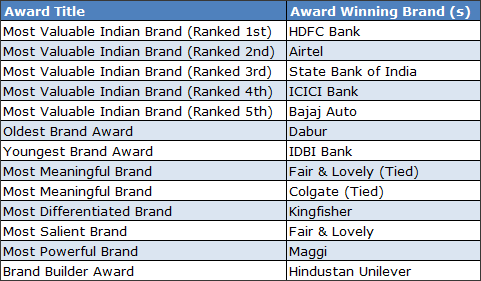
    In addition to the rankings, special awards were also presented to brands among the Top 50 under the following categories.


    Millward Brown BrandZ India Awards 2014

    A copy of the BrandZ™ Top 50 Most Valuable Indian Brands 2014 report can be downloaded at www.brandz.com


  • What Ticks for Indian Consumers/ Men- Rohan Bhansali and Devendra Chawla

    Continuing with our extracts from the second edition of the MxMIndia Annual, we present contributions by Rohan Bhansali and Devendra Chawla


    Brands cannot target men the way they target women


    By Rohan Bhansali


    In India, women have conventionally been the Chief Purchase Officers of the household. However, over the last few years, the men in the families have successfully stepped up to this role. Meet Rahul, your quintessential Indian male consumer. He is more aware about products and brands, for him shopping is no more than a dreaded activity he must not undertake unless absolutely necessary. Men, generally, are inclined towards online shopping and exhibit consistency in adopting online shopping. In addition to that, their range is not limited to low ticket categories. The trend extends to high involvement categories like technology, real estate, etc.


    Men’s role in family affairs
    has evolved


    By Devendra Chawla


    The fabric of the society has been changing, and it has made men evolve from just being bread earners to a more family centric role. As more and more women are stepping out of home, men are getting more involved in household sphere – from attending parent-teacher meetings to shopping – they are doing it all. Some men are even taking up cooking as a hobby inspired by cooking shows like MasterChef. Weekend cooking by men is gaining in popularity.


    A key change one witnesses is that more and more men are now accompanying their spouse/family on shopping trips. Modern retail is acting as a catalyst for men to include shopping in their schedule. They are more impulsive shoppers than women, and a lot of experimentation is taking place.


    Ever since, marketers have ignored men and focused on targeting women for their campaigns. However, in the last two decades, rapid globalisation has completely changed the way brands target their consumers. For instance, the marketing strategy used for condoms focuses on sensuality, while lingerie is marketed primarily as a gift item. This basically points at how brands are interlinking TGs and creating new channels to sell. However, there always remains a core TG for brands to survive on. Men, as a group, show great potential to be a gateway to reach the complete family.


    While men live more in the moment and believe in finishing the task they have taken in hand, they simply act as a receptive target group. On the other hand, with impulsiveness, the interest in power and the need to look good, well-embedded in their DNA, brands cannot target men the way they target women.


    Getting to the root of the consumer behavior of the Indian Male – The DNA

    Patience
    Men simply hate waiting. Being a part of those long queues would never interest them. Their idea of shopping can be simplified into the Neanderthal-like instinct – ‘Go. Seek. Buy!’ Ample instances show men bouncing off as confused if the checkout process is complicated. Forcing men to register on your website to gain access to the product he is looking for will simply put him off. So keep it simple. And make it fast.


    Trust
    Men like transparency. Nobody wants to take risks with his hard-earned money and men are no exceptions. All they want is trust and a transparent experience. You could gain their trust by not asking them for unnecessary personal information. That’s the way to being in their good books.


    Impulsive
    The stir of impulsiveness and accessibility is a huge drive for men. If they feel it, they want it. They are not hugely turned off by delivery charges if they want a product the next day. And no, they won’t mind spending extra on delivery if the product is what they fancy.


    Good at Research
    Men research intensely and excessively. They are quick and thoughtful while looking for what they want. I personally know of a few men who will do all their research online, zero in on the product they want, find out where they will get it and go offline and buy it – a great example of ‘Go. Seek. Buy’.


    Loyalty
    If you provide them with what they want in the most efficient way, they WILL come back. They believe in brand loyalty and are more often than not, brand loyalists.


    Coming back to the quintessential Rahul, who we spoke about earlier, he can be categorised into the following groups, and brands can engage him accordingly:

    The Simpleton – Driven by family values and tradition. He loves his family and believes in value for money. He wouldn’t mind paying a little extra for value.


    How do you engage the simpleton?
    :: Showing him the value that your brand can add
    :: Surprise him with offers and better deals
    :: Making it funny, as humor is a great way to reach out to his kind


    The Alpha – Driven by need and hunger for status and pleasure, this metropolitan dweller has been exposed to the best of facilities around him. He identifies value with how much a concept appeals to his elitist instincts. For him, appearance of the product is of as much value as the usefulness, if not more. Status and social recognition are important too.


    We can engage the Alphas by:
    :: Focusing on ‘Me’. Alpha males are heavily self-driven. Give them content that satisfies their ego and put them a step ahead of other males
    :: Give them exclusive content that is not for the masses
    :: Talk about pride and the status symbol associated with your brand
    :: Create an elitist appeal


    The Progressive – Similar to ‘The Simpleton’, he is hugely involved in his family life. He thinks about his wife and kids as well. He is educated, progressive in outlook, not overly simpleton nor overly an alpha male. Such males take purchase decision by collaborating and are driven by rationality than impulse.


    Such men can be engaged by:
    :: Giving content that increases productivity adding value in their lives
    :: Packaging family in your conversations
    :: Using more of testimonials and product reviews


    The next time you happen to deal with a Rahul, know that he has evolved from the Neanderthal, but is still very much the man at heart. He is well informed, brand conscious, wants status and at the same time believes in value for money. And even though he is impatient, he enjoys research and likes to spend quality time in the process of information gathering. Thus, brands need to ensure that the selling points and product details are available easily. Positive reviews and testimonials will also add more value when dealing with men.


    A positive, strong and active presence on social media has also become a lethal tool in this direction. A lot of men look at these platforms for insights on brands and products. Another important aspect is the ranks of the brands on search engines. Men don’t tend to go beyond page 1 of the results page on search engines. So, it is important for brands to rank high and if possible, appear in the top 3 results of the searches.


    Brands must also incorporate entertaining and engaging videos into content as men react a lot to such content. While they’re a tough combination of expectations to live up to, the challenge can be exciting. Identifying the right segment is key to applying the right strategy. Keep in mind the above categories and somewhere you’ll know which Rahul fits your brand and embodies your target group.


    A quick tip: Colors like blue, red, black and green tones catch the male eye better than others. Men stay away from shades like purple and brown.


    An added attraction for them while shopping is explosion in men’s categories in super markets, for instance male grooming. Men’s grooming is growing nearly double the rate of overall personal care category given its smaller base.


    This brings us to yet another change in men’s behaviour: personal grooming. Looking good is important for men now, leading to them visiting spas more frequently. Centuries ago, women would choose their grooms in swayamvar, which put pressure on men to be at their best in all forms of skills and looks. With women increasingly choosing their partners and no longer just being well dressed dolls for men to see and select, men are again under pressure to look good.


    That, though, is not the only reason for being better groomed. Good grooming makes one more presentable and confident at work. Besides, women in 30’s, 40’s and 50’s are very well groomed and they want their men to be well groomed as well. Older men, are hence, under pressure to keep pace with their better halves who use age defying cosmetics and don’t want their partners to look old revealing their age.


    Modern man, thus has changed a lot – he is more involved in household activities, is better groomed, and an avid shopper. Credit for this change, to a very large extent goes to the sea change the Indian woman has gone through – she is much better groomed now, and is no longer confined to the four walls of the house.


    Tomorrow (Aug 21): Women -Harish Bijoor and Lynn de Souza


  • Now, will newspaper publishers opt out of IRS?


    By A Correspondent


    Now that the MRUC and RSCI have decided to lift the abeyance on the IRS 2013 numbers released in late January this year, there is mixed reaction from stakeholders. While media agencies and advertisers are happy that they have data to base their buying decisions, a large number of publishers have express shock and dismay.


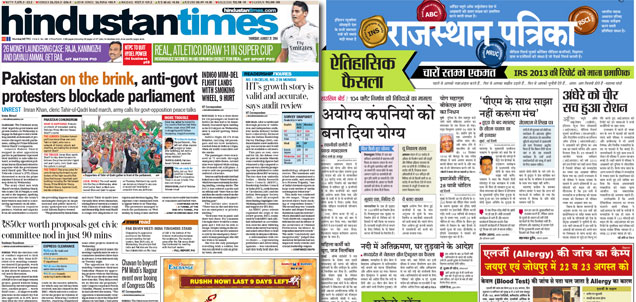
    Although none of them have done so in public, in the quiet, a majority of the big media groups – save the Hindustan Times and Rajasthan Patrika – are mulling their next steps.


    But first let’s read the press release that has been issued by the MRUC:

    “The Indian Readership Survey, 2013 was released on January 28, 2014. The release attracted differing views on the accuracy of the data and therefore the Readership Studies Council of India voluntarily requested subscribers to hold the study in abeyance and decided to undertake a revalidation exercise.


    Subsequently a sub-committee for revalidation was established with two co-chairs representing publishers and advertising agencies. The sub-committee unanimously concluded that the methodology used to conduct IRS 2013 was in order and decided to commission a Process Audit.


    This committee, after viewing several proposals unanimously agreed to award this audit to Mr Praveen Tripathi, (Magic 9 Media) India’s foremost expert on large-scale studies of media consumption behavior.


    The finding of the revalidation sub-committee and audit report, it was decided, would be discussed by the Heads of four industry bodies i.e. Chairman-MRUC, Chairman-RSCI, President-INS and Chairman-ABC, and a decision taken by them.


    The said Heads of the four bodies received and deliberated upon the report submitted by Mr. Praveen Tripathi and discussed the same with the chairman of RSCI – Technical Committee as well as the two co-chairmen of the revalidation committee.


    The Audit was conducted in two stages. Stage one involving direct back checking of respondent homes after which a much broader and deeper Forensic Statistical Analysis exercise was carried out to indentify and isolate both fieldwork compliance deficiencies and incidence of the occurrence of Unusual Publication Incidence (UPI) in respondent interview records. By sieving the aggregate data set for these issues, the audit was able to judge unequivocally whether the statistical deviations systematically changed any of the crucial readership output. The outcome was conclusive and unequivocal. The study results had not been impacted.


    After intense deliberations and careful examination of the audit report, Chairman-MRUC, Chairman-RSCI, President-INS and Chairman-ABC, have arrived at a unanimous and unambiguous decision to lift the voluntary abeyance placed on The Indian Readership Survey, 2013.


    The voluntary abeyance placed on The Indian Readership Survey 2013 is lifted with effect from 20th August, 2014.


    As has been reported, a large section of newspaper and magazine publishers had grouped together to take on the MRUC in February 2014. Among the actions proposed then were law suits and pulling out of subscriptions to the MRUC.


    According to an industry person in the know, there was a wide scale agreement that there is need for measurement data. Newspaper publishers which were earlier fighting the onslaught of television have in recent times been facing the heat from activation and OOH and the digital media. “With competition staring in our face, there was need to work things out. What’s worrying is that the crossfire we may see. It shouldn’t become a Times of India v/s Hindustan Times and a Dainik Bhaskar v/s Rajasthan Patrika duel.”


    A media agency captain who MxMIndia spoke to said: “Although IRS 2013 was kept in abeyance, we knew what those figures were and factored them in our decision-making. However, we must also say that we were not too convinced about the findings.”


    The newspaper industry marketer wasn’t too happy with the views of media agency professionals. “It’s fine for them to sit on their high horses now, but how will they react if they are subjected to a similar study. We should not forget we are part of the same ecosystem. This whole display of fiendish delight is unpalatable. We don’t want cowboys in the system!”


    Given that various the heads of various associations – Chairman-MRUC, Chairman-RSCI, President-INS and Chairman-ABC – took “a unanimous and unambiguous decision to lift the voluntary abeyance” as the MRUC press release states, there is little chance of any of the industry bodies crying foul. But it’s the news publishers are key components of the ecosystem and if they decide to dismiss the system or pull out of the IRS/MRUC or decide to have a competiting measurement body, we could see trouble.


    But, of course, one is expecting some fireworks.


    Watch this space.


  • What Ticks for Indian Consumers/ Women -Harish Bijoor and Lynn de Souza

    Continuing with our extracts from the second edition of the MxMIndia Annual, we present contributions by Harish Bijoor and Lynn de Souza.


    Death of gender ahead


    By Harish Bijoor


    Study the advertising of a nation, and you understand its people. I follow this diktat to the core when I study a nation, its culture, its peoples, and its brand and marketing formats. Advertising used by the marketers of a nation reveals more than hides. While the reality is that consumers must define advertising, advertising often defines consumers as well. However, on more occasions than most, advertising of a nation is a great barometer of its people and their resultant consumer behaviour patterns.


    The current topic at hand is the changing consumer behaviour patterns we see and what we will witness in the coming years right up to 2020. The focus is women. As complex as it gets!


    Consumer behaviour patterns among women in India have changed radically and continually over the last nine decades and more. The earliest decade of it all saw literally no participation by women in what they bought. In the early twenties, if you were to peek into the life of your grandmother or great grandmother for that matter, women just did not show themselves to be active buyers at all. The woman sat at home, and consumed just about anything that the man and men of the house brought in. There was indeed a time when it was taboo for a woman in early India to go to the corner grocer even. Women just did not expose themselves to the retailer at large. Never mind that the retailer at the corner was related to you in some way of the other. Women expressed their choice to their husbands and brothers and fathers and the men bought. At times bought tailoring everything to their own choice even.


    Women came into their own in terms of expressing choice and articulating it all in purchase behaviour of every kind much, much later. In many ways, the way marriages were and are conducted in India says it all. The women had little choice in the men they chose to marry. More often than not, “purchase behaviour” here was dictated as well.


    The dark ages of social media in India


    By Lynn de Souza


    Run a Google search for ‘Women in India’. It will throw up the following links: ‘the status of Indian women’; ‘safety of Indian women in cities’; ‘freedom from gender bias’; ‘harassment of Indian women’, ‘Women in India: Goddesses or sluts?’


    All of these links will lead to contributions by men, sadly reflective of a malaise that is still very prevalent even in the rapidly growing and highly contemporary digital universe. Two facts are evident. One, that the Indian woman’s voice in popular media is still muffled, and two, when spoken about, the content pertains to her protection rather than her progress.


    India has nearly 60 million women internet users. This is more than the entire populations of Spain or South Africa! Yet, women account only for 40 per cent of India’s internet users, a far lower ratio than seen in most other countries. A recent IAMAI study does show a healthy trend however – that housewives and college girls do account for the maximum growth in the digital universe in the past one year.


    On an average, women speak 13,000 words more than men a day, says a research conducted by University of Maryland School of Medicine. By this statistic, the woman’s voice should be better heard on social media platforms. We are after all natural networkers, gatherers of information and builders of communities. Yet, our representation and influence in social media isn’t anything to speak of. A recent Pinstorm survey revealed that there are just four women among the top 20 social media influencers today, and all of them are from Bollywood. Women are more ‘seen’ than ‘heard’ on social media. To have social media influence therefore in India, a glamorous persona seems to be a prerequisite.


    Today however, things are a bit different. Love marriages are in vogue, and a woman literally has the choice to marry anyone, just as long as they are of the opposite sex and are human. As this trend cascades, consumer behaviour among women gets more accentuated, articulated and driving in its motion. Marketers today study consumer behaviour patterns among women differently as opposed to that among men and children.

    The years ahead in the tenure 2014-20 will see dramatic changes in the consumer behaviour patterns as articulated by women. Expect lots. Expect the woman to be getting more and more ‘I, me and myself ” centric than she is today. Today she is the benign mother, wife, daughter and daughter-in-law, overseeing everyone’s happiness. Expect this trend to shift more to the “I”. This will have women looking to buy products and services that are leveraged to their personal choices more than aggregated family choices.


    Expect women to destroy and decimate the paradigm think of many a marketers. Expect the woman to stop thinking the same old pinks and bright-yellows in colour choices, whether it is clothes, auto, microwaves or fans. Expect women to exhibit consumer behaviour that is that much more “non-womanly”. Expect radical shifts here. Expect lots!


    Expect the woman to be making many more decisions on her own as well. She will decide on which mini-skirt to buy, just as she will decide on how short or long it must be. She will decide as well on which car to buy, which Insurance product to latch onto and which bank to operate an account out of.


    However, expect 2020 to erase much of this gender divide as well.


    Man today is seen to be the calculative one, and women are seen to be the impulsive ones. Marketers and advertisers don’t want to break this imagery up, as it divides the sexes and their dominant appeals clearly. Any attempt to bring fuzziness here, will result in confusion. Marketers and advertisers are in many ways postponing the inevitable, one ad at a time! The death of the differentiator between the genders is going to happen, later than sooner. But till it exists, reap it to your advantage. And guess what, both the genders love it. As of now.


    Touche!


    – The author is a brand expert & CEO, Harish Bijoor Consults Inc. You can follow him on Twitter: @harishbijoor


    One key reason for our inconspicuous social media presence could be that Indian women as a collective have traditionally been more socially reserved than their western counterparts. Modesty has been a desired quality. Women today are breaking out of this mould and adopting a different world view. We have entered every sphere of male dominance, and rightly seek a place in the forefront at par with men. This is especially true in urban India. But as all change, this too is facing resistance. As a result, unfortunately, there have been many jarring, disruptive aberrations in our society, with dire consequences.And, fittingly, our pitch is rising in social media, and must continue to. What better platform to reach out to millions and billions of people keen to watch our every move? Social media lends itself very well to activism.


    In the wake of the recent brutal gang rapes both in New Delhi and Mumbai, a lot of opinion, action, and support were mobilized for women’s safety through social media platforms. One of the pioneering social media campaigns in India on violence against women, the ‘Pink Chaddi’ campaign, was started by a woman in 2009, which received an overwhelming response. It went viral and how! The Pink Breast Cancer movement is also one of the most successful pitches in social media.

    There is yet another unexpected breed of social media users that easily escapes public attention. They, in fact, top the list of users. Women homemakers are using social media’s reach and power to make a mark as entrepreneurs, bloggers and tutors among other things. There are more Indian women using LinkedIn, than their global counterparts. While most of the internet users in India are under 35, among women the 35-44 years age group has indicated heavy usage points out digital analytics firm, comScore. This has always been an excellent target audience for advertisers, and there is no limit to how they can influence views if they raise their voice on social media. In general, research shows that Indians tend to spend their time online on Facebook games, apps and viewing photographs.


    This can hamper meaningful social engagement online. It could well be because more than 70 per cent of internet users in India are under the age of 35, compared to just over half, worldwide. This gives even more credence to encourage the voice of the significant, yet overlooked women users. It would take one far, to pay attention to the women. In an era of social media and global connection, there is only more opportunity to have a voice and reach out to people with a global perspective and make a difference.


    – With inputs from Deepa Krishnan.


    Tomorrow (Aug 22): Geetanjali Bhattacharji and Ritu Gupta


  • ENIL strengthens leadership team

    Hitesh Sharma

    By A Correspondent


    Entertainment Network India Limited (ENIL) has announced significant changes in the senior management team in line with its strategy for rapid growth. As part of the new team structure, Hitesh Sharma, erstwhile COO, has been promoted to Executive President. Hitesh will now look after Phase-3 expansion program of the company and any other strategic growth areas the company may pursue. In addition, Radio Mirchi also elevated Mahesh Shetty to Chief Operating Officer. As COO, Mahesh will look after the ambitious plans of the current radio business. Hitesh and Mahesh will assume their new roles with immediate effect.


    Prashant Panday

    Talking about the development Prashant Panday, MD and CEO, ENIL said, “This is the most exciting time for the radio industry. This elevation comes at a time when we are gearing up for a rapid growth with the announcement of Phase III. We want to be well equipped with the best seasoned team to make the right decisions. We are confident Hitesh and Mahesh will steer the company in the right direction going forward.