Category: MEDIA

  • On eve of anniversary, Loginworks unveils new brand identity

    By A Correspondent


    Kicking off its eighth anniversary celebrations, Loginworks Softwares has unveiled a new brand identity, symbolized by the introduction of a new logo, new brand portfolio and a re-designed website.


    Speaking on the occasion, Dheeraj Juneja, Founder & CEO, Loginworks Softwares, stated, “Our new brand identity resonates with what we stand for today. As a technology partner and service provider, our company plays a crucial role in fueling business gains and realizing competitive advantage through Loginworks DataStream and Loginworks ONE. We help our clients during their transformation stage by incorporating advanced solutions to their business strategy.”


    The new logo comes in a sleek and modern design with initials “L” and “W”, that signifies our growth and transformation. The colours “Red” for the initials and “Black” for the base have been advertently used to align our corporate brand values of passion, energy and action.


    Another key element of this transformation is the company’s new portfolio that includes Loginworks DataStream, Loginworks Advanced Solutions, and Loginworks One.


    — Loginworks DataStream delivers up-to-date quality data for Actionable Decisions and Strategy Formulation, Analysis and Monitoring. This service is a boon to market research companies, online retail business and upcoming ventures in exploring new markets and staying competitive.


    — Loginworks Advanced Solutions caters to responsive web and mobile application development using latest technologies for today’s dynamic market environment.


    — Loginworks One provides online marketing strategy and implementation for building brand reputation and enhancing engagements.

     

  • Rasika Bamba joins Quasar as head of Digital Media

    By A Correspondent


    Quasar has announced the appointment of Rasika Bamba as the new Regional Head, North & East. She will be in charge of scaling up new business initiatives and to strengthen existing relationships in the region. She will additionally be responsible for the media practice at Quasar. Rasika will report into Gaurav Nabh, Business Head, Quasar and will be based out of New Delhi.


    With over 10 years of digital experience, Rasika joins the Quasar team from Hungama Digital Services (HDS) where she was heading business development and servicing – defining the digital roadmap for several key clients at the agency. She spearheaded client relationships like Hindustan Unilever, Microsoft, Mahindra, ACC, SBI MF and was also in-charge of the Media Practice. Prior to Hungama, she has been associated with brands like Yahoo India, Affle & Afaqs.


    Gaurav Nabh, Business Head, Quasar said, “Rasika is a thorough digital professional, with experience across various industries. Over the years she has handled some tough clients and mastered her skills in managing tough situations. With her a deep understanding of the medium, she has been instrumental in convincing brands to venture into the digital medium. We look forward to Rasika’s invaluable inputs as she leads our client relationships and grows our specialised media practice.”


    Rasika brings to the table a vast domain knowledge, a keen understanding of integrated media requirements and enjoys working with various facets of digital media to ensure thorough execution of the core business strategy to deliver results.


  • What Ticks for Indian Consumers: Ashish Bhasin and Rana Barua

    Continuing with our extracts from the second edition of the MxMIndia Annual, we present contributions by Rana Barua and Ashish Bhasin.


    With men, keep it very simple The evolution of the Indian male in the last decade


    By Rana Barua


    Women in India have always been the ones that love to shop. No wonder we see a lot of advertising geared towards women.


    Men were, a few years back, considered to be anti-shopping in a sense that they would not like to spend too much time shopping, but hang out with friends or spend extra hours at workplace. But today, things have changed and how. Men have become an important element in the marketer’s gameplan.


    Today, India’s male consumer has become more fashionable, he is more brand conscious, he wants to look good and wants to leave a mark wherever he goes – in terms of his personality and appearance. Products like Fair & Lovely for Men realized this trend early enough and cashed in on the opportunity. From thereon, what we have seen is an influx of advertisements targeting the Indian men consumers. Old Spice is another example that comes to mind.


    With men, keep it very simple The evolution of the Indian male in the last decade


    By Ashish Bhasin


    It’s very easy, when talking about the evolution of the Indian male, to fall into the trap of stereotyping. Additionally, in a country as large and diverse as ours, there is no likely single trend. In fact, many trends are contradictory and often diametrically opposite, if you consider the rural versus urban differences or the North vs. South divide. The only common truth will be, whichever way you look at it, the Indian male has evolved rapidly over the last decade. And the advertising and marketing reflects that.


    The Indian male is much more comfortable with his so called ‘feminine’ side today, than he was a decade ago. A TV commercial showing a bridegroom take the bride’s surname would have been unimaginable 10 years ago. While HUL knew it for a fact that Fair & Lovely had a significant male usership even then, nobody could have imagined the number of male grooming products that are available in the market today, perhaps spurred by Fair & Handsome trying to bring the covert Fair & Lovely users above board and making them comfortable with the fact that men can overtly use ‘Cosmetic’ products.


    Not only are men spending more time shopping at malls and multiplexes, quite interestingly they are also spending a lot of time researching on the internet about brands, products and services of their interest.


    Marketers should rise to the fact that India’s male consumers have evolved and their buying behavior has seen a massive change from what it was a few years ago. And digital media has played a significant role in men wanting to know more about brands in the marketplace… they want to know the latest features and specifications before taking a purchase decision. They would typically shortlist four to five brands post their research before finalising on one or two products/ brands.


    This buying behavior is strikingly different from women who prefer to rely more on looks and instincts. Men are more rational and most of their buying decisions are rational decisions more than anything else.


    If one looks at the financial services category, even today, most decisions related to investments are made by the male member in the family, because he has taken upon himself to secure the family’s future. Yes, women have increasingly come to the fore in sharing the responsibility equally. But, men are very much calling the shots in social and financials aspects of the family with women being strong influencers.


    How can one effectively engage with this TG? I think the best way to do is by keeping it very, very simple. Men do not like to complicate things. Simpler the communication, the better it is for brands and marketing managers.


    In fact, sometimes when you hear the so called ‘Metrosexual’ males discuss their parlour trips for manicure & facials, one wonders if the pendulum is swinging too far, too soon. Equally, every once in a while you have a shocking and distressing reminder that actually male thinking has regressed and is repressed even more than before, when you see incidents like the Nirbhaya rape case or hear of the Khap Panchayats taking blatantly anti-women stances. These are stark reminders that tell us in many ways how little the Indian male has evolved, in some parts of the country. Further statistical evidence, which shows a regression rather than an evolution, is available, after every census when the gender ratios are revealed.


    The beauty of today’s male in India is that there is a comfortable co-existence of ubermetrosexuals, perhaps caricatured by Ritesh Desmukh, and the retro-sexuals, still caricatured best by Dharmendra.


    When looking at anything in a diverse country like ours, it is not uncommon to find paradoxes. Sometimes they manifest in social attitudes and behavior. Sometimes they rear an ugly head through distressing incidents but what remains a fact is that the Indian male is rapidly evolving. In many ways, for the better. It may not be uniform.


    It may have variations based on socio-economic classes or geographies. However, the Indian male a decade hence, thanks to increasing levels of education, would be more comfortable with himself, with less need to constantly show machismo, than the male of today. I just hope it doesn’t go too far, too soon because I am yet to come to terms with males booking their facial appointments!.


    Tomorrow: Women – Vinay Bhatia and Mitrajit Bhattacharya


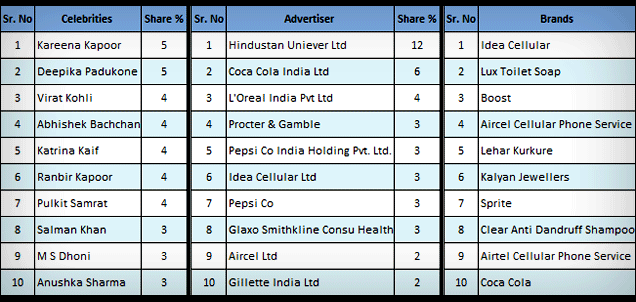
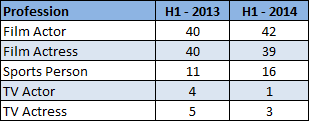
  • Vital Stats: Kareena, HUL & Idea top Celebrity Endorsement & Buzz in Jan-June 2014

    Celebrity Endorsement during Jan – June 2014

    Source : TAM AdEx


    Presenting Celebrity Endorsement Data which comes from TAM AdEx and Celebrity Buzz Data that is from Eikona. Here’s how this data can be helpful for the media industry and professionals:
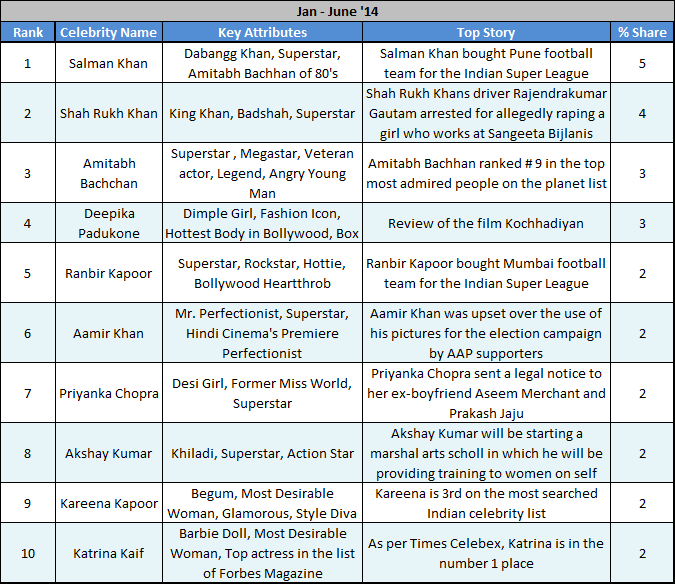

     

    Eikona Data(Celebrity Buzz): While selecting a celebrity for a brand, the connect between brands and a celebrity is always important. The brand personality and celebrity personality have to complement each other. Eikona data with the help of attributes/adjectives used to describe the celebrities can be helpful for the advertiser/advertising agencies to select the proper fit for the brand.


    TAM AdEx Data (Celebrity Endorsement): Celebrity Endorsement Data showcases the visibility of celebrities during the breaktime on TV through Ad Volumes. This can be a great help for advertiser, advertising agencies, celebrity management companies to keep track of their celebrity brand endorsement.


    When we are talking of celebrities and the buzz they create, why have words. Let the figures (no pun intended) do the talking.


    Source: Eikona


  • Proprietary planning tool ‘Resolve’ launched by Maxus

    Maxus has announced the launch of a bespoke tool, Resolve, based on a proprietary survey of consumer insights in India. The findings of the survey are the most in-depth ever to be carried out in the country.


    Resolve is Maxus’ comprehensive proprietary communications planning tool built using the knowledge and expertise of the agency’s planning leaders. The tool is supported by bespoke consumer-based surveys called Compose, which go beyond simple media usage to explore consumer sentiment towards media channels and the messaging those channels employ. The tool is used by global and local clients worldwide to gain insights on particular markets.


    Kartik Sharma, Managing Director, Maxus South Asia, said: “Maxus’s dedication to data inspired us to create a tool to help our teams make tough decisions and have them supported with strong logic and data. The Compose surveys get behind the attitudes and behaviours of consumers – not just their media usage – and how they view specific channels to deliver specific messages. Resolve has been a success so far not only for our clients, but also helping to push our teams out of their comfort zones, to try new channels and ways of thinking.”


  • Akash Chawla appointed Business Head of Essel Vision Productions

    Zee Entertainment Enterprises Ltd (ZEEL) has appointed Akash Chawla, who has successfully been heading the Marketing Function for National Channels at ZEEL, to take charge as the Business Head – EVPL.


    Akash has been given the mandate to head the TV Production (all languages), Movie Production (all languages except Marathi), Studio Production Business, Digital & Online Production, Events & IP creation. Akash will drive the organizational aspiration of EVPL and contribute in multiplying its business from its current business levels. For this role, Akash will report to Nittin Keni.


    “Essel Vision is very focused in the film & television production, digital, events and the IP creation business. Having spearheaded marketing for Zee TV, Zee Cinema, Zee Classic and Zee Cine Awards, Akash has worked successfully towards the launch of three of ZEEL’s new brands in the last one year – &pictures, Zee Anmol and Zindagi. He will work towards strengthening our presence in Hindi and other languages movie production & marketing and the digital business to catapult the organization’s ambitions to the next level.  We will produce content not just for the Indian audiences but also for companies and audiences the world over. While IP rights provide the foundation upon which innovation is shared and creativity is encouraged, the digital age provides many opportunities within the entertainment media industry to improve efficiency, costs and viewer experiences. Everything we do is driven by an unyielding passion for excellence-and an unfaltering commitment to develop the best products. We are in talks with various leading collaborators for the same and will soon announce new initiatives,” shared Nittin Keni.


    Essel Vision’s consistency and success are built on its unwavering dedication to setting benchmarks and excellence. It has already made a mark on the map of Television and Feature Films – both in the Hindi and Marathi space. With blockbuster films like ‘D-Day’, ‘Gulaal’, ‘Natrang’, ‘Kaaksparsh’, Essel Vision has taken its first steps to another high with its ventures like “Time Pass”, “Lai Bhari” and  ‘Duniyadaari’ which have been the highest grossers in the Marathi film space. Its other creation ‘The Lunchbox’ has already received accolades around the world. In the television space, the company has been successful with qualitative programs like ‘Fear Files’, ‘Dance India Dance’ and ‘India’s Best Dramebaaz’, ‘Saregama’, ‘DID L’il Masters’, ‘DID Super Moms’, on Hindi TV, and ‘Eka Peksha Ek’ and ‘Fu Bai Fu’ amongst others on Marathi TV.  The upcoming feature films include ‘Mad About Dance’ which is promoted by Shah Rukh Khan himself and another film called ‘3AM’ (horror film) is on the anvil.


    Just as ZEE is an innovative leader in developing new business models for the evolving television and film landscape, Essel Vision’s objective is to be a one-stop shop for all Film, Television, Digital, Events & IP creation related services where it will produce, co-produce, market and distribute.


  • What Ticks for Indian Consumers/Women: Vinay Bhatia and Mitrajit Bhattacharya

    Continuing with our extracts from the second edition of the MxMIndia Annual, we present contributions by Vinay Bhatia and Mitrajit Bhattacharya.


    Marketing driven analytics is the way forward


    By Vinay Bhatia


    In the past two years, we have seen a rise in the use of marketing driven analytics by brands in India in order to deliver a better retail experience at the consumer level.


    At Shoppers Stop, we have been investing in data driven marketing a lot and have created tailor-made programmes for our customers, through which we can then keep a track on their spends.


    While it is true that data driven marketing is the way forward for India’s retail industry, it is still in its nascent stages; it is probably just beginning to be recognised as an effective marketing tool in India. I guess, in the next five to seven years, we will see massive growth in this area – and I see that within retail – every aspect of investment will be much more data driven.


    To remain connected with the consumers at large, we undertake digital and social media campaigns. Gone are the days where brands rely on traditional modes of communication. Today word of mouth has become an important factor in decision making, and this is true of both men as well as women consumers.


    Don’t preach,  just build bonds that’ll last


    By Mitrajit Bhattacharya


    Magazine as a brand or magazine as a printed product? Most publishers are still struggling to figure out the transition from the latter to the former and the earlier they do it, the better it is for them. Readers particularly women, as we all know might be difficult to understand but when they profess their loyalty to something, they are quite rigid about the same. And this is where trusted brands should swiftly move in to become the friend, philosopher and guide to their readers rather than continue being printed magazines.


    There are many examples of great magazine brands, like Vanitha, Sananda, Grihashobha, Chitralekha etc where the relationship has evolved much beyond that of a magazine and a reader. We at Chitralekha do many things to keep our women readers engaged, and in a very entertaining manner. Our motto: never be preachy and change with times. We have a dedicated magazine within Chitralekha addressing the needs of women, named Priyadarshini.


    A magazine-withinmagazine, it was launched in 2001 as we felt we needed to create a different ambience for the women audience. During our 60th anniversary celebrations in 2010 we took 60 of our readers on a paid holiday to Thailand. It was not a favour we did to them but was an acknowledgement for the goodwill they have showered on us over the years by following every word published.


    They do ask their friends before buying a product or a service. Various mobile applications (such as WhatsApp) and social media networks have made it easier for consumers to share and review their purchase decisions with friends. Therefore, retailers have taken to digital and social media very seriously. And we’ve certainly taken it very seriously as well.

    We were among the first retailers in India to have leveraged the digital space effectively. On Facebook, we have more than 5 million fans – the 8th largest Facebook page in India across all brands and all categories. We are also very active on Twitter with more than 70,000 followers. As far as consumer and consumer spends are concerned, this year, we have seen a steady growth despite the economic slowdown.


    In the apparel category, we clearly see an upswing where consumers are spending more, they want better brands, and they want to own more brands. Women in particular. We have seen an increase in sales of women footwear and women bags in the premium category like never before. All we need to do moving forward is keep the buzz going in the social space and leverage that with tailor-made programmes made for consumers with the help of data analytics.


    They really know more than we do about our magazine. In fact, when we found a couple of issues missing from our archives and approached our readers, many came forward to provide them to us. One more recent example has been a massive consumer activation programme on recipes with stars of Colors’ TV shows and Everest Masala. The activity which ran for 15 weeks received an overwhelming 5000 original recipes from readers on the favourite food of the TV celebs.

    The lucky winners visited the sets of Colors to meet the stars and were showered with prizes too. A magazine brand connected with its audience, how can we not leverage the social media? We have a very active FB page with strong properties like Chhoti Si Mulakat, Wah Bhai Wah, Elchi etc which are very unique to us. We were able to build a very strong connect with the younger audience through FB within a very short period of two years.


    Tomorrow: Teens -Anupriya Acharya and Lavneesh Gupta


  • What Ticks for Indian Consumers/Teens: Anupriya Acharya and Lavneesh Gupta

    Continuing with our extracts from the second edition of the MxMIndia Annual, we present contributions by Anupriya Acharya and Lavneesh Gupta.


    The evolving teenagers


    By Anupriya Acharya


    While people across all age groups are evolving at a fast pace in India, teenagers are changing the fastest. They are growing up in a world with a lot more exposure, many more opportunities and a plethora of choices. As an outcome of it, they are far more informed and decisive as compared to teenagers of a decade back. They take informed decisions after carefully weighing their choices.


    There are quite a few factors at play that are shaping up the behaviour pattern of today’s teenagers: First, digital is playing a very important role in the way teenagers are shaping up. They are way better connected largely due to social media. They have a much larger peer group thanks to their friends in the virtual world. As the entire generation, more so in urban areas, is on social networking websites, there are higher pressures on being ‘cool’ and very well connected.


    Secondly, higher wealth levels in the country have led to higher standard of living. As a result, teenagers are getting better pocket money. Consumerism is in, and they are able to spend on things they want to.


    Next, media exposure, social networking and peer groups all have come together to create too much pressure on ‘girlfriend/ boyfriend’ phenomenon, and that too at a much younger age. Teenagers consider it to be of great importance to have a ‘girlfriend/ boyfriend’ to hang out with.


    ‘Innovation in content has become the need of the hour’


    By Lavneesh Gupta


    Much of the growth in TV viewership is coming from the youth in the age bracket of 15-35 yrs – a segment that wants novelty. Same kind of content builds boredom and results in an overall drop in viewership.


    Innovation in content in terms of storylines or new formats ( for entertainment channels) has become the need of the hour. For reality shows, the key learning is to keep the duration of the entire season shorter than what we are currently seeing.


    A timeline of three to fourth months for a reality show may lose the interest of young audiences in between a season, so the focus, instead, can be towards maintaining a healthy viewership across the season, getting them hooked on to the show; not losing them in between by having the same kind of content for a longer duration. A healthy mix of all types of content too augurs well for an entertainment channel.


    We have seen specialist channels emerge, but as an entertainment channel, one must look at genres such as music, movies, action, crime, sitcoms, reality shows, fashion, Bollywood etc for the younger audiences. Youth loves to share their opinions on issues be it national or local. Channels must provide a platform for the youth to share their views.


    Thanks to information overload, there is a lot of exposure to adult themes. Thankfully, they are much better geared to handle it. Talking of studies, earlier tuitions were a taboo, and taking them was an acknowledgement of being weak in studies. However, today is the world of cut-throat competition even for teenagers, and tuitions are absolutely acceptable.


    An interesting consequence of all the changes impacting teenagers is that being informed, having a large peer group with whom they interact a lot, teenagers today are far more expressive too. While there might be a few undue pressures on them, by and large, teenagers today are far more focussed, confident and optimistic about their future than the teenagers of a decade back.


    They are raring to take advantage of multiple opportunities coming their way. Teenagers of today have a mind of their own and use it without hesitation or trepidations.


    For the age-group which is under 21 years, entertainment channels can also look at playing a role in guiding their careers. Parents have increasingly become busy in their jobs and in pursuing their professional careers and are not able to spend much time in guiding their kids on career options. An opportunity for broadcasters to engage with youngsters. Another area which comes to mind is entrepreneurship for youngsters – shows focusing on aspects of entrepreneurship.


    The point I’m making is that singular kind of content does not interest the youth. So it is important to have a healthy mix of content. For youth to watch fiction on a daily basis, it has to be light-hearted and not very serious kind of drama. It may not be necessarily linear – like most fiction shows are. At Big Magic, we run light-hearted episodic fiction shows which are relevant to the youth.


    Our fiction show Raavi, for instance is a witty, quirky story of a girl who grows up disguised as a boy in a Punjabi household. It is light-hearted and episodic. In summary, singular content may not work for youngsters. A mix of content types with a light-hearted and fun loving flavour will sustain viewership amongst the youth.


    On Monday, August 18: Children -Lara Balsara and Nabendu Bhattacharyya


  • FCB Ulka highlights ‘Shake Feature’ for Snapdeal

    By A Correspondent


    Smartphones have empowered consumers to shop on the go, at a time convenient to them. This calls for a shift in focus to a more tech savvy way of shopping i.e. via a mobile phone. But how do online retailers get consumers to download their mobile app instead of the competition? One way of course, is to innovate and introduce new features and thereby create a superior shopping experience. Snapdeal’s Shake Feature does exactly that. The new TVC created by FCB Ulka gets the message across, by highlighting the app cleverly.


    Keeping the quirkiness that is the hallmark of Snapdeal’s communication, the Shake Feature TVC, crafted by FCB Ulka, shows the protagonist (played by actor Pulkit Samrat) dancing at a colorful Indian wedding. Every time he does a shake with his smartphone in hand, he is given money by an enthusiastic relative in the wedding party. The voice over meanwhile tells the viewers that using Shake Feature is a sure shot way to get additional discounts from Snapdeal.


    Sachin Das Burma, Group Creative Director, FCB Ulka, commented on the campaign “The shake feature is a new thing and we wanted the communication to demonstrate this in an interesting manner, without losing out on the entertainment quotient and slice of life situation that has been our attempt for all work we do on snapdeal. I think we have managed to achieve that.”


    Sandeep Komaravelly, Vice President Marketing, Snapdeal.com, said, “The smartphone has become an extremely important medium to reach out to our customers. 50% of our transactions on Snapdeal.com come via our mobile app. The Shake feature is an innovative step to amplify the user experience while shopping on the mobile application. The customers will be able to avail exciting offers on diverse range of 4 lakh products across 6000+ brands.”


  • Sony Six bags Champions Tennis League mandate

    By A Correspondent


    Sony SIX has bagged the exclusive broadcasting rights for Champions Tennis League. The inaugural league will take place between the 17th to 26th November and will be held in six cities in India. The league will witness national and international tennis talent with each team having top ATP and WTA players, captained by a Tennis legend.


    The Champions Tennis League will feature six city based teams, who will play 12 matches over an 8-day period, with the matches kick-starting from November 17. The teams will be structured into two groups, each having three sides each, where they would play each other in a home and away format. The top team in each half play each other in the 13th match on the 10th day for the inaugural Champions Tennis League trophy.


    Each team in the Champions Tennis league will feature one male and one female international player ranked amongst the top 25 in the ATP and WTA rankings. Each of the six teams will also have an international legend as their playing captain, apart from a noted top ranked Indian male tennis player. Two juniors, aged under 21 will also be a part of the team, selected by the All India Tennis Association, in order to give them exposure and the experience of playing with some of the best players in the world. All the games will be featured live and exclusive on Sony SIX and Sony SIX HD.


    The Champions Tennis League, together with Sony Six will travel the country bringing excitement and entertainment in a spectacle of such magnitude that has never been seen before for tennis in India.


    On the announcement of the acquisition, NP Singh, CEO, MSM India said, “Introduction of Champions Tennis League will help redefine the Indian tennis market paradigm. This will be a landmark event that will put India on the global map of tennis, featuring some of the world’s greatest tennis stars playing right here in our country. We are excited about this partnership and believe that the tournament will be a perfect blend of tennis and entertainment that has never been seen in India.”


    Sony Six EVP & Business Head Prasana Krishnan said “We are delighted to have Champions Tennis League on board as this acquisition signifies yet another endeavour by Sony SIX into bringing diverse sports offerings to the viewers. Champions Tennis league will be a treat for viewers as they will get to see the best of tennis action where International players and our National talent share the court. We believe that the league will not only give a fantastic viewing experience to the viewers but also help young Indian talent to perform on a grand stage.”


    The Champions Tennis League will start on the 17th of November and the finals will be held on the 26th of November 2014.


  • I-Day Eve Feel-Good: Meet the Flipkart Crorepatis


    By Radhika P Nair


    About 400 employees with stock options at online retailer Flipkart have hit the ‘crorepati’ jackpot because of the surging valuation of the online retailer.


    The bonanza is reminiscent of the times when thousands of employees – among them office assistants, drivers and receptionists – at another Bangalore-based company Infosys hit Esop paydirt. “About 400 of the employees who own a stake have now become crorepatis,” said a person who has direct knowledge of the employee stock option scheme at Flipkart, which received $1 billion (Rs 6,000 crore) in funding last month, valuing it at $7 billion.


    About one-fourth of Flipkart’s 7,000 full-time employees own a stake in the company.


    At the seniormost level, nearly 20 employees who are at the grade of senior vice-president or above and joined over two years ago are now dollar millionaires, meaning their stock options are worth at least Rs 6 crore on paper. The firm’s stock options get vested over four years. Flipkart declined to provide details for the report.


    It is the online retail market leader’s valuation jump that has led to this wealth creation.


    In 2012, the company was valued at about $850 million when it raised about $150 million.


    In two years, Flipkart’s valuation has grown eight times. For the company’s founders, Esops are a conscious attempt at creating wealth for their employees. “While we are competitive when it comes to salaries, Esops offer the opportunity for wealth and value creation,” said Sachin Bansal, 32, Flipkart’s co-founder and chief executive. “It’s a long-term reward for those who believe in the future of Flipkart.”


    After the IT services industry, ecommerce is now the next big opportunity for employees to create wealth, said Anshuman Das, managing partner at Longhouse Consulting, a recruitment firm that works with startups. “The message going out to entrepreneurs is that wealth creation cannot be restricted to just the founders.”


    A number of junior employees at Flipkart too hold sizeable stake in the company. This has helped employees like 29-year-old Ambur Iyyappa, a senior manager of customer operations at Flipkart. “I was getting married in 2012 and the buyback allowed me to take care of my wedding expenses,” said the graduate of Annamalai University.


    Iyyappa, who sold only a part of his stake at the time of the buyback, declined to reveal how many shares he still holds.


    He was the second non-founder employee to join Flipkart in 2008. It was only in 2009, the same year that the company raised its first round of funding of $1 million (over Rs 6 crore) from Accel Partners, that Flipkart started providing Esops.


    Fashion e-tailer Myntra, which was acquired by Flipkart in May, allowed employees to sell shares at the time of the acquisition, according to a person with direct knowledge of the deal. The company declined to confirm this. Myntra provides Esops to all its core employees, numbering about 600, in functions such as technology and marketing across all levels.


    For existing employees like Iyyappa, Esops provide recognition. “Esops are a motivation for us employees,” said Iyyappa. “It is how the company recognises our work.”


    Source:The Economic Times

    Copyright © 2014, Bennett, Coleman & Co. Ltd. All Rights Reserved

    Licensed to republish


  • Ajit Anjum appointed Managing Editor at India TV

    By A Correspondent


    In a development that could further impact the equations in the Hindi news genre, Ajit Anjum, a veteran of 25 years, has joined India TV’s newsroom as Managing Editor.


    Anjum, whose last stint was with BAG network as the Managing Editor of News 24 is best known for experimenting and ideating many path-breaking shows like Sansani, Poll Khol & Red Alert to name a few.  At India TV, he will be reporting to Rajat Sharma, Chairman & Editor-in-chief.


    Rajat Sharma

    Rajat Sharma said, “Ajit is a man of ideas, a professional with tremendous energy levels. At this juncture when India TV has successfully established itself as one of the most respected news brands in the country, his entry will definitely help us consolidate our position further.”


    A Ramnath Goenka Awardee for Political reporting in 2010, Anjum’s first major break with media was with newspaper Amar Ujala in 1990. His career has been punctuated with a couple of smaller stints with Chauthi Duniya & Aaj Tak, however, he has spent the major part of his career, almost 19 years with BAG network.