Category: MEDIA

  • Big FM announces leadership changes

    By A Correspondent


    Reliance Broadcast Network Ltd. (RBNL) has announced the consolidation and strengthening of functions within its radio business, 92.7 Big FM, through strategic elevations across key positions.


    Ashwin Padmanabhan

    Ashwin Padmanabhan takes over as Business Head from being Business Head for West and South; while Nitin Jain takes over as National Sales Head, at Big FM. Mr Jain will now oversee the national sales function as he leads the team from the front. Shalini Dureja has been appointed as Vice-President, Head Impact Sales West & South. In her new role, she will service key clients, sell key innovations and intellectual properties, while maximising revenues. Kiran Thangarajan gets promoted to Cluster Head, Tamil Nadu and Kerala.


    Charanjeet Arora moves to the position of Regional Business Head – North 2, which includes the regions of Uttar Pradesh, Madhya Pradesh, Bihar, Jharkhand, and Rajasthan. Sanjeev Sharma joined 92.7 BIG FM in 2010 as the Regional Head (Govt. Business) based in Chandigarh growing quickly through the hierarchy to his current role as National Head – Government Business, where he will be responsible for revenue generation for both the radio and television businesses.


    Tarun Katial

    Tarun Katial, CEO, Reliance Broadcast Network said, “We have always been immensely proud of the quality of our workforce. It is they who help create ever-growing value for our customers while driving profitable growth for the company. As the radio business continues to dominate key markets across India, we feel the need to streamline business divisions to derive maximum value within us. We are confident that these moves will help us transform into a more holistic radio business and see us achieving better growth in the near future.”


  • Battle of the Story: Casting critical eye on Media

    By Ananya Saha


    The media is playing more important role in our society today. As social and traditional media continue to permeate our lives, industry veterans recently got together at a conference organized by the Indian Chamber of Commerce to discuss the role of media, convergence, new media, and new technology. As Rajiv Mundhra, President, ICC, pointed out, “New media has become a tool for social change.”


    The panel comprising of Jawhar Sircar, CEO, Prasar Bharati; Subhash Chandra, Chairman, ZEE and Essel Group; Sunil Lulla, MD and CEO, Times Television Network; Anuradha Prasad, Chairperson, BAG Films and Media Ltd; Anshuman Tewari, Chief of National Bureau, Dainik Jagran talked about how media only portrays reality as shaped by people. While agreeing that in the “heat-of-the-moment”, the news channels do forget their responsibility towards the nation and compromise national security such as the 26/11, according to Mr Chandra, the Indian media has acted responsibly. He further said, “There are people who are history-sheeters and are running news channels. This is a cause of concern.


    Sunil Lulla

    Concurring, Mr Lulla said, “With the mushrooming of news channels, it was the broadcasters themselves who got together to say that we need to set standards. Since that idea got criticized by journalists, we asked the journalists to form the guidelines under the committee headed by Late Justice Verma. NBSA was thus formed. And with the passing years, the guidebook is only getting thicker.” He further said, “We are all for responsible content. For instance, no other business carries 72 messages in a day giving information of redressal authorities.” The panel coherently agreed that they were united in the cause of bringing responsible content to its audience.


    Mr Sircar said, “It is important that the media takes note of what it is doing. If the fourth estate caves in, we will see an eruption of public angst, which will defy the constitution.”


    Uday Kumar Varma

    Uday Kumar Varma, Secretary, MIB, talked about how technology is enabling advances in the broadcast sector. He spoke about the three challenges that the sector is facing, “Digitization is the best thing to happen to the broadcasting sector in the last 20 years. And the first challenge is that all digitization is aimed at, is achieved.” He said that till digitization sees complete transparency, issue of carriage fees is not solved, and till revenue sharing is equitable, the process of digitization cannot be called complete. The second challenge, according to him is the question of monopolies. He said, “There have been certain developments that have disturbed the equilibrium. Problems that arise because of lack of policy have to be addressed. Cross-media regulation, which can be horizontal or vertical, has to be addressed as well.”


    The third and the last challenge he shared was about the TV rating system. He said, “the current rating system is far from satisfactory. The bottomline features of a television rating system should be put in place.”


  • Fino PayTech takes animation route for its maiden brand campaign

    By A Correspondent


    Fino PayTech Limited, the company that enables financial inclusion, has launched its first ever television commercial. The commercial, which is running on-air currently, talks of how the company has brought the benefits of access to banking services to the doorsteps of the poor. This has been done through an animation film, which uses characters like Fino Man, Kanhaiya and Bandhu.


    “As the pioneers in the space of financial inclusion, it is has been an eventful journey so far for Fino PayTech. As we push for greater inclusive growth, we believe it is important for all the stakeholders to know what is happening and what is possible in this space. The story we are trying to communicate is not merely about a product or a company. It actually tells you about the ills of informal credit channels prevalent across the country to the advantages of access to formal banking services that can change the financial landscape in rural and unbanked India. The Fino bandhu is not merely an agent of the company but a catalyst for social change,” said Shweta Aprameya, Vice-President, Fino PayTech Limited.


    The audio-visual commercial, titled Fino ki Kahani Kanhaiya ki Zubaani, has been created by Climb Media.


    Kireet Khurana, Creative producer of Climb Media said, “The fascinating success story of Fino PayTech and its impact on the entire country is something that was entreating to be told. We are happy and privileged to have been given this opportunity to weave an emotionally connecting story with FINO’s empowering cause and achievements in the financial inclusion domain, bringing it to the fore. Animation has been created in a way to convey the message in a simple yet effective manner.”


    The commercial is on air till May 5, 2013 and will be telecast across channels such as CNBC-TV 18, NDTV 24×7, Aaj Tak, Dilli Aaj Tak and Tez.


  • Ten Sports extends ‘Tour De France’ for another 4 years

    By A Correspondent


    Sports content provider Ten Sports has announced that it has acquired broadcast rights for Tour De France till 2016 for the Indian subcontinent. Ten Sports will be the exclusive rights holder in the Indian subcontinent with the exception of rights being shared with the pan-regional broadcaster Eurosport in Sri Lanka.


    Commenting on the acquisition, Atul Pande, CEO, Ten Sports said, “We are proud to be associated with an event as esteemed as Tour De France, especially at a time when it is having its 100th edition in 2013. This long-term relationship with Tour De France will bring in much delight to our viewers who crave high-adrenaline bicycle racing.”


    The 2013 Tour de France, the 100th edition of the race, is scheduled to start on June 29 in Corsica, in the city of Porto-Vecchio. The island will host the first three stages. Corsica is the only Metropolitan department which the Tour has never passed through and the organizers wanted to combine the 100th edition of the Tour with the Tour’s first ever visit to Corsica.


  • Moneycontrol.com holds Master Your Money, an online investor event

    By A Correspondent


    Moneycontrol.com has launched an online investor camp starting April 30. The day-long event will include a host of investment experts who will answer queries from investors all over India.


    Master Your Money brings an opportunity to investors in India to go online and connect with leading experts, and get answers to their investment queries online. It provides a resource to millions of investors currently confronted by falling stock markets, high rates of inflation, skyrocketing real estate prices and the exploding value of gold.


    Master Your Money is open to all kinds of investors, from buyers of fixed deposits, government bonds and insurance, HNI stock and mutual fund investors, individual traders and corporate finance professionals. The online event covers stocks, bonds, insurance, gold and real estate.


    “As a national portal dedicated to serving investors in India, we conceptualized Master Your Money to provide financial knowledge to the entire community of Indian investors,” said Joyson Thomas, CEO, moneycontrol.com.


    More details are available at http://www.moneycontrol.com/master_your_money/.


  • Decoding Digital with Rajan Anandan


    It’s not always that industry folk get an opportunity to be upclose digital luminarie and get them to answer all their queries and address all their doubts. Well, almost. The only limiting factor is the time.


    The platform provided by the International Association of Advertisers (India Chapter) facilitates that with the ‘World Goes Digital’ webinar series.


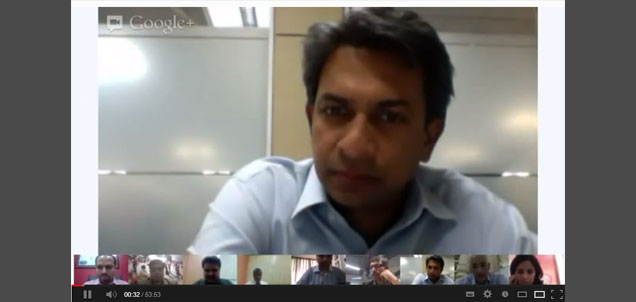
    The inaugural webinar got off to a stimulating start last week (April 26). The platform chosen was Google Hangout which allows for simulatenous ‘meeting’ of 10 people in a ‘virtual’ room. With Rajan Anandan, Managing Director, Google India, as the first guest, the series struck a discerning chord as a cross-section of the fraternity congregated online and many more watching him live on the Youtube. They heard Mr Anandan share his version and vision of the growth of online space and also posed a few questions on the scope and challenges facing the medium in India.


    Srinivasan K Swamy, President, IAA India Chapter, began with an introductory note on the role of IAA in steering such initiatives and promised more such debates in time to come. Abhishek Karnani, co-chair and Director, Free Press Journal group also spoke on the webinar initiative.


    Other than Messrs Swamy and Karnani, other panelists included: Manish Advani, head – marketing and public relations, Mahindra Special Services Group (also co-chair of the the IAA webinar series), Vishaka Singh, Executive Director, Aurora Comms, Nishad Ramachandran, Vice President, Hansa Cequity, Mudit Singhal, Founder and Business Head, Storycentre, Gaurav Mendiratta, CEO, SocioSquare and Jay Sampat, M&E practice at Accenture. Mr Advani proposed the vote of thanks and the panel was moderated by Pradyuman Maheshwari, Editor-in-Chief, MxMIndia.


    Execerpts from the conversation:

    Q: Several companies in India are reluctant to start their own digital enterprise as they feel that if something nasty is posted about them, their business will get affected. What is your advice to these companies?

    Rajan Anandan: I’d like to say that there are 150 million users on the internet and about 95 per cent of the SEC A, B 15-44 yr-olds are on the internet and are spending more time on the internet than any other medium. If you happen to sell products or services that cater to these audience group then if you are not on the internet you won’t be able to reach them. More importantly, if you do not engage with them and other companies engage with them who turn out to be competitors then the users may migrate to those other brands.  We have seen this happen in other countries as well and what’s interesting about India is that despite being at 12 per cent penetration, it already has a 150 million users. For many of us, the industries where we mainly focus on SEC A, B 15-44 this has become a must-have medium. The important thing to realize about the medium is that in the digital arena consumers are the ones that propagate brands. It used to be brands talk to consumers in a one-way dialogue but that has completely changed with the advent of the internet.


    I see two kinds of companies from the umpteen that are present on the medium.  One that says that now I can get instantaneous feedback when something is not going well or when there are opportunities for improvement and those companies are able to leverage this medium in incredibly powerful ways not just for building awareness or driving transaction but also for getting feedback from consumers. Then there is another group of consumers who say that if something goes wrong then consumers will talk about it and the whole world will find out about it. But the reality today is that with the advent of the internet, social networks and online video users are able to stay connected. There are 2.4 billion consumers on the internet today and by 2020 that number will become 6 billion. So everyone will be connected to internet by that year and unless you are selling to people outside of planet earth, it’s important to be on the internet and leverage the medium well.


    Q: A large number of SEC A, B audiences are online and in the Indian context what matters is the language.  Is all of that coming online now for brands to engage more deeply with the consumers?

    Rajan Anandan: The simplistic way to look at this is there are 150 million users in the country who speak, read and write English today. So every new user who comes to the internet today is outside of that bastion. Local language content is important today.  Some of the fastest growing websites on the internet are local-language driven. If you look at videos, especially YouTube which has 50 million unique users per month, more than 80 per cent of the views are actually non-English. We are seeing a large amount of user-generated content in local languages that are being uploaded. Also there are many web-only content creators that are emerging… but the point is that it is still very early days but the content ecosystem  will develop very rapidly. There will be three things that will be witnessed: the first is the underlined infrastructure that will enable local language content at scale. One of the important things is standardized open source fonts. Today, there are not so many open source fonts in our country but that problem will get solved over within the next one year. There are several industries that are working together…the other thing is that there is a lot of content that exists in Indian languages which is not on the web. That content we are seeing it come on to the web.  We think the news print industry has led that wave and we are seeing a lot of publishers etc come online. The third thing that will be a breakthrough in 5-10 years is web-only content creators. Today we have about 40,000 Indian content partners on YouTube and almost all of them are non-English. We are now seeing an interesting trend where content creators are focusing on creating content only for the web. As the ad ecosystem grows such models will get more interesting. Over the next 3-4 years we will see a tsunami of non-English content come to the web.


    Q: How can content creators and creative people use the online video medium effectively in terms of ROI? Also, can you reveal details on the captivity of audiences watching non-English videos on YouTube?

    Rajan Anandan: Let me share with you some statistics on that front with respect to YouTube. We have about 11,000 full-length movies, we have about 90 per cent of Bollywood music catalogue, about 80 per cent of all the regional music catalogue, TV shows of the Top 6 TV networks and live sports as well. Clearly, all this wouldn’t be there on YouTube if there wasn’t a way to monetize it. Now the monetization rates on online today are significantly lower than on TV. If you look at the TV rates, they are in the north of 3 billion dollars while digital advertising is about Rs 2500 crores till last year. So we are 1/6th the size of the ad industry in digital excluding classifieds compared to TV. But the only thing is that digital is growing at 50 per cent while television is at about 12-14 per cent I guess. So there is a way to monetize. The second part to it is that if you want to become a digital-only content creator can you make that viable and how does that compare with say being a content creator in the television space. The simple way to think about the internet is that if you are going to have the same cost structure that you do in the TV industry to make content in the internet industry your toast, because effectively the monetization rates are actually quite low and what we are seeing is that the successful content creators who are already building multi-million dollar business literally starting from scratch. They have a very different cost structure and therefore they are effectively able to make good returns. It’s very important to understand the economics of the medium and therefore build a content business that aligns with the economics of the business. The good news is that there are thousands of digital-only content creators today, which is an encouraging sign. But at the same time if you want to make say an 80-crore movie and say that you are not distribute anywhere else but only on the internet – can I breakeven on that, probably not yet. That’s going to take some time as the CPMs have to catch up and so on and so forth.


    In terms of the users and quality of broadband, the thing is that there are 50 million users including mobile. There are about 10 million unique visitors who access YouTube on mobile while about 40 million view us directly on the web. The TG is 15-44 SEC A, B and this is an interesting audience set. For example, it’s been about two weeks for IPL so the time spent on YouTube on IPL has doubled year-on-year. But my view is that with not so great connectivity India is already at the state of connectivity that there is. As broadband begins to scale out the consumption of viewer-based online content will go through the roof. If there is one thing that is preventing the internet from realizing its potential, it is broadband.


    Q: Google has been doing a lot of activities to bring new businesses online. Will you be able to share data on the kind of agencies that are coming and sticking on with the medium? If they are not hanging around then what are the reasons for the same?

    Rajan Anandan:  To give you an insight, there are about 12 million businesses in India that have more than 5 employees. That is the third largest in the world next to China and the US. Despite that huge number only 1,50,000 businesses advertise in any media. So in print at least 1,50,000 people advertise at least once in a given year; about 10,000 businesses advertise on television and about 7000 businesses advertise on radio. If you look at digital advertising, it is orders of magnitude bigger than television but less than print in India. To grow the digital and mobile advertising market the first step is for businesses to have a mobile or online presence. Over two years ago, when we launched the ‘India get your businesses online’ initiative there were only about 400,000 businesses that were online but when we looked at the quality of those website only 100,000 of them were decent. When we did a little more research behind this, we found that what works in India is generally a free model.  So we built about half a million websites for businesses for free. This was supposed to be a three-year initiative and I am excited to state that we have crossed 300,000 websites which is a three-fold growth and we are confident of achieving half a million quality websites by 2014.


    Also, businesses that are able to generate leads from the internet like travel agencies or doctors or lawyers, etc…if you see today there are half a million doctors in India but less than 50,000 of them have decent quality websites. But the ones that have a website are seeing a significant shift in the way their practice is being run. Basically, consumer-focused businesses that can be used to get leads will be the best way to move forward.  By 2015, there will be more advertisers that will advertise on digital than and by any other medium.


    Q: You have been talking about internet penetration and I have been desperately waiting to hear some bit on mobile internet penetration. Today, mobile internet penetration has crossed pc internet. There are some wonderful examples of mobile projects like M-pesa in South Africa. We hardly hear any story on mobile internet in India. What initiatives should we be taking to drive consumption through mobile internet as compared to PC.?

    Let me start by presenting some facts. There are 150 million users of which 50 million are desktop/notebook users, 50 million users access the internet through a mobile device and the other 50 million access the internet through both a desktop and a mobile device. If you look at the last 6-7 months most of the new users who are coming to the internet are mobile-first and mobile-only. We are essentially starting to see a mobile-only option taking off in India. As I said earlier, all the new users who will be added this year will be from mobile-only. They are doing pretty much the same thing as what one would do on desktops or notebooks. The only thing difficult as of now is video on mobile due to bandwidth issues but outside of that there is an explosive growth that is being witnessed in the mobile space. To quote an example, there are about 25 million smartphone users but the average user is spending about 120 minutes per day on the internet.


    For businesses there are certain implications that come along. For example, today e-commerce is at an inflection point; most e-commerce sites in India are getting between 3-10 per cent of transactions from a mobile device. However the traffic to such sites has now crossed 25 per cent. That is a huge number. Going forward we expect to see a phenomenal jump coming from a mobile device to such websites. It means that if you are a mobile company you will need to have a mobile optimized site. I am surprised to see some companies that do not have this facility. The second thing is that it is important to have native apps. Also, mobile is a very important medium top leverage branding and the good thing today is that one can have very exciting mobile ads. Our view s that the time for mobile has arrived and there is no going back now.


    The webinar can be accessed at https://www.youtube.com/iaaindiachapter

     

  • Lifestyle content in Braille via ‘White Print’

    By Ananya Saha


    Upasana Makati

    India is home to 12 million visually impaired people of which 56 lakh are literate. While we do have loads of literature to read, the literate visually impaired people have to depend on audio books, screen-reading software or radio for entertainment. This is the thought that motivated 24-year-old Upasana Makati to launch White Print, an English lifestyle magazine in Braille. The first issue will debut in May.


    A graduate in Mass Communication, Ms Makati wanted to do something on her own. The home-grown initiative was born to cater to the needs of the visually impaired community and be a source of information and entertainment at the same time. Printed at the National Association for the Blind (NAB) in Mumbai, the monthly magazine will consist of 64 pages and will feature stories about common man, review of audio books, gadgets, travel and hospitality and food related columns. It also comprises information pertaining to politics, art and culture from across the globe.


    “When one thinks of visually impaired people, we think that their lifestyle must be totally different. But in reality it is not so. When I thought of this magazine, I did a lot of research. It took me eight months to get the title, so I spoke to a lot of visually impaired people. It was very clear that they want such content, but did not have access to it. White Print is an effort to provide the visually impaired community a companion while they are on the go or sitting by the coffee table on a Sunday afternoon. A magazine that is a source of information and entertainment was long over due and we hope we are able to make a difference in even a small way,” Ms Makati stated.


    Currently, Ms Makati’s team of friends is contributing the articles but the magazine invites young authors to write short stories for it. The articles once received are converted in Braille format at NAB. Priced at Rs 30, the magazine will be circulated throughout the country but will be subscription-driven. NAB will also manage the distribution of the magazine. “The cost of the magazine is less than half of the production of the magazine. I am depending on advertisers, which I hope grow, for revenues. Though very low and subsidized, we also have to pay NAB for its services,” informed Ms Makati who is the founder and publisher of the magazine.


    The magazine cannot carry the conventional printed advertising. Hence, it does text-heavy advertisements. “We just carried a five-page descriptive advertorial of Raymond’s Spring-Summer collection,” she said, adding, “Grand Hyatt Goa has shared one recipe with us. Since I am a first in this space, a lot of advertisers are enthusiastic about this product. But yes, it is also a challenge getting them on board.” Ms Makati makes it clear that it is not a charity that she is doing, and expects the revenues to grow.


    White Print has tied up with Radio City for promotions, apart from making individual calls and sending mailers to their database of visually impaired people. The magazine’s first print run will be 500 copies.


  • Rediff.com goes in for new, mobile-friendly look

    By A Correspondent


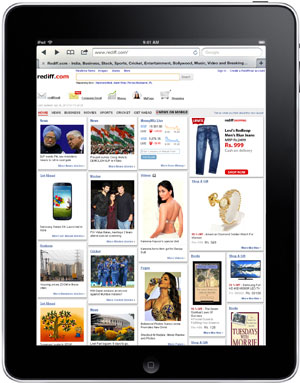
    Rediff.com India Limited has released its latest version of its website Rediff.com, featuring a new and enhanced homepage sporting a tiled interface. The design, developed inhouse, is based on user feedback. The Rediff homepage in its new avatar brings alive an assortment of content and services using the contemporary grid layout. Each unit of the grid features information photographs and videos, giving it a more interactive, image-friendly feel.

     

    “Current change is to respond to the consumer shift from PCs to high-graphic quality tablets and smartphones and better bandwidth in India and international markets,” Ajit Balakrishnan, Chairman and CEO, Rediff.com told MxMIndia. According to him, mobile access of Rediff.com in India currently stands at 20 percent and is rising fast. “In markets like the US it is much higher,” he said.


    Mr Balakrishnan further stated, “We have also redesigned the site in terms of providing users with the content and imagery they desire on our home page, while adding more e-commerce options, which have been in higher demand from this growing population. The Indian internet user base is quickly moving to consuming our services on various types of mobile devices, whether at home or on the go. As a result, this transition required us to take a fresh and innovative view of how our users are likely to interact with our portal. Our new tiled interface is a step towards making it easy for a rapidly growing segment of users who access our website from tablet like touch screen devices.”


    Apart from the grid layout, Rediff’s e-commerce platform, a fast-growing segment for Rediff, also gets a boost with a large footprint on the homepage to capitalize on the growing usage of e-commerce platforms throughout India.


    While e-commerce websites in India are gung-ho about their promotional and marketing activities, Rediff plans to keep it low. “We used to use TV up until 2008; since then the intersection between TV and Web has decreased. Active web users do not seem to be watching much TV. Word of mouth will carry this initiative forward,” Mr Balakrishnan asserted.


  • Times Internet partners AIR for live IPL commentary

    By A Correspondent


    Times Internet Limited (TIL) and AIR will broadcast live commentary of 33 select Pepsi IPL 2013 matches over AIR’s National Channel and FM Gold. Updates for all matches will be broadcast on AIR FM Rainbow Channel.


    The running commentary of the matches of Pepsi IPL 2013, including the Playoffs/Final, being played in India, will be broadcast alternately in Hindi and English on National Channel and FM Gold Network. The coverage area of National Channel includes Andhra Pradesh, Bihar, Chhattisgarh, Delhi, Goa, Haryana, Jharkhand, Karnataka, Madhya Pradesh, Manipur, Meghalaya, Orissa, Pondicherry, Tripura, Uttar Pradesh, Uttaranchal and parts of Assam, Maharashtra, Rajasthan and Tamil Nadu. The live commentary of all 33 identified matches will be broadcast over National Channel of AIR which is available all over India.


    Satyan Gajwani

    Speaking on the association, Satyan Gajwani, CEO, Times Internet, said, “We’re delighted to renew our association with AIR on Pepsi IPL. By partnering with All India Radio, Pepsi IPL 2013 will tap into a new set of cricket fan audiences across India, particularly beyond the metros.”


    “All India Radio, which has always been in the forefront of popularizing sports in India including cricket, is happy to bring live and exciting action from IPL to its listeners”, said LD Mandloi, Director General, All India Radio.


  • Zee Cinema plans to add a punch at primetime with South Indian films

    By A Correspondent


    Move over SRK, Salman and Akshay. Nagarjuna and co are here with their OTT action and comedy sequences. To make most of the genre, Zee Cinema has launched a two-week-long festival of popular southern blockbusters dubbed in Hindi – ‘South Ka Super Punch’. “Films from the South dubbed in Hindi have always given us a great response. They have their own unique brand of over-the-top action that works extremely well with the male audiences,” says Mohan Gopinath, Business Head – Hindi Movie Cluster, ZEEL when asked why the channel chose dubbed movies for the primetime slot.


    Mr Gopinath, adds, “In times when we all lead hectic lives, viewers look to cinema or television as a stress-buster. Cinema from the South with its larger-than-life hero worship and flamboyant brand of action and drama, serve as a beautiful avenue for escapism where people can forget all their stress and have a good laugh. These films have been enormous successes down south and the lead actors are worshipped like demi-Gods. Dubbed versions of south films have always rated extremely well each time we have aired these in the past and there is a strong demand for us to air more such films. Our previous festival of a similar nature ‘Dosa Meets Samosa’ had met with an overwhelming response. We’re confident that the audience will enjoy the new festival too!”


    Like the movies to be shown, the channel has also taken an off-beat creative route to promote the festival. Instead of showcasing any of the stars or even visuals from the films being aired as a part of the ‘South Ka Super Punch’ festival, the promo raises a toast to the sheer flashiness and flamboyance of southern cinema and its unique brand of comical action. It features a special rap song that has been composed in-house by the creative team at Zee Cinema, celebrating the magnificent larger-than-life attributes of these films, explains Mr Gopinath.


    Similarly to cash in on the current rage of cricket, Zee Cinema has created cricket-centric comic strips, spoofing the most widely discussed developments from the ongoing series and associating them with the festival in a unique manner. These comic strips will be available across various digital platforms.


  • Chat live while watching TV

    By A Correspondent


    iCouch, an exclusive Live TV chat platform has been developed for the ardent TV viewers and show fans. It is a free mobile application by iDubba. Launching in partnership with Zee Cafe’s ‘Grey’s Anatomy’ Season 7 from May 1, iCouch lets the viewer chat while the program is running and captures the favourite scenes.


    iCouch enables the viewer to read and ‘like’ popular chat and get heard by thousands of other fans watching the program. One can find out interesting facts and trivia about a show, invite friends and send them alerts, play contests and win big prizes while making TV viewing experience extremely entertaining and fulfilling.


    Rabi Gupta, Co-Founder – iDubba, said, “iCouch is definitely not another news or gossip outlet where we reports things or events, in-fact here the news and gossip makers and breakers are the ardent fans of the TV show. It is a chat forum that has no bar, you are the one building and developing the discussion of your favourite show.


  • Directors discuss Bombay Talkies and 100 years of cinema

    By A Correspondent


    The directorial cast of Bombay Talkies made an appearance on the show Etc Bollywood Business with trade expert Komal Nahta. The team shared their experiences about each of their short films in the upcoming Bombay Talkies, which is slated to release today.


    The trio – Dibakar Banerjee, Zoya Akhtar, and Karan Johar – talk about the evolution of Bollywood over the past hundred years, the oldest movies that the directors have seen, the longest kiss on celluloid and the journey of each of their careers in Bollywood.


    This episode of Bollywood Business will be aired exclusively on Etc on May 3 at 8.30pm with a repeat telecast at 11.30pm on the same night.