Category: MEDIA

  • 1 Minute View: S4 > i5?

    Some of you may have seen the glitzy Diana Hayden emcee the launch of the Galaxy Samsung S4 in Gurgaon’s Kingdom of Dreams live at the venue or online. The attempt was to showcase the device and its various features. And how!


    Indeed many of these are very cool, and would get people to switch to the S4. But, of course, if you have paid upwards of 30k just a year back for the S3, it remains to be seen how many people upgrade.


    In a price sensitive Indian market, we believe the S4 buyer will be users of sub S3 or other handsets. Samsung India officials have clearly stated there is no exchange offer coming up.


    What may work in the S4’s favour is the MRP of Rs 41,500. Note this is MRP so we will have retailers offering a lower rate. Plus there are offers coming up from Vodafone.


    The big question: is the S4 better than the iPhone 5? Well, it’s got some cool features which don’t exist on the flagship Apple handset. But the experience of the iPhone, like that of any Apple machine, is amazing. And it’s not going to be easy to get a diehard i5 user or even that of an i4 or i4s to make the switch.


    So why’s a media, ad and marketing destination like MxMIndia writing about the Samsung Galaxy S4, one may ask. Over the last few years, Samsung has become a significant player in the mobile devices space. Other than the fact that each of these devices has a fantastic adspend budget, they are media vehicles and the newer features that each of them offer can play a huge influence on applications (or apps) that will be developed in future.


  • Radio One operating profit grows exponentially

    By A Correspondent


    Radio One Ltd, now renamed Next Radio Ltd, the joint venture between Next MediaWorks Ltd and BBC Worldwide, has declared its audited financial results for the year ended March 31, 2013 at the annual board meeting held recently.


    Revenue grew 16 percent to Rs 50.41 crore for the year ended March 31 as compared to Rs 43.48 crore in the corresponding period last year.


    EBIDTA profit grew exponentially to Rs 18.41 crore in the year ended March 31, as compared to Rs 0.25 crore in the corresponding period last year. The EBIDTA margin for the year ended March 31 was at 36.5 percent which is in line with the best in the media industry.


    Profit before tax (before exceptional items) improved to a positive of Rs 0.58 crore in the year ended March 31 as compared to a loss of Rs 17.78 crore in the corresponding period last year.


    The operations were sufficiently cash positive for the first time.


    Radio One MD & CEO Vineet Singh Hukmani said ‘We have transformed our business with strategic restructuring. Our focus on profiled educated audiences helped us move 100% advertising revenue to our ‘on air’ product. Led by our international formats in Mumbai and Delhi, we are delivering high quality differentiated products in each of our 7 cities at the lowest cost. Added to this we have initiated up to a 30% increase in advertising rates successfully.’


    Radio One, which runs 94.3FM, is keen to participate in Phase 3 bidding and is looking to expand to high value metro markets. “We are hopeful that the MIB will soon allow existing players with 10 year licenses to extend to 15 year licenses before phase 3 bidding. This will result in confident bidding by existing players,” added Mr Hukmani.


  • Magnon\TBWA announces post-acquisition senior hirings

    By A Correspondent


    Magnon\TBWA has announced significant strengthening of its digital capabilities with three senior level appointments in web/mobile technology, social media as well as client development functions. This is the agency’s first round of strategic talent recruitment, after its acquisition by TBWA\ in December 2012. These hirings have been carried out for both Magnon\TBWA as well as Magnon E-GRAPHICS, the agency’s international digital delivery arm.


    The three appointments include KN Ajit Narayan as Group Director, Social Media Marketing, Paurush Pandit as Group Director, Web/Mobile Technology and Alok Garg, Associate Vice President, Client Development for Magnon\TBWA.


    Mr Narayan has moved to Magnon from Interactive Avenues, where he was managing social media offerings for a range of clients. Mr Pandit is a technology evangelist with over 10 years of experience in both start-ups as well as large organisations. In the past he has worked in key technology positions with Makemytrip.com and Yatra.com. Mr Garg comes with over 16 years of strong experience in client acquisition and managing key customer relationships.


    Speaking about the new appointments, Vineet Bajpai, Founder & Group CEO, Magnon\TBWA and Magnon E-Graphics said, “At Magnon\TBWA, people have always been central to strategy. As digital media evolves, agencies and marketers will need to find new innovative approaches to connect brands and consumers. The team expansion at Magnon is in sync with the current and potential opportunities and challenges. Magnon\TBWA stands committed to offering best-in-class interactive media solutions to our clients.”


  • Delhi Duty Free assigns digital mandate to Ignitee Digital

    By A Correspondent


    Delhi Duty Free has appointed digital marketing agency Ignitee Digital to manage their social media campaigns and digital communication. Delhi Duty Free had increased its engagement on Facebook and Twitter since last year, and aims to cement its online presence to inform, educate and influence consumers’ buying behaviour.


    Delhi Duty Freehopes to increase its interface and engagement with current and potential international travellers and offer updated data about the various activities and promotions about the brand. Through the association with Ignitee, Delhi Duty Free will seek to leverage the digital platform and build a unique brand image. Ignitee will manage not only its consumer engagement across all social networking sites but also the digital media planning and buying for the brand across digital platforms.


    Atul Hegde

    Atul Hegde, CEO, Ignitee Digital Services commented, “We are extremely excited to create a 360-degree digital experience for Delhi Duty Free, leverage this opportunity and create many innovations and help create a distinct image of the brand in the minds of consumers and also bring many ‘firsts’ in this space for our category.”


    Abhijit Das, Head of Marketing, Delhi Duty Free, said, “Being the single largest duty free retail operator in India, Delhi Duty Free looks at introducing its one-of-a-kind products to the audience and give them a chance to interact and engage with the brand on the digital and social media platforms. We want to bring our target audience closer to the brand through our digital activities and for this we have brought Ignitee Digital on board. Ignitee has been one of the key players in the digital marketing arena and their expertise and ingenious thinking will surely help the brand grow.”


  • Louis Philippe launches e-mag, The Label

    By A Correspondent


    Men’s fashion brand Louis Philippe has announced the launch of its first fashion e-magazine, called ‘The Label’, which aims to educate its consumer with the latest in fashion through the digital platform.


    “We, at Louis Philippe, have a vision of educating our consumers about the fine things of life and keeping them abreast of what is happening in their interest spaces. In order to do this, we felt the right medium would be the Internet, which is an ubiquitous part our consumer’s daily life. This was also corroborated by the increasing incidence of e-books and e-magazines amongst our target group. It was this learning that pushed Louis Philippe to launch TheLabel.in, a content vehicle for the brand to reach out and educate its audience. It is also in line with the brand’s vision of creating an interesting digital ecosystem to bring alive the brand in this space” said Jacob John, Brand Head, Louis Philippe.


    The Label is available on www.thelabel.in.


  • Battle of the Story: Casting critical eye on Media

    By A Correspondent


    The media is playing more important role in our society today. As social and traditional media continue to permeate our lives, the industry veterans recently got together at the conference organised by Indian Chamber of Commerce to discuss the role of media, convergence, new media, and new technology. As Rajiv Mundhra, President, ICC, pointed out, “New media has become a tool for social change.”


    The panel comprising Jawhar Sircar, CEO, Prasar Bharati; Subhash Chandra, Chairman, ZEE and Essel Group; Sunil Lulla, MD and CEO, Times Television Network; Anuradha Prasad, Chairperson, BAG Films and Media Ltd; Anshuman Tewari, Chief of National Bureau, Dainik Jagran talked about how media only portrays reality as shaped by people. While agreeing that in the “heat-of-the-moment”, the news channels do forget their responsibility towards the nation and compromise national security such as the 26/11, according to Mr Chandra, the Indian media has acted responsibly. He further said, “There are people who are history-sheeters and are running news channels. This is a cause of concern.


    Sunil Lulla

    Concurring, Mr Lulla said, “With the mushrooming of news channels, it was the broadcasters themselves who got together to say that we need to set standards. Since that idea got criticized by journalists, we asked the journalists to form the guidelines under the committee headed by Late Justice Verma. NBSA was thus formed. And with the passing years, the guidebook is only getting thicker.” He further said, “We are all for responsible content. For instance, no other business carries 72 messages in a day giving information of redressal authorities.” The panel coherently agreed that they were united in the cause of bringing responsible content to its audience.


    Mr Sircar said, “It is important that the media takes note of what it is doing. If the fourth estate caves in, we will see an eruption of public angst, which will defy the constitution.”


    Uday Kumar Varma, Secretary, MIB, talked about how technology is enabling advances in the broadcast sector. He spoke about the three challenges that the sector is facing, “Digitization is the best thing to happen to the broadcasting sector in the last 20 years. And the first challenge is that all digitization is aimed at, is achieved.” He said that till digitization sees complete transparency, issue of carriage fees is not solved, and till revenue sharing is equitable, the process of digitization cannot be called complete. The second challenge, according to him is the question of monopolies. He said, “There have been certain developments that have disturbed the equilibrium. Problems that arise because of lack of policy have to be addressed. Cross-media regulation, which can be horizontal or vertical, has to be addressed as well.”


    The third and the last challenge he shared was about the TV rating system. He said, “the current rating system is far from satisfactory. The bottomline features of a television rating system should be put in place.” A panel discussion on the impact of social followed Mr Varma’s speech.


  • Kids, youth want ‘quick & fast’ entertainment: Jiggy George

    By A Correspondent


    Next year is a big deal for football fans, one that comes every four years. It’s one of the sporting world’s biggest properties – the Football World Cup 2014. Dream Theatre Pvt Ltd, the Mumbai-based brand management and licensing enterprise in association with Pacific Licensing Studio (PLS), FIFA’s appointed licensing agent for South East Asia has announced the rollout of its licensed merchandise collection.


    To be targeted toward young adults and children across India, the merchandise range will include apparel, accessories, footwear, sporting goods; back-to-school supplies, stationery, home furnishing, eyewear and computer accessories among others.


    In conversation with MxMIndia, Jiggy George, CEO and Founder of Dream Theatre Pvt Ltd, shares his plans from the new initiative and dwells on the experiences that the users can take advantage of from the initiative in days to come.


    It seems the right time to be launching the merchandising collection, what with the World Cup in 2014. How would you describe this new foray by Dream Theatre in India?

    We at Dream Theatre are very keen to navigate more forms of licensing outside of pure entertainment licensing. Sports, celebrity, fashion and corporate are some of the licensing extensions that you would see in the coming months. The World Cup Football 2014 is a landmark event and we are so proud to be associated with the same.


    Is there a specific TG you’d be addressing through the new merchandising push in India?

    Yes, the merchandise will be targeted at young adults and kids of India.


    You would in a sense be competing with merchandise brands that are targeted towards popular sports such as cricket and hockey given that football is just about beginning to pick up in India. Are you optimistic about its popularity picking up among fans in India?

    It’s Zeitgeist – the sign of the times! Today, kids and youth of India are looking at “quick and fast” entertainment. The format of sports is transitioning from Test cricket to T20. We believe football, though still small, in context to cricket, has the pace and aspiration to be very popular in India.


    Are you considering partnering local football clubs from India? Have you made any headway on that front?

    The big lacuna in India for licensing is retail and today, it makes more commercial sense to use licensing for brands that have a pan-India appeal rather than regional clubs. It’s too early and we don’t believe we are ready to partner with Indian football clubs.


    Would you be engaging in a high-decibel pan-India marketing promotion for your new venture?

    We hope to have a good number of products in the market and there will be excitement closer to the event.


    What would be your emphasis on pushing your products through the digital route vis-a-vis traditional?

    Our focus will be to get the best-in-class licensees to launch high quality merchandise via traditional retail.


    Would you be looking at partnering competing sporting properties (cricket, hockey etc) to push your case in India?

    We have no plans yet. We will keep you posted.


  • MxM Monday: Paid news – yes or no?


    By Ananya Saha


    Mediaah! Are disclaimers enough to pass off paid content?

    Readers expect the content in the newspaper to be published based on the decision of the editor, and not an advertiser paying for it, writes Pradyuman Maheshwari. Read more…


    Paid content such as Medianet has gained much ground. Despite flak from different quarters, it appears that buyers are still willing to pay for space that resembled news and features. And readers may never know the difference. More media houses have begun indulging in paid content, but surely that does not make it right?


    We ask industry folks to weigh in with their views.


    Arun Anant, CEO, The Hindu Group of Publications

    People may not know that some newspapers carry paid-for articles, and some people do not care either. That does not make it right. If an article is paid for by an advertiser, it should be made clear that there is an interested party that has paid for it.


    Ranjona Banerji in ‘Freaking News’
     

    :: Medianet mars an otherwise trendsetting paper

    :: Not too late for TOI to correct practices


    Santosh Desai, MD, Future Brands

    Globally, it has become a phenomenon where sponsors pay for news. There needs to exist a clear difference between journalism and an act of promotion. If not kept separate, the line of demarcation will blur between the two. However, what is more dangerous is that when news is influenced by a transaction. Many do not care about Page 3, so if you have paid for it, it does not matter. The issue arises about hard news, when you do not know who has paid for it. MediaNet in itself not a wrong thing as long as you are announcing it who is paying for it. For instance, if you are reporting about a policy being announced and you do know which political party or a corporate house has paid for it. What is a much bigger issue is the corporate ownership of the media houses. There has to be a divide between news and advertisement: and how do you tell it? How do you divide ownership and journalism: and do you – that is more serious threat than MediaNet, in my opinion. The bigger point is about trusting the ‘news’.


    Bharat Kapadia, Chairman, Whatuwant Solutions, and Founder at ideas@bharatkapadia.com

    Using Medianet is completely unethical – whether readers do not seem to notice it or whether they do not care. There are two parts to it: the publisher and the readers. The publisher has been doing it for a much longer time than visible, especially at the time of elections. The readers, unless told, would not know which news is being paid and which is not. When, it all began, Bombay Times used to mention with a small symbol that it is paid news. Now even that is gone. People buy or consume news media trusting for a fair perspective. Now, if this perspective can be influenced, it is definitely not fair.


    Anamika Mehta, COO, Lodestar UM

    My personal point of view is, for a newspaper or any other medium, there are different and more questions about paid content. It happens globally in various forms but of course, it is not a good practice. A lot of brands and advertisers have jumped on this wagon, yes, but as a responsible media one should know where to draw the line. If one considers Page 3, where you can pay to get featured, it is all for entertainment. So one does not seem to mind. The moment it starts entering news or motivate political, business or economic sentiment, then it is a problem.


    One can see that business pages also carry small snippets or news that might sway the reader into investing in a particular stock, or to create impact. Some of the brands do MediaNet for promotion. However, a line needs to be drawn. The reader should not be misled, and motivated information should be kept under check.


  • Mediaah! Are disclaimers enough to pass off paid content?

    By Pradyuman Maheshwari


    Last week, as part of The Times of India’s announcement of its 175 years, there was a full-page edit by editor Jaideep Bose. There’s an interesting bit from this note that I would like to highlight:


    “Truth is, we have no masters and no hidden agendas. Our dharma is to serve our readers. Which is why we take constructive criticism seriously and listen when you speak. Political parties go to the people once every five years; we seek your mandate every day of the year. The relationship between The Times of India and its readers is a nuanced one. There exists an invisible line of tension between what the editor thinks the reader should be interested in, and what the reader thinks the editor should offer him or her. It is the editor’s job to strike that delicate balance. What appears in the paper is often the product of hours of intense debate and introspection over content and tone.”


    There is no denying that the TOI has improved hugely in the last eight years. In fact even before – from the time of the Gujarat riots to this day, the paper has taken up issues and campaigns that have one would expect a newspaper to do.


    However, along with all this, its paid content practice called ‘Medianet’ has flourished too. The city-specific supplements may carry the disclaimer ‘Advertorial Editorial Promotional Feature’ under their mastheads, but the fact that the owners persisted with what’s clearly a regressive practice has got a lot of people questioning whether other parts of the paper are also similarly compromised.


    When Bose, who I have much regard for, writes that what “appears in the paper is often the product of hours of intense debate and introspection over content and tone”, he obviously doesn’t mean that the city supplements are part of the main paper, or it’s possibly that paid content has been so internalized that he doesn’t really think there’s anything wrong with the practice.


    A few years back, at the Pitch CMO Summit, Suparna Mitra, the then Titan Industries global marketing head (now business head – south) spoke about the various ways in which Titan had marketed its watches so successfully. And one of these, she said in her presentation, was Medianet in The Times of India’s city supplements.


    What surprised me was that Mitra represented the Tatas, a business group known to not compromise on values. I was quite shocked to learn that a Tata group company bought editorial space to further its ends.


    When I met her a few months later on the sidelines of the Indian Magazine Congress in Delhi, I told her I was surprised that Titan was paying for content. She wondered why I was saying that and then a leading publisher in the room came to her rescue insisting that there’s nothing wrong with it since it was aboveboard.


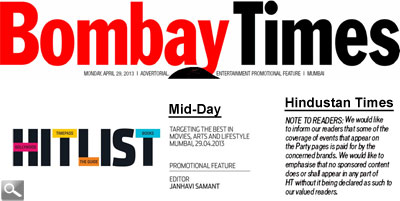
    Calling it a legit activity is like saying there’s nothing wrong if you adulterate milk with water. When The Times of India started Medianet, the editors of many publications cried hoarse about the practice. Prominent among these were Vir Sanghvi in Hindustan Times, N Ram in Hindu and Aakar Patel in Mid-Day. While the Hindu hasn’t given in to the pressures of revenues, both Mid-Day and Hindustan Times have buckled under. Mid-Day has been in it for a few years now, albeit on the entertainment pages. The sections carrying these are tagged ‘Promotional Feature’.


    When Hindustan Times got into the act recently, it knew the practice was incorrect. Page 3 in ‘HT Café’ is tagged ‘Entertainment and Promotional Features’ and there is a disclaimer on the front page of the supplement which states: “We would like to inform our readers that some of the coverage of events that appear on the Party pages is paid for by the concerned brands. We would like to emphasise that no sponsored content does or shall appear in any part of HT without it being declared as such to our valued readers.”


    I think it’s great that HT says it in so many words that some of the content is paid for. However, the features inside aren’t tagged as such. Also, the disclaimers are in fine print and unless it was pointed out to them, the readers would miss them. I asked five regular and two first-time readers of the paper, and only one of them noticed it, when being told what to look for.


    If HT is serious about its intentions it must do what the group’s business daily Mint does: put a disclaimer on the front page of the main paper. In addition, it must tag each and every article that’s paid for. Ditto with The Times of India, Mid-day and all other publications charging for content.


    **


    Should a newspaper be published only for social good? If it’s got to make monies, why shouldn’t it be doing so from every conceivable way, one may ask. I agree and see no harm with profit being the primary motive of any business. I don’t think it’s right to expect a newspaper to be only reporting on political, civic and developmental issues. People are interested in a reading a lot more… including news on health, sports and entertainment.


    However, one would expect the content in the newspaper to be published based on the decision of the editor, and not an advertiser paying for it.


    Newspaper owners ask the powers that be for several favours – DAVP ads, land allotment at discounted rates, access to various official functions and the government grants them these because newspapers are supposed to be serving a larger social good.


    By passing off content for which it has charged and is published not on the discretion of the editor, the newspaper is cheating readers. Thankfully for the owners – and possibly because many of them are very powerful – the law-influencers (including the Press Council of India) havent’ really damned paid entertainment/glamour content. Various favours continue to be granted to newspaper owners despite them charging for editorial content.


    In private many editors and publishers have told me that they are against the cash-for-content policies of their publications. However, it’s only in the film and party pages that are edited by an entertainment editor, they add, trying to wash their hands off the regressive practice. So on one hand, editors carry campaigns against the various wrongs of society and even write editorials on these, on the other they allow part of their paper to be used to publish paid-for content.


    I asked a dozen readers from across four metros and the seven others I had spoken with earlier to comment on the issue. Here are the Top 3 observations:

    1. They don’t differentiate between the entertainment supplements and the main paper, even though Bombay/Delhi Times, HT City/HT Café and Hitlist are popular titles.
    2. As high as 60 percent of the respondents don’t trust the movie and restaurant reviews, even if they carry a disclaimer that the reviewers pay for their food bills
    3. They don’t really care that the content is paid for or not.


    The views of 19 people can of course not be extrapolated to the entire readership of these papers, but the last of these views left me wondering whether I was being a prude.


    Perhaps, but happily so.


    Pradyuman Maheshwari is editor-in-chief, MxMIndia. The views expressed here are his own.

     

  • 1 Minute View: Turn off the tap to those offering paid content!

    While we are against the government interfering in the affairs of the media and the media in turn asking the government for favours, the only way in which errant news publishers can be taught a lesson for indulging in paid content is by hurting them where it hurts most: stop the favours and grants.


    Yes, so no more DAVP ads, special postage rates, pay market rates for property etc.


    If newspapers are charging for content, then they aren’t necessarily operating in the ‘social work’ domain, so they may as well be operating in the open market scenario and not get the largesse from the Central and State governments. So, much against our wishes, we would urge the government to intervene.


    Note, we aren’t suggesting revoking the licence because we see nothing wrong in newspapers carrying content on entertainment, glamour and parties.


    However, paid content – where content is published for a consideration, is an incorrect practice. We aren’t calling it illegal… that’s for various others to decide. But it sure it’s an unethical practice.


  • TOI celebrates ‘dodransbicentennial’; to launch TV channels & radio stations

    By A Correspondent


    This year, The Times of India celebrates 175 years of existence (dodransbicentennial is the word). To celebrate and mark the occasion, the year for Bennett Coleman & Company Ltd began with film awards event TOIFA. And the celebrations will continue through the year.


    To kickstart the journey, Vineet Jain, MD addressed all the employees of BCCL and TTN through the Live Video Streaming on Monday, April 22, 2013, simultaneously in 13 offices around the country. Ravi Dhariwal, CEO-Publishing, BCCL and Shrijeet Mishra, COO, BCCL joined Mr Jain on the scope of the year-long programme.


    While addressing the employees, Mr Jain said that the group will be launching more television channels and radio stations soon. The television channels would be in the genre of general entertainment and regional channels. Mr Jain also shared the history of the group with the employees.


    In a signed full-page editorial, editor Jaideep Bose writes: “Like India, The Times of India too is a mass of niches, and like India, we’ve become adept at managing and marrying contradictions. This big-tent philosophy opens us up to all kinds of criticism. We have been accused of being “hard” and “soft” on the same government; of being “too negative” and “too positive ” in our coverage; of being obsessed with cricket, crime and cinema — and yet being preoccupied with politics. (We have also been accused of being “too commercial”, but how many of our readers know that several companies and governments have stopped advertising with us because we wrote something they didn’t want us to, or we didn’t write something they wanted us to. Our refusal to bend to their will has cost us hundreds of crores.)”


    Meanwhile, a TVC starring actor Ranbir Kapoor drives home the message of the celebrations. The emphasis is clearly on attracting the youth. In fact the footnote of a front-page ad created by Taproot states that: “As we complete 175 years, we don’t just look back at what we have achieved but also look ahead at what we hope to do. We aim to begin an intensive year-long programme of initiatives to mobilise the youth and make changes at the grassroot level. And we prepare to not just write, but shape the story of a better, more powerful India.”


  • Jagdish Mulchandani appointed CFO at Times Television Network

    By A Correspondent


    Times Television Network (TTN) has announced the appointment of Jagdish Mulchandani as Chief Financial Officer, with effect from April 2, 2013. Based out of Mumbai, Mr Mulchandani will lead and drive finance-related strategy and operations for Times Television Network. In addition, he will also oversee the functions of Distribution, Traffic and Administration of the all the Times Television Network channels – ET Now, Movies Now, Times Now and Zoom.


    Mr Mulchandani has over 20 years of robust experience across various sectors, including distribution, finance, accounts and business transformation among others. Prior to joining TTN, he was associated with MediaPro (a Star – Zee joint venture) as Chief Financial Officer. He has also worked with Star Den, Star India and Star Middle East. In his new role, he will leverage his distribution experience with Times Television Network having now adopted its own penetration and distribution team and its domestic subscription business now with MSM Discovery Pvt. Ltd.


    Speaking on the announcement, Sunil Lulla, Managing Director and Chief Executive Officer, Times Television Network said, “Jagdish comes on board at the opportune time to help steer and grow Times Television Network’s value proposition. Armed with a vast experience across various industries including the Media & Entertainment domain in India and overseas, Jagdish is a key member of Times Television Network’s leadership team. Apart from Finance, his experience with Distribution will be an asset for our business in this new era of TV Broadcasting. I am sure he will add great value to the profitable growth of our channels and our business.”


    Commenting on his new role, Mr Mulchandani said, “I am very happy to be part of India’s finest media group, with such high repute. Times Television Network has strong brands, leaders in their respective categories, and the business is on a strong growth path.  In this new phase of growth for the network, I look forward to working with some highly motivated individuals and adding value to the business. Apart from my Finance and Strategy skills, I look forward to adding muscle to Times Television Network’s Distribution function.”


    Mr Mulchandani will be reporting into Avinash Kaul, Chief Executive Officer, ET Now, Times Now and Zoom.