Category: MEDIA

  • COFI has reservations about digitization

    By A Correspondent


    Fifteen days to go and controversies regarding the first phase of digitization refuse to die. Kolkata Cable Operators Digitization Committee has already written to the ministry to take into account their representation in the meetings. Now, the Cable Operators Federation of India (COFI) has voiced its apprehension regarding a-la-carte packages. In a task-force meeting in New Delhi, COFI presented a paper saying, “Government’s promises of a high quality digital cable service with affordable price and a facility to choose their favourite channels and pay only for them will prove false if subscribers find on November I that in spite of paying Rs 800 to Rs 2000 for STB they don’t have any choice and being forced to pay two to four times more to get the same cable TV service.”


    The paper then went onto list the offers from MSOs as given on their respective websites:

    • DEN Networks has NO channel from Indiacast (Viacom 18 and Sun) like Colors, Sun South Indian channels etc.
    • DIGI has no STAR channels, no ZEE channels and no SPORTS CHANNELS except DD sports and their package price is Rs. 250 PM.
    • IN CABLE has not given any names of the channels that they will carry on their network.
    • HATHWAY is the only MSO to carry all popular Premium channels on their Network but package with popular channels cost consumers more than Rs 350 (with Taxes).
    • No MSO has given a-la-carte rates of channels to allow consumers to select individual channels.


    Channel Package Offers from MSOs

    MSO Name of Package No. of Channels Rate Per Month in Rs (Exclusive of Taxes) Remarks
    Digi Cable Basic 145 180 No Star and ZEE Channels. Minimum customer price after taxes in Delhi will be Rs. 260.00 Taxes applicable on all packages and monthly rentals:1. Entertainment Tax- Rs 20 in Delhi.2. Service Tax- 12.5%

    3. Vat- 10%

    4. STB Rental- Rs 15- Rs 100 per month

    Gold 151 200
    Premium 165 250
    Hathway Basic 135 160 Minimum Customer price Rs 240.00 after taxes
    Medium 198 220
    Premium 242 275
    DEN Pack1 112 180 No Colosr, Sun group etc. Minimum Customer Price Rs. 260 after taxes
    Pack2 219 225
    Pack3 235 270
    WWIL Janta 118 100 Minimum Customer Price Rs. 160 after taxes Minimum Customer Price Rs. 160 after taxes
    Popular1 (Kolkata) 151 150
    Popular2 (Mumbai) 153 150
    Popular3 (Delhi) 142 150
    IN Cable Manoranjan FTA 100 100 Minimum Customer Price Rs. 160 after taxes
    IN Silver 140 225
    IN Gold 175 275
    IN Platinum 200 325
    IN Diamond 250 400


    STB Selling Schemes

    MSO Outright Purchase Rental Scheme Hire Purchase
    DEN Rs.1999/- including taxes Rs.799/- + Rs.15/-p.m. for 5 years, excluding taxes Rs.400/- + Rs.40/-p.m. for 5 years excluding taxes
    Hathway Rs.1999/- including taxes Rs.1900/- + Rs.40/- p.m. for 35 months including taxes Rs.500/- + Rs.100/-p.m. for 15 months including taxes
    Incable NIL Rs.500/- + Rs.40/- p.m. for 40 months Rs.500/- + Rs.100/- p.m. for 18 months
    Digicable Not available
    WWIL Not available


    It was also pointed out that none of the MSOs are offering the Rs 100 FTA package as provided in the regulations.


    According to the COFI memorandum, LCOs had raised this point of packages and pricing on 8th June at stakeholders meet in Vigyan Bhawan and were assured by the I&B Minister and MSO representatives that they will come out with final packages very soon. More than 4 months have passed and still no sign of any clarity on packages, pricing of channels and STB schemes.


     

  • Jaldi 5 with Raj Datta: TOI has a strong youth connect but ABP is undisputed leader

    It was launched with much fanfare in Kolkata yesterday. But will Ei Samay from The Times of India stable be able to create enough impact in the Ananda Bazar Patrika-dominated Bengal market? We spoke to Raj Datta, Senior GM, MPG-Kolkata for his first impressions on the new daily.


    Raj Datta

    On the qualitative front a lot of the editorial team has moved from ABP to TOI, almost to prove a point as DNA had done to TOI, giving ABP a run for its money. So they know the market, its people and the competition, a heady combination. Editorial content being good, the case would be to develop their weekend content and other sections.

    On the quantitative front, Ei Samay is offering very competitive introductory pricing. For a  six-month subscription, the package is Rs 175, as also special and bumper pricing helping to increase circulation potential and get  hold of those initial eyeballs. Re-subscription would remain to be seen, but undoubtedly they will garner a captive audience for the first six months, really quite a bit of time for a reader to get habituated to style and format.


    02 Will a Bengali newspaper from The Times of India stable will be able to dent the market?

    Historically and in numbers, ABP has been the undisputed leader in Kolkata with a sticky brand loyalty associated with them. TOI has had marketing muscle, been innovative and agile with a strong youth connect and flexibility to changing technologies and trends.

    Whether Ei Samay will dent the market or not remains to be seen but certainly they will dent the method of operation of the ABP group making them more aggressive, reactive and proactive. Already there has been a review in its pricing, something they have not with other entrants and Ei Bela launched to target a younger segment in a compact newspaper format akin to a Mid-Day.


    03 How was the response  for the launch issues= of Ei Samay?

    The first issue was out at an inaugural 72 pages, a first-timer for a newspaper anytime, anywhere. The editorial content was very good and it had some great innovations, like there was a French window on the front page which opened half way on both sides. It certainly hit you in one shot as it aimed to do. The response would have to be a wait and watch but certainly it’s something ABP will respond proactively to.


    04 About Ei Samay, Times group editorial director Jaideep Bose wrote, “It will be Ei Samay’s endeavour to champion its readers’ causes in every possible way — be it to enhance their quality of life, or help rejuvenate Bengal, or create opportunities for the young, or simply provide a platform for ideas and solutions.” Do you think the product epitomises this thinking?

    The recent IRS confirmed that ABP’s youth profile is poor, something which Ei Bela is positioned to counter-act to balance the absolute number rule with the problematic youth area panacea.

    Traditionally, TOI has had a strong youth connect with experience in marketing initiatives and the ‘power of ideas’ involving a younger audience. It knows how to bring in the celebrity and style, talk of where the next party, poetry reading or art show is happening; or come up with editorial sections by student or experts. It knows how to create events and awards to take center stage.


    05 How are advertisers responding? 

    Ei Samay’s pricing is extremely competitive and the packaging very attractive with add-on rates at just Rs.150-Rs.200 making it a value-for-money part of the advertising offering. It is essentially targeting Kolkota city over the rest of Bengal. Ei Bela by ABP is also targeted to the city and is offering competitive advertising rates as are the ABP group publications but TOI is being extremely aggressive on this front.

    The corporate business should be easy for TOI to garner with most of the companies having offices in other cities too, but the real fight is in the retail business, which is huge… like saris, jewellery, etc. And there are other Kolkota publications like Bartaman and Sambad Pratidin too.


    As told to Ananya Saha


  • Mogae Digital launches Mobiya Trader

    By A Correspondent


    Mogae Digital has partnered with Mobiya to launch a suite of mobile classifieds services in India using the Mobiya Trader platform. Designed as a scalable full service platform, Mobiya Trader has been specifically developed for India and other countries where text messaging still dominates mobile communications and mobile advertising. The initial services will launch nationwide focused on the domestic jobs marketplace and there are plans to launch a property service, a matrimony service and also a wider industry jobs service too.


    Job seekers can use the new DomJobs service using SMS text messages to search for jobs and will receive daily updates about any matching adverts. Employers can also advertise by simply texting their advert into the Mobiya Trader service. Revenues are driven by user subscriptions and mobile advertising.


    Tanya Goyal, Executive Director, Mogae Digital, said, “Our new DomJobs service will, for the first time in India, help in the creation of jobs among blue collar workers through mobile phones. This service reaches job seekers in “rurban” (rural-urban) communities as well as the employers in the towns and cities and serves as an effective marketplace for bringing together blue collared workers and potential employers.”


    The vast majority of mobile phone users in India do not have a smart phone or broadband Internet access; therefore texting remains their primary communications method. Until now these types of domestic jobs were advertised locally in newspapers or by word of mouth.


    Ms Goyal continued, “The Mobiya Trader platform is flexible and allows us to configure and roll out new classifieds services rapidly, in some case even within minutes. This is important in a country with multiple languages, religions and cultural preferences; we need to be able to create marketplaces that accommodate these differences whilst maintaining ease of use, speed and of course being fun to use”.


    Mobiya’s CEO Martin Davis commented, “We are delighted that Mogae Digital has chosen to partner with us and use our Mobiya Trader platform to launch a variety of mobile marketplaces in India. With a mobile population approaching 900 million we are excited about the potential size of the customer base we will serve and the growing opportunity to deliver new services as India’s mobile technology adoption accelerates.”


  • Rakesh Sethi adds spice to Reliance Broadcast Network

    By A Correspondent


    Reliance Broadcast Network Limited (RBNL) has announced the appointment of well-known chef Rakesh Sethi as the Network Culinary Head, with the colloquial title of Big Chef. Chef Sethi is all set to take audiences of the Reliance Broadcast Network across radio and television, on a culinary journey that will include sharing recipes, updates on food, chats with prominent personalities, advice on diet and nutrition, and so on.


    Chef Sethi will present a special segment each day on 92.7 BIG FM between 1 and 2pm across the 31 Hindi-speaking markets, where audiences can look forward to tips on creating exciting recipes. He will also offer useful information on the nutritional aspects of food and how to retain them while cooking. There will also be a ‘Food Trivia’ section with listeners where he will share fun and interesting tips.


    Chef Sethi will also feature as a part of Big Memsaab on Big Magic and Big Punjaban on Spark Punjabi. On these shows, Chef Sethi will act as a mentor to contestants, leading them through the competition and also hosting special workshops with them. Additionally, he will also present a special family reality series on both channels called Saas Bahu aur Swad wherein he will pit the saas against her bahu as they both cook their best dishes in an attempt to win over the men of the family – who, in a blind tasting, will choose the woman who is the master of the kitchen!


    Commenting on his appointment as Big Chef, Rakesh Sethi said, “I am delighted to have come on board the network of Reliance Broadcast, which is known to reach out to audiences in new and exciting ways, across multiple platforms. Together, we will share and celebrate our country’s love for good food that is such a central part of the life and culture in India. I look forward to working with the team and creating, producing and distributing an assortment of offerings that meet the taste buds of Indian audiences.”


  • Sigh! What makes Gangnam Style and Kolaveri Di such a rage?

    Photograph courtesy: Music channel M-Tunes which had premiered Psy’s Gangnam Style earlier this month


    By Tuhina Anand


    Who would have thought that a rather stocky looking guy mouthing Korean lines would have become a rage around the world? Gangnam Style by South Korean rapper Psy has become a viral hit just like Kolaveri Di which took the digital world by storm. Last, Gangnam Style had 474,915,766 views since being uploaded in July 2012 while Kolaveri Di has 62,798,000 views since it was uploaded in November 2011. The popularity of Gangnam surpasses that of Kolaveri, and it is digital that has played the key role in the video becoming such a rage. How is it that some videos catch the fancy and become such huge hits, whereas others just die out eventually? Dhanush’s Kolaveri Di was such a rage but his next video where he pays tribute to Sachin… errrrr what is it anyway… did not match up to the success of Kolaveri even though it is about a cricketing legend that the nation is crazy about.


    Rahul Nanda

    Rahul Nanda, COO at Webchutney, explained, “There is no science that can work out a formula for the success of a viral. I think it depends on the quality of content.” Giving a peek into creating a viral he pointed that one should stick to the basics and remember that content is always the king. He added, “Gangnam Style video doesn’t really feature a handsome hero but the dancing catches the eye. It is then essentially about providing that hook which could be humour or having an emotional connect which has the potential of catching viral and being shared by people. Also to keep in mind is that what catches peoples’ attention is usually something that is simple and easy to understand.”


    A Kolaveri Di could not have been such a hit had it just been an audio. The video which captures behind-the-scene moments while recording the song makes it extremely delightful to watch, it shows fun while making the song which many enjoy watching. Similarly, if Gangnam Style was just a song it would probably not be so popular, but the video element adds to the song thus making it extremely watchable and shareable.


    Rajiv Dingra

    Rajiv Dingra, CEO of WATConsult.com categorically puts that going viral and a hit depends on two factors- it should be unexpected and original. People would want to watch and share only if there is an element of surprise like in Gangnam Style the dance moves and in Kolaveri Di the lyrics. There has to be a surprise element, besides of course the content has to be original. He adds, “The content while being original should allow people to create their own versions thus giving people a sense of identification.” This definitely happened in the case of Kolaveri considering the various versions that came out and they too enjoy a decent number of views.


    Zafar Rais

    On the success of Kolaveri Di or Gangnam style, Zafar Rais, Founder and CEO, Mindshift Interactive, said, “Kolaveri Di owes 80 percent of its success to the entertaining content it brought along. That is the element most brands forget in wanting to create the next ‘viral’ concept. An agency does have the capability to use the right strategies in increasing visibility to help you reach out, but without an insightful approach towards the content apt for your consumers, you just won’t make it. Humour, music and emotions are the key riders of all viral marketing efforts. Likewise, for the Gangnam style of dancing. Additionally, originality and unexpectedness are the superpowers in the viral race. It’s time for simple ideas to take over big ideas, Beyond One Language: strengthening the concept that regional innovations with a mix of global touches, does add to the concept. If it’s funny, it got to be viral and youth connect: connecting with the youth via their daily experiences in their diction is the key.”


    One cannot overlook the role of professional players in making a viral gain epic proportion. Like in the case of Gangnam which has been around for 6-8 months but gained popularity only once Sony Music took over its distribution and splashed it across various networks to garner better mileage.


    Same was also the case with Kolaveri Di too which Sony Music and the agency Jack in the Box Worldwide worked on to devise its viral strategy.


    Carlton D’Silva

    Carlton D’Silva, Chief Creative Officer at Hungama Digital Media Entertainment also pointed that the ridiculous nature of the video is what has helped in making Gangnam popular. He said, “I have seen that humour though not the only factor but is an important driving factor when essaying out a viral campaign. It’s not necessary to just bank on humour to make inroads into the digital medium and reaching the consumers. However, humour works well on the internet medium.” He also cites the example of Johnnie Walker F1 campaign where they put videos of behind the scenes which has caught on well on viral and this doesn’t necessarily stick to taking the humorous approach.


    Arvind Nair, Business Head, Social Wavelength echoes the humour element that all the digital players have expressed. However, he added, “It has to do with creating content that cut across all type of people. However, there have been brands who have experienced great success on digital by taking the route of a cause. Aircel with Save the Tiger campaign has done it successfully and has sustained it for long thus becoming relatable with this cause and also a viral hit.”


    So it is clear that original with a surprise element does best for going viral. Humour is the best route but not the only route when brands want to go viral. Keep in mind though that it is always the content that rules.


  • Paritosh Joshi: What did Felix Baumgartner teach us?

    By Paritosh Joshi


    “Felix Baumgartner, who?” did I hear you say? May I request you to crawl out from under that rock, Mr Rip Van Winkle?


    Last Sunday, October 14, 2012, Felix Baumgartner reset the previous world skydiving record of 31,333 metres held in the name of Col Joe Kittinger since 1960, by a ginormous (that really is a word) 8,000 metres to 39,045 metres. Let me put some perspective on this. Commercial jet aircraft (that you haven’t travelled in, Mr Winkle, seeing as you have been asleep these past 100 years) travel at a height of 10,000 metres. Felix ascended in his balloon to a height almost four times greater, right into the Stratosphere, for kicking off on his skydiving mission, Red Bull Stratos.


    What does all this have to do with a column called Media Matrix? A whole lot, actually. Before all else, this was a media event. By paying for the cost of the mission, Red Bull bought, essentially gratis, a moment of high drama that was played live on over 8 million youtube streams and was telecast live to a few hundred million more across the planet.


    A few months back, this column argued that every brand of consequence was not prepared any more to be merely a buyer of media space and time but endeavoured to‘earn’ and eventually ‘own’ media outlets. There are many good reasons why this should be so:


    • Commercial media inventories are expensive. As audiences get ever more sharply segmented, large pools of audience at a single media ‘location’ are ever scarcer. The latest US Upfront Market, in June 2012, pulled in over $ 9 billion delivering the networks 6% y-o-y increases in CPM (cost per thousand impressions).Current primetime CPMs in the US average ~$24, ~Rs. 1200. Research suggests that CPMs have generally risen at double the secular inflation rate in the US.
    • Commercial media are cluttered. Indian television audiences are used to seeing commercials taking up anything up to 30 minutes per hour. Not easy for a brand to be noticed if it is crowded in with 59 other brands doing their 30 second song and dance routine over an hour of programming time.
    • Commercial media appeal to diverse audiences, not all of whom are relevant to the brand. This multiplies the CPMs to reach the ‘desired’ audience as against the ‘aggregate’ audience that an insertion might yield.
    • Commercial media are primarily about the content and not the advertising break. Shows will remind you, “Don’t go away. We will be right back after the break”. The break is an unwelcome intruder, both for the audience and the broadcaster that they tolerate only with the greatest reluctance- or so it would appear.


    It is easy to see why brands would seek out alternative opportunities to expose their brands to audiences that are inexpensive, uncluttered and focussed and where the brand is not an interloper but the protagonist.


    Red Bull Stratos, then, was the creation, in a fleeting instant, of a global, owned medium.


    We can’t wish away more brand owners asking their communication partners- creative and media agencies, to develop such ideas that focus solus attention on them. We must however recognize that this undermines the advertising funded television model unless broadcasters are willing to push back with the right response (and the right response isn’t an ostrich’s dive into the silica). What lessons does it have for television broadcasters who depend on advertising as their primary source of revenue (aka most Indian broadcasters)?

    • Tighten your audience focus. The days of loosely defined target audiences are gone forever. Nostalgia might be wonderful thing in many ways but it is not a good guide to winning the television market.
    • Embrace co-creation of content with brands. Brands are as much a part of the cultural milieu that consumers inhabit. A lot of ‘owned’ media initiatives work precisely because consumers intimately associate brands with their lifestyles. Red Bull Stratos tapped into a carefully crafted association of the brand with instant energy, captured in its memorable “Red Bull gives you wings”, baseline.
    • Shorten commercial breaks and tighten bloated inventories. It may not show up immediately but eventually, price is a demand/supply interaction. The more you are prepared to supply, the lower your price will drop.


    Heck, this is a good prescription for ALL advertising funded television, owned inventory or not.


    Paritosh Joshi has been a marketer, a mediaperson and a key officebearer on industry bodies. He is developing an independent media advisory practice. He can reached via his Twitter handle @paritoshZero


  • Outlook Puja Special has Sandeep Ray as Guest Ed

    By A Correspondent


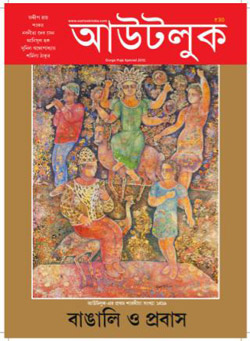
    Bangali O Probas (The Expatriate Bengali), Outlook’s first Puja special in Bengali has Sandeep Ray, the filmmaker and Satyajit Ray’s son, as the Guest Editor. The cover design is a painting done by the renowned Paris-based artist, Shakti Burman. The lead essay is by one of the leading and most popular Bengali writers, Shankar, of  Chowringhee fame.The focus of the issue is on the expatriate Bengali and contributors include Nabaneeta Deb Sen and Sunil Gangopadhyay, two respected figures in Bengali literature. Contributions have also come in from London, Massachusettes and Australia. Graphic novel has been done by Delhi based Bishwajyoti Ghosh.


    The art review is by curator Ina Puri. There is a bit of history, a bit of nostalgia, a bit of humour, an adda session on Bengal’s politics, a humour column by Suhel Seth and column by Sharmila Tagore.There are interviews with Bipasha Basu, Diya Mirza and the director of Kahani, Sujoy Ghosh. There is a photo feature as well on Bengali actors. There are provocative reports on Bengali actresses hogging the limelight in the South, a Bengali being the first Law Minister of Pakistan and the growing matrimonial bonds between Kerala and Bengal. There is an erudite essay on Bihar based Bengali writers enriching Bengali literature and also a review of Bengali blogs. A whosesome and varied fare, in short, to stimulate the mind, draw a laugh or two and make readers think.


  • Hathway goes all out for digitization awareness

    By A Correspondent


    Digitization of TV is less than a fortnight away and Hathway is leaving no stone unturned to educate the customers about the benefits and importance of digitization. With digitization, consumers will be able to watch a wider variety of TV channels in digital quality, providing them better viewing experience than ever before. Digitization will also allow consumers to pick their mix of favourite channels.


    Hathway has undertaken multiple initiatives to make the consumer aware that digitization is affordable and will take TV viewing experience to the next level. Marketing activities including advertising placements in mainstream print publications across the country, outdoor advertising and door-to-door campaigns are being conducted to educate the consumers.


    Infomercials about digitization are running on Hathway’s local channels, and its consumers are also receiving e-newsletters on the issue.


  • Ashish Joshi moves to Dhingana from Universal Music

    By A Correspondent


    Indian music service Dhingana has announced that Ashish Joshi, Head of Digital and Business Development (India and SAARC) at Universal Music India, has joined them as Vice President, Business Development.


    Prior to his stint with Universal, Mr Joshi served as the General Manager at Hungama Digital Media Entertainment for almost three years. He holds a Master’s Degree in Computer Software Applications from KJ Somaiya Institute of MGMT Studies & Research in India.


    Snehal Shinde, Co-founder and CEO, Dhingana, said, “We are very happy that Ashish has decided to work with us. We are expanding rapidly and are focused on providing a much wider music collection to our customers. Ashish’s deep knowledge and expertise of how music industry functions will play a big role in taking Dhingana to the next level of growth.”


    Mr Joshi said, “With my extensive prior experience of over a decade in content acquisition and distribution on various digital platforms in a B2B environment, it was only a logical step to join a B2C player which is a leader in its space. At Dhingana, I will get a chance to explore my entrepreneurial streak and help build a very strong consumer facing brand in the rapidly growing streaming business. I believe that Dhingana is fast becoming the most compelling destination for music labels and content owners to monetize their assets while, for consumers, it provides the ultimate listening experience.”


    Dhingana (www.dhingana.com) is a social music streaming service for Bollywood and Indian music, and is accessed by users across 220+ countries/territories. The company today has a collection of over 5,00,000 songs across 35 different genres, which are available, legally and for free. By using Dhingana, consumers also become device-independent and can access their favorite music across different devices and platforms like iPhone / iPad / iPod, Android, BlackBerry and Nokia based devices, as well as their PCs and laptops. Headquartered in Sunnyvale, California, Dhingana also has their offices in Pune, India.


  • Chitralekha launches 62nd anniversary issue

    By A Correspondent


    The anniversary issue by the Chitralekha Group had a simultaneous five-city launch in Ahmedabad, Surat, Baroda, Rajkot and Mumbai by columnist, humourist, writer and playwright Taarak Mehta, psychiatrist and sex therapist, Dr Mukul Choksi, painter, Ghulam Mohammed Sheikh, chairman of the Khadi and Village Industries Commission (KVIC), Devendra Desai and Vice Chairman of MCX-SX, Jignesh Shah, respectively.


    Themed on the topic ‘Game Changers’ the issue has contributions by experts like Chandan Mitra, Sam Pitroda, Justice Markandey Katju, Kapil Dev, Gunwant Shah, Sagarika Ghosh, Salim Khan amongst others who have shared their perspective on people and incidents which have changed the conventional rules of the game and emerged as “Change Agents”.


    The issue also houses the third edition of Chitralekha’s ‘Gujarati Power List’, which comprises superstars from the fields of politics, business, corporate, music, fine arts, cinema, sports, media and social service, who have gone beyond their own areas of comfort and influenced the larger society.


    Moreover, the issue also carries a specially compiled music CD by Sa Re Ga Ma comprising 62 best songs of the superstars of Indian Cinema, Dev Anand, Shammi Kapoor and Rajesh Khanna.


  • TAM is digitization-ready, says LV Krishnan

    By A Correspondent


    LV Krishnan

    It’s a deferment, and a temporary one at that. It’s not a suspension, as some people have incorrectly termed. In the wake of the impending phase-wise DAS implementation across India, the custodians of TAM Media Research – Advertisers (ISA), Media Agencies (AAAI) and TV Broadcasters (IBF) – arrived at a joint consensus on the need to temporarily defer TAM TV Viewing data release for ALL INDIA market for a period of 9 Weeks starting Week 41 (October 7, 2012, Sunday) and ending Week 49 (December 8, 2012). This deferred data will be released on December 19, 2012 (Tuesday) along with data for Week 50 (December 9-15, 2012).


    This decision is aimed aiding Digitization and maintain the benefits of all the stakeholders during the DAS implementation scenario. TAM, on its part, is all set to aid the industry take the next big leap to the Digital World and implement this joint industry decision. Going forward, TAM will continue to keep a close watch of the on-ground dynamics and will be flexible enough to keep adjusting its course, whenever needed. In parallel, to help the industry settle down and understand the ongoing nuances of this consumer shift, TAM has proactively issued an Industry Guide for reference.


    On this Joint Industry request, LV Krishnan, CEO, TAM Media Research, said, “We are research specialists who generate and provide data backed by years of global knowhow, local audience understanding and evolving scientific methodologies. This specific request of data deferment by the industry to TAM is purely to aid Digitization and we, as the central and neutral media research service provider, are ready to partner in this exercise for the benefit of the industry.”


    “In fact, TAM has been long ready to measure the transition to the Digital World since way back in 2007. We implemented the state-of-the-art, platform-neutral, TVM5 Peoplemeter system then and started reporting data in July 2008. Ever since the government announced the digitization initiative, TAM has been focusing on the key steps required to manage the panel transition from analogue to digital efficiently. TAM has proactively prepared an Industry Guide that will be released soon,” added Krishnan.


    TAM is geared up to measure Indian TV Households’ transition from analogue to digital and hand-hold the industry through this phase. It will constantly keep a close watch of the ground reality.


    As a special initiative, soon after government notification on DAS, in May 2012, TAM commissioned a special DAS Establishment Survey (DASES) across four metros. These survey waves will continue through November 2012, even after the DAS deadline. This will help maintain TAM TV Viewership data stability for the four metros. In addition to the above DASES, TAM will conduct a special ALL India Digital Establishment Survey (DES) – spanning both urban (including 4 metros) and rural Indian markets in December 2012. While the above gives a ground reality check for 4 metros, this special DES will give a confirmation of digital proportions for ALL India. Also, this will help TAM project the data to the right Digital Universe on an ALL INDIA basis on Week 1 of 2013.


  • Digitization in Delhi crosses 66%, 99% in Mumbai: MIB

    By A Correspondent


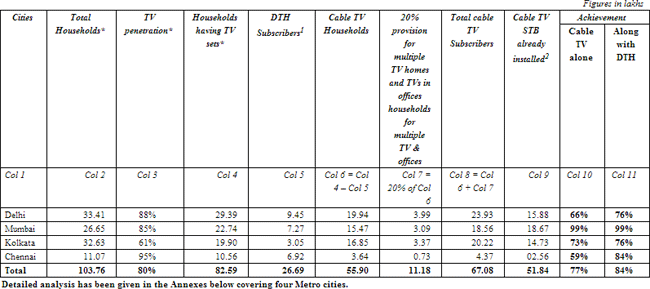
    As per the data made available to the Ministry of Information and Broadcasting by the Multi System operators (MSO), the level of cable TV digitization in Delhi has increased to 66 percent. It has been reported by the six private DTH operators that 9.45 lakh households have got DTH connections in Delhi as on October 9, 2012. This implies that 19.94 lakh households have cable TV connections. Adding a provision of 20 percent to account for multiple TV homes and TV sets in offices etc., it is implied that about 23.93 lakh subscribers require set top boxes. As per the data made available by the Multi System Operators, 15.88 lakh set top boxes have already been installed in Delhi.


    Taking into consideration that the fact that figures given by the ministry have been questioned, the release from the ministry said, “During the initial stage of planning, the data was collated by the Ministry based on the information supplied by the MSOs. On perusal of the data, it was observed that there were grave discrepancies in data, particularly number of Cable TV subscribers in four metro cities furnished by the MSOs.” The Ministry has thus undertaken the exercise to base the data Census of India 2011, released by Office of Registrar General & Census Commissioner, India, which gives authentic figures relating to households and TV penetration in Delhi, Mumbai, Kolkata and Chennai.


    The analysis of data received from the four metro cities reveals that overall 77 percent of cable TV digitization has already been achieved. City wise data shows that the achievement of Cable digitization in Mumbai is 99 percent, followed by Kolkata (73%), Delhi (66%) and Chennai (59%). Taking into consideration, the progress made by DTH in this sector the level of digitization goes up to 84 percent in the four metros.