I would like to humbly consider myself one of those rare lucky people who gets to do what they love, in the sense that my work is my passion. So, as one may know, on a daily basis I work closely with Music and Films, being a contributory entity to both these fields in various ways for the past two decades.
Now in an age where film and music are the national pastimes, and a majority of the population use these two avenues as a ‘winding’ down technique, where does that leave me? On the one hand Music and Films are my passion and on the other hand they are my work as well.
So when the day is over (which in Mumbai city it never is) and I want to relax… I do it by listening to some music that I haven’t heard in a long time, or catch up with the latest films and TV shows.
Reading is also an interest, so books about film and music enter my mind space. Of course, I do love a good fiction story as well.
I love silent cinema, so I find a strange calmness in just sitting back and watching the images unfold in front of me while an appropriate soundtrack is unfurled.
The company of animals is also a great pacifier, The two cats that share my space act as a great deterrent from the chores of the day and are absolute family to me.
And at the time when the weekends roll around the city beckons again, the company of friends and dinners and dancing and music brings me back to the world of work and passion in equal measure.
With the explosive growth in broadband penetration and mobile phone usage across population strata and town classes, the online population in India is expected to double by 2015. This will fuel the demand for products and services available online.
#2 Enhancement of service levels by e-commerce firms:
E-commerce companies are constantly enhancing their service levels through better delivery, more realistic shopping experience, customer-centric purchase and return policies. This will lead to an increase in customer confidence for shopping online and they will migrate a higher proportion of their discretionary spends online.
#3 Increasing need for convenience:
Traffic congestion and crowded retail infrastructure in smaller towns and cities increase the demand for home delivery. We will soon see major retailers adopting the e-commerce route to keep up with consumer demand.
#4 Increasing adoption of online shopping by the younger population:
The younger population, with an early exposure to the internet has been quick to adopt online shopping. This increasing adoption opens more growth opportunity for the e-commerce industry.
#5 High infrastructural costs for brick and mortar outlets:
As the cost of establishing and maintaining an offline retail presence becomes increasingly expensive, big brands will be prompted to invest in increasing their online presence.
Satish Mani is Chief Technical Officer of Zovi.com
As part of a new global rebranding campaign, Accor’s ibis brand family of economy hotels is launching the world’s biggest virtual pillow fight, with the “ibis Pillow Fight Party” Facebook application. The campaign, developed by Media Contacts Singapore, invites netizens in Asia-Pacific to discover the ibis family and stand the chance to win hotel stays at ibis hotels in popular destinations in the region.
The campaign, which targets Facebook users in the Asia-Pacific region, invites consumers to discover the unique personality of the ibis brand family in a fun and creative way. The inspiration for the campaign is the brand’s iconic pillow logo.
The pillow fight runs until November 21, 2012 and all fans of the ibis Facebook page in Asia-Pacific can take part in the fun. The first step is to become a fan of the ibis Facebook page and connect to the ibis Pillow Fight Party application. Next, participants create customized pillows and craft personalised messages to their friends. Then, the mayhem begins, as players throw their pillows at each other to score points – each virtual “throw†earns one point, while each pillow thrown back at them nets them two points.
At the end of the six-week campaign, the top ten highest-scoring players will win a three-night stay at selected ibis family hotels in popular Asia-Pacific destinations including India, Bangkok, Bali and Singapore. In addition, each week one randomly “Mystery Pillow†also rewards one player with a hotel stay.
“We are very excited to celebrate the rebranding of the ibis brand family with the launch of the ibis Pillow Fight Party Facebook application,†says Jens Uwe Parkitny, Vice President, Digital Marketing & Distribution, Accor Asia-Pacific.
“Given the rapidly evolving social media landscape – and its growing importance for reaching consumers – in Asia-Pacific, we believe that this application is one of the best ways to introduce the ibis family to our target customers.â€
“In a way, the Facebook community in the region mirrors the ibis brand – energetic, savvy, connected and on-the-go,†Parkitny added. “We think this application will energize our Facebook fans and help them discover the ibis family in a fun way.â€
Gautam Dutt, Managing Director of Media Contacts Singapore, said: “We wanted to use social media to communicate the rebranding undertaken by ibis in an engaging and innovative fashion. We had a great time working on this application and we are hoping that Facebook users in Asia-Pacific will have as much fun in interacting with this as we had in creating it.â€
Today the ibis brand family has 178 hotels in Asia-Pacific, including seven ibis hotels in India.
The ibis Pillow Fight Party Facebook application can be played by Facebook users based in Asia-Pacific on desktop browsers and on iOS and Android mobile devices – and is available in English, Thai and Bahasa Indonesia. Fans can take part in the pillow fight and learn more about the ibis brand family by visiting the ibis Facebook page. (http://www.facebook.com/ibis).
About Accor
Accor, the world’s leading hotel operator and market leader in Europe, is present in 92 countries with nearly 3,500 hotels and 440,000 rooms. Accor’s broad portfolio of hotel brands – Sofitel, Pullman, MGallery, Novotel, Suite Novotel, Mercure, Adagio, ibis, ibis Styles, ibis budget and hotelF1 – provide an extensive offer from luxury to budget. With more than 160,000 employees in Accor brand hotels worldwide, the Group offers its clients and partners 45 years of know-how and expertise.
About Media Contacts
Media Contacts (“MC”) is the global interactive media network of Havas Digital – the interactive division of Havas Media. MC provides data driven media solutions across all interactive channels: digital, direct response, relationship based media.
MC brings together professional expertise, proven strategic insight, and Artemis®, Havas Digital advanced proprietary technology platform, to maximize impact of the advertiser’s interactive media investment.
Since 1997, and in 42 countries in 54 cities across Europe, North America, South America, Africa, Asia and Australia, Media Contacts has been the trusted partner of more than 400 clients, including the market leaders in many industries, such as Air France, Danone, Expedia, Fidelity, France Telecom, ING Direct, Nike, Peugeot/Citröen, Repsol, Reckitt Benckiser, Sears, and Vodafone, amongst others.
Please go to www.mediacontacts.com for more information
Press contacts:
Accor Asia-Pacific
Chris Messer
Sustainable Development & Public Relations Manager
Newsweek, founded nearly eight decades ago, is moving to a digital-only product from 2013. According to editor-in-chief Tina Brown, it cost $42 million a year to manufacture, print, distribute, and manage the circulation of Newsweek.
Newsweek is in the best position to go completely digital due to their strong online presence through Daily Beast. But the news has sounded an alarm bell for print magazines all around the world. As news becomes a 24/7 affair and people prefer online access, the readership of news magazines is on decline the world over. It is no wonder then that magazines are reaffirming their presence in the online space too. With Kindle usage on the rise, e-magazines are creating waves.
Tarun Rai
Even as Indian print industry continues to see new launches, the readership is on the decline (though a minor slide), as recorded by recent IRS figures. “I am not very surprised at the decision. I believe the issue for Newsweek is the nature of the magazine it is. As a result, the relevance of a weekly ‘news digest’ has diminished. It is not a question of print or digital – it is a question of the nature of some magazines that may not be as relevant today. The same cannot be said for lifestyle and special interest magazines,” opined Tarun Rai, President of the Association of Indian Magazines and CEO, Worldwide Media.
Suggesting that print media still has a bright future, Paresh Nath, Editor and Publisher, Delhi Press said, “It is more of a failure of a publisher than the sunset of an industry. Printed books and material will continue to be relevant as they were in the last several hundred years.” Agreeing that the digital market for Newsweek may have matured earlier than the publishers expected, Pradeep Gupta, chairman and managing director of CyberMedia, said, “In the market they are operating in, digital is growing very rapidly and therefore Newsweek has moved in that direction.”
The predicament of the dawn of the digital era has been repeated often in the Indian context.
“I am happy to say that magazines are already re-inventing themselves for the digital world. Abroad as well as in India. All our magazines are available in their digital versions. We are also aggressively developing various magazines’ apps and will be launching them soon. We see an opportunity in reaching a new younger audience through our digital initiatives,” said Mr Rai.
Even while most magazines have moved towards digital and print versions simultaneously, the print version remains important for reaching the wider audience of readers and advertisers. Time magazine also has responded with their online version adaptable to any platform and any size, particularly for mobile reading. Varghese Chandy, Chief General Manager, Marketing Advertising Sales at Malayala Manorama said, “Reinventing needs to be done not only for news magazines, but every single product for its survival.”
According to Anilkumar Sathiraju, AVP & Head, DDB MudraMax – Media, South, revenue will still come from print version since revenues from digital in India are still at a nascent stage, even though digital penetration is increasing rapidly. Going forward, he predicted that revenues will still be higher from offline magazines.
Magazine have the most engaging format with the deepest touch points according to various international surveys. The growing numbers of tablets reassert the fact that this is the platform that gives the closest magazine-reading experience. Mr Chandy said, “However, monetizing the digital platform will be a greater challenge even for Newsweek.”
While the industry believes that magazines should be ready for the digital era, Mr Nath holds an interesting view: “Magazines do not need to reinvent themselves due to the digital onslaught. Digital delivery of content is like delivering content in Times Square by shouting when hundreds of voices are simultaneously trying to convey the same or similar things. When crowds assembled in Tahrir Square, Cairo, it was thought that the digital media is a powerful weapon, as sentiments were whipped up not by newspapers but by digital media. What is the end result? Muslim Brotherhood that conveys thoughts through printed material ultimately got into power. Very little original content is created on digital media. It only copies and pastes and does so millions of times over. Magazines or print versions of newspapers do not know how to overcome the shouting match where noise and not seriousness is the basic currency. When the time of reckoning comes, people will have to go to the print version, and magazines and newspapers will remain relevant. Magazines have to find out how to outgrow the noise.”
Delivery is still an issue – from readers visiting libraries in the past for content consumption, to wanting the content delivered to them. “Print brands have given up the will to fight and are trying to join the digital crowd that has weapons stolen from print itself. Yes, the world of delivery has changed, not consumption of content,” said Mr Nath.
But with readers wanting immediate access to content, 24×7, digital is only going to grow. It is time that that magazines move faster towards the digital era, according to Mr. Sathiraju.
The way forward
“In India, spend on magazines continues to grow because of an increase in literacy, increase in disposal income and lower internet penetration. Therefore, Indian publishers are embracing digital formats. Print advertising is currently 10 times the digital advertising in India. Over the next five years, the penetration of digital will increase. And that is why CyberMedia has reoriented its strategy around creating of a media mesh,” predicted Mr Gupta.
Mr Nath said that the question of digital versus print comes from the English-educated class in India. He said, “Long ago in India, content used to be created and consumed under the banyan tree. Now it is in front of a screen but the quality of this content is poor, one-way, where hundreds speak and no one listens. In India among the English educated there is a problem as this class cannot enjoy English content (is there any English Indian serials or English Indian movies or English Indian music?) whether in print or on digital media. This class keeps shouting that print is dying as it does not know how to ‘read’ in any language.”
The view might hold true but the increased consumption of magazines on digital platforms cannot be ignored.
“It’s anybody’s guess as to when the digital versions of magazines will become bigger than the printed ones. I firmly believe that the lifestyle and special-interest magazines space will continue to grow in both. It is the sunrise sector of Indian media. And both the print as well as the digital versions will grow, allowing our content to reach an even wider audience,” said Mr Rai.
As Mr Chandy concluded, “The Indian print industry needs to be ready for the future. Currently online penetration is single-digit. This is likely to change in the near future, especially in the metros.” Thus, publishers need to be platform-agnostic and essentially become content managers. Their primary task will be to reach the audience through whichever platform is relevant.
Given the worsening traffic jams in Pune, Sakal Times has initiated a unique social initiative in Pune. Called Pune Bus Day, the campaign urges the citizens of the city to use public transport (buses) on November 1. The campaign, which has been taking shape for about a month now, has seen much support from Pune Mahanagar Parivahan Mahamandal Limited (PMPML), which will be plying 3,000 buses that day, instead of the usual 1,500 on city roads. Volunteers will help the people to figure out the bus routes.
Powered by high-decibel print, electronic, outdoor and social media, the campaign will have over one lakh volunteers to help the people to figure out the bus routes on November 1. All citizens, from civic authorities to bureaucrats, activists and police personnel have been supporting the campaign.
The clarion call of ‘Be the change you wish to see in the world,’ promises to be the beginning of finding a permanent solution to Pune’s traffic problems within the next two years.
Shriram Pawar, Editor-in-Chief, Sakal Times said, “Unless you don’t connect with the ground level, nothing happens. Criticism or discussion doesn’t solve the problem. Sakal Times managed to get all political parties on the same table, and they in many ways gave the green signal to the movement and supporting it. We spoke to masses and got to know everybody wanted to help and work towards solving the traffic problem in Pune. All we did was give them a platform to come together and work as a force towards one cause.”
Labour unions to journalists to housemaids have pledged some part of their salary too, according to Mr Pawar. Different associations such   as CREDAI, MCCIA, HIA, NASSCOM, SEAP, ICAI, IMA are backing the cause and are also pledging financial support.
“We have a whole plan ready for PMPML of how to take the initiative forward for the next two years,” said Mr Pawar, adding, “We have supporters who will help man traffic with the traffic police for the whole one year. We are looking at long-term traffic solution.” The supporters of Pune Bus Day movement, initiated by Sakal Media Group can now wear a ‘Pune Bus Day’ T-shirt and support the cause.
It’s been action time for a while for Sunil Kumaran, Business Head, Language TV at Reliance Broadcast Network Ltd. The channel has been in the works ever since a jv with leading European network, the RTL Group, was inked last year. Mr Kumaran spoke to MxMIndia soon after announcing the launch of the BIG RTL Thrill next month.
01. Yours will be the first national Hindi channel doing a phased-wise launch. Why this strategy?
The strategy for the channel is to enter the different markets with local language feed, catering to the need of the respective market. UP is part of the first phase as it has affinity to action content.
Our strategy is to consolidate our position further in the markets where we already enjoy a significant presence with our Radio and existing TV offerings. This gives us a significant edge over the others in the space as we already reach a very large part of the population.
Also the Hindi-speaking markets contribute to more than 65% of total advertising spends across television, radio, print etc. and the idea is to create a media network that rides on the consumer boom in the tier II and III markets.
Does the UP launch mean consumers in Mumbai will not be able to access it?
BIG RTL Thrill will be available on DTH platform across India, so people across all metros including Mumbai will able to see it. We have already tied up with Reliance Digital TV and are in the process of closing the rest
Will you also be looking at dialects of UP being used in the dubbing?
We will be dubbing it in Hindi for UP but with regional undertones.
Will we see it entering southern markets too with local dubbed feeds?
Too early to comment.
02. Will we see any ‘Made in India’ programming on the channel?
Yes, that is part of the programming line-up in the future…
03. What has been the response from advertisers thus far?
We have got a good amount of response especially the brands which have Male as the primary TG. They are also excited to be part of channel which provides differential offering… across Automobile, telecom, FMCG, BSFI, Consumer Durables
04. Any special promotions to hook viewers?
Apart from big marketing campaign, we are looking innovative on-ground and rural activations. We are also hunting for local Action ka Baap’s
05. Given that action programming lends itself to loads of on-ground activity, do we see that happening?
Yes, on-ground activation and programming is going to be part of the promotional strategy and sustenance.
Akhadas, et al?
We are not only limiting it to Akhadas, but also extending it to action stunts in local mela and local talent hunt etc.
It’s a well-deserved reward for a loyal Congress soldier. Lok Sabha member from Punjab, 45-year-old Manish Tewari, was appointed minister to head the vital Information and Broadcasting Ministry yesterday. Although ranked Minister of State, Mr Tewari gets independent charge.
He still needs to get the handover notes from predecessor and senior party colleague Ambika Soni, but he’s got some quick decisions to take on the digitization issue. Although his first response to the waiting media was that he would speak to all stakeholders as well as with Ms Soni, unless the High Court in Mumbai intervenes, he will need to take some quick decisions.
On the issue of curbs, Mr Tewari said “self-regulation is the best regulationâ€.
The relationship of the UPA-2 government and the media has been rocky with the government at the receiving end for its conduct. There have also been charges against the media for crossing its line and last week, Congress MP Naveen Jindal went public with allegations against editors of Zee News.
Earlier, Ms Soni resigned as the I&B minister in order to work for the party in the run-up to the 2014 general elections. While it’s not an uncommon practice for senior ministers to quit to mobilize the party machinery ahead of a general election, the decision was untimely as it came less than a week from when the most critical and gamechanging action of the government for the broadcast sector was to happen on November 1.
See:
Manish Tewari Lok Sabha member profile: http://mib.nic.in/ShowContentOne.aspx?id=1&Section=7
Reliance Broadcast Network (RBNL) and RTL Group, the leading European entertainment network, have announced the launch of their joint venture channel BIG RTL Thrill. To be positioned as an action entertainment channel targeted at male audiences, with the tagline Action ka Baap (Ultimate Action Destination), the channel will launch on November 5 in India.
Initially, the channel will go on air in Uttar Pradesh, featuring international content dubbed in Hindi. Phased expansion to other Hindi-speaking markets and the SAARC region (South Asian Association for Regional Cooperation which include the countries of Sri Lanka, Bhutan, India, Maldives, Nepal, Pakistan, Bangladesh and Afghanistan) will follow. The channel will cater to a largely untapped market segment, with an entertainment mix developed by detailed sampling of content, focus group research and comprehensive market analysis.
Thrill will target at male viewers aged 15 to 44 and promises to offer adrenaline rush, ‘edge of the seat’ entertainment with hand-picked content from across the globe including reality shows, action series, wrestling, extreme sports, game shows and movies. Content has been acquired from some of the world’s best production companies such as FremantleMedia, Endemol and Red Bull with key shows including Fear Factor, Cobra 11, Criss Angel, WipeOut and BayWatch. The line-up will also feature a strong library of international action films.
The channel will complement and provide synergies with RBNL’s 92.7 BIG FM which has six stations in the state, along with its variety entertainment channel BIG Magic. This consolidates Reliance Broadcast Network’s position as a leading media platform in Uttar Pradesh, offering maximum focussed reach to marketers. The channel will be marketed through a holistic multi-media campaign across television, radio, out of home, on ground, print and digital.
Speaking on the occasion, Tarun Katial, CEO, Reliance Broadcast Network Ltd. said, “BIG RTL Thrill comes as an answer to the Indian males’ quest for action entertainment. The product is world class, served in Hindi, and has been designed to fill a clear void that exists in the market, ensuring high audience engagement. With the launch of this channel, RBNL fortifies its standing in Uttar Pradesh, offering advertisers a robust and unmatched offering in the region, delivering exceptional value for their brands.â€
Andreas Rudas, Executive Vice President Regional Operations & Business Development CEE and Asia of RTL Group, said: “This is an exciting moment for us at RTL Group; it’s our first step into the Indian broadcasting market, which offers very promising growth opportunities. We will contribute our long-term broadcasting and programming expertise to BIG RTL Thrill – with high-quality content targeting a clearly defined audience. The powerful combination with Reliance Broadcast Network will help ensure that BIG RTL Thrill becomes a strong new brand on the Indian market.â€
The Dainik Bhaskar Group has announced the start of the nomination process for the India Pride Awards 2012, which will be given in New Delhi in December. The awards acknowledge and recognize contributions by Indian PSUs and the excellent work done by them in serving the nation.
This year sees the 4th edition of the India Pride Awards which began in 2009 and is the only awards ceremony in India by a non-government body that acknowledges the efforts of Indian PSUs in nation-building. IPA extended its scope in 2011. In addition to the Central and State PSUs, two new categories, Social Change Agents and Impact Creator – Civil Servants, honouring individuals, were introduced.
This year will see introduction of another category, ‘Best Media Agency – PSU’. The award will recognize the advertising agency for the most impactful PSU campaign. The awarded campaign is expected to have demonstrated in an impactful way the message on PSU competencies and its impact on the society and economy of the nation. The award is media-neutral and will consider the best work in print / electronic or any other media.
Speaking on this new category introduction in IPA 2012, Jaideep Dhagat, National Head- Government Business, Dainik Bhaskar group said, “Communication and in that extension advertising plays a vital role in reaching out to the masses; important stakeholders in the PSU eco-system. The category of communication in PSU comes with its own challenges and we believe that lot of good work is being done by advertising agencies for the PSUs. This new category will bring alive these efforts and work towards becoming a benchmark for the category.”
The last date for receiving nominations is November 10, 2012. Details about the awards and entry / nomination forms are available at www.dbindiaprideawards.com.
This year “Wital See” is the title sponsor, ICRA is the knowledge partner and CNBC Awaaz is the television partner.
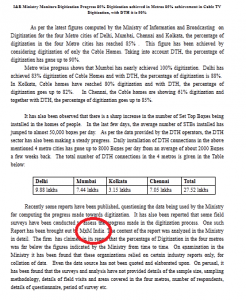
On Friday evening, the Ministry of Information and Broadcasting of the Government of India issued a statement defending the digitization numbers it has put out. The MIB contests the study published by Television Street Maps (TSM) and MxMIndia.com.
While we are happy to note that the ministry has carefully studied our data, we – TSM and MxMIndia – stand by the data published.
We will happy to cooperate with the Government and/or the TRAI if it wishes to see any clarifications. These can be addressed to editor@mxmindia.com and we will revert soonest.
We wish to reiterate that we are eager to see digitization happen. MxMIndia commissioned TSM to conduct the study only because it was felt that the data being put out by the MIB was not reflecting the true on-ground situation.
We understand the ministry too has undertaken its own study of the market. Records at the MSO headends, sms activations etc have been looked into.
We now have a new I&B minister in Manish Tewari. It’s a big day for him today – October 29. His first working day as the minister. There is a taskforce meeting scheduled for today. And there’s a Mumbai High Court hearing coming up on the delay in digitization.
Loads happening. We’ll bring you all the news and analyses.
It’s not unusual that national dailies (or dailies which have a large footprint in the country) have tried to make a mark in markets where there have been strong, well-entrenched regional players. The Times of India, for instance, set up successfully in Bengaluru many years back, but found the story different with Deccan Chronicle in Hyderabad. In Chennai and Kolkata earlier, it did not outwit competition entirely, but was successful in shaking up the market.
Earlier this month, the TOI group enterted the Bengali newspaper market, taking on the Ananda Bazar Patrika group in possibly the country’s most culturally aware market.
But it is not about one newspaper group spreading its tentacles and the issue we are looking in MxM Mondays today is: Do regional newspapers have it in them to face the competition and clout of national newspapers. We spoke to a cross-section of industrypersons on the issue:
(in alphabetical order of their last names)
?
Anwesh Bose, Senior Vice President, DDB MudraMax Media
Anwesh Bose
The Times of India’s success in Bangalore has a lot to do with Bangalore evolving from a sleepy and quiet retirement paradise to a bulging at the seams metropolis. With Bangalore becoming a metropolis, the swell of urban to urban migration came prominently from Delhi and Mumbai wherein Times of India was already an established brand. The resident Bangalorean is still not satisfied without his Deccan Herald and coffee. Barring this example Times of India has not been able to create a significant dent among any other regional market. The trend of emergence of regional parties (Didi, Amma, Behenji, Nitish ji, Karuna ji, Mulayam ji, Patnaik ji, Abdulla ji, etc) who are calling the shots in the country also mirror the fact that not only are regional entities more relevant than they ever were but are here to stay & dominate. India as a country was, is & will remain to be culturally diverse and local will always be more prevalent than national. To conclude, Vijay Vani is already on its way to unseat the position of Vijay Karnataka… keep watching!
Mitrajit Bhattacharya, President-Publisher, Chitralekha Group
Mitrajit Bhattacharya
I think we should not look at it from the individual brand point of view.
It is actually more from the portfolio point of view from the groups, for example, the English traditional groups like the TOI are expanding into regional markets. Similarly, regional biggies are launching in English. ABP group has launched magazines and got licences for magazines like Fortune. The larger groups are getting larger, and are consolidating by having as many products to cover all the gaps in their portfolio. It is not as simple as saying that the regional biggies are outdoing the English biggies or the English biggies are outdoing the regional biggies.
If you really look at the percentage of advertising which the English media garners vis-Ã -vis their readership, it’s totally lopsided compared to the regional media players. Now the thing is that even if the regional player has much larger readership, they still get much lesser advertising. This was the traditional format. It also happened in television. This format is changing and regional players with their smart marketing moves in the last five years have started garnering a lot more advertising than they used to get probably 5-10 years ago. That shift is happening and that shift will sharpen.
Now there is another point. It is also happening because the tier 2 and tier 3 towns are becoming more and more critical in the marketing mix of most organisations. So when tier 2 and 3 cities become more important the regional players’ share of advertising is bound to go up.
Manajit Ghoshal, MD & CEO, Midday Infomedia Ltd.
Manajit Ghoshal
I am a firm believer in the saying ‘Change is the only constant’. As much as some of our predecessors in the media would like us to believe that brand loyalty is sacrosanct (especially in newsprint reading habits), I beg to differ. Yes, newspaper reading is a habit-forming phenomenon, but like all other things, this is changing and it’s changing at an accelerating pace.
The English print readers are migrating to digital. The newly educated in vernacular languages are adding to the regional language print readership, but these readers are going to be increasingly brand neutral. The regional newspapers have an increasingly older readership profile and these newspapers need to reinvent themselves if they are to appeal to the regional youth as they once appealed to their forefathers.
Having said that, the national newspapers will have to spend huge sums of capital to break the iron grip that some of the regional newspapers have over their markets. The financial resources and the timelines required to do this is naturally an entry barrier and will give some breathing space to the regional newspapers to catch up, but not for long.
The national newspapers have clearly realized that they cannot have ‘one size fits all’ type of content and are playing this round smartly by having increasingly localized content and are challenging the hyper-local content strategy of regional newspapers by playing their own game and beating the regional newspapers through bigger and better resources.
It is up to the regional newspapers to invest in their brands and protect their turf, but the consolidation game has already started in right earnest and it might already be too late for them.
Bharat Kapadia, Chairman, Whatuwant Solutions, and Founder at ideas@bharatkapadia.com
Bharat Kapadia
We do not have any real national newspaper in India. One shouldn’t confuse regional languages with regional papers. Among English language papers, TOI has done very well but it is 5-6 editions that are significant, and it just barely features in the top 10 read newspapers. TOI had started a Gujarati newspaper which they closed down. Their Maharashtra edition is growing well now. In Western countries, for example in the USA , Wall Street Journal will have a national presence but everywhere else it will be NY Times, LA Times Chicago Tribune and so on. There was no national newspaper till the time USA Today was launched!
Speaking of the advertising trend, about 10 years ago, 70-80 percent of advertising went to English newspapers even when English newspapers had limited editions and readership. Today, this percentage stands has come down at less than 60 percent for English newspapers. Surprisingly DAVP also gives importance to English newspapers which as per their policy have to get 30 percent ads and at a premium. Hindi gets 35 percent and all the regional newspapers put together get 35 percent of their advertisements, which is ridiculous.
However, the growth of tier II and III cities, and lower penetration of English (less than 5 percent) will result in advertising buck to follow the regional newspapers. Literacy levels are also rising. When the person gets literate, the chances are it will be in his/her own regional language. Hence, you see, unlike anywhere else in the world, regional newspapers are growing in India when it comes to readership and circulation.
For me, it is definitely in favour of regional media for some time at least.
Basant Rathore, Vice President-Strategy, Brand and BD, Jagran Prakashan Ltd
Basant Rathore
To my mind, there is no one national newspaper in India. There are papers that are available in various languages addressing individual markets and audience segments within each individual market.
If we were to structure the print market, there are there are the South states, Gujarat, Maharashtra, Punjab, West Bengal, Orissa, Assam and North East. Then we have the Hindi belt comprising UP, UT, Bihar, Jharkhand, MP, Chhattisgarh, Punjab, Haryana, J&K, HP, Delhi, Rajasthan – this is by far the largest geographical belt, and the Hindi papers have the highest readership in India. Five of the Top 10 papers of India are in Hindi. The reach of any Hindi daily is 3.4 X of the next language – and this No 2 language is not English. Marathi and Malayalam dailies have a higher reach than English. So therefore, this entire segmentation of newspapers into National and Regional dailies has no basis.
Over the last few years, there has been a significant amount of marketing attention shifting to the tier 2 and tier 3 markets. As benefits of development percolate down the tiers, interest in different geographies is increasing. Marketers want to reach out to a wider market and media that reach these markets are the natural choices. Therefore, these markets will have competition across sectors.
Having said that, each newspaper has its own strengths, on the basis of which it competes. Today there are brand leaders in different languages and different geographies – all of them have a connect with their readers and their marketing strategies are something that are customized based on the individual market conditions. So when a brand which operates in a particular geography launches the brand in another market, to my mind, there is a level competitive playing field for all. Each brand would leverage its existing strength, and the reader chooses to buy the brand or brands he/she wants. So when a so-called “national newspaper” launches in a “regional stronghold” of another daily, it’s competition as usual. Eventually, the brand that strikes a better local cultural connect will win and just credentials alone aren’t enough to guarantee success.
Anita Nayyar, CEO, Havas Media, India & South Asia
Anita Nayyar
The answer is: Yes and No, It depends (on the approach and method). Newspapers as a medium form a relationship and habit patterns with readers. Also here you don’t have a new one dropping in every day as it does in your inbox, so you open it once in a way.
Culturally, India is diverse and its languages without the dialects are vast; 438 as per the Economist. IRS has consistently shown how the top five publications and dailies are not English. Tier 2 and 3 cities are new ports even for luxury brands with their old wealth and new-age entrepreneurs.
Today marketing is getting more footprint-mandated and more segmented as brands are launching many sub-brands catering to these segments to increase revenue and market share. Print traditionally is sustained by this advertising. This is a climate all publications are very aware of. Growth is coming from regional markets, making the national biggies focus on these and in the process expand their footprint. Smaller towns are becoming welcome targets for brands and their consumption is leading to market expansions which are a welcoming sign for publications to reach and target.
Hindustan Times (HT) when only in Delhi did not have the geographical reach and lost in advertising economies of scale to Times of India (TOI). Even the south-based Hindu has focused on increasing its Delhi readership as essential to command ad-rates and advertiser perception. So many major publications will use the strategy to go across and cross region; but readership will belong to those who are able forge either a relevant position or sufficient connect with the customer.
TOI in Bangalore focused on the incoming new audience at the time of the IT boom, its inherent position of youthful and buzzing rendering a profitable mix with the upcoming economic and cultural mindset. The south, however, becomes complicated with its languages and dialects. In Hyderabad, TOI has not been able to penetrate the landscape to reach number 1 while local publications, even new ones launched like Sakshi, are doing well. Even the regional biggies have multiple editions to penetrate the cities, not such an easy infrastructure to follow.
Anand Business Patrika’s Kolkata-based Telegraph has used a regional strategy in its expansion focusing on the east so it has established many roots to be severed before it is de-throned. Ei Samay in Kolkota has definitely made an impact with the shift of some of the editorial team, launch at 79 pages and TOI bundled add on packaging of Rs.150-Rs.200 making it most lucrative. But ABP too has responded in a way it has not done before, by dropping rates and being open to deals even in an approaching festive season when ad sales, down this year are expected to pick up.
Yes, Hindu is the Mount Road Maha Vishnu, but TOI is the old lady of Bori Bunder and she did ‘awaken’ the Lord to an aggressive ‘Good Morning Chennai’; but also, she learnt, has muscle and a flexible attitude. The recent Kerala TOI launch with elephants was theatrical but then TOI does know how to get heard. It also knows how to get inventive, readers can save Rs 50 per month by subscribing to TOI and Mathrubhumi, packaging English and Malyalam, a good idea for a family speaking both. Also the old lady attracts innovation – the aromatic coffee newspaper with ‘Bru’ and ‘Hide & Seek’ or the newspapers with a voice by Volkswagen.
Hence my answer, ‘Yes and No, It depends’. Either way neither national dailies nor regional biggies can afford to get complacent but will have to be aggressive, proactive and inventive to protect their territories or make the break-through, and it will be over time.
Relevance is a very important factor here. Talk to me in my language and you become more relevant. Be present in my environment and you have more retention, customise to my needs and you find a place in my life and get a share of my wallet. This is what brands need to do irrespective of whether it is a publication or any other product category.
PN Vasanti, Director, CMS India
PN Vasanti
I do not see the difference between regional and national biggies. There is no difference when it comes to tactics, strategies, and manoeuvring. It is only that regional newspapers have local advantage, which national newspapers miss. We are in competition era and in media space for next generation everybody will try to establish themselves. And survival of the fittest is going to matter. Everybody, hence, will try to launch as many products to see where they can survive and fit, and where they cannot.
There will be competition. But where there is enough market potential, one will have to enter otherwise one would not be able to survive.
UTV Spotboy and AKFPL (Anurag Kashyap Films Pvt Ltd), producers of Luv Shuv Tey Chicken Khurana, have joined hands with India Food Network’s (IFN) home chefs to create an exclusive rendering of the popular Chicken Khurana recipe.
IFN’s chefs Joel D Souza, Kalyan Karmakar, Veena Gidwani and Archana Arte took up the challenge by coming up with their best interpretations of the Chicken Khurana recipe. While some chefs prepared an authentic Punjabi dhaba dish, some added a twist to popular dishes like Chicken Tikka and Tandoori Chicken. The chefs used Punjabi ingredients and interesting improvisations to get the perfect flavours.
“The entire cooking session saw tremendous ingenuity on the part of our chefs. We could never imagine that you could replicate a dhaba style of cooking in your kitchen. One of our chefs, Archana, actually used charcoal to create that asli Chicken Khurana feel,” said Anagha Rajadhyaksha, Director, Acquisitions, Ping Digital Network.
Luv Shuv Tey Chicken Khurana is the story of a quirky Punjabi family in pursuit of a secret recipe that will enable them to reclaim their pride and wealth. The film, directed by Sameer Sharma, releases on November 2.

 By Satish Mani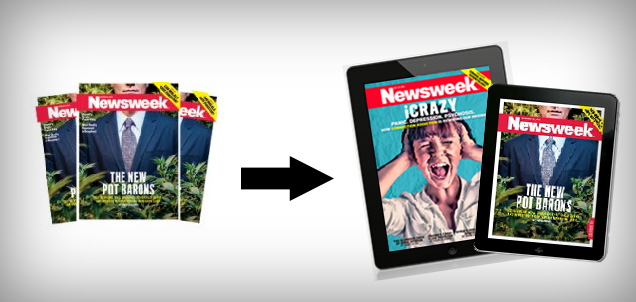

 By A Correspondent
 It’s been action time for a while for Sunil Kumaran, Business Head, Language TV at Reliance Broadcast Network Ltd. The channel has been in the works ever since a jv with leading European network, the RTL Group, was inked last year. Mr Kumaran spoke to MxMIndia soon after announcing the launch of the BIG RTL Thrill next month.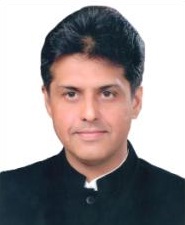
 Reliance Broadcast Network (RBNL) and RTL Group, the leading European entertainment network, have announced the launch of their joint venture channel BIG RTL Thrill. To be positioned as an action entertainment channel targeted at male audiences, with the tagline Action ka Baap (Ultimate Action Destination), the channel will launch on November 5 in India.
 On Friday evening, the Ministry of Information and Broadcasting of the Government of India issued a statement defending the digitization numbers it has put out. The MIB contests the study published by Television Street Maps (TSM) and MxMIndia.com.