Category: MEDIA

  • Yuvi’s Twitter contest sees 1.6mn views in under 4 hours

    By A Correspondent


    Life ka Balla, a Twitter contest launched by Yuvraj Singh, saw major traction from the followers of Yuvraj. The contest was viewed by more than 1.6 million followers in less than 4 hours. The southpaw, who made an unbelievable comeback in cricket by scoring a magnificent double century in the ongoing Duleep Trophy, encourages the public at large to share their hard-fought moments of life on Twitter through this contest.


    The contest has already received overwhelming response from the ever growing fans base of Yuvraj with post including ‘winning best student award’ to ‘climbing the Himalaya’ to ‘buying the dream house’ to ‘getting married and getting a child’. The responses were posted by people of all age group across the globe.


    Yuvraj’s tweet: @YUVSTRONG12: Playing for Team India was always my dream. I planned for it and here I am! Truly one of my best #LifeKaBalla moments yet.


  • The media event of the week for me. What was yours?

    By Peter Mukerjea


    When you have probably the most powerful man in the world, along with someone who is looking to topple him from that perch and take his place – you can safely say that you almost have probably the two most seriously powerful men in the world, together in an arena. They are then slugging it out for almost two hours nonstop and are no doubt being watched by a global audience of billions, in goodness knows how many languages; it turns into a most enthralling media opportunity.


    For both these two alpha males it was an opportunity to present themselves to their supporters, their opponents supporters and those voters who are fence-sitting and undecided. But also, to the people of the world at large, to other political leaders, students of politics and so on and so forth.


    The issues they talked about, their presentation styles, techniques, body language, facial expressions, timekeeping, dress sense, quality of their content were all being minutely analyzed by this vast audience in offices, bedrooms and living rooms around the world – depending on the time zone in which they were watching. It was just great TV viewing. I’m sure this is exactly what was in his mind when one media mogul once said: “Give me a war and I’ll give you the pictures.”


    I guess it’s a little easier, not much though, if you’re the challenger and not yet in office but are looking to knock down the incumbent and can therefore be a little more relaxed than if you’re in the hot seat as the President and having to defend your actions of the past four or so years and where the result of some of those actions are still not yet visible.


    This was war at its best. Both sides aimed at each other and fired without fear of retribution or of spilling blood. It was truly a great spectacle to watch. I have to say that even though I’m an Obama supporter and a follower of the Democrats’ philosophy, I thought Romney came off marginally better in the debate overall. He was a better speaker and I was a little disappointed by Obama’s slightly lacklustre performance overall. They were both wonderful to watch but neither was as slick or well groomed or more articulate than Bill Clinton – who takes the cake, surely, for public speaking. Clinton is a charmer all round.


    They were both terrific though and each had their own moments of glory and moments when they were a little pensive.


    But, they attacked, they argued, they growled but with a smile and they defended. They took potshots at each other and did not relent one bit. They were both as slick as it gets on TV, without it being a drama or a soap opera or a late night chat show or a reality show. Well, it was a kind of reality show, with a prize at the end of it and what a prize that is – to be the next President of the United States.


    The host of the debate deserves a mention too. She was equally good and remarkable how she managed to keep these two – equivalent of male tigers ie candidates, to their specified times and subjects throughout the duration. It was a boxing match in many ways but without the physical bashing or ringing of a bell signifying the end of every round and a getting final winner at the end of the match.


    I was wondering if we will ever be able to see such a debate in India on TV between our esteemed political party leaders and when that might be. And equally important – who would be a capable host for such a debate?


    Never mind that. I guess we will when we’re nice and ready to do so.


    In the meantime let us sit back and enjoy good TV viewing from the other side of the world and I for one look forward to the next such debate in a couple of days’ time.


  • BBC Good Food to celebrate Good Food Day on Oct 21

    By A Correspondent


    Sunday, October 21 is Good Food Day. Just as it had celebrated the day last year, BBC Good Food Magazine will observe it this year too. A celebratory event will be held at the ITC Grand Central, Mumbai between 12noon and 4:30pm. Celebrated chefs will rustle up a minor storm of global culinary classics in keeping with the magazine’s first anniversary issue theme, creating an impressive spread across three cuisines – Indian, Pan Asian and European – across three restaurants of ITC Grand Central in Mumbai. A formidable line-up of chefs includes ITC’s Kulsum Begum, MasterChef Haji Mohammad Farooqui and Chef Yang Jiayu. The chefs who will also participate in this event include Chef Gresham Fernandes of Smoke House Deli, Chef Viraf Patel of Café Zoe, Chef Jaydeep Mukherjee of Indigo Deli, Le 15 Patisserie’s Pooja Dhingra, Lemongrass chef NitinTandon and Busaba’s Nikhil Chib. Reservations are priced at Rs. 1,500 all inclusive per head per restaurant and can be availed at www.in.bookmyshow.com/goodfoodday


    Commenting on the occasion, Tarun Rai CEO Worldwide said, “In just one year since launch BBC Good Food has become the favorite magazine of food lovers. To celebrate Good Food Day we have got together some of India’s most talented chefs to prepare an exquisite menu at an incredible price. This is just one of the many activities taking place across cities in India as we celebrate good food and Good Food Day”.


    Adding to the celebrations, select restaurants across eight cities have also partnered with the magazine on the occasion, offering discounts and set menus. Specially designed Good Food Day subscription offers are being extended to customers of all participating restaurants, at Foodhall Mumbai and Bangalore, and to those at the ITC Grand Central Mumbai event. Besides these free passes to the Good Food Day event at the ITC Grand Central,Mumbai are also being given out to some lucky magazine fans, in return for their participation in the brand’s social channel activities.


  • Mogae to bring ‘Laughter Challenge’ to your mobiles

    By A Correspondent


    Mogae Digital has announced the launch of Star’s Laughter Challenge on Mobile. Set to go live on various mobile networks this week, the animated toony version of Star TV’s humour show will be available to Indian mobile users in easily accessible form of short two-minute videos, created with original voice tracks of various artists.


    Commenting on the launch, Tanya Goyal, Executive Director, Mogae Group, “Animated Laughter Challenge jokes refresh the magic created by the original show. The animated caricatures add a new comic dimension to the existing jokes and users would love watching them again and again, that too right on their mobile screens. Mogae has invested more than 12 months into creating the animated Laughter content, specifically for mobile devices.”


    Mogae recently launched its Talking Comics on various DTH platforms, which, the company’s communique says,  have been received very well by viewers. Mogae’s mobile comics with over 2000 mythology, history and humour stories are already live across various telcos. “Our momics were created for the mobile. Hence UI and downloads are designed for good consumer experience,”  she added.


    Mogae has a 40-man studio dedicated to creating the mobile comics (momics) content at its Gurgaon HQ. “We will start a second round of creative development in Q1 2013 with another 2000 new stories to be created”, adds Ms Goyal.


    Mogae Digital is part of the Mogae Group, co-owned by Sandeep and Tanya Goyal, erstwhile JV partners of Dentsu in India.


  • The Anchor: 5 reasons media reach & measurability in India are different internationally

    By Jenish Shah


    #1 South Asian channels are a niche segment. Regardless of the size of channels like Sony, Zee, Star, etc in the Indian markets, one has to remember that these channels cater to a very small base but extremely targeted audience of the South Asian diaspora worldwide.


    #2 Niche channels do not rate accurately. In the same vein that Indian niche channels are currently hotly debating the rating mechanism in India (such as the NDTV vs TAM debate), ratings of South Asian channels on mainstream rating systems (Nielsen, Rentrack etc) do not throw accurate light on channel performance. For example, a channel like Fox News caters to almost the entire universe of 311 million people in the US. While a Hindi GEC like SET, Zee, STAR caters to the relatively small 2.83 million NRIs. It’s unfair to compare apples with oranges!


    #3 Distribution is the accepted currency. In the absence of any industry accepted rating mechanism for South Asian channels, distribution of the channels (ie the number of DTH, cable, IPTV platforms they are present in) is the currently accepted method of gauging the strength of South Asian TV channels in the international markets.


    #4 Subscription revenues. While in India, the revenue split for media houses of ad sales versus subscription revenues is typically 70:30 in favour of ad-sales, the reverse is true for the international markets. While we are still struggling to implement the digitization bill here, almost the entire TV universe in the international markets is digitized. Which makes distribution (and hence subscription) an important part of the equation in the international business.


    #5 Moving beyond TV. International markets are more evolved in terms of internet penetration and hence avenues like Roku TV and Google TV have become an increasingly important part of content distribution. Just being present on TV is not enough – being present on any screen that the audience interacts with becomes a must!


    Jenish Shah is VP International Sales, Prime Time India


  • Stop this farce of 87% digitization!


    By Pradyuman Maheshwari and Ananya Saha


    It’s unfortunate. Every stakeholder MxMIndia spoke to says that there is a lot to be achieved on digitization, but no one appears to have the guts to tell Minister Ambika Soni that achieving 100 percent digitization on November 1 is well-nigh impossible.


    Just because the bureaucrats in the Ministry of Information and Broadcasting have committed to a date, it doesn’t mean that they need to continue the charade endlessly.


    According to the numbers revealed by the MIB mandarins, 87 percent of the four metros are digitized. This number includes those who have subscribed to DTH. In Mumbai, the number is said to be 100 percent.


    This info is based on communiqué MxMIndia received yesterday: The recent review of the digitization progress by the Ministry of Information and Broadcasting has revealed that 81% of Cable TV Digitization has already been achieved in the four metro cities of Delhi, Mumbai, Kolkata and Chennai. The figure is estimated to go up to 87% if the progress made by DTH is also taken into account. DTH operators have informed that 27 lakh boxes have been installed so far in the four Metro cities.


    Mumbai has already achieved nearly 100% digitisation. In the three other cities, Kolkata has achieved 78% digitisation in cable alone while the DTH percentage of digitisation in Kolkata has gone up to 81%. In Delhi, the digitisation percentage of cable TV is 74% and DTH has gone up to 81%. Chennai has registered 60% cable digitisation and 85% in DTH penetration.


    As per the data provided by MSOs, currently about 45,000 Set Top Boxes are being installed per day in the designated four Metro cities. However, the local cable operators MxM India spoke to said that the statistics are not true. “The data is not true. Since June till date, two MSOs have not provided set-top boxes. It is festival season here and no one is bothered right now. We are not getting any seeding requests. Penetration is still less here. The true picture of percentage of consumers who have digitized will come to fore after November 1,” said Swapan Chowdhury, General Secretary, Cable & Broadband Operators’ Welfare Association, Kolkata.


    Agreeing with him was Arvind Prabhoo, Owner, Orbit Television Network, who said, “Mumbai is nowhere close to 100%. I still have 400 STBs in my office.” He said that only 60-65% homes in Mumbai have been digitised so far. Another cable operator in Delhi, who did not wish to be named, refuted the figures.


    An operator affiliated to the network told MxMIndia that the MSO had still not taken a small operator like him in confidence. Claiming that only 65 percent of his userbase was digitized, he said according to him that’s the non-DTH figure he has for the rest of the city. The cable operator didn’t want to be named due to fear of being reprimanded by the government. The CEO and CFO of the MSO the operator spoke of were not available for comment despite repeated attempts to reach them.


    Ashok Mansukhani

    Ashok Mansukhani, President, MSO Alliance, said, “We have no reasons to disbelieve the data by the government. The local cable operators have a reason to not believe in the data because they still have to come in terms with the fact that there is less than 10 days to go for digitisation.”


    Another MSO, who did not wish to be named, said while the earlier figures were based on the assumption of single TV homes, the data now reflects second TV sets for 20% homes, and only 4-5% figures might be off-the-mark.


    With less than 10 days to go, it remains to be seen how phase one of digitisation will progress. As the interplay between stakeholders’ increases, MxM India will continue to deliver unbiased reportage on digitization. And also attempt to independently assess the extent of digitization.


    Large or small MSOs are concerned about how much digitization will impact their livelihood via carriage fees. Local cable operators have just begun to realize that their margins will be reduced much. And some popular channels will not be part of the packages from your cable operator. Negotiations on these may well reach the midnight of October 31.


    What one hopes for though is that rather than make it a ‘prestige issue’ as one operator chose to call it, the government makes an honest assessment of the on-ground situation before asking broadcasters to pull the plug on analogue signals in the four metros.


    Digitization is the way to go, but there was much to be achieved in the execution of the process.


    (Pssst! Not all the TV sets in the homes of the MxMIndia team located in Mumbai and Delhi are digitized)


  • Online theft severe threat to Pay TV: MPA

    By A Correspondent


    Media Partners Asia has published a study on Online Theft in Asia and how it is a severe threat to the Pay Television business.


    Excerpts from the executive summary shared with MxMIndia: The continued rise in online theft is adversely impacting the pay television business around the world. This is especially the case in certain leading markets across the Asia Pacific.


    The size of the problem in Asia’s advanced markets is more acute than elsewhere for two main reasons: (1) Penetration of high-speed broadband networks; and (2) Early adoption of smart phones, tablets and internet-connected television sets.


    These factors have ensured a significant spike in online theft in six of the most developed markets in Asia, namely Japan, South Korea, Hong Kong, Taiwan, Singapore and Malaysia. Of all these territories, online theft is the most acute in Singapore. Half of all internet users in Singapore visit infringing sites. Furthermore, data from a number of studies show Singapore’s per capita infringement ranks number one in Asia and the fifth highest globally.


    With online theft reaching such peak levels, the business of legitimate in-country players in Singapore is hurt, as is the business of legitimate players in Asia’s other advanced markets. More broadly, such piracy hurts Singapore’s vibrant creative economy and perverts the island’s content ecosystem.


    Meanwhile, these same legitimate pay tv players are innovating swiftly in their home markets to provide ‘TV Everywhere’service offerings. But with online theft now a mainstream practice, the growth of these new legitimate online offerings is stunted. Of these six advanced Asia countries, two – South Korea and Malaysia – have governments that are implementing effective practical approaches to mute the continued growth of online theft. Singapore, Taiwan, Hong Kong and Japan – for the good of legitimate in-country players – should consider following suit.


  • Jaldi 5 with Joydip Kapadia: Data based on ground-level info + professional & expert assumptions

    The government claimed an 87% achievement of digitization while the study conducted for MxMIndia by Television Street Maps showed this achievement to be only 59%. While this figure is for cable and DTH homes, that in cable homes alone is a low 38% as against the I&B ministry claim of 81%. MxMIndia spoke to Joydip Kapadia, Business Head, Television Street Maps on the issue:


    01. There is a huge variance between the TSM study figures of 59 per cent total digitization as against 87 per cent which the government is quoting. Why do you think do we have this huge difference between the two figures?

    I wouldn’t be in a position to comment on the numbers quoted in other studies. After all, whether its the authorities or TSM or other third parties releasing info about the ground, we all have to resort to diverse methodologies and assumptions. Sometimes the estimates of individual studies could vary due to the underlying assumptions considered. These assumptions work at multiple levels – each or all of these assumptions levels could influence the end result. For instance, differences in defining the areas within the city, definition of Digital TV (including or excluding DTH), total cable homes in a city extrapolated from census and other sources – are just some of the places where assumptions taken upstream within the analysis could produce variations in numbers coming out downstream – at the end of the analysis. All I can say is that our data is based on information obtained from the ground overlaid with our professional and expert assumptions.


    02. By your estimates how much do you see the 59 per cent grow to by October 31?

    It’s difficult to predict given the scale of the initiative and the number of players and variable involved. I wouldn’t like to hazard a guess.


    03. Would you see broadcasters lose out because of the delay (given more carriage fees, the delay in transparency, but then assured reach)

    We have actually not looked at these aspects so I wouldn’t like to say anything on that.


    04. Is there any one thing that you would like to see being done right if there’s a delay in the date and/or for the digitization for the rest of the country?

    We are not direct stakeholders in this and cannot offer any advice in this regard.


    05. 05. Do you think it would be prudent for the government to push the digitization date in the four metros by another three months?

    The math for all stakeholders comes down to what is the overall target to achieve vis-a-vis the seeding pace of the industry to reach that target. If that Math adds up then great, else the verdict would be to budget for greater time.


  • Dainik Bhaskar unveils 8-page gatefold ‘Gateway to New Bhopal’

    By A Correspondent


    On Sunday, October 21, readers of Dainik Bhaskar’s flagship Bhopal edition in Madhya Pradesh were treated to an 8-page gate fold. The innovative gatefold was specially printed on the state-of-art KBA machine.


    The front page gave no indication of the 8 page gate fold (Image- Cover page), but when the readers opened it they were treated to the Door visual (image – inside page) which opened from the centre on both sides (image- inside opening) and resulted in a 8 page gatefold with details on all the properties from the participating builders (image- 8 page gate fold). An initiative by the Dainik Bhaskar Bhopal sales team, it brought together 10 Builders of Bhopal which are developing ‘New Bhopal Area’ near International Airport. This opportunity was created with the Builders Exhibition ‘Awas Mela’ happening at Bhopal. Festival season is a very auspicious period for booking residential assets in our markets and hence this Gatefold, primarily a collective advertisement feature by the 10 Builders was highly relevant for the market. This special feature was circulated with the Bhopal City edition of Dainik Bhaskar.


    Speaking on this initiative, Alok Purohit, CEO, MPCG & Gujarat, Dainik Bhaskar Group said, “Innovation works best when it is relevant and a pleasant surprise to the readers. For impact this is an intrusive innovation – as the reader must interact with it to get to their favourite newspaper and hence has a huge visibility and impact generator. To have done this in a live edition with the huge print run of Dainik Bhaskar Bhopal is another plus”.


    R D Bhatnagar, CTO of Dainik Bhaskar Group said, “Dainik Bhaskar group is one of the few media houses, which have KBA Machines allowing multiple innovative possibilities. The special feature for the Bhopal Unit was printed at the Ahmedabad centre. The group is geared to bring alive such possibilities by utilising its strength in printing technology across centres”. Vinay Maheshwari, Sr. Vice President, SMD added, “This task required a massive effort on logistics and distribution to be able to reach readers on time with a large print run.”


    KBA Machines are the state-of-art newspaper printing machinery from Germany. These high speed machines are capable of printing 80,000 copies in an hour allowing paper to go to bed late.


  • Only 59% (&not 87%) digitization achieved!


    By Pradyuman Maheshwari


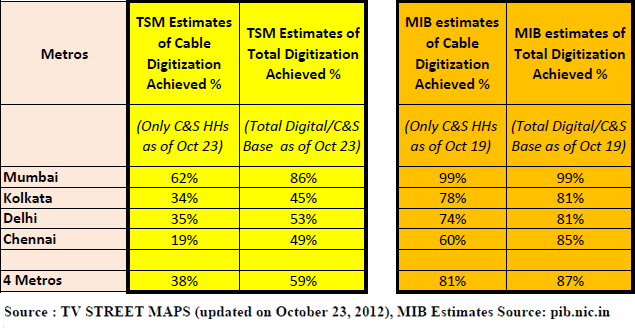
    Only 59 per cent of digitization has been achieved in the four metro as per the first ever independent survey of the extent of digitization in the four metros was conducted by Television Street Maps for MxMIndia. This number is in sharp variance to the claim made by the Ministry of Information and Broadcasting that 87% of the four metro was digitized.


    The figures for the four metros tell the story:


    For Cable & DTH:

    Mumbai: 86% (Govt: 99%)

    Delhi: 45% (81%)

    Kolkata: 53% (81%)

    Chennai: 49% (85%)

    The gap grows when you look at the achievement of digitization only in cable homes.


    Mumbai: 62% (Govt: 99%)

    Delhi: 34% (78%)

    Kolkata: 35% (74%)

    Chennai: 19% (60%)


    On Tuesday, we made a clarion call to the mandarins of the Ministry of Information and Broadcasting urging them to put an end of this charade of make-believe numbers of digitization.


    MxMIndia strongly believes that digitization is THE ONLY way in which the broadcast business can survive and thrive. For too long there has been much confusion amongst stakeholders. With half-baked regulations and guidelines, certain sections of the ecosystem were getting away with unethical practices.


    India has been among the most happening markets in the global broadcast business. Most of the world’s media superpowers are here. What was needed was some order in the business. Which digitization was going to bring in this, as it happened internationally. Unfortunately, the government has appeared to have missed  a trick in its attempt to execute this.


    The Sunset Date for the switch from analogue to digital transmission in the four metros was first fixed as June 30, 2012.  Then it was shifted at the last-minute to October 31.  When this writer mentioned that even that date looks tough to achieve, there were many in the industry who said that the momentum will build eventually.


    Although MxMIndia had been running a series starting 100 days to the June 30 deadline, we didn’t look at digitization in a big way until there 50 days left for November 1. But soon after interacting with all stakeholders, we figured that none of the numbers on the extent of digitization achieved that were being dished out could be believed.


    Jaldi 5 with Joydip Kapadia: Data based on ground-level info + professional & expert assumptions
     

    The government claimed an 87% achievement of digitization while the study conducted for MxMIndia by Television Street Maps showed this achievement to be only 59%. While this figure is for cable and DTH homes, that in cable homes alone is a low 38% as against the I&B ministry claim of 81%. MxMIndia spoke to Joydip Kapadia, Business Head, Television Street Maps on the issue:01. There is a huge variance between the TSM study figures of 59 per cent total digitization as against 87 per cent which the government is quoting. Why do you think do we have this huge difference between the two figures?

    I wouldn’t be in a position to comment on the numbers quoted in other studies. After all, whether its the authorities or TSM or other third parties releasing info about the ground, we all have to resort to diverse methodologies and assumptions. Sometimes the estimates of individual studies could vary due to the underlying assumptions considered. These assumptions work at multiple levels – each or all of these assumptions levels could influence the end result. For instance, differences in defining the areas within the city, definition of Digital TV (including or excluding DTH), total cable homes in a city extrapolated from census and other sources – are just some of the places where assumptions taken upstream within the analysis could produce variations in numbers coming out downstream – at the end of the analysis. All I can say is that our data is based on information obtained from the ground overlaid with our professional and expert assumptions.


    02. By your estimates how much do you see the 59 per cent grow to by October 31?

    It’s difficult to predict given the scale of the initiative and the number of players and variable involved. I wouldn’t like to hazard a guess.


    03. Would you see broadcasters lose out because of the delay (given more carriage fees, the delay in transparency, but then assured reach)

    We have actually not looked at these aspects so I wouldn’t like to say anything on that.


    04. Is there any one thing that you would like to see being done right if there’s a delay in the date and/or for the digitization for the rest of the country?

    We are not direct stakeholders in this and cannot offer any advice in this regard.


    05. 05. Do you think it would be prudent for the government to push the digitization date in the four metros by another three months?

    The math for all stakeholders comes down to what is the overall target to achieve vis-a-vis the seeding pace of the industry to reach that target. If that Math adds up then great, else the verdict would be to budget for greater time.


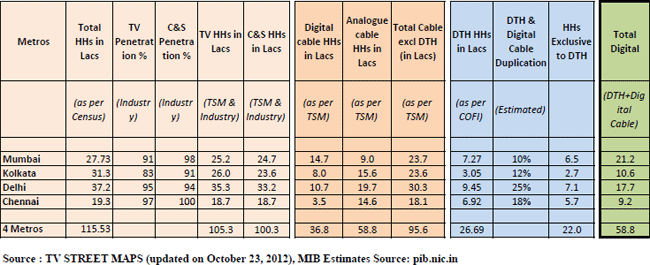
    It is then that we commissioned Television Street Maps (TSM),  India’s largest and widest channel distribution monitoring service covering over 1500 headends across  675+ cities/towns, to conduct this study. TSM placement monitoring data is provided on a weekly basis to its clients who include names such as Indiacast, One Alliance, Viacom18, MSM, Star, UTV, etc. Besides providing distribution monitoring for analogue and digital for Class-1 towns, TSM has recently started providing distribution monitoring for LC1 towns as well as Digital Track, a system to analyse Digital offerings of MSOs and DTH companies.


    Over the last two years, TSM has been tracking cable headends on a daily basis and reporting on a weekly level in almost a cable census style – covering every headend for the geographies it represents. While the data provided here are just the toplines we intend to provide detailed insights to our client on DAS. (see box: Jaldi 5 interview with TSM Business Head Joydip Kapadia: Data based on ground-level info + professional & expert assumptions ).


    Methodology of Data Capture:

    Over the last two years, TSM has been capturing TV channel distribution on a daily basis – the expanse of which is now a staggering 1500 headends across 675+ towns. This daily activity has been augmented since August 2012 for the four metros to capture the movement from analogue to digital at a more granular level. This augmentation/ expansion has been done using extensive ground intelligence and multiple verifications due to the criticality of the data. To ensure correctness of the data, more frequent scans were done in the last few days. The current release is for the ground situation as on October 23, 2012.


    The ground info on Analogue versus Digital has been layered with metro universes data collated from census and other third party sources to ultimately validate and put together the digital penetration data for the 4 metros.


    The sharp variance in the numbers as per the TSM survey and those put out by the government is reason for worry. But this is precisely what led MxMIndia to commissioning this study. No one really believes the numbers that are being put out by the government though MxMIndia, like other media, has been publishing these.


    MxM View

    MxMIndia recommends that the government act in a mature way on the issue. While a delay will mean a loss of face, it’s better to schedule for a time when 100 percent digitization is truly achieved. At the time of writing, we’ve heard of rumours that the government may well announce a delay by two months. We would urge the government to not look at December 31 as the Sunset Date. There is a fair amount of special programming on television planned on that day and the government would be well advised to look at a date like January 31.


    However, while doing so, it must get assurances from the governments in West Bengal and Tamil Nadu on compliance. The government must also meet all stakeholders to ensure that everyone is on the same page and is working towards the greater common good. It may be a good idea for it to appoint a full-time Officer on Special Duty for digitization. Either someone from its ranks, or pulled from the industry.


    A note of caution: there is a general election coming up in 2014, possibly earlier. Elections have been lost due to grave national issues and teary ones like onion prices. If there’s any mess-up with digitization, the government can ill-afford a crisis where the masses won’t get to watch their favourite shows on telly. Then, the cry will surely be: alag chahiye!


  • Rowdy Rathore leads Sunday programming; Veera set to open well: Ormax study

    By A Correspondent


    According to the results of Ormax Media’s TV Track, a syndicated study based on Day After Recall (DAR) of TV channel and programme viewing, the premiere of Rowdy Rathore was by far the dominant programme watched on television on Sunday, October 21, 2012.


    Ormax TV Track covers respondents in the 15-44 years age group in SEC ABC, across 17 cities in India. The top 5 viewed programmes on Sunday were: Rowdy Rathore (Sony), Cocktail (Colors), Bigg Boss (Colors), Crime Patrol (Sony) and Taarak Mehta Ka Ooltah Chashmah (SAB TV).


    According to Ormax’s syndicated product Showbuzz, Star Plus’ next week’s launch Veera has been tracking well and is set to grow the 10.30pm slot for Star Plus by at least 30%.


    Speaking about the findings, Shailesh Kapoor, CEO – Ormax Media said: “TV Track is conducted amongst regular TV viewers across the week. Rowdy Rathore’s excellent performance was expected given the film’s immense mass appeal. Veera has broken the Showbuzz record of being the most recalled new programme on Star Plus two weeks before its launch. If the campaign sustains itself well, Veera may even show a 40 percent growth in the 10.30pm slot.”


  • Paritosh Joshi: No money to buy media? Make your own

    By Paritosh Joshi


    I advise a startup in the Personal Finance space. Like many businesses at a similar stage, their ambitions are running ahead of their resources. An area of particular antsyness is the inability to advertise their service.


    It is time to stop complaining and start acting. I mean that literally.


    act·ing/ˈaktiNG/ noun: The art or occupation of performing in plays, movies, or television productions.


    But we are getting ahead of ourselves. Back up a bit then.


    On more than one occasion this column has spoken of bought, earned and owned media. Indeed, just last week, you read about what Felix Baumgartner was really doing – creating a large, owned media opportunity for Red Bull.


    Now it is one thing for a large and successful multinational to stage such an expensive production so that it can communicate its brand story to millions of current and potential customers but that is clearly not what the wee business I advise can do. Which shouldn’t come in the way of building the audience it needs.


    There’s this thing called the internet. Um, I almost forgot. You are reading this on that very thing, aren’t you? And Mr. Rajan Anandan told us last year that we are on course to have 300 million Internet users in India by 2014, up from 100 million when he made his prediction in September 2011. Tens of millions of these users regularly access YouTube and Facebook. Use them right and you have all sorts of possibilities staring at you right there.


    Thanks to my kids, one of my regular destinations on YouTube is Smosh. Get this. The boys who started it in 2005 were 18 years old at the time. At 25, they run a channel with 5.6 million subscribers and 1.8 BILLION video views to date. For comparison, Lady Gaga’s channel has a mere 1.8 million subscribers. Difference? Smosh wasn’t built on the back of the financial and marketing budgets available to a Universal Music imprint called Interscope.


    Now it is true that from their very first parody take on Pokémon, Smosh was making some rather impressive video but the real secret of their success was the endless amplifying power of the meme. Cultural anthropology is, if grudgingly, accepting memes into mainstream thinking. On dictionary.com, a meme is defined thus: “a cultural item that is transmitted by repetition in a manner analogous to the biological transmission of genes”.  How many years have they been around? For as long as human civilization has, it would be fair to say but with the caveat that, thanks to the internet, their speed and power are at levels impossible to imagine even 10 years ago. A meme is a contagion. Unlike biological contagions that need physical transmission of a vector via a host to a recipient, memes leap from mind to mind via digital connections at the speed of light.


    So you are not Smosh. Do you still have a chance at doing this meme thing? Let me introduce to you the ‘long tail’. For long, the world had to live with only a few options and a lot of people being compelled to make all sorts of accommodations to adjust to these compromises. No longer. Producers accept and even embrace the endless variations in the tapestry called humanity. On its part, the great god Google fulfils the obscurest wish by putting supply and demand together.


    Back to YouTube and amateur video. If there is one common theme that I find running through compelling amateur video it is this: authenticity. If you have an idea that will make sense to someone, express it clearly. Pat Condell is, depending upon your position, a venomous racist or brutally candid, but armed with nothing more than a simple video camera and with a blank white wall for a backdrop, he has scored over 43 million views- and counting. (You’ll find an extreme example of authenticity here: Jazz for Cows).


    Happily, the power of authenticity does not stop just with getting the initial viewers for such content. Social media, or at least Twitter, are informed by the same extensive use of authenticometer. Honest content carries a warm aroma of being authentic. Generate an honest video. Upload to YouTube. Tweet and ask, humbly, for retweets. And be prepared to be pleasantly surprised. After that, of course, it is the power of the idea and if it will become a meme, at least for the precise audience to which it is addressed.


    Which is why I said, stop complaining and start acting.