Category: MEDIA

  • No resting easy on laurels: Ravi Rao


    By Johnson Napier


    There’s some magic mantra that seems to be driving the team at Mindshare India to be at their performing best. How else would one explain the endless series of notches in their awards belt? After emerging No 1 agency at the Emvies this year, Mindshare India has gone on to win another big accolade – Media Agency of the Year at Spikes Asia 2012.


    MxMIndia spoke to the man behind the agency churning out the dream run, Ravi Rao, Leader, South Asia for Mindshare. While he admits to the agency throwing up some spectacular work it would in no way mean resting easy on the laurels. There’s a bigger challenge that lies ahead for the agency, he affirms. Excerpts:


    Mindshare Mumbai is on a roll again on the awards front. You’ve just bagged the all-important Media Agency of the Year accolade at Spikes Asia. What was it that brought the tide in your favour?

    We are extremely delighted to have won the accolade; and to win it for a client like HUL is a double delight. If you analyse, we had 5 shortlists and they were spread across three of our brands. More importantly, all three brands went on to win some award at Spikes, which is terrific for us. I would credit the showing to the all-round performance of the team.


    The big takeaways that emerge from our performance at Spikes this year are: firstly, all of the brands are local by stature – other than Rin – so that’s a big booster for us. Very simply, the power of an idea to push it through and get us an award is something that is very unique and has also helped the brand awareness as well as volume share in the process. Most importantly, it is the combination of every single media playing a role and each one delivering and creating synergies to bring the best out of the results. In a way, if I again look at the tally and say that we won against several competitors across the region also gives us a sense of bearing in terms of where we are today.


    What it also means is that we need to continue to deliver similar if not better work for our clients. It is a challenge that we want to continuously keep pushing ourselves against. No doubt the competition is getting tougher but we will have to adjust ourselves and up the single point of call that we have in Mindshare.


    By winning this accolade, have you pipped other notable contenders (from Mindshare) across Asia to the tag of being the best in the space?

    I think it is a matter of structuring how to get out real ideas. It is an idea that has to be behind an insight that works very well for the brand and land it properly. I think that is the key element in getting an award. We managed to do that well. The interesting part is yes, it has been a windfall for us this year but we do not want to rest easy on our laurels and want to keep pushing our boundaries even further.


    Are you disappointed with some entries not managing to make the cut in terms of a win?

    What we realised is that there are certain other entries that we thought were worthy of an award but somehow didn’t make the call. For example, if we look at the Emvies in terms of the wins that we’ve had and at the others too…I guess the parameters change and it’s important that you really look at how best you can reach the audience in a different way. As a country, we still have some way to go in terms of one, the content and secondly, in terms of the format of presentation which is also very critical. But all said and done, we are in the learning phase and will only get better and better as we move ahead.


    What significance does a creative award like Spikes Asia hold for a media agency like Mindshare India?

    Winning at Spikes is a big accolade for us but we do not want to take it easy because yes, there were a great set of campaigns that collectively made it work for us this time but what it requires is that we need to excel in a similar way across every single campaign and client that we cater to. It means that we want to keep doing better all the time and it’s only going to be a bigger challenge for us in the future. So while we would definitely relish the wins we want to fold our sleeves and get back to doing some great work in the future.


    Do you see HUL emerging a hot contender for the Client of the Year title in the future?

    As I see it, it is a systematic way of shoring up everything in the process. In my mind, it is an intense but healthy competition and all it does is bring the best out of every single team – whether from the agency or client’s side. We will surely give everyone a run as we go along as much as the competition is going to do and it is only going to get more intense as we move ahead.


    What would be the next big focus area for Mindshare India as you move forward?

    One area that we really want to look at is Cannes. It is the single biggest aim that we have going forward. The other thing for us is to make great campaigns that have a high ROI. By doing this, we even want to look at other areas like winning awards with IPA. Those are the targets that we have. We are working towards that goal and time will tell.
     

  • Kareena Kapoor calls CID for help!

    By A Correspondent


    Today Bollywood stars are a common sight on the small screen as they make “appearances” on other shows. The latest to join the bandwagon is Kareena Kapoor.


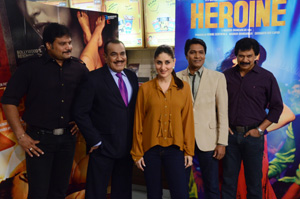
    The gorgeous heroine has shot for a special episode of CID on Sony Entertainment Television, where she will play herself, an actress. The plot revolves around an obsessed fan, who threatens Kareena to the extent that she considers leaving her career in films and actually marrying him. In the episode, while promoting one of her films, she discovers that her life is in danger and she solicits help from the CID bureau headed by ACP Pradyuman.


    When asked about her experience working with ACP Pradyuman (Shivaji Satam) and his team, she said, “CID is one of the biggest shows running on Indian television. I am happy and delighted to work with such talented people who are running the show successfully for over 15 years. I thoroughly enjoyed myself while acting with the CID team and wish them all the very best as they continue to entertain their viewers.


    The special episode airs this Friday, September 21, coinciding with the release date of the actor’s new film Heroine as well as her birthday. It was shot at Fun Republic Cinemas in Andheri West.


  • Red FM launches ‘Crime Chi Gheun Tak’

    By A Correspondent


    From September 27, 2012, Red FM will feature stories of ordinary individuals who have fought against crime – irrespective of their age, gender or profession. These real life heroes will share their experience with RJ Malishka on Morning No.1 from Monday to Friday.


    Issues such as crimes against the elderly, eve-teasing, suicide etc. will be discussed on-air. The promos for the show mention that crime does not spread because of criminals, but because of individuals who bear it.


    Nisha Narayanan

    Nisha Narayanan, Senior VP – Programming and Projects, Red FM said, “‘Crime’ is a new genre for radio, the relevance of which is even more in our metro cities, Mumbai being one of them. The campaign thought for our prime-time show comes from an inherent responsibility to highlight what we think should be brought to the notice of our listeners. These heroes are also a part of our listening universe, and the deeds instill a sense of pride in their fellow citizens. This is Red FM’s second initiative to fight crime. In early August, we launched ‘Crime Ki Keh Ke Lenge’ for our listeners in New Delhi. The show, hosted by RJs Peeyuush and Swati, had a successful inning. We hope to take this to the next level in Mumbai.”


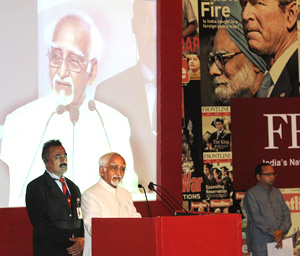
  • Vice-President Hamid Ansari lauds relaunch of Frontline

    By A Correspondent


    “I may be forgiven for admitting that I am moderately conservative and tolerably radical – conservative in habits and radical in thinking. For this reason, I was less than enthused when the Shri Venkitesh Ramakrishnan met me with the suggestion that I attend today’s re-launch function,” said Hamid Ansari, Vice-President of India at the re-launch of Frontline. The fortnightly magazine from The Hindu Group will not be available for Rs 40.



     

    “I could not help recalling the old maxim don’t fix what is not broke. To me personally, ‘Frontline’ has always been a stimulant to the mind apart from providing good reading on most matters that I care to spend time on. The need for a remix in Bollywood terms therefore did not arise. Nor was there a need to replace persuasion with titillation,” said Mr Ansari.


    The magazine was re-launched in the presence of N Ram, former Editor-in-Chief, The Hindu, and Professor Romila Thapar.


    “In today’s age, the audio-visual media has emerged as a dominant medium for quenching the thirst of the target audience for real time news on current affairs, culture
    and entertainment. Despite this, there remains a real and popular demand for serious publications on topical issues which cannot be substituted by the ‘breaking news’ culture and short-attention span snippets in the domain of the electronic media,” Mr Ansari added.


    The new Frontline will hit stands in October, and will have 150 pages.


  • Jaldi 5 with Supriyo Sinha, VP – Bengali Dailies, ABP

    Supriyo Sinha

    Ebela, the tabloid from Anandabazar Patrika Group, recently launched in Kolkata and Howrah, priced at Rs 2. Supriyo Sinha is positively hopeful about its success. Jaldi 5 with him reveals more about the Bengal market.


    1. Since ABP is the undisputed Bengali daily in the market, why was there a need to launch another Bengali daily?

    ABP is the most iconic group in Eastern part of India. The group has been in the market for almost a century. ABP is, by far, the leading newspaper. A Bengali tabloid is a historic milestone for us. We launched Ebela to address the certain need gap that arose from communicating with Bengali youth, and the Bengali young-at-heart.


    2. Why has the launch been restricted to only in Kolkata and Howrah? How is ABP marketing Ebela?

    We launched in these markets based on market research. The research estimated that the appetite for a tabloid is higher in Kolkata and neighboring regions. The other markets are still traditional when it comes to news consumption and believe in broadsheet.to market the product, we are using a four-pronged approach. We are out-of-home media in a big way to spread awareness. Then there is web promotion to capture the youth on Facebook and Youtube, Television and radio commercials created by Ogilvy, and on-ground events. We are also driving subscription promotions.


    3. Is the advertiser profile for ABP and Ebela the same?

    Yes and no. National brands who wish to target the young-at-heart and local brands with youth as TG have been approaching Ebela. The ad rates for both the products is different.


    4. TOI is entering the market with Eyi Shomoy. Would it imply any strategy shifts for ABP?

    No. There is a core market reason for us to be doing this. TOI has been changing its own marketing and communication strategy in this market because of our strong presence.


    5. What are your expectations from Ebela?

    I dare not speak for the market but I am hoping for a positive response. From the initial print of three lakh copies, we only wish to grow. The readers, and advertisers, are calling it a refreshing and exciting product.


  • Promising tales of tiny, tall agencies


    By Johnson Napier


    The last few weeks were rife with news of independent — or shall we say not-so-big — advertising agencies that were going all out to make their presence felt in the M&E space in India. Whether for the awards they had bagged across festivals or the largescale client wins that they had managed to pocket in their kitty, these agencies were in the news for some reason or the other. But while it may be the ‘popularity’ tag or the affiliation to a large parent company that may have done the trick for these agencies, there are others that fall shy of this honour.


    For instance, one may have faint acquaintance with an agency that goes by the name Apex Advertising or for that matter Flagship Advertising but if one were given a glimpse of the kind of clientele they have to boast – be it RBI, Taj Group of Hotels, BSNL, Pantaloon Retail, Pidilite Industries, MTV Networks etc – or even the kind of billings that they manage to pile up that ranges anywhere from Rs 5 to 50 crore, it would make for an interesting cover. And that’s precisely where the industry seems to be holding back or rather not giving these small yet powerful ad independents their due.


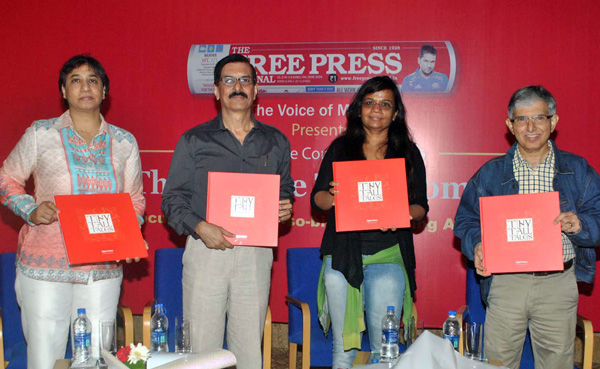
    This lacuna is currently being addressed by veteran print player Free Press Journal, that has come up with an interesting coffee table book titled ‘Tiny Tall Tales’. As the tagline suggests, this book plays up the initiatives of small agencies that are making it big. Said to be a slice of the coverage from The Free Press Journal’s column ‘Small Size Big Ideas’, the book will be launched at FPJ’s second roundtable conclave on 22nd September by Lynn De Souza, Chairman and CEO, Lintas Media Group.


    Abhishek Karnani

    Throwing light on the thought-process and the merit behind warranting such an effort that has been the benchmark of FPJ for some time now, Abhishek Karnani, Director, Free Press Journal said: “There are around 180 accredited ad agencies in Mumbai but we always hear and talk about the Top 15 agencies. There is life beyond them and these not so big agencies are doing great work away from the limelight. These agencies also represent a substantial business and have close affinity with the clients. We are proud of this initiative of the Free Press Journal, where we have taken time to look not at the obvious leaders but at those who are important and often overlooked by the media. This outlook builds on our worldview that there is deep value in the big and the small and it is important to study the not-so-big to learn about ground realities and to spot trends and understand markets that much better.”


    Sharing his experience, Author & producer of the book Sandeep Singh said, “Traditionally if you see, everybody just loves to talk about the top 10-15 agencies but there is a whole volume of business that comes from smaller agencies. Some of them are intentionally small because they want to be creative or whatever way you want to look at it, but great works do come across from them. This book is an attempt to cover these agencies.” Elaborating on the participation factor on behalf of the agencies, Singh said, “Though a few agencies refrained from participating citing some reason or the other, the book profiles most of them. Also, it is worth noting that the minimum billing of the agencies in this book is around Rs 5 crore while the maximum is pegged at Rs 50 crore.”


    Elaborating on the scope and scale of the initiative, Jagdish Rattanani, Business Editor, Free Press Journal who along with his team has helped in putting together the book said, “We hear a lot about the top 10 or 15 small ad agencies in India who are spoken about and praised a lot by the media but if you go beyond there are these ‘not-so-big’ advertising agencies that are still big in terms of what they manage to bring to the table. They are big in being strong and powerful enterprises and are dealing with a lot of interesting ideas. We sensed that there was a lot of energy and growth potential amongst these small agencies. Also we found that nobody ever tries to cover them and understand their perspective or see what they might need in this era of change to make the next big leap. That’s what encouraged us in taking this initiative further.”


    As for the point on finding the cause to be an apt fit with the model with which Free Press Journal itself moves forward with, Rattanani asserted by saying, “Though Free Press Journal is not among the biggest of the big, it is but the oldest Indian-owned English newspaper in Mumbai. Basis this, we said that we have a special interest and focus on trying to look at the others who are as good but are not so big and thus started the journey of deliberately trying to exclude the very big and focussing on the not-so-big,” affirmed Rattanani. Adding further he said, “For this exercise, we ended up going and visiting these agencies and even ran features over a period of two years and tried to play up their point of view and perspectives. All said and done, the larger story is of the ideas that lie just beneath the surface.”


    On whether the initiative was carried out to bring about intangible benefits for the newspaper group in terms of revenue from advertisers, Karnani thwarted the thinking by suggesting, “We are rendering this as a Corporate Social Responsibility. Our only concern is to help this segment to take a leap to the next level. We want to empower the not so big ad agencies to not only survive but also thrive and outgrow the market in these times.”


    In fact the group is looking at other avenues to take forward similar causes on behalf of the industry. Asserted Karnani: “We have already kickstarted our Knowledge Series wherein we invite experts to come and share their views with this group. We are also in talks with international ad associations wherein we plan to use their platform to host events for the not-so-big agencies. Also, we are also hosting our second exclusive conclave “The Change That Cometh” that is focused on the not-so-big advertising agencies. So there is a lot to look forward to.”


    While it is too early to predict the outcome of the book from peers from the ad industry, Singh is hopeful that the book will receive a positive approval from all concerned. He avers: “I hope the bigger agencies are happy and take note of the initiative in a positive light.”


    As for its plans of coming out with a sequel to the book, Singh said, “We would like to explore an opportunity of coming out with a sequel to this edition but it is still early days to be talking about that.” Agreeing with Singh, Rattanani said, “I can only say that the idea is rich and we can build on this idea but how the idea will further shape up only time will tell.”


  • Zee launches first ever 24/7 Bangla movie channel

    By Meghna Sharma


    Zee Entertainment Enterprises Ltd is all set to strengthen its position in the regional space with the launch of a 24×7 Bengali movie channel called Zee Bangla Cinema on Sunday, September 23

     

    Speaking on the launch of the movie channel, Punit Goenka, MD & CEO, Zee Entertainment Enterprises Ltd. (ZEE) said, “With a strong Bengali audience in India and abroad, the Bangla film market has expanded exponentially. Zee Bangla Cinemas entry is to tap this growing potential. We are sure that ZEEs pioneering presence in the regional space would be further strengthened with the addition of this new movie channel.”


    Says Sujay Kutty, business head of the channel, “Bengali cinema is a celebration, The time is just right as Bangla cinema is going through a great patch and the movies that are being made or are available for audiences satiate all aspects of the Bengali life and their ever-changing lifestyles yet rooted to the cultural diaspora.”


    Sujay Kutty

    But is there room for a 24×7 movie channel? “There are a large number of Bengali general entertainment and other channels. However, the Bengali-speaking viewers are moving towards Hindi movie channels as they do not have a 24×7 platform where they can find a cinema in their language. The top two channels in the GEC space only run cinema on the weekends. So, there is opportunity for a Zee Bangla Cinema to come, own and dominate the space.”


    Kolkata-based media planners and media professionals too feel that it is the right time. “After the great old years of Satyajit Ray and Mrunal Sen, Bengali cinema went through a lull. However, things are changing for the good and now Bengali movies are not only being played on single screen but multiplexes too. There is a boom in the market and Im sure, people are going to glad to have a 24/7 movie channel,” feels Raj Datta, Senior General Manager, TME.


    “The channel has acquired rights of some of the great films and this will surely get them the eyeballs. And the network has already been able to create a hype around the launch. The city is filled with hoardings regarding the launch of the channel.” Mr Datta adds.


    The channel promises to offer a mixed bag of blockbusters from the golden era directors and the best masterpieces of Satyajit Ray, Mrinal Sen, Ritwick Ghatak, Tarun Mazumdar to the present movies of directors like Rituparno Ghosh, Raj Chakraborty and Anjan Dutta. With a highly youthful and engaging content, Zee Bangla Cinema will also be a ready source of trivia from film news to music releases to muhuraats, along with a mixed and exciting bag of blockbusters.


    The launch will be supported by a 360-degree campaign launch, creating a platform for the people of Bengal to celebrate Jibon Ekhon Superhit with Zee Bangla Cinema. The campaign includes radio, TV, print, digital & outdoor along with on-ground activation initiatives. “We have also used a unique approach wherein handpainted larger-than-life cut-outs of popular Bengali stars – from Uttam Kumar, Suchitra Sen/ Prosenjit/Jeet/Dev Koel are placed in prominent locales of the city to give the viewer a feel and taste of what the channel is set to create for them and an offering of having available with them an array of evergreen movies, urging people to go home and tune into the first ever 24×7 Bengali movie channel. The entire city will feel the presence of Zee Bangla Cinema through these innovative cut outs of their favorite stars,” explains Kutty.


    Will the excitement on the street work for the channel? “While the channel will get its audience, how they sustain it on weekdays is what is going to be interesting. The channel alone cannot sustain on movies. Therefore, the programming mix matters a lot here. So, well have to just wait and watch how it does overall,” says Datta.


    “Star Jalsa is the No 1 GEC followed by Zee. Therefore, what Star does next will be interesting to watch too.” adds a leading film critic with a leading daily.


    Clearly, the viewer will be the ultimate winner, and for now, its Advantage Zee Bangla.


  • RIP, G Kasturi, Editor, The Hindu (1965-91)

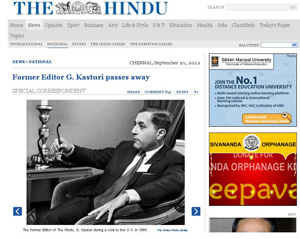
    Screengrab of The Hindu report announcing the passing away of G Kasturi

    By A Correspondent


    Mr G Kasturi, veteran journalist and Editor of The Hindu from 1965 to 1991 passed away last Friday (September 21). He was 87.


    Reports The Hindu: “The end came peacefully at 2 a.m. on September 21. He had been unwell for some time, but was alert and active till the last. The cremation took place on Friday afternoon at the Mylapore crematorium. He is survived by his wife of 64 years, Kamala, sons K. Balaji and K. Venugopal, daughter Lakshmi Srinath, and five granddaughters and two great-grandchildren.”


    Links to coverage on Mr G Kasturi:

    Report in The Hindu and former Editor-in-Chief N Ram’s comment:

    http://www.thehindu.com/news/national/former-editor-g-kasturi-passes-away/article3919690.ece


    Photo feature in The Hindu

    http://www.thehindu.com/news/national/a-photo-feature-on-g-kasturi/article3919952.ece?homepage=true&ref=slideshow


    Links to various tributes in The Hindu

    http://www.thehindu.com/system/topicRoot/G__KASTURI__1924-2012_/


    Mahesh Vijapurkar on G Kasturi in Firstpost

    http://www.firstpost.com/india/what-made-g-kasturi-different-from-other-editors-464693.html


    Sans serif: Hindu’s longest serving editor G. Kasturi: RIP

    Hindu’s longest serving editor G. Kasturi: RIP


  • FPJ boost for small agencies


    By Johnson Napier


    Seldom does the media think of moving beyond the influential set of players when it comes to playing up the achievements of a particular sector or an industry. While the top 10 or 20 is what the goalpost seems for most in terms of coverage, quite often it is the players who are bundled up in the lower end of the spectrum that contribute as much if not significantly more to the growth of any sector. But this divide was almost forgotten at Grand Hyatt, Mumbai on September 22 when a host of mid- and small-sized advertising agencies came together to pick up nuances and mantras from doyens of the upper strata of the advertising industry.


    The initiative was part of the annual conclave hosted by Free Press Journal that seeks to empower SMEs in the advertising sector. The theme this year was ‘the change that cometh’. The panellists comprised Sam Balsara, CMD of Madison World, Punitha Arumugam, Director – Agency Business at Google India and Bharat Kapadia, founder of ideas@bharatkapadia.com. The conclave was well attended by the who’s who from the ‘not-so-big’ advertising agencies.


    The day began with Madison’s Sam Balsara taking the lead and enlightening the audience on the road ahead for the industry. Speaking on the topic “How to make the leap to the next level”, Balsara began by assuring all gathered in the audience that they were indeed in the right place at the right time. “Advertising is a booming business and the long-term perspective is indeed bright for all players in the industry. But while our economy continues to grow at a healthy 7-8 per cent, advertising’s contribution to the overall economic growth is not as satisfactory. Advertising as a percentage of India’s GNP is just 0.35 per cent compared to the global average of 0.8 per cent. In fact in the US, the number is around 1 per cent.” He cautioned the audience that there was no reason to be weighed down by the slowdown as there were better days ahead for the industry.


    Belting out some of the mantras that enabled Madison Media reach where it is today, Balsara highlighted that the small and medium agencies can indeed give a run to the big agencies by ‘thinking small, beating big’. “Most agencies would advocate one to thing big but we did the reverse and that’s how we managed to work our way to the top,” he averred. Balsara even went on to tag his agency as being a David amongst the Goliaths that existed in the industry, but he cautioned that it didn’t mean that one has to get bogged down by the size of the bigger agencies.


    Advocating to the audience his recipe for success, Balsara said that it was essential for the agencies to do what is right for the client only then will success come one’s way. According to Balsara, the key aspect was the need for agencies to develop core competency. Sharing with the gathering his favourite definition of advertising that steered him to deliver his best, Balsara said that advertising is the art of arresting human intelligence long enough to be able to make a person reach out and open his wallet. This will ultimately benefit the client leading to the growth of the advertising agency as well.


    Presenting the mantras that led Madison to emerge where it is today, Balsara shared the 10 immutable laws that he believed could do wonders to the fortunes of other agencies as well. These include: the law of disadvantage, law of service, law of innovation, law of research/technology, law of specialisation, law of focus, law of organisational building, law of conservation, law of patience and law of perception. Balsara further went on to burst a few myths about advertising which he believed was highly prevalent in the marketplace. These include advertising is too expensive; advertising is only for big companies; advertising is only for FMCG companies; good marketers do not believe in advertising and finally, consumers do not believe in advertising.


    Post Balsara’s unmissable takeaways, it was the turn of Bharat Kapadia to hand out his secrets as he spoke on ‘Getting ready for the future.”. Rather than term them as not-so-big, Kapadia took the liberty of altering the name to aspiring to-be-big agencies. Kapadia began by straight away highlighting the influential role that technology played today. “With technology eliminating most middlemen out of business, there is a fear whether advertising agencies may survive in the future? But according to me ad agencies won’t just survive they will continue to throw up spectacular growth as well.” Presenting his ideas on the secrets to chart out good growth and profitability for the company, Kapadia enlisted a few pointers that included: knowing well what the client’s opportunities were; understanding the role and importance of research/data in business; need to lay more emphasis on new media that is not only cheap but cost-effective as well; need for experiential marketing; and most importantly, the need for agencies to be more innovative. Kapadia shared with the gathering an innovation that he had effectively carried out in a newspaper in the recent past that was reasonably successful – Bru Coffee.


    Highlighting the strengths that small or medium agencies possessed compared to the big giants, Kapadia asserted that one didn’t need a sword to cut vegetables. A small knife itself could do the job more effectively. The possible strengths that the aspiring to-be-big agencies possessed include ability to garner more trust and ensure personalised service to clients, be able to deliver a local touch and the ability to offer specialisation services.


    Assigned the task of acclimatising the gathering to the role of new media in running any business, Punitha Arumugam of Google began by saying that the thing about new media is that if you do not know where you are going any road will take you there. Taking inspiration from her mentor Sam Balsara, Arumugam too went on to present the ten commandments of new media, which would help any agency to emerge successful in the future. The first was the need to think business: it was essential to have a big idea; being small or big by size is secondary. She went on to cite examples of Myntra.com and dollarshaveclub.com that went on to become successful case-studies in the recent past due to the power of thinking big. Next was the need to think fluidity: this was essential if one wanted to become successful and get good ROI. The third was think mind-casting: it was important for agencies to narrowcast and address a certain section of the audience as the underlying motive should be about targeting change leaders. The fourth was think re-imagine: with television and print both co-existing as effective mediums it was essential that agencies come up with ads that could work wonders across multiple mediums. The next mantra was think continuity: this had to do more about getting metrics that are used offline to be used successfully in the online world as well. The next was think solutions: this would be made possible with the help of technology that would make any solution come alive. Next commandment was think co-exist: the obvious need to see that all mediums co-exist seamlessly with a role being prioritised for each. Next was think adaption: need to pollinate offline ideas to online and do so effortlessly. The next was think structure: it was important that agencies learn to collaborate whether with generalists or with specialists if the job so demands. And the last but not the least, think covet: at the end, it is all about money. So it is okay if one desired a better share of the client’s attention and hence the business if he had to stay ahead of the race.


    The conclave concluded with a Q&A session where the panellists cleared a few doubts from the audience. This was followed by a vote of thanks by Jagdish Rattanani, business editor of FPJ.


  • Jaldi 5 with Roop Sharma: Govt must be transparent with consumers on digitization

    Roop Sharma

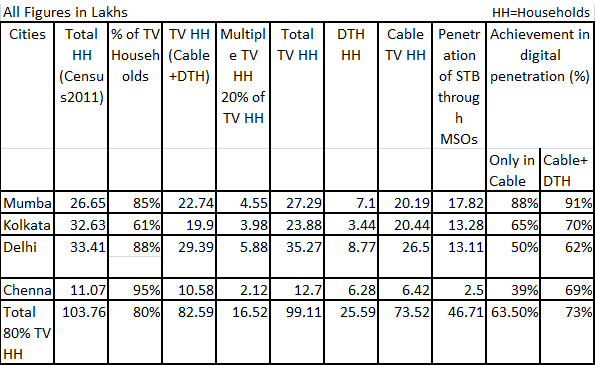
    She has been one of the most vocal voices in various discussions on digitization having been part of the cable industry for over two decades. While the government came up with a status report stating that 68 per cent of the TV households in the four metros was digitized, in the run-up to the Sunset date of October 31, we first asked Roop Sharma, founder President of the Cable Operators Federation of India, on what the reality is on the ground.


    1. We have a little over a month to go for digitization in the four metros. If the government estimates of last week were to be believed, by now over 70 per cent of Mumbai, Delhi, Kolkata and Chennai would be digitized. What is your information?

    Well, there are still some issues, but we think the government figures are off the mark. Our figures are as follows:


    Corrected STB Penetration Table -17 September 2012

    ( Includes DTH HH as part of Multiple TV HH not considered by I&B)

    Note:-
    1. Ministry has not included DTH TV HH in multiple TV HH where as it should have done so, being part of the same universe.
    2. Basis of % of TV HH in the Metros is hypothetical. Mechanism of its working out or its source has not been mentioned.


    The time has come to incentivize MSOs, but instead the licences have been cancelled of two of them.


    We are on September 24, and the price that consumers would have to pay is still not out, so things need to be moving faster.


    Broadcasters need to also ensure that there is availability of digital signals in all four metros.


    2. What is your information: are the lower income groups in these cities buying set-top boxes?

    They have been asking many questions. They want to know how much it will really cost them. Remember, some of them don’t even have colour television sets.


    Unfortunately, there is only one group representing consumers in the various taskforce meetings. Consumers would like to know how much it will really cost them.


    There will be an uproar if people don’t get to watch TV from November 1 because of this lack of information.


    3. There is a worry that there will be some piracy in the form of pilferage of signals after November 1…

    Why should there be any such pilferage? The broadcasters can simply stop the analogue signals. The question is: do they want to stop these? Will they fear loss of advertising if according to them digitization is not complete?


    4. What more would you like the government to do to ensure 100% digitization?

    Well, the government needs to do a variety of things.


    First, through the various advertisements, tell consumers very truthfully and clearly that one needs a set-top box for every TV set. And there’s an entertainment tax to be paid per TV set. So in Delhi, a consumer needs to pay Rs 20 for one set-top box and Rs 60 for three, if he or she has three TV sets.


    Second, consumers need to be made aware, that there is electricity consumption of around 18-20 watts per month which would roughly mean an extra spend of Rs 100. Also, they need to be aware that on these vanilla set-top boxes, they can’t get broadband or video on demand. There is no swap scheme and there is no portability currently.


    Third, consumers must also know where are the service centres for these set-top boxes in case the boxes need to be repaired.


    And broadcasters?

    Broadcasters also need to do more. For instance, in the various serials and reality shows, they must get the stars and anchors to talk about the need to buy set-top boxes!


    5. The last mile which is managed by the local cable operators is the key to the implementation of Digitization. Are all cable operators in the four metros about the implementation of the October 31 deadlline?

    Let me reiterate here that all cable operators want digitization. We will be happy to see consumers getting a choice and they will only pay as they watch.


    In fact had there been good availability of set-top boxes, we could have achieved things much faster. Right now, when a cable operator goes to the MSO for boxes on paying money, you don’t get the entire lot of boxes.


    We will be happy to see total transparency. We would like to also see deals between broadcasters and operators signed not on a lumpsum basis but as per the set-top boxes.


  • RBNL launches ‘Switch To’ campaign in run-up to digitization

    By A Correspondent


    With October 31 fixed as the D-Day for Digitization, Reliance Broadcast Network is all set to make the most of it with its new campaign titled ‘Switch To’. The campaign is designed to create enormous awareness amongst target audiences – to ‘Switch To’ the right service provider who can offer best value basis individual’s entertainment needs. The campaign also provides operators an effective tool to reach out through the marketing muscle and expertise of RBNL’s mediums across television, radio, on-ground, digital and outdoor, to gain increased visibility through this multi-media campaign.


    ‘Switch To’ launches on the back of earlier ‘Choose Your Set Top Box Wisely’ campaign that has been tailored to increase awareness and empower consumers with adequate information. The first phase of this campaign will be led across four metros: Delhi, Mumbai, Bangalore and Kolkata via BIG CBS Network’s key shows such as America’s Got Talent, The X Factor and American Idol.


    The campaign also aims at offering operators an excellent marketing campaign to strengthen their brand equity and gain optimally from the eminent revolution.


    Anand Chakravarthy

    Said Anand Chakravarthy – Business Head, BIG CBS Networks, “Digitization is an imperative step for the growth of the broadcast sector in India. While we have technologies available to improve efficiencies of broadcasting across the value chain, the lack of adoption from consumers slows the growth of the industry. This campaign enables consumers to Switch To the provider that meets their requirements, while at the same time offering the operators with an effective marketing campaign to partner with. Together, we are confident, we can bring about the much-needed Switch!”


  • India TV signs up Paritosh Joshi as strategist

    By A Correspondent


    In a yet another aggressive move, India TV has announced the appointment of Paritosh Joshi as a strategist.


    Until April 2012 Mr Joshi was the CEO, STAR CJ Network India, a STAR Group and CJO Shopping of South Korea’s Joint Venture.


    In his role as a strategist for India TV, Mr Joshi primarily will be responsible for optimizing and leading the revenue function of the existing businesses, and business development for the forthcoming ventures for the company.


    Apart from working with the Management at the Strategic level, as a mentor Joshi will also actively connect &engage India TV’s business teams including Sales, New Media and Brand.


    Announcing his appointment, Ritu Dhawan, MD & CEO, India TV, said, “Immensely experienced, Paritosh will be a tremendous resource in formulating the strategy for our new, ready to roll business plans. While we look forward to his contribution in taking independent news service to the next level, we feel delighted in welcoming Paritosh on the team. With his outstanding record, we are confident that he will be making most significant contributions in increasing our lead over competition as the most profitable media company.”


    Commenting on the assignment Mr Joshi observed, “I have had the pleasure of knowing Mr Rajat Sharma as a senior industry colleague and fellow IBF Board member for the last 6 years and we have had many lively conversations on the television business. It is from such a conversation earlier this year that the idea of this engagement began. It is a privilege to be invited to participate in this exciting journey and I look forward to a stimulating, inspiring assignment.”