Category: MEDIA

  • HT Brunch Dialogues on the changing face of Indian heroine

    By A Correspondent


    The launch of a coffee table book on print advertising – ‘The Magic of Print’ – by HT Media was followed by the HT Brunch Dialogues. The second edition of HT Brunch Dialogues was launched by Hindustan Times Brunch, and was themed, The Changing Face of the Indian Heroine. Two rounds of panel discussions were held.


    The panellists in the first round included Film Director, Madhur Bhandarkar; Producer, Siddharth Roy Kapur and filmmaker and screenplay writer, Raj Kumar Gupta. The panellists discussed the filmmaker’s role in portraying the Indian female lead. They delved on how the female oriented films and the roles offered to actresses have changed and evolved over the years. They also pondered on whether an actress in the long run would be at par with the actor, in terms of pay.


    “Times have changed, today heroines are willing to experiment with their roles or even their image which was not so earlier, when they were very conscious about their image and the roles they play” said Madhur Bhandarkar.


    On whether heroines will also be paid on par with heroes, Siddharth Roy Kapur said, “If a female oriented film crosses Rs. 100 crore, it may see heroines getting paid as much as the heroes.”


    The second session of the panellists included film personalities Kareena Kapoor, Karisma Kapoor and Sharmila Tagore. Both these sessions were moderated by Vir Sanghvi, Advisor, HT Media.


    Their discussions revolved around the way scripts or films have evolved over the years for the Hindi film heroine. And how they have managed to stay relevant or break the myth about actress only as a show piece in the film and their take on whether things will get any better for the Hindi film heroine in the near future.


    According to Sharmila Tagore, there is a huge difference in the roles women or heroines do today. Times have certainly changed, cinema has become professional today, unlike before, but roles are still not written for women.


  • Industry to analyse Dainik Bhaskar case study

    By A Correspondent


    The Dainik Bhaskar Group has placed IIM Bangalore’s recently completed classroom case study of Dainik Bhaskar group’s Maharashtra success, titled ‘Aspiring Growth’, for the industry to analyse.


    The case showcases the fast-paced expansion of the group into 13 markets and the successful launch of Divya Marathi in Aurangabad, Maharashtra with a roaring success with five editions within such a short span of time. The case leaves the reader with a pertinent question in the current scenario ‘Which market/ territory / language should Dainik Bhaskar Group enter next?”


    The contest will follow a two-stage process. In stage 1; teams registering at Dainikbhaskargroup.com will send in their summary of recommendation and approach. In Stage 2; 5 to 7 shortlisted teams will then finally make presentation to a jury of Bhaskar team, senior fraternity members and IIM Bangalore professor Ms Seema Gupta who has developed the case. The winner team stands to get Rs 1,00,000 as prize money.


    Elaborating on this further, Sanjeev Kotnala, Vice President, Dainik Bhaskar Group said, “Before the case was finalised, we had two classroom sessions at IIM Bangalore and the Brand team raised a simple question – what if the case was to be solved by the media-advertising-marketing fraternity. This was the birth of this unique innovative contest. We debated this with Prof Seema Gupta, who has been encouraging and excited by the innovative contest. She agreed that this will make the case that much stronger for future classroom discussions. We as a team are gearing to hear some totally differentiated point of view and approaches- as the professionals working within the industry definitely have an advantage.”


    The contest is open to professionals in media, advertising, communication and marketing and students of premier management institutes, he added Those wishing to register and download the case can do so at www.dainikbhaskargroup.com.


  • Vivel launches ‘digital talent hunt’ with Hungama

    By A Correspondent


    Hungama Digital Media Entertainment along with ITC’s personal care brand, Vivel Face Wash, has unveiled a new television commercial called ‘MOBISur – Sitaron Ki Talaash with Shankar Mahadevan’ to look for India’s first digital talent hunt, which will give millions of Indians an opportunity to become a singing star.


    This talent hunt enables participation from anywhere in the country; all that a participant requires is a mobile phone or an internet connection. This property empowers the participants to break the queue and forego travelling to the nearest city for an audition. The winners of the contest will get an opportunity to record an album with Shankar Mahadevan which will be released by T Series and Hungama. The winners will also receive Rs 5 lakh rupees.


    Developed by Meridian Communications, the TVC features well-known Indian musician Shankar Mahadevan encouraging aspiring singers, who don’t get enough time out of their busy schedules, to showcase their talent through this platform. The TVC also features the ‘Ghar baithe baithe famous singer bano’ concept that highlights the various ways to participate in the contest so that the aspirants can live their musical dreams.


    The contest has already received a phenomenal response since its launch with over 4,50,000 call-ins on IVR and more than  6,00,000 entries on the website in just 40 days.


    The TVC is currently on air across various music and other GEC channels. The latest TVC can be viewed at http://www.youtube.com/watch?v=FonHDegCo9A.


    Credits:

    Meridian Communications Pvt Ltd

    Creative: Anurag Khandelwal, Satish deSa

    Account Management: Mohit Ahuja, Abhishek Nand

    Production House:

    Jack in the Box

    Director: Myles

    Producer: Ashlesha Bangia


  • BIG CBS Prime, Bloomberg TV to simulcast India’s Prime Icon

    By A Correspondent


    The BIG CBS Network is readying to launch its latest home grown property India’s Prime Icon which will be dual-cast across its targeted channels – BIG CBS PRIME and Bloomberg TV India. The show aims to get Indians choose their icons – successful and celebrated personalities who inspire and influence them the most! The USP of the property is that it allows people to choose their icons from across all sectors of life, be it sports, entertainment, business, politics or social welfare.


    With BIG CBS Prime and Bloomberg TV India, both targeting premium audiences, the show has been designed to ensure it meets the entertainment requirements of the upwardly mobile males, seeking this quality content. India’s Prime Icon will bring forth the lifestyle of Indian society’s elite personalities and evaluate them basis qualities which will make them the prime icons of the country.


    Speaking of the show, Anand Chakravarthy, Business Head, BIG CBS Networks said, “Our country boasts of some of the most influential men and women who are an inspiration, role model and icons for the people. India’s Prime Icon is a new concept, which has not been explored in the past and which indicates at an opportunity to connect with audiences. Both BIG CBS Prime and Bloomberg India are premium channels, making them perfect platforms to reach out to the right audience mix, both for this show as well as for marketers.”


    The show is designed to give audiences a peek about the life stories of some of India’s most distinguished men and women. Seagram’s 100 Pipers collaborates in this initiative. Bikram Basu, VP-Marketing, Pernod Ricard India,commented on this association, “Seagram’s 100 Pipers stands for True Legends. Our association with BIG CBS Prime’s India’s Prime Icon show reiterates our common values, and brings our brand closer to India’s true icons.”


    Recommendations for India’s Prime Icons will come from none other than the audiences themselves, through a voting system, and will see prominent personalities – from across business tycoons, sports personalities, entertainers, Bollywood celebs etc. making it to the list. Following this, an eminent jury will qualify the entries and shortlist the top 20 icons. The 20 icons will be revealed on the Channel each evening during prime time and a voting window will be kept open for 24 hours so that viewers can vote for their favourite icons, which decided the Top 10 icons.


    The Top 10 icons will then battle it out to the coveted title of India’s Prime Icon, with each episode unveiling one icon showcasing never heard before stories of their lives, style statements, achievements, sex appeal, philanthropy popularity and more…


    To ensure optimal reach, BIG CBS Networks has planned an extensive marketing campaign for the show. The network will engage audiences on multiple touch points ranging radio, television, out of home media and social media.


  • Ormax launches box-office forecasting model ‘FBO’

    By A Correspondent


    Media & entertainment research firm Ormax Media has announced the launch of FBO, India’s first scientific box office forecasting model. FBO stands for First-Day Box Office. The model forecasts the opening day nett collections at domestic box office for unreleased films upto seven weeks before release.


    The FBO model takes into account a series of input parameters. These include inputs from Ormax Media’s film campaign tracking product Cinematix, which tracks the Buzz, Reach & Appeal of unreleased Bollywood films for almost three years now. Cinematix covers 19 cities across India, accounting for more than 95 percent of domestic box office coverage. Other FBO model inputs include release scale, holiday and festival factors, audience profile and several other such variables on which normative data has been built by Ormax Media over the last four years.


    FBO forecast will be available to subscribers every day, from seven weeks before the release of a film till the day of the release. The model has been tested to accurately forecast the first-day box office collections of at least 85 percent films with less than 10 percent error margin.


    FBO is being targeted at film studios and producers, as well as media agencies and advertisers who associate with films through co-branded promotions and in-film placement. Existing subscribers of Cinematix will be upgraded to an FBO-enabled version of the product at an incremental cost.


    Speaking about FBO, Shailesh Kapoor, CEO – Ormax Media said: “The model is extremely valuable as the box office estimate will be available seven weeks in advance. That will give the stakeholders enough time to take corrective action. Also, it is not a back-of-the-envelope prediction of the box office. It is a statistically tested forecast model that has self-learning built into it, guaranteeing progressively better results with time.”


    The first official FBO forecast was done for last week’s release Barfi, at Rs. 8.80 crore nett opening day at the domestic box office. The actual figures stood at Rs. 8.56 crore nett – an error margin of less than 3 percent.


  • Jaldi 5 with Raj Nayak: No sex, no violence, no Pakistani in Bigg Boss 6…

    Raj Nayak

    Okay, we’ve cheated. We went out to ask just five questions, but ended up with several interjections, so the Jaldi 5 is a rapidfire 10. Or thereabouts.

    Raj Nayak, CEO, Colors is one of the best minds in the broadcast business.  MxMIndia caught up with him soon after a presser with actor and Bigg Boss host Salman Khan and Endemol India CEO, Deepak Dhar. Mr Nayak was candid when he admitted to MxMIndia that the show was a dampener last year. Guess for the honesty in answering some tricky questions, Mr Nayak deserves to win this critical round.


    01. A ‘paarivaarik’ Bigg Boss? Why junk the USP of catering to the voyeuristic Indian?

    Over the last few seasons, we Bigg Boss became very predictable. Even participants who’ve previous Bigg Boss shows think they need to behave in the same way. Tasks in the house have been very predictive. While the vouyerism is the soul of the show, it has also alienated a lot of audiences. We believe that it is a cult programme, no doubt about it. It is one of the biggest programmes for Colors. Among all the reality shows that we do, it is the most expensive show. There are 59-62 cameras at work. It is an amazing experience.


    Over the last six months whatever we have done on Colors, we have done differently. We scaled up Jhalak Dikhla Jaa. We did not make it just a dance show, but dance and humour. A show like Bigg Boss has a huge cult following. Then we have Salman Khan whose popularity transcends from 7- to 70-yr-olds, he appeals to everybody. Whether it is classes or masses, he is a superstar. Not to leverage his brand appeal would be stupid. This was the thought process then. We thought, let’s convert the show, flip it on and do it on a positive note. Some of the things we have learnt – what we can do, what we can’t do. So we have tinkered with the format a little bit.


    So no voyeurism, no sex and violence?

    The voyeurism will be there. That cannot go. It is the soul of the show. The casting will ensure that all houseguest are achievers. There will be no negativity. Earlier we had people who were newsmakers but they always had something negative. But this year, not one person who goes into the house will be negative. Even if there is voyeurism, there will be a lot of fun element in the show. Even voyuerism will be in acceptable norms.


    And clearly no sex and violence. We want the whole family to watch the show. One can have a good show without having sex or without having violence. Jhalak Dhikla Jaa is good example. That will give you a good indicator of the slotting.


    But someone like Sanath Jaisurya didn’t do very well?

    Yes but what it did was to bring out the wow factor of the show.


    Any Pakistani?

    No, we won’t. We think there is enough talent in this country at this moment and the casting team thought they have enough people they can cast from within the country at this moment.


    02. What are your expectations from ratings? Last year was a dampener and the bar has been rasied much now…

    Yes, last year was a dampener. There is no doubt about it. But the way we are looking it is that we want Bigg Boss 6 to be the most successful season that Bigg Boss has ever had. We have dissected the show from the first to the last frame and you will very many new elements this time. We genuinely believe that it has the potential to become blockbuster. As for the bar, it will always keep raising. You can’t keep looking at the scoreboard because it is different matches and genres. Within the genres, ground and match that we are in, we are sure that we will put on a bloody good show.


    Sur-Kshetra didn’t do well in ratings last week?

    Yes, last week setting the foundation. We hadn’t have Ashaji then.  The show actually started this week. Last week, the show was setting foundation of how the auditions happened in Pakistan and India. I am a firm believer that the show will pick up with every passing week.


    03. Sony pushed KBC to the weekend slot. How will Bigg Boss affect your fiction slot?

    We shifted Khatron ka Khiladi to weekend. We did Jhalak Dhiklaa Ja on weekend. We don’t have a fixed policy. But we felt Bigg Boss is a big show, it is bloody expensive show. And if you have to amortize the cost, you have to run it seven days a week.


    04. Who are your sponsors? Are reality shows value for money?

    We are in discussion with sponsors.


    Vodafone?

    With Vodafone as well and many other players


    The ticket price has gone up substantially this year because we are scaling up the show in many different ways. Hopefully, we will have enough sponsors to achieve our targeted figure.


    See, value for money means different things to different people. But let me put it this way: most reality shows do not make money. While there may be exceptions to the rule,  on a reality show, you normally recover about 70 percent of your investment. There may be some reality shows on which you make 100 percent. But you need to have reality shows for the intangible value they bring to the brand, and to the channel.


    Last year, in-show placements had become a little too much?

    Exactly. Those are the things which we have taken into account. One of the things is that not only Bigg Boss, but also other shows like Jhalak Dhikla Jaa and India’s Got Talent we are very conscious that at the end of the day we have to give value to our advertisers but I think we can do it far more creatively, we can be subtle about it which probably will give more credibility and give more bang for the buck.


    05. What next? The Yuvraj Singh show?

    If all goes well, we should have it either at the end of October or first week of November.


    We are looking at one or two more show formats.


    Reality or fiction?

    Can be either. But we are looking at some more interesting stuff. It may be big or small. You must have noticed that in last six months, we keep reinventing, experimenting with new things. Like Manmohan Singh said, ‘We are not afraid to take risks and we have courage to do so.’


  • Video: Good effort to evangelize print: Vikram Sakhuja, Shashi Sinha & Josy Paul. Sequel planned: Rajan Bhalla

    By Robin Thomas


    On the sidelines of the HT Media event to unveil the book – ‘The Magic of Print’, MxMIndia caught up with some industry players for their views on the evolution of print advertising, the road ahead for the medium and of course their reactions to ‘The Magic of Print’ and whether such initiatives really help the industry?


    1. Vikram Sakhuja, Global CEO, Maxus

    [youtube width=”400″ height=”220″]http://www.youtube.com/watch?v=gleSCF4K05A[/youtube]

    Your reactions on the book – ‘The Magic of Print’…?

    It’s a great book, it’s a beautiful production, it’s got some very good tips. There are some twelve tips to re-create the magic of print and an absolutely mind blowing compilation of ads. I think Rajan Bhalla has done a brilliant job.


    Does the industry need more such initiatives?

    Yes, absolutely. The good thing about these kind of initiatives that it makes you stop back and think, reflect and when you are tuning with some great minds and if something comes out of it, is always nice.


    2. Shashi Sinha, CEO, Lodestar UM

    [youtube width=”400″ height=”220″]http://www.youtube.com/watch?v=9vILEEM6PeQ[/youtube]

    Your  reactions to the book (‘The Magic of Print’)…?

    It’s a lovely book, and it’s got a combination of some great ads, and there are some simple tips. Copywriting is one area which is very difficult for a beginner in advertising to enter into and the ones that have managed to enter into this field can also learn quite a lot from this book.


    On whether the industry needs more such endeavours?

    There are so many business schools, but no one teaches you the craft of advertising. So I believe this is a great endeavour and for a publisher in-house to do this initiative and to inculcate the spirit, I think it’s a great opportunity.


    Does the industry need more innovation for better growth?

    I won’t be worried if innovations happen or not because ultimately if there are a lot many ads on print, innovation will automatically happen. Innovation is something you do for the long term, so I won’t be worried if innovation happens or not. The fact is that advertising in print will continue to grow and as television rates go up, automatically people will come back to print. Whether it takes two years or five years, I won’t be able to predict, but, this will happen.


    A word of advice for print media…?

    Keep providing great content, contents which are engaging and the rest will follow.


    3. Josy Paul, Chairman and National Creative Director, BBDO India


    [youtube width=”400″ height=”220″]http://www.youtube.com/watch?v=h83bzcVtlck[/youtube]

    Your reactions on the book – ‘The Magic of Print’…?

    It’s a good book, well printed, it’s got some nice images and makes me want to spend more time with it and share it with my team and may be even have some discussions on which of those are fantastic work.


    And does the industry need more such endeavours?

    I think more discussions are good because a discussion makes you think about the medium a little more. Basically it is about focusing on the medium and what makes the medium a little more interesting and exciting. So I think that conversations are good, always.


    Does the print industry need more innovations for better growth?

    I am not sure about the word innovation in print because as a reader if I find people coming in the way of my news, I do get irritated. I believe true innovation is when within the context of the page and with respect to the page you can still create magic and still have a point of view that will make people think again or get excited or share things or put it up on their board, then that’s great. However this whole thing of irritation to the reader is not innovation, in fact is suddenly makes the news a nuisance.


    Where do you see creativity in Print media, five years from now?

    Creativity can never die, it’s forever. I expect newer things to happen, more beautiful things, and younger people will bring in more filters to print and we will see beautiful things that we never thought about. So one cannot really predict, creativity in fact evolves.


    What about print as a medium five years from now?

    I think print will take a new avatar. We all know that education is a big necessity in this Country and newspapers will become an integral part of education and it will start finding new audiences and I think it will further penetrate into the different strata of the society. So, newspapers or print media is like a river that will grow very deep and I don’t think it will just die like that.


    4. Rajan Bhalla, Head, Corporate Marketing and Magazines, HT Media

    [youtube width=”400″ height=”220″]http://www.youtube.com/watch?v=1P8utJgX-EA[/youtube]

    On the idea behind initiating- ‘The Magic of Print’?

    Well, I think the magic of Print is our contribution, our effort to help everybody in the industry associated with print advertising to understand how to create the magic in print advertising. I think it is absolutely clear that print is an absolutely great media vehicle from the point of view of showcasing brands and above all lending a lot of credibility to the message. It is time that we all started looking at how great print advertising can be created and this is our effort in that direction.


    On the process that went behind creating this initiative?

    It was a tedious process that lasted us almost a year. We first identified the content of what we wanted to present in the book. Once we had the content right, we then started scanning for the best examples we could find across the globe to fit into that category. We were not so concerned about picking brands from India, we just looked at global advertising as a market place and we looked at just the best in class advertising that was created under every single theme that you will see.


    How have the advertisers responded to the book?

    The book has just launched, so I am very positive that both the media fraternity as well as the creative fraternity is going to view this as a great initiative, which is also going to help clear a lot of thinking that they put into creating great advertising that works for them. So, it is just the beginning and we would like to probably move on this path as we go forward, year on year.


    So, will there be a sequel to this book – ‘The Magic of Print’?

    Absolutely yes; so we would be looking at various genres in which we can actually help impact the print industry, impact print advertising and help our advertisers in different ways. So you can look forward to another such initiative one year from now.


     

  • Jaldi 5 with Shailesh Gupta: Both readership & circulation will co-exist & complement each other

    On Friday, Shailesh Gupta, Director-Marketing, Jagran Prakashan was unanimously elected Chairman of the Audit Bureau of Circulations (ABC) for the year 2012-2013. S M Ahmad, Executive Vice President – Marketing of ITC was also unanimously elected as the Deputy Chairman of the Bureau for the year 2012-2013. Sam Balsara, Chairman and Managing Director, Madison World was the outgoing Chairman of the ABC.

     

    MxMIndia caught up with Mr Gupta on the sidelines of a dinner hosted by Mr Balsara on the occasion and sought his answers in the first edition of a new ‘quick interview’ series.


    01.   What will be your priorities as Chairman of the ABC?

    The priority is to bring about a more transparent system, evolve the ABC as a currency and make it a powerful decision-making tool for the industry.


    02.  Over the last few years, the ABC’s role has diminished given the growth of readership as a currency… what will be your attempt to reverse it?

    The idea is not to reverse it. Both Readership and Circulation as currencies will co-exist and complement each other. However, in order to make it more relevant to decision making, the currency needs to evolve with the changing times. The attempt will be to ensure that circulation as a currency regains the confidence of the industry and is of genuine use for decision making by both planners and media owners.


    03.  With the merger of the NRS with the IRS, the readership currency will only get stronger with newspaper marketers. Do you see a further diminishing of the role of the ABC and the currency of ‘net paid sales’?

    The core issue I think is that while the Readership currency has evolved on the one hand, the circulation as a currency has lived in status quo. Also while Readership as a currency will always be a sample-based study, Circulation is the census – therefore, the importance of the NPS is very clear. Rather than the role being diminished, I look at a scenario where we see these studies complementing each other and eventually benefiting the print industry at large.


    04.   One of the charges that many publishers have had is that the ABC – over the last 15-20 years – has failed to take into account present-day practices of invitation pricing and low cover prices of publications. As publisher of India’s largest daily, do you see that rule being amended in the near future?

    It’s too early to talk of the possible amendments. But clearly we will need to march ahead, look at the changes in the environment, and be able to evolve the currency to reflect the changes. For this, we will need to have all publishers on the same page. It will be important to consider suggestions and opinions of all stakeholders to create a robust and transparent currency – one that truly reflects what’s happening in the marketplace.


    05.   In the United States, there’s an ABCi for measurement of traffic on websites. Do you see the ABC in India doing that in the future?

    Too early to comment on that at the moment, but as of now we have a clear priority ahead in terms of restoring the sanctity of ABC as a currency and making it more relevant for the entire industry eco system.


  • Does anyone care about GEC GRPs see-sawing?


    By Meghna Sharma


    The battle of the Hindi general entertainment channels has intensified in the past few months. With most of them showing new seasons of popular shows like Kaun Banega Crorepati, Jhalak Dikhla Jaa, Dance India Dance etc, the competition has not only increased between the channels but also viewers – who wants to watch what?


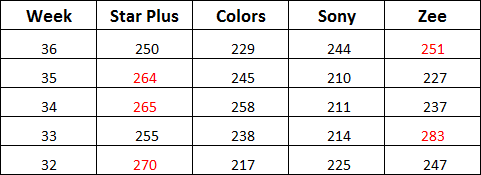
    If the TAM ratings of the past few weeks are studied, it becomes very clear that there is no sure-shot contender for the numero uno position. The weekend which saw the first episode of KBC on Sony made the channel numero uno for the weekend slot. However, overall ratings for week 36 saw Zee in the top slot. Week 35, saw Star Plus in the top place whereas for week 33, it was Zee at number one position.


    The yo-yoing has been going on for sometime now, so who gets affected by this – channels, media planners or advertisers? Or don’t the weekly ratings matter much? MxMIndia spoke to a few media planners/buyers and advertisers to get their perspective on it and to find a few answers.


    According to Anita Nayyar, CEO, India and Southeast Asia, Havas Media, in the GEC space there are four top channels – Star Plus, Sony, Zee and Colors – and their ratings keep fluctuating among themselves, which isn’t a recent phenomenon. “One week, one channel is peaking so the other week it’s another channel’s chance. Also, there isn’t much difference between their GRPs; it’s a matter of only a few numbers that they fall short of each other in the race. Therefore, it’s nothing alarming even for the clients who follow the GRPs to the T. However, we do keep in mind the trends and what gets the eyeballs to the channel. For instance, KBC taking Sony to number slot was expected. One needs to keep such issues in mind and plan accordingly.”

     

    Agreeing with Ms Nayyar, Hiren Pandit, managing partner, GroupM adds that one needs to keep in mind what is the programming mix of different channels. With KBC opening with 6.1 TVR, Sony was bound to reach the top slot. Therefore, one needs to track the new big shows coming up and how they’ll fare rather than worrying about channel shares which keeps see-sawing because of these shows. As for advertisers, they too focus more on shows and its performance rather than channels. Hence, such yo-yoing shouldn’t bother anyone unless it’s a drastic one.


    “I don’t think anyone takes these weekly GRPs of GECs into account; therefore, such weekly see-sawing shouldn’t matter. If one looks at various channels, you’ll see that most of them have reality shows or special episodes or Grand finale etc as their strategy to drive channel GRPs especially on the weekend. Hence, a media planner or buyer doesn’t get affected by it as most of the deals are separate for these (channel driver) reality shows and separate for rest of channel (regular) programs. And to advertisers what matters is the consistent deliveries through regular shows and not these few spike on select shows,” adds Neelkamal Sharma, COO – Buying, Madison Group.


    However, the advertisers feel a little different as GECs which have a vast reach in the country are seen by the advertisers as the best way to reach out to their audiences and brands spend millions to use the visibility given by these channels.


    Kamal Nandi, vice-president (sales & marketing) of Godrej & Boyce Manufacturing explains that as a brand, for them the two things that matter the most are efficiency and effectiveness. “Therefore, as advertisers on these GECs, we do look at cost and ratings points as the two most critical evaluating parameters. Hence, such fluctuations do effect our decisions as we monitor them closely.”


    Similarly, Mayank Shah, Group Product Manager, Parle Products says, “The content of every show on every channel varies. Despite the fluctuations, there are certain properties that continue to be at the top. These shows provide great opportunities for advertisers. However, strategies keep changing. So we do keep these fluctuations in our mind and alter the strategy as and when required. Advertising strategies are based on the kind of viewership a channel has. If a product matches with the channel’s target group, then advertisers will continue to advertise on that channel because the reach is effective. Also, there are various aspects to consider while choosing channels. Hence, the positioning is an important criteria, but not the sole criteria.”


    Hence, one thing is clear, that weekly ratings of GECs might not be considered as the sole criteria by planners or advertisers as much a monthly or the performance of the show in general. But they do matter when it comes to brands spending on GECs to reach their desired audience.


  • Spuul’s 1-stop entertainment to beat piracy

    By A Correspondent


    Spuul.com was founded by Sudesh Iyer who is the Founder of Sony Entertainment Television and S Mohan, the Founder of Accellion, buUuk and a number of other technology and venture companies. Spuul.com was launched in 2010 and aims to combat online piracy by trying to acquire newer movies immediately after their theatrical release and offer them to consumers in good quality and at a relevant price. Spuul.com, which aims to launch newer genres of Indian content too, wants to be a one stop entertainment destination for Indian content in the long run.


     

    Spuul.com is an advertising supported subscription service that provides on-demand access to the best of Bollywood movies and television programmes via the web and mobile devices. If the year 2011 was all about focusing on technology and content acquisition, the year 2012 will see the company increasingly focus on building up its content. Only recently this year, Spuul.com had launched the iOS app i.e. the apps for iPhone and iPad etc, thus making it easier for the users across the globe to watch Indian contents online whether it is Hindi Cinema, television shows or even regional contents.


    Spuul.com offers three levels of content to its consumers, ‘Freemium content’ which includes access to a broad range of free movies. ‘Specials’ which are pay per view movies, available at a certain price (pay per movie for 72 hours of unlimited views) and premium subscription which provides consumers access to the very best of Bollywood for a month. Spuul.com is said to be receiving good traction from India, and particularly from other parts of the world namely, the US, UK and even Middle East wherein users are increasingly visiting Spuul.com and consuming Indian contents online.


    Prakash Ramchandani

    According to Prakash Ramchandani, South-Asia and India Head, Spuul, “We are in the evolution phase and we want to grow and set a benchmark in the industry. Content consumption is getting more fragmented today. We see a trend in India as well as internationally that there is no dedicated service which is legal, purely for Indian content. So we are targeting just the Indian segment, which includes the Hindi cinema as well as television programmes as well as regional content. Thus we will be across multiple content genres, pan India for consumers across the world. We want to be ready for India when India is ready for it.”


    Spuul.com which is said to have pre-roll ads that does not interfere or disrupt the consumers viewing experience, also aims to combat piracy and make it a better monetization model for the producer and the content provider. “Our entire focus is to combat piracy and to provide better monetization model for the producer and content provider. If we can get the movie as soon as possible post theatrical release and give it to the consumer on the go, it is better than somebody giving it away for free. Our focus is also providing good content and customer experience. In fact we had our first subscriber within one hour of launch, this shows that there are consumers and that they are ready to subscribe or buy online if they are given different content, at the right price and with a good customer experience, they will buy it” added Mr Ramchandani.


    In the long run Spuul.com wants to be a one stop entertainment destination for Indian content wherein its breath of content would include all types of genres as long as it is premium focused.  Currently, Spuul.com has a total of 15 employees in its Singapore office, it has also has an office in Mumbai and aims to open more offices across the globe in the near future. Speaking on the future of online video streaming in India, Mr Ramchandani was of the view that smart phone and tablets will drive the online video consumption as the growth of smart phones will be much faster in the near future than what it was in the last six years. “Online video streaming is exploding in India and globally and this is the best time for the second screen i.e. mobile” said Mr Ramchandani.


  • Jaldi 5 with Sorbojeet Chatterjee: Quality editorial is core for any news brand

    A disclosure: he’s our quizmaster and hence part of the MxMIndia family.

    But he’s a professional first and as he sets out to make a dramatic switch from television to print, we thought it would be good to do a ‘Jaldi 5’ with him. For the record, Sorbojeet Chatterjee assumes office today as Vice President – Marketing at Diligent Media, publishers of the multi-edition DNA newspaper.


    01. From the No 1 Hindi news channel network to a challenger sports network to a challenger newspaper brand… you could”ve been sitting pretty with the leader at Aaj Tak. So why change?

    The answer lies in the question… as a marketing professional it’s critical to get varied exposure and not get too comfortable. After a fantastic stint in television news, the scale of sports was indeed tempting. I have been quite fortunate working across strong leader and challenger brands with some of the sharpest minds in the media industry. The momentum continues with DNA.


    02. You don’t hear of too many people switching from television to print. As a media marketer, do you see fair amount of action in print?

    There is no denying that the relevance and more importantly the impact of newspapers are constantly growing… especially in India.


    For me it completes the proverbial ‘circle’ in media…television, radio and now print. The complexities of building a strong newspaper brand are quite different from what I have done so far and I am looking forward to a new set of marketing challenges.


    03. What’s the first big thing that one can see on you joining DNA? Will there be more synergies with the parent group’s media offerings?

    Too premature to say anything. Will be suitably poised to answer this after a few weeks of rolling up my sleeves and getting my hands dirty.


    04. There are various views on it, but we would like yours: what’s more important for a newspaper’s success – quality editorial or great marketing?

    This is hardly a debate. Quality editorial is the core product for any news brand and is the solid foundation. Aggressive marketing is essential to create consumer awareness and overall buzz. A strong product without strategic marketing or a struggling product with cutting edge marketing yield the same result – a failed attempt!


    05. How’s Mumbai been for you at work? Pardon our putting you into a spot on this, but a quick Mumbai v/s Delhi analysis?

    Ah, this is a toughie! As a professional in this dynamic environment, one can’t afford to get attached to any particular location… it’s not the city that matters, but the culture in the workplace. How’s that for diplomacy?


  • TRAI extends last date for comments on ad duration rules

    By A Correspondent


    On the request of stakeholders, the Telecom Regulatory Authority of India (TRAI) has extended the last date for receipt of comments on the draft regulation of Duration of Advertisements in Television Channels (Amendment) Regulation, 2012 to September 24, 2012.


    The Telecom Regulatory Authority of India (TRAI) released a draft regulation on Duration of Advertisements in Television Channels(Amendment) Regulation, 2012 on 27.08.2012 for which comments of the stakeholders were sought by September 11, 2012. TRAI’s notification in May 2012 sought to limit the duration of television advertisements to 12 minutes per hour. The move was criticized heavily by broadcasters, who rely heavily on revenues from advertisements.


    In June 2012, however, Telecom Disputes Settlement and Appellate Tribunal (TDSAT) had stayed the Telecom Regulatory Authority of India’s (TRAI) notification to limit the duration of ads to 12 minutes per hour.