Category: MEDIA

  • Network18 elevates Kshipra Jatana as group general counsel

    By A Correspondent


    Network18 Group has elevated Kshipra Jatana, EVP & Head Legal, News Networks to Group General Counsel. In her new role, Ms Jatana will oversee legal operations and regulatory matters for all group businesses and joint ventures including A+E Networks | TV18, Viacom18, HomeShop18 and India cast.


    Earlier, Ms Jatana was the General Counsel at Capital18, the group’s investment arm where she was responsible for deal structuring, legal and compliance for its portfolio investments.


    Commenting on this development, Raghav Bahl, Founder & Editor, Network18 said: “Kshipra has been instrumental in managing legal and structuring matters for us, across the group. While, our growth has been led by strong management teams at each of our businesses, the role played by group level talent in driving ‘Network’ synergies cannot be overemphasised.”


    Speaking on this, B Sai Kumar, Group CEO, Network18 said: “Apart from managing legal matters, Kshipra has played a critical role in structuring key ventures and transactions in the recent past. Her unique ability to work across businesses and address a range of challenges, positions her well for the task ahead, as the group moves into a new phase of growth.”


    Ms Jatana added: “It’s been a great journey and has been full of exciting milestones and the opportunity to work with some of the brightest minds in the industry. As a group we are well poised with a strong foot print across all segments of the industry.  The challenge is to enable a strong defensive framework that allows all our businesses to grow while meeting high standards of legal compliance.”


    She brings with her 17 years of work experience in the legal advisory and corporate law space. Prior to joining Network18, she was the General Counsel/Head of M&A at MIH India and has also worked with Star TV and AZB & Partners in the past.


  • Google, HT Media, Vodafone bag ‘Best Companies to Work for’ accolade

    By A Correspondent


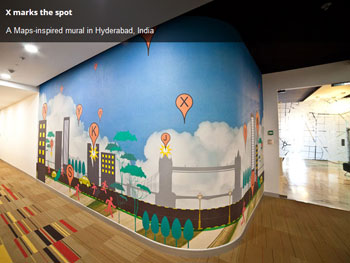
    A Google Maps-inspire Mural in the Hyderabad office. Photograph courtesy: Google.com

    It may not be the best of times to release a report like ‘The Best Companies to Work for’, given the low morale on the economy front and crunch in job opportunities prevailing in the marketplace. But there are companies that prefer to stand aloof from the depressing lot and would like to be counted as being amongst the best places to work for.


    The Economic Times in partnership withGreat PlaceTo Work have released ‘India’s Best Companies to Work for 2012′. The study throws up a diverse line-up of companies as favourites to work for.  Emerging the number one employer is Google India followed by Intel and NTPC at third. Further, five out of the top 10 companies are multinationals, pointing at the role played by global HR practices in stimulating employee satisfaction across workplaces in India.


    The study has been divided into the Top 50 and Top 25 best workplaces. When analysed further, only two out of the Top 25 Best Workplaces are companies which are new to the list of Best Workplaces, the rest having featured in the list in previous years. However, similar consistency is not seen in the Top 50 list in which there are 14 companies which have never featured in the list in India before.


    As for the standings, Gurgaon-based Makemytrip occupies the fourth spot, a drop from last year’s third rank. Amongst the media companies, HT Media Ltd is the only player to figure in the Top 25 list and is ranked 16th.


    Reacting to the win, Rajiv Verma, CEO, HT Media Limited, said: “This recognition is a testament to the strength and integrity of HT Media’s corporate culture. A few years ago, when we crafted a set of long-term goals for our company, we embraced the vision of being an ’employer of choice’. The recognition that we received from the study is a compelling sign that we have been moving in the right direction.”


    Other nominees include Cactus Communications that has been placed at number 20, Cleartrip Travel that is placed at 29th spot, Music Broadcast (operates radio channel Radio City) at number 41, Viacom18 placed at number 48 and Vodafone at number 49.


    In the category of Best in Class, Outdoor Advertising Professionals India Pvt. Ltd. achieves the top spot under Advertising & Marketing; Vodafone India Ltd. is number 2 under Telecommunications; Godrej Consumer Products Ltd., Procter & Gamble, Mars International India Pvt Ltd. and Mother Dairy Fruit & Vegetable Pvt. Ltd. are selected under FMCG; and Google India under IT.


    Some prominent companies that came up trumps across 22 sectors include: Vodafone India in Best Company in Large Organisations (more than 10,000 employees); Makemytrip, Cactus Communications & Cleartrip Travel Services under Professional Services, and HT Media Ltd and Viacom18 Media under Media.


    The study

    TheGreat Placeto Work® framework is based on over 27 years of research of the best workplaces across the globe from employees’ point of view. Some key trends spotted include: overall employee perception of their workplace culture has not changed significantly from 2011 – this is true for all companies, the Top 50, and Top 25 best workplaces in the Study. Thus, while individual companies may have done well or poorly in building trust with their employees, the workplace culture in India Inc., as perceived by their people, remains the same.


    Positive perceptions about their workplace culture continues to be high for senior management category compared to supervisory staff, with 7 per cent less supervisory staff giving positive feedback about their workplace culture. The study further reveals that 75 per cent of employees are below 35 years of age. While they are the majority in most organisations, their views about the workplace culture are significantly less positive than employees over 45 years in age. Only 20 per cent of employees, on an average, have worked in the same organisation for more than five years. There is a slow but gradual improvement in employee perception as one stays longer in an organisation, the study notes.


    As in the previous years, the Top 50 best workplaces are concentrated in Mumbai, NCR and Bangalore, but also have representation from Chennai, Pune, Hyderabad and Ahmedabad. 35 of the Top 50 have more than 1,000 employees, with 14 out of 50 having more than 5,000 employees. Only 7 of the Top 50 Best Workplaces saw employee increases of more than 30 per cent in the previous year, and 6 actually reduced their workforce.


    Also, the percentage of women continued to be low with only 5 of the Top 50 employing more than 40 per cent women employees. Women constitute less than 10 per cent of employees in seven of the top 50. Only three of the Top 50 have more than 30 per cent of their senior management as women. While 15 out of Top 50 best workplaces have employee attrition of over 20 per cent, however, in all major industries, attrition for the Top 50, on an average, is less by one-third to two-third of the industry average.


  • What makes Google top ‘best companies’ list

    By Devina Sengupta


    It is difficult to pinpoint what exactly gives a giant corporation like Google its famous startup culture. Perhaps it’s the independence people enjoy, the absence of red tape or the freedom to disagree.


    Or it could be that the search giant has managed to pick the right lot of people – those who can come up with next big idea, or better still, help a colleague come up with it. And this becomes glaringly obvious to those for whom Google was not their first employer. Ramesh Ravishankar had worked with other firms before he joined Google Hyderabad and realised that this was a wholly different workplace.


    “Bosses work closely with you and you are never penalised for your failures,” he said. This is starkly different from most other companies where numbers and targets are paramount and there is no excuse for not achieving them. “We are in the business of selling ideas,” said Rashi Tyagi, who works for Google’s online sales team.


    A lot of the credit for creating this culture goes to Google’s hiring policy. The company is not always looking for the smartest candidates; it wants people who fit in and that gets gauged by the peers, juniors and bosses in an interview. When Jayashri Ramamurti, currently head of people operations, first walked in for an interview, she was interviewed by her (future) juniors before being accepted at Google.


    “They wanted to know my views on the compensation structure,” she recalled. While this was an unusual experience for Ms Ramamurti, she eventually realised why it was necessary. Google wants people who seamlessly fit into its culture. That’s why it pushes its employees to ask their friends to join them. It takes time for new people to settle into any organisation but if they’re known to employees, the transition becomes easier.


    Newcomers are given six months to watch and absorb Google’s ways of working before being put on a team. Mit Koradia said this led to a smooth transition for him, “Despite being surrounded by IIT and IIM graduates, I wasn’t uncomfortable with the transition at all. On the contrary, I was made to feel comfortable from day one.”


    Teams play a central role in the professional and personal lives of Google’s staff. Whether it’s a query on income tax or a piece of code, all one has to do is create a discussion thread online and the solutions come pouring in. Ms Ramamurti just returned from the US with medicines for an employee she had never met, after seeing a request on one such thread.


    Similarly, when Rashi Tyagi and her US-based colleague faced a roadblock in their project, they needed some clarifications from their Tel Aviv team. Within a few hours, they were patched on to a video conference with the team from Israel.


    At Google, roles are defined but not rigid. The company likes to whet the risk appetite of its employees by challenging them. Ayesha Chauhan was accepted as an account planner and within a few months, was moved to a specialist role, despite being relatively new at the firm.


    During appraisals, metrics are clearly defined and regular one-on-one sessions are arranged so that there is no haziness at the end of the year. The firm is making its reward system more frequent, flexible and fast so that employees will be rewarded for good work immediately. Every business decision has the HR as business partner to ensure that it remains about the people and not merely markets.


    Even the washrooms echo the entrepreneurial spirit of the company with zero per cent attrition. A poster featuring a Google employee talking about his working style is slapped behind the restroom doors. He says: “Keep doing your own thing. Till they fire you”. And firing someone for an idea, no matter how bizarre, is simply not Google’s style.


    Source: The Economic Times

    Copyright © 2012, Bennett, Coleman & Co. Ltd. All Rights Reserved


  • Strategy to use TV & radio simultaneously for max impact: Anand Chakravarthy

    By Meghna Sharma


    That regional channels are not a new phenomenon is evident when one surfs through various channels available today. And the available channels don’t seem to be enough as networks have launched, or are planning to launch, regional channels to tap specific target audience.


    So, when Reliance Broadcast Network launched Spark Punjabi, a regional channel for the PHCHP (Punjab, Haryana,Chandigarh, Himachal Pradesh) region, earlier this year, there was no surprise or shock.s.


    Anand Chakravarthy

    Speaking on the role regional channel play for a network, Anand Chakravarthy, executive vice president, Marketing, RBNL and business head, Big Magic said: “India is not one country, but is formed of various countries. And in the past five-six years, there has been an increase in number of regional channels. Traditionally, only southern states had separate channels, but today the markets have opened up in other states too. And this is because of availability of better quality content.”


    Localization of content has helped channels and networks to know and capture their TG well. Mr Chakravarthy states that it’s not only regional channels which are going local, but also national Hindi GECs too. “Take a look at any primetime show on a GEC – you’ll be seeing the differences – right from costumes to language used by the characters is localized as well as the story of the show. This is because even GECs know that if they do so, it becomes more relevant to a certain set of audience.”


    The network wants to give its audiences a very local feel and want to be seen as part of the region. “We show dubbed international shows, along with specially created programming because it helps us reach our audience better. It’s our USP. And we’ll continue to make shows which are very regional in their approach.”


    However, what is unique about the Reliance Broadcast Network is its strategy to use radio and TV simultaneously to strengthen the hold in a region. “We do a lot of marketing on our radio stations which helps a show’s launch on television, as it is able to create a lot of buzz. We plan to strengthen our regional footprint and our strategy is to launch in regions where we have very stronghold as it will help us and also form a unique advertising  offering which will get us advertisers and help us grow as well,” pointed out Mr Chakravarthy.


    And this is why the channel – Spark Punjabi – along with 92.7 BIG FM, came together to conceptualize BIG Boli Star - a talent hunt contest aimed at promoting Punjabi Boliyaan (a traditional Punjabi form of art). “Punjab has a very rich traditional art forms and Boliyaan have been passed down from generation to generation. Spark Punjabi and 92.7 BIG FM are ensuring that this traditional art continues to flourish, both in the rural and urban areas of the Punjab region. The BIG Boli Star talent hunt is creating a new wave of enthusiasm for traditional Punjabi culture as well as bringing new talent to the forefront.” The show is currently the no 1 reality show in Punjab and was able to deliver a 0.77 TVR in the CS4+ category (week 27).


    The network also plans to launch more regional specific shows as well as two more regional channels in the coming few weeks.


  • InMobi & Cricbuzz announce partnership

    By A Correspondent


    Bangalore-based independent mobile ad network InMobi and Cricbuzz, the cricket property with over 17 million unique users, has announced an exclusive partnership for bringing mobile ads to consumers on Cricbuzz’s mobile site and applications, for the India market. This partnership will make it easier for advertisers to reach premium mobile consumers on Cricbuzz.


    Under the terms of the partnership, InMobi will have exclusive rights to monetize Cricbuzz’s mobile properties across all devices on phones and tablets in India. Advertisers that want to advertise on Cricbuzz’s mobile application on these platforms will now engage with InMobi.


    InMobi delivers reach to 578 million consumers, in over 165 countries, through more than 93.5 billion mobile ad impressions monthly. It provides end-to-end solution for mobile advertising including rich media ad creation, distribution, tracking and optimization.


    With a presence across multiple digital platforms, Cricbuzz attracts over 17 million monthly unique visitors on its web and mobile properties. This partnership is for ad monetization, and on all their properties – mobile web and apps on phones and tablets.


    “Since inception, we have focused on making cricket information available on mobile devices of varying capabilities and were the first to launch a WAP-enabled version as early as 2005. We are excited to announce this partnership with a global leader in mobile advertising, such as InMobi. Being the top cricket destination on mobile, we were looking for a globally renowned partner and InMobi was the obvious choice,” said Pankaj Chhaparwal, Founder and Managing Director at Cricbuzz.


    Sandeep Deshpande, Country GM -India at InMobi said: “This exclusive agreement with Cricbuzz reinforces InMobi’s leadership position in the Indian market. Cricbuzz’s mobile properties on all platforms have been immensely popular in India and abroad. In a Cricket fanatic country like ours, where all brands want a share of this pie, advertisers will now be able to reach their target audience wherever they are, through this partnership.”


  • Business Line launches ‘Weekend Life’

    By A Correspondent


    Does Horlicks sell more than Coca Cola in India? Why is the Amul girl suddenly pushing milk, instead of butter? What made a music channel stop airing music? Ever wondered why European kitchen equipment stores are popping up everywhere? Find out all this and more about the business of brands, in one handy, 8-page packet, Weekend Life, being brought out by Business Line from July 6.


    One of the sections, Brandline, brings you the stories and the stories behind the stories from the world of advertising and marketing. Along with insight and analysis from some of the leading lights of the industry.


    Whether it is food and wine and gyan from leading chefs of India, or an insight into gender issues and how women, including rural women, are changing the face of India, it is all included in the supplement.


    Even the tech-savvy will be satisfied with eWorld’s updates on the latest trends, fads and analysis from the world of information technology.


  • Paritosh Joshi: _____________ Maketh A Man

    By Paritosh Joshi


    Surely, you are wondering why I chose to leave that first word blank when everyone knows the word that completes the aphorism?


    A Methuselah of our Media & Communications business came by a few years ago, when I was still gainfully employed and not a lily of the field, to talk about the media and their place in our lives. The conversation made an impression on me, abiding enough that I am compelled to develop it in today’s essay.


    Let me rewind to my early memories circa 1968.Kanpurhad no local English newspaper. The Times of India would ship theDelhi‘Dak’ Edition to our mofussil outpost. By the time the (now only of distant memory) Toofan Mail with her imposing steam locomotive growled intoKanpurstation with the precious newspaper, it would already be a day late. The news wasn’t yet stale, mind. After all, the only other source of news and current affairs we had, was the nightly bulletin on All India Radio delivered in the richly textured baritones of Jasdev Singh, Ashok Bajpai and their ilk. I must add that the scratchy Short Wave signals that our prized Murphy radio managed to extract from the ether made listening challenging at the best of times. Barring the most momentous of events and emergencies, the world beyond the nearest 10 kilometers was at least two days away. And it didn’t matter. Life, as we led it then, had little or nothing to do with the world beyond.


    Fast forward to 1977, nearly a whole decade later. We lived inNasikjust 175 kilometers fromBombay. Yes, in those days it was stillBombay.  Here was a city that offered not just one but TWO local (also local language) newspapers, Gavkari and Deshdoot. Times ofIndia,Bombay’s Dak edition would reach us the same day except it probably carried the previous day’s stories. There was still no television inNasik, so we still were served only by the stale newspaper and the highly expurgated radio. Not a lot had changed. Our lives continued to be led in the isolation and serenity of small townIndiaand, quite frankly, we didn’t think we were missing anything.


    Things began to change with the move toBombayin 1980. Suddenly, a television arrived at home. Black & White it may have been and only for a few hours of low fidelity transmission every day. And featuring exciting content such as missing people’s reports and Krishi Darshan, the farmers’ show, only occasionally spiced up with Chitrahar and Chhayageet. From consuming less than an hour’s worth of assorted media (perhaps half an hour each of radio and newspaper), our days now had at least another hour dedicated to TV.


    Television continued to grow. Print began to proliferate, not just in the form of a growing range of magazines, but also as a daily in the form of the afternoon or evening tabloid. Soon there was a Mid-Day fan and an Afternoon aficionado; an India Today enthusiast and a Week loyalist; a Stardust addict and a Filmfare feeder. Between all the diversity now available to them, many consumers were spending several hours a day just consuming all the options they were fond of.


    Cut to 2012. From perhaps 2 or 3 hours of exposure to various media a day, the modern urban Indian probably spends 4 or more hours a day consuming or in some way interacting with one medium or another. And it is no longer just urbanIndiaeither. DTH is available all over the country and a subscriber in the most remote hamlet has to just train its little antenna toward the sky to receive the latest content from around the world, a lot of it for free, in full digital video and Dolby Stereophonic Audio.


    People are defining themselves by the mix of content they consume.


    Can there be a segmentation approach that is based on shared commonalities AND uniquenesses in the way people consume the media?


    Which is why I left that heading blank.


    It really ought to read:


    Media maketh the man!


    Paritosh Joshi was until recently CEO, Star CJ. He has been a marketer, a mediaperson and a key officebearer on industry bodies. He is Strategic Advisor, Ormax Media. He can reached via his Twitter handle @paritoshZero


  • Network18 consolidates publishing businesses

    By A Correspondent


    Infomedia18’s publishing business has de-merged and consolidated within Network18 framework under ‘Network18 Publishing’ following the de-merger approved by the Delhi High Court in 2011. The printing press business will continue to remain with Infomedia18.


    Speaking about the development, Sandeep Khosla, earlier the CEO-Publishing at Infomedia18, and now at the helm as CEO, Network18 Publishing, said: “As Network18 Publishing, our growth strategy will evolve in line with an increasingly multi-platform publishing environment. Considering the strong traction of our brands in key consumer and business communities, our focus will be on leveraging this across areas – including print, new media, on-ground activation and value-added services. We hope to build on this further by maximizing synergies with group platforms and in the process deepen engagement with our audiences and aid monetization of our brands.”


    Network18 Publishing will encompass three divisions of Infomedia18’s publishing business – Business to Consumer (B2C) magazines, Business to Business (B2B) magazines and Business Directories Division (BDD).


    The popular titles that will now come under the Network18 Publishing umbrella are as follows:


    • B2C: Overdrive, Overdrive Hindi, Entrepreneur, Better Photography, Better Photography Hindi, Better Interiors, CHIP, T3, AVMAX.
    • B2B: Search, Auto Monitor, Modern Machine Tools, Chemical World, Modern Plastics & Polymers, Modern Packaging & Design, Modern Medicare, Modern Pharmaceuticals, Modern Food Processing, Smart Logistics, Aftermarket.
    • Business Directories: Multi-city editions of Yellow Pages Business Directories, Machine Tool Guide, Indian Exporters Guide, Construction and Interior Design Guide, Industries State Guide and Motor Pumps & Valves directories.


    B Sai Kumar, group CEO, Network18 said: “We believe that the special interest and B2B spaces will be one of the key drivers for publishing in India, both in print and new media. With Network18 Publishing, we’ve aligned our assets to capitalize on this trend, both from a community building as well as a commercial perspective. Going forward, as publishing models develop, this alignment will significantly enhance our market proposition”


    In addition, Network18 Publishing will also manage production and circulation operations for titles from the Forbes India stable which currently includes Forbes India and Forbes Life India.


  • Games2win USA appoints Chris Beech

    By A Correspondent


    Games2win USA has announced the appointment of Chris Beech as a Games Developer for its US business operations. Mr Beech, 40, is a veteran of casual games and has many international hits to his credit.

     

    Justin Molyneaux, Head of Games, USA said: “I have worked with Chris for over 5 years during my tenure at AddictingGames. I first discovered Chris when he won the first annual Most AddictingGames Developer Award. He is a very prolific developer who has built nearly thirty games out of which most of them were productions that we created together. He is both a skilled artist and a great programmer.”


    Mr Beech will actively work with Mr Molyneaux and help build new global titles for both the online and mobile mediums for Games2win.


    Alok Kejriwal – CEO and Co-founder of Games2win said: “We are really excited to have Chris on board. Chris is really talented and can swiftly turn around ideas and concepts into working game prototypes and finished products. He greatly compliments Justin’s game designer skills and I believe that as a team they are set to rock the gaming world!”


    Games2win is a global casual games business and entertains over 15 million unique users a month as per comScore. Games2win owns over 600 original games that are published on its portals Games2Win.com and GangofGamers.com and on the iOS and Android market places. Games2win’s latest game ‘Parking Frenzy’ recently reached no 1 position on the global iTunes Stores after scoring top ranks in the Android market place.


  • Xrbia goes social to promote project

    By A Correspondent


    XRBIA Developers’ aim was to bring consumers closer to realizing and living their dream of an idyllic house in a dream country. This was the genesis of XRBIA’S dream campaign. The idea was to create a country which was perfect, where people were happy; there was no rush; air, water and environment was clean. And thus giving shape to the idea, XRBIA went in for a threefold strategy: The team started with a teaser launch promoting XRBIA as a country, which lead to the press conference announcing XRBIA as an affordable housing developer and finally moved to launch the first project at Hinjewadi in Pune.


    XRBIA Developers initiated a social media campaign where they designed their Facebook page as a tourist destination. XRBIA engaged users with tidbits about the country’s cultural nuances, including its culinary habits, nightlife, and so on and so forth. This engagement program started with a unique contest of “where in heaven is XRBIA?” This campaign drew a lot of interaction with almost everyone having an opinion on where XRBIA was located. This set the ground for the rest of the campaign where the developers shared more information about XRBIA and the life there.


    The outcome of the campaign resulted in about 30,000 likes, which is commendable, as the teaser ended on June 20, barely 4 days after the launch. Since then, there have been more than 4 million page views and 1.3 million unique visitors on the Facebook page.


    This is a first-of-its-kind campaign, especially for a real estate brand. The concept of promoting XRBIA as a country was initiated with the thought of running the teaser campaign as a tourism campaign where people are invited to experience the country. The line “Visa on Arrival” was coined to invite people to visit XRBIA. This idea behind the thought was that once the teaser campaign was over, the real estate brand would be revealed and people would be invited to stay at their dream destination.


    Before XRBIA was unveiled as real estate company, many of the interactions on Facebook were about people asking where the new country was, some even asking if it was a rebranding campaign by Serbia. Some even applied for a job in the country. The high amount of interaction reinforced the success of the campaign.


  • We’re here 2 get inspired & celebrate: Ajay Kakar

    Ajay Kakar, CMO-Financial Services, Aditya Birla Group shares his idea of the changes spotted this year at Goafest and the inspiration it has on the youth of today.


    What’s there for clients at Goafest?

    Goafest 2012 is a boiling pot for media, marketing and advertising industries to come together and think, discuss and get inspired. And I think 2012 was no exception.


    Key takeaways from sessions…

    Takeways remain the same: whatever you do, whoever you are there is so much more that you can do, there is so much work for you to get inspired and learn from. You go back thinking that whatever I have done, I have not done enough. We need to tap the real potential.


    Emphasis on digital…

    Digital has been given due focus for many years now. My one request or regret is that we should stop calling it digital and new medium; it is the medium of today and it will be the medium of tomorrow. How do we bring the potential upfront with the many success stories, I think that should be the focus going forward.


    Recognition through awards…

    Awards are just another recognition for marketers and agencies to do more better. This year, the number of entries, the number of agencies from which these entries came and the quality of entries have really done us proud. I think that’s the important part – it’s the work that we are here to get inspired by and celebrate. That’s been a great reality this year.