Category: MEDIA

  • We hope digital could translate into more benefits to clients: Ajay Chandwani

    Ajay Chandwani, Director, Percept talks ton MxM India on what shone and clicked at Goafest 2012 and spells out his expectations for 2013.


    What were the key takeaways from Goafest 2012?

    Even though I may have missed some of the sessions at Goafest 2012 since I wasn’t there at that time, however, I was told the sessions were very impactful and that it had covered every length and breadth of the subjects. I was also told how the 3D’s i.e. Design, Direct, and Digital stole the limelight at the day one of Goafest 2012 awards. In fact, it is no longer just the media awards, but the day one awards cover the media and the 3D’s, so I am happy that it has reached that point. Besides, I also found Professor John Philip Jones’ session very interesting and insightful.


    On the emphasis given to digital this Goafest:

    Digital is certainly the flavour of the day, may be flavour of the year or the last few years. If you look at most of the seminars, digital has been the talking point, it is because digital is a new medium, it is an evolving medium and it is very fashionable these days to talk about digital. We are hoping that it could translate into more benefits to the clients because today it is still a television and print led economy as far as advertising is concerned. Ironically, not more than 3 or 4 per cent of clients’ money is actually going to digital. So I am hoping that this would change, I am also hoping that through these seminars it will enlarge the digital complementary, it will create interest in the mainstream creative people to enter digital and when this happens then the medium will expand.


    Has there been an improvement in digital creatives over the years?

    Yes, there has definitely been an improvement in the digital creative which was not so until two years ago because it was a new medium, it is still not attracting the top talent of, say, the mainstream creative, but when this happens, only then we will see the real growth of digital happening in India. However, the fact that we won a grand prix in digital in itself is a very good trend.


    Expectations from Goafest 2013…

    We expect Goafest 2013 to be even better and even brighter and smarter in terms of selection and more participation from companies is also expected.


  • Cheil launches Olympics campaign for Samsung

    By A Correspondent


    Cheil Worldwide has produced a commercial for Samsung Electronics to mark the London 2012 Olympic Games. The commercials talk about how through Galaxy S III, the anticipation, excitement, and celebration of the Olympic Games are shared with everyone.


    This spot draws on the sense of excitement generated by the launch of the 2012 London Olympic Games and the Samsung Galaxy S III. It shows people all over the world waiting expectantly for the games to begin and then exploding into life when David Beckham launches the games using his Galaxy S III. Ordinary citizens can share the Olympic spirit as much as a professional athlete using the Galaxy S III.


    It embraces all races as an expression of humanity. David Beckham kicks a ball against a drum, signaling the beginning of the world’s biggest sporting event. Then virtually everybody, over the ground and under the ground, gets into the Olympics.


    It is shown that even those who don’t have the tickets can enjoy the Games through Samsung Galaxy S III’s mobile technology anywhere, so the global IT giant invites everyone for the London Olympics. One can even share Beckham’s footage using S-Beam function, a nifty phone-to-phone wireless transfer.


    The English footballer, who is also an Olympic ambassador, has already endorsed Samsung smartphones. Throughout the whole campaign, the mobile brand bases its Olympic marketing activity around an “Everyone’s Olympic Games” theme. Cheil has successfully visualized Samsung’s “humanized technology”, which understands our life needs and can tangibly be experienced in our daily lives.


    “London 2012 is the first Olympics where television will no longer be the dominant medium; our film shows how the new Galaxy S III opens up the games for everyone to enjoy, in a variety of different ways, thanks to the phone’s multi-functions. More than just a sports spot, we aim to show how, more than ever before, it’s ‘everyone’s Olympic Games”, said Wain Choi, Global ECD of Cheil Worldwide.


    “This will be the first truly ‘social’ Olympics. We wanted to use one of the most recognised sportsmen in the world (David Beckham) to invite the world to participate in these games as never before, through the incredible technology inside the Samsung Galaxy S3. Beckham literally ‘kicks off’ the excitement, hitting a huge gong with an amazing long range shot, as all the world looks on,” added Logan Wilmont, ECD of Cheil UK.


  • Starcom tops RECMA’s global billings rankings, OMD is #2

    By A Correspondent


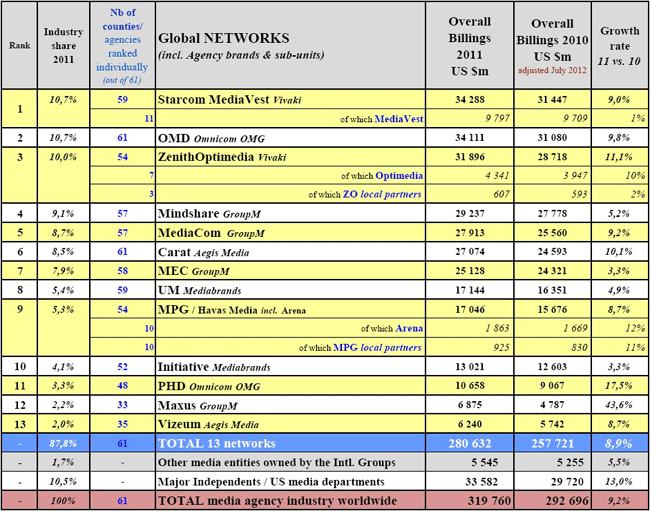
    Media agency analyst RECMA has announced the publication of the 13th edition of its Global Billings Rankings report. As many as 865 agencies in 61 countries were evaluated and all the data (10 different indicators for each agency) were consolidated in a pivot table.


    Industry indicators point to a sustained growth (+9.2 per cent) – a lower rate than in 2010 though (+13.8 per cent) – partly fueled by the continuing development of Digital activities within the agency core business.


    In the global network ranking 2011, Starcom MediaVest Group holds the lead it took over OMD last year but with a very tiny gap (less than $0.2m). SMG increased its billings by +9 per cent (or +$2.8bn) while OMD posted a +9.8 per cent overall growth (or +$3bn).


    Four networks recorded a double digit growth (vs. 11 networks last year): Maxus (+43.6 per cent), PHD (+17.5 per cent),ZenithOptimedia (+11.1 per cent) and Carat (+10.1 per cent).


    As the undisputable industry leader, GroupM showed a below-the-average growth rate with uneven performances across the regions: low billings increase in the USA(+5 per cent vs. +10 per cent on average) but high in Asia-Pacific (+$2.3bn).


    Internal hierarchy of the four WPP media networks remains unchanged: Mindshare, MediaCom, MEC and Maxus. The latter increasing its share thanks to strong performances in the USA (where it has doubled its billings), the UK and Germany.


    On July 12, Aegis agreed to be acquired by Dentsu.  The takeover of Aegis by Dentsu provides is a perfect geographical fit and does not have any impact in the billings tables of this report.


    However the addition of Dentsu Media Japan to Aegis Media’ global billings would allow this new Group to reach the third rank ahead of Omnicom Media Group (statement based on an estimated billing figure of $bn 10 for Dentsu Media Japan (about a quarter vadpends).


    The full report is accessible to subscribers at www.recma.com via My RECMA link.


  • Discovery Tamil now on Dish TV

    By A Correspondent


    Discovery Channel Tamil has announced that it will now also be available on Dish TV. Already available across all analogue homes, Discovery Channel Tamil is one of the most widely distributed channels in Tamil Nadu reaching over 10 million subscribers.  With availability on Dish TV, the channel expands its penetration in India, targeting Tamil speaking viewers around the country.


    Dish TV, being one of the major DTH platforms will drive Discovery Channel Tamil’s to reach viewers throughoutIndia, especially catering to Tamil population inNorthern India.


    Announcing the affiliation with Dish TV, Rahul Johri, senior vice president and general manager – South Asia, Discovery Networks Asia-Pacific, said: “Discovery Channel Tamil has received tremendous response from the Tamil speaking viewers for its attractive look, engaging and unmatched content. The availability of the channel now on Dish TV demonstrates our commitment to reach viewers around the country and offer them enhanced viewing experience.”


    Nearly one year of its launch, Discovery Channel Tamil, the standalone channel for Tamil Nadu market continues to grow ratings month-on-month. Discovery Channel Tamil is a customized product offering for Tamil viewers. The 24-hour factual entertainment channel has programmes scheduled as per Tamil audience tastes and preferences.


    Salil Kapoor, Chief Operating Officer (COO), Dish TV, said: “Dish TV is proud to provide content in regional language. The latest is the addition of Discovery Channel Tamil on Dish TV platform to our subscribers. The launch of Discovery Channel Tamil will provide us with a perfect offering which will help us serve our Tamil customers in a better way. Dish TV has been a trendsetter in offering its viewers the best content, service and quality.”


  • Arena Animation creates country’s first 3D commercial

    By A Correspondent


    Aptech’s education brand, Arena Animation has created the first 3D stereoscopy commercial. The commercial named as ‘Dudolls’ is the first ever TVC produced inIndiathat has undergone a 3D stereoscopy conversion. It means that the TVC can be viewed on any 3D supported device like 3D cinema theatre and 3D monitors.


    ‘Dudolls’ has been created by the reputed production house, Talking Donkeys for Arena. It shows playful animated characters (named Dudolls) in an Arena centre and the backdrop showcases facilities provided by Arena Animation to their students.


    The TVC is already being aired on many national TV channels. However, the 3D stereoscopy output will be seen in multiplexes in 3D movies. It would be seamlessly built into the ad slot during the 3D films. It is meant for any 3D device that includes television and mobile phones. The advertisement is also expected to run on the 3D televisions of the future.


    The concept is to showcase Animation & Multimedia as a fun and rewarding career.

    The concept has been collaboratively built by the marketing team at Arena & the creative agency, Quadrum Solutions.


    Speaking at the launch, Mr. Ninad Karpe, MD & CEO, Aptech Ltd said: “We have moved a step further in the world of animation with our latest TVC in 3D. It will help us reiterate ourselves as leaders in the animation arena and expand in our category. ‘Dudolls’ just reiterates how animation is gaining prominence and has become a coveted career of the youth.”


    Sonya Banerjee, Marketing Head, Aptech added: “We made a 3D commercial foreseeing the trend in 3D content. Planning on this required a foresight to integrate the 3D vision early in storyboarding stage and not as an after thought.”


  • BIG plans for regional media: Tarun Katial


    For once, what you are reading is a truly BIG story. Literally, metaphorically and every way you would like to. A lot has been written about the way his empire that has been expanding its tentacles. It’s been a 360-degree approach to media and entertainment with events and activations getting a fair deal of attention as the radio stations and TV channels.


    In fact, there is every reason for the CEO to be delighted with the success of his television channels, network of radio stations and slew of other allied entities. Together, both the BIG networks have been churning out good numbers for RBNL encouraging it to spread its activities across regions in India. Having launched BIG Spark Punjabi and BIG Magic, the emphasis of the network is on tapping the potential from regional settings and that is where they have centred their attention around currently. The next 12-18 months will see the network exploit opportunities in the regional space through both, organic and inorganic route.


    Tarun Katial, CEO, Reliance Broadcast Network Ltd met with Pradyuman Maheshwari, Johnson Napier & Meghna Sharma of MxMIndia, and walked them through the road traversed by BIG thus far. While the discussion on the regional foray was the mainstay of the discussion, he also spoke about the launch of BIG RTL Thrill (to be a Male, Action channel in Hindi), on grappling with measurement issues for niche channels and why he is hopeful of radio pulling it off big time post the onset of Phase III in India. Excerpts from the interview:


    How has RBNL’s growth story been in 2011-12?

    [youtube width=”400″ height=”225″]http://www.youtube.com/watch?v=6PnkBC-d4tQ[/youtube]

    It has been a mixed year for us. I wouldn’t say it was great but there have been some good things that have happened. In an environment like this, you’ve got to make the most of what you can do. To begin with, there were some good things that happened in our radio business. One, we were able to get some advantages out of the Phase 3 regulations. With the policies being announced, we have been able to put together some amount of capital expenditure and operational expenditure rationalisation with that and been able to build a more robust network with that. So, over a period of time, we have been able to build content hubs to build some amount of excellence in the quality of work that was getting done across the country.


    Tell us more about the synergies of the radio and TV businesses…

    Yes, what has been good for the radio business is that over a period of time we have been able to build more and more 360 degree value using both the radio and television platforms together. It’s actually been equally good for radio and television that we got the regional television business. We’ve been able to draw some serious amount of synergies both in terms of marketing & promotion and content and in terms of the value that we have been able to deliver to clients in the region.


    We’ve been able to do some path-breaking work like in UP, MP, Bihar and Punjab we’ve been able to build radio and television content ideas that have done exceedingly well in terms of numbers, revenues and advertiser impact. Also, they go beyond the classic IP that we were creating over a period of time, which comprise numerous regional events, concerts etc to picking up regional insights and building shows and content ideas around it. For example, we created a show in Punjab called the BIG Boli Star which was a huge success and was the number one show on Punjabi Entertainment Television for many weeks. It was an idea that actually played out on radio three months ahead of even television. In Punjab, we have also created the first daily radio and television show live together, where we do the top 20 show from radio live on television.


    Are your synergies inclined more towards regional channels and lesser towards the English channels in your network?

    Yes, the synergies are far more with the regional space. So radio and television have been working exceedingly well together for us. We believe that regional audiences and advertisers like this bundle exceedingly well – any idea that gets created from a point of view that it cannot get amplified but can take a form and shape of a show or content in itself on both the platforms. We created another good platform for kids and mothers in UP, MP and Bihar called ‘Bal Kalakaar’, which we just wrapped up and have just started another series called ‘BIG Memsaab’  in MP, Bihar and Jharkhand. So with these ideas, a lot of these classic FMCG clients who do not have engagement platforms and do not have a 360 degree amplified property are getting exceedingly excited about them. It also helps us to build our brand, build a local connect and build 360 degree engagement for the BIG FM, BIG Magic or BIG Spark Punjabi brands in the region.


    You currently have an all-India footprint with BIG FM and with BIG Magic, Spark Punjabi etc in the North. What about the regions where you do not have a presence?

    For the other regions we end up working with the leading regional broadcaster of that region like Star Vijay in the South or ETV in Bengal, Maharashtra, Kannada…


    Will you be looking at launching regional channels under BIG CBS network?

    I cannot comment any thing on that for now. India is not one India today; it is a mini-continent. I was reading this article recently which highlighted how brands are picking flavours or building variants for regions specifically. The same is true for media platforms too. It is just the start of how regional television is developing; we’ve had some standard ones in the South and even in the Hindi speaking belt, we have seen how Marathi and Bengali have done exceedingly well. We have our eyes firmly set on the Punjab and Hindi heartland space. I think there will be opportunities over the next 12-18 months that we would want to exploit…


    Organic or inorganic?

    Both… we have a firm belief in the regional space. We have seen that very clearly with our radio venture where advertisers now want to boost their noise levels in certain regions but even more so there are consumers who have huge parochial pride who look for local connect and do so very differently with national and regional entertainment mediums.


    You tweaked your offering on Spark Punjabi…

    It started out as a completely international content channel dubbed in Punjabi. We had always planned to do more regional content around it. But as we developed, we have seen that the off take of the local content is also as good. So while the international content is doing well we have supplemented it with very good local content. So there have been shows from Punjab in Pakistan which have worked very well here because of the language and cultural similarities. So there have been some changes that we have added on to the channel.


    Even Spark which was earlier into general entertainment is now more music.

    We do show a lot of youth shows on it but because it is primarily international shows so there is less that you can do on it; there is more music that we play out with it. We are now doing America’s Got Talent that will be simulcast on spark at the end of July. We have done some music shows like the one where we partnered with ArtistAloud called Thank God It’s Rock on Friday, then there is another one called International Music Favourites, then we have just done a show around Justin Beiber…So the essential insight in youth but we have also realised that with youth the biggest insight is music. That’s because their attention spans are very low and they look for snacking/aspirational content. Some of the heavy series content have been restricted to BIG CBS Prime and BIG CBS Love and is slightly focussed towards older audiences.


    And what about Love (the channel)…

    It’s pretty much the same and is performing well. You must have seen our work around Diva Destination – I think it is first of the block. We’ve done an output deal with Fremantle which will give us access to the latest season of America’s Got Talent and a few other shows which you’ll hear about soon.


    Would you be looking at getting more Indian content on these channels?

    We do a fair bit of it… we probably do more than a few others. We run a show called I Love Style, we are planning to do the next season of India’s Sexiest Bachelor and India’s Next Top Model…in conjunction with that we plan to do India’s Next Top Model Expo which is a platform for women and luxury brands to come together based on an international format. It is also a platform where casting calls happen for the show. So essentially these channels will stay international, but we’ve cherry-picked some upper SEC luxury ideas on to the channels.


    What are your plans for BIG RTL Thrill?

    We’ve been doing some good content acquisitions which I believe we have a good winning library. Hopefully, you should see the channel taking off by the end of this quarter. The content will be primarily Hindi but it will have international content as well. It will be a Male Action channel in Hindi.


    And how has the advertiser network grown in BIG CBS stable over last year?

    Our network is unique as it is not a classic one like the Hindi GEC or movies platform. We have built it around the luxurious brands and have unique brands like Kimaya that does a show with us and we believe that because of the kind of content and positioning we build these channels around it gives us an advantage. There is no woman-centric upper-end channel in the country. I believe Love has that unique positioning and that’s why these luxurious brands end up partnering with the channel.


    So is advertiser-funded programming the way to go for you?

    It’s not advertiser-funded but advertiser context programming. It’s not funded by anybody but by us but is contextually relevant to a luxury brand. That is the way to go for us as we believe that outside of the English magazines luxury brands have very little room or platform to advertise on without too much wastage. Television works far better than any other platform to be able to give you that audio-visual appeal.


    And has that worked for Spark too?

    On Spark we have seen a lot of youth off-take like Vodafone 3G, Airtel 3G, Justin Beibers etc. So telcos are the big clients today. When you look at our regional channels, you have the classic FMCG clients who advertise with us in significant volumes. We’ve been able to build 360 degree properties for clients like Reckitt Benckiser, which is known to be a tough advertiser in the marketplace – they did a whole property for us for Big Memsaab in UP, Bihar, Jharkhand etc with Harpic as well as Dettol; HUL has been with us for a long time and so is Tata salt, Godrej, P&G, SC Johnson, Nestle, etc.


    Do you see this move receiving impetus with the onset of digitisation?

    I think the English channels will tend to benefit very well both in terms of availability and subscription revenue. Channels like these are key to any platforms channels list because if they want to draw in ARPUs and if they want significant premium on the English side of the business they need to have enough such channels on the platform. We believe this is really the time for channels such as these to be in the marketplace.


    One of the peeves facing English magazines is that readership studies do not reflect the kind of profile of the audience very well. Do you feel this also applies to niche channels like the ones you have?

    If you look at how TAM does its sampling on the digital base they have an issue on how they do their sampling on the digital base. And when you cut SEC A it is essential to cut digital because if you are hoping for somebody to buy an outfit from Kimaya or high-end luxury items you are safely assuming that he or she has a STB or a DTH box at home. If you start to sample audiences like that you end up getting very small sample sizes and the data pretty much reflects nothing. So obviously there is an issue with the way sampling is done and boosters are put in that profile of audiences. Over a period of time, TAM has been assuring us that they will boost the sample size and change their sampling mechanism but that hasn’t happened yet.


    They are said to be increasing the sample size by 650 meters soon…

    But I do not know how that will help the SEC A profile. Because suppose if I am a sample house and have a DTH connection at my place and I subscribe to a certain pack on it like Platinum, Silver or Gold…now the first thing there is whether my sampling matching the universe of the number of people who are on the Silver pack. So if Dish TV has 100 subscribers and if 60 of them are on the Silver pack then does TAM reflect that 60 or does it reflect nothing? Because as you measure in a digital pay environment it becomes very difficult to sample basis the universe sampling of the DTH box or the STB. What happens in the UK or the US is that measurement does not extend to channels outside of the ones which are on the base line.


    That’s because in a sampling mechanism you will never be able to cover the entire luxury or specialised channels viewers…

    We’ve been engaging with TAM and discussing how these surveys are ought to be done. There is no point getting into a rating platform that does not actually represent the base level on any of these digital platforms. So if I have seven different DTH platforms and seven MSOs and they have different pacts and different universal samples take different pacts, so how does that reflect into the TAM measurement sample? If you get picked up as a sample home, how do you become a sample home? Nobody knows the universe to pick a sample, right? So what gets picked on the sample is most common between all platforms, which is the base channels.


    Guess that’s the way to go for niche channels such as yours?

    In fact you could refer to the survey that is done by BARB in the UK you’ll get a sense of what the others are doing.


    BARC has taken from the BARB model, though it’s taking too much time

    It ought to have been done a while ago. We have far too many diverse interests now.


    There is this whole issue of carriage fees that is obviously expected to take a dramatic turn post digitalization. What are your thoughts on the issue?

    I think it already has changed to some extent. People understand that content that is required by any MSO who has to fill 500 channels is not easy. Are all 500 channels willing to pay that much carriage fee? They need to understand if they want to compete with DTH, they should be able to offer better or at least similar service, if they want to retain customers. And if they are able to communicate that promise effectively then you have to have content on your side.


    You had made your foray in the SAARC region with Sri Lanka this year. How has that been doing?

    Our big focus in the international market is through Big Magic which is to take it across Indian audiences. It is still in its early stages but its strength has been the content. And because of the regional programming has allowed the network to connect with audiences. We have already launched in Canada and we plan to take that to the US, UK and Australia as well. So it gives us a fairly good footprint across the globe. Sri Lanka has our CBS channels, but Hindi channels are going everywhere.


    How is the arrangement with CBS going?

    Good. It’s a JV. They contribute a lot in terms of content, programming. We have four new shows coming up this year including Sherlock Holmes from the US for which we are very excited. It’s the first on Indian television.


    And in terms of films, are you looking at acquisitions?

    We do a fair amount of that but it’s mostly on weekends because it is a series channel and we don’t want to mix and confuse the viewer. Our focus is on America’s Got Talent, American Idol and X Factor which will keep us ahead as it’s going to be relayed live from the US. One side you’ll have Simon Cowell on X Factor, another side JLO on Idol etc…


    So what’s the next big thing from RBNL?

    I think on the radio side, we are very excited about the phase III. We want to go to the deepest part of the country and it will be a big play. We also want sports on the radio. We’ll want to buy ICC’s rights on cricket for radio – live commentary. And we are also very excited about this play between regional TV and radio. The combo has been a really good one for us.


    What are your plans on the regional channels front? Are we going to see more of them in the next year or so?

    There is no given timeline to it. We will now focus on consolidating the two we have. And when RT Thrill is launched it’s going to be 3+3 English channels. Six is a lot. We want to get through that before we decide to launch more.


    Is South an area you are looking at?

    I don’t think so because even are radio stations don’t extend too much to that area. Our strength lies in the HSM belt. Except for Karnataka, we are not very big down south.


    You have various divisions beyond radio and TV channels…

    We did a lot of work on Big Live so we do a lot of live events – about 50-60 of live event formats in the country. Today as per sheer value and volume, we are the biggest IP owners in the country but we don’t speak about it too much. And we are slowly and steadily building over these platforms. We have gone beyond building classic entertainment formats to engagement platforms so we are doing more and more things that matter to the consumer.


    And awards too?

    Yes, we do about 50 awards or more than that across regions. We have also started doing some interesting thing like Big Disha, which is about providing career counselling to tier 3 and 4 college kids. And P&G is actually working with us on it. We do something called Mele Ka Big Star where do big melas and do a kind of talent hunt which eventually comes on to TV and radio. We also do another one which is called Big Aasman which is grooming platform which we created for tier 2 and semi-urban women who plan to move to the metros. We do a lot of this but we don’t talk about it too much. They do well for the brand, for the advertiser and for the consumer.


    Since advertisers also get the benefit of radio, does that cannabalise on the revenue of the radio station or is it all factored in?

    It’s all factored in; they chip the revenue. We don’t put the money of live event or on radio but it’s really more of the 360 degree market share strategy. It ends up delivering more value to the advertiser, which helps us in building a stronger relationship.


    Any big IP events coming up?

    We already have 3-4 of them. We have the BIG Star Entertainment awards that happens at the end of the year on Star; we just finished the BIG Young Achievers awards which will appear on Star Plus next month… Then there is BIG Star IMA awards, Television awards…


    Fair number of tie-ups with Star?

    Yes, three of them are on Star. But we also work a lot with regional guys.


    What about Digital? What is your presence there?

    We do a lot of digital stuff too. We deploy content on as many devices as we can. We also work very closely with BigFlix. We have launched the BigFlix services in addition to Big Magic service in North America. We are doing a dual-play.


    Finally, in terms of revenue ratios, how is the organisation doing?

    I think it’s 70 per cent radio and 30 per cent television, but we want to get into 50:50 ratio. It will take about 18 months from now to get to that ratio.


    With Big Magic Marathi and Bengali channels coming up?

    You can ask me this as many times as you want to… (laughs) But it’s too early to talk.

     

  • Of ‘Pimple’ and ‘The Phenomenon’

    By Ranjona Banerji

    It was something of a shocker when Rajesh Khanna’s marriage to the young Dimple Kapadia made it to the front page of the venerable Times of India. I can still remember the shock with which my father read out the news to us. Newspapers in 1973 were serious and sober and did not have much to do with filmi matters. It was perhaps a measure of the enormous popularity of the film star that his marriage was worthy of mention in a space strictly reserved for politics and matters of great import. It was only decades later that The Times of India became what it is today. In those days, film stuff was reserved for film magazines and those were read assiduously by all faithfuls. My mother banned me from reading Stardust for some years to protect my young and innocent mind but that doesn’t mean that I didn’t sneak a peek whenever I could.

    Film stars in the 1970s were different and so were film magazines. It was not all PR driven and film journalists were usually bitchy rather than slobbering the way they are now. Filmfare of course was goodie-goodie and nicer than Star & Style and Stardust was irreverent and chock-full of stuff. The subjects of discourse would shock today’s pap-fed journalists as starlets discussed the colour of their nipples and their Playboy days. Katy Mirza burst her way into our lives long before Sherlyn Chopra was a gleam in her daddy’s eye. The fact that Mirza’s assets took her career nowhere was a subject of much sniggering. Cine Blitz came later.

    Rajesh Khanna was also the subject of much mockery. After he married Dimple, the family was often called Pimple (he), Dimple and Simple (her sister, who tried to imitate but failed). He was also dubbed “The Phenomenon”. Devyani Choubal promoted him heavily. And unlike Amitabh Bachchan, Khanna did not declare war on the film press.

    This is in spite of a colourful lifestyle lived openly. First with Anju Mahendroo for years, then marrying this young girl about whom there was already much speculation, the dumping Dimple for Tina Munim… It was as if Rajesh Khanna did not have to succumb to the hypocrisy which Indian society still demands. He was the eternal romantic and needed nothing else. And the press went along with that.

    It is perhaps fitting then that in his death Khanna has sent the media into one of the biggest nostalgia sprees I have ever seen. For anyone born before about 1970 at a vague guess – and there are many in the media of that vintage – Khanna was an inescapable part of the environment, crinkling his eyes and smiling down at you.

    And he’s taken us back to that journey with his death.

  • Nachiket Pantvaidya to replace Nitin Vaidya as head of Star Plus

    Nachiket Pantvaidya

    By A Correspondent


    Nachiket Pantvaidya, Executive VP and general manager at Star India and incharge of Star Pravah, the Marathi GEC of the Star bouquet of channels, has been appointed as incharge of flagship GEC Star Plus.


    Confirming the appointment, a spokesperson told MxMIndia that Mr Pantvaidya will take over from Nitin Vaidya who has put in his papers after a stint of 14 months.


    Mr Pantvaidya has been with the group since 2009 when he was appointed managing director of Fox Television Studios, the TV production unit of Newscorp’s Fox Entertainment Group. Earlier, he has been general manager,South Asia with the BBC and Executive Director, Programming and Production, for Disney where he managed the localisation of the Disney brands. An IIM-Ahmedabad alumnus, Mr Pantvaidya has held several key positions MSM (Sony) network.


    Nitin Vaidya

    Meanwhile, confirming the news to MxMIndia about his resignation, Mr Nitin Vaidya said: “Yes, I have quit and it has been a nice and exciting experience. Star is a great organization to work with and the team has been remarkable.” Mr Vaidya had joined Star India in May 2011 and was heading Hindi channels Star Plus, Star One (which is now discontinued), Star Gold and Star Utsav.


    On his next move, Mr Vaidya said: “I have plans of my own and as of now I’m not joining anywhere for the moment.” Without disclosing any dates, Mr Vaidya assured that only after a smooth transition will he move on from the organization.


    Nitin Vaidya, Photograph: Fotocorp


  • Introducing: MxM Buzzer, the all-new weekly Media Quiz

    Here it is. An all-new media quiz that will happen every Friday on MxMIndia. Our quizmaster is Sorbojeet Chatterjee, Vice President – Marketing at Neo Sports. To enter this quiz, simply email the answers with your personal details (Name, email id and telephone number) and a one-word descriptor for MxMIndia at editor@mxmindia.com with Buzzer#1 in the subject. Standard contest rules apply (see box below).

    There will be 2 prizes every week.

    First Prize: Rs 1001, Second Prize: Rs 501. If there’s a tie, the best descriptor for MxMIndia will get the prize (note: tie-breaker question will change every week). Last date for sending entries: Wednesday, July 25.


    ‘Dancing With The Stars’ has been licensed to over 35 countries by BBC. How do we know this successful reality show in India?
    This programme was possibly the first reality programme on television. Complete the popular phrase - “Smile, you’re on ______________”
    The 2nd season was won by Sandeep Acharya, Prashant Tamang won the 3rd season and Sourabhee was the first girl to win it. Which reality show?
    What is common to the following reality shows - Who Wants to Be a Millionaire, Wipe Out and Are You Smarter Than a 5th Grader?
    This programme originated in UK with the working title -CashMountain. How do we know it in India?
    Colors has agreed to simulcast the reality show Sur Kshetra with Sahara One. Name the International channel that will also simulcast the same show?
    Which reality show regular owns the television production and music publishing house - Syco?
    Identify the performers. They were the winners of a popular reality show
    Which reality show was promoted with the tagline - Jo Darr Gaya, Woh Ghar Gaya!
    This model of Indian origin was in the news recently due to a controversy in an International reality show. Which show?
    I am a media professional by day and a trivia junkie by night. The amalgamation into a weekly media quiz is only fitting. There is no escaping Reality Programmes on TV, hence an ideal theme to kickstart this series... – Sorbo
    1. The families and employees of MxMIndia Private Limited and its associates are not eligible to win prizes. 2. You can send as many entries as you would like. There is no entry fee. 3. In case of more than one all-correct entry, the tie-breaker will be the decider. 4. The decision of the Quizmaster and/or the MxMIndia editor will be final. 5. If the winner is not reachable by phone/email, the next best entry will be awarded the prize. 6. By sending your entry, it is assumed that you are n agreement with the rules.
  • Percept Live takes flight with Rs 200cr investment

    By A Correspondent


    There’s no denying the endless opportunities that live events manage to throw up. Ask the owners of Percept who’ve organised some memorable – and of course profitable – events in the recent past. With the number of properties seeing an upward spike, the media and communications powerhouse has decided to house all its event properties under a newly instituted division, Percept Live.


    Percept Live businesses will include all the IPs created and owned by the Percept Group, including IPs in the live entertainment, sports, celebrity management, digital and media space. Some of the renowned IPs currently owned by Percept Limited includes Sunburn, Fight Nights, Bollywood Live, Lost Music Festival, Fan Football Championship, Champions of the World and Windsong Music Festival.


    The group would be pumping in close to Rs200 crore to execute its plans over the next three years. While Rs100 crore will be raised through equity, Rs50 crore will be raised through debt and the remaining Rs50 crore will be through internal accruals. Of this amount, Rs50 crore has already been raised and will be used in creating innovative IPs with global appeal as well as scaling up existing IPs.


    To take their plans in the space forward, the group has bought back former head Manuj Agarwal who has been appointed CEO of Percept Live and will be responsible for providing strategic direction to Percept’s IP business.


    Prior to coming back to Percept, Mr Agarwal was CEO-Television at Balaji Telefilms Ltd.  Mr Agarwal said: “I am delighted to take on this new and challenging role. This new initiative is designed to consolidate our efforts in the area of IP creation and management, and will ensure that we take ownership of our ideas and convert them into assets that would benefit our clients and Percept in the long run.”


    Elaborating on the prominence being laid on the new venture, Shailendra Singh, Joint Managing Director, Percept Limited said that for long Indian companies have been dependent on ideas from outside and failed to produce something spectacular from their own home ground. But all that is changing now and Indian ideas are now finding acceptance with the outside world. It was therefore essential to come up with ideas that are ‘glocal’ in nature.


    “We have been in the ‘Ideas’ business for the past 28 years and have been instrumental in creating many legendary Intellectual Properties in the past for our clients. The launch of a dedicated IP vertical is but a further extension to our existing knowledge and expertise in the Entertainment, Media and Communications domain and is in keeping with the growth plans of Percept in the coming years. Our vision is to convert path breaking innovative ideas into assets in order to create long term value for brand Percept as well as our clients and investors,” said Mr Singh.


    Of the several properties, Sunburn has been Asia’s biggest and most desired electronic dance music festival. It has completed five years and in its 6th year the brand is going truly global with Sunburn already finalized for SL, Singapore, Jakarta and Dubai, besides a big domestic calendar. Other events include Fight Nights – India’s first ever indoor boxing bouts between leading Indian and International boxers; Bollywood Live – the first ever multi-city Bollywood Dance Music Festival; Champions of the World – bringing together under one roof celebrated super-icons in the arena of Sports, Cinema, Business, Entertainment & Entrepreneurship; and Lost – a music festival extravaganza featuring International and domestic talent across various live music genres such as Pop, Rock, Dubstep, House, Reggae, Metal and R&B. Lost will be India’s largest Live Music Festival.


  • Cadbury’s ‘nayi dosti ka Subh aarambh’

    By A Correspondent


    Cadbury Dairy Milk celebrates the beginning of new friendships with its latest TVC – ‘Nayi Dosti Ka Shubh Aarambh’. The TVC showcases the first magical moments of a blossoming friendship between a young girl and boy on the sidelines of a wedding, an occasion that in itself connotes new relationships. The traditional setting, combined with the contemporary twist results in an easily relatable and youthful TVC which hit TV screens nationwide on July 21 and is expected to have a presence in over 70 television channels.


    To further strengthen the brand’s digital presence, the TVC was released online on YouTube and Facebook on July 13. The response in the first 6 days has seen close to 573,000 hits on YouTube and 10,600 likes on Facebook.


    Speaking on the campaign Chandramouli Venkatesan, Director, Snacking & Strategy, Cadbury India said: “Cadbury Dairy Milk encapsulates an enormous breadth of emotions, from shared values such as family togetherness, to the personal values of individual enjoyment. The latest TVC celebrates and honours another very important aspect of relationships- the start of a new friendship.”


    Abijit Avasthi, National Creative Director, Ogilvy India added: “The campaign is perfectly timed to coincide with Friendship Day on August 5. This is an exciting, action-packed time for youngsters since colleges re-open around this time and they get to meet new people and start new meaningful friendships that last a lifetime.”


    The TVC will be supported by a robust integrated marketing campaign, including on-ground activations in 80 colleges, creative print placements, interesting radio capsules in leading radio stations across many cities and outdoor, to urge people to make new friends and celebrate special “friendship moments”.


    The new commercial plays out at a traditional wedding ceremony. A teenage girl and boy exchange notes on how every family has a “dancing uncle/aunty” and an “allergy aunty/uncle”. They quickly realize that the two families have much more in common than they thought. When the girl excitedly asks, “Tumhaari family mein mere jaisa kaun hai?”, the boy smiles and replies “Main”. A piece of Cadbury Dairy Milk is exchanged to celebrate their new found friendship and the closing VO states “Nayi Dosti Ka Shubh Aarambh. Kuch Meetha Ho Jaaye.”


  • Is there money to be made in e-commerce?


    By Tuhina Anand


    There has been a lot of buzz surrounding e-commerce, what with new sites being launched every other day, investment galore and customers finally warming up to buying more than air or train tickets online, one would think that the category come of age.


    However, if the front-end gives an impression that everything is hunky dory, a closer look will throw up a completely different picture. There are several reports doing rounds on how Flipkart, the site which is largely responsible for rewriting the game of e-comm is bleeding profusely and unofficial estimates put the losses to around Rs6-7 crores monthly. One does wonder if this is the scenario, then how it is with other e-comm sites and what lies ahead for the players.


    Kashyap Vadapalli

    Kashyap Vadapalli, Chief Marketing Officer, eBay India said: “There is a lot of buzz around e-commerce – new funding, new player announcements, consolidations and closures, expansions into new areas of business – all making news and hitting the consumer consciousness. However, it is certain that e-commerce is here to stay. Reputed players in the e-commerce industry are focusing on building consumer trust by evangelising online shopping’s benefits to them. This is probably of as much importance as it is to convert internet users to online shopping.”


    “There is a significant increase in supply side dynamism, especially over the last 2-3 years, where we have seen large brands, manufacturers and offline retail chains increasingly showing interest in the e-commerce opportunity. Once brands with offline recognition participate in e-commerce, comfort levels for end users will also increase. The fundamental characteristic of building a successful e-commerce business is one that provides consumers with ‘selection’ or ‘variety’ and not just ‘deals or value for money’,” he added.


    An interesting facet is that for the many outside the few cities where modern retail has penetrated, online shopping provides access to brands which are not available in their city or town, bridging distribution inefficiencies. eBay India Census 2011 identified buyers from 3,311 Indian cities which are shopping online covering all 28 states & 7 union territories of India.


    The Internet & Mobile Association of India (IAMAI) has estimated Indian eCommerce market to be worth Rs46,520 crore or $10 billion in 2011, with a user base estimated at around 10 million people.


    Ravi Vora, VP – Marketing, Flipkart said: “The e-commerce story in India is still to reach its full potential. 2011 was the year when this industry finally started to come of age. Today, increased attention from serious players and investors has given this ecosystem a much needed boost. Consumers too are slowly buying into the concept of online shopping – and as online companies continue to improve on their service experience, we see this trend continuing. It’s true that we are seeing the entry of lots of players in the current scenario – and going forward we do expect to see some consolidation in this space. However, the India n e-commerce story is far from over. In fact, in the near future we expect to see it become as robust a model as offline retail is in the country today.”


    Mr Vora of Flipkart elaborates that the domestic market has a lot of potential: “The company is scaling up business in order to be able to make the most of it. Our initial customers were the urban, net-savvy youth. However, with our current campaign we have started focusing on offline shoppers, especially in tier 2 and 3 cities. We believe this is where the growth will come from in the coming months – and our aim is to convert these offline shoppers to the online mode. Additionally, we are betting big on the digital business. We think it will expand a lot in the near future and have already made our debut with our online music download service – Flyte.”


    K Vaitheeswaran

    While the players talk about potential, and the largely untapped, market in tier II and III towns, there is another side of the story. K Vaitheeswaran, Founder & CEO, India plaza.com, one of the pioneers in online shopping in India, having founded www.fabmart.com in 1999 and later acquired and rebranded as Indiaplaza.com, has been through two cycles of boom and bust in the dotcom. He is of the opinion that the category has already begun to see some correction: “Unlike the first time when most e-comm companies had to shut shop, I think now the scenario will be different. Now the customers have experienced online shopping and know its merits so what one would see is consolidation in this category.”


    For him the mantra for success has been by “keeping a ruthless focus on cost management”. So no snazzy address and definitely no stocking inventory or having a warehouse, but focus is on great selection of products, good pricing and timely delivery. It’s a simple market place structure where they have vendors who provide goods and they manage the backend. Mr Vaitheeswaran said: “If you look at our ROCE (return on capital employed), I think we will top in profitability. Today most players are burning money; I mean how can a business be profitable if you are losing money faster than you are making and you are mindlessly growing operations cost? I think its high time people look at e-comm as a business and not merely as hobby.”


    The estimated size of the e-commerce industry is Rs2,000 crore (that is if one is looking at margins) minus the travel. This has been growing at 50 per cent, especially last year.


    In this growth, Flipkart has played a role which cannot be undermined. With its superfast delivery mechanism and COD (cash on delivery) option, it has revolutionized the e-comm market in India. Its high decibel campaign addressing deterrents in e-comm has also helped in making e-comm amenable to Indians, besides helping the company create a brand name for itself, which has a high recall. However, this has come at a cost for the company. Its investors – Tiger Global Management and Accel Partners (the latter did not revert on our query) – it seems are not keen on investing any further. Hence, now for Flipkart, which has recently acquired Letsbuy.com, the option is to be either open to acquisition by a global giant or look for a larger PE investor.


    Mahendra Swarup

    Giving his take, Mahendra Swarup, Partner, Avigo Capital, said: “In the long run, e-commerce will grow, given that internet penetration in India will only rise and more number of population will become comfortable with the medium.”


    He believes what has gone wrong is the way e-comm companies have been structured. What the companies have been selling on the net is a value proposition, while at the same time, the cost of customer acquisition remains high. In fact, in many categories like the books there is hardly any margin. He said: “The VC’s have taken the e-comm business to scale, but after a point there is a need for large PEs to come to rescue as in the case of Flipkart.”


    Mr Swarup’s company Avigo Capital has not invested in any e-comm sites as he said: “we are not interested in that game”. He makes a relevant point when he says that most e-comm sites have failed to create a mature management and have been stuck at the entrepreneur level, unlike in other parts of the world where entrepreneurs take back seat and hand over the reins in able managers while still remaining the face of the company, fine example being Google and Facebook.


    Also their supply-chain management is not that mature, so in reality, they haven’t created anything that will be attractive for a PE to invest: “I think many small e-comm companies who are non-funded have a better chance to survive than the funded ones.”


    Mr Swarup said that the whole talk of Amazon buying Flipkart holds no value as the latter has created no value or attractive proposition for the former to buy and as far as customer loyalty on the web is concerned, none exists. He feels niche players providing specialized merchandise like bikes, mountaineering equipments or kids clothing and accessories have a better chance of survival.


    However, the whole e-comm buzz has helped players who remained dormant after creating e-comm platforms on their sites. A large player has seen 100 per cent growth in last year by just tweaking its website and catalogue changes with no additional cost. In fact, most players follow no inventory, no warehouse model, unlike Flipkart whose losses is attributed to its business model of stocking products, which has helped it in delivering fast but cost a dent to the company.


    Also, the COD model, which has lured many customers to order from the net, is seen as a complete ‘con game’, as one doesn’t get cash immediately and margins gets reduced immensely plus products get returned, thus creating additional cost burden. In fact, this problem could be solved by creating a database which can be shared by the e-comm players with suspect customers similar to banking sector.


    Ashutosh Lawania

    However, all is not lost, Ashutosh Lawania, Co-Founder & Head of Sales, Myntra.com, said: “We have been doubling every six months and it has gone as per the plan. Currently there are 120 million internet users in India which is estimated to grow to 300-400 million users. Out of the 120 mn internet users today, only 10 per cent are transacting online. This number will only grow as more and more people will have trust on online shopping. Overall, this is a big market and there is enough for all the players. In the next 12-24 months, I do see some kind of consolidation happening.”


    Myntra, which started with offering personalized merchandise, now sees almost 55 per cent demand from the footwear category. There is potential and there are ready customers so the e-comm story which began as a roller-coaster ride will see some correction to pave way for future growth.


    However, one should pay caution to the business model as speedy growth comes at a cost and for running a business what one must always remember is the basic – be profitable and do whatever it takes to achieve that. However, e-comm in India right now has become nothing less than a soap opera.