Category: MEDIA

  • The Half-Year That Was-II

    By Team MxM


    Continuing with the feature we carried on July 2 (Link: http://www.mxmindia.com/2012/07/the-half-year-that-was/), we bring in more views from the industry on the six months gone by. This half-yearly report card is again a mixed bag – while some have had an excellent run, others had few hitches on the way. Here’s bringing views from some leading players of the industry.


    Broadcasting:

    Rohit Gupta

    Rohit Gupta, President, Sony Entertainment Television

    So far, it’s been an excellent year for Sony network. And I’m sure it’s been same for the industry, at large. The industry is still growing and there have been no cuts in spends. People are still putting their money in the medium. I’m sure there is no gloom surrounding this industry. Even the 2008 slowdown didn’t affect us. So, there is nothing to worry about too.



    Sunil Lulla

    Sunil Lulla, MD and CEO, Times Television Network

    I would say, it has been testing six months for the broadcast industry. The biggest set-back has been the extension of the digitization implementation. The IBF ran a very good campaign for it but since MSOs couldn’t fulfill the requirements, unfortunately it has to be postponed. My advice to the ministry now would be to take strict actions and make sure the new deadline is met. It is important for the industry since it will shape the industry and help us understand it better too.


    By and large, important events in the broadcast industry like IPL, Indian Idol did well and a new show like Satyamev Jayate was launched. However, there is still a gap between how a show performs and what the viewers really want. Hence, I think TAM needs to be more clear and needs to increase its sample size too.


    But what really shocked the industry was the new adult timings and ‘A’ restrictions on television. What happened with Dirty Picture’s telecast was regrettable. Nevertheless, after the self regulation imposed by various channels – news and GECs – the quality of content has improved.


    As from the business point of view, from January till April, it was good; but May onwards the marketers have had a watchful attitude. It might not impact the industry at large, but a certain sections might get affected. Also, given the current economic climate, one will have to keep a very watchful eye for the near future.

     

    Prasana Krishnan

    Prasana Krishnan, COO, Neo Sports Broadcasting Pvt. Ltd

    The last six months have been eventful for the broadcast industry. First it was the whole discussion regarding digitization – from notifications to it finally getting delayed. Hopefully, the new deadline will be met as it is positive for the broadcast industry. Also, the new advertising guidelines set by TRAI will make sure that the market doesn’t get diluted.  Such moves will only benefit the industry and help it grow.


    However, there has been a slowdown in ad sales and revenue generation. Everyone knows what happened during an event like IPL. It is a slow phase right now, but the costs of purchasing rights are still high. So, it won’t be wrong to say that testing times are ahead.

     

    K Sriram

    K Sriram, GM, Vijay TV

    The last 6 months in the Tamil GEC space has seen a dramatic change in programming. KBC travelled into Tamil Nadu and with actor Suriya donning the role of anchor. The barrier between the big screen and television was truly breached for the first time. KBC Tamil ensured that prime time television in TN was redefined, as it not only cut across audiences, but also surged ahead of the power cuts and the IPL fever and eroded into SUN TV’s prime time shares. Vijay TV saw a growth of 41 per cent in the year in a market which was otherwise declining. Content came to the fore.


    Tamil television also saw the movie acquisition game being taken to another level with Nanban, the hit Tamil adaptation of 3 idiots, being screened within 100 Days on Vijay TV. Another path breaker given that A+ titles before were insulated for a year. Loud and clear in the Tamil GE space – the game just got bigger and in the last 6 months there was only one player playing the game. Competition is sure playing catch up.


    Marketers:

    Harkirat Singh

    Harkirat Singh, MD, Woodland

    The overall market in the branded retail segment has been seeing growth. The biggest change that one sees in this segment is that now the growth comes from smaller towns. In the earlier phase, the growth came from metros; and if one ventured into smaller towns in branded retail say a decade back, most likely, things would not fall in place. Now the risk factor in venturing into the smaller towns is much less and there are many players in branded retail who are turning towards these cities knowing that growth opportunity lies there.


    For Woodland, last six months have seen steady growth and we intend to open 60 stores this year, though the rider is to expand but be selective. The market, I would say, has been slow. But that is the trend I would say during a particular time of the year where each year business is slow and picks up only later. As for retail, I think the market is vibrant and the sector has been seeing activity and is slated to see increased activity with FDI in retail being relaxed.

     

    Vikas Jain

    Vikas Jain, Executive Director and Co-Founder, Micromax

    For the mobile phone industry there has been no concern about consumption, as the demand for new sets continues to be on rise. The change being that now the customers are well-educated on the mobile sets they want to buy and with change in technology there have been change in the preference on the type of mobile sets. The key, therefore, is to recognize and anticipate the product in demand and meet the needs of consumers. The players need to create a roadmap of the products to be launched rather than get carried away by technological changes. Keep an eye on the changing trends and tweak the launches accordingly.


    On the flip side, the devaluation of rupee has put pressure on the margins and Micromax being a player that vouches for being cost effective will not yield to increasing prices of the phone sets. As for following any trend on cost cutting on the marketing and communications front, we have not done any. We continue to be associated with Bollywood and Cricket and would associate if any good opportunity came to us.


    Media Agencies:


    PM Balakrishna

    PM Balakrishna, COO – Allied Media

    I think the months of April-May were on par but June was not so great. The feeling is that of a slowdown for sure. But an advertising perspective there is cause for worry. It’s a reflection of the economy not looking good in the past few months with petrol prices seeing a hike, inflation seeing a rise and other such factors. These factors play a part in the way media spends pan out.


    Where television is concerned there were some properties that did well like the Euro Cup recently and also the IPL before that, but then there are signs of slowdown with advertisers not being too keen to be associated with properties and also with the rates coming down. With Print, which sees ads from sectors like Real Estate and so on, there was a sudden upsurge that was seen in June with most property dealers advertising a lot in dailies and magazines. But that may be a sheer sign of desperation because transactions are not really happening or consumers are not really picking up stocks. There has not been a surge from other sectors as well and they are treading cautiously. So if one were to do a quarter to quarter analysis, one would see that there has been a decline in April-June this year compared to the same quarter last year.


    As for the revival, what I have observed recently is that clients have been drawing up plans which they might want to unveil soon, probably around the festival season. But I think overall, the growth will meander along in the next quarter also. Probably the last four months of this year may turn out to be good but whether it is enough to offset the slow-burn over the first six months – I am not too sure.

     

    Anamika Mehta

    Anamika Mehta, COO – Lodestar Universal

    Although we are six months into the year, I do not think the industry will record the original projections that were forecasted. We are just into the first quarter and therefore we cannot conclude much but overall some categories are seeing a slowdown. Sectors like real estate and finance have seen a slowdown in the spends but FMCG companies are yet to go slow. They are playing a cautious game though.


    Also, much of the growth is also the result of the current economic conditions which do not look good at the moment. But it will not be all gloom and doom as is being witnessed in Europe but it will also not be a great story as was being propounded forIndia. Also, one cannot predict the exact figure beyond a point but the approach is going to be that of caution.

     

    Sundeep Nagpal

    Sundeep Nagpal, MD, Stratagem Media

    I would say the media industry in India is already feeling the effects of the economic gloom that has been in the works for some time now. From what I have been given to understand the first quarter of this fiscal has been reasonably difficult. In fact nothing can be said about the trend that will emerge in the next six months as there is some amount of scepticism in the industry. Unfortunately, in our industry fluctuations are happening faster than what we have witnessed before – whether up or down. It takes a lot of deeper understanding and attention to details if one has to figure out what the current media scenario correlates to. Frankly, even I do not have an answer to that. It’s very easy to say that it is dependent on the overall global or Indian outlook but that is too macro a view to attribute to. If I was a media planner, I would be looking at ways to look out for the early signals and accordingly find out the relevant methods to adopt. Overall, the industry may just about see a decline in its growth numbers for 2012 than what was originally anticipated.


    Advertising:

     

    Arvind Sharma

    Arvind Sharma, Chairman, Indian Subcontinent, Leo Burnett

    As the GDP numbers have been showing a slowdown, one can see that it is getting reflected in the advertising spends too. While at peak the advertising industry was showing a growth of 25 per cent, it would be somewhere around 7 per cent in the first half of 2012. At individual agency level, while we have seen a growth on 40 per cent in 2010 and 25 per cent in 2011, in the first half of 2012 we would see a growth of around 15 per cent. But I think at an individual agency level we still can manage fairly good growth as India has close to Rs35,000 crore advertising expenditure hence the need of the hour is to get aggressive and lay claim to the bigger pie from that budget. This will happen from organic growth from current clients to acquiring new businesses. This growth will also come from making our offering robust.


    If one were to look at growth, then in our case, I would say that we have seen growth from our existing clients but growth from new clients or from new major initiatives have been significantly less. However, I would say that the mood currently is to be cautious.


    PR:
     

    NS Rajan

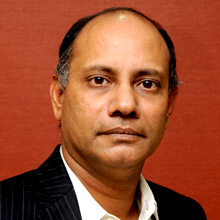
    NS Rajan, Managing Director, Ketchum Sampark

    While we have grown by about 20 per cent in the first half, we are witnessing headwinds gathering across various sectors which can in turn affect growth in these segments and consequently the PR business in the second half.


    Also margins could be under pressure in the coming months as the increased cost of servicing may not be compensated by incremental revenues unless the economic environment changes significantly which can lift up sentiment.


    [To be Concluded]

     

  • Paritosh Joshi: So you want a job in the Media?

    By Paritosh Joshi


    MBA from a leading business school in the American Midwest, two years with a boutique investment bank in Boston and then this young man lands up for a chat about what he needs to do to get a job in the media.


    It is still easy to think there is a clear demarcation that sets the media apart from the rest of the world. Aamir, Ashton, Arnab and Aishwarya are in the Media. (They don’t even need surnames to identify them). Media people ‘need no introduction’. Us grunts have nothing worth introducing and thus, don’t need to be introduced.


    Or is it so simple?


    There were the Media people but they were few and readily identified as such. M J Akbar dazzled us with his insight in columns for a newspaper he edited. Rajat Sharma put people into the dock, quite literally, as he hosted a talk show. Derek O’Brien got all of us furiously scratching our heads even as he quizzed school kids. Madhuri Dixit sent testosterone levels into orbit merely by counting from 1 to 13. And Lalu had to invoke Sridevi’s cheeks in search of a universally comprehensible metaphor for Bihar’s roads.


    Then Tim Berners-Lee came along and changed everything, although for years after he thought up hypertext in an obscure corner of CERN, we would scarcely have known it.


    By the late 90s, regular blokes discovered that it was possible to find a wider audience for their periodic rants on WWW than they previously could muster around a water cooler or in a cafe. The web log, then portmanteau-ed to weblog and finally truncated to blog was born either in 1995 or 1997 (you can find an interesting history here).


    Then blogger came along in 1999, bang in the heady days of the Dotcom Boom and setting up a blog became Luddite-proof. From the very beginning, the blogging community had a wide range of interests and capability. The largest majority would create an account in an idle moment never to visit it ever again. A few would invest time and effort in their posts and endeavour to reach out to an audience with regular, engaging updates. Remember that these were people operating far away from the conventional notion, but what they were doing was indisputably publishing.


    Everyman had just stormed Fortress Media.


    It began with the written word. Soon enough, authors had found ways of adding pictures to their words. And the web was becoming more clever all the time. It was able to transport not just text but sound and video too. Also, devices to record audio and video had started to shrink in price and size even as they got massively more powerful, thus putting near professional quality sound and image acquisition within reach. Events unfolded at a rapid pace thereafter. Amazon pioneered a lightweight handheld device for reading digital publications. The Kindle was a runaway success and for the first time, books could be self-published by anyone with a good idea and capable penmanship without ever being imprinted onto the dead-tree medium. Soundcloud allowed wannabe speakers, singers and instrumentalists to distribute their art and craft without surrendering themselves to the crafty gnomes of the music industry. Youtube opened doors for every standup comic, ballerina, burlesque queen and cute kitten to show off its talents on glorious Technicolor video.


    But wait, we were talking about an investment banker contemplating a career in the media. So what’s with this long riff about what we now refer to, rather condescendingly I might add, as User Generated Content?


    Well, it wasn’t just individuals that got inspired to start using the all new powers of WWW to talk to their “Audience”. Businesses of every stripe saw the opportunity too. To be rather more honest, what they saw was consumers – happy and irate, sounding off about their brand experiences in these wide open spaces and were left with little choice but to deal, for better or worse, with what they were getting. Surely we’ve all heard the now almost apocryphal story of Coca Cola’s attempt to take down a fan page on Facebook that spectacularly backfired? To the point where they had to pretty much say ‘Let bygones be bygones and let’s be friends’? (Moral: Don’t clobber, co-opt).


    You see what’s happening here. Companies and brands were becoming broadcasters and publishers.


    At no time before in the history of our human civilization has communication across every conventional fence and barrier been so easy, inexpensive and by implication pervasive or ubiquitous. And barring the rare exception, individuals and entities find it more productive to be participants in this endless feast of reason and flow of soul than mere mute spectators. There’s even a taxonomy to describe different levels of involvement with media: Paid media are, as the name suggests, those that you have to buy access to. Earned media are where the media voluntarily carry news or content about you. Finally, owned media are, again as evidenced by the name, those that you own and control. Who doesn’t want earned and owned media?


    And what was it that we were talking about when we began this ramble? Ah, yes. A job in the media.


    I told the young man, he could stop looking. After all, every job- FMCG, Banking, Automobiles, Telecommunication, <insert randomly chosen industry name here> eventually, was going to be a job in the Media.


    Paritosh Joshi was until recently CEO, Star CJ. He has been a marketer, a mediaperson and a key officebearer on industry bodies. He is Strategic Advisor, Ormax Media. He can reached via his Twitter handle @paritoshZero


  • Mobile ad network Seventynine to launch ‘unique’ Android product

    By A Correspondent


    Launched in July 2011, Seventynine, the mobile ad network, started commercial engagement in the market in April 2012 with a focus on rich media inventory especially videos to enrich user experience. Seventynine has clocked record growth serving 700mn ad requests within three months of operation.


    Currently, Seventynine is working with brands such as Microsoft, Lufthansa, Nokia, Opera Mini, ICICI bank, ICI Dulux, Tata Docomo, Nazara, Mcarbon, Techzone  and so on and is in talks with other large brands for similar association. The mobile ad network is focusing actively on building inventories across mobile applications and mobile web.


    In an email interaction with MxMIndia, Chirag Shah, Co-founder, Seventynine spoke about his company’s journey since July 2011, its break-even plans and so on. “The journey so far has been very exciting and full of challenges. We are focusing heavily on unique product development, platform and analytics. Since March 2012, we have hit the market and managed to get some amazing response. Mobile ad spends are growing at more than 100 per cent. Spend on content such as application is growing at more than 400 per cent growth rate.”


    “We are launching a unique product on android platform and we intend to share details on that in the next 10-15 days. This unique product will be our focus for 2012-13” he added.


    “Mobile phone and mobile internet users are growing rapidly and consumers are spending more time on mobile as compared to TV, newspaper and internet. We are actively focusing on innovative technology solutions to create the differentiation that will position us ahead of the curve.” added Deven Dharamdasani, Co-Founder, Seventynine.


    The team size of Seventynine is currently 15 but, the mobile ad network company will be hiring aggressively. “We intend to have a 50 member team by the end of this year” observed Mr Shah.


    Seventynine is said to be one of the fastest growing mobile ad network in the country with Rich Media serving capability such as videos and HTML5. It is working closely with The Times Group, Network 18, Reuters, Business Standard, Nimbuzz, Angry Bird, Talking Tom Cat and others and has tie-ups with leading exchanges across the world.


  • Mogae launches mobile creative agency ‘Mobocracy’

    By A Correspondent


    Mogae Media has announced the launch of Mobocracy, India’s first single window mobile creative agency. Headquartered at its Gurgaon offices, the new mobile boutique already has a team of 12 professionals across design, creative, technology and mobile integration.


     

    “The world is getting smaller. At Mobocracy we’ve invested in founding the right skills for optimizing design for the small screen and strengthening communication strategies for this next wave of advertising. We are already working with our diverse portfolio of clients to integrate smart mobile thinking into new and existing campaigns,” said Tanya Goyal, Executive Director of the Mogae Group.


    With massive rise in the number of mobile phone users accessing the web on their handhelds, it is very important for a brand to have mobile version and Mobocracy offers top-notch mobile web design services to help a brand reach its target audience that is scattered over many handsets & versions in a unified way.


    “It’s hard to believe that as recently as a decade ago; most businesses did not even have a website or, at best, maintained a meagre online presence. Today it is as much a staple of our daily lives as is the personal computer, making it vital for businesses to not only maintain a comprehensive website, but to keep updated with advances in technology that will offer customers easy access to the information they desire. Further the advent of ‘smart phones’ such as the iPhone, Android phone or Blackberry has prompted those in the business of building and hosting websites to explore new technological avenues, leading to the creation of ‘mobile web sites’,” said Tanya Goyal. “Ultimately, mobile websites are a win-win both for clients and consumers – helping to deliver a brand’s message and compelling content to current and potential customers with just a glance at their mobile phone screen.”


    Mogae Media, the parent entity of Mobocracy, was set up in October 2011 by veteran ad-man Sandeep Goyal, former JV partner and Chairman of Dentsu India.


  • Marmalade Digital thrusts on Demand Side Platform (DSP)

    By A Correspondent


    Marmalade Digital is making use of several technologies plugged together in one platform called Demand Side Platform (DSP). DSP offers transparent automated media buying across multiple sources in real-time.


    Buyers have complete control through a web-based interface. DSP is fully transparent and neutral, not favouring any publisher, advertiser or inventory over others. This increased transparency and targeting addresses prevailing disparities in display domain.


    Throwing light on Marmalade DSP, Hemant Kumar, founder and chief executive officer, Marmalade Digital said: “Our goal is to be the digital partner who will provides smart media buying insights and optimization to agencies, enabling them to focus more on client strategy, brand building and less on execution of media plan.”


    Till date advertisers had access to only reports which tells whether campaign has performed or not. With direct control and full involvement in media buying, advertisers will know exactly what performs best for them and how the performance can be improved. The learning stays with the agency and can be re-used.


    “Marmalade DSP is an intelligent media buying platform that will offer value beyond impressions and clicks to its advertisers. To ensure brand safety, Marmalade DSP maintains a strict compliance with IAB standards. Advertiser can also choose type, content and category appropriate for its brand,” he added.


  • We’re bigger than the sum of all our competitors: Rahul Johri


    Text & Video by Shruti Pushkarna
    Although most of its channels are not mass like those offering soaps and sitcoms, the Discovery Network is a key member of the Indian broadcast landscape. The Discovery Network Asia Pacific’s Senior Vice President & General Manager for South Asia, RahulJohri attributes the network’s success to its dedicated and loyal viewership and says it is far ahead of competition


    Under Mr Johri’s leadership, Discovery India’s portfolio has grown from two to eight channels. In 2009, he led Discovery Channel to become India’s No.1 channel in non-fiction entertainment. He cemented TLC as India’s definitive lifestyle channel and energized Animal Planet with the brand recording the highest audience growth in the factual space.


    He launched three new networks in 2010, Discovery Science, Discovery Turbo and a 24-hour high definition channel – Discovery HD World. Mr Johri has also pioneered the channel’s localization strategy by launching language feeds in Telugu and Bengali. Discovery Channel Tamil was also launched in 2011.


    At a press meet in the Capital on July 5, Mr Johri announced the launch of a new series on TLC called Be Blunt with Adhuna Akhtar. A six-part series, Be Blunt with Adhuna Akhtar showcases the striking transformation of the girls selected from across India into dazzling divas by popular hairstylist Adhuna Akhtar and her brother Osh Bhabani.


    MxMIndia caught up with Mr Johri soon after he unveiled Be Blunt to the media. In this one-on-one interaction, Mr Johri tells MxMIndia about Discovery’s leadership and the network’s latest offering and that Discovery Kids will be unveiled shortly. He also shares his views on how digitization is set to impact Discovery and other niche channels.


    Excerpts from the interview:

    It’s interesting that you have a show on hairstyling. Tell us a little about this show with Adhuna Akhtar?

    Our focus in TLC is on different aspects of lifestyle and one of the most prominent ones of that is appearance. So keeping that in mind we thought a hairstyling show would fit in really well on the channel. And there is no other hairstyling show. When we wanted to do it, we found Adhuna Akhtar, who is one of the most popular hair dressers in the country. This show takes in six different individuals and carries out a makeover on them and in the midst of doing the makeover, Adhuna gives viewers a lot of tips on how to keep their hair better.


    [youtube width=”400″ height=”225″]http://www.youtube.com/watch?v=0LvsvFWwOTA[/youtube]

    You mentioned there are six episodes of this show ready to air… what’s coming up next?

    We have always done new things and surprised our viewers. Whether it’s a show on Shah Rukh Khan’s life, the jewellery show, and now it’s a hair dressing show, so we will continue to surprise people.


    And then there’s the programme capturing the Indian Army’s Women Expedition to Everest…

    The Army sent an expedition which scaled Mount Evereston May 25 and 26. There are seven women who were part of that expedition and a total of 17 climbers who climbed Everest. We shot the whole show; in fact, a Discovery cameraman also climbed Mount Everest along with the climbers. Right now we are editing the footage that has been brought back and we hope to bring this show within this year.


    And the two-part series on Oprah’s visit to India?

    Oprah was here earlier this year and she shot extensively in Mumbai, Vrindavan, Agra and Jaipur. There are two episodes of this new series that she now does which is called The Next Chapter which appears on Oprah Winfrey’s Network in US and in India you will see it both on Discovery Channel and on TLC. Discovery has had quite a few specials in the past, like the special show with Shah Rukh Khan, another one of course coming up with Oprah…


    Considering a lot of money has to be invested in promotion for programming, isn’t it better to stick to longer format shows rather than these one-offs?

    It is a part of the kind of shows we do. A documentary filmmaker does not make a series, there is no 52-part documentary. It will always be smaller parts. And viewers know that there will be specials and we have now eight different channels of our own. So we have enough air time to take the message to the viewers.


    Discovery has got a lot of competition in this space now, especially from a channel like History which is doing fairly well. How do you view competition from upcoming channels?

    We are, by far, the leaders in the genre. We are bigger than the sum of all our competitors. We’ve been in the business for 15 years and no matter how you slice and dice the numbers, we are the leaders. And we will continue to present to our viewers with quality programming. And the other important thing which is responsible for our leadership position is, on Discovery you will always find shows which are on brand. There is nothing that is not on brand. So viewers get from Discovery what they expect from Discovery. And that is really responsible for the loyalty that we have of our viewers.


    A channel like TLC is fighting for viewership with English GECs like Star World and Zee Cafe…

     TLC is bigger than most of them and TLC has a very dedicated audience. If you ask people what they watch on TLC, they will give you names of shows that they follow. And TLC has managed to establish itself as the definitive lifestyle channel in this country and that really gives it the advantage.


    Speaking of niche channels, how are Discovery Turbo and Discovery Science doing?

    In terms of reach, they continue to grow. Discovery Turbo has very dedicated audience in the metro markets and Discovery Science has been growing all over the country. Its distribution has been growing. And if there is a country in the world where a Science channel fits in perfectly, it is India because 65 per cent of India is under 30 years of age. And 35 per cent of the country is under 14 years of age. And everybody understands the value of education. And that is why the science channel works so well here.


    And how’s your regional foray going? Discovery Tamil is a success… what languages up next?

    Discovery Channel Tamil is a great success. Discovery is the only international company to have a full-fledged channel and not just a dubbed feed in the language. So it has its own programming grid, it has all the on-air packaging in Tamil. And from the day we launched in Tamil, the rating has more than doubled. Today it is the No 9 channel in Tamil Nadu. We are already available in Bangla, Telugu and Hindi and we continue to evaluate languages.


    It’s been a while since you announced Discovery Kids at FICCI Frames. When will it be launched?

    The test signals of Discovery Kids are already on and we are currently seeding the channel in various parts of the country. We should be announcing the launch very soon.


    And how will it be different from the other channels in this space?

    Discovery Kids is not a 100 percent animation channel. It has the inherent Discovery values. However, we understand the value of entertainment so there is a lot of entertainment on the channel and it’s a parent-approved entertainment channel.


    What will be its driver shows? For instance, POGO has Chhota Bheem and Disney has Doraemon…

    We have our set, and like I said it’s just a matter of time that we’ll announce Discovery Kids and we will show you all the big shows that Discovery Kids has.


    Are you looking at a reality show like Endurance which is a rage internationally?

    You will get all the big shows of Discovery Kids in India!


    Do you think digitization will have a positive impact on channels like Discovery?

    In a digital world where the consumers are not constrained by the bandwidth capacity and have a complete choice, channels like Discovery become that much more important. As a consumer you get complete control over what you want to watch and that is where clearly defined offerings like TLC, Discovery Science, Animal Planet have a clear cut proposition and they become that much more pronounced in a digital environment.


    Given that TRAI will have restrictions on pricing of channels, will niche channels (like Discovery) really benefit from it, considering the huge amount of investment on content by these channels…

    Not being able to price your channel has its drawbacks… I would like to bring the military channel here which talks about all kinds of war strategies and so on. But that will have a small dedicated tribe to watch it. Till the numbers grow, the next level of specialization is difficult. It’s a challenge to get extremely specialized channels into the country.


  • The Half-Year That Was-III

    By Team MxM


    Presenting the concluding part of our feature asking some business leaders to review how the January to June 2012 period was for the industry as a whole and/or their specific sectors and organizations.


    Read the earlier parts at: Part 1 Part 2


    Mohit Joshi

    Mohit Joshi, MD, MPG

    There has been a marginal growth (under 5 per cent) in adex in Jan-June 2012, as when compared to the same period in 2011. Some sectors that have been slightly depressed are auto and cellular phone service while sectors that have gone up are education/ institutes, jewellery and insurance.


    Jaideep Shergill, CEO, Hanmer MSL

    Jaideep Shergill

    I would say the PR space is growing but it has not been a year where there have been some big pitches that one would expect. That was what 2010-11 was all about. Although there has been some business, it has been more of an organic one. One of the factors that led to the sluggish growth is the economic scenario which has been going through a hard phase recently. But I would want to think of it as otherwise – when there is a general lack of trust in the market, I think that is where PR has a larger role to play. But that is not what usually happens. For our group too, it has been a good year but it could have been better.

    As the market conditions get more complicated, clients are looking at other streams to expand their business. And that’s where social media is playing a huge role. Our social media unit itself has been seeing some tremendous traction and we have hired more people in the unit. So the medium will continue to see some good growth. But the other thing about social media is that it is evolving continuously – what was happening a year ago and what is happening now is completely different. The medium has been evolving at a good pace.


    Pankaj Raj

    Pankaj Raj, Director, Search Value Consultants Pvt Ltd

    I would summarize hiring as still being slow and sluggish in this space. There are 2-3 observations that I would like to bring across. The first is that most organisations today are in ‘sensible hiring’ mode. This is really about replacement, immediate benefit kind of hiring. The second trend that I am seeing is that there is a huge sense on cost consciousness, whose effects are seen in the hiring space as well. The third trend that I am seeing is that increments haven’t been really good. So there is a level of concern amongst employees in the M&E sector. But having said that, some organisations are still hiring and not in standstill mode.


    As for the next six months, it’s a function of revenues – on how the September quarter turns out for the advertisers. Also, the December quarter is a peak season from an advertiser point of view; a lot of advertisers are active during this period. But to predict growth for the March quarter next year is a bit difficult. We will have to wait and watch how the growth pans out till then.


    Abha Kapoor

    Abha Kapoor, Executive Director, K&J Consultants

    The Media and Entertainment sector is not an island. This space is as affected as any other by the global and national environment. What’s going on in the rest of the world, and in our own country – the economic indices, inflation, governance or the lack of it, have a universal effect on all sectors, not just Media. So if the indices and sentiment are looking southward, then we are as affected by it as any other sector. You have to consider the macro perspective as also the ones specific to us to probably understand the lull in the hiring market.


    There is likely to be a spike from September-October onwards, during the festival period. That’s when you see brands spending more. Therefore, there is likely to be a more optimistic/feel good factor and an expansion (need-based) in hiring. But it is not likely to be at the rate and scale that we have seen in the past.


    In our case at K&J – we are used to working on three start-ups simultaneously like television, radio and digital – which used to be the case a couple of years ago, but no more! So the pace has definitely slowed down. Digital is the new kid on the block, so there is a lot of activity happening in that vertical.


    K Jayaraman

    K Jayaraman, MD and CEO of Hathway Cable and Datacom Limited

    The industry is been focused on digitization, as its on the anvil and the Indian broadcasting space is in the process of witnessing the dawn of a new digital era with its implementation proposed by the Government of India. With this, the government has paved the way for transition to a Digital Addressable Cable TV system (DAS).


    For the average Indian family, the TV is the primary source of news, entertainment and education. The liberalization of the Indian economy starting 1991 has led to what it termed as an explosion of channels catering to different genres. Today we have more than 550 channels broadcasting leaving out the count of local channels specific to regions.


    As per The Cable Television Networks (Regulation) Amendment Bill, 2011, the cable TV industry is required to migrate all subscribers from analog signals to digital. The overall objective of the industry has been to expose every television viewer to an experience which will invariably give consumers the opportunity to resolve some of the issues they have faced with analog cable systems.


    At Hathway our aim has always been to providing consumers with enhanced viewing experience.


    Sanjay Dua

    Sanjay Dua, CEO, Network18 News Media

    This year has been a mixed bag for the industry quite frankly. On the advertising front, the decline in economic sentiment has created a challenging environment, especially for some genres. So, while growth continues to exist, its pace has been muted and variable. However, given the positive move towards digitization, a possible revival in outlook and the impetus of festival spending, the second half holds a lot more promise for broadcasters. We are cautiously optimistic about the scenario going forward.


    Rahul Razdan

    Rahul Razdan, President – ibibo Games & Mobile

    The gaming industry in India witnessed a concerted shift towards mobile gaming on the iOS and Android platforms. Games are now ubiquitous across platforms.


    Games exploiting the touch and tilt features of smartphones were very well received. Our game – Can You Draw, which we’d made for our web platform two years back – became one of the top games on the Android platform within weeks of being launched there.


    While the first phase of web social games plateaued out, live multiplayer games maintained their growth and continue to be the top games on our platform.


    Dr. Subho Ray

    Dr Subho Ray, President – Internet & Mobile Association of India (IAMAI)

    I would say that the year began with a bang. Between January and April there were serious hopes that that this would be a bumper year for the industry. However, in the last two months, there have been some caution and apprehension. The very positive performance was the result of key factors like secular growth of traffic both in urban and rural areas, investments coming in on time and some friendly regulatory announcements like removal of service tax on digital advertisement. The more recent sentiment of caution is led by primarily European crisis. However, so far it is only a caution and alert stage.


    Jogi George

    Jogi George, CEO, Percept Sport & Entertainment

    To be frank, the first half wasn’t as it was expected to be. There was business, but it was more about collections. Also, for our company, some of the major projects have been moved to the second half. Hopefully, this trend won’t continue and things will improve once the rupee stabilizes. As for the overall industry, it’s not that people aren’t  ready to spend, but they have become more cautious and selective as some of the sectors are experiencing a gloomy outlook. Hence, there is a wait and watch attitude.


    Hemal Thakkar

    Hemal Thakkar, producer, Playtime Creation

    It’s been a mixed year so far, a major setback was Imagine shutting down and a big welcome was Life Ok. Lot of new format shows have been launched this year – the biggest being Satyamev Jayate. Inflation has put lot of pressure on the industry, and with rising cost of programmes, we have to put together a skilled team to manage our shows within budgets. In future, rising expenses are going to be major burden for the industry. Playtime Creations has had good start with Ruk Jana Nahi and as a company, we feel that this show has given us the opportunity to experiment with new content. There are couple of other projects in the pipeline which we are excited about. The best aspect of our industry is it keeps us on our toes and so we expand rediscover and reinvent and keep breathing.


  • Vijayavani launches 9th edition in 3 months

    From the MxM Infodesk


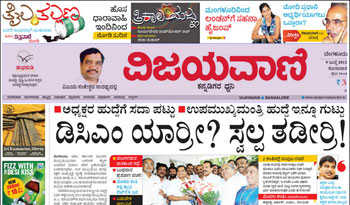
    Vijayavani launched its ninth edition in Karnataka from Gulbarga on June 30. The Kannada daily started with only three editions when it launched on April 1 this year. It now has editions from Bengaluru, Mangalore, Hubli, Bijapur,Mysore, Gangavathi, Chithradurga, Shimoga and Gulbarga.


    Vijayavani was launched by Anand Sankeshwar, a leading businessman in the logistics space and a former newspaper baron. Mr Sankeshwar’s logistics company, VRL Logistics Ltd, has a fleet of commercial vehicles in the private sector. The company operates from 1,000 branches and franchisees across the country.


    In the last 3 months, Vijayavani is said to have averaged more than am innovation every week. An average main issue of 16 pages comprises four pages on local/ hyperlocal issues, two pages each on national, state and sports, one calendar page on entertainment/events, one page on serials/stories and  one page on commerce/business.


    In addition, Vijayavani carries  four page-supplements on various subjects – Vittavani (Commerce), Lalitha (Women), Masth (Youth), Samskruti (Culture), Cinivani (Cinema), Putani (Children), and VijayaVihara (Sundays). The paper is the only daily in Karnataka with all colour pages across all its editions.


  • Maa network goes aggro on OOH

    By A Correspondent


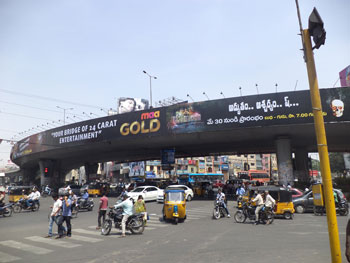
    To target all the sections of Telugu viewing population in Andhra Pradesh, Maa TV has gone out on the streets to promote their programs using the outdoor medium. The channels have been heavily promoted using flyover bridges, unipoles, centre medians and other offside promotions include train & bus branding too. The total outdoor units used are 200 Hoardings, 200+ Centre Medians across Andhra Pradesh.


    The highlight of the campaign was the selection of specific locations to place the outdoor creatives that have additional cut out of characters in heavy traffic areas.


    The channel was promoting their upcoming annual awards function, Cinema Awards 2012 heavily and also 2-month long programs that are running on Maa Gold.


    Maa Television Network has promoted all their programs in major parts of the state -Hyderabad, Vishakhapatnam,Vijayawada, Tirupathi and other few towns. It will be top among the GECs in Andhra Pradesh promoting the programs in a huge scale.


  • MIB amends law, asks cable trade to furnish correct DAS info or face cancellation/ suspension

    From the MxM Infodesk


    Although the news was flashed by the wires last week, it got official only on Saturday. The Ministry of Information and Broadcasting has decided to amend the Cable Television Network Rule, 1995 (Cable Rules) making it obligatory for every Multi-system Operator (MSO) and Local Cable Operator (LCO) to provide correct and timely information to the Ministry as and when it is sought for.


    The background: The I&B ministry has been closely monitoring the preparedness of various activities for the implementation of Distributed Antenna System (DAS). The success of DAS depends on timely seeding of STBs at the consumer premises. As such, availability and deployment of set-top boxes (STBs) by MSOs / LCOs are paramount important for the implementation of DAS. Timely availability of accurate data with regard to the seeding of STBs by service providers (MSOs/LCOs) is also critical for the Ministry to ensure digital switch over within the timeframe as well as for taking mid-course corrections if necessary. While assessing the preparedness of DAS in four metros, the Ministry has come across numerous inconsistencies of data provided by the service providers, particularly MSOs, in regard to inventory position of STB and its deployment.


    In the Cable Television Network Rule, 1995(Second Amendment) Rule, 2012, a new rule, namely, rule 10A – Obligation to furnish information – has been inserted making it mandatory for MSOs and cable operators to provide information as and when it is sought for by the Central government or state government or authorized officer or any agency of the Central government. The obligation to furnish information under the amended rule 10 A has been incorporated as one of the terms and conditions of registration of cable operator under Rule 5 A and MSOs under rule 11 D.


    As per sub-section (7) of section 4 of the Cable Television Networks (Regulation) Act, 1995, the Central government may suspend or revoke the registration of cable operators or MSOs if they violate one or more of the terms and conditions of registration. Incorporation of rule 10 A as one of the terms and conditions of registration of cable operators and MSOs will empower the Central government to cancel or suspend the registration of cable operators or MSO if the information sought for by it is not provided by them. This, MIB hopes, will ensure correct and timely submission of information by cable operators and MSOs.


  • We’ll continue focus on customer delight, says Myntra’s Bansal

    E-tailing in India has seen some brisk business being conducted by a few players in the recent past. While some may brand the space as crowded, there are a few players who have created a niche and are gaining handsome dividends too. Like Myntra.com, that has been consistently doubling its revenues every 5-6 months for the past 15 months and is currently doing over 8,000 transactions daily. According to Mukesh Bansal, Founder and CEO, Myntra.com, the opportunity to offer the widest catalogue across national and international brands, 24/7 shopping, 30 day returns and Cash on Delivery are some of the features unique to online shopping and have helped grow the market.


    In an interaction with MxMIndia, Mr Bansal talks about the growth story of Myntra in a crowded marketplace, on the USP that sets it apart from its peers and what are its plans to derive next phase of growth in India. Excerpts:


    What according to you are the factors that are driving the growth of the e-commerce marketplace in India?

    Some factors that are enabling the growth of the e-commerce in India:


    > Internet penetration:India, currently at 120 million users, is one of the fastest growing internet markets in the world and is expected to touch 300 million by 2015. This has led to opportunities for a vast number of businesses to mushroom online. E-commerce is the largest and the fastest growing segments online.

    > Success of online travel sites & ticket bookings: This has led to increased confidence among consumers to venture into online shopping.

    > Convenience: Widest catalogue across the best national and international brands, 24/7 shopping, 30 day returns and Cash on Delivery are some of the features unique to online shopping and have helped grow the market.

    > Investment from VCs and private players: Investors are looking at e-commerce as a long term investment portfolio as the space has shown tremendous potential to become a multi-billion dollar business.


    How would you analyse Myntra’s growth story in India over 2011-12?

    Myntra has been consistently doubling its revenues every 5-6 months for the past 15 months and is currently doing over 8,000 transactions daily. Our daily traffic has grown to over 4,00,000 visits and our network has grown to cover 1,200 towns and cities across the country. With over 350 of the best national and international brands, Myntra is, today, the largest online retailer in the fashion and lifestyle segment.


    We are also one of the well-funded companies in the space and at the current growth rate, we are confident of achieving our target of Rs500 crore by the end of this financial year.


    The e-tailing space is flooded with players offering the same set of user services, what is the USP that Myntra brings to the table? 

    Back in 2010, Myntra took a bold decision to enter the full catalogue, current season segment to retail merchandise on MRP. Along with the largest catalogue of marquee brands, Myntra was able to target untapped markets across the country coupled with on-time delivery and flexible policies.


    Cash on Delivery as a payment option became an instant hit among our shoppers and today constitute about 65 per cent of our overall business.


    Could you summarize what your core TG of online shoppers looks like?

    Our typical shoppers fall in the age bracket of 20-35 years (SECAB) with about 70 per cent of our shoppers being male. About 55 per cent of our shoppers are from tier 2 & 3 cities with the rest in top 10 cities.


    What is the emphasis you lay on the distribution/delivery across India?

    One of the biggest challenges for any e-commerce player is to effectively manage its supply chain and logistics. At Myntra, we are constantly upgrading our processes to provide a hassle free shopping experience while strengthening our in-house logistic network. We are currently operational in over 12 cities across the country and plan to reach as much as 70 per cent of our customers directly via our own logistic network by the end of this year.


    What is the impetus that you are laying on the marketing/communication plans for Myntra?

    Our latest TVC hit the networks in June 2012 across major national channels. We are now entering regional markets in the south with language specific ads in Tamil, Kannada and Malayalam.


    We are also partnering with various other properties that enhance our fashion quotient.


    Do you think e-tailing is gaining ground in India at the expense of other modes of shopping?

    The overall lifestyle category in India is pegged at approximately $50 billion, growing at 16 per cent CAGR. This is one of the largest categories, not considering travel & tourism. The industry is expected to cross $100 billion in 2015 with approximately 5-8 per cent of this being online. This clearly indicates that the market is big enough for both to co-exist.


    What are the challenges in running a successful e-tailing network in India?

    The biggest challenge for any e-commerce player is to effectively manage its supply chain (inventory, logistics etc) and customer experience. Delivery team and customer support being the two main touch point for an online retailer, utmost importance needs to be given to both these aspects.


    At Myntra, we are constantly upgrading our processes to provide a hassle free shopping experience while strengthening our in-house logistic network. We are also constantly training and motivating our CC teams to imbibe the Myntra core values and pass them on to our customers.


    What are your plans for the next phase of growth in India?

    According to recent reports, online apparel will be a $2 billion market by 2015 and we see great potential to grow in this environment. Our investments in technology, brand and supply chain is already paying dividends and we will continue to focus on delighting our customers.


    We are also adding new features on our interface to aid our customers in their buying process and helping them make the right fashion choice with our fashion blog called Style Mynt.


    Social media is a very important platform for us and we are making steady progress with over 6.5 lakh fans on our Facebook page while Twitter, Google and Pinterest are gaining momentum.


  • Mobile handset revenues drop 5% to Rs 31k cr

    By A Correspondent


    The Indian mobile handset market saw a drop of 5 per cent in revenues in FY 2011-12. The revenues dropped to Rs31,215 crore from Rs33,031 crore a year back. The annual survey of the Indian telecom industry by CyberMedia Group’s flagship journal for the telecom industry – Voice&Data attributes this drop to de-growth in the feature phones sales as well as lower average selling values (ASVs).


    The 17th annual study ‘V&D 100’ surveyed over 30 mobile handset firms – both multi-national and Indian – selling feature phones, multimedia phones, enterprise phones and smartphones in India.


    The disappearing act by the home-grown handset makers was a big surprise of the year. Barring Karbonn and Lava, none of the Indian handset players could face intense competition. Their main stay – feature phones – saw a negative growth while the entry level smartphones of various companies saw a marginal rise.


    “Indian mobile phone brands that had hoped to make a mark by sourcing Chinese handsets and selling them only on the price plank were in for a big surprise. These players will have to quickly rethink their product, marketing and service strategy afresh to put their house in order,” said Ibrahim Ahmad, Group Editor, Voice&Data.


    Top 10IndiaMobileHandset Vendors: Voice&Data 100 survey 2012
    Revenue in Rs Crore
    Rank 2011-12 2010-11 Change Mkt Share in %
    1 Nokia 11925 12929 -8 38.2
    2 Samsung 7891 5720 38 25.3
    3 Micromax 1978.0 2289 -14 6.3
    4 Blackberry 1460.0 1950 -25 4.7
    5 Karbonn 1327.0 1004 32 4.3
    6 HTC 923.0 450 105 3.0
    7 Spice 790.0 920 -14 2.5
    8 LG 780.0 1834 -57 2.5
    9 Huawei 750.0 626 20 2.4
    10 G’Five 670.0 1326 -49 2.1
    Total 31,215.0 33,031.0 -5 100.0
    Source: Cybermedia’s Voice&Data Annual survey of the industry 2012


    Nokia remained the number 1 player in the handset business in FY 2011-12 with revenue of Rs11,925 crore, despite a 8 per cent  drop. The Finnish company lost market share in smartphones and multi-media segment to Samsung, HTC and Apple, among others.


    Nokia felt its absence in the Android ecosystem dent its performance, it made a head way in the dual SIM phones category but lost out in the smartphone market and ended the year with a market share of 38.2 per cent.


    The Korean giant Samsung, grew its revenues 38 per cent to Rs7,891 crore at the second spot with a market share of 25.3 per cent. Voice&Data analysts attribute Samsung’s success to its rich product portfolio based on Windows, Android and Bada operating systems. Samsung’s Galaxy Note, a hybrid between smartphone and tablet was a trail blazer selling 40,000 units each month since launch in late 2011.


    “As consumers look for applications beyond voice and SMS, the market will see fight for high-end feature phones and smart phones intensify further. Consumers can also look forward to steeper price drops and more features in the same price,” said Mr Ahmad.


    Homegrown handset company Micromax with revenues of Rs1,978 crore ranked third among Voice&Data100 Top10 mobile handset brands, recording a 13 per cent negative growth and a market share of 6.3 per cent.


    The only other Indian player to post revenues of over Rs1,000 crore was Karbonn. The company grew its revenues 32 per cent to emerge as the No 5 player with a market share of 4.3 per cent.


    Among the global companies in the V&D100 Top 10 players, BlackBerry maker Research In Motion dropped the most- 25 per cent – to post revenues of Rs1,460 crore. At No 4, Blackberry had a market share of 4.7 per cent on the back of entry level smart phones last year.


    Taiwanese handset maker HTC saw maximum growth among all the brands surveyed by Voice&Data. HTC’s revenue more than doubled to Rs923 crore to inch a 3 per cent market share.


    The other key players in the Top 10 list include Spice Telecom (Rs790 crore), LG (Rs780 crore), Huawei (Rs760 crore) and G’Five (Rs670 crore),