Category: Digital

  • BharatPe launches marketing campaign for Postpe

    By Our Staff


    BharatPe, the fintech company, has announced the rollout of its latest 360-degree marketing campaign to promote its Buy Now, Pay Later (BNPL) product- Postpe. Conceptualised in line with the theme ‘De Dena Aaram Se’, the campaign is designed to create awareness about the various use-cases of Postpe around interoperability and instant approvals.


    Speaking on the launch of this new campaign, Parth Joshi, Chief Marketing Officer, BharatPe, said: “Consumer credit in India is highly underpenetrated, and limited to very few categories. It, thus, becomes important for us to evangelize the category and educate consumers on why they should switch to ‘Buy Now Pay Later’ and bid adieu to traditional payment modes like credit cards. With this aim, we have launched this film to drive category adoption as well as enable growth for our product.”


  • MX Gold hikes annual subscription fee

    By Our Staff


    MX Gold, the SVOD service of MX Player, has announced its annual subscription fee for users at Rs 299 for its flagship MX Gold Annual pack. The change comes into effect on Friday, May 27 onwards, putting an end to the current offer of Rs 199.


    Said Abhishek Joshi, Business Head, SVOD, at MX Player: “With our new Annual Subscription fee at Rs 299, we are empowering our viewers to enjoy, and binge-watch the hit shows and movies ad-free at an affordable price of less than Rs 1 per day. It’s our effort to provide our viewers with a superlative user experience and ensure the most unique, engaging and entertaining content with zero interruptions and no ad breaks. Consumer centricity lies at the core of all that we do at MX, and we do everything to put the customer first.


  • Technology: Nature’s Catalyst for Human Evolution


    By Ashoke Agarrwal


    Ashoke AgarrwalPre-script: My remit is to write a column on the interface of technology and marketing. This fortnight I take a step back and take a look at the interface of technology and modern civilisation of which marketing is small subset.


    The doom and the gloom hang heavy over the world these days— the reality of climate change, the increasing social and cultural divide within and across nations, a naggingly persistent pandemic and the spectre of war and economic hardship.


    An antidote to the doom and gloom is to take the long view.

    Take technology, for instance.


    Many cite technology as a critical factor driving the crises facing humankind. The agriculture and industrial revolution fuelled a consumerist, rapacious society overburdening the earth. The resultant destruction of animal habitats and air travel makes zoonotic pandemics inevitable. And, of course, the Internet and social media divide society into mindless tribalism and parochialism. And new, advanced weapons promise to make the wars of the 21st-century ultra-destructive. And so on. The charge sheet against technology is long.


    So much so, the trope among run-of-the-mill science fiction writers is to imagine a dystopian future for humanity: a dog-it-dog, bleak Mad Max world.


    Peel away these layers of techno-pessimism, and you will find a view that puts technology, at the core, outside the order of nature. A belief that sees technology as an aberration fuelled by human ambition, greed and hubris.


    Allow me to present an alternative view.

    What if we view technology as an integral part of human evolution?

    In his pathbreaking bestseller, A Brief History of Humankind, Yuval Noah Harari presented a compelling insight into two revolutions that shaped early human history.


    The first he called the ‘Cognitive Revolution’ – was propelled about 70,000 years ago by changes in the brains of homo sapiens that enabled the emergence of a language that allowed for conversations that ranged beyond the signalling of approaching danger and of the availability of food. According to Harari, this significant development initially led to the emergence of gossip as a human occupation and, in time, fiction creation. An anthropologist could classify both activities as unproductive and harmful in the initial phase. Much as a sociologist is liable to label the effects of social media today.


    However, in Harai’s telling, taking a longer and deeper view, the emergence of gossip allowed bonds of trust to form and for communities to emerge. And the ability to create and propagate fiction is at the heart of the uniquely human ability to create myths and intangible entities – the creation and propagation of religion, nations, education and business entities.


    About 30,000 years ago, the Agriculture Revolution happened. With the widespread cultivation of wheat, rice and potatoes, humankind starts transitioning from being foraging and thus nomadic bands to settling down into communities around farmlands. Contrary to popular belief, the Agriculture Revolution’s early effects were to reduce the quality of life drastically. Foraging offered excitement, a much more varied and nutritious diet, and a better shot at survival than the boredom and near-slavery of farming, the restricted diet, and the ever-present threat of famine. Yet, many thousands of years later, it is acknowledged that the Agriculture Revolution was much more than that. Without it, humankind would not have become the dominant species. And human civilisations, with large swathes of their population freed from foraging for food, could rise through the pursuit of commerce, the arts, and the sciences.


    The Scientific Revolution is not more than 500 years old. The internet is just 50 years old, and AI and biotech are still in relative infancy. So, could it be that the immediate effects of this revolution are just the preliminary and passing results of the latest step-up in human evolution?


    It took between twenty to thirty thousand years for the long-term evolutionary effects of the Cognitive Revolution to be fully realised.


    The Agriculture Revolution took less than ten thousand years. Evolution is speeding up. Will the ongoing Scientific Revolution fully realise the next stage of human evolution in the next two to three hundred years?


    Given the ills of today, many would assert that modern technology has only exacerbated inequalities and inequities and brought the planet to the brink of disaster.


    That, I think, is an ultimately self-defeating way to look at it.

    Going by the past epochs of humanity’s history, we must believe that the Scientific Revolution heralds humankind’s leap into a new orbit.

    Perhaps technology is a dance – two steps forward, one step back, three steps ahead.


    Perhaps the threat of climate change will ultimately result in the acquisition of geoengineering – the ability to effect change at a planetary scale, not over centuries but in decades. Perhaps the next economy of sustainable consumption will be driven by sustainable, on-demand, accretive manufacturing that will destroy inequalities based on means of production and consumption. Perhaps genetic engineering and symbiosis of man and machine will give every individual the means to discover and fulfil their potential. Perhaps space exploration will reach a stage where national boundaries here on earth will seem meaningless. Perhaps physics will solve the mystery of consciousness, and humankind will dissolve divisive religious myths.


    Perhaps as Yuval Noah Harari posits in his book, humankind, on the back of the Scientific Revolution, will graduate in a hundred or two hundred years from being Homo Sapiens to Homo Deus – a godlike species with seemingly magical powers and flirting with immortality.


    All that could be in humankind’s grasp, but only if we let the dreamers among us dream and strive. And not given to the doubts and the gloom as they will arise every now and then. And allow technology to perform its role as nature’s catalyst for human evolution.

     

  • Nukkad By Stage launches new commercial in ‘Desi Andaaz’

    By Our Staff


    Nukkad by Stage, a infotainment media platform, has launches a new digital ad commercial to create awareness of its credo ‘Desh Ki Baat, Desi Andaaz’.


    Said Runa Sinha, Vice President: “The commercial is a refresh of the unique offering of Nukkad which helps brands build trust ,awareness leading to conversations amongst the Bharat audience. This will be coupled now with the other assets/ offerings of Nukkad which has a significant following.”


    Added a communique: “Nukkad by Stage offerings reach 536 million Indians who spend an average of 24 min per day on video consumption. Hindi is the primary content language as 450 million Hindi speakers in India are twice as big a market as our country’s 220 million English speakers. Keeping that in mind, Nukkad has a total of 130M+ Reach, 50M+ Views, 10M+ Engagement, 110M+ Watch Time. Following are the assets (other pages) of Nukkad By Stage: Nukkad Foodmate, Geeksmate, Duniya Digest, and Nukkad Sports with a total audience of more than 10 million.” The company was founded by Vinay Singhal, Parveen Singhal and Shashank Vaishnav in 2019.


    https://www.youtube.com/watch?v=VxZn5Kzqxgg


  • Smalltown India is the future for SVOD


    By Indrani Sen


    Indrani SenOrmax Media, a specialised Insights consultancy firm, was established in 2008. In its own words: “Over the last 13 years we have pioneered the usage of various testing, tracking and forecasting-based tools, designed to achieve higher profitability in films, television, streaming, print, radio and other categories in the Indian media industry… We are constantly innovating to introduce new tools and build knowledge that can help the Indian media & entertainment industry use consumer insights and data analytics to create businesses, brands, shows, films and campaigns that are both consumer-centric and profitable.”
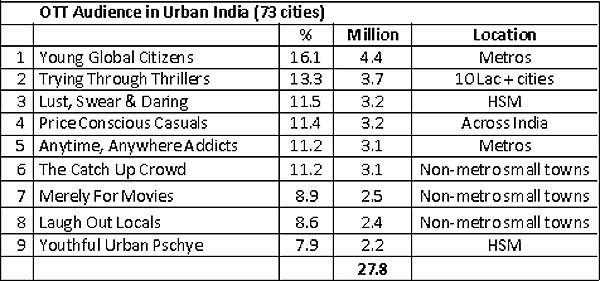

     

    Ormax Media launched the first edition of its Ormax OTT Audience Report 2019 with a promise to conduct similar reports year on year. In its first report, Ormax analysed the viewing behavior by preference of content watched and divided the urban OTT audience into interesting segments of nine different types.


    Source: OTT_AudienceSegments_OrmaxMedia__1_.pdf


    The onslaught of Covid-19 and the national lockdown forced them to miss the opportunity of conducting field research in 2020. But Ormax was back in 2021 with the 2021 report based on a 12,000 sample size across urban and rural India. As per that report, OTT audience universe in India in 2021 stood at 353.2 million (35.32 Crore) people. In other words, the penetration of OTT viewing was of 25.3% of the population, “which means that one in four Indians watched online videos at least once in the last one month”. The report was aligned to other syndicated media research and presented analysis of the universe by gender, age, NCCS, pop strata, states and cities.  This second report elevated OTT from a niche medium to a mass medium with huge prospect for further growth. It was possible to calculate reach of the OTT medium in different target audiences for the first time. The report also revealed that in 2021 there were 353 million OTT users in India of which 40.7 million were paying (SVOD) audiences accounting for 96 million active OTT subscriptions. In other words, each unduplicated paying audience member was subscribing to 2.4 OTT subscriptions on an average. This SOVD audience were dominated by male members who constituted 66% of 40.7 million.


    Last month, Ormax Media released The Ormax OTT Audience Report 2022, which has some interesting insights related to viewing habits of OTT audiences including content watched in different languages. The latest report is based on a sample size of 6,000 SVOD and AVOD audiences in urban India, and is probably India’s largest profiling study of the streaming /OTT audience.


    The report has revealed that Indian SVOD viewers use the dubbing and subtitling options on their OTT platforms and watch content in four to five languages on an average, while AVOD viewers watch in at least two languages, primarily due to less content options available to them. AVOD viewers watch a lot of content on YouTube where no dubbed content available.


    Content in the four South Indian languages have a large audience outside their home states, 88 per cent Malayalam SOVD content viewers and 82 per cent Tamil SOVD content viewers are respectively from outside Kerala and Tamil Nadu.


    This research also has highlighted the difference in preferences for content between SOVD and AOVD audiences.  The latter do not prefer to use web series instead they want more of shorter formats, like comedy scenes, songs, knowledge videos, including recipes, education and health, and films.


    The research has predicted that the next level of growth of SOVD viewers would come from small towns as 60-70 per cent of the top six metros’ population has already converted to SVOD audience, making the metros a near-saturated market. The male domination of the SOVD audience segment continues which may be due to other socio-cultural reasons and not just financial independence of women.


    On the whole, The Ormax OTT Audience Report 2022 has opened up a new vista of opportunities for content strategy and content creation for the Indian OTT platforms. It is interesting to note that Ormax media so far has not repeated any research on OTT audience in India, but has looked at a new concept for research every year to provide the users in the industry with either better estimates or in-depth insights.


  • Star Sports forays into esports, teams up with Nodwin

    By Our Staff


    Star Sports and Nodwin Gaming have inked a deal whereby the former will broadcast the BattleGrounds Mobile India (BGMI) Masters Series tournament from June 24 to July 17, 2022, in Hindi, Tamil and English. The tournament will be aired live on Star Sports 2 from the Nodwin Studios in New Delhi.


    Speaking about the association with Nodwin Gaming and the broadcast of BGMI Masters, Sanjog Gupta, Head – Sports, Disney Star said, “Esports in India is a fast-growing segment which has seen accelerated adoption over the last two years. It has immense headroom for growth in India when compared with its status in evolved markets around the world. It is also gaining prominence in the ecosystem as a competitive sport. Esports competitions have already developed a niche following on digital platforms. As the preferred destination for sports fandom, Star Sports is always looking for opportunities to engage fans, galvanise communities and recruit new audiences. Our partnership with Nodwin Gaming seeks to shape the future of eSports in India by introducing high quality competition and prominent players to millions of TV viewers around the country. It will hopefully fuel fandom for eSports amongst gamers and elevate aspiration amongst athletes.”


    The tournament will see India’s top 24 BGMI squads battling for glory. The teams, with fan bases reaching up to millions that have dominated the digital space, will take their game prowess, star performances and rivalries on linear distribution for the nation to enjoy.


    Added Akshat Rathee, MD & Co-Founder, NODWIN Gaming: “We have been working tirelessly through the pandemic to build the foundation for such a big collaboration. This is a very big step for us in the right direction as we now take esports to the masses. So far, esports has always been associated with live streaming on digital platforms. Through this collaboration with a mainstream sports channel, we hope to break that mould. Satellite television does have its advantages like its unrivalled reach across every nook and corner of the country, uninterrupted and timely broadcast that is not dependent on internet connectivity and speed as well as affordability for the masses living in far-out areas. We look forward to spreading the reach of esports, making a connection with the youth across India and bringing esports into the arena of other traditional sports.”


  • Prime Video collaborates with AMC Networks

    By Our Staff


    Amazon Prime Video and AMC Networks, an American entertainment company, have announced the launch of AMC+ and Acorn TV on Prime Video Channels. AMC+ is a subscription service that offers Prime members access to scripted dramas, fan-favourite franchises, and a wide range of ad-free exclusive series and films from the US and around the world.
     

    Said Chaitanya Divan, head of Prime Video Channels & Sports, Amazon Prime Video India: “As the destination for the latest, acclaimed and popular international content, at Amazon Prime Video, we believe in super-serving our customers with choice, access and convenience. Since launch last year, Prime Video Channels has expanded the choice of English and international content available to customers further by giving them access to a wide range of exclusive, high-quality programming from multiple streaming services, while offering them the convenience of enjoying their favourite shows and movies at a single destination, with all their favourite Prime Video features. We are delighted to partner with AMC Networks and offer our viewers an even wider selection of popular and blockbuster English content. Prime members have loved our extensive selection of premium international content, available as add-on subscriptions, and we are committed to satisfying their diverse entertainment needs.”


    Added Courtney Thomasma, General Manager of AMC+: “AMC+ offers viewers thousands of hours of celebrated and award-winning series, including our critically-acclaimed dramas from The Son to 61st Street as well as the next generation of fan-driven franchises including The Walking Dead Universe and Anne Rice’s Interview with the Vampire. With our upcoming slate of AMC+ Originals like Dark Winds and Moonhaven along with access to Acorn TV’s beloved international mysteries and dramas, AMC+ combines thought-provoking stories and iconic characters in one subscription. We are excited to partner with Prime Video Channels to bring our slate of original programming to audiences in India and look forward to delivering many exclusive premieres in the months ahead.”


  • Koffee with Karan S7 only on OTT

    By Our Staff


    If the naughtiness on earlier seasons often got crass, sometimes downright vulgar (remember the Hardik Pandya show), get ready for some more of it. Since it’s OTT, all of this can work perhaps. Even if it’s Disney-owned Disney+ Hotstar. Crassness – in the garb of edginess – however doesn’t seem to upset the advertising community which shuns toxicity on news channels. While one isn’t criticising the move (god bless them!), a communique reports 100% of its ad inventory for the just-started Season 7 has been sold. The advertisers are some discerning names in business: Ajio Luxe, Bru, Amazon Alexa, BoAt, Only Natural Diamonds, Audi, Jaquar Bath+ Light and MyGlamm. The host is the same: Karan Johar.


    Said an unnamed Disney+ Hotstar spokesperson: “The popularity of reality shows has been growing, and as one of India’s longest-running reality talk show, Koffee with Karan establishes new standards with each new season, creating extraordinary excitement and for viewers and advertisers alike. The complete sell-out of the show’s ad inventory is a testimony to this fact, and with Koffee with Karan going Disney+ Hotstar exclusive, it offers a great opportunity for our advertisers to connect with their audiences said a. He further added, “We are thrilled to welcome onboard our sponsors for the latest season of the legacy talk show and are excited to see the response of the audiences.”


  • Netplus launches TVC to promote biopic

    By Our Staff


    Netplus, a broadband service provider has announced an association with Tapsee Pannu’s upcoming film ‘Shabaash Mithu’, a  biopic based on the life of the cricketer Mithali Raj.


    Speaking on the accomplishment, S. Gurdeep Singh, Chairman, Jujhar Group said: “This association Tapsee Pannu starrer ‘Shabaash Mithu’, re-affirms our commitment towards the narratives that matter and impact our users. We take pride in associating ourselves with the journey of the Mithali Raj, who is an inspiration to many.”


    Commenting on the association Ajit Andhare, COO of Viacom18 Studios added: “Shabaash Mithu celebrates the determination, commitment and resilience of a legendary cricketer like Mithali Raj. I am happy to partner with a brand like Netplus that embodies the same spirit of commitment and dedication to build a connected India.’”.


  • 2022 So Far: The Best of Indian Streaming


    By Shailesh Kapoor


    Shailesh Kapoor2022 is more than halfway through, and even as the pandemic lurks around, the year has a semblance of normalcy to it, something we have not felt since 2019. The entertainment narrative in the pandemic years was largely centered around streaming (direct-to-OTT) content. This year, the conversation has shifted significantly to theatrical films, with the release of some big blockbusters, especially in Telugu, Tamil and Kannada languages.

     

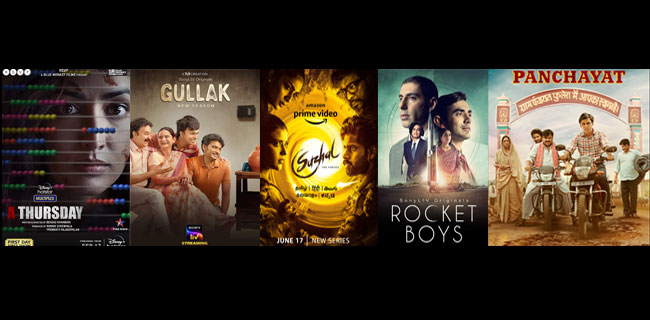
    But streaming content continues to build a wider audience base, and is now a flourishing parallel industry that’s hard to not take notice of. The first half of the year has seen its fair share of hits and misses on the streaming front. Here’s my choice of five Indian streaming originals that made a mark in Jan-Jun 2022:


    5. A Thursday (Disney+ Hotstar)

    There haven’t been too many direct-to-OTT films that have made a mark this year, as the best content has been released theatrically first. But the Feb 2022 Hotstar thriller A Thursday, headlined by Yami Gautam Dhar, got the audience attention like no other film could. With an estimated viewership of 25.5 Mn, it is the most-watched streaming original film in India this year, ahead of the more-hyped Gehraiyaan. The thriller, with a very relevant message in the last act, may end up being the biggest direct-to-OTT film of the year too, given that streamers are now shifting their focus firmly to series than films.



    4. Gullak S3 (Sony LIV)

    Gullak is a partnership between a platform (Sony LIV) and a producer (TVF) who are both recognized for some excellent work in the streaming space over the last few years. The show revels in its simplicity and the ‘aam aadmi’ connect, making it stand out in a category that’s still driven by a predominantly cosmopolitan outlook. There has been amazing consistency across the three seasons of the show, in terms of character portrayal, the quality of humor, and the overall tonality of the show itself. One hopes the fourth season is round the corner, because the show’s growing fanbase is eagerly anticipating it.



    3. Suzhal: The Vortex (Amazon Prime Video)

    Created by Pushkar-Gayathri, of Vikram Vedha fame, crime thriller Suzhal has managed to find an audience outside its native (Tamil) market, despite the setting of the story setting being rooted in the local culture. The streaming category has made the language barrier a lesser factor over the last two years, and we can expect more shows like Suzhal to break through in the Hindi market in the coming months.



    2. Rocket Boys (Sony LIV)

    Rocket Boys, a biopic that traces the life of Homi Bhabha and Vikram Sarabhai, is a masterful recreation of an important chapter in modern Indian history. But it’s not the historical significance that makes the show so delightful to watch. Rocket Boys, created by Abhay Pannu, has an irresistible vibe, as it seamlessly blends humor with drama, romance with history, and irreverence with a sense of responsibility. Imaginative casting is one of the show’s strengths, and Jim Sarbh as Bhabha is particularly outstanding.



    1. Panchayat S2 (Amazon Prime Video)

    Panchayat is the second TVF show on this list. TVF’s strong presence on any Indian streaming list is a given, given the consistency of their offering over a few years now. Unlike Gullak, which has a more homely and next-door vibe, Panchayat has a certain cinematic quality to it, despite its simple, almost innocent, imagery. You can sense that this show is going to only get bigger and more ambitious with each season, because it’s uniquely wry style of giving social commentary is some sort of an acquired taste.

     

  • Homo Proxies: Beyond Income Inequality & The Digital Divide


    By Ashoke Agarrwal


    Ashoke Agarrwal“As for living, our servants will do that for us.”

    From the play Axel by Auguste Villiers de I’Isle-Adam. Also used by WB Yeats as an epigraph in The Secret Rose.

    To my mind, the invention of money is at par with the control of fire as a seminal development of human society. Capital produced the class system, which is the bedrock of modern human society’s economic, political and cultural structure.

    Many who ponder humanity’s future see the emergence of Artificial Intelligence (AI) as a development that will alter the core structure of human society.

    AI’s progress over the decades has been stop-start. For decades it has been the saga of a promise fulfilled more in science fiction than reality.

    Quite often, it has been a cliche with wannabe setup trying to pass off data analytics and second-order model-building as AI.

    However, over the past few years, the exploits of Google, Deep Mind (a subsidiary of Alphabet, Google’s parent company) and OpenAI have once again brought the promise and perils of AI front and centre in the popular imagination.

    In June 2022, Blake Lemoine jolted the world by claiming that Google AI engine LaMDA (Language Model for Dialogue Application) had turned sentient. The powers that be at Google denied the claim and sacked Mr Lemoine. Was Google upset that Lemoine pre-empted the announcement of what many would think is a seminal milestone in the development of AI? Or was Google upset by the revelation of a secret it would want to, for myriad reasons, keep from the world? Or was it simply that Mr Lemoine’s claim was hyperbolic and premature?

    Whatever the case, the media attention that Mr Lemoine’s claim got is symptomatic of the widespread realisation, conscious and sub-conscious, that AI is much more than just another technological development. On the contrary, it is a recognition of AI’s power to change the very dynamics of human society.

    I have been writing in this column about one aspect of how AI, as it develops, will change an individual’s life. In my January 6, 2022 column, I have written about Concierge Intelligence (CI). CI will augment the capabilities of an individual to deliver better outcomes for her – at work, in learning and in relationships. It will be the next big thing – a consumer service whose impact will be an order of magnitude higher than, say, the emergence of the personal computer or the smartphone.

    CI will be an AI companion of the individual, assisting her in all her interactions with the world. CI will enable the individual to communicate better, learn more and better, work better and even shop better. It will do so by developing a deep understanding of the individual’s capabilities, biases, needs and desires. CI will combine this depth of knowledge about the individual with near-encyclopedic knowledge and awareness of the world to deliver solutions and assistance at the speed of a computer.

    The overall impact of CI on society will be more or less egalitarian, as is increasingly the case with personal computers and smartphones. As the CI technology matures, most people who cross the poverty and subsistence lines will be able to afford CI.

    However, there will be an aspect of CI that has the potential to further immeasurably the class divide. This divide will go much beyond the divide of being able to afford a better brand of smartphone or PC. It will even go beyond the digital divide that separates people with access to the digital world and those deprived of it.

    The divide that a specialised aspect of CI can produce could be to create an almost different species of humans. Not yet Harari’s Homo Deus (as posited in his book ‘Homo Deus. A Brief History of Tomorrow’) but on the way. An era of Homo Proxies.

    ‘Proxies’ is the name I have given this species-creating aspect of CI. I have borrowed this concept from Jennifer Egan’s latest book, ‘The Candy House’. Egan comes to the idea of Proxies from a different technological development – the ability to download one’s memories – conscious and sub-conscious. In her imagining, Proxies are an escape hatch devised by those wanting to escape the tyranny of this technology.

    In that sense, I have only borrowed the label from Egan. In my imagining, Proxies are a result of CI, and a means for individuals to distort the technology to entrench their power and pelf further.

    Proxies will be a form of super CI that an individual will use to create multiple identities. As much of human society’s endeavours – economic, social, cultural and political – move online, an individual using Proxies will have the means to exist as multiple entities. Proxies will be a turbocharged CI – say a Super CI – that will enable an individual to digitally live and interact as multiple entities that multiply the time and the legal and social presence available to the individual. In that sense, Proxies go beyond the concept of fake identities.

    While this Super CI will be expensive, the inequality that will result from proxies goes beyond the cost aspect of it. Instead, it will be more to do with the individual’s capabilities. For example, proxies-driven multiple identities are valuable and produce more economic and social capital only if the individual is either a knowledge worker or an entrepreneur.

    Imagine a world where a class of individuals will enjoy unlimited “me-time” while their multiple proxies take care of worldly endeavours. It will create a different species of human beings way beyond the current divide driven by economic and social power.

    Dig below the anxiety that the coming age of AI produces among many, and you will find that the possibility of proxies is part of it.

    As the 21st century slips into middle age over the next couple of decades, a new leisure class will likely emerge. And to paraphrase Auguste Villiers, an elite who says, “as for earning fame and money, our proxies will do that for us”.


  • E-commerce facilitator GoKwik appoints Amitt Sharma as CCO

    By Our Staff


    Gokwik, an e-commerce enabler, has announced the appointment of Amitt Sharma as its Chief Customer Officer (CCO). Sharma would be working closely with the rest of the verticals and the leadership team in driving GoKwik’s vision to maximize the value delivery to its clients as a part of the company’s growth strategy. (Note the name is spelt with two Ts, it’s not a typo).


    On the appointment, Chirag Taneja, Co-founder of GoKwik, said: “As we expand our business into newer segments and geographies, it becomes critical to constantly bring the best practices in improving and modernizing GoKwik’s customer care approach and leadership. We believe that with Amitt coming on board, we would build a world-class organization focussed on the ethos of customer centricity and uplift e-commerce conversion rates at a rapid scale.”