Category: PRODUCTS

  • Videcon claims 10mn d2h connections

    By A Correspondent


    Videocon d2h may have been a late entrant in the direct to home television distribution space, but if a communiqué from the company is to be believed, the service has crossed 10 million connections.  d2H was launched pan-India in 2010.


    Said Saurabh Dhoot, Director, Videocon group: “Our commitment is to deliver the best to our customers and the encouraging response of the customers is an endorsement of our services.”


    Added CEO Anil Khera: “We are continuously differentiating ourselves from competitors by offering quality.”

  • SapientNitro is Lycra’s global AOR

    By A Correspondent


    SapientNitro has announced that it has been appointed global advertising agency of record for the Lycra brand. Invista, which owns the brand, has tasked SapientNitro with responsibility for global brand strategy, advertising, digital, social and customer experience.


    Said Bob Kirkwood, Executive Vice-President of Marketing at Invista: “Lycra is one of the best known ingredient brands globally and we have high aspirations for the brand. We want to communicate our brand positioning to the millennial generation and build a consumer following of Lycra brand ambassadors.”


    The account will be run out of SapientNitro’s London office. The work will involve TV-led brand advertising as well as co-operative campaigns with famous garment and retailer brands and will be rolled out globally across key regions in 2014.


    Said Nigel Vaz, SVP and European Managing Director at SapientNitro:  “Invista is an exceptional global innovator. This is a fantastic global advertising account win for us and a powerful demonstration of where our Storyscaping approach – which combines the power of storytelling with systems thinking to allow brands to create not just ads but worlds – can take us and our clients.”


  • Mumbai leg of IAA Retrospect & Prospects with D Shivakumar on Feb 12

    D Shivakumar

    By A Correspondent


    PepsiCo India Chairman and CEO D Shivakumar will present a 60-minute review of the highs and lows in media, advertising and marketing in 2013 and a forecast of what will happen in 2014 Colors is presenting partner of the event which will be held at Hotel Sahara Star. Last month, Mr Shivakumar had presented a similar session in Delhi NCR.


    Srinivasan Swamy

    Said Srinivasan Swamy, President, IAA India Chapter and VP-Development, IAA Asia Pacific: “This would be infotainment at its best. In sixty minutes, we will have the wisdom and insights of a leader of our fraternity encapsulating the immediate past and the near-future in an absorbing audio-visual format. It will be a must-see for all members of our industry. The Delhi audience loved it. We, along with our partner Colors, felt there was a need to present this in both Mumbai and Delhi.”


  • Noose on ‘misleading’ ads gets tighter as govt panel says celebs also liable for endorsements

    By Dipak Kumar Dash


    If the skin whitening cream isn’t as phenomenal as advertised or the hair oil not producing a lush mop as promised, you may soon be able to claim compensation not only from the advertisers, but from the celebrities endorsing the product.


    The Central Consumer Protection Council (CCPC), under the chairmanship of minister K V Thomas, on Monday decided to set up a sub-committee to suggest strategies to deal with such advertisers. Among the concerns raised was peddling of products by celebrities.


    “About 50% of the daylong conference was spent addressing … the huge impact of misleading advertisements, particularly food items, hair oil and health products,” said a CCPC member who attended the meeting in Kochi. “Even the celebrities must pay compensation in case there is a complaint,” said Joseph Victor, a CCPC member.


    What seems to have moved the consumer affairs ministry is a direction from the MP high court to set up an ad monitoring panel as recommended by the Vibha Bhargava Commission. “An ad monitoring committee with proper budgetary support from the Centre may be set up to monitor the advertisements on regular basis… the committee will have the powers to (take) corrective actions and (impose) compensation,” the CCPC said.


    Sources said that the decision was taken unanimously by CCPC, which has members from central and state governments, besides representatives from consumer organizations and academicians. The sub-committee may be formed in less than a week and could submit its recommendations by February-end, sources said.


    Some members saod the issue of southern superstar Mamootty endorsing products was discussed. “We have similar problems across the country. We have Shah Rukh Khan or some other Hindi film star endorsing consumer items and they get huge payment for doing so. A misleading ads featuring such famous faces shown on TV even for a day serves the purpose of advertisers. We discussed how suo motu action can be taken against ads which have been withdrawn. Even the celebrities must pay compensation in case there is a complaint,” said Joseph Victor, a CCPC member.


    Another member, Ashim Sanyal, said he had raised the issue of monitoring ads, which are in huge numbers and across different modes and media. “We need to plan the mechanism for monitoring. The sub-committee will come out with directions and provisions to deal with the menace,” he added. Lok Sabha MP Charles Dias, who also attended the meeting, told TOI that concerns were raised on manufacturers’ ad spend, which is passed on to buyers. “Most of us felt that there should some sort of monitoring on how much is being spent on advertisements,” he said.


    Source:The Economic Times

    Copyright © 2014, Bennett, Coleman & Co. Ltd. All Rights Reserved

    Licensed to republish
     

  • Indian car buyer act very rationally: Deloitte report

    By A Correspondent


    Indian car buyers act very rationally while making their purchase decisions, noted a report by Deloitte titled “Driving through the consumer’s mind – Considerations for Car Purchase”. While the brand itself and the perceptions around it are important, the buyer today looks to buying a car for the family and subsequently looks at the quality of the dealership for service, vehicle reliability and re-sale value while shortlisting brands; thereby ensuring that several brands get into the consideration set of a buyer, says the report.


    According to Mr. Kumar Kandaswami, Senior Director – Deloitte Touche Tohmatsu India Private Limited, “Contrary to the popular notion that car buying is an emotional decision, rationality has come out as a strong aspect amongst Indian buyers. Once primary reasons to buy a car such as space, family requirements or need to upgrade are fulfilled, buyers look for quality of service, product reliability and re-sale value. Fuel efficiency is no longer a unique differentiator to attract consumers; presumably, it is a table-stake matter. Given these factors, it becomes extremely important for the OEMs to manage the expectations of the consumers appropriately through the life cycle of the product to be considered favourably for the next purchase”.


    Key findings of the report have been detailed under three broad areas impacting the decision making process towards any particular brand:


    Purchase Drivers –

    :: Necessity of having a car for the family needs drives the buying behavior of the first time buyers irrespective of their age and gender. Once the buying decision is made, factors such as reliability, dealer service and resale value determine the brand choice of the consumers.


    :: For repeat buyers, technology and larger space requirement stood out as ruling factors. Unlike the first–time buyer, a repeat buyer understandably aspires to upgrade. In their case, a more sophisticated product is the primary requirement. As in case of first time buyers, repeat buyers too use reliability, dealer services and resale value as filters to make brand choices.


    :: In respect of choices related to changing their cars, the average time between purchases of two cars is likely to be 6-7 years. While males typically drive a car for 55,000 km or more before making a new purchase, female consumers are likely to change cars after 45,000 km.


    :: Future usage trends indicate that the share of personal cars is expected to increase over the next five years at the cost of other mobility solutions. This increased usage will largely be driven by Gen Y and women drivers. Consequent to the increased usage, the time to own a car is also likely reduce from the current 6+ years to about 5.5 years.


    Brand Consideration –

    :: While considering which brand to buy, what has come out as a significant trend is that both first time and repeat buyers, consider 3-5 brands before making their final selection, thus giving most brands a chance to get into the consideration set. This trend has been true for Indian buyers for over seven years, covering both the high growth and difficult periods. Further, SUV and Mini-Van owners tend to look for more options before making their final decision on a particular brand as compared to consumers who look out for a hatchback and sedan.


    :: One key highlight remains that the number of brands considered remains similar for non-luxury as well as luxury cars, indicating importance of a car value proposition in both the consumer segments. Even in case of repeat purchases, buyers don’t behave very differently from the first time buyers, thus indicating that they do not identify themselves with a brand in terms of personality or performance.


    :: Rural buyers look out for limited number of brands in comparison to urban or semi-urban buyers, which may also be a function of the choices available and the price points they consider.


    :: There is a small but increasing trend amongst the urban population of going with a single brand which may be on account of familiarity of the brand, loyalty programs of OEMs, or the aspirational value offered by a brand at that point of time for a particular product.


    :: With the increase in the car price, consumers tend to evaluate greater number of brands, with Gen X considering more brands as compared to Gen Y consumers. Gen X consumers, who own a car between Rs 6-8 lakh, tend to evaluate more number of brands, with more than 40% evaluating six or more cars for their last purchase. However, less than 20% of Gen Y consumers evaluated six or more across the price range.


    :: Sedans are placed at the top of the consideration set for the current hatchback owners for their next vehicle purchase and SUVs for the current sedan owner. Similarly, respondents with cars in the price range of Rs 2-6 lakh are more likely to consider sedans for their next purchase. This highlights the aspiration of the consumers to purchase a larger car and move up to the next segment. However, SUV owners buck the trend with more than 50% of SUV owners expressing a desire to go for another SUV in their next purchase.


    Brand Perception of Car Owners –

    :: Interestingly, when respondents were asked to specifically mark the brands they considered before making their selection, they ended up with more number than their stated position of considering 3-5 brands, thus suggesting that they started with a long-list of several brands but seem to think of a smaller number as a serious set of possibilities.


    :: In case of brands considered by existing car owners, SUV owners considered more brands as compared with van/mini-van users. From the number of brands that are considered, it is apparent that product types other than what they eventually select are considered.


    :: While rating their own brand choice, owners seemed to be reasonably happy with what they have. Consumers are likely to once again consider several brands when they are in the market to buy their next car, thus making it imperative for the OEMs to convert their current satisfaction levels into brand loyalty and repeat purchase.


    For the Driving through the consumer’s mind – Considerations for Car Purchase Report 2014, please click here.


  • Apple, Ferrari top world’s brand list


    By A Correspondent


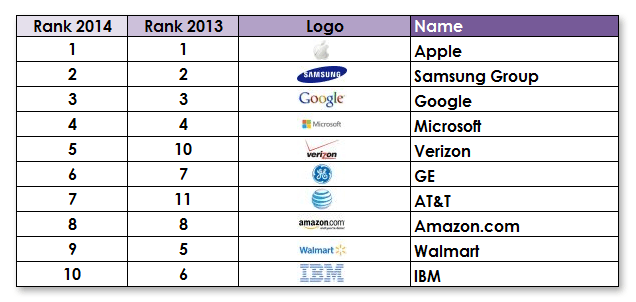
    Ferrari is the world’s most powerful brand. Apple is the world’s most valuable brand. And Tata is the most valuable Indian brand.


    These are the headlines from the Brand Finance Global 500 released on Tuesday, the much-awaited annual study conducted by leading brand valuation consultancy, Brand Finance. The world’s biggest brands are put to the test and evaluated to determine which are the most powerful and most valuable.


    Ferrari is the world’s most powerful brand. The legendary Italian carmaker scores highly on a wide variety of measures on Brand Finance’s Brand Strength Index, from desirability, loyalty and consumer sentiment to visual identity, online presence and employee satisfaction. Ferrari is one of only eleven brands (including Google, Hermès, Coca-Cola, Disney, Rolex and F1 racing rivals Red Bull) to be awarded an AAA+ brand rating and has the highest overall score.


    Said Brand Finance Chief Executive David Haigh: “The prancing horse on a yellow badge is instantly recognizable the world over, even where paved roads have yet to reach. In its home country and among its many admirers worldwide Ferrari inspires more than just brand loyalty, more of a cultish, even quasi-religious devotion, its brand power is indisputable.”


    Though Ferrari is the world’s most powerful brand, being a niche, luxury brand with an officially capped production, it is perhaps unsurprising that it is some way off being the world’s most valuable. Its US$4 billion brand value puts it 350th in brand value terms. Mr Haigh added: “Apple also has a powerful brand, rated AAA by Brand Finance. However what sets it apart is its ability to monetize that brand. For example, though tablets were in use before the iPad, it was the application of the Apple brand to the concept that captured the public imagination and allowed it to take off as a commercial reality.” This is just one of the factors responsible for its US$105 billion brand value; it is the world’s most valuable brand for the third year in a row.


    According to a communiqué: Apple’s dominance is being challenged by Samsung however. The Korean giant’s improving reputation for reliability, a faster pace of innovation and wider range of devices are among many factors that have seen its brand value increase by US$20 billion to US$79 billion this year. Other tech successes include Netflix, which has nearly doubled its brand value to appear in the Brand Finance Global 500 for the first time. Its value has grown 93% in a year to US$3.2 billion, to make Netflix the 468th most valuable brand. Still operating only in the Americas, Scandinavia and the British Isles, there is huge potential for further growth. Facebook meanwhile has recovered from its problematic IPO, which saw its reputation suffer and its brand value plunge in 2013. This year it has rebounded, adding 76% to its brand value to bring the total to US$9.8 billion, putting it 122nd. Investor confidence in its long term prospects has returned as revenues from mobile advertising have grown.


    Tech brands in general have tightened their grip on the Brand Finance Global 500. Walmart is the only non-tech brand remaining in the top 10. Once the world’s most valuable brand, it now sits in 9th having been overtaken by Amazon. The usurpation of the world’s biggest retail brand by the biggest online retailer represents yet another coup for tech brands over ‘real-world’ businesses.


    US brands continue to dominate the Brand Finance’s list, occupying 185 brands of the 500 spots. Japan is second. Despite 7 Japanese brands having dropped out of the table, the total for the country as a whole is up thanks to brand value increases of over 30% from Japan’s three biggest brands; Toyota, Mitsubishi and Honda. President Shinzo Abe’s ‘Abenomics’ programme has begun to pay off and global demand for Japanese goods is improving. Germany, France and the UK complete the top 5. Despite China’s status as the world’s second biggest economy, it is 6th in terms of total brand value as its brands are still developing. Huawei and Baidu have both increased their brand values by over 50%. While controversial for their close associations with the Chinese government, both are likely to exert increasing influence around the world in the next few years.


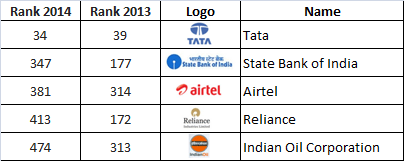
    Nations that have not fared so well include Finland. The country’s only brand, Nokia, has finally been squeezed out of the table after years of slow decline. Nokia has continued to hemorrhage brand value as a result of its inability to effectively counter the challenge Apple and Samsung. Falling out of the Brand Finance Global 500, it follows Blackberry, which dropped out of the top 500 last year. The BRIC nations of Russia, India and in particular Brazil have also fared relatively poorly. The number of Brazilian brands in the table is down from 9 to 5 and those that remain have all lost over 20% of their brand value. One Indian brand has dropped out of the table and several of those that remain have fallen further down the rankings. Tata, India’s flagship brand is the exception however, climbing to 34th worldwide with a brand value of US$21.1 billion.


  • Wills Lifestyle appoints iContract for digital marketing

    By A Correspondent


    Wills Lifestyle, the fashion and lifestyle brand from ITC, has appointed iContract, a part of Contract Advertising, to handle its digital marketing and social media portfolio.


    After a rigorous selection process involving 12 top agencies, from which three agencies were shortlisted for the final round of consideration, iContract was selected for its creative strategy and execution plan to build the brand in the digital space.


    Karan Kumar

    Speaking on the selection process, Karan Kumar, General Manager, Lifestyle Retailing Business Division, ITC said, “The marketing paradigm has changed with the dawn of digital age. Consumer engagement and consumer dialogue has taken the forefront to drive brand salience. With online shopping going live it was inevitable for us to mandate an agency with the brand’s digital duties. With iContract on board we look forward to strengthen brand presence online including social media platforms.”


  • L’Oreal long leap


    By Dibeyendu Ganguly


    Waiting at the reception of L’Oreal India’s corporate headquarters in a new high-rise in Parel, we watch a steady stream of cool people with funky hairstyles breeze in and out the door.


    Could they be employees living their product, we wonder? Or business associates maybe? The mystery’s solved when we go in to meet managing director Jean-Christophe Letellier. “They’re hairdressers,” he says. “Our hairdressing academy is integrated into our office space. It keeps us in contact with our customers. We don’t want a closed office that is shut out from the real world.”


    L’Oreal has 50 academies across the country where it trains 1.5 lakh hairdressers annually in the art of colouring, styling, perming, straightening – all using its own products.


    In an unorganised market, the company has helped upgrade salons and even turned a few of them into chains. This high level of engagement with small salon owners and individual hairdressers has propelled it to the leadership spot in a market where other global brands (Schwarzkopf of Germany, for example) have faltered. Today, it’s normal to find even the most ordinary salons offering L’Oreal as the brand of choice for hair colour.


    “It has taken a huge effort at ground level,” says Dinesh Dayal, L’Oreal’s chief operating officer, who has been with the company for 20 years. “Education is at the heart of our operation. You need a lot of patience, resilience and staying power to succeed.” The salon segment is important, but it is still only 20% of L’Oreal India’s Rs 1,800 crore annual turnover (2013).


    The big chunk of the market is FMCG, where L’Oreal competes with the likes of Unilever, P&G and Lakme in hair care, skin care and cosmetics. One of L’Oreal’s most successful FMCG products has been Garnier Colour Naturals, a crème hair dye launched in 2002 and priced at a fraction of the global brand, L’Oreal Paris Excellence.


    Developed in L’Oreal’s Research Centre in Paris for the Indian market, the product added a new benefit that it could be stored after opening and did not have to be used in one go. It was a hit and is now the market leader in hair colours by far.


    Mr Letellier, who was earlier based in Singapore, heading L’Oreal’s FMCG business for Asia, plans to launch more products developed specifically for the Indian market. He’s spending the largest chunk of his Rs 1,000 crore investment budget for 2011-16 on research & innovation (R&I).


    L’Oreal has always had a small R&I centre at its manufacturing facility in Pune. Last year, it commissioned a larger R&I centre in Mumbai and this year it launched a phytochemistry laboratory for basic research in Bangalore. “Our only chance to be big in India is to invent new products, new categories.


    R&I is at the heart of our strategy here,” says Mr Letellier. A visit to the L’Oreal R&I Centre, spread over two floors in a high-rise in the suburb of Chembur, is revealing. One section has a number of bathrooms where people bathe using L’Oreal products.


    In another section, a group of women are being quizzed by a young lady on their experience with a new face mask while the scientists who are formulating the product monitor the interview behind a one-way mirror, much like in police interrogation rooms. Upstairs, in the laboratory, a chemist is trying out the effects of different dye formulations on strands of Indian hair.


    Another chemist is creating an array of colour options for a hair conditioner, which will later be tested on consumers downstairs. Overseeing all this is Francois Pradier, who arrived in Mumbai from Paris six months ago to take charge as director (R&I) L’Oreal India.


    “We want to attack the market with brand new technologies and products in all categories. We are not interested in making small improvements to existing products,” he says.


    L’Oreal India has just launched a new range of shampoos and conditioners for the scalp under its L’Oreal Paris brand name. Next in line is a hair oil and fairness cream with a talc-like texture, especially formulated for hot and humid conditions, which will be marketed under the Garnier name.


    Meanwhile, the new phytochemistry laboratory in Bangalore has the job of analysing the efficacy of a number of ayurvedic ingredients. Mr Pradier is especially interested in working with traditional products like henna to create ‘bridge products’ that deliver better results while using these familiar ingredients.


    “Expect to hear some breakthough announcements from me in two years,” he says. “We will use all the knowledge of L’Oreal world-wide research to develop something for the Indian consumer. We will also create totally new formulations in our laboratories in India from scratch.”


    Model Citizen

    Beauty, they say, is only skin deep. Who would know that letter than a skin care specialist like L’Oreal? Which is why managing director Jean-Christophe Letellier is seeing to it that the organisation gains inner radiance to go with its good looks.


    “India is part of our universalisation strategy. We want to leave a footprint here as a socially responsible company,” he says. A visible symbol of L’Oreal commitment to being a model corporate citizen is Emmanuel Lulin.


    A Masters in law from the University of Chicago, Mr Lulin has been with L’Oreal for 14 years, seven of which have been as global chief ethics officer. When we meet him, he’s preparing a talk he’s going to give the 300 employees at the company’s Mumbai headquarters.


    “My message is going to be: speak up. We are a very transparent organisation where nobody needs to hold back on anything. We have many new hires and they need to know about the L’Oreal culture,” he says. Mr Lulin defines ethics very broadly as practising correct behaviour, as individuals and as an organisation. “Ethics starts where legal compliance stops,” he says.


    “Ethics is about discretionary decisions and it touches every activity in the organisation.” As global corporates expand into emerging markets that sometimes have a poor record in human rights and corruption, the issue of ethics has gained importance – hence Mr Lulin.


    “We have to be extremely attentive to the local environment, whether it is Brazil, Argentina, Russia or India. Business practises may be different here, but we have to send a message that L’Oreal has zero tolerance for any kind of unethical behaviour,” he says.


    Bribery, discrimination, inadequate safety, conflict of interest, sexual harassment – these have always been problematic issues. The difference now is that information travels much faster nothing stays hidden for long. “If society believes an organisation is unethical, it will sooner or later lose its licence to operate. In today’s world, it will happen much sooner,” says Mr Lulin.


    It has taken a huge effort at ground level. Education is at the heart of our operation. You need a lot of patience, resilience and staying power to succeed.


    Source:The Economic Times

    Copyright © 2014, Bennett, Coleman & Co. Ltd. All Rights Reserved

    Licensed to republish
     

  • Timex modifies positioning to ‘Wear it Well’

    By a correspondent


    Poised as the largest marketing and rebranding exercise ever taken, Timex has unveiled a multi-million dollar marketing campaign that focuses on its American heritage and its portfolio of watches which feature classic styles that stand the test of time.


    The multi-platform ‘Wear it Wellâ„¢’ campaign acknowledges that men and women no longer wear a watch to simply tell time – they wear a watch to make a statement about themselves.


    “Our objective in developing our new positioning and advertising campaign was to help this generation rediscover Timex,” said Paolo Marai, President, Timex Business Unit. “We wanted to communicate that our brand is relevant by leveraging what has made us great for the past 160 years – that Timex is truly timeless and that Timex watches are classics and never go out of style. Wear it Well does exactly that.”


    Created by Toth + Co, an award winning marketing agency based in Cambridge, MA, the campaign is centered around a series of black and white photographs that provide insights into the character of the people who wear Timex watches. Various executions of the ads will appear in print, on-line and outdoor media throughout the world.


  • Brands and retailers team up to offer 0% EMI schemes

    By Writankar Mukherjee


    Zero percent EMI schemes are back. Not that they’d gone away altogether, but offers had dwindled as banks got cold feet after the Reserve Bank of India frowned upon the practice because it seemed to be a way of concealing charges. However, with customers staying away, retailers are entering into business arrangements with brands to draw them back to showrooms, bypassing the banks.


    Under the new arrangement, retailers and manufacturers will share the interest cost on such offers that were earlier taken on by banks and brands. All such offers will be on the (lower) market operating price and not the maximum retail price (MRP) as it often used to be earlier, another grey area that the central bank had pointed out in September last year.


    The country’s largest cellphone retail chain, Essar Group-owned The Mobile Store, launched a zero percent scheme 10 days ago in partnership with Samsung, Sony and Nokia on smartphones bought through credit cards.


    Other chains such as Next Retail, PlanetM Retail and Future Group said they are in the process of launching such schemes, while Tata-owned Croma and Reliance Digital said they would be evaluating such programmes. Sony has re-launched a scheme for its televisions, but it’s taking on all of the interest cost.


    The Mobile Store CEO Himanshu Chakrawarti said there has been a sudden pickup in sales, up 30-35% in the last seven days, through the plan. “Sales are at par with Diwali. A bridge such as interest-free EMI (equated monthly installment) was required and hence we re-launched the zero EMI offer across all brands and banks,” he said.


    Before the RBI notification, zero percent EMI plans accounted for 20-30% of sales of electronic products such as mobile phones, laptops, tablets, LED televisions and home appliances.


    Banks withdrew the credit card schemes in October and started to focus on consumer goods loans, but this failed to pick up the slack as the formalities were cumbersome and interest rates were high. Also, consumer demand has been slack since Diwali with just an occasional bump on special sale days.


    Videocon-group owned cellphone chain PlanetM Retail CEO Sanjay Karwa said the retailer will launch its zero percent scheme by April. “We have got a positive sign from the brands who would share the interest burden and are talking to NBFCs (non-banking finance companies) so that the EMI scheme can also be availed of by those who don’t have credit cards,” he said.


    A senior Sony India official said the company’s scheme has been launched with NBFCs without any processing fees. “Post the RBI diktat when we re-launched the scheme, we strictly informed our trade partners that they won’t charge anything extra and offer it on the market price to comply with the advisory,” he said, requesting anonymity.


    RBI said last year that the schemes “only serve the purpose of (luring) and exploiting vulnerable customers.”


    The central bank had said the interest component was being camouflaged and passed on to consumers in the form of a processing fee. Besides this, such loans were mostly on MRP, which was always higher than the actual market price.


    RBI mandated banks to offer loans on the market price of the product and be open about interest costs and the final price mechanism. The new zero interest schemes will ensure transparency with the credit card statement of the consumer showing how brands and retailers have subsidised the interest cost.


    Ajit Joshi, chief executive officer and MD at Infiniti Retail, which owns the Croma chain of stores, said the company would seek legal opinion before re-launching zero percent EMI schemes.


    “Of course, such a scheme would help to boost demand of premium products but we would evaluate it thoroughly before re-launching it,” Joshi said.


    A senior Reliance Retail official said that the company would be interested in re-launching such schemes now that the brands were picking up the interest cost.


    Source:The Economic Times

    Copyright © 2014, Bennett, Coleman & Co. Ltd. All Rights Reserved

    Licensed to republish
     

  • Bata goes ‘waist down’ with its new TVC

    By a correspondent


    Leading footwear retailer and manufacturer Bata announced the launch of its new Spring Summer’14 marketing campaign for its entire range of footwear, accessories, bags and glasses. The campaign features a 360-degree multimedia integration of TV commercial, radio, cinema, print, innovative outdoor, events, promotions and digital platforms.


    The TV commercial has been innovatively shot to capture slice-of-life situations in the lives of people through a literal focus on the footwear. The film uses a unique technique of following those real life moments by showing the action only from knee down. The situations captured include from the nervous to the dramatic to the adventurous, including a group of students eagerly looking at their exam results, colleagues watching a cricket match in office and a group of young girls enjoying their ‘day out.’ The film also showcases all the leading brands in their latest styles from Bata in an aspirational way. Shot in a contemporary manner and stitched together using fast-paced music, the film reiterates the brand’s presence in the lives of individuals, cutting across the barriers of age, a necessity considering the eclectic portfolio of Bata.


    The campaign is yet another remarkable milestone in Bata’s journey of symbolizing that shoes can be lifestyle led, young, vibrant and yet comfortable. The campaign’s “waist down” TVC treatment captures how the shoe line’s range covers the gamut of shoes from business indoors to comfortable outdoors.


    Sumit Kumar, Vice President and Head of Marketing and Customer Service, Bata India said, “Drawing on our vast experience and understanding of the Indian consumer, we have designed our latest 360-degree marketing campaign to appeal to the sensibilities of the Indian consumer across age groups and demographic profiles. We have a fantastic range of stylish, on-trend and contemporary products that will appeal not only to our loyal customers but also to a wider audience. We intend to communicate the brand as aspirational and yet comfortable. We are continuing our external marketing journey with fabulous in-store environment featuring our new global concept stores to make shopping a pleasurable experience for our customers.”


    Sonal Dabral
    Sonal Dabral

    Sonal Dabral, Chairman & CCO, DDB Mudra Group said, A whole generation of Indians have grown up with Bata and it’s an inseparable part of everyone’s growing up memories. The strategy and the idea behind the new campaign is to build on this equity and to also help the brand make a fresh connect with the youth. I am really excited for the TVC we have worked on. A story told by the stylish Bata shoes themselves which I’m sure will do its bit in helping make this iconic brand a vibrant and colourful brand of today transforming it from just a shoe to a destination where life meets style.”


  • And now the Sau Crore ad campaign

    The Big Bazaar and DDB Mudra teams while announcing the campaign to the media. Sonal Dabral was travelling


    By A Correspondent


    If their offices aren’t buzzing with business cards from television adsales folk, they will do so now. Future Group’s Big Bazaar and its Media AOR Allied Media (of the Percept group) will see budgets for television adspends zooming from 10 to 40 percent. Printwallahs needn’t despair: while the allocation will go down from the current 70 taka to 40, in value terms the moolah isn’t going to go down.


    The purse of Rs 200 crore on adspends is going to expand by another Rs 75 crore. Rs 100 crore is going to be spent on the TVCs alone, with another Rs 20 crore on allied activities around the expanded purse of Rs 275 crore now earmarked for TVCs.


    Inspired by Swedish homestore Ikea’s 365 ads in 365 days campaign, the Big Bazaar bosses commissioned its creative agency DDB Mudra to craft a strategy which the agency’s Group CEO and Managing Director Madhukar Kamath says is the biggest ever marketing campaign he has seen in his near four-decade-long career. “We were commissioned five weeks back, and produced the commercial within days,” said Kamath.


    For Future Group CEO Kishore Biyani, the attempt is to adapt to changing times. He isn’t fazed by the extra marketing spends with Rs 120 crore on this year-long blitz. “The increase in sales will take care of the enhanced spends,” he told MxMIndia. Added Sandeep Tarkas, President, Customer Strategy (Future Group) and CEO (Future Media): “We hope to see sales grow by 20 per cent on the back of this campaign.” Until now, the hypermart thinktank’s strategy has been on tactical advertising, but this 52-TVC campaign which goes on air on March 24 takes one product every week from Big Bazaar and through them demonstrate how these products are making the lives of Indians more beautiful. The campaign will be backed by outdoor, radio and in-store visual merchandising. Print will not be a part of the campaign, though.


    Each TVC is a light-hearted commentary on the changes that are happening in Indian society, and make for interesting stories of the role that products play in making people’s life more beautiful and enriching. Added SonalDabral, Chairman & CCO, DDB Mudra Group: “In terms of tonality, we have kept it real because that’s the voice of Big Bazaar. These are not ad films they are closely observed 52 sparkling stories of the small changes Big Bazaar and its products are bringing to everyday India.”


    Added Mr Kamath: “It is a unique, never done before and a brave campaign which can only come from a leader like Big Bazaar. The brand has been at the forefront of innovation and leading change. This campaign redefines the step-change that Big Bazaar is making in its relationship with its current and prospective shoppers. It will further establish Big Bazaar as a company that sells products which enable and inspire every Indian to make their world look beautiful on the outside, as well as on the inside.”