Category: MARKETING

  • SapientNitro is Lycra’s global AOR

    By A Correspondent


    SapientNitro has announced that it has been appointed global advertising agency of record for the Lycra brand. Invista, which owns the brand, has tasked SapientNitro with responsibility for global brand strategy, advertising, digital, social and customer experience.


    Said Bob Kirkwood, Executive Vice-President of Marketing at Invista: “Lycra is one of the best known ingredient brands globally and we have high aspirations for the brand. We want to communicate our brand positioning to the millennial generation and build a consumer following of Lycra brand ambassadors.”


    The account will be run out of SapientNitro’s London office. The work will involve TV-led brand advertising as well as co-operative campaigns with famous garment and retailer brands and will be rolled out globally across key regions in 2014.


    Said Nigel Vaz, SVP and European Managing Director at SapientNitro:  “Invista is an exceptional global innovator. This is a fantastic global advertising account win for us and a powerful demonstration of where our Storyscaping approach – which combines the power of storytelling with systems thinking to allow brands to create not just ads but worlds – can take us and our clients.”


  • Mumbai leg of IAA Retrospect & Prospects with D Shivakumar on Feb 12

    D Shivakumar

    By A Correspondent


    PepsiCo India Chairman and CEO D Shivakumar will present a 60-minute review of the highs and lows in media, advertising and marketing in 2013 and a forecast of what will happen in 2014 Colors is presenting partner of the event which will be held at Hotel Sahara Star. Last month, Mr Shivakumar had presented a similar session in Delhi NCR.


    Srinivasan Swamy

    Said Srinivasan Swamy, President, IAA India Chapter and VP-Development, IAA Asia Pacific: “This would be infotainment at its best. In sixty minutes, we will have the wisdom and insights of a leader of our fraternity encapsulating the immediate past and the near-future in an absorbing audio-visual format. It will be a must-see for all members of our industry. The Delhi audience loved it. We, along with our partner Colors, felt there was a need to present this in both Mumbai and Delhi.”


  • Noose on ‘misleading’ ads gets tighter as govt panel says celebs also liable for endorsements

    By Dipak Kumar Dash


    If the skin whitening cream isn’t as phenomenal as advertised or the hair oil not producing a lush mop as promised, you may soon be able to claim compensation not only from the advertisers, but from the celebrities endorsing the product.


    The Central Consumer Protection Council (CCPC), under the chairmanship of minister K V Thomas, on Monday decided to set up a sub-committee to suggest strategies to deal with such advertisers. Among the concerns raised was peddling of products by celebrities.


    “About 50% of the daylong conference was spent addressing … the huge impact of misleading advertisements, particularly food items, hair oil and health products,” said a CCPC member who attended the meeting in Kochi. “Even the celebrities must pay compensation in case there is a complaint,” said Joseph Victor, a CCPC member.


    What seems to have moved the consumer affairs ministry is a direction from the MP high court to set up an ad monitoring panel as recommended by the Vibha Bhargava Commission. “An ad monitoring committee with proper budgetary support from the Centre may be set up to monitor the advertisements on regular basis… the committee will have the powers to (take) corrective actions and (impose) compensation,” the CCPC said.


    Sources said that the decision was taken unanimously by CCPC, which has members from central and state governments, besides representatives from consumer organizations and academicians. The sub-committee may be formed in less than a week and could submit its recommendations by February-end, sources said.


    Some members saod the issue of southern superstar Mamootty endorsing products was discussed. “We have similar problems across the country. We have Shah Rukh Khan or some other Hindi film star endorsing consumer items and they get huge payment for doing so. A misleading ads featuring such famous faces shown on TV even for a day serves the purpose of advertisers. We discussed how suo motu action can be taken against ads which have been withdrawn. Even the celebrities must pay compensation in case there is a complaint,” said Joseph Victor, a CCPC member.


    Another member, Ashim Sanyal, said he had raised the issue of monitoring ads, which are in huge numbers and across different modes and media. “We need to plan the mechanism for monitoring. The sub-committee will come out with directions and provisions to deal with the menace,” he added. Lok Sabha MP Charles Dias, who also attended the meeting, told TOI that concerns were raised on manufacturers’ ad spend, which is passed on to buyers. “Most of us felt that there should some sort of monitoring on how much is being spent on advertisements,” he said.


    Source:The Economic Times

    Copyright © 2014, Bennett, Coleman & Co. Ltd. All Rights Reserved

    Licensed to republish


  • Damodar Mall to helm Reliance’s supermarket biz

    By Rasul Bailay & Chaitali Chakravarty


    Damodar Mall

    Damodar Mall will take over from Rob Cissell as chief executive of Reliance Retail’s supermarket and hypermarket division as the former chief operating officer of Walmart China is leaving after three years running the business.


    Value retail, which includes supermarkets and hypermarkets, grocery and cash-and-carry, accounted for 53% or Rs`5,700 crore of the Mukesh Ambani-run Reliance Industries’ retail venture in the first nine months of the current fiscal year. Randall Guttery will continue to be in charge of the cash-and-carry business.


    “After a stint of three years leading our consumer grocery business, Rob has decided to relocate outside India to pursue other opportunities,” said an internal communication announcing the management change. “Rob will continue to work with us till March 31, 2014.”


    The latest announcement is part of other organisational changes at Reliance Retail. Mr Guttery, another Walmart executive who joined with Mr Cissell and who has been spearheading the cash-and-carry business Reliance Market, will now double up as a mentor for the grocery unit that includes the Reliance Fresh convenience chain, besides the Reliance Super and Reliance Mart supermarkets. “To be in line with our stated objective of simplification, we would be creating a common executive management structure for grocery business. This will allow us to leverage the complementary skill sets available within the business,” said the internal communiqué to staff.


    “However, to continue the focus on consumer and wholesale nature of the formats we will continue to operate with two separate executive councils providing leadership to these formats respectively.” A Reliance Retail spokesperson declined to comment on the developments.


    During Mr Cissell’s tenure, Reliance Retail has focused on larger supermarkets rather than the smaller convenience store format that competed directly with India’s formidable neighbourhood shops.


    Rob Cissell

    Mr Cissell took over in 2011 from Gwyn Sundhagul, another expatriate with global experience who’d worked at Tesco Lotus in Thailand. Apart from Mr Cissell and Mr Guttery, it hired another former Walmart executive Shawn Grey as chief operating officer of the value retailing business as part of a round of top management changes since starting up in 2006. Both Mr Cissell and Mr Gray were part of the top team at Walmart’s China arm that had around 333 outlets, generating $7.5 billion in revenue, or 1.8% of the Bentonville, Arkansas-based company’s total sales of $420 billion in 2010.


    Mr Mall, currently chief customer strategy officer for the value retail business is an industry veteran having previously worked at Future Group.


    Reliance Retail, which operates more than 1,500 stores in 141 cities, posted sales of .`10,857 crore in the nine months ended December 2013.


    Source:The Economic Times

    Copyright © 2014, Bennett, Coleman & Co. Ltd. All Rights Reserved

    Licensed to republish


  • Indian car buyer act very rationally: Deloitte report

    By A Correspondent


    Indian car buyers act very rationally while making their purchase decisions, noted a report by Deloitte titled “Driving through the consumer’s mind – Considerations for Car Purchase”. While the brand itself and the perceptions around it are important, the buyer today looks to buying a car for the family and subsequently looks at the quality of the dealership for service, vehicle reliability and re-sale value while shortlisting brands; thereby ensuring that several brands get into the consideration set of a buyer, says the report.


    According to Mr. Kumar Kandaswami, Senior Director – Deloitte Touche Tohmatsu India Private Limited, “Contrary to the popular notion that car buying is an emotional decision, rationality has come out as a strong aspect amongst Indian buyers. Once primary reasons to buy a car such as space, family requirements or need to upgrade are fulfilled, buyers look for quality of service, product reliability and re-sale value. Fuel efficiency is no longer a unique differentiator to attract consumers; presumably, it is a table-stake matter. Given these factors, it becomes extremely important for the OEMs to manage the expectations of the consumers appropriately through the life cycle of the product to be considered favourably for the next purchase”.


    Key findings of the report have been detailed under three broad areas impacting the decision making process towards any particular brand:


    Purchase Drivers –

    :: Necessity of having a car for the family needs drives the buying behavior of the first time buyers irrespective of their age and gender. Once the buying decision is made, factors such as reliability, dealer service and resale value determine the brand choice of the consumers.


    :: For repeat buyers, technology and larger space requirement stood out as ruling factors. Unlike the first–time buyer, a repeat buyer understandably aspires to upgrade. In their case, a more sophisticated product is the primary requirement. As in case of first time buyers, repeat buyers too use reliability, dealer services and resale value as filters to make brand choices.


    :: In respect of choices related to changing their cars, the average time between purchases of two cars is likely to be 6-7 years. While males typically drive a car for 55,000 km or more before making a new purchase, female consumers are likely to change cars after 45,000 km.


    :: Future usage trends indicate that the share of personal cars is expected to increase over the next five years at the cost of other mobility solutions. This increased usage will largely be driven by Gen Y and women drivers. Consequent to the increased usage, the time to own a car is also likely reduce from the current 6+ years to about 5.5 years.


    Brand Consideration –

    :: While considering which brand to buy, what has come out as a significant trend is that both first time and repeat buyers, consider 3-5 brands before making their final selection, thus giving most brands a chance to get into the consideration set. This trend has been true for Indian buyers for over seven years, covering both the high growth and difficult periods. Further, SUV and Mini-Van owners tend to look for more options before making their final decision on a particular brand as compared to consumers who look out for a hatchback and sedan.


    :: One key highlight remains that the number of brands considered remains similar for non-luxury as well as luxury cars, indicating importance of a car value proposition in both the consumer segments. Even in case of repeat purchases, buyers don’t behave very differently from the first time buyers, thus indicating that they do not identify themselves with a brand in terms of personality or performance.


    :: Rural buyers look out for limited number of brands in comparison to urban or semi-urban buyers, which may also be a function of the choices available and the price points they consider.


    :: There is a small but increasing trend amongst the urban population of going with a single brand which may be on account of familiarity of the brand, loyalty programs of OEMs, or the aspirational value offered by a brand at that point of time for a particular product.


    :: With the increase in the car price, consumers tend to evaluate greater number of brands, with Gen X considering more brands as compared to Gen Y consumers. Gen X consumers, who own a car between Rs 6-8 lakh, tend to evaluate more number of brands, with more than 40% evaluating six or more cars for their last purchase. However, less than 20% of Gen Y consumers evaluated six or more across the price range.


    :: Sedans are placed at the top of the consideration set for the current hatchback owners for their next vehicle purchase and SUVs for the current sedan owner. Similarly, respondents with cars in the price range of Rs 2-6 lakh are more likely to consider sedans for their next purchase. This highlights the aspiration of the consumers to purchase a larger car and move up to the next segment. However, SUV owners buck the trend with more than 50% of SUV owners expressing a desire to go for another SUV in their next purchase.


    Brand Perception of Car Owners –

    :: Interestingly, when respondents were asked to specifically mark the brands they considered before making their selection, they ended up with more number than their stated position of considering 3-5 brands, thus suggesting that they started with a long-list of several brands but seem to think of a smaller number as a serious set of possibilities.


    :: In case of brands considered by existing car owners, SUV owners considered more brands as compared with van/mini-van users. From the number of brands that are considered, it is apparent that product types other than what they eventually select are considered.


    :: While rating their own brand choice, owners seemed to be reasonably happy with what they have. Consumers are likely to once again consider several brands when they are in the market to buy their next car, thus making it imperative for the OEMs to convert their current satisfaction levels into brand loyalty and repeat purchase.


    For the Driving through the consumer’s mind – Considerations for Car Purchase Report 2014, please click here.
     

  • Tata group drafts new rules for royalty & ethics

    By Kala Vijayaraghavan & Satish John


    The $97-billion Tata Group has started work on an overhaul of its Brand Equity and Business Promotion (BEBP) agreement, an omnibus document that governs, among other things, which group companies use the Tata name and how, and also how much royalty they pay for it.


    The agreement, drafted in 1996 and never revisited since, is now being redrawn to reflect the ‘more universal’ nature of its business as 63% of revenues now accrue from overseas. This includes multibillion dollar businesses Jaguar Land Rover, Corus Group and soda ash maker General Chemicals.


    “A number of brands in the Tata fold don’t carry the Tata name and, therefore, it is critical that more investors, consumers and stakeholders in international markets are aware of the history and heritage of the group,” said Mukund Rajan, Tata Group’s brand custodian and chief ethics officer, confirming the revamp plan. Asked if this would entail global group companies such as JLR and Corus also paying royalty, Rajan declined comment saying such decisions are yet to be made.


    Group firms that use the Tata name directly pay a royalty of 0.25% of respective revenues. Companies such as Titan that don’t use the Tata name directly pay less.


    Streamline use of Tata brand

    “We have to streamline the way our companies use the Tata brand,” another official involved in the revamp of the BEBP said. “In the past, we have allowed Tata companies to use the Tata brand and other companies have not. Do we have sufficient clarity in our own minds on how we want to build the brand? It is still work in progress.”


    Sources say that top group officials feel the international visibility of the Tata brand is not up to the mark.


    The group will also soon unfurl a major corporate campaign to build awareness among investors, consumers and stakeholders on ‘Brand Tata’ in its major overseas markets.


    “In some markets, Tata is known as a software company while in some markets as an automobile maker. Our last big brand campaign was done in 2004 and therefore it is critical to ensure that key stakeholders and influencers are aware of our heritage and legacy,” Rajan added. He is also the chairman of the Tata Council for Community Initiatives.


    The Tata Code of Conduct, a part of the BEBP agreement, is also being reworked to make it more relevant in “certain jurisdictions” outside India. “We have to see whether it is potentially conflicting with local regulatory requirements.


    We want a code which resonates with regulations in different geographies,” the official added. Tata Sons, the holding company of the group, owns the Tata brand and the Tata trademark registered in India and several other countries. Individual companies have signed the BEBP with Tata Sons.


    Source:The Economic Times

    Copyright © 2014, Bennett, Coleman & Co. Ltd. All Rights Reserved

    Licensed to republish


  • Jio mere lal! Mukesh Ambani’s son Akash joins RIL; begins at telecom arm

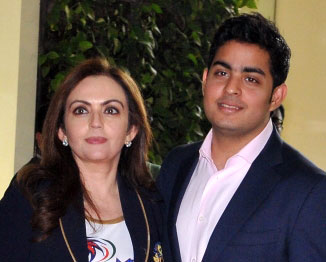
    Akash Ambani with mother and Reliance Foundation chairperson Nita Ambani at the IPL auctions on February 13… Fotocorp

    By Rajeev Jayaswal & Chaitali Chakravarty


    Thirty-two years ago, Dhirubhai Ambani’s son Mukesh joined the company his father had founded. Now, Chairman Mukesh Ambani’s son Akash has joined Reliance Industries Ltd, starting at its telecom unit at a critical time. He’s involved in finalising the go-to-market strategy of the ambitious 4G telecom venture, said two persons aware of the development.


    “He comes to office regularly and sits in review meetings with his father and Manoj Modi. He is also working closely with Reliance Jio Infocomm’s Group President Sandip Das. The company doesn’t want to talk about it because he is new to the business and learning the ropes,” said one of those cited above.


    It is learnt that Akash, who was also seen at the IPL players’ auction last week along with mother Nita Ambani, is working with Mr Das in preparing a comprehensive plan for Reliance Jio that will include strategies for customer acquisition, service, call centres and related issues.


    According to one of the persons cited above, Mukesh Ambani is keen that his son sits through all critical meetings of Reliance Jio because he feels this would be the best education for him. The elder Ambani learnt the fundamentals of the group’s flagship petrochemicals business by shadowing his father, the late Dhirubhai Ambani, at every meeting and at every juncture that decisions were taken.


    Mukesh Ambani joined RIL in 1981 at the age of 24 and went on to set up India’s biggest refinery at Jamnagar in Gujarat. He was also responsible for setting up the group’s telecom venture and had an ambitious vision of where he wanted to go with it. But the unit became part of younger brother Anil Ambani’s businesses following a split between them. A subsequent rapprochement between the brothers meant the older brother could reenter the business that he felt so strongly about.


    An RIL spokesman did not respond to repeated requests for comment on the younger Ambani’s induction. Akash Ambani, 22, who pursued undergraduate studies at Brown University in the US, returned to India last year to intern in the family business. His twin sister Isha, a graduate from Yale, is likely to join the Reliance Foundation, which houses the group’s schools and hospital ventures, said a person aware of the plans. Their younger brother, Anant, is pursuing higher studies in the US.


    People familiar with the inner workings of the company say Mr Modi is one of Akash’s key mentors. Mr Modi, 55, was Mukesh Ambani’s classmate at engineering college and is a hands-on operations person.


    Regarded by many as Mr Ambani’s closest associate, Mr Modi played a large role in setting up the Hazira petrochemicals complex, the Jamnagar refinery, the first telecom business, Reliance Retail and now the 4G rollout. The 4G project provides the right opportunity for the younger Ambani to learn the basics of setting up a venture from scratch, said some of those cited above.


    RIL, which is said to have aggressive plans to roll out a nationwide voice and data network to rival that of the incumbents, bid around Rs 11,000 crore for spectrum in auctions that ended last week. Reliance Jio, a subsidiary of RIL, is the first telecom operator to hold a pan-India unified licence, which means it can offer all telecom services everywhere in India.


    The initiation of Akash into the telecom venture seems to be a conscious decision on the part of Mukesh Ambani because the business combines both the need for innovation and taps into the aspirations of the younger generation. Akash is part of a venture that has grown rapidly from less than 700 professionals a year ago to over 3,000 employees. Reliance Industries as a whole is a powerhouse with a net profit of Rs 21,003 crore and total assets in excess of Rs 318,500 crore.


    Ambani junior is often seen in the Reliance Corporate Park located at Ghansoli in Navi Mumbai, people said. The plush corporate office, popularly known as RCP, was built about four years ago and houses almost all the RIL businesses. RCP also has an office for Ambani senior, although he usually functions from Maker IV in Nariman Point. Akash’s RCP office is in the same building as that of the chairman’s office, they said.


    Much will depend on how Reliance’s long-anticipated telecom plans unfold. Bharti, Vodafone and Idea will fight hard to make sure the new entrant doesn’t hurt their business.


    The younger Ambani has been given the ideal platform from which to launch himself and make a mark as the first member of the third generation of a family that has transformed India’s business history in the past half-century.


    Source:The Economic Times

    Copyright © 2014, Bennett, Coleman & Co. Ltd. All Rights Reserved

    Licensed to republish


  • Apple, Ferrari top world’s brand list


    By A Correspondent


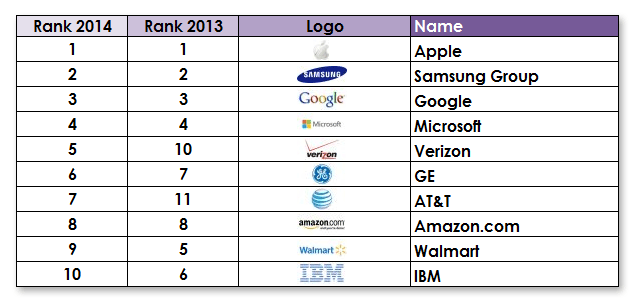
    Ferrari is the world’s most powerful brand. Apple is the world’s most valuable brand. And Tata is the most valuable Indian brand.


    These are the headlines from the Brand Finance Global 500 released on Tuesday, the much-awaited annual study conducted by leading brand valuation consultancy, Brand Finance. The world’s biggest brands are put to the test and evaluated to determine which are the most powerful and most valuable.


    Ferrari is the world’s most powerful brand. The legendary Italian carmaker scores highly on a wide variety of measures on Brand Finance’s Brand Strength Index, from desirability, loyalty and consumer sentiment to visual identity, online presence and employee satisfaction. Ferrari is one of only eleven brands (including Google, Hermès, Coca-Cola, Disney, Rolex and F1 racing rivals Red Bull) to be awarded an AAA+ brand rating and has the highest overall score.


    Said Brand Finance Chief Executive David Haigh: “The prancing horse on a yellow badge is instantly recognizable the world over, even where paved roads have yet to reach. In its home country and among its many admirers worldwide Ferrari inspires more than just brand loyalty, more of a cultish, even quasi-religious devotion, its brand power is indisputable.”


    Though Ferrari is the world’s most powerful brand, being a niche, luxury brand with an officially capped production, it is perhaps unsurprising that it is some way off being the world’s most valuable. Its US$4 billion brand value puts it 350th in brand value terms. Mr Haigh added: “Apple also has a powerful brand, rated AAA by Brand Finance. However what sets it apart is its ability to monetize that brand. For example, though tablets were in use before the iPad, it was the application of the Apple brand to the concept that captured the public imagination and allowed it to take off as a commercial reality.” This is just one of the factors responsible for its US$105 billion brand value; it is the world’s most valuable brand for the third year in a row.


    According to a communiqué: Apple’s dominance is being challenged by Samsung however. The Korean giant’s improving reputation for reliability, a faster pace of innovation and wider range of devices are among many factors that have seen its brand value increase by US$20 billion to US$79 billion this year. Other tech successes include Netflix, which has nearly doubled its brand value to appear in the Brand Finance Global 500 for the first time. Its value has grown 93% in a year to US$3.2 billion, to make Netflix the 468th most valuable brand. Still operating only in the Americas, Scandinavia and the British Isles, there is huge potential for further growth. Facebook meanwhile has recovered from its problematic IPO, which saw its reputation suffer and its brand value plunge in 2013. This year it has rebounded, adding 76% to its brand value to bring the total to US$9.8 billion, putting it 122nd. Investor confidence in its long term prospects has returned as revenues from mobile advertising have grown.


    Tech brands in general have tightened their grip on the Brand Finance Global 500. Walmart is the only non-tech brand remaining in the top 10. Once the world’s most valuable brand, it now sits in 9th having been overtaken by Amazon. The usurpation of the world’s biggest retail brand by the biggest online retailer represents yet another coup for tech brands over ‘real-world’ businesses.


    US brands continue to dominate the Brand Finance’s list, occupying 185 brands of the 500 spots. Japan is second. Despite 7 Japanese brands having dropped out of the table, the total for the country as a whole is up thanks to brand value increases of over 30% from Japan’s three biggest brands; Toyota, Mitsubishi and Honda. President Shinzo Abe’s ‘Abenomics’ programme has begun to pay off and global demand for Japanese goods is improving. Germany, France and the UK complete the top 5. Despite China’s status as the world’s second biggest economy, it is 6th in terms of total brand value as its brands are still developing. Huawei and Baidu have both increased their brand values by over 50%. While controversial for their close associations with the Chinese government, both are likely to exert increasing influence around the world in the next few years.


     

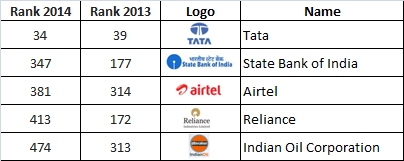
    Nations that have not fared so well include Finland. The country’s only brand, Nokia, has finally been squeezed out of the table after years of slow decline. Nokia has continued to hemorrhage brand value as a result of its inability to effectively counter the challenge Apple and Samsung. Falling out of the Brand Finance Global 500, it follows Blackberry, which dropped out of the top 500 last year. The BRIC nations of Russia, India and in particular Brazil have also fared relatively poorly. The number of Brazilian brands in the table is down from 9 to 5 and those that remain have all lost over 20% of their brand value. One Indian brand has dropped out of the table and several of those that remain have fallen further down the rankings. Tata, India’s flagship brand is the exception however, climbing to 34th worldwide with a brand value of US$21.1 billion.


  • Wills Lifestyle appoints iContract for digital marketing

    By A Correspondent


    Wills Lifestyle, the fashion and lifestyle brand from ITC, has appointed iContract, a part of Contract Advertising, to handle its digital marketing and social media portfolio.


    After a rigorous selection process involving 12 top agencies, from which three agencies were shortlisted for the final round of consideration, iContract was selected for its creative strategy and execution plan to build the brand in the digital space.


    Karan Kumar

    Speaking on the selection process, Karan Kumar, General Manager, Lifestyle Retailing Business Division, ITC said, “The marketing paradigm has changed with the dawn of digital age. Consumer engagement and consumer dialogue has taken the forefront to drive brand salience. With online shopping going live it was inevitable for us to mandate an agency with the brand’s digital duties. With iContract on board we look forward to strengthen brand presence online including social media platforms.”


  • Infibeam to acquire digital marketing firm ODigMa

    By A Correspondent


    Ahmedabad-based ecommerce company Infibeam has acquired a 100 percent stake in ODigMa, a leading digital marketing company headquartered in Bengaluru. The buy will help the seven-year-old ecom firm strengthen its offerings.


    ODigMa is a specialist in customer engagement via social networks and Twitter and Whatsapp. Infibeam, on the other hand, runs a B2C platform Infibeam.com and a B2B platform at BuildaBazaar.com.


    With more than 400 brands as clients, ODigMa will help Infibeam’s merchant on its B2B service. Said Sachin Oswal, COO, Infibeam.com: “The OdigMa acquisition will expand our digital marketing capabilities in the key areas of social media and SEO, SEM etc. complementing our existing strengths.”


    Advit Sahdev, CEO of ODigMa, added: “We are excited to build tools and processes to deliver transformational marketing services for SMEs and enterprise clients by attracting the best talent in the industry.”


  • Titan study pegs consumption as top priority for India’s millennials

    By a correspondent


    New research published by Titan Company’s Paradox Panel, a think-tank convened to research, debate and develop insights into India’s 21-35 year-olds states that the status associated with communicating and sharing each stage of the purchase process is potentially more important to India’s millennial consumers than what they actually purchase.


    According to the report, with 89 per cent of Indian millennials researching online before making a purchase, and 74 per cent believing that they influence the buying decisions of others, the entire consumption process has become an opportunity to enhance profile and status – from research to post-purchase.


    While India’s millennials are extremely individualistic in their shopping habits, the report suggests that 43 per cent Indian millennials shop alone and a third of them cite ‘personal satisfaction’ as the single most important factor behind their decision-making – the need for endorsement, validation and communication of each stage of the purchase process remains ever-present. Further, 9 out of 10 Indian millennials actually believe it’s their responsibility to share feedback with companies after a good or bad brand experience; sharing is not merely desirable for millennials, it has become a fundamental aspect of consumer behaviour.


    The concept of Collective Individualism highlights this demographic group’s obsession with self-expression, individual choice and personal opinion, while at the same time exhibiting an unprecedented desire to share and belong to some form of community, both in the professional and personal context.  According to the Paradox Panel’s Second Quarterly Report – India’s Millennial Paradox and what it means for the way they consume – this contradiction is palpable at each stage of the purchase process.


    Another consumer trend revealed in the report is millennials’ obsession with the search for wisdom; not knowledge in the traditional sense, but rather information which is compelling yet difficult to find – the more compelling the information and complex the search the greater the resulting prestige.


    According to S Ravi Kant, CEO, Eyewear Division & Executive Vice President Corporate Communications, the purchase process perfectly reflects the Collective Individual paradox at the heart of India’s millennials. “India’s millennials see value not just beyond the product but in all stages of the ‘highly involved’ purchase cycle; from the research and selection to the acquisition and the final experience. The ability to share and validate each step of the process is absolutely critical. The contradiction being that, while today’s millennial consumers demand an experience which is genuinely personalised and unique, they also crave endorsement and approval at each stage of the process.”


    To mark Titan company’s 25th anniversary, the Paradox Panel comprising Aditya Swamy – Executive Vice President, MTV India, Dr. Bino Paul – Professor and Chairperson, Tata Institute of Social Sciences, Kaustav Sengupta – Associate Professor at National Institute of Fashion Technology, Sam Ahmed, Film Director and Arun Nair, Your Design and Punchline will be exploring the implications of the Millennial Paradox on India’s youth in terms of their consumer behaviour, family and relationships, professional lives and careers, and leisure.


  • Unlike @SrBachchan, Shah Rukh says he will not deride brands he’s endorsed

    By Krishna Kumar


    Shah Rukh Khan
    Amitabh Bachchan

    Shah Rukh Khan said that he will never make fun of any brand he has once endorsed, taking a sideswipe at Amitabh Bachchan’s recent ‘poison’ comment on Pepsi.


    “Having worked with someone, should I ever deride it? No. I have been an employee of someone,” the film star said on Monday. Khan’s comment comes just about a month after Bachchan said that he stopped endorsing Pepsi after a girl asked him why he was promoting something her teacher had termed as “poison”.


    Speaking at the sidelines of a brand event in Mumbai, Khan said, “People sometimes even question why we are endorsing XYZ product. My logic is, if it is legal, if it is available in the market, then there is nothing wrong in endorsing that particular product.”


    At the same time, Shah Rukh Khan said that being a professional actor, he sees no issues with endorsing competing brands at different times. “I was endorsing the brand you just mentioned (Pepsi), now I endorse Sprite, and now I do Frooti. You have different considerations. The accountability of a celebrity is as much as you know about the product,” Khan said.


    Source:The Economic Times

    Copyright © 2014, Bennett, Coleman & Co. Ltd. All Rights Reserved

    Licensed to republish