Category: MARKETING

  • Saavn & Tata Docomo launch multi-channel mktg prog

    By A Correspondent


    Digital music service Saavn has announced the rollout of a pop culture marketing campaign to complement its recent data partnership with telecom operator Tata Docomo. Docomo’s target audience in India is comprised of more than 80 percent youth, resulting in a conscious effort to roll out a marketing campaign featuring US artists Justin Timberlake and Daft Punk. Saavn and Docomo have taken a joint initiative to run the campaign aimed at increasing the level of awareness through various touch points. The campaign will include TV, in-store, social and a massive SMS marketing programme.


    The marketing campaign is an extension of a deal between Saavn and Docomo that kicked off earlier this month, bringing Indian mobile users a music-integrated data plan for the first time ever. Docomo’s subscribers will now have access to Saavn’s catalogue of 1.1 million songs via a special stream-anywhere data plan – no WiFi necessary. Three monthly plans are available for Docomo’s GSP Prepay customers: 500 minutes, 1,000 minutes and 2,000 minutes.


    Both companies believe the campaign and new data service will create more value for Indian consumers to adopt smartphone data services while enjoying free social music services.


    With 700 million mobile users, India boasts one of the largest mobile phone user bases in the world. This partnership marks the first-ever streaming music and carrier deal in India following a global trend of similar deals in America, Brazil, Scandanavia and France. Slacker and Muve recently teamed with carriers in the US, and Spotify and Deezer have launched similar programmes in Scandanavia and France respectively.


    “In India, consumers need an emotional reason to purchase data plans – music is the answer,” Paramdeep Singh, Co-founder and Managing Director of Saavn, said. “The combination of Docomo’s stellar reputation as a carrier, our vast Indian music catalog, and the appeal of global pop brands like Justin Timberlake, Daft Punk, Pink, Michael Jackson and Rihanna will only amplify the benefits of a worldwide shift in the way mobile users consume data.”


    Content-integrated data plans are emerging as a three-way win: content providers can win millions of users out of the deal, carriers further substantiate date packages and open themselves up to a mobile advertising market worth billions of dollars, while consumers retain the freedom to consume data without being penalized.


  • SRK returns to push relaunched Emami Fair and Handsome

    By A Correspondent


    Emami Ltd has relaunched its fairness cream for men, Fair and Handsome, in a bid to expand further on its dominant market position in personal care segment. Riding on the brand equity of its endorser Shahrukh Khan, the brand has had a numero uno run with market share volume clocking in at 58 percent of the Rs 329 crore men’s fairness market, in FY 12-13.


    The relaunch of the new Fair and Handsome, which is developed in collaboration with Actiogen Corp, USA, is supported by a 360-degree integrated communication. The relaunch will see an A&M spend of 20 percent of the total targeted sales of the brand for the current financial year.


    With Indian middle class expected to increase tenfold to 583 million by 2025, the Indian consumer market is at the threshold of becoming the fifth largest in the world, offering vast opportunities for personal care segment. The transformation in Fair and Handsome is expected to be a category driver and boost sales substantially.


    Speaking on the occasion of the relaunch, Mohan Goenka, Director, Emami Ltd said, “When we launched Fair and Handsome in 2005, the then consumer insight revealed that 30 percent of fairness cream consumers were males. There was a yearning for men’s fairness cream, but no available option. It presented us with an opportunity to create a new category – men’s fairness in the existing fairness cream space. Recent research reveals men’s fairness category has evolved and men want more from fairness products, resulting in the advanced formulations in the new advanced Fair and Handsome. Today, the Fair and Handsome brand offers much more ‘zyada’ to become more than just a fairness cream. With the launch of the new Fair and Handsome, we aim to capture a sizeable market share in the booming men’s grooming product category, with a substantial increase of 40 percent in our A&M spend for the brand over last year.”


    Developed by Situations Advertising and produced by Raj Kumar Hirani’s Canvas Films, the new TVC has been directed by Shakun Batra of Ek Main aur Ekk Tu fame. The all-new TVC revolves around the theme of Shah Rukh Khan’s ascent to the pinnacle by virtue of his pursuit for zyada (more) from life. The campaign will go on air in early July 2013 nationally.


  • Mu Sigma algorithms help companies accelerate Big Data analysis

    By A Correspondent


    Mu Sigma (http://www.mu-sigma.com), pure-play provider of decision sciences and analytics solutions for global enterprise customers, launched a new addition to its series of analytical products. muHPC (for High Performance Computing) is a library of popular statistical algorithms written in MapReduce, designed for enterprise-class Big Data analysis in Hadoop environments. As with Mu Sigma’s other products, muHPC was successfully and extensively used within Mu Sigma on many client engagements before the company brought it to market.


    Traditionally, enterprises that wanted to leverage R and Hadoop for Big Data analysis have had to write their own algorithms, or rely on open-source options that had not been widely used or tested. Quality varied, and it was a challenge for companies to acquire talent with relevant skills and competencies in order to code their own algorithms. Mu Sigma’s offering enables enterprises to accelerate their R and Hadoop initiatives, and their overall Big Data analysis programs. In testing, muHPC packages consistently outperformed a leading commercial software in equivalent procedures in terms of execution time on large data sets, proving to be 2-4 times faster while achieving the same results.


    “We talk with so many large enterprises that want to leverage open-source tools such as R and Hadoop but simply cannot find staff with the requisite skills,” said Zubin Dowlaty, Head of Innovation and Development at Mu Sigma – the group responsible for developing new technology solutions for Mu Sigma’s internal use and for eventual launch to the public. “muHPC directly addresses that market need by providing a packaged set of the most common R-based algorithms that can be used in a Hadoop environment right out of the box. muHPC is a breakthrough concept that removes significant barriers to Big Data analysis.”


    muHPC consists of three packages currently:

    – muGLM: Offers easy-to-use R functions for building a wide variety of generalized linear models (OLS, Logistic, Poisson, Negative Binomial, Gamma etc.) on Big Data.

    – muEDA: Offers easy-to-use R functions for performing exploratory analysis on Big Data.

    – muKMeans: Offers easy-to-use R functions for data clustering on Big Data using the K-means algorithm.


    Mu Sigma leveraged technology from Cloudera and Revolution Analytics to build muHPC. “Cloudera’s Distribution including Apache Hadoop is a great platform for organizations to store and analyze data,” said Tim Stevens, vice president, Business Development, Cloudera. “Mu Sigma developing and certifying their new solution on top of Cloudera ensures that their approach to solving big data challenges is both innovative and effective.”


    muHPC algorithms have been written using components from Revolution Analytics’ open-source RHadoop project. Hadoop integration is based on the rmr2 package, which provides Hadoop MapReduce functionality in R, and has been implemented and tested with Cloudera’s distribution of Hadoop and Revolution R Enterprise.


    “Mu Sigma’s initiative to utilize open-source R packages for commercial implementations provides a great impetus to R’s popularity and it being adopted as the standard environment for mainstream analytical analysis,” said Greg Fuller, Vice President, Partners and Channels at Revolution Analytics.  “We are very pleased that our Alliance partners are building differentiated solutions based on Revolution Analytics solutions. We look forward to doing even more with our partners as we further develop Revolution R Enterprise Platform-as-a-Service.”


    muHPC is available now, and comes with an annual subscription license on a per-cluster basis with an incremental price-per-node. More information is available at www.mu-sigma.com/muhpc.


  • Lowe Lintas appoints Vikas Mehta as CMO

    By A Correspondent


    Lowe Lintas and Partners has appointed Vikas Mehta as Chief Marketing Officer. This is a newly created role and is part of the Lowe Lintas and Partners management team. Mr Mehta joined the agency in May 2013 and will report to Joseph George, CEO Lowe Lintas and Partners.


    Mr Mehta’s appointment follows his success as the Regional Growth Officer, Lowe Asia Pacific, where he helped take Lowe among the top 10 agency networks in Asia leading new business and strategic growth initiatives.


    In this key leadership role, he will play a pivotal role on driving group strategy for organic and inorganic growth, strengthening Lowe’s brand equity in the market place among marketers and practitioners and building the company’s innovation funnel of new offerings. Additionally, the role includes working with prospective clients by aggregating group offerings.


    Mr George commented, “Our growth ambition needs to be pursued in conjunction with further enhancing the thought leadership and agency reputation in the market. It is towards delivering on this objective that Vikas joins us.”


    Speaking on his appointment Mr Mehta said, “The business of advertising agencies is going through a transformation and we believe it will be a significantly different ball game soon. The mandate is to help our business capitalize on these changes. The purpose behind creating the marketing function at Lowe is to drive our corporate strategy at a group level.”


    Speaking on the challenges that come with this role Vikas believes, “The hardest bit is to try and explain what a CMO is doing in an ad agency. It’s a phenomenon I call ‘too many services and too few solutions’. Every discipline in the marketing spectrum today is being sold as a specialist vertical. As a result, a typical client has a specialist partner each for advertising, digital, search, social, CRM, PR, activation and so on. The biggest challenge is to create a solution that drives medium-agnostic brand strategy, and goes on to build a brand-narrative that straddles all areas of consumer engagement.”


    An alumnus of Narsee Monjee Institute of Management Studies (NMIMS) Mumbai, Mr Mehta brings with him experience across international markets. Prior to his stint in Singapore, he was Managing Director of Lowe Vietnam, heading the agency’s country operations. Before joining the Lowe network in 2006, he worked with advertising agencies such as Publicis and Leo Burnett.


    Over the years, he has handled brand portfolios for companies such as Unilever, Nestle, Johnson & Johnson, Vinamilk, Total Lubricants, Pernod Ricard, Vietnamobile, Intel, Cathay-Pacific, P&G, Beiersdorf, Raymond, Coca-Cola, Heinz, Diageo and Indian Oil.


  • Eureka Forbes kicks off ‘Sehat Ki Awaaz’ campaign for Aquaguard

    By A Correspondent


    Water purification brand Eureka Forbes Limited has launched a new campaign, ‘Sehat Ki Awaaz’, for its flagship water purifier brand Aquaguard. Being a leader in water purification in the country, Eureka Forbes’ new marketing campaign aims to educate consumers about the nutritional value of drinking water for good health.


    Developed by Triton Communications Pvt. Ltd, ‘Sehat Ki Awaz’ is an integrated ad campaign featuring a new TVC and print ads across India.


    Commenting on the new ad campaign, Marzin R Shroff, CEO Direct Sales & Marketing Head, Eureka Forbes Limited, said, “Water contains important minerals like calcium, sodium, potassium, magnesium and many more which are unequivocally essential for human health. Our ‘Sehat Ki Awaaz ad campaign educates consumers about nutrients in drinking water that are essential for good health, a core offering of our brand Aquaguard, Paani Ka Doctor. Eureka Forbes believes that pure and safe drinking water is birthright of every individual and Aquaguard is our offering to the huge consumer base.”


    Renton D’Sousa, CEO & National Creative Director, Triton Communications, added, “Aquaguard has not only emerged as leader but ultimate solution provider in the area of drinking water, the brand was positioned as the Expert Advisor and hence derived to the positioning of Paani Ka Doctor. To reinforce this change from ‘Purity to Nutrition’, Aquaguard Paani ka Doctor has now positioned itself as the ‘Healthiest Water on Earth’. Aquaguard’s new communication will play catalyst in creating awareness among consumers about the health benefits associated with drinking water.”


  • Prada and Gucci go balle-balle in fame index

    By Vijaya Rathore


    When a state has flamboyance as a sub-culture and makes no bones about it, you know that Prada and Gucci might as well be part of folklore. By the river Chenab, it’s as if you can almost hear the jingle-jangle of the Swarovski-studded bangles of Heer even as time stands still in the Cellini Rolex that adorns the wrist of her eternal lover Ranjha.


    “Punjabi dil se hi branded hote hain (We come branded at heart),” says Mika, Bhangra superstar and Bollywood playback singer, who’d rather show off the orange Hummer that he imported to India about seven years ago than try to impress you with his deftness with higher octaves.


    “A lot of people may own Hummers, but no one in Asia has an orange one,” says Mika, who insists his eyewear would either be Prada or Louis Vuitton. “My favourite watch is the Rs 40-lakh Rolex,” Mika adds for good measure, him, originally from Patiala, born in Durgapur and raised in Patna.


    Mika and his ilk feel eminently proud to be a part of the music mall of Bhangra where ace global brands these days vie with each other for your attention lest you get lost in the melee or meaning of lyrics.


    And so are their avid listeners. Like Navjot Kaur, all of 25, who decided to go for a Gucci handbag after hearing Honey Singh – the controversial but popular Bhangra-rap singer – expound virtues of the 92-year-old Florentine brand thus: Main keha kaali teri Gucci, te Prada tera laal; Kithe challo oh sohneyo, sajh dajh ke. In the video from the album curiously titled International Villager, Singh is seen zipping in a red convertible Bugatti announcing that he’d go for a brown-skinned Indian girl over any ‘white chick’.


    And back home, Indian girls seem to be swallowing the bait – hook, line, singer and brand. “I always knew about Gucci, but got a craving to own the label after watching Honey Singh videos… It’s cool stuff,” says Kaur, who claims she is in love with Honey Singh.


    Kaur bought a Gucci bag along with a pair of Jimmy Choo shoes from Delhi recently in cash, as birthday gifts from her businessman father.


    Be it singer Sharry Maan who weaves in Armani and Enfield Bullet in his songs, or a Bollywood hero wooing a girl to go for a long drive in his Pajero to celebrate her ‘Appy Birthday’, Punjabi songs are talking the brand language like never before.


    In one of India’s richest states with a sizeable population of NRIs, high-street brands have always had a great ride, but the brush with Bhangra is making them fly.


    Brand experts say these songs are only projecting what’s there on the ground. “These songs are short-hand for a certain kind of lifestyle Punjabis have. It is aspirational,” says brand consultant Santosh Desai. Also, brands that are iconic find a place in these songs. “They do not become iconic just because they are mentioned in a song,” he adds.


    Songwriters underwrite what Desai observes by clarifying that they never make a deliberate attempt to promote any brand.


    “It is a way of storytelling by describing a personality. People in Punjab love dressing up and love to wear brands,” says singer Sharry Maan. He says Punjabi is a very ‘practical language’ and integrating English names is easy. “Youngsters want to be seen wearing the best and these are the same people who like our songs,” adds Maan, who is currently busy composing a couple of new songs that will also have many brand names, including a few luxury labels.


    Thanks to the huge NRI population, most Punjabis have a close connect with Canada, the UK and Australia. Even the songwriters, singers and composers have either lived abroad or record the music at international locations, which exposes them to global lifestyles, luxury and the world of brands, which eventually gets reflected back home.


    Though Gucci, Prada or Armani may not have opened shops in Punjab yet, brands that are already in Punjab are having a great time.


    Brooks Brothers, a UK-based menswear brand that sells suits for Rs 70,000 and above, recently opened its largest store in the country in Chandigarh, and is happy being there. “Shortly after we opened, a middle-aged man walked in asking for the most expensive suits in the store for his son’s wedding,” says an executive managing the brand.


    Vijay Singh, a Mumbai-based businessman, who owns a hotel in Ludhiana, says the spending capacity of people in the state matches Delhi and Mumbai. “The per guest expense at weddings in Punjab goes up to Rs 3,000 and many times more than a big wedding in Delhi or Mumbai,” says Singh.


    Karanjeet Singh, who owns a multi-brand outlet selling brands like Rado, Longines, Tag Heuer, Mont Blanc and Omega, says his customers splurge on watches with gold, diamonds and Swarovski crystals. “We sell watches priced between Rs 50,000 and Rs 10 lakh. A lot of people buy expensive ones when they travel to Chandigarh or Delhi and even abroad,” he says.


    Coming back to the bhangra brands, Mitsubishi sells about 250 Pajero cars in the state per year. Sachin Goyal, owner of Ludhiana-based Northern Motors, says the company is adding more dealerships in view of rising demand from high networth individuals. “People here love to take the SUVs to the fields ideally suited for only tractors,” says Goyal. He often makes sales pitch to prospective buyers referring to local celebrities or politicians who own the same car. “Buyers get exciting about the vehicles they see in films, music videos or being are used by celebrities,” he points out.


    Fashion house Satya Paul is seeing its business in Punjab growing at 30-40% annually. “People are open minded and progressive, with an enthusiasm towards opulence making it an accessible eager market,” says Rajiv Grover, vice president of the high-end brand owned by Genesis Colors.


    Source:The Economic Times

    Copyright © 2013, Bennett, Coleman & Co. Ltd. All Rights Reserved

    Licensed to republish


  • MTS connects entire brand mandate to Creativeland

    By A Correspondent


    Sistema Shyam TeleServices Limited (SSTL), that provides telecom services under the MTS brand, has announced the appointment of Creativeland Asia as its Agency on Retainer (AOR) for the entire business. The mandate covers mainline, BTL, circles and digital media for the India market.


    This win makes MTS the second brand-partner for Creativeland in the capital city within months of starting the process of setting up operations. The decision to partner together was taken after an intense multi-agency pitch process held earlier this year. Creativeland has been tasked with developing strategy and communications for brand MTS and all its offerings in every circle.


    Commenting on the partnership, Leonid Musatov, Chief Marketing & Sales Officer, MTS India, informed, “MTS is in the process of charting a fresh creative thought to complement the extensive growth plans underway. Our requirement included a characteristic perspective that will redefine the brand and amplify our future business growth. And, Creativeland Asia came in with a contemporary and creatively cultivated approach to youthful brands.”


    Added Amitesh Rao, MTS’s Director, Brand & Media, “I believe that both MTS and Creativeland are brands that are poised for exponential growth in the near future. This was reflected in the energy, enthusiasm and the Creativeland distinctiveness during the pitch process, which in turn, made them a unanimous choice internally.”


    On the partnership, Sajan Raj Kurup, Founder & Creative Chairman, Creativeland Asia, said, “I am delighted to have MTS on board. We have been waiting to reel the Creativeland touch in the telecom sector for some time now. In MTS, we discovered a like-minded brand that is hungry for Creativity and roaring to make a mark in one of the most dynamic categories in the country.”


  • What’s in a name? There’s some method in the madness!


    By Mitul Thakkar


    Among the many traits that made Steve Jobs a phenomenon was his uncanny way with names. In an age when computers came with names like Type 704 and their makers were at best called Computing-Tabulating-Recording Company – the former name of IBM – Jobs took a leap of faith and named his firm Apple. And among its product line were a Macintosh, a Lisa and a Newton.


    Well, that’s one way to capture attention: by humanising your company or product. Yet, the history of incorporation reveals naming a company or a product is anything but predictable.


    A certain Tulsi Tanti, for instance, was sure that a combo of wisdom and funds is what will keep a firm going. So back in the 60s, he named his first textile venture Suzlon – ‘Suz’ or wisdom and ‘Lon’ the way Gujaratis pronounce the word loan. Subsequently, Tanti diversified into wind power equipment-making. The name, which had more to do with corporate strategy than with the product line, stayed.


    Well, personal names are still favourites – Adidas from founder Adi Dassler, McDonalds from their family name, Audi for the Latin of Horch (founder August Horch’s name was already being used by his previous auto manufacturing firm), Bridgestone for English of founder Shojiro Ishibashi (means Bridge of Stone in Japanese), Tata Sons, Aditya Birla Group et al. Names of the places of origin are also commonplace – Nokia for the Finnish village, Adobe Systems from the Adobe Creek that ran behind the house of co-founder John Warnock, Cisco is the short form of San Francisco, and back home, makers of one of the world’s selling biscuit brands, Parle.


    A Little Meaning can Go a Long Way

    Parle Products chairman Ramesh Chauhan says the group’s – and the product’s – name harks back to their humble origins from the Vile Parle locality in Mumbai in 1929. “But now people keep thinking that because of Parle brand, the place came to be known as Vile Parle,” he says.


    Brand consultant Harish Bijoor believes that when it comes to the art of corporate naming, the Bard of Avon has the final word. “Believe in what Shakespeare said – what’s in a name? You can promote any name and the brand becomes iconic by its sheer ubiquity even when there is nothing in a brand. Best brands are often created from evidently meaningless words,” says brand consultant Harish Bijoor.


    He could have been talking about one of India’s marquee tech names, Wipro, which actually derived from Western India Palm Refined Oil Ltd. The company started as a modest Vanaspati and laundry soap producer. Or Haagen-Dazs, a meaningless name invented in 1961 by ice-cream makers Reuben and Rose Mattus – European-sounding names were considered ‘classy’ then.


    Yet, a little meaning can go a long way. Tata Group combined two words for its jewellery arm Tanishq which is a combination of Tata and Nishq or gold coins in Sanskrit. In Urdu, it stands for ‘tan’, meaning body and ‘ishq’ or love. One of India’s oldest cosmetic brands, Lakme, traces its name to a French opera.


    Often, the product and services brands become so much part of the market without consumers knowing their roots. For instance, the father of White Revolution, Verghese Kurien, named the first cooperative dairy Amul, the short form of ‘amulya’ or priceless. Amul was also an abbreviation for Anand Milk Union Limited. Anand, a small town in central Gujarat, later became the epicentre of the Kurien-led cooperative dairy movement.


    Similarly, the Shah family-promoted textile and garment maker Garden Vareli’s plant is located in Vareli village of Surat district in South Gujarat.


    Gujarat-based FMCG giant Karsanbhai Patel named his washing powder Nirma after his daughter Nirupama. Instead of using the family name or symbolizing product feature, the Desai family of Gujarat opted a curious name for their brand of tea – Wagh Bakri, meaning Tiger-Goat tea. According to the company that claims to be the third-largest player packaged tea player in Indian market, “Wagh Bakri symbolises the co-existence of one and all creating long lasting relationships in society by dissolving differences over a good cup of tea.”


    Pradeep Jain, managing director of Karbonn Mobiles, sat down with his co-promoters for a brainstorming session over tea to decide the name of the company, which is now one of the top five handset makers in the country. They zeroed in on Carbon within an hour. Jain considered the number 7 extremely lucky, so an extra ‘N’ was added for luck, making the official name Karbonn. He was not superstitious about using alphabet ‘K’; a little research revealed that a jewellery chain was running their business under the same brand name. To avoid any registration issues, they changed the initial letter from C to K, making it Karbonn. Evidently, both ‘K’ and the extra ‘N’ worked for the Indian company competing against multinationals.


    For every entrepreneur conscious of what his product/company’s name mean, there are a few who are willing to fly off the handle. Like Jagdish Suri, chairman of Gurgaon-based Amir Chand Jagdish Kumar Exports. When he launched his brand of packaged basmati rice in, he chose to call it ‘Aeroplane’.


    “Around the world, children and adults alike are fascinated by aeroplanes. Hence, we branded our basmati rice as Aeroplane. With a universal name, it is easy to be pronounced and branded,” says Suri.


    Somewhere in their corporate HQs, you can see makers of Parachute coconut oil and Wheel detergent cakes nodding to the age-old wisdom of Suri.


    (Inputs from Madhvi Sally & Gulveen Aulakh)


    Source:The Economic Times

    Copyright © 2013, Bennett, Coleman & Co. Ltd. All Rights Reserved

    Licensed to republish
     

  • Way to go for Franchising


    India, by witnessing huge demographic transformation fuelled by the consumption led growth, stands as an attractive destination globally for the franchising fraternity. Consumerism is growing rapidly aided by high population, increasing household incomes over the last two decades. Overall, the Indian economy has witnessed a structural shift from an agricultural based economy to a service based economy.


    Franchising as a concept has been prevalent in India since a long time. However, shifting consumer trends including growing preference for branded products, global exposure and use of international brands is driving adoption of the franchising route to growth. According to KPMG in India estimates, the franchising industry is expected to quadruple between 2012 and 2017. There is scope for the franchising industry to contribute to almost 4 percent of India’s GDP in 2017 (assuming 6 percent Y-o-Y GDP growth between 2012 and 2017), growing from a current estimated contribution of 1.4 percent of GDP. This is also expected to create job opportunities (including to create job opportunities (including additional 11 million people by 2017).


    KPMG report released at CII Franchising Summit
     

    At CII’s Franchising Summit, Bhaskar Bhat, Managing Director, Titan Industries Ltd, Ninad Karpe, Chairman, CII Maharashtra State Council and CEO & Managing Director, Aptech Ltd, SKV Srinivasan, Executive Director, IDBI Bank Ltd, Alan Branch, President – Global Development, Global Franchise Partners Pvt. Ltd, Australia and Dinesh Kanabar, Deputy CEO, KPMG in India released the report titled ‘Collaborating for growth’: Report on Franchising in India 2013.
    According to the report, the franchising industry is expected to quadruple between 2012 and 2017. There is scope for the franchising industry to contribute to almost 4 percent of India GDP in 2017 (assuming 6 percent y-o-y GDP growth between 2012 and 2017), growing from a current estimated contribution of 1.4 percent of GDP. This is also expected open up a deluge of job opportunities both (including both direct and indirect) for an additional 11 million people by 2017.


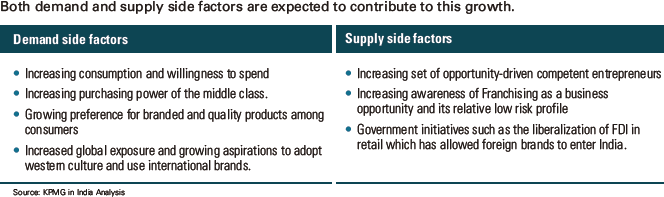
    While increasing consumption, willingness to spend, growing preference for branded products, global exposure and use of international brands are driving the demand side of franchising, increasing set of opportunity-driven competent entrepreneurs, growing awareness of franchising as a business opportunity and its relative low risk profile are driving the supply of new franchisee units.


    Even as market potential is huge in the retail sector, KPMG in India estimates that the franchising opportunity would be relatively high in consumer services, food service, and education and health and wellness sectors. Cumulatively, these sectors have a potential to add 1 lakh franchisees in the next five years. Franchising in health and wellness sub-segment is estimated to grow six times the current penetration.  With FDI in single and multi brands retail now permitted, this segment is expected to emerge as one of the high potential service sectors within franchising to cater to the prevailing consumption boom. KPMG in India estimates that over 43000 franchisee establishments (valued at USD 36 billion) may be required by 2017.


    “The franchising industry in India has potential to grow to USD ~50 bn in the next half decade – around four times the current size. This is also expected to create job opportunities (including both direct and indirect) for an additional 11 million people by 2017. Franchising will be extremely critical for brands to scale up quickly and profitably in India. While policy and financial institutional support is important – the critical growth enabler is going to be the extent of self regulation that franchisers introduce for sustainable and profitable growth of their franchisees.” said Anand Ramanathan, Associate Director- Management Consulting, KPMG in India.


    Ninad Karpe, Chairman, CII Maharashtra State Council and CEO & Managing Director, Aptech Ltd said. That franchising is a popular way to grow through collaborative efforts, reaching territories where opportunities exist. The umbrella of a popular brand aided by power packed processes makes for a sound business proposition.


    Overall, the franchising industry in India is expected to witness an above average growth rate over 2012-17 across sectors. The growth would be fuelled by rising income and expenditure levels of the young population along with the recent FDI policy changes, economic and socio-cultural developments.


    Franchising Opportunity: Sector Overview

    As per KPMG in India analysis, retail and consumer services sectors are expected to emerge as high potential service sectors within franchising to cater to the prevailing consumption boom. Non-traditional segments such as food service, jewellery, pre-schools etc. also present a huge opportunity for growth in franchising.


    Despite the challenges the country presents, there have been many successful case studies of franchising in India. From franchisors such as Aptech and NIIT which have pioneered the franchising model in India to new age franchisors  such as Gitanjali and VLCC who are adopting innovative expansion models within franchising, many brands/companies are adopting the franchising model to expand and provide a consistent and quality experience to its end customers.


    Franchise Business Models

    Firms that have created an easily replicable business model, often choose franchising as their preferred route to expand their operations and scale their brand. However, within the realm of franchising, there are several franchising models that differ significantly in terms of operation, control and legal scope. While certain operating models within franchising – such as area development and regional master franchisee – appear more attractive than others, diversity in Indian consumer preferences and degree of localization impact the choice of the final model to be adopted.


    Attractiveness of India in Global Franchising

    Many international brands have already entered India and are adopting the Franchise route to growth. Global brands such as Domino’s, KFC, Baskin Robbins have adopted variations of the franchise models to grow in India. Many other international brands are contemplating entry plans into India.


    However, India’s growing but fragmented market can seem chaotic and difficult to deal with. The international franchisors consider the following factors as challenges while entering into India:


    > Transparent Legislative framework: Due to no specific rules or laws promulgated in India to address the functioning of franchisors and franchisees, international players perceive a higher risk to business continuity.

    > India is not ‘one’ market: Entering a new market becomes more complicated in case of India where consumers hail from diverse cultural backgrounds. Several cultures, languages and socio-economic diversities make it a set of multiple markets. It becomes a challenge for an international franchisor to understand all diversified tastes and preferences, to establish and expand business in India.

    > Bribe and corruption: International franchisors remain threatened with the bribe and corruption cases in India. Due to no legislation around ‘anti-bribe’ in India, as in the US; it not only discourages the expansion strategies of many brands, but also impacts India’s credibility in the international market.


    Franchise Industry Survey – Key Highlights

    While the survey carried out by KPMG in India corroborated the above key reasons for growth in franchising and operating models, it also brought out certain key findings as mentioned below:


    > Franchisors believe that they are providing adequate support to their franchisees; however the latter are expecting more support particularly in the post launch phase of operations. Response to another related question in the survey suggested that almost half of those interviewed were not willing to take up additional franchisees with the existing franchisors suggesting certain level of dissatisfaction.

    > While franchisors adopt franchising model for growth, many entrepreneurs are opting for the franchising route as it primarily offers a safe and relatively easy way of establishing business and is expected to offer higher than market levels of profitability. This trend necessitates the need for franchisors to educate the franchisees on potential profitability and investment returns from the business. Sectors such as jewellery where payback periods could range between a minimum of four to five years are particularly vulnerable to such mismatch in outlook.

    > Real estate rentals are posing a major challenge for the success of franchising. Collaborative efforts between franchisors and franchisees in structuring business models that are sustainable even under such conditions could address this concern.


    Regulatory Scenario

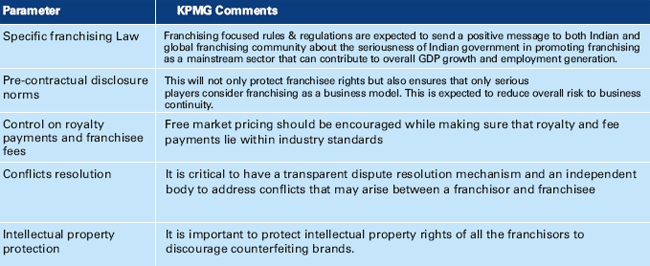
    While franchising sector in India, per se is not regulated, there are multiple laws which have an impact on franchise operations. Any future regulations in this area should allow conducive growth of franchise systems along with protection of franchisee rights. KPMG India’s comments on a few areas of regulations have been highlighted in the table below:


    Source: KPMG in India Analysis


    Financing the Franchise Business

    One of the key criteria of franchisors while selecting a franchisee is investment capability and financial strength. This in itself is an indicator of how difficult it is for a franchisee to tap the debt route to investment. Most lenders do not treat franchisees as a separate customer segment and usually cover them under the ambit of the broader Small & Medium sized Enterprise (SME) sector classification. This gets particularly magnified in case of ‘services’ franchising where there is an absence of asset base on which a collateral can be taken to provide a loan.


    A comprehensive and collaborative mechanism is once again needed to address this issue. While lending institutions can offer innovative financial products to franchisees, adequate support from the franchising ecosystem including that of franchisors and industry associations is necessary to make this a success.


  • Pepsi takes on ‘localikes’: It’s crunchy, it’s munchy, but it’s not Kurkure

    By Rajiv Singh


    Chutkure, Hurhure, Chulhule, Karkare, Taktake – all may be crunchy, but not Kurkure.


    Feeling the heat from a sea of lookalike local and regional brands that have been munching on the popularity of Kurkure over the last few years, beverages and snacks major PepsiCo has finally decided to fight back.


    Tedha’s Straight Journey


    Launched in 1999, Kurkure is not only the first made-for-India salty snack brand from PepsiCo but also among the eight Rs 1,000-crore plus brands in PepsiCo India’s portfolio.


    Over the last few years, the brand has been adding regional flavours. In 2010, Kurkure rolled out an ingredient innovation with the launch of Kurkure made with Rajma. Next year, ‘Ingredients of India’ range rolled out regional flavours like Mumbai Chatpata Usal, Bengali Jhaal and South Spice Mix. Earlier this year, it introduced three new flavour combinations, based on popular international cuisines but with a desi twist-Punjabi Pizza, Andhra Bangkok Curry and Rajasthani Manchurian.


    Last December, the brand went for a makeover. It dropped its long-time mascot Juhi Chawla and roped in five new brand ambassadors-Parineeti Chopra, Kunal Kapoor, Boman Irani, Farida Jalal and Ramya Krishnan-to widen its appeal.


    The latest TV commercial of PepsiCo’s flagship salty snack brand Kurkure asks viewers: Kuch bhi crunchy milega toh khaoge kya? (Will you eat anything that is crunchy?). The advertisement, pushing Rs 5 pack of Kurkure, ends by saying ‘5 Rupaye mein koi khaane waali cheez khao.’


    However, PepsiCo says desi brands are an irritant, but definitely not a headache. “There are over 140 lookalikes of Kurkure,” says Nalin Sood, category director, India Snacks, PepsiCo India Foods, “and over 2,500 local players in this segment.” But we are not feeling the heat from them, he avers.


    The Rs 5 price point is an impulse category where consumers are not emotionally attached to the brand, points out Sood. “Our latest advertisement not only hits at local brands but also tries to inculcate brand loyalty among consumers for this low price point,” he says, explaining the trigger for the latest commercial.


    But marketing and branding experts disagree. The fact that PepsiCo for the first time is urging consumers to make an informed choice while buying snacks says it all.


    “Unarguably, Kurkure is feeling the heat from local brands that are near lookalikes,” says Smitha Sarma Ranganathan, a brand communication specialist who teaches marketing management at IBS Bangalore.


    Instead of targeting some unknown brand in the commercial, the company should have continued with its focus on creating a family-driven context for connecting with Kurkure wherein the brand becomes the snacky content of choice, she adds. “Consumers look for value-for-money and not loyalty at Rs 5 price point.”


    The Head is On

    PepsiCo’s Kurkure and Lay’s, which dominate the Rs 9,500-crore Indian snacks market, have been steadily losing market share to a slew of regional players such as Gujarat-based Balaji, Indore’s Yellow Diamond and DFM Foods’ Crax that have cracked the local market as well as matched global players on pricing, quality and regionalization.


    While the market share of both the brands slipped 2-3% in the April-September period last year, Balaji, Parle, Yellow Diamond and ITC’s Bingo gained, according to Nielsen data. However, PepsiCo’s Sood says the market share of Kurkure is intact.


    Recently, PepsiCo has been facing headwinds not only in the snacks sector but also in the beverages segment, as it reaped less-than-expected returns from Rs 160 crore spent on the sixth edition of IPL.


    While its market share in April this year fell to 29.7% from 32.1% over the same month last year, rival Coca-Cola increased its share to 48.3% from 45.8%. Moreover, PepsiCo’s region president for India and South Asia Manu Anand quit late last month.


    Desi Tadka Rules!

    Desi brands, say FMCG analysts, not only have their finger on the pulse of regional flavor and taste, they also pip global biggies in giving more margin to the local retailers.


    “Local brands know PepsiCo can’t match them in terms of offering high margin to distributors,” says an analyst, requesting anonymity. So the retailers keep pushing desi brands, he says, adding that Rs 5 price point has become highly competitive. “And PepsiCo is feeling the heat because Rs 5 is the single-largest selling pack for Kurkure.” So, they are left with no choice but to react, he says.


    But if PepsiCo indeed is hitting at the local brands, the message that its TVC conveys is tedha (twisted), point out experts.


    They need to make it clear who they are fighting against, says KV Sridhar, chief creative officer of Leo Burnett, Indian subcontinent. “If they are targeting look-alikes, then the advertisement doesn’t talk about it.”


    The TVC shows a chic pack of a 5-rupee snack in the hands of Kunal Kapoor, which supposedly attempts a direct hit at local 5 brands only to that it turns out to be a googly, says Ranganathan of IBS Bangalore.


    A closer look at the pack visual translates into ‘oh-so-familiar looking’ feeling of deja-vu, only to get the consumer relate it to Lay’s, also belonging to the PepsiCo snacks stable, perhaps risking a cannibalisation, she adds.


    Agrees Sridhar. If indeed they are hitting at local brands, then they could have used transparent packs to show that, he says. “In their eagerness to push sales, they have missed out the details.”


    PepsiCo says it carried out intensive pre-tests with consumers before the launch of the TVC. “During the research conducted both prior and post the campaign, an overwhelming majority associated the pack with the unorganised/unbranded snacking options available and not to any branded large national player,” counters PepsiCo’s Sood.


    Source:The Economic Times

    Copyright © 2013, Bennett, Coleman & Co. Ltd. All Rights Reserved

    Licensed to republish
     

    Box:


  • Whose Loyalty is it anyway?


    By G Seetharaman


    It could well have been just yesterday when you walked into your friendly neighbourhood kirana store and muttered to the shopkeeper the by-now-familiar line: “Kuch toh discount dijiye, main toh har baar idhar hi aata hoon.” The guy behind the counter perhaps wouldn’t be amused – particularly if he’s never seen you before – but he isn’t likely to show his irritation; instead he may well decide to reward you for your apparent loyalty by shaving a few rupees off your bill.


    Consumers love a bargain – and marketers love to show that they’re giving one. There’s a fair bit of role-playing with the shopper trying hard to show her loyalty and the marketer trying even harder to reward it. Those efforts manifest themselves in wallets swelling with loyalty cards of retailers, airlines and hotels. But are the points that consumers stockpile in the hope of encashing them one fine day juicy enough carrots to keep them coming back for more? Perhaps not.


    C Prabhakar, a Chennai-based company secretary, does not set much store by points-based loyalty programmes. “Rather than waiting for a really long time to earn enough points to redeem them for something I like, it makes more sense to just go ahead and buy it,” he says. Two years back, Mr Prabhakar became a member of the loyalty programme of the Landmark group, which has retail chains like Lifestyle and Home Centre. “Just because I have the loyalty card does not mean I’m going to go there again and again. If I happen to go there, I will use the card, that’s it,” he adds.


    Customers like Mr Prabhakar are a marketer’s nightmare and defy what companies are trying to achieve through loyalty programmes. Siddharth S Singh, associate professor of marketing at the Indian School of Business (ISB) who has researched loyalty management in the US and India, is not surprised. “Companies here have tried to imitate the West. Sometimes loyalty management firms that devise programmes for companies are not experts. They are just IT vendors,” he says.


    Not Very Loyal

    While some retailers in India handle their own loyalty programmes, most of them hire loyalty management companies to do it for them. The loyalty programme market in India is pegged at about Rs 5,000 crore; retail accounts for two-thirds of that, and travel and financial services for 10% each. The rest comes from other sectors including hospitality and also channel loyalty initiatives.


    Loyalty marketing research firm Colloquy estimates the number of loyalty programme members in India to be over 35 million. The points earned in a loyalty programme can be redeemed for discounts or other rewards like movie tickets, accessories and consumer durables. MS Ashok, chief operating officer of Accentiv India, a loyalty management company, says cost is a huge factor in the very limited nature of loyalty programmes.


    “Companies are not able to move their marketing budgets from ATL [above the line] to BTL [below the line]. Loyalty programmes should be a big part of any company’s marketing budget,” he notes. While advertising falls under ATL activities, loyalty programmes are under BTL.


    Bijaei Jayaraj, founder and chief executive of Accentiv’s peer Loylty Rewardz, says even globally loyalty programmes are not very evolved. “Loyalty programmes are much more than points. There are some associated things which companies do not do very well, like suggesting purchases based on a customer’s transaction history,” he notes.


    Loylty Rewardz runs programmes for banks like Punjab National Bank, Bank of India and the State Bank group. Vijay Bobba, managing director and CEO, Payback India, says a good points-based loyalty programme should see a redemption of at least 50% of the points: “There are very few such loyalty programmes here and no programme crosses 70%.”


    Not all brands need a loyalty programme. Those that are either truly aspirational or those that anyways provide total value for money for sure don’t. Mr Bobba gives the examples of Apple (aspirational) and Walmart (value-for money) that can afford to not have a loyalty programme.


    “Apple provides the most premium customer experience and has a huge following. Walmart sells at the lowest price possible.” For others who fall between these two ends of the positioning spectrum, loyalty cards are a great way to identify customers, adds Mr Bobba. Payback India runs a unified loyalty programme for several brands including Future Group, ICICI Bank and travel portal MakeMyTrip.


    Know Your Customer

    Srikanth Chunduri, co-founder of Emart Solutions India, which devises loyalty programmes for companies, says the problem lies in not understanding customers. “It took the guy at the coffee shop I visit regularly six visits to know me. My kirana store owner knows me better. He doesn’t give me discounts for being a loyal customer but gives me convenience of free home delivery,” he observes.


    Vinay Bhatia, vice-president, marketing and loyalty, Shoppers Stop, believes a piece of plastic does not create loyalty: “Points are just the transactional part of the programme. You have to go significantly beyond points.”


    He also says it is better to charge customers for a loyalty card than to dole out freebies. “When a customer pays, he takes interest and asks so many questions about the rewards. That’s what we want,” he adds.


    Shoppers Stop charges Rs 300 for a ‘First Citizen’ card. First Citizen along with Jet Airways’ ‘Jet Privilege’ is among the best known loyalty programmes in the country.


    Over 70% of Shoppers Stop’s revenues come from its 2.8 million First Citizen customers. Marketing professional Tanaz Makujina concurs with Mr Bhatia on the benefits of retailers charging customers for loyalty cards. A First Citizen member, she used to redeem her points but now does not visit Shoppers Stop because she does not like their collection. “I’m not brand-loyal when it comes to retail stores. As I’m not one of those people who will go to a particular shop just to earn points, I won’t pay for a loyalty card again,” says Ms Makujina who owns eight loyalty cards.


    Talking of the points she earns on her ICICI Bank debit card, she says that since she has to visit the Payback site to find out what her points will get her, she does not bother. According to a 2011 Cross-Cultural Loyalty Study by Colloquy, only 42% of shoppers surveyed in India belonged to a loyalty programme compared to 74% of Americans surveyed. Companies, expectedly, say points-based loyalty programmes are effective. “I don’t think there is disenchantment with the points system among customers. It works when you give significant value to your customers,” says Anil Ramachandran, who heads the credit cards business at IndusInd Bank.


    Devendra Chawla, president of Future Group’s Food Bazaar, says the group’s Payback programme has 1.1 million members. “One loyalty card across formats and different merchant establishments certainly works better for customers as they get points on almost every item they buy, and more points get accumulated,” he adds. Parag Rao, business head, card payment products, HDFC Bank, claims the bank’s credit cardholders have displayed the “highest rewards redemption behaviour in the industry”.


    HDFC Bank is the largest credit card issuer in the country, accounting for a third of the total outstanding cards. Kaushal Satam, head, Jet Privilege, says the relationship between accrual and redemption of points is a symbiotic one: “The ability to redeem points is as important as the opportunities to earn those and success in one area determines success in the other.”


    Points are Not Everything

    While marketers emphasise the need for points, they have also realised they have to think beyond points to get their customers to stick with them. Shoppers Stop, for instance, decided to expand its Durga Puja offers outside West Bengal last year and mined its First Citizen database for Bengalis in New Delhi, Mumbai and Bangalore and notified them about the offers.


    “We saw an incremental turnover of Rs 1 crore,” says Mr Bhatia. Apparel brand Louis Philippe also offers sweeteners beyond points to its “Upper Crest” members. “Events like theatre, golf tournament invites and red carpet invites to stores for wine and cheese evenings with Louis Philippe designers and marketing teams have been very well received by members,” says Jacob John, brand head, Louis Philippe India.


    Manisha Lath Gupta, chief marketing officer, Axis Bank, says points are a currency which should be used intelligently. She adds: “There should be different incentives for different customers. For instance, I could give people who have never swiped their debit card bonus points to get them to use their cards.” Axis Bank recently revamped its loyalty programme to make it a pan-bank loyalty programme which means customers can earn points not just on debit and credit cards but also on their savings accounts, internet and mobile banking. “Earlier, redemption of points was in lower single digits but now it is has gone up to 16-17%,” she says.


    Mr Chunduri of Emart Solutions feels companies should think of innovative ways to reward customers. “An online bookstore could send out invites to a book reading,” he says. Companies in India do not know how to leverage their database, according to ISB’s Singh. “That’s what Tesco and BestBuy have done. They focus on their most valuable customers,” he notes.


    Tesco and BestBuy are American and British multinational retailers respectively. Their loyalty programmes, along with that of Amazon’s, are considered among the best. With increasing options for customers for almost every product and service, retaining them is no walk in the park for companies. But such a scenario also provides them with an opportunity to make their loyalty programme stand out from their peers’. Only a handful have done that so far.


    Source:The Economic Times

    Copyright © 2013, Bennett, Coleman & Co. Ltd. All Rights Reserved

    Licensed to republish
     

  • It’s Bhaag Milk-ha Bhaag for Amul and Milkha Singh

    By A Correspondent


    Amul Milk is collaborating with sporting legend Milkha Singh given the upcoming biopic Bhaag Milkha Bhaag.


    The association of the film and Amul Milk has been planned and executed by Lodestar UM Brand Experience together with Viacom 18.


    According to a communique, a lesser known fact is that milk has played a crucial role in Milkha Singh’s success story. Reportedly, soon after he joined the Indian Army, the jawaans were asked to participate in a cross-country race where the winner would be awarded with a glass of milk. Milkha ran this very first race chanting “doodh, doodh, doodh” and stood first to enjoy a glass full of milk. This insatiable love for milk kept him strong for years making him one of the most celebrated Indian athletes, across the world. Drinking milk has been a part of his cherished childhood memories.


    To leverage this association, Gujarat Cooperative Milk Marketing Federation (GCMMF) has created a co-branded promo using footage from the movie and Amul Milk TVC. The promo will celebrate the synergy between the two brands, encouraging consumers to explore the Milkha within them with the world’s original energy drink — Milk.


    The new campaign will be aired across television channels, radio, social media and radio medium.


    “This movie has a great fit with brand Amul, it stands for striving and winning to become the leader and we want the youth to follow this … to persevere with dedication, awakening the winner in us”, says GCMMF’s managing director R S Sodhi. He further adds, “Milk, the World’s original energy drink, will help provide nourishment and energy to reach their goals.”


    Nitin Karkare

    “The association with Bhaag Milka Bhaag seemed like a perfect next step for the brand after the London Olympics, The Amazing Spiderman and Man of Steel. The objective is to reach our TG with the core message of milk as the original energy drink, but at the same time retaining the freshness, topicality and excitement” says Nitin Karkare, Chief Operating Officer, Mumbai, Draftfcb Ulka.