Category: MARKETING

  • Amway India elevates Gursharan Singh Cheema as Regional Head- North

    By A Correspondent


    Amway India Enterprises has announced the promotion of Gursharan Singh Cheema as the Regional Head – North. In his new role, Mr Cheema will be responsible for managing the overall operations of North region including states – Delhi, Haryana, Punjab, Rajasthan, Uttar Pradesh, Uttarakhand, Jammu & Kashmir and Himachal Pradesh. He will be based in Amway’s regional office in New Delhi. Mr. Cheema takes over the responsibility from Achinta Banerjie who has been promoted to a new role in the Head office.


    Congratulating Mr Cheema on his promotion, William S. Pinckney, Managing Director & CEO, Amway India said, “G S Cheema has always worked diligently for the growth of the organization. He has played a significant role in leading the state of West Bengal to the growth path. It is his desire to excel and his commitment towards work that has helped him achieves professional accomplishments.”


  • Revlon promotes foodproof lipstick with 6-sec video tweet

    By A Correspondent


    Digital marketing agency VML Qais has created a video tweet to help promote its client, Revlon. The product being promoted is Revlon’s Color Stay Ultimate Suede lipstick.


    The agency wanted to find an innovating and engaging way to tell Revlon’s Twitter followers about the USP of the new product that has been launched, notes a communique. It is a food-proof lipstick and VML Qais wanted to highlight that visually. To achieve the objective, the agency created a custom vine (a 6-second video tweet) for Revlon (link: https://twitter.com/RevlonIndia/status/347628970998632449). Recently acquired by Twitter, Vine is a social media service which allows the user to shoot and share 6 second videos.


  • Ogilvy’s ‘anti-boring’ TVC for Alpenliebe Pop

    By A Correspondent


    Leading confectionary player Perfetti Van Melle India (PVMI) has made yet another attempt to offer clutter-breaking advertising for its products.


    PVMI has launched a new TVC positioning its lollipop product, Alpenliebe Pop, as ‘Anti-Boring’ devices. The insight behind the ad stems from the fact that subjects like history and science are fascinating – but only to historians and scientists and not to the poor students who are forced to study them for their examinations. In the tongue-in-cheek ad film, Archimedes comes to life and offers the student an Alpenliebe Pop to deal with the boredom.


    Commenting on the launch, Nikhil Sharma, Director-Marketing, Perfetti Van Melle India said “In many markets across the world Lollipops have a significant consumption amongst youth while in India it is dominated by Kids. Seeing this as an opportunity, the challenge for us as leaders is to not only increase consumption among current users but also convert non users to users. This communication is hence targeted specifically at the youth and is based on an insight that they can easily relate to”


    Said Anurag Agnihotri, GCD, Ogilvy & Mather, the creative agency that handles the brand, “We borrowed the insight behind the ads from life. Every youngster, at some point or the other, grows bored of studying and says or at least thinks that if only he could get hold of the mathematicians, scientists etc. who formulated such complex equations, he would give them a piece of his mind.”


  • Global retail biggies pause, will check life after polls


    By Rasul Bailay & Chaitali Chakravarty


    The government resolutely faced a vote of no-confidence in Parliament last year over its decision to allow entry to foreign supermarkets, but it is unlikely to reap any benefit as global retail chains have decided to wait for the outcome of state polls later this year and 2014 general elections before pledging investments.


    Three executives who work closely with foreign retailers said these chains will assess the post-election political landscape and then make their moves. BJP’s virulent opposition to their entry has made them nervous, and they don’t want to be caught in no-man’s land if the party comes to power and scraps the multi-brand retail policy. While Narendra Modi, BJP’s presumptive PM candidate, has the reputation of being pro-business, he has banned the entry of foreign retailers in his state Gujarat.


    “If India can go after Vodafone after so many years, I would say hypothetically anything is possible,” said a retail analyst with a foreign consultancy firm who asked not to be named as he advises global retailers. He was referring to the government’s decision to retrospectively amend its tax laws and slap a multi-billion-dollar demand on the UK’s Vodafone Plc, despite the Supreme Court ruling in favour of the company.


    Foreign retailers are currently allowed to open stores in 12 states. Of these, 11 are Congress-ruled while the 12th, Jammu & Kashmir, is ruled by a National Conference-Congress coalition. But two of the states – Delhi and Rajasthan – will go to polls in the next few months.


    “We are concerned about the state polls because the recent clarifications have given local governments sweeping power to change policy,” said a person familiar with the plans of Tesco Plc. “What if BJP comes to power in Delhi and says retailers need to source 50% locally, instead of the existing 30%?”


    The UPA government at the Centre is expected to shortly announce a fresh set of clarifications that could further ease entry norms for foreign retailers. Commerce & Industry Minister Anand Sharma, who has led the government’s drive to open up the retail sector to foreigners, recently met with global and local retailers in Delhi. He is expected to meet top Walmart executives during his visit to the US this week. But for now, it looks unlikely that Sharma or the government are going to attract the fistful of dollars they are looking for.


    Walmart’s Indian arm, that is currently embroiled in the internal problems that led to the recent departure of its chief executive Raj Jain, is focusing on a widespread compliance procedure of the US Foreign Corrupt Practices Act, cost-cutting at the wholesale venture, and to make the business viable even as expansion plans have been stalled since November.


    Bharti Walmart’s interim Chief Executive Ramnik Narsey has asked department heads to come up with ideas to trim costs even as he focuses on cleansing operations.


    A Walmart India spokeswoman said the retailer continued to work with the government to better understand the rules for foreign direct investment. “We are still very early in the process on FDI, but are excited by the opportunity in front of us,” she said.


    The spokesperson for Tesco, the UK-based retailer, said the company was waiting for further clarifications before deciding on its next steps. Carrefour, the French retail chain, declined comment.


    While foreign retailers want to analyse the political alignment post the general election, some are cautiously optimistic that there will not be a dramatic about-turn in India’s policies. “BJP cannot afford to go back on the policy as it would sent an extremely negative signal to global investors,” said an executive who works closely with one of the global supermarkets.


    For the past two decades, successive governments have shied away from opening up the country’s multi-brand retail sector to foreign investments due to opposition from small vendors as well as top politicians, as they feared liberalisation of the sector could jeopardise the livelihoods of millions of small and marginal retailers.


    However, in September 2012, the Congress-led government went ahead and opened up the sector and even went to the extent of risking its survival on the issue. But about 10 months later, the government has not received a single investment from a foreign company.


    Source:The Economic Times

    Copyright © 2013, Bennett, Coleman & Co. Ltd. All Rights Reserved

    Licensed to republish

     

  • Dream scheme to let ads pay for car EMIs

    By A Correspondent


    Pune-based Dreamers Media and Advertising Pvt has announced what is an innovative concept in out-of-home adveritisng.


    Consumers who wish to purchase a car through Dreamers can avail of the offer by paying a 25 percent downpayment with an payback tenure of 5 years. Dreamers will pay the equated monthly instalments (EMIs) for the first three years while consumer will make the payments for the last two years. In return, Dreamers will utilize 40-60 percent of the customer’s car space. This space is the commercial driver for Dreamers, which will then sign up both long and short-term contracts with interested advertisers.


    Explaining the concept, Sunis Mohamed, CEO of Dreamers said: “With our unique offering we intend to create demand and give a boost to the auto industry which is currently going through a lull phase. It will allow a common man to translate his aspiration of buying a car into reality. At the same time, the concept will also enable brands to reach in the most interactive manner to a wider target audience and create a new communication medium in the OOH space which still is at a very nascent stage and is poised for growth”.


    Dreamers Media and Advertising is reportedly in talks with auto companies as well as banks and insurance companies and hopes to achieve a turnover of Rs 150 crore in the first fiscal.


  • Colgate launches offensive to take on P&G’s Oral B toothpaste

    By Kala VijayaRaghavan & Sagar Malviya


    Last week, when Procter & Gamble launched Oral B, its first toothpaste in India, perhaps no one else was watching it more closely than Prabha Parameswaran, the MD of rival Colgate, also the market leader in the Rs 5,000-crore oral care market.


    Ms Parameswaran’s swift and no-holds-barred retort to the P&G threat has by all accounts left the latter overwhelmed in the market.


    A heap of 250-odd Colgate toothpaste packs greets customers at a leading supermarket in the suburbs of Mumbai. Almost each of the neatly stacked packs forming a mini-pyramid has either BOGO (buy one get one) printed on it or carries reduced price tags. Here and across 4.5 million retail outlets, Colgate is being a shameless bully, elbowing P&G out of any shelf space. It is throwing toothbrushes, pastes, and brand events and promotions with trade partners, and discounts, all to deny or delay giving P&G even a toehold. Such promotional intensity wasn’t there even two weeks ago.


    “Several large retailers haven’t even stocked P&G’s new toothpaste as the margins offered were lower than Colgate and GSK,” said two officials at leading supermarkets.


    This is already turning out to be a costly battle – Colgate has hiked its advertising and promotion spends by 31% during the first half of this calendar year.


    Devendra Chawla

    “There has been a new-found aggression in Colgate during the past year,” says Devendra Chawla, president-Food Bazaar at the Future Group.


    P&G India is hardly a wimp when it comes to a scrap for market share. The Cincinnati-headquartered company has had dozens of such brawls with arch rival Unilever in segments such as detergents, shampoo and skin creams. But this is the first time P&G is wrestling with Colgate.


    “Though it is still very early, our launch of Oral B toothpaste and initial plans are very much on track,” a P&G spokesperson said, responding to an email about the battle with Colgate. “We are very pleased with the response and support we are receiving from both our customers as well as the professional community.” Ms Parameswaran, 51, too is quite familiar with the exertions of such battles. Before she was elevated to the top job in India, she had fought P&G for over a decade at their home turf – the US – and more recently Mexico, where she was the marketing head until 2012. Colgate controls more than half the market and Ms Parameswaran is fiercely guarding every inch. In the months preceding P&G’s first toothpaste launch, she was hitting the roads, meeting dealers, distributors and trade partners, say sources in direct know of things. A media-shy Colgate declined comment. “Ms Parameswaran has fired up the organisation,” says a highly placed official privy to recent happenings within Colgate.


    Since she took charge in February 2012, Colgate’s market share has increased from 53.1% to 55%, its highest since 1998, and a rare instance of a market leader gaining new ground. In the same period, its stock has risen 41%, even as the BSE Sensex has gone up just 14%. “Colgate is like a well-oiled machine. What a very good leader can do with such a welloiled machine is what is happening now at Colgate,” says Abneesh Roy, associate director at Edelweiss Securities. “Usually, the market leader tends to protect share rather than drive further growth. Colgate has managed growth under Ms Parameswaran,” he adds. Roy, who had met Ms Parameswaran recently, says she comes across as an extremely savvy marketer with a curiosity to know what is happening in other categories.


    “Colgate has usually tended to do well under attack, earlier from Pepsodent and later from low-cost brands such as Anchor,” says Vikram Kaushik, ex-MD of Tata Sky. He was executive vice-president (marketing) at Colgate-Palmolive (India) in 2004. Ms Parameswaran has worked with Colgate for two decades. She started off with experiences across verticals including initiatives to revitalise its personal care business that included the launch of Palmolive Naturals soap, Palmolive Optims and the male toiletries and skin care equities. She moved to New York as associate director (global business development), oral care, in 1997, and was later the vice-president (marketing) for Colgate India between 2007 and 2009.


    Ms Parameswaran worked with Lintas India (now Lowe Lintas) before joining Colgate and had handled HUL campaigns, including ‘Zara sa Rin!’, ‘Dur ho ja meri nazron se!’ (for Wheel) and ‘Dhoondte reh jaoge!’ (for Surf Ultra). “I remember her then for her team leadership skills as well as witty sense of humour. She was extremely insightful,” says Pranesh Misra, chairman & MD, Brandscapes Worldwide. He had worked along with Ms Parameswaran in Lowe Lintas on HUL brands. “After years at Colgate in different geographies and roles, she has further sharpened her skills in marketing and business leadership,” he adds.


    (With inputs from Amit Bapna)


    Source:The Economic Times

    Copyright © 2013, Bennett, Coleman & Co. Ltd. All Rights Reserved

    Licensed to republish

     

  • 1 Minute View: The concern of overseas retailers is real

    Politicians have their problems with the entry of global retail giants to India as even a trade-friendly Narendra Modi has shown his opposition to their entry.


    Given the opposition of all of the non-UPA run states in the country, it is natural that the transnational international retailers are wary of making significant investments into the country. So fickle are our values that if if the NDA comes to power in the next general elections, the BJP could well turn pro-retail FDI and the Congress-led UPA may adopt an anti stance!


    But opposing big international retail formats is as foolhardy as, say, insisting that the news media cannot have majority investment from foreign players.


    Small traders have traditionally been active donors of the election campaigns so there is reason why some parties are batting against FDI in retail. The fear is misplaced as even now small retailers aren’t driven out of business by the big bazaars, though their profits may have shrunk.


    Big retailers will never be able to offer the personalized service that neighbourhood stores can. We’ve already seen in cities like Mumbai how many malls have failed. In fact a few have even converted themselves to office complexes.


    While homegrown retail biggies will offer most of the benefits that the international majors can bring in, the presence of the big ‘uns will ensure that the bar is raised in terms of standards.


    Needless to say the entering the global biggies will not only see more dollars getting into the country but also help energise the advertising and marketing sectors.


  • Orra showcases timelessness by sending telegrams

    By A Correspondent


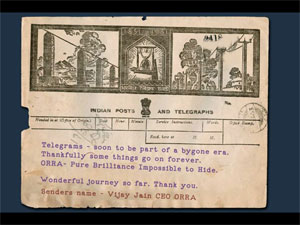
    Branded jeweller major Orra has launched a campaign using telegrams to commemorate the end of the service on July 15. These telegrams were sent to well-wishers and customers, bidding goodbye to the era of telegrams and showcasing the timelessness of Orra.


    Said Vijay Jain, CEO, ORRA: “The idea of telegrams was to capture both the nostalgia of the end of an era as well as showcase the timelessness of Orra. For many people this will the be the first and the last opportunity to send a telegram . Also to reach to out to the youth in India we are marrying the old world with the young by sending out telegrams on behalf of our Twitter and Facebook fans.”


    The message sent in the telegram was as follows: “Telegrams – Soon to be part of a bygone era. Thankfully some things go on forever. ORRA – Pure Brilliance Impossible to Hide.


  • Tata Capital invites Indians to share their ‘Do Right’ story

    By A Correspondent


    Financial services firm Tata Capital has launched the ‘Do Right’ initiative with the aim of “inspiring and inculcating the ‘right’ values in children from a young age, so that an overall positive impact is made in society at large”.


    The initiative, reflective of Tata Capital’s brand promise – ‘We only do what’s right for you’, is an attempt to get parents and other adults to spread the spirit of ‘doing right’,inspiring children through their actions, informs a communique. As a key step in the Do Right initiative, Tata Capital has launched the ‘Do Right’ Stories, a compilation of warm, heart-warming stories of children exhibiting the spirit of ‘do right’ in their daily lives. Individuals are encouraged to share their childhood stories or stories of their children exhibiting values such as trust, respect and honesty on the Do Right Stories platform on the website www.doright.in.


    A highlight of the exercise is also the Tata Capital Signature song, the lyrics of which have been written by lyricist Gulzar and whose music has been composed and performed by Shankar Ehsaan Loy.


  • VIP Industries appoints McCann as creative agency

    By A Correspondent


    Leading luggage manufacturer VIP Industries Pvt Ltd has announced the appointment of McCann Erickson as its creative agency for VIP brand. The company also said that it is currently scouting for a creative partner for its Skybags brand.  The business has moved both its brands -VIP and Skybags from its incumbent agency Ogilvy and Mather


    Commenting on the development, Sudip Ghose, Vice President, Marketing- VIP Industries said, “We believe that McCann has the potential of leveraging our innately strong brand and providing the thrust to take it to the next level. ”


    Prasoon Joshi

    Prasoon Joshi, executive chairman and CEO McCann Worldgroup said, “VIP is among India’s most prestigious brands. We are proud to partner a brand of this stature and heritage. We look forward to doing great work on the brands and a long-term relationship.”


  • Can this man resurrect his businesses?


    By G Seetharaman


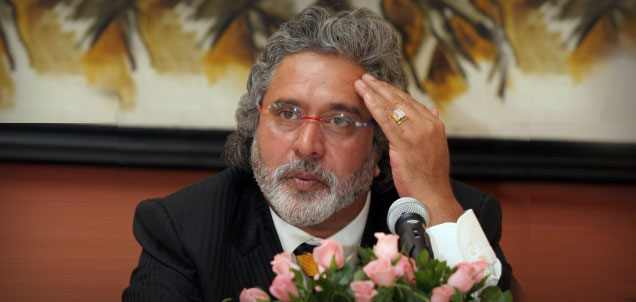
    You must be joking!” says a seasoned dealmaker, who had worked on a deal involving a United Breweries (UB) group company years ago, when asked if Vijay Mallya will be able to rebuild his empire. “What does he have now?” he asks.


    The question may not entirely be appropriate but is not without reason either, for the 57-year-old is probably in the stickiest situation of his life. His most ambitious dream, Kingfisher Airlines Ltd (KAL) – some say it has never been more than just a dream – now lies in tatters, having been grounded for nine months now.


    As if that was not turbulence enough, or perhaps to mitigate it, he has had to cede control of his flagship company United Spirits Ltd (USL), best known as the maker of McDowell’s whisky. The latest blow: Dr Mallya may no longer find himself calling the shots at his Rs 2,780-crore fertiliser company. He may have weathered many a storm in his roller-coaster of a career, but now has the unenviable task of once again convincing peers and public alike that he can deliver the goods as a businessman.


    Parting with a Giant

    When you Google “UB group”, the link to its website says “Dr Vijay Mallya’s UB Group is the World’s No. 3 Spirits Company”. But those words may soon change since USL is technically no longer “his” company. In the first week of July, the world’s largest spirits maker Diageo Plc, with a 25% stake in USL, became its biggest shareholder; the UB group’s stake reduced from 28% before the announcement of the deal in November to just a shade over 11%.


    While as per the agreement, Diageo was to acquire 53.4% in USL for over Rs 11,000 crore, it has managed to buy less than half of that for about Rs 5,200 crore, thanks to a poor response to Diageo’s open offer to USL shareholders. The tepid reaction is a result of the offer price being lower than that in the market, and the British liquor maker’s inability to acquire 2.38% held in USL by USL Benefit Trust. The latter’s shares are pledged with USL’s lenders who have refused to release those shares for the transaction.


    When asked how Diageo plans to raise its stake further, its spokesperson says: “We are not targeting a specific level of ownership but we do want to control the strategic direction of the company. We have now achieved that.”


    USL, which controls about half the Indian spirits market of 250 million cases, owns 140 brands including Royal Challenge and Bagpiper whiskies, Honeybee brandy and Romanov vodka. According to London-based industry magazine Drinks International, McDowells No. 1 whisky was the eighth largest-selling spirits brand in 2012. USL has two more brands in the top 10.


    Group chief financial officer Ravi Nedungadi says United Breweries Holdings Ltd (UBHL), the group’s holding company, has used the proceeds of the sale to Diageo to pay off some debt, without specifying a number. UBHL held 13.6% in USL at the end of June and had debt of around Rs 3,000 crore in March.


    USL investors have welcomed the acquisition, with the stock price almost dou-bling since November to Rs 2,642. V Srinivasan, analyst with Angel Broking, says with this deal USL will focus more on premium brands and will see a rise in its operating margins which are in the region of 11-12%. “Since Diageo is an MNC, there will also be more transparency,” he notes.


    Deepak Roy, vice-chairman and chief executive of Allied Blenders & Distillers (ABD), maker of Officer’s Choice whisky, concurs. “The deal is good for the industry as a whole, where some players try to get the government to structure policies f avourable to them,” says Mr Roy, who worked with both USL and Diageo in the past.


    Dr Mallya was involved in a long tug of war with ABD chairman Kishore Chhabria over ownership of the Officer’s Choice brand which was settled out of court last year with ABD paying USL Rs 8 crore.


    Clipped Wings

    Just a month before the Diageo deal, staff unrest forced the grounding of KAL, which has never turned a profit since its founding in 2005. The airline’s licence was suspended in December and its headcount has fallen by three-fourths to 2,000 in just a year, according to a senior civil aviation ministry official. Its lenders in February decided to recall loans advanced to the airline which currently owes them about Rs 6,000 crore.


    Amber Dubey, head, aerospace and defence, KPMG India, says while the airline has to be credited with creating a great brand and a loyal band of passengers, especially corporate clients, its “reluctance to keep modifying its operating model in line with industry trends and customer preferences led to its ultimate demise”.


    Kingfisher bought Captain Gopinath’s Air Deccan, India’s first low-cost carrier in 2007, but four years later exited the lowcost segment, which includes IndiGo Airlines, SpiceJet, GoAir and Jet Konnect.


    Kingfisher’s lenders, led by State Bank of India, have so far got back about Rs 550 crore from the sale of shares of USL and Mangalore Chemicals & Fertilizers (MCF), and are now looking to take possession of two of the group’s properties in Mumbai and Goa, reportedly worth Rs 120 crore. “The KAL brand may not be worth anything since the airline is not operational. But we have corporate guarantees from Dr Mallya and UB Holdings,” says a senior official from one of the large banks in the 17-lender consortium.


    The airline had guarantees worth over Rs 14,830 crore, including Rs 5,900 crore from Dr Mallya, on its liabilities at the end of March 2012, as per its annual report for 2011-12. His plans to find an investor for the airline after India allowed 49% foreign direct investment in the sector earlier this year have not yet come to fruition.


    According to M Unni Krishnan, global strategy director, Brand Finance, there is still value to be unlocked in the KAL brand. Mr Nedungadi says there is a plan in place to revive the airline, but doesn’t give details or the timeline. But Dubey thinks the chances of that hap-pening are “unfortunately, very low”. The biggest hurdle for Dr Mallya, also a Rajya Sabha MP, to put KAL back on the runway is his lenders. The loan recovery process, with its legal ramifications, could take years.


    Another One on the Block

    If it were not for KAL’s travails, there would not be a bidding war for MCF. When in April, the airline’s lenders sold the MCF shares pledged with them, Zuari Agro Chemicals, a KK Birla company, bought them and ended up with about a 10% stake in the company. Not to be outdone, its Pune-based competitor Deepak Fertilisers and Petrochemicals Corporation bought MCF shares in the open market earlier this month, and now with a stake of 24.5%, is the biggest shareholder in the company; the UB group’s holding stood at 22% as of the March-ended quarter (the latest period for which the shareholding pattern was available on the BSE website at the time of writing).


    While there was talk that Zuari would sell its stake to Deepak, this week Zuari responded by buying another 3.5% in the company. While a Deepak spokesperson declined comment, Zuari chairman Saroj Poddar was not available for comment. “MCF is not the group’s focus. They have not invested much in the company in the past 7-8 years, but the company has good assets which will benefit both Deepak and Zuari,” says an analyst with a domestic brokerage. MCF’s 3.8 million tonne per annum urea capacity means a new segment for Deepak and a substantial addition to Zuari’s urea capacity. “MCF also has 50 acres of surplus land in Mangalore, which is a strategic location,” says Satish Mishra, analyst with HDFC Securities.


    With three of his companies either in trouble or going out of his hand, the only sizeable operation that Mallya is left with is United Breweries which, like USL, has a market share of well over 50% in the Indian market. Its share of the beer market was just 43% in 2006, the year that saw the entry of Danish brewer Carlsberg group into India. Many more beer labels have entered the fray since, and there are now over 200 beer brands in the country, according to Akash Sahu, general manager, brand communications, SABMiller.


    But UB is not worried. Samar Singh Shekhawat, senior vice-president, marketing, UB, feels new entrants will help grow the market. “We are sticking to our brand plans across all segments and geographies, and have actually seen share and volume gains consistently over the past few years,” he adds.


    A former top official of the UB group says it would be difficult for Dr Mallya to hold the reins at UB in the long run since Heineken already has a 37.4% stake, as big as the UB group’s. A detailed questionnaire sent to Mallya went unanswered. UB spokesperson Prakash Mirpuri said Dr Mallya was overseas and hence would not be able to answer the questions. When reached on his mobile phone, Dr Mallya said, “I’m not able to speak to you now. I will call you when I’m able to speak.”


    Buy and Sell

    Entering and exiting businesses have been par for the course for Dr Mallya, who became chairman of the group in 1983 at the age of 28 after his father Vittal Mallya’s demise. Among those ventures are a pizza chain, Berger Paints which he bought in 1988 and later sold at a handsome profit, engineering company Best & Crompton and Vijay TV. He has also divested legacy investments like Kissan Products, a stake in Aventis Pharma and Hindustan Polymers.


    One of the businesses Dr Mallya hasn’t exited yet – and which surprises a section of UB watchers – is UB Engineering. Founded in 1963 and listed nine years later, the company came into the UB group fold in 1988. It executes engineering, procurement and construction (EPC) projects in sectors like steel, cement, oil and gas, and power. Despite having been around for such a long time, the company ended 2012-13 with revenues of just Rs 583 crore and a net profit of Rs 78 lakh.


    To provide some context, Thermax, which competes with UB in some segments and was founded around the same time, had sales of around Rs 4,700 crore and a bottomline of Rs 350 crore in 2012-13. UB Engineering managing director JK Sardana did not respond to emailed questions. Another sector where the group has not been able to scale up is information technology, where it has had a presence for two decades now. Will the group exit these businesses? “There is no such plan in the near future,” says Mr Nedungadi.


    One of Dr Mallya’s newest businesses is real estate where UBHL has partnered Bangalore-based Prestige Estates. UB City, with 1.6 million sq ft and which is on the road named after Vittal Mallya in Bangalore, is the largest commercial real estate project in the city, and houses MNCs such as Citibank and Vodafone.


    Besides office space, it includes a luxury mall and services apartments. Another project, which is also being developed by the group with Prestige, is Kingfisher Towers, a residential project. With a developable area of 1.1 million sq ft and 83 apartments, Kingfisher Towers is among the most expensive residential properties in the city.


    “They have done a really good job with the projects but commercial will not be as profitable as residential, and the UB group does not have a lot of land besides this in Bangalore which it can monetise,” says the head of a real estate company. Prestige chairman and managing director Irfan Razack was not available for comment.


    If most of his businesses are in no great shape, Dr Mallya’s sports ventures will not really make him jump in joy. Royal Challengers Bangalore (RCB), the Indian Premier League (IPL) team owned by USL, was one of only two teams to see its valuation fall after IPL 2012 when the league’s valuation itself rose to $3.03 billion from $2.92 billion in 2011, according to a report by Brand Finance.


    RCB’s brand value fell 8% from 2012 to $37.8 million and its brand rating dropped from A+ to A-. Mr Krishnan says the decline did not have to do with the airline’s troubles, although it may have coincided with them. The franchisees are measured on three parameters: cricketing excellence, corporate governance and marketing excellence.


    RCB, despite being a fairly consistent performer, has not yet won the IPL. Dr Mallya’s Formula 1 team, where Sahara picked up 42.5% in 2011 for $100 million, has fared far worse. Sahara Force India’s best result so far has been a sixth place finish in the 2011 championship. A British newspaper in March reported the team has accumulated losses of £126.1 million, or over Rs 1,000 crore, since Dr Mallya bought the team in 2007.


    But the F1 team is a personal investment of Dr Mallya and not one of the UB group. Mallya, known more for his flashy lifestyle than his business acumen, was dropped from the Forbes list of billionaires this year.


    The magazine had pegged his wealth at $800 million in October. He’s not a liquor tycoon now – beer baron would be more appropriate although arguably not totally correct – but Dr Mallya has over the decades earned a reputation for coming back from the dumps. An ally turned rival in the liquor business has in the past said that Dr Mallya always has had luck on his side.


    As example he pointed to the untimely death of liquor baron Manu Chhabria, which led to the unthinkable taking place: Shaw Wallace entering the UB fold. Today, however, the Shaw Wallace buyout is a distant memory, and the Diageo buy-in a more immediate one. Still, the dealmaker quoted at the beginning concedes Mallya has a good understanding of consumer businesses. But he also adds: “He was never an entrepreneur like his father but he could have been a better manager.”


    Source:The Economic Times

    Copyright © 2013, Bennett, Coleman & Co. Ltd. All Rights Reserved

    Licensed to republish

     

  • Ritu Midha: Are marketers targeting men at the expense of women?

    By Ritu Midha


    Women are the focus of most marketing communication, for most product categories. The evolution of modern urban Indian women is the topic of discussion at many a marketing forum – more true, perhaps, of upmarket women.


    I would be the last person to object to women being in the focus of marketers’ attention, but are marketers reaching them at the expense of men?


    I intend to restrict my musings to SEC A and A+ male. Aren’t men, with due apologies to the ever-increasing tribe of single, ‘doing well’ females in the country, still the main bread- (and health food in many cases!) earners of 99 per cent of the families, even in this strata of society? And, by default, the key purchase decision-makers?


    To my mind, it is a conscious attempt by many marketers to connect with women even in the categories where they are not the purchase decision-makers but only the influencers. And the reason for the same is simple: it is far too expensive to reach men as compared to women.


    Women are on television – some men are on television too, but the fragmentation there is way too high! Courtesy the number of news and movie channels. Also, remember that women wield the remote at primetime too, the time when men might choose to settle in front of the television, if they could control the remote. When it comes to sports channels, there is lesser worry – cricket hai jahan, marketers hain wahan!


    As for newspapers, and barring weekends, men are supposed to be much bigger consumers of the same than women (at least the main paper), one tends to see education, retail, real estate and entertainment ads largely. Do marketers of male-centric categories feel that men don’t read newspapers, or do they feel that even if they read them, they don’t really notice the ads there?!


    Is digital the right option then? Social media? Mobile? Radio? Niche magazines? Ground events? Small events targeting premium audiences are gaining momentum globally and are gradually picking up in our country too.


    One thing is sure: the day marketers get the right media mix to reach the elusive upmarket male, they would go after him full throttle. He is the key decision-maker in purchase of most high ticket items, and where he is not, he is the key influencer.


    Though elusive he is, he cannot be ignored by marketers. Is it time platform-agnostic content providers experimented and engaged these audiences across platforms culminating it on his handheld device, and where it delivers a good RoI, into an event?


    Ritu Midha is a senior journalist and web strategist based in Mumbai. She is also Consulting Editor and Editor – Special Projects, MxMIndia.