Category: MARKETING

  • Marketing budgets, staffing see positive leap: Warc data

    By A Correspondent


    The outlook for global marketers continues to improve, according to the latest data from Warc’s Global Marketing Index. The headline GMI, a metric which combines trends observed in marketing budgets, trading conditions and staffing levels, registered a reading of 56.2 in February, it noted.


    According to the data, the index has recorded month-on-month improvement for three successive months. Marketers in Asia Pacific registered the strongest improvement in outlook, with the headline GMI rising from 53.8 last month to 56.2. The Americas continues to be the most positive region, with its headline GMI showing a strong reading of 59.5, up 1.5 points from January. The headline GMI for Europe also shows continued improvement, reaching 53.1 in February, albeit remaining slightly less optimistic than the other measured regions.


    The GMI provides a unique monthly indicator of the state of the global marketing industry, by tracking current conditions among marketers. A GMI reading of 50 indicates no change, and a reading of over 60 indicates rapid growth.


    The index for global trading conditions indicates rapid improvement for February and now stands at 59.4 (up 1.5 points from January). This is the index’s highest reading since April 2012. The outlook for trading conditions remains most positive in the Americas on 60.9, followed by Asia Pacific (59.7) and Europe (57.4).


    The index of global marketing budgets registered further growth in February (51.7). Marketers in the Asia Pacific region registered an increase for the first time in four months. The index rose by 2.2 points compared with last month to record a marginal net expansion on 50.3. Marketers in the Americas continue to display the greatest confidence (55.5). Marketing budgets continue to be cut across Europe, but the European index recorded a value of 48.8 in February, an increase of 2.6 points compared with January.


    The global index of staffing levels – the third component of headline GMI – registered further improvement in February (57.6). Staffing levels continue to rise in all global regions, with the Americas on 62.1, Asia Pacific on 58.5 and Europe on 53.2.


    Suzy Young, Data and Journals Director at Warc, commented, “The continued upward trajectory in headline GMI is encouraging. The outlook for global marketing budgets has improved since the start of the year with both the Americas and Asia Pacific recording positive growth.”


  • Creating stories digitally for marketing success


    By A Correspondent


    Digital media is becoming an integral part of brand communication and journey. The content, connected consumers and convergence is only fuelling the digital marketing. From Coca-cola to SMEs in Delhi’s Chandni Chowk are exploring this medium to connect with consumers. There is close to 72 hours of content that is generated every minute of every day from around the world. Most of it is being consumed in real-time. Digital is growing exponentially, and brands not taking advantage of it might just face tougher time engaging with the consumers.


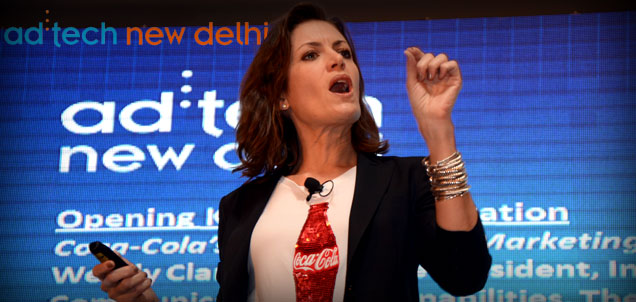
    Speaking at ad:tech 2013, the premier digital marketing event held in Gurgaon every year, Wendy Clark, Senior Vice President, Integrated Marketing Communications and Capabilities, The Coca Cola Company, stressed on the need to create more stories that are share-worthy instead of typical advertisements. Sharing the digital campaigns by Coca-Cola, she deliberated on the concept of Liquid & Linked Marketing. “There are eight learnings so far on this journey,” she shared, “be share-worthy by creating content that is interesting and compelling; embrace the new salesforce which are consumers willing to carry brand messages ahead; listen and then engage; test, fail, learn, and then scale; speed trumps perfection so be ‘flawsome’; disrupt yourself or be disrupted by the market; do not accept the status quo; and, play well on a behavioural level to manage increasingly complicated campaigns.”


    Ms Clark was of the view that storytelling could happen on digital, or any other traditional media, “It is only storytelling of different durations,” she maintained. Focusing on the three areas of stories, spread and value, she cited the example of the ‘Hug Machine’ set up by Coca Cola in National University of Singapore, which would offer a free can of Coke if you hugged the machine. Even though the campaign ran only inSingapore, it became viral globally and generated over 10 million views in theUSitself.


    Katharyn White, Vice President Marketing, IBM Global Business Services delved into how the changing consumer is also resulting in the changing role of marketers. She emphasized on the three imperatives for marketing professionals: understanding the customer as an individual; creating a system of engagement that maximizes value creation at every touch; and designing culture and brand so that they are authentically one.


    Technology, according to marketers is increasingly becoming an enabler that is helping brands create emotionally connected brand stories. Sanjay Tripathy, Executive VP – Marketing, Product and Direct Sales Channels, HDFC Life, spoke about how his company thought of engaging consumers by creating themes around insurance and thus, creating conversations. Nikhil Rungta, Country Marketing Head, Google India, cautioned, “Technology can be intimidating,” but that did not stop Google from creating conversations around real people and real stories, such as the Thanjavur painting. Technology helped the brand marketers to not only create stories but make conversations out of it.


    Mr Rungta also shared how AT&T created a series of 5 webisodes to connect with the consumer, instead of TVCs. The power of videos also enable to consumers to share it, co-create it, become a part of it and, in the long run evangelize the brand.


    Rajesh Chakrabarti, CMO and Chief Innovation Officer, Reliance Commercial Finance and Reliance Home Finance said that while internet penetration and usage is growing multi-fold inIndia, “it is still difficult to sell insurance online.” Reliance used the ground (offline) to get the customers to the web and today, the number of policies sold online has grown from 10,000 to 70,000 policies every month even though he emphasised that it is not easy to engage consumer on the internet. To attract the consumers to online insurance, Reliance kept the interface simple and managed to increase its online revenues by 83 percent in the Commercial Finance and Home Finance domain.


    K Ramakrishnan, President – Marketing, Cafe Coffee Day, stated that offline and online channels are merging. “The brands need to communicate to consumer has changed to ‘how to make consumers communicate on brands’ behalf’. With creating right conversations, consumers do indulge in brand evangelism. Being open to social media also implies that you will get negative feedback. It is an opportunity for brands in this case to look for opportunity here, brand should be able to listen and reward people for it. There needs to be courage to take risks.” Sanjeev Kapur, CMO, Citi (India) talked about delivering customized experiences to consumer according to their preferences.


    Harneet Singh, VP-Marketing, Domino’s Pizza India shared how Domino’s replicated its offline 30-minute delivery challenge online. And today, “eCommerce contributes 15 percent of delivery sales. With native Apps, we have introduced advanced analytical re-marketing strategy. The mobile ordering app has results in 10 percent of our total digital sales.”


    Marketers are also sure that going forward, digital marketing investments will significantly outpace the traditional media investments.


    With the changing media matrix, the role of media agencies is also changing. Speaking to MxM India, Mr Chakrabarti said that with digital becoming an integral part of any marketers’ plan, the need arises for specialised agencies which can provide specific solutions and plans. Ruth Stubbs, CEO, iProspect and Digital Media – Aegis Media APAC said, “Digital technology is creating more media. With more and more business being done online, we need to reinvent the roles we play. It is important to know how we can reset our approach to reinvent the way brands are built in this 24×7 connected environment. It becomes our massive responsibility to guide the brands through the massive digital chaos.”


    Digital chaos it may be, but it sure is throwing up some great stories and conversations!

     

  • Yannick Colaco is managing director, NBA India

    By A Correspondent


    The National Basketball Association (NBA) has announced that Yannick Colaco, the former chief operating officer of Nimbus Sport, has been named Managing Director, NBA India. Mr Colaco will manage the NBA’s India office, based in Mumbai, and oversee the league’s business and basketball development in the country. He will report to NBA President, International, Heidi Ueberroth.


    “Yannick Colaco has the ideal combination of experience and knowledge of the sports landscape in India necessary to lead our expanding operations in the country,” said Ms Ueberroth. “Basketball is on the rise in India and we are thrilled to have Yannick lead our extremely talented staff as we build towards the future.”


    Mr Colaco will be responsible for leading the growth of the NBA in India. He will continue to build on the league’s efforts to grow participation in basketball in partnership with the Basketball Federation of India (BFI). Mr Colaco, who played basketball at the national university level in India, will work with the league’s media, marketing and merchandising partners to make the NBA more accessible to fans in India.


    “The sports market in India is poised for significant growth and as basketball participation increases further there is a tremendous opportunity for the NBA,” said Mr Colaco. “The league has a strong staff in Mumbai and I look forward to joining their efforts to carry out the NBA’s mission to grow basketball in India.”


  • Kansai Nerolac extends its ‘Paint the Change’ initiative to Delhi University

    By A Correspondent


    Kansai Nerolac Paints has received an overwhelming response for its recent initiative ‘Paint the Change’ from the consumers across India. The group had undertaken its first activity of painting a one-km long stretch outside the Delhi University wall on 24th February 2013, Sunday. Here by, encouraging the donation of unused paint that would touch the lives of millions by spreading happiness and cheer.


     

    The group had zeroed in on this site only after carefully analyzing the many entries along with the reasoning received on the Facebook application. T


    The Delhi Wallbook at the Delhi University (North) was painted by approximately five hundred graphic artists/ painters who put up their expressions on the more than 1 km long stretch outside the Delhi University wall where Nerolac donated eight hundred and seventy liters of unused paints which was collected from the consumers at their collection centers. The same was mobilized to the University by Nerolac.


    “At Nerolac transformation is considered as the core value. We strongly believe that paint is a tool that one can use to express themselves. Taking this thought forward, the Delhi University exercise further enabled us empower and educate consumers to invest in a sustainable tomorrow thereby brining a transformation. This activity was an extension of our ‘Paint the Change’ initiative that has beautified the external walls thus adding to the charm of university and has also provided the emerging artists with a prospect to create & showcase their work in the open,” said Sukhpreet Singh, Vice President, Marketing & Sales (Decorative), Kansai Nerolac Paints Ltd.


  • No stay, only tweak in Dettol Healthy Kitchen TVC

    By A Correspondent


    The Calcutta HIgh Court has not granted any stay on the TVC asserting that Dettol Healthy Kitchen is 100 times better at germ killing capability than Vim Liquid, according to a communique As an interim measure the court recorded that Reckitt Benckiser would remove from its TVC only the portion showing the visual of quantum of germs killed by use of the two competing products. As a result it can continue to compare Dettol Healthy Kitchen with Vim Liquid and assert that the germ kill capability of Dettol Healthy Kitchen is 100 times more than Vim Liquid. It is learnt, that the Calcutta HC has ordered the suit to be listed on March 18, 2013, for further proceedings.


    Dettol, one of the most trusted power brands from the portfolio of Reckitt Benckiser has launched Dettol Kitchen, the new range of disinfectant kitchen gel. Dettol Kitchen marks Dettol’s entry into a new segment after Liquid Hand Wash in 1992. Dettol Kitchen with 100X better germ kill ‘cleans for real’.


    Chander Mohan Sethi, Senior Vice President- South East Asia, Reckitt Benckiser said, “Dettol’s brand vision is to be the trusted champion of health, every day. To achieve this, Dettol provides mothers with solutions to help create a healthy home. The kitchen is one of the germ hotspots in the house with invisible germs present on dishes and other food contact surfaces. In fact kitchen sponges too are a harbour for all types of germs. It made complete sense to extend this promise of Dettol’s germ protection to the Kitchen by providing a single solution for a truly Healthy Kitchen.”


  • A spell(ing) well laid

    By A Correspondent


    The fifth edition of HDFC Life Spell Bee – India Spells 2013 ended on a high note recently with Vaswati Das of Gurukul Grammar Sr Second School, Guwahati being proclaimed the winner. With a cash prize of Rs 2 lakh at stake, doubled from last year’s Rs 1 lakh, the organizers hyped the excitement this year by allowing the winner to take the principal or teacher from his school to witness the Scripps Spell Bee in Washington DC.


    Seen as India’s adaption of the Scripps National Spelling Bee held in Washington DC, this year’s contest garnered robust participation from 35 cities reiterating the popularity of India’s biggest school spelling contest. Close to 3 lakh students from class 5-9 across 1000 different schools went through grueling initial rounds of spelling tests that challenged them on various parameters of their vocabulary.


    A property of ENIL, Spell Bee has also evolved over the last five years and today is one of the most awaited properties every year. Sharing his experience on the contest, Hitesh Sharma, Chief Operating Officer, ENIL said: “This year Spell Bee has taken a quantum leap in delivering a wholesome experience to one and all within the space of edutainment. An additional level of screening in the form of the ‘Semi Finals’ has helped us focus on bringing out the best spellers at the National level. Spell Bee revised its format of tests completely and the manner in which they were conducted in 2013. The robust participation that we received online stands as testimony to the manner in which Spell Bee 2013 grew to being a competition that young students across India look forward to.”


    Being the principal sponsors for the competition for the fifth year in a row, Sanjay Tripathy, Executive Vice President and Head, Marketing and Direct Channels, HDFC Life said, “It has been a constant endeavour to take the property to the next higher level year on year and this year has been a significant jump over the previous years. We really upped the scale this year not only in terms of the size and spread but also drastically changed the format to make it purely a spelling based contest closer to its US cousin the Scripps National Spelling Bee. Also, we have ensured that the winners are genuine spelling wizards who had to perform well consistently at every level of the competition.”


    Asserting the importance that is levied on making the contest truly big in terms of scale, Mr Sharma said that amongst other engagements that have been crafted by Radio Mirchi, Spell Bee is a unique as it has constantly focused in helping Indian students spell right and thereby communicate better. “The objective of the property has been to make a difference or contribute to the overall development of Indian students across the country.  The biggest benefit that accrues to us is to have the ability to recognise Indian talent and give it an opportunity to shine.”


    Mr Tripathy, who had a similar experience to share, said that the association with such an event has helped HDFC Life to reach out to and increase brand salience of HDFC Life amongst the core TG. “Through this property, we have been able to engage and interact with over 3 lakh students in over 1000 schools across 35 cities in India. We also believe that as a leader in the child segment that we should be responsible and provide a learning platform for today’s children and with Spell Bee, we have successfully managed to create one.”


    With the contest being sought eagerly by school children every year, the organizers are looking at 2014 throwing up even more surprises. Affirmed Mr. Sharma, “The format that we introduced this year has been exciting and has worked brilliantly for us. Having said that Spell Bee is an ever-evolving property and I am confident that interesting things will keep happening in and around it taking the changing needs of the Indian student into consideration.”


    Admitting that he wanted HDFC Life Spell Bee to become synonymous with Spelling-based contests in India, Mr Tripathy said, “With HDFC Life Spell Bee, change has been the only constant. We are continuously evaluating and evolving the property to take it to the next level – a few notches higher – year on year, every year. Therefore going forward there will definitely be some more interesting changes and it’s all a part of continuous evolution.”


  • The soap that saves lives, and other marketing stories


    By Meghna Sharma


    The latest campaign by Lifebuoy shows a man walking on his hands from his house to the village temple as people follow him because his son turned five. ‘What’s so special about it?’ is the first thought which comes to mind, and this is echoed by the tourist who witnesses it at the end of the advertisement. The answer is the fact that two million children the world over still die before the age of five due to preventable infections like diarrhoea and pneumonia.


    The advertisement is nothing but taking forward the commitment of Unilever’s health soap, Lifebuoy, of teaching children healthy hand washing habits. The three-minute film seeks to inspire action from viewers to pledge support for Lifebuoy’s handwashing programmes on the ground.


    Saving Lives

    Samir Singh, Global Brand VP, Lifebuoy says, “Our goal is to change the handwashing behaviours of a billion people by 2015. We wanted to tell the world the Lifebuoy story in a deeply emotional way. Our brief was to translate the statistics into something real, personal and powerful. And through this film, that’s just what’s been done.”


    The campaign is created by Lowe Lintas. On the film, R Balki, Chairman and Chief Creative Officer of Lowe Lintas, comments, “A small act like washing hands with Lifebuoy can save a child’s life. This message needs to reach far and wide. So, we created this campaign that can open one’s mind to this amazing message. A campaign that moves people to the extent that they care to share it with others”.


    The campaign aims to share the brand’s purpose. And since, social media and technology play an important role in connecting like-minded people who are eager to do something to make this world a better place. The brand wants to tap into this new community of people to inspire them to spread this message of saving lives.


    “This is not just about an ad, but about creating an act. It’s an act that will make a real difference. An act that allows individuals, professionals and organizations to come together and collaborate around the common goal of eliminating child deaths due to diarrhoea and pneumonia. This film is the beginning of that journey and a clarion call to all to join this purpose,” adds HUL’s spokesperson.


    Roti Alert!

    At the beginning of this year, the brand launched another unique campaign – Roti Reminder.


    The Maha Kumbh Mela which sees almost 100 million people descending upon the city of Allahabad turns into a temporary city in itself. And since the infrastructure available is often unable to service the sanitation and health needs of all attendees, infections tend to occur and spread far more easily through transmission of germs, which happens most commonly through infected hands. Hence, Lifebuoy hoped to aid the patrons and attendees by reminding them about the importance of washing hands and protecting oneself from germs. Lifebuoy not only spread the message at key junctures throughout the city through street hoardings and banners. But reminded people to wash their hands before having food through the food itself!


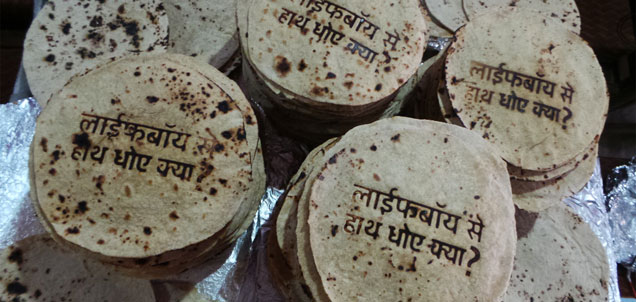
    Lifebuoy created a special heat stamp with the message, ‘Did you wash your hands with Lifebuoy?’ and then hired 100 promoters to stand in 100 kitchens spread across the Maha Kumbh Mela and imprint fresh rotis with the Lifebuoy message.


    Speaking about the genesis of the idea, Sudhir Sitapati, General Manager – Skin Cleansing, HUL says,” The idea came from the insight that hand washing with soap before eating can prevent transmission of many disease causing germs, but people often ignore or forget to do this simple act. A reminder at the right time can go a long way to ensure this habit is followed. This was the starting thought from which we developed a unique intervention – the Roti Reminder.”


    The activation was for a period of one month and started from February 1, 2013. Lifebuoy also provided free soap to attendees at the Kumbh Mela.


    The idea helped Lifebuoy reach out to a massive audience, at a fraction of the cost.


    The on-going commitment

    Over the years Hindustan Unilever has targeted its memorable campaigns towards achieving its aim, and Lifebuoy’s social mission has been to bring safety, security and health to people through the active promotion of hand washing with soap.


    In 2002, Lifebuoy started a campaign known as Lifebuoy Swasthya Chetna, to promote good health practices by actively encouraging people to inculcate good hygiene practices, such as washing hands with soap at least five times a day. From 2002 to 2010, the project touched more than 120 million Indians.


    Lifebuoy reached out to nearly 30 million people in rural India over 2010 and 2011 through a multi-brand rural outreach programme called Khushiyon Ki Doli (KKD) or “Caravan of happiness”.


    Over the past 10 years, Lifebuoy has taken its hand washing behaviour change programmes to millions of people across the world, and now through its latest campaign it is aiming to change the hand washing behaviour of a whole village in central India – Thesgora, a village with one of the highest rates of diarrhoea. The initiative supports Unilever’s goal to deliver on one of its commitment under its Sustainable Living Plan – to help more than one billion people take action to improve their health and well-being.


    By 2015, Lifebuoy aims to change the hygiene behaviour of 1 billion people across Asia, Africa and Latin America by promoting the benefits of hand washing with soap at key times.


  • Google Business Photos debuts in India

    By A Correspondent


    The Google Business Photos program is now officially open to businesses in India. It is a paid premium product offered by Google through its network of Google Trusted Photographers and is currently live in the US, Australia, New Zealand, France, Ireland, Netherlands, Canada and Spain. India will be the first emerging market country for Google Business Photos.


    The initiative aims to break down the barriers that stop small businesses from getting online by offering a quick and easy tool, to help them in their line of work. Through Google Business Photos, consumers can see the interior imagery of popular businesses in their cities, starting with the main eight cities and eventually expanding to more businesses across 20 cities in India. It is envisaged that small businesses which are a household name across retail, hotel, leisure and entertainment will be at the forefront in taking advantage of Google’s new initiative in India.


    Shailesh Nalawadi, Product Manager, Google Maps said, “I am very excited about bringing the power of the internet to each and every business in India. Consumers will  be able to visit a business right from their laptop, mobile phone or tablet. The potential for Google Business Photos in small and medium businesses is limitless.”


  • Ad:tech 2013 focuses on integrated digital marketing

    By A Correspondent


    The third India edition of digital marketing event, ad:tech New Delhi 2013 saw panellists deliberate on topics such as integrated mobile marketing, video integration, location-based relevancy, social media ROI, search and content. Alyssa Altman, Vice President, SapientNitro, in her keynote on the second day of Ad:tech New Delhi 2013 shared findings of their survey in which 88 percent of respondents said that today’s global marketing world has become challenging than ever before. She cited a Gartner study which predicts that by 2017, CMOs will purchase more technology than CIOs.


    While the first day of the conference focused on marketers’ perspectives on the digital consumer; the second day hailed ‘gamification’ as the latest trend for this year and speakers predicted that it will become a major global experience by 2016. Globally, there are more than 500 million people playing games at least for one hour every day. Avinash Jhangiani, Vice President – Digital, Omnicom Media Group, explained about their game changing live collaboration platform for global media planning, ‘Source’, which can even create powerpoint decks automatically. He also shared examples of brands like Visa, Mahindra and Movie Munchies that have successfully gamified their campaigns.


    Citing the example of Mario Bros, Rahul Avasthy, Director Strategy for Zapak Digital Entertainment, said that the same game mechanics can be applied to non-game real-life experiences to help solve the challenges of bounce rate and converting latent leads (CPL). He noted that successful campaigns require not just good content but also intent, citing the example of Arby’s Burger which leveraged gamification generated over 41,000 organic entrants and 3,00,000 actions.


    Mohd. Imthiaz of Hoppr said that there are only 20 million smart phone users in India which is why marketers need to plan campaigns that can run on every type of phone. He said that location-based services can help make the typical lean hours into peak hours. He mentioned that for a consumer, the real benefit a marketer can provide is the joy of watching and sharing content.


    Praveen Sharma, Head of Media Sales, Google India, insisted that with proliferation of multi-screens, apart from the opportunity, it also poses challenge for content creators since viewers filter out the mediocrity on screens other than the TV. T Gangadhar, MD, MEC India said, “As a media agency, we are moving away from media planning to audience planning. We consider YouTube as channel. Plans are increasingly becoming video plans.”


    Prashant Singh, MD – Media, Nielsen India said, “It is important for a digital campaign to be based on three parameters: reach, resonance and reaction. Getting these three basics right would help measure the ROI.” Pratik Mazumder, Head Marketing and Strategic Relations, Yatra.com highlighted the fact that while brands are insistent on ROI from digital media, many brands do not move beyond ‘Likes’ on social media to engage with the consumer.


    The event concluded with power-packed presentations from Sunita Rajan, Senior Vice President, BBC Advertising who spoke on ‘Revenue at the speed of User Adoption’ and Bettina Sherick, SVP Digital Strategic marketing, 20th century Fox International on ‘Marketing the cinema experience in a digital world’. She cited the example of global marketing initiatives for Life of Pi and how Fox leveraged the proliferation of digital platforms for marketing purposes, and also created innovations for consumers to disconnect and experience films on the big screen.


  • Ford launches EcoSport Urban Discoveries campaign

    By A Correspondent


    Ford India has announced the roll-out of its integrated marketing and communications product experiential campaign, EcoSport Urban Discoveries. The 360-degree campaign is the foundation for the launch of Ford’s upcoming urban SUV, EcoSport. Hosted on an online platform, www.ecosportdiscoveries.co.in, the campaign aims to reach out to a target customer base spread across the country.


    The scale of this campaign will be achieved by a high output, simultaneous amplification strategy that will be leveraged through multiple paid, owned and earned media channels. Ford will additionally carry out in-programme placement that will help take the EcoSport directly to home television screens in India through general entertainment channels.


    Announcing the roll-out, Vinay Piparsania, executive director of Marketing, Sales and Service for Ford India, said, “We at Ford believe that real people and their real experiences truly bring out the best in our products. This has inspired us to empower the people of India to set the stage for EcoSport’s launch in the country. EcoSport Urban Discoveries will give over a hundred customers, the opportunity to drive and experience our exciting Ford EcoSport ahead of its market launch. This campaign will help us go further in engaging with our customers and educating them about our upcoming big product.”


    EcoSport Urban Discoveries will be executed in two phases divided by consumer activation roadshows across 12 key cities – New Delhi (including NCR), Mumbai (including Navi Mumbai), Bengaluru, Chandigarh, Kochi, Ludhiana, Chennai, Jaipur, Hyderabad, Ahmedabad, Pune and Kolkata to cover North, South, East and West regions. These roadshows will feature modular interactive zones that will be set up in high-footfall malls in each city to offer potential customers a touch and feel experience of the product and its features.


    “With EcoSport Urban Discoveries we would like to help customers make the right purchase decision for them to enjoy an unforgettable ownership experience and, en route, take away fascinating stories which they can share back home with their family and friends,” said Mr Piparsania.


  • MxM Mondays: How useful are conferences?


    By Johnson Napier


    It’s that time of the year when honchos and executives across industry domains squeeze out time from their schedules to catch up on trends and events. It’s the season for conferences and all-day seminars, especially for folk from Media. After the Indian Magazine Congress 2013 that was held a fortnight ago, delegates will fill the halls at Hotel Renaissance, Powai for FICCI Frames 2013.


    But while conclaves and industry gatherings do serve a purpose, there have been questions about the quality of discussions and relevance of topics, and whether they have brought about any impact or change. The lack of new ideas at these dos also bothers those who attend the events with the hope of getting something more.


    MxMIndia asked industrywallahs what they think of conferences and whether more needs to be done in terms of relevance and generation of new ideas.


    Anwesh Bose, Senior VP, DDB Mudra Max

    “Well, the ideas are there but the discussions are not well thought of. What happens at most conferences is that things get left at the discussion stage and it doesn’t go any further. There is no effort seen where it comes to implementing solutions. Also, most of the events are sponsor-driven and are not taken seriously. Even something like Goafest is more of a celebration thing than something that is followed at Cannes. So when organisers send out invites they should be serious about whom they are calling and what they intend to achieve by hosting such seminars.”


    Sanjeev Gupta, MD, Global Advertisers

    “The Indian media industry is at a nascent stage in comparison to western countries. We need to continuously improve our methods, approach and strategy. And for that, we need to have common platforms to discuss our challenges and difficulties with industry experts more often. Trade shows, exhibitions of new technology, conferences, workshops all have various topics to discuss including new trends and growth pattern of the industry. We would like to suggest that these conferences should be more interactive, touch new subjects and discuss data from an Indian perspective.


    “The numbers of media conferences in India are still very less, we need to organize more such events in future for the betterment of the industry. We would also like to suggest that we need to organize these shows in Tier II & Tier III cities to understand the needs of rural India.”


    Nisha Narayanan, Senior VP – Projects and Programming, 93.5 Red FM

    “Conferences are good platforms for germination of ideas and are good conversation builders. When industry leaders from media sit at a forum together, conversations that get built give fresher and newer perspective to issues being discussed. However it has a fair chance of being repetitive if the topics are the same and the policy has not changed.


    “For instance since 2006 of phase 2 of FM radio, the radio players have the same issues and regardless of the event, the same issues become rather boring to the audience. Now with phase 3, we hope to engage people with fresh concerns and celebrations.”


    Krishna Prasad, Editor-in-chief, Outlook

    “Trade conferences provide a legitimate forum for networking and schmoozing. But individuals and institutions which organize and take part in them need to jump out of the box of cliches if they have to fulfil their core mandate, which is presumably to inspire and throw new light. In other words, there needs to be more ‘disruption’, rather than everybody nodding their heads sagely between checking their phones and yawning. And there needs to be more intense questioning of the holy cows, rather than blind acceptance of their received and perceived wisdom.”


    Prema Sagar, Principal and Founder, Genesis Burson-Marsteller
    “Conferences in India, trade or otherwise, were deeply boring in the years gone by. In recent times, the subjects are more global in scope with local focus. Every expert, speaker and academician is happy to be part of conferences in India…. there are now better speakers with good content and articulation, there is more learning on new subjects, and networking is always a great takeaway. What needs to improve is better planning and execution of events, follow-up papers on subjects that provide further value to those attendees who value the ongoing engagement.”


    Srinivasan K Swamy, CMD, RK Swamy BBDO

    “Good conferences with a timely and focused theme and a set of good speakers are always relevant. Unfortunately we have too many of these undifferentiated ones. They all have the same topics discussed, the same speakers and more often the same audience! Also in many conferences there is too much selling by the speaker about his company, and that is a put-off for audiences.


    “Some introspection is needed before embarking on the next conference on three dimensions: Is the theme addressing the current and the immediate needs of the intended audience? Can we divide this theme into topics that can be looked at closely, multi-dimensionally? Can we get engaging speakers to address the chosen subjects – not something they can repackage from their earlier presentations?”


  • Intelligent marketing tool from MICA

    By A Correspondent


    Mudra Institute of Communications, Ahmedabad (MICA) has launched a market intelligence product called MICA Indian Marketing Intelligence (MIMI) that assists businesses in making sound and strategic marketing and business decisions in India.


    Built around a unique data-fusion algorithm developed by the professors and researchers at MICA, MIMI fuses the variety of structured information, compiled from authentic sources, to provide a composite, granular market-view. It also provides Market Potential Index (MPI) and other data separately for rural, urban and total Indian market for more than 630 districts, hitherto not provided by any other similar product.


    The main highlights of MIMI are:-

    Provides market potential index: As one of the most acute needs of the marketer is to arrive at a district prioritization for purposes ranging from market entry to product/Service launch, MIMI provides Market Potential Index (MPI) for 630 districts for rural, urban and total market. The higher the MPI, the higher is the market prioritization.


    Provides a wide array of Information and applicability: With 143 variables across rural and urban market, MIMI provides data related to Demographics, Agricultural, Financial Services, Media Ownership, Vehicle Ownership, House Hold (HH) Size and Usage, HH Basic Amenities, HH Light and Fuel, etc. to be applied across sectors ranging from Construction and FMCG to Telecom.


    Simplifies decision-making: To interpret data quickly and effectively, MIMI provides a host of features like Graphs, GIS maps, Quartile and Potentiometer in downloadable format. These features are helpful for better presentation of the data and clarity of analysis. For example, if a marketer would like to target a specific region, the Quartile-based model helps him to compare various districts on selected variables, simultaneously, to arrive at a comparative picture.


    User-friendly interface: With a highly interactive website and user friendly interface, users can perform a large number of functions like execute simple arithmetic functions, customize variables, save work-space, compare districts across the states, besides others, with the help of MIMI’s superlative filtered features.


    Comes with zero IT cost: MIMI is based on a powerful cloud platform, and eliminates the need for software upgrades and hardware maintenance.


    Has composite score for selected categories of variables: To better understand the prosperity of a district and penetration of assets, composite score for selected categories of variables like agriculture, financial services, media ownership, and vehicle ownership are provided.