Category: MARKETING

  • H&M, Topshop get set for India

    By Samidha Sharma & Boby Kurian


    Swedish fast-fashion giant Hennes & Mauritz (H&M) has asked leading mall developers to block space for its initial stores in India, as the world’s second largest fashion retailer hopes to open a local office in the next three months. British billionaire Philip Green-owned Topshop is another foreign retailer finalizing plans to enter the country through a local joint venture, as global biggies revive interest in India on the back of recovering consumer sentiments and the recent reform push.


    India allowed 100 per cent foreign direct investment (FDI) in single brand retail, a route which H&M would take to enter this market just like its Swedish peer furniture retailer Ikea. H&M’s international expansion head Frederik Olsson has frequented the local market in the recent past, asking leading mall developers like DLF and Phoenix Market City to block potential store locations, said people directly familiar with the matter.


    “H&M is likely to open an India office within three months after they move the Foreign Investment Promotion Board,” said a source who did not wish to be named. H&M’s chief executive Karl-Johan Persson while announcing the company’s quarterly earnings recently said the retailer would enter India on its own, and was ready to meet 30 per cent local sourcing norms.


    UK’s Topshop, which came close to partnering the Tatas five years ago, has revived India plans and is close to firming up a local joint venture partner. “We are actively speaking with a number of parties about the market, but as yet nothing is confirmed,” said a spokesperson for Topshop. An H&M spokesperson declined to comment on future plans.


    These developments come even as Japan’s Uniqlo is moving towards striking a joint venture with Arvind, while American retailer Gap Inc has made moves to identify its best possible market access. H&M and Uniqlo could open maiden stores in the first half of 2014. Another iconic US retailer Abercrombie & Fitch has started work to enter the country, possibly through the 100 per cent FDI route.


    The New York-listed A&F’s Hong Kong office has begun work with leading real estate consulting firms to explore an entry strategy, said sources cited earlier. An emailed query to Abercrombie & Fitch remained unanswered.


    Notwithstanding the reviving euphoria, India still represents a complex market for most retailers, with real estate costs among the most expensive in the world. Zara, part of the biggest global fashion conglomerate Spain’s Inditex group, opened nine stores in an aggressive three year expansion.


    But Zara’s 18,000-sq-ft stores, which pay a fixed 6 per cent fee on sales to mall owners, have not gone down well with many developers in a market with huge shortage of quality retailing locations.


    The mall owners who in the past chased Zara, even offering to take up store fit-ins, have cooled off, with some preferring to wait out for the newer global entrants like H&M, Uniqlo and Forever 21 while deciding on space allocations for the next 24 months.


    Source:The Economic Times

    Copyright © 2013, Bennett, Coleman & Co. Ltd. All Rights Reserved


  • TELiBrahma launches Brandclub

    By A Correspondent


    Mobile advertising solutions company TELiBrahma has launched Brandclub, a digital media closest to Point of Sale to enhance media efficiencies by targeting consumers who are within the vicinity of the retail outlets.


    Brandclub enables retailers to cross-leverage partner network to increase and engage the walk-ins. Brandclub will offer consumers the best shopping experience at a given shopping destination. They can get relevant information about new arrivals, coupons, menus, offers and other promotional content from the store they are in, as well those nearby.


    Upon connecting to Brandclub through Wi-Fi or Bluetooth, consumers can access the above information right on their mobile phones without having to download any application.


    Retail Brands can benefit from Brandclub by engaging deeper with serious shoppers and also generate additional walk-ins from the participating brands in their cluster. Brandclub can deliver reach to consumers within the proximity, with the commitment of a reach to eight-times the footfalls at fraction of the cost of other media; this in addition to increased targeting, interactivity and measurements possible.


  • Final Shiva Trilogy book to be launched with music album, video

    By A Correspondent


    Think WhyNot, a strategic creative agency, is all set to usher in an era of unprecedented innovation in book marketing through the launch of the campaign for the release of Amish’s 3rd book titled ‘The Oath of the Vayuputras’, the concluding book of the Shiva Trilogy. The first two books in the Shiva Trilogy - The Immortals of Meluha and The Secrets of the Nagas – have sold a million copies till date, making it one of the fastest selling book series in Indian publishing history. Think WhyNot has been a key partner in the marketing strategies that have played a role in its success.


    Think WhyNot, which has retained the creative account of Shiva Trilogy, will launch the latest campaign by unveiling one of the world’s first-ever music video and original soundtrack made for the promotion of a book. The video will be broadcast in popular television channels and across all social media platforms. It will bring alive the journey of the 3 books of the Shiva Trilogy in a world-class 5 minute music video. The Music video is part of an album with 10 songs by top-notch artists including Sonu Nigam, Taufiq Qureshi, Bickram Ghosh and Palash Sen among others. All the songs of the music album were created around relevant situations drawn from the three books. The album has been conceptualised by Think WhyNot, while the video has been directed by Amit Pandirkar and the music has been produced by music industry veteran Rajeev Sharma.


    The final leg of marketing initiatives for the Shiva Trilogy will include launching interactive apps, innovative merchandise and some great viral events that will follow the music and book launch.


    Speaking on the occasion, Sangram Surve, CEO, Think WhyNot said, “After tasting the stupendous marketing success of, ‘The Secrets of the Nagas’, we are very excited to partner with Amish for the launch of his third book, ‘The Oath of the Vayuputras’. The ‘think big’ brief given to us was apt for the launch of the final book of the Shiva Trilogy, which has the largest-ever initial print-run in Indian publishing history. The challenge was to not just get existing fans of the franchise to buy The Oath of Vayuputras – that would happen anyway – but to expand the reader base. The campaign idea revolved around creating another ‘first-of-its-kind’ in book marketing, which this time around turned out to be the production of a world-class music video which is poised at reaching out to the masses through television, in a bid to garner greater awareness about the book.”


    Commenting on the partnership Amish said: “I am glad to have Think WhyNot on board again for the launch of the third and final book of the Shiva Trilogy, The Oath of the Vayuputras. Think WhyNot has been a crucial partner in the marketing of my books, with excellent conceptualization and implementation of some out-of-the-box initiatives. The music video and original soundtrack idea is fantastic and will help in introducing the trilogy to a larger base of readers and followers of Lord Shiva.”


    The music album will be sold in physical stores as well as digital ones, and is available for pre-order from the first week of February.


  • Publicitas Digital signs exclusive sales partnership with Orbitz Worldwide

    By A Correspondent


    Publicitas Digital in India has signed an exclusive sales partnership with leading global online travel company Orbitz Worldwide, wherein they will provide Orbitz digital expertise and access to their sales network to help Orbitz enter the Indian market.


    Publicitas Digital will sell Orbitz Worlwide digital inventory to advertisers in India aiming to reach foreign tourists. Orbitz Worldwide is a leading global online travel company that uses technology to enable travellers to research, plan and book a broad range of travel products, with a portfolio of consumer brands that includes Orbitz (www.orbitz.com), CheapTickets (www.cheaptickets.com), ebookers (www.ebookers.com), HotelClub (www.hotelclub.com), RatesToGo (www.ratestogo.com) and the Away Network (www.away.com).


    “Orbitz is pleased to partner with Publicitas as we enter into a new market with tremendous growth potential,” said Josh Winkler, Vice President of partner marketing for Orbitz Worldwide. “Publicitas offers an extensive sales network coupled with a deep understanding of the local market, so we look forward to leveraging their expertise throughout the course of this partnership.”


    Namita Sahu, COO, Publicitas Digital India and Asia, said, “Travel advertisers are looking at catching the attention of their audience at the decision making stage. This is the best contextual environment where an Indian advertiser looking to connect with the foreign tourists can promote their offerings. With this partnership we have further consolidated our position in the Indian market to provide our advertisers a one stop shop for all their communication needs to reach out to the discerning travellers. Our goal is to provide Orbitz access to our extremely well spread sales network and digital expertise to help them enter the Indian market.”


  • Getting set for the Big Leap: John Goodman


    Of the numerous verticals under the ambit of advertising and communications behemoth Ogilvy, the one that John Goodman is particularly proud of is Ogilvy Action. While it may be natural for him to favour the agency, given his association as President, Asia Pacific he in fact has a firm reason to share: it is the fastest growing agency in the world for the group.


    Not a surprising statement to make given that in the last couple of years, Ogilvy Action has seen annual growth across Asia Pacific in the range of 30 per cent a year. That’s miles ahead of the growth number that the other agencies have managed to throw up year-on-year. And if Mr Goodman is to be believed, apart from the fabulous growth, what makes his agency a favourite is its ability to offer both the analytical and creative & implementation side of solutions.


    In India to release and share findings from the survey Shop Talk, Mr Goodman takes some time out prior to the event and talks shop with Johnson Napier of MxMIndia. India, talent, emerging markets and FDI take prominence as Mr Goodman gets talking on these topics and more. Excerpts:


    Could you take us through some of the findings from Shop Talk – the survey that reveals valuable information around the shopper-consumer?

    The event is intended to announce the findings of the research that we have done into how Indian shoppers behave, how they act when they are in hypermarkets, what the differences are between what people think and what the reality is and then talk a little bit about the tools that we have developed to help people understand that and be able to use it to be more effective in their marketing.


    You’ve concentrated on three important markets of Delhi, Mumbai and Bangalore for the survey. What was unique about these shortlisted markets; why did you leave out other important metros that could’ve lent you a wider perspective?

    There are many important markets in India and beyond a point you have to draw a line on how many cities you want to cover. The hypermarket area is the most developed in these three cities of Delhi, Mumbai and Bangalore and therefore we thought we could get more useful information from these pivotal markets. There may be regional differences that could arise from a Chennai, Kolkata or Hyderabad etc but in general we haven’t seen great difference in behaviour from one city to another.


    Is this the first such study based out of India? What relevance does it hold for your agency from an Asia-Pacific perspective?

    We’ve done various studies on how people behave in stores and how it makes a difference to what brands are trying to sell. In the recent past we have done studies in China, UK, the USA etc and what you see is that people often change their decisions; they behave differently when they are in the store. We always talk about the difference between the consumer and the shopper; the consumer is fairly passive – they are sitting and watching television or out in the car or in the office and they may have seen some advertising but they are not actively making decisions. But when they are in the store whether in the hypermarket or mom-and-pop store or even online, they behave differently. They are thinking about what they are going to buy, they know they are going to spend money, they are engaged…they are thinking positively about what brand, what products and what decisions they make. Up until a few years ago people really didn’t think about it and they spent all their money trying to influence people when they are home or out through radio, billboard etc but so many decisions get made at the last minute when people are actually in the store or are just deciding to buy or whatever – you need to communicate to people and need to understand what’s going on in their mind.


    What are your observations about the Shopper Marketing space in India? How have you seen it evolve over the years?

    There is a lot of traditional trade existent in India; it is the smallest market for organised trade. It has changed hypermarkets, changed supermarkets, branded stores and so on…it has changed quickly but it is still much further away from say a China or Thailand or other developing countries. As a result the behaviour is different – people are coming to a new experience and are going to shopping malls, hypermarkets, which were not there a few years ago. And therefore we have to have an understanding of how Indian consumers react, which is a new territory because we often know how consumers behave when they shop in a mom-and-pop or big stores but how they behave in an organised trade is very different. Our research tells us that this will continue to be the trend; it is inevitable over the next few years that whatever happens with FDI or with local investment that the trade will become more organised because it works much better that way.


    In terms of criticality, how has your focus around research / analytics grown over the years?

    We put a lot of emphasis on research, data and insights and where we are looking at insights we want evidence whether those insights are correct or not. So if we want an understanding of how people are behaving in stores we need not just take a guess but research and analyse that data in order to have robust outcomes that people will want to use.


    How has Ogilvy Action as a unit performed for you over the past one year, including India?

    In Asia, this has been the fastest growing part of Ogilvy’s business. We are starting to see that take off in India as well. So we have a lot of clients whom we work with who are now coming to us for this kind of support and advice. Also, there aren’t many agencies in India who are doing this. If you look at traditional advertising there are a lot of agencies out there available to service you but that’s not the case in this arena. Though we have big competitors from other agencies who come here to India but we obviously have an advantage as we are the first in this space.


    How have you been able to quantify this fast growth into absolute numbers?

    In the last couple of years we have seen an annual growth across Asia Pacific in the range of 30 per cent a year. We think we are in a good position as we are able to offer both the analytical and also creative & implementation side of solutions. While there are others who are either good in creative or analytics but not in both the disciplines. That has been our point of difference. We can tell you what to do and then we can do that for you too.


    Do you see India leading from the front where growth is concerned?

    I expect in India the business to grow very quickly as I expect the client to firstly wake up to the trend and secondly, the advertising market is quite cluttered so people are looking at new ways to reach out to consumers. Also, the trade is becoming much more organised and as that happens these kinds of services become more important.


    In a normal scenario, clients would prefer to wait and watch then reach out to their purses during an economic slowdown. Did you see that happen with your agency?

    We operate in an interesting area because we combine with three parties: client, retailer and the consumer and we have to come up solutions that make all three happy. That’s because retailers won’t co-operate with us if they do not feel it is going to build their business, clients want to see things move in their store and for the consumer it is about better information and choices. So things go up and down in the Indian economy but generally we see a lot of growth to come from this market. It is such a huge country that it’s potential for growth is limitless.


    What is your observation on the current state of affairs where FDI in retail is concerned?

    This is one of those situations where it is one step forward, one step back. It’s like they decide on something, and then they change their mind. It’s difficult to predict. From the point of view of the client, it is both an opportunity and a threat. Opportunity because they can deal with fewer consumers and bigger networks but the threat is that retailers tend to control the retail environment. If you’ve invested in a big network in a hypermarket the retailers are in a very good negotiating position with the manufacturer and therefore the manufacturer has to demonstrate value to the retailer. It becomes a very competitive environment for the manufacturer.


    Any other challenges you foresee for the sector in India?

    The politics of it is really very worrying because as I said if the FDI becomes less controversial and if people see the benefits it brings to ordinary people, then it will continue to keep growing. The fact is that in organised retail the consumer benefits the most, more than anybody else. They get better prices, better quality of food, good hygiene standards and so on. At the end of the day it is the consumer who is going to win.


    How has your Rural Marketing division been performing over the years?

    We were the first ones to develop a rural marketing agency, started back in 1995. We work extensively with clients like Unilever and Castrol in terms of reaching out to villages, rural areas, small towns… and it is really an exciting part of our business. Also it is very challenging as we get faced with infrastructural issues and the fact that you are dealing with a huge number of people who are very diverse and spread out. But it’s an interesting part of the business because the messaging has to be very different. While the urban audiences tend to be more sophisticated and good at decoding messages and understanding communication, that’s not the case with rural audiences for whom the communication has to be different.


    As you move forward, what would be the core areas of focus for Ogilvy Action?

    There will be a growing emphasis on digital and data that enables clients to get a much better understanding of the big picture. We are now in a situation where the client can stop to build up data and digital contact with a much bigger reach. So from the technology point of view, it is helping the way we work. At the same time the rural area is still underdeveloped, and if you see the size of the rural population we have barely managed to scratch the surface where reaching out to them is concerned. So the sophistication of data and rural contact are important for the Indian market, and when the two come into contact the connections become better.


    What about growth from the Asia Pacific market – how has it panned out for you?

    For Asia Pacific it is difficult to say because what happens in Japan is different from what we do in China or Malaysia etc. But at the end of the day, the client wants to reach out to the shopper, wherever they are. That’s where the decisions get made.


    Any emerging markets that you are aggressively considering tapping into, moving forward?

    I think Indonesia will be a huge opportunity because it has been a sleeping giant for long now. It is the third largest country in the world but it has remained quiet so far. That is all set to change, I guess. Similarly Vietnam, that has a large rural population and is also a very dynamic market. A place where we have just opened an office is Myanmar, because with the political situation changing and with the country being open to the West we saw a good opportunity there. We are the first ones to enter that market.


    Are you content with the talent situation in your agency or is it still WIP?

    Talent is the most difficult challenge we face. To be quite honest, it is easier to find a new client than to find new talent. We are trying very hard to train, to develop to get new talent from outside and move experienced people from one place to another, but the demand for talent is huge and if we could find more people who are good at what we do, we would grow quicker. While we are not worried about the leadership issue in Mumbai, we are looking at positions outside Mumbai including Delhi, Bangalore etc where we are seeing good traction in the business. We hope to appoint new people in these markets soon.

     

  • HUL sells Lifebuoy by stamping rotis at Kumbh Mela

    By Sagar Malviya


    At Kumbh Mela, the largest congregation on earth where all big marketers are vying to sell their wares and boost their brands, one promotion that stands out is Hindustan Unilever’s ‘Roti Reminder’ for its Lifebuoy soap brand.
     

    The country’s largest consumer products firm, along with creative agency Ogilvy, has partnered more than 100 dhabas and hotels at the mela site to serve rotis that are stamped with “Lifebuoy se haath dhoye kya?” (Have you washed your hand with Lifebuoy?) “The ‘Roti Reminder’ gets a consumer’s attention at the exact time when hand washing is critical,” Sudhir Sitapati, general manager, skin cleansing, at HUL, says. That is, right when she sits down to eat roti with her hand.


    The company has made special heat stamps to make an impression of its message on rotis and hired 100 promoters to stand in 100 kitchens across the mela. The campaign started on February 1 and will run for 30 days. The company hopes to put the hand wash reminder on 2.5 million rotis.


    “The Maha Kumbh provides a unique opportunity to communicate this message to a large, predominantly small-town and rural population,” Sitapati says. “In effect, this simple, clutter-breaking idea will help us reach out to a massive audience, at a fraction of the cost.”


    Source:The Economic Times

    Copyright © 2013, Bennett, Coleman & Co. Ltd. All Rights Reserved


  • Sachin exceeds target for Support My School campaign

    By A Correspondent


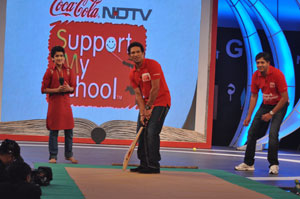
    NDTV, along with the entire Coca-Cola family of bottlers and employees came together with campaign ambassador Sachin Tendulkar and Bollywood superstar and icon Aishwarya Rai Bachchan to support the live 12-hour telethon which was telecast across the NDTV network channels on February 3. Sachin set a target of 250 schools to be supported.

     

    This edition of the campaign received an overwhelming response from people across different walks of life and generated 13.5 crores to support 272 schools, with the Bollywood and TV fraternity, corporate houses, athletes, NGOs politicians and everyone contributing wholeheartedly to this cause to raise funds, and partner NDTV in its mission to make a difference to as many schools as possible across the country.


    A host of prominent personalities including Kajol, Ajay Devgan, Anil Kapoor, Ronnie Screwvala, Alyque Padamsee, Pamela Chopra, Priya Dutt, Yuvraj Singh, Shashi Tharoor, Kailash Kher, Javed Ali, Sushant Singh Rajput, Rahul Bose, Adnan Sami, Shilpa Rao, Cyrus Broacha, Prasoon Joshi, Govind Nihalani, PT Usha, Nagarjuna, Chief Ministers Shivraj Singh Chauhan, Bhupinder Singh Hooda, Coca-Cola CEO Atul Singh, Dr Kulwant Singh of UN- Habitat, Bhagyashree Dengle Head World Vision & Plan India, Dr Jay Kumar of World Vision, Meenakshi Batra CEO CAF, Khozem Merchant CEO Pearson, Anubhav Sinha and more, along with NDTV’s Group CEO Vikram Chandra, campaign ambassador Sachin Tendulkar and co-host Aishwarya Rai Bachchan took centre-stage to reach out to millions of viewers to generate maximum funds for the cause.


    Delighted with the tremendous response received for the initiative, Dr Prannoy Roy, Chairperson, NDTV Group, said, “This campaign which focuses on reducing the school drop-out rate by girl students across the country is of great importance. Most girl students drop out of school because there are no toilets for girls in majority of our schools. This campaign aims at changing that directly by adopting schools and building these facilities as well as indirectly by raising awareness of the problem and putting pressure on state governments to ensure that every school has toilets and facilities for girl students. We appreciate the amazing support from our viewers and urge everyone to once again come forward and help Sachin and NDTV “Support My School”


    Speaking about the campaign, Atul Singh, President & CEO, Coca-Cola India and South West Asia, said, “It has been a heartening experience to see the variety of stakeholders who came together for this noble cause today. We believe that Support My School’s success is a result of collective endeavor and this has been proven again today. I am proud to be part of this initiative which is not only revitalizing schools but also helping shift the national focus to the issues plaguing our education infrastructure. The response we have received this year has surpassed the previous year and I am excited about the journey ahead for the campaign, this season. The contributions raised at the Telethon 2013 will go a long way in fulfilling our vision for season 2 and bring more children back to where they belong.in schools.”


    Actress Aishwarya Rai Bachchan, Campaign Ambassador, who led the campaign along with Sachin Tendulkar said, “Joining the Support My School Team on this platform today truly gives me great pleasure. I believe Education is immensely Invaluable, Essential and the most Empowering gift we can give the children of our Country. Every child deserves the best of opportunities to grow and prosper… Every girl needs to recognise that she herself is a beacon of hope and has the potential to influence her future. And I understand and recognise, for this to be possible, these opportunities have to be made available to our children!!! In a vast country like India, there are many and varied challenges one faces while working with diverse rural and semi-urban communities. Individually, we may not comprehend these challenges, but collectively we are much stronger! And the overwhelming response to this campaign this time has proven that! With 272 schools and counting, the second season of Coca-Cola NDTV Support My School is spreading the joy of learning amongst the children of our country… And this has only been possible All Thanks to Every support and encouragement from donors, viewers, campaign partners and all on board the collective effort today!!! God Bless everyone for their contribution and Thank you!!!”


    With the funds generated through the ‘Support My School’ Telethon, NDTV and Coca-Cola along with CAF, UN-Habitat, World Vision, Plan India and Pearson will reach out to transform 272 schools across the length and breadth of the county providing Sanitation, separate toilets for girls and boys, drinking water, libraries, Sports and Recreation facilities and improvement in their overall infrastructure and environment, to give Indian children a better tomorrow.


    Supporting the initiative actor Ajay Devgan said, “The only thing we lack in our country is education. Any solution to any problem in our country is education.”


    Adding to it Kajol said, “For a country to go forward education is the first basic step to it and it is every child’s birth right. If by taking small steps such as this can change the situation, more of these should be done.”


    The event also featured several enthralling performances by Ayushman Khurana, Kailash Kher, Javed Ali, Adnan Sami, Shilpa Rao, Shweta Tiwari, Nikhil Paul George, Anwesha from Chote Ustad, Anshuman and Deep Raj from India’s Got Talent, Faisal and Ronan from Dance India Dance, Salman, Azmat Husaain and Sanjana Bhola Sa Re Ga Ma Pa Little Champs and India’s 3 year old Drummer, Anshuman Nandi, young singers Priyanshi and Rimsha and honoured a few deserving teachers, toppers and child prodigies. Adding further excitement to the event was ‘Sachin ki Paathshala’ – an interactive session where the Master Blaster shared his Gyaan with children joining in live from across the country. The telethon also featured success stories from supported schools across rural India.


    Batting maestro Sachin Tendulkar, who spent 12 hours on the show giving valuable tips to school students while repeatedly appealing for donations, made a personal contribution of Rs 10 lakhs, as did Aishwarya Rai Bachchan and Kajol and Ajay Devgn.


  • Click for a Linc

    By A Correspondent


    Linc, one of the top three players in the organized writing instrument industry in India, launched its retail sales online through its portal www.officelinc.com. Now consumers can directly buy pens & stationery from Linc’s website.


    Earlier available through online platforms like William Pens, TSG Fashions, Flipkart, Snapdeal, Indiaplaza, etc., Linc has planned to start its distribution through the online channel in an aggressive way. Through this site, consumers (both B2B & B2C) can choose from a wide range of products right from the convenience of their home/ office.


    Commenting on this new development, Rohit Deepak Jalan, Business Development Executive, Linc Pen & Pl. Ltd. said, “We realized that companies/consumers spend time online on researching for gift products and prefer dealing online. Linc provides this opportunity, through Office Linc, to shop for not only pens but also stationery through its online platform. The format will be like the Office Linc store, only that the model has been shifted to a digital platform. The payment can be done online and will also have the Cash on Delivery (COD) convenience.”


    He added, “For any product to succeed in the market, the target segment must be taken into account. With the changing preference in consumers and digital marketing becoming an important tool, having an online sales platform was an important decision. Through this platform we want to bring service right at the doorstep of our consumers and make it convenient for them to shop.”


    Office Linc sells products starting from Rs. 5 to Rs. 65,000. The online store will have pens from Linc, Uniball, Lamy, Cruiser and stationery from select brands like Markline, Bensia, Faber Castell, Maped etc to start with. More product categories might be added in the future. Initially this service will be launched in Kolkata where products will be delivered at the door step of the consumer against a minimum order amount of Rs. 200.


    Currently the company’s products are available across more than 1,25,000 retail outlets throughout India covered through a network of over 2200 redistribution stockists and 40 main stockists. This is facilitated by sales and marketing team of around 300 professionals.


  • We are very optimistic about India: Tripti Lochan

    By Johnson Napier


    Digital marketing agency VML Qais has had a busy 2012-13 helping multinational clients and digital start-ups chart their digital course and implement groundbreaking online initiatives. One such recent example the agency undertook was an online study for their client Revlon India, which was conducted to better understand the mindset of Indian women and their attitudes and habits towards foundation.


    According to Tripti Lochan, CEO, VML Qais, as was the case with Revlon India, brands are today recognizing that digital provides a more powerful engagement than any other media. In fact she is very confident that marketers will soon be putting their dollars more convincingly behind digital.


    In an interaction with MxMIndia, Ms Lochan stresses on the need for real-time creation of branded content by brands and how regional clients are increasingly demanding India-specific strategies as part of value-added services. Excerpts:


    We know of brands flocking to the social media platform to reach out to their audiences wherever they are. What was unique about the social media exercise you undertook with your client Revlon India?

    We believe that all strategy needs to be driven by consumer insights. As a first step for Revlon India, we carried out a social listening piece, to understand real consumer conversations & attitudes regarding beauty, health, and wellness. Our strategy was then pivoted on these insights. With Revlon India we are bench-marking not only against Indian competition but global beauty and fashion players like MAC/ Estee Lauder/ Burberry. We want to use social media as a long-term conversation platform that allows Revlon to continuously gain insights from consumers, and be relevant to their needs.


    Any notable trends that emerged as the users sampled your questions/survey?

    There were a lot of interesting trends, notably the fact that Indian women prefer natural make-up. Colours are welcome but those that work best with Indian skin tones. Many Indian women are multi-tasking and looking for beauty brands that match that lifestyle – easy to use and long-lasting are two recurring needs. This is validated through Generation Asia India research that we carried out earlier in the year where the theme of individualism is strong.


    Is a sample size of 75,000 (via online) big enough a number to convert perception to reality? Did you consider collating inputs through the offline route as well?

    It is a substantial sample to consider. And since our strategy was online focused, with focus on communicating on Facebook, we wanted to get the perception of this audience – which is digital, the connected segment.


    As a digital agency, how according to you have brands woken up to pursuing online marketing activities in terms of budgetary allocations and importance vis-a-vis traditional mediums?

    The spends on digital do not by any stretch of the imagination mirror the time consumers are spending online. This is because brands have a “comfort factor” concerning spending on things they know well. But the good news is that brands are recognizing that digital provides a more powerful engagement than any other media. We are already seeing experimental budgets being set aside. I am very confident that marketers will soon be putting their dollars more convincingly behind digital. If you look at a brand like Revlon, it’s an opportunity to replicate beauty-counter conversation around make-up into a digital dialogue with consumers. Which other medium would allow them this?


    VML Qais seems to have an array of corporate clients under its belt. What makes your firm an agency to vie for?

    As an agency we have a firm belief: we are marketers first, before anything else. And as marketers, we keep to the fundamentals of marketing: take direction from business objectives, base everything on consumer insights, and think holistically. Yes, digital is complex; it requires an understanding of an added layer – technology. Of course the importance of understanding this cannot be underestimated. And to steer through this requires you to have the ability to join the dots – between what your business objectives are as a brand, what consumers want, and what technology allows us to do today. We believe that technology will continue to change, as it has been over the last decade. There are new developments that impact marketing every day. And we need to be in continuous curiosity and learning mode, so we can help our clients navigate through this sometimes-confusing environment. The first thing I tell our clients is that we are not experts in their business – and that we learn as much from them as they do from us. As an agency, it is our desire to do the best we can by our clients that shows results.


    What is the trend you anticipate 2013 to throw up regarding brands taking the social media space for marketing & promotional activities?

    I think one of the most interesting trends we have been seeing is the real-time creation of branded content by brands. This is the ability, in real time, to look at conversation in real time, create a point of view or response against this, weaving in the brand’s POV. This, done in an innovative, creative way, can be used for marketing and promotional activities by brands.


    What does 2013 augur for VML Qais on the growth front in India?

    We continue to have some really interesting projects at hand in India. Our client relationships are strong and growing. We have set some aggressive growth targets for VML Qais in the region, including for India. The year has begun well with big regional wins. We see a lot of our regional clients wanting specific India strategies, and that is part of the value-add we can offer them. We are able to provide global insights in India to brands that want to benchmark against global competitors, and Indian companies that want a regional or even global strategy. We are very optimistic about India.


  • DDB MudraMax appoints Deepak Trikha as VP, Experiential

    By A Correspondent


    DDB MudraMax has roped in Deepak Trikha as VP, Experiential. Mr Trikha will be based out of Delhi and will report to Mandeep Malhotra, President, DDB MudraMax.


    Mr Trikha joins DDB MudraMax’s experiential team from Sistema Shyam Teleservices (MTS), where he was AGM, Marketing Communication, responsible for strategy and execution of 360 degree marketing campaigns for MTS’s telecom products and services. He started his career with Kidstuff, DDB MudraMax’s Promotional & Events unit, and then moved to Encompass as AVP where he served for six years. With over a decade of experience in the field of marketing, he has worked with some world renowned MNCs such as Ford, Britannia, World Space, Toyota, Sony, Hewlett Packard and Nokia among others.


    Mandeep Malhotra

    Commenting on this new appointment, Mandeep Malhotra, President, DDB MudraMax, said, “I am really glad to welcome Deepak in my team. He comes with a lot of experience in the business. I strongly feel he will complete the dots for a constellation in our Delhi office of glittering stars. Looking forward to a great innings with DDB MudraMax. My advice to him is stay hungry, as I strongly believe Delhi has a lot to offer.”


    Mr Trikha said, “I am very excited to be part of the DDB Mudra Group family which is India’s largest Integrated Marketing Communications entity. Creativity and customer centricity being the driving factor to run its business. The DDB Mudra Group is well poised to take up the market leadership position in the field of brand and marketing communications. I am delighted to be a part of this passionate and highly spirited team and looking forward to play a pivotal role in achieving greater milestones in times to come.”


  • Eureka Forbes partners Digitas for digital

    By A Correspondent


    Water purifier manufacturer Eureka Forbes has awarded its digital and social media mandate to Digitas India, digital marketing agency and a member of the Publicis Groupe. Eureka Forbes has been a pioneer in direct selling with marquee brands like Aquaguard and Euroclean for nearly 30 years.


    Digitas will be responsible for an integrated and end-to-end solution to strengthen engagement with customers across digital platforms like Electronic Customer Relationship Marketing (e-CRM), e-commerce, Online Relationship Management (ORM), Social media, etc. E-commerce will play an important role in the company’s digital strategy as Eureka Forbes is strengthening its presence not only in direct sales but also retail and B2B space as well.


    Speaking on the announcement, Marzin R Shroff, CEO, Direct Sales and Senior Vice President, Marketing, Eureka Forbes Limited, said, “We are happy to partner with Digitas as our digital agency. The core strength of Eureka Forbes is ‘relationships’ with our customers. In this digital age, it is important for us to engage with our customers real-time on the digital platforms as well and cater to their needs. For over 30 years, India has known us for our direct marketing efforts; the vision is to replicate the same on the digital space as well. We believe the integrated approach and rich experience of Digitas will help us to strengthen our customer relationships on a long term basis and wish to build a strong e-commerce channel to supplement our success of direct selling in India.”


    Kanika Mathur, President, Digitas India said, “This is an amazing opportunity and we are incredibly excited to be a part of the digital initiative for Eureka Forbes. More of Eureka Forbes customers will be online as the internet explodes in India and we believe that a significant business model can be created online.”


  • Biscuit biggie Parle-G is India’s first homegrown Rs 5k cr FMCG brand

    By A Correspondent


    When Parle Products launched Parle-G in 1939 during the British rule, the firm considered it a responsibility to sell affordable biscuits to Indians.


    Today, the same value plank has helped the glucose biscuit brand become the first Indian FMCG brand to cross the Rs 5,000-crore mark in retail sales in a year.


    In 2012, Parle Products sold Rs 5,010 crore worth of its flagship glucose biscuit brand at retail price, besting the entire domestic sales of Dabur or Godrej products and selling three times more than Maggi noodles.


    This meant sales of more than Rs 100 crore packets across sizes every month, or Rs 14,600 crore biscuits in the entire year, that is, 121 biscuits each for the 1.2 billion Indians.


    Mayank Shah, group product manager at Parle Products, said the companys realisation was around 60-65 per cent of the retail sale. While Parle-G, with less than $1 billion in annual sales, is nowhere near the worlds top-selling brands such as Coca-Cola and Gillette, it has a healthy lead over its closest Indian rivals such as Hindustan Unilevers Wheel and Rohit Surfactants Ghari Detergent.


    VALUE PLANK PAYS OFF

    Started by Mohanlal Dayal Chauhan way back in 1929 at Vile-Parle, a Mumbai suburb, Parle Products first launched an orange candy and then other confectionaries before entering the biscuits segment 10 years later.


    “Launching Parle-G in 1939 was not just a business decision but also a responsibility to sell affordable biscuits to Indians (during British rule) at a time the market was flooded with costly imports,” said Ajay Chauhan, executive director at the Rs 8,000-crore Parle Products and a member of the founders fourth generation clan.


    “Even after 70 years, we havent digressed from that philosophy and the pricing has helped the brand become a staple today,” Mr Chauhan added.


    This affordability proposition is exactly what has been paying off for Parle-G despite rivals such as ITC and Britannia entering the space. There was a time when Parle-Gs dominance was threatened by rival brands, especially Britannias Tiger, which targeted kids. But when Parle-G sponsored childrens television show Shaktimaan on Doordarshan, it literally rescued the brand.


    The company also managed to keep prices unchanged for over a decade – between 1996 and 2006 – even as the prices of raw materials such as wheat, sugar and milk escalated up to 150 per cent.


    Net result: Parle-G increased its share from 67 per cent in 2002 to 79 per cent in 2012 while the share of Britannias Tiger fell to 9 per cent from 26 per cent during the same period. ITCs Sunfeast brand too had over 9 per cent share in the glucose segment last year.


    Analysts said that Parles relentless focus on top line has driven its rivals to shift strategy from glucose to other sub-segments such as cream and cookies.


    “Historical analysis of the biscuits category reinforces that even a single margin disruptive player can impact the margin profile of the entire category,” Anand Mour of ICICI Securities said in a recent note.


    Between FY06 and FY11, Parle Biscuits EBITDA margin declined by 720 bps to 2.9 per cent in FY11 and Britannias EBITDA margin declined by 550 bps to 5.5 per cent. “This is despite Parle seeing the highest revenue CAGR of 32 per cent during the period, the highest among FMCG companies,” Mr Mour said.


    Even rivals agree that its tough to match Parle-G in pricing.


    “Parle-G has sheer economies of scale which we cant match without impacting our margins,” a senior official at ITC Foods said. “At that price point, it is difficult to compete in the category and we would rather focus and invest on our strength and earn profit on products such as cream biscuits,” added the official, who didnt wish to be identified.


    Parle Products said the value-for-money plank has been crucial in growing Parle-G at over 15 per cent compounded annual growth rate in the past five years.


    Parles 10 own manufacturing units and around 75 contract manufacturing plants across the country helped it beat rivals in distribution efficiency and cost. While rivals have signed on celebrities, Parle-G has managed to grow its sales with just a simple white-and-yellow striped wrapper with a picture of a baby on it.


    KAL KE GENIUS, REALLY?

    Yet, there are question marks over Parle-Gs potential to keep its growth rate and to become the countrys first Rs 10,000-crore FMCG brand mainly because of the increasing popularity of cookies and cream biscuits, which are available at similar price points as glucose biscuits. Another concern is the ability of the 73-year-old Parle-G brand to stay relevant to the next generation of customers. But the company is confident about the brands future.


    “We saw consumers upgrade to the cookie and cream segment as companies, including Parle, introduced lower-priced products in the past three years, which impacted the glucose category initially. However, Parle-G grew 10 per cent last year despite such a high base,” Parles Mr Shah said.


    Experts agree. Alpana Parida, president at brand firm DY Works, said that Parle-G is to India what Coca-Cola is to America, “Many of us have grown up with Parle-G and tea at various points of time in our lives. It has an emotional connect to Indians.”


    She said that Parle-G might not grow as fast as the overall biscuit market as cross-category competition increases. “However, it will still be the default biscuit in every house and if the company leverages the brand into other options such as hi-fibre biscuits or other value-added segments, the penetration of the brand will go up,” Ms Parida added.


    Share of Parle-G in the firms overall sales has declined to about 50 per cent now from more than 70 per cent a decade ago.


    To stay connected to the new generation, Parle-G last month launched a new advertisement campaign after 10 years. Titled Kal Ke Genius, the campaign created by Ogilvy was received well and made waves in the social media platform.


    Parle also last year launched Parle-G Gold, a premium glucose biscuit that is heavier and has a richer formulation than Parle-G. The biscuit market in India is estimated at Rs 21,000 crore with the glucose segment accounting for 30 per cent of it.


    Source:The Economic Times

    Copyright © 2013, Bennett, Coleman & Co. Ltd. All Rights Reserved