Category: MARKETING

  • Day 2 @ad:tech: Nothing’s too small in new digi world

    By Shruti Pushkarna


    [youtube width=”400″ height=”200″]http://www.youtube.com/watch?v=p2FRhKna0k8[/youtube]

    The final day of ad:tech witnessed engaging keynotes and panels on topics like social commerce and mobile marketing. Here’s a wrap up of the second day at the conference.


    Small is the new big: Rethinking digital in a world of smaller, smarter screens

    Day 2 of ad:tech 2012 opened with a keynote by Pete Blackshaw, Global Head of Digital Marketing and Social Media for Nestle. Mr Blackshaw opened his session, ‘Small is the new big: Rethinking digital in a world of smaller, smarter screens’ by introducing two broad themes. First, ‘the boring basics still really matter’ and the second, ‘small is the new big’. Elaborating on the first theme, Mr Blackshaw emphasized that the essentials of marketing are the very principles that a company should build its digital strategy upon. He said, “The essentials of marketing in the traditional sense that include: Searching out and identifying big ideas that are contact neutral and have a potential of sustainable communication; engaging with consumers when they are most ready to receive; and creating an attractive and rewarding brand, find unique life on the digital platform.”


    Talking about his role in both the areas of corporate communication and consumer communication, he said that a big convergence is happening between the two. “There is convergence between corporate and consumer communications; marketing and research – asking questions has been an integral part of consumer research and now involves a large part of digital too; product quality and sales and; supply chain and digital – as consumers can now look behind the brand,” explained Mr Blackshaw.


    He also talked about the three operating pillars of Nestle, listening, engaging and transforming. He said that these three are part of the many winning actions that Nestle has uniquely defined for each function. And one basic that still applies is the power of storytelling. Blackshaw cited the example of Nescafe Know Your Neighbour campaign in India to emphasize his point that good narratives work well with the consumers. One has to device a good narrative, tie it to a big idea to engage consumers.


    Speaking of the other theme, ‘small is the new big’, Mr Blackshaw said, “We need to think harder about simplifying our messaging and serving the consumer. We need to shrink, simplify and serve. Our screens are shrinking and so we need to simplify to serve better.”


    “This is a great time in marketing…organizations are in transformation, digital is creating lots of new opportunities to connect and bond and add value for consumers. The number of consumers going online, using social media is unbelievable, I think that creates both challenges and opportunities,” concluded Mr Blackshaw.


    The evolution of content, commerce and entertainment in the digital world

    Satyan Gajwani, Director-New Media, BCCL delivered the second keynote address on Day 2. His presentation was divided into three basic areas, content, commerce and entertainment.


    In entertainment, said Mr Gajwani, “…the focus has been on two or three major initiatives. One is gaana which is a digital music platform that’s really oriented around discovering new content. Second is the way we have looked at sports and IPL specifically, that’s going to be a big focus for us in a month from now when IPL launches in April. And last is a new project we are going to launch in a couple of weeks, called Box TV. Box TV is going to be a premium video destination for India where we’ll get full length movies and TV shows and eventually sports, a lot of high end content oriented around a different type of video experience.” Mr Gajwani also emphasized that it’s important to be ‘social by design’ in today’s digital world.


    Talking about commerce, Mr Gajwani said it is time to understand the supply chain better. He also said, “Eventually there has to be some sort of molding between content and commerce as a model where the user can engage with content that’s engaging and quickly use that as a means to transact as well.”


    Behind all content, entertainment and commerce, Mr Gajwani said, “…we are trying to build a KYC behind it all, which is Knowing Your Customer, both in terms of what is it that he likes and eventually developing some sort of profile of who he is. And behind that we want to launch a loyalty programme where we know what kind of a user you are and then encourage you to be a more active user by giving you badges that validate you for your activity.”


    Mr Gajwani concluded by saying that the hottest thing in 2011 was e-commerce and that 2012 will be all about consolidation and a deeper focus on supply chain management.


    Mobile Marketing

    This session designed to look at insights on how marketers are evaluating the power of mobile as a medium to drive their business objectives, was moderated by Rajesh Jain, Founder Chairman & Managing Director, Netcore Solutions. Other panelists included, Dippak Khurana, Co-Founder & CEO, Vserv Mobile; Dr Nickhil Jakatdar, CEO & Co-Founder, Vuclip; Abdul Khan, Senior Vice President & National Head of Business Marketing, Tata Teleservices and Kiran Gopinath, Founder & CEO, Ozone Media Solutions.

    Rajesh Jain opened the debate with a fundamental question to every panelist, ‘what are the barriers that are holding mobile marketing back?’

    Abdul Khan of Tata Teleservices said, “Mobile marketing has got a terrible press. Creativity is abysmal in this area. It is because of the pricing structure that it is viewed as a commodity.”

    Mr Gopinath said, “One of the key barriers holding it back is that a lot of our customers are slow in mobilizing their sites, the lack of mobile sites is holding it back. And secondly, it will take a lot more education of people in the agencies for mobile marketing to fully take off.”

    Mr Khan also added, “It is probably just a lazy mindset that is holding back mobile marketing, it cannot be money as people are frivolously allocating money tp programmes like IPL.”

    Mr Jakatdar echoed Mr Gopinath’s point of educating people, saying, “We need to communicate in the same language with brands, agencies and publishers.”

    Dippak Khurana made an interesting point that the ecosystem today is quite complex and for mobile marketing to kick off, dedicated resources have to be allocated. He said, “Currently organizations are busy with digital and social, leadership needs to take a call and put dedicated people for mobile.”

    Rajesh Jain concluded the session by drawing out the main points from all panelists. He said, “There is a need for dedicated people in organizations to look at mobile. The lack of mobile sites needs to be addressed and finally someone needs to look at the ability to convert clicks into cash. Clicks are not getting converted into cash because of lack of payment options on mobile.


    Social Commerce

    The session was moderated by Rajan Srinivasan, Senior VP Marketing, Web18 Software Services Ltd and the panelists included- Narasimha Jayakumar, COO, E-commerce, Homeshop18; Kirthiga Reddy, Director Online Operations, Facebook India; Ramesh Chembath, Asst Vice President, Head- Marketing and Modern Trade, Godrej and Ishita Swarup, CEO, 99labels.

    The session centred on how brands can make the most of social technologies to transform shopping experience.

    Ms Reddy making her initial comments on the subject said, “E-commerce sites need to rethink the whole e-commerce experience and think of how to put people at the centre.” She also added that online behaviour is nothing but a reflection of offline behaviour.

    Mr Jayakumar emphasized that before we get into engaging the consumers we need to get the basics of the e-commerce in place. He said, ‘First ee have to make sure that the consumer is happy with the experience and then we start engaging.”

    Answering a point on whether there is any difference in the digital social and the traditional social, Mr Chembath of Godrej said, “When it comes to appliances, it is really a social activity. Buying an appliance is when a whole family goes out to make the purchase. But there has beena huge shift in consumer buying behaviour off late. In traditional social, one would ask members of the family, neighbours or even friends before making the purchase. But now with nuclear families, people are willing to experiment with brands. Instead of asking their peers, they want to go online and check the reviews posted by users on products and brands. That’s the new digital social.”

    From the debate it also emerged that brands need to see the value of social in fundamental areas like connecting with people, sharing experiences etc. The power of social really comes from the personal connection brands can provide on the web with the help of social.


    Exploring the future of storytelling

    Richard Dunmall, Vice President, Global Accounts & Agencies, Microsoft Advertising made his keynote presentation on ‘Exploring the Future of Storytelling’. Mr Dunmall shared a glimpse of futuristic technologies being adopted by advertisers and publishers in connecting with their audiences and telling their brand stories. He started off by talking about how to master the new digital storytelling world. He said, “What consumers want, technology delivers through self-expression, enjoyment, connection and discovery.”

    The four trends according to Mr Dunmall that marketers are making big bets on, are


    i) Everyone’s a storyteller

    ii) The new face of fun – the ability for people to play, share experiences

    iii) Increasingly contextual world

    iv) More human experiences


    Mr Dunmall said, “Everyone is becoming a storyteller in the new digital world, becoming a relevant owner of content. Every brand has a story to tell and digital is enabling new ways of storytelling.”

    Talking about the new face of fun, Mr Dunmall said, “Technology allows human to play in a much more enhanced way, the ability to compete with each other and have fun is what leads to engagement.”

    Talking about the third trend of the world becoming increasingly contextual, Mr Dunmall said, “Every surface can become a digital source of content in the future.”

    And of all this leads to a more ‘you’ centric experience that allows brands to customize and build a brand narrative around it. Mr Dunmall concluded his presentation by reemphasizing, “Possibilities of technology are endless.”


    The DigiMarketing Imperative

    The last keynote of Day 2 was a presentation on ‘The DigiMarketing Imperative’ by Kent Wertime, Chief Operating Officer, Ogilvy & Mather, Asia Pacific. Mr Wertime started off his presentation with a question on how ready are marketers to make the shift to DigiMarketing and everything it entails.

    Mr Wertime said, “Market despite the enormous opportunity is dramatically under-spent around the world. Agencies need to be much quicker in moving and they need to add a lot more capability than they have. There is definitely a continued lag in digital and as an industry, marketers need to fill the gap increasingly.”

    Mr Wertime also said that the shift to DigiMarketing needs to be a tectonic shift. He said, “It’s really not about the fast movers but about the slow movers. If one looks at the shaping of the future, it has actually followed a very logical course. Similarly the shift to DigiMarketing needs to be a tectonic shift. Marketing money is going to go increasingly to the digital and within a global context, markets like India have enormous room to grow.”

    Mr Wertime also added that the number of people armed with digital devices is increasing and so as an industry we have to take opportunity of this shift in a way that will please customers.

    Talking about whether the shift to digital will be that of a replacement kind, Mr Wertime said, “The digital is an additive story and not replacement, it is a relational story with traditional media.”

    Concluding his presentation, Mr Wertime said “There has to be a shift from POE to PUC, that is, Paid Owned and Earned to Participation Utilty and Contribution.”


    ***


    Delhi will play 3rd time host to ad:tech in 2013. Rammohan Sundaram, Event Chairman and Founder, CEO & Managing Director, Networkplay Media Pvt Ltd announced that ad:tech will be back in New Delhi in 2013 between Feb 20 and 23. He also announced that the launch of ad:tech Bangalore will take place sometime towards the end of September.


     

  • Nokia unveils phone with 41 MP camera!


    By A Correspondent


    This wasn’t going to be our Big Story today. Given the launch of our smashing new journalism channel, a story on the state of scribeland was more appropriate. But, we were woken up to the amazing sounds of surprise, shock and awe on social networks. Good ol’ boy Nokia is keen on a fight to the Finnish. Pardon the pun, but let’s get on with it.


    At the Mobile World Congress in Barcelona, Spain, Nokia unveiled what’s possibly the mother-of-all-camera phones. The Pureview with a 41MP sensor.


    The Nokia 808 PureView is the first smartphone to feature Nokia PureView imaging technologies, bringing together high resolution sensors, Carl Zeiss optics and Nokia developed algorithms, which will support new high-end imaging experiences for future Nokia products. It runs on the Belle operating system and is likely to available from May 2012… just a few more months. It is rumoured to be priced at $600.


    “Nokia PureView imaging technology sets a new industry standard by whatever measure you use,” said Jo Harlow, executive vice president of Nokia Smart Devices. “People will inevitably focus on the 41 megapixel sensor, but the real quantum leap is how the pixels are used to deliver breath-taking image quality at any resolution and the freedom it provides to choose the story you want to tell.”


    The PureView should be a delight even for professional photographers. It features a large, high-resolution 41 megapixel sensor with superior Carl Zeiss optics and an innovative pixel oversampling technology. At standard resolutions (2/3, 5 and 8 megapixels), this means the ability to zoom without loss of clarity and capture seven pixels of information, condensing into one pixel for the sharpest images imaginable. At high-resolution (38 megapixel max) it means the ability to capture an image, then zoom, reframe, crop and resize afterwards to expose previously unseen levels of details. With great low-light performance and the ability to save in compact file sizes for sharing via email, MMS, and on social networks, the PureView makes it possible for anyone to take cool, pro-like images in any conditions.


    Comments Devindra Hardawar on venturebeat.com: “Nokia is well aware that such large resolution pictures will be difficult to share, so the phone will oversample pictures to a size roughly around a 5 megapixel picture. That means better picture quality without scary file sizes. And if you do dare to take a picture at the full resolution (which is actually 38 MP), you’ll be able to zoom into the picture after the fact without losing much detail.


    In addition to superior still imaging technology, the PureView also includes full HD 1080p video recording and playback with 4X lossless zoom and the world’s first use of Nokia Rich Recording. Rich Recording enables audio recording at CD-like levels of quality, previously only possible with external microphones. This is a boon for online journalism as short, clear clips can be captured clearly on the device.


    The phone features exclusive Dolby Headphone technology, transforming stereo content into a personal surround sound experience over any headphones and Dolby Digital Plus for 5.1 channel surround sound playback. In fact, the unveiling at the Mobile World Congress yesterday happened at the Nokia and the Dolby stalls.


    Check out the Pureview preview at http://www.nokia.com/in-en/products/pureview/


  • The Anchor: 5 drivers in B2B marketing

    By Chaitanya Prakash


    #1 Your channel partner has the key.

    In a B2B scenario, your channel partners are often closer to your customers. Realising their importance, ensuring the right framework to support them, enabling and engaging them with your brand is critical. While channel development is a function by itself, marketing pitches in with co-branding, co-promotion and joint marketing initiatives. Engaging them through special portals, forums, meets and networks forms the foundation for a long term relationship, besides helping tremendously in understanding customers. Remember, your Channel partners are your brand ambassadors, and hence engaging them requires a long term view (read investment).


    #2 Building your intellectual capital.

    Steer your PR for more intellectual-driven engagement, showcasing the knowledge and management depth of your company. Clients are often a lot more influenced and assured if their B2B seller knows the business. Participating in seminars, presenting white papers and getting invited for guest columns are only a few ways to start this long journey.


    #3 Content. Content. Content.

    B2B marketing is far more content-driven, be it presenting through your product or service brochure, case studies, video or advocacy. Focus on the content and evaluate its worth frequently. While the medium today has expanded several fold, and ‘creative’ is important, your key theme (read message) is critical.


    #4 Take things personally.

    Vijay Mallya makes a bold statement to his guests aboard Kingfisher flights, that ‘he is taking things personally’. In good times, it cut the ice among his guests (today, of course, it may be a different story). In B2B marketing, be committed to take things personally, when it comes to your customers. Engaging your customers beyond the ordinary, with a personal touch, triggers several ripple effects – word of mouth, repeat orders, endorsements and advocacy, to name a few.


    #5 Resist the ‘visibility’ syndrome.

    Visibility may not be as critical as the right associations. Resist the temptation of investing in a highly ‘visible’ campaign. Instead, think the right visibility campaign, where your brand gets to be seen in the right light, at the right places, with the right associations. It’s long-term, but it’s rock-solid.


    Chaitanya Prakash is the Head of Strategic Marketing & Communication for Weir Businesses in India.

  • Swad of Success: Regional FMCG firms like Panjon, Bisk Farm, Mapro, raising funds to expand operations

    By Sagar Malviya


    After a gap of almost four years, TV commercial of the once popular Swad digestive candy hit the screens early this month. Swad, which is making a come back, is one of the brands owned by 48-year old Panjon, an Indore-based firm that sells candies to balm and toothpaste endorsed by Shammi Kapoor and Sonali Bendre in its glory days. The plan is to reach out to more states, expand product portfolio and grow sales ten-fold in two years.


    Panjon isn’t alone. Almost half a dozen smaller regional firms such as Bisk Farm, Mapro, Wagh Bakri and V-John, among others, are entering newer states, some advertising for the first time, while others planning to raise funds to survive a fresh salvo by large consumer goods companies that expanded into the turf of smaller rivals last year.


    “While our products are doing well in MP and UP, competition is also getting intense in these home markets,” admitted Atul Kothari, managing director at Panjon, which is in talks with a clutch of private investors to raise funds for expansion. “We are looking to enter Gujarat, Punjab, Haryana and Bihar this year,” he said. The company plans to add more than 1,400 distributors to its existing network of 600.


    So what exactly was the trigger? Well, for one, large FMCG firms have been aggressively reaching out to rural consumers through expanded distribution, which led to smaller regional players losing market share across segments in their core markets.


    Over the past couple of years, P&G has almost doubled its distribution reach and now has a direct reach of 1.3 million outlets, against HUL’s direct reach of 1.60 million outlets. Emami expanded reach by as much as 30 per cent primarily in rural areas, while HUL added more than 50,000 villages to its network just last year. Ditto, in the case of Dabur, which rolled out special rural focused sales initiatives across eight key states and widened reach in 71 high potential districts.


    However, the regional players are now plotting a counter attack, not just in their existing markets but also in newer states. The Rs 500-crore SAJ Food Products that dominatesEastern Indiawith its biscuit Bisk Farm is a case in point.


    “Last year, we entered Karnataka and are planning to reach Andhra Pradesh next month. We aim to have a national footprint by 2013,” saidVijay Singh,MDof Kolkata-based SAJ Food Products. He added that the firm has even discussed internally about coming with a public issue in the next two years.


    But it won’t be easy. And smaller rivals are aware of the fact that price competitiveness with national players would rather be futile with the latter having economies of scale. Hence, they are looking to cash on through their quality proposition rather than being price warriors.


    Maharashtra-based processed food firm Mapro Foods andGujarat’s tea company Wagh Bakri feel that they are better in terms of quality compared with rivals such as Hindustan Unilever. “Large players are very aggressive in terms of schemes and offers. But we believe that consumers want quality and not price-offs,” said Parag Desai, executive director of Wagh Bakri, that is looking to enterPunjaband Haryana.


    Some firms that already have an indirect reach nationally are also keen to distribute products directly and cut costs on intermediaries. Delhi-based Vi-John is reworking its distribution strategy by eliminating super-stockist and instead having selling agents in each state.


    “We are planning to add over 1,500 distributors and 70 stockists to have direct reach in western and southern markets,” said Vimal Pande, CEO of Vi-John Group, which has 30 stockists and 2,500 distributors.


    Modern trade is doing its bit too. “Regional brands need to build stronger consumer connect to keep their consumer franchise or they could expand distribution to add new consumers and grow base,” said Devendra Chawla, president – food and FMCG at Future Group.


    Source: The Economic Times

    Copyright © 2012, Bennett, Coleman & Co. Ltd. All Rights Reserved


  • Realigned DDB Mudra ups ante for APAC push

    By A Correspondent


    After a realigning and restructuring exercise that stretched through to 100 days plus and with several key appointments and a few exits later, the DDB-Mudra alliance presented itself in a new avatar as the DDB Mudra Group at an event in Mumbai yesterday. The event was made interesting by having the APAC, Japan and India Chairman & CEO of DDB, John Zeigler announce the key milestones to the gathering.


    While the top-level realigning at the group was made known earlier to one and all, the event also witnessed a couple of other key announcements from the group. These included the entry of TracyLocke, one of the world’s most awarded shopper marketing agencies into India and the decision to make Water, the strategic branding and design consultancy to join the Interbrand network and represent Interbrand in India.


    With a client roster that boasts the likes of HP, T-Mobile, Starbucks, Johnson & Johnson, Gatorade, Tropicana, PepsiCo, Sony and Unilever’s Lipton, TracyLocke will be managed in India by Pratap Bose, Chief Operating Officer of DDB Mudra Group. According to Jim Sexton, Global Chief Marketing Officer of TracyLocke, “Once we saw the level of retail expertise and comprehensive knowledge of the India consumer and shopper at DDB MudraMax, we knew we had the perfect fit. We look forward to delivering to our clients a unique brand of shopper marketing relevant to each segment of the Indian market. Additionally, we hope to share proprietary marketing tools that we can take from India to the rest of the world.”


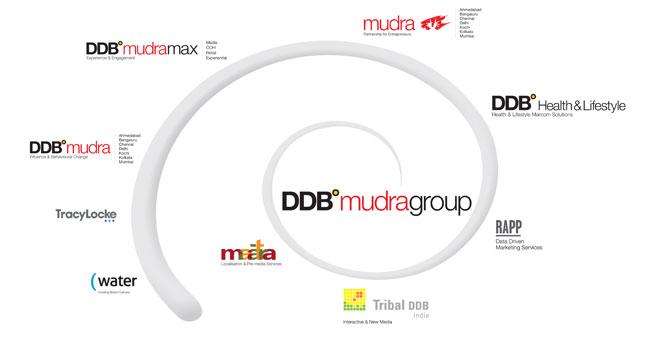
    As for the revitalised DDB Mudra Group, the network in India will be split as DDB Mudra, Mudra and DDB MudraMax. Accordingly the group has adopted a new structure, brand identity, colours and architecture that will drive forward the change. The new structure will comprise eight branded agencies as follows: DDB Mudra – the Influence & behavioural change agency with a pan India presence across Ahmedabad, Bengaluru, Chennai, Delhi, Kochi, Kolkata and Mumbai; DDB MudraMax – the Experience & Engagement agency which offers Media, Out-Of-Home, Retail and Experiential; Mudra – the partnership for entrepreneurs agency with a pan India presence across Ahmedabad, Bengaluru, Chennai, Delhi, Kochi, Kolkata and Mumbai; DDB Health & Lifestyle – Health & Lifestyle Solutions practice; RAPP – data driven marketing services agency; Tribal DDB India – interactive & new media agency; Water – Brand & Design consultancy and Maatra – localisation & pre-media services agency.


    Elaborating on the proposed management structure, Madhukar Kamath, Group CEO and MD, DDB Mudra Group said that while he was proud of Mudra’s past, he is equally excited about the future. According to Kamath, the executive board committee will comprise of Sonal Dabral, Chairman & CCO, DDB Mudra Group, Pratap Bose, COO – DDB Mudra Group, Madhukar Kamath, Group CEO & MD, DDB Mudra Group, Dilipkumar Upadhyaya, CFO and Ajit Menon, EVP – DDB Mudra Group. Excited about the largescale realigning, Kamath said that the new venture would see DDB Mudra emerging amongst the fastest and topmost agency in a few months from now. He was also in praise of his clients of whom he said that about 40 per cent of them access more than one business service of the Group, which speaks volumes of the solutions and services that the group has to offer.


    Earlier, John Zeigler began by highlighting the growth of DDB Worldwide and how it is looking at Asia Pacific, led especially by India, to drive its expansion into the region. “Current figures suggest our growth split as 44 per cent from Europe, 38 per cent from North America, 6 per cent from Latin America and 11 per cent from Asia Pacific. Our core focus would be to increase the pie of Asia Pacific to a large sum going forward and this would be driven by India which is being seen as a leading market in marketing communications by most agencies.” In a one-on-one conversation with MxMIndia, Mr Zeigler was hopeful of deriving a modest growth across APAC as he said, “With the kind of businesses we have in India we should be able to achieve a growth rate of 25 per cent plus. As for our other agencies across Asia Pacific, we had a compounded growth rate in excess of 30 per cent year on year.”


    Mr Zeigler further highlighted how DDB’s model was unique in the sense that it captured both local and global sentiments of its clients and offered services that were unmatched in nature. The idea, according to Zeigler, was to be seen as an agency offering local solutions to international clients who wanted to tap outside markets as well as offering international solutions to local clients who wanted outside exposure to derive local growth.


    On getting TracyLocke to India, Mr Ziegler said, “As one of the leading shopper marketing agencies in US andEurope, TracyLocke brings vital shopper insight and great creativity into our future. The launch in India is its entry intoAsiaand will be providing vast opportunities for the entire DDB Asia Pacific group.” The summit is to be conducted next month and will showcase the experience, skill sets, global practices and learning of the entire DDB Asia Pacific region which has distinguished itself in 2011 with several impressive wins including Spikes Asia’s Network Agency of the Year 2010 and 2011, and AdFest Network Agency of the Year. The summit will be attended by Chuck Brymer, President and CEO of DDB Group Worldwide; John Zeigler, Chairman & CEO, DDB Asia Pacific, India & Japan; and Patrick Rona, Tribal DDB Asia Pacific’s President and Chief Digital Officer for DDB Group Asia Pacific, as well as an overseas contingent of senior agency personnel from across the Asia Pacific region.


  • DraftFCB Ulka’s Cogito Consulting & Asterii Analytics Release India 2061 Report

    By A Correspondent


    Cogito Consulting and Asterii Analytics present a fitting finale to the Draftfcb Ulka Group’s 50 Year Celebration, with a projection of whatIndiacould be when the Group celebrates its centenary. After digesting reports from over 150 sources, more than 1000 pages of data, talking to experts, economists, academics, a concise form was put in public domain on February 29.


    Coming from the context and belief that brands have a potential for immortality and last well beyond brand managers and sometimes even companies and owners, it may be necessary to plan for brands well beyond just the next 3-5 years.  The supplement highlights some important scenarios that will help build brands for not just the next few years, but well into the next 50.


    Some key aspects of the report on ‘India 2061’.

    • From a pre-dominant rural population today urbanization will lead to rural population constituting to about 43 per cent of the total population.
    • Average life expectancy to go up to 79 years and number of senior citizens to grow from 8per cent  to about 24 per cent  of the population.
    • Within the next 10 years, literacy levels are projected to jump to 95 per cent  with almost complete literacy achieved by about 2030.
    • Internet penetration will touch 92.7 per cent  with over 1592 million users.
    • Per capita income will be up to Rs11,63,000 from the current Rs. 37,000.
    • There will be an estimated 319 million four-wheelers and 573 million two-wheelers making a total of 900 million vehicles on the Indian roads.
    • Number of air travellers will double every decade andtouch 860 million in 2061.
    • Televisions are expected to achieve a 97 per cent  penetration with over 50 per cent  homes boasting of multiple TV sets.
    • Ad spends are expected to grow to Rs33 trillion by 2061 and contribute a wholesome 1.5 per cent  of the GDP.
    • The movie industry acrossIndiawill produce about 2234 films in 2061 i.e. more than all the Hindi movies produced between 1961 and 1991 in India.


    The knowledge piece has been released in a leading publication and is available on www.cogitoconsulting.com


  • Aegon Religare hijacks ‘i’ from TOI

    By A Correspondent


    Aegon Religare ‘hijacked’ the letter ‘i’ from yesterday’s national daily, The Times of India. The innovation was done to introduce the new and improved iTerm Insurance plan for Aegon Religare. The front page of the TOI in 8 metros carried the letter ”I’ in the masthead and headlines in the colour blue and in small font similar to the ‘i’ used in the word icon in the main copy advertising for Religare.


    Talking about the objective behind this campaign, Mukesh Waje, AVP, Branding, Aegon Religare said, “It is very clearly to announce the launch of a product that has been a pioneer in the market. This campaign is to announce the comeback of an icon. The campaign will unfold further on the web and will heavily rely on this medium. Besides we will have radio and print to support for the duration of the next three weeks.”


    The campaign is designed by Ogilvy and BCCL has partnered on media. Though Mr Waje refused to put the amount spent on the campaign, he added, “We have already started getting calls post the ad and we are positive that the campaign will do well for us.”


    Aegon had earlier created a stir with its KILB campaign during its launch which talks about being underinsured. Last year, during the same time, the company had done another print campaign on the jacket of TOI where the print of the first page was hardly legible, thus asking if one’s insurance was as faint as the words on the paper, again pointing to being underinsured.


  • Airtel voted India’s ‘buzziest’ brand

    By A Correspondent


    Leading marketing communications portal www.afaqs.com announced that Airtel is the number one in the results of its seventh edition of ‘India’s Buzziest Brands’ – a poll-based survey aimed at measuring the viral effect and customer conversations garnered by brands across India.


    Airtel, which has been accorded with the coveted “Buzzy Gold” title for emerging at the top, faced stiff competition from Facebook and Flipkart, which bagged the second and the third spot respectively. As per findings of this poll, Airtel is the only telecom operator to place in the top 10.


    The poll was carried out on the website from January 30 to February 7. A total of 60 brands were shortlisted for the poll. Voters were sent a link for voting on their email account to avoid digital ballot-stuffing. On visiting the Poll page on the website, the voters were asked to choose five brands that they felt had the greatest ‘buzz’ in the year gone by from the shortlist of 60.


    List of the 15 Buzziest Brands as per the India’s Buzziest Brand Poll 2012


    1 Airtel
    2 Facebook
    3 Flipkart
    4 Hero
    5 Samsung
    6 Google
    7 Snapdeal
    8 Cadbury
    9 iPhone
    10 Twitter
    11 Vodafone
    12 YouTube
    13 Blackberry
    14 Pepsi
    15 Nokia


  • Red Digital creates the second successful TweetMob for Mirinda

    By A Correspondent


    Post the announcement of Mirinda signing up Red Digital for its social media duties and in the back drop of having successfully introduced and executed the concept of a TweetMob, Red Digital yet again created a TweetMob on February 24 for Mirinda. The result this time was even better. Twice in two weeks now, Mirinda TweetMob #tags were one of the most talked about topics on Twitter.


    With the hot Indian summer approaching fast, PepsiCo has launched a new campaign for its orange soft drink, Mirinda. The campaign, which orbits around the theme ‘Pagalpanti Bhi Zaroori Hai’, is based on the thought that drinking Mirinda, this summer, is an intense and inescapable experience that leaves one breathless.


    “We think of TweetMob as a flashmob on Twitter where our intention is to take over Twitter and engage the twitterati for a certain duration while plugging the brand connect. After the successful execution of the first TweetMob on February 14, it was a challenge for us to out-do ourselves with the benchmarks we set for Mirinda and, more importantly, prove to ourselves that it was not a one-off success by repeating it in a grander manner. It was great to taste success again and take over Twitter,” said Yashraj Vakil, Chief Operating Officer, Red Digital.


    The TweetMob started at 3pm on February 24 with a simple question asking people what they thought was crazy enough around them to be called #PagalPanti. The TweetMob lasted till midnight during which Red Digital created and managed conversation around the hashtag ‘#PagalPanti’. Through the TweetMob, Red Digital helped connect Twitter and Facebook users who tweeted about the topic with various Mirinda branded hash tags, creating a plethora of endorsements for the brand.


    It wasn’t long before #PagalPanti started trending inIndia. The activity saw 3,700 tweets in the span of 9 hours for @MirindaIndia. Every 50 tweets with #PagalPanti helped the brand reach 7,990 people generating close to 0.6 million views. The brand reach this time was 5 times of what the first TweetMob generated. #Pagalpanti featured among the topics breaking globally and trended in Mumbai,New Delhi,HyderabadandBangalore. @MirindaIndia also saw itself trending in Chennai andHyderabad.


    The TweetMob will happen again on March 2 and the following Friday after that.


    Commenting on the TweetMob and its success, Harsh Jain, Founder & Managing Director, Red Digital said, “Flashmobs are suppose to be innovative, rebellious and spontaneous. With every flashmob now being represented as a Bollywood song and dance activity, we wanted to showcase their true power in other forms. We chose Twitter because it has become a platform for people to share ideas, collaborate, aggregate and explore new things spontaneously. Twitter is both a place where like-minded people can interact as well as a place for rebels to express their views. We are proud to have created and introduced the concept of the TweetMob; success was just a corollary. The independence of ideating with a bold and social brand like Mirinda has given us this opportunity to explore and innovate. We are thankful as well as determined to create and execute many more path breaking ideas through our association with Mirinda.”


    Speaking on Mirinda’s partnership with Red Digital, Ruchira Jaitly, Executive Vice President – Marketing, Beverages (Flavours), PepsiCo India said, “As marketers, we continuously seek ways to engage with the consumers via innovative means. Mirinda’s TweetMobs is a unique innovation on the digital space that utilizes the strengths of the medium effectively to communicate with our consumers on our latest initiative. The idea is fun and youthful and helped to create awareness of our new flavour campaign in a never-before fashion. It is delightful to see the results of this path-breaking idea for the second time in a row.”


  • Will Coke’s 200ml pack price cut cannibalise Thums Up?

    By Preethi Chamikutty


    Summer is still a few weeks away, but cola brands have already started feeling the heat. While most brands are closely guarding their marketing secrets for the season, Coca-Cola surprised pundits when it dropped the price for the 200 ml returnable glass bottle (RGB) by Rs2 to Rs8.


    That may not seem unusual – after all in the past, Coke has cut price. However, most of those reductions were across all brands in the portfolio, from flagship Thums Up and Sprite to Limca and Fanta. This time, however, the exercise applies only to Coca-Cola.


    Independent marketers are not convinced about the strategy as they feel that in the urge to close in on arch-rival Pepsi, Coke runs the risk of cannibalising Thums Up, its top cola brand and the country’s largest selling carbonated drink.


    So why is one of the world’s most valuable brands discounting itself in India? The official response from Coca-Cola is that the “special promotional price” will “fuel growth of the cola category. As the 200 ml pack is the entry point into the category, it will recruit new consumers into the cola segment since it is a very attractive price point,” said a company spokesperson.


    The promotional offer is being rolled out in phases across select markets; 70 per cent of markets will have the Rs8 price. Those familiar with the promotion say that this is a pilot project for three months, with an option to extend it.


    Clearly, Coke has trained its sights on Pepsi – which has yet to react to the price cut – and hopes to inch closer to it. Still, market observers wonder whether the drop in price is aimed at Pepsi or at Coke’s own brand, Thums Up, which is the leader in the cola category as well as in carbonated drinks.


    Latest market share figures are unavailable – both cola majors will not part with them – but those familiar with recent numbers point out that Thums Up has a share of roughly 42 per cent of the Rs4,000 crore pure cola market. Pepsi follows with 36 per cent, and Coca follows with a share of just under a fifth (a few regional brands account for the rest).


    An official at a beverage marketer says that Thums Up also leads the approximately Rs10,000 crore carbonated soft drinks market with a 15 per cent share. If marketers do not approve of Coke’s move, it’s with good reason. “Unless this is a global diktat, this strategy is flawed from Thums Up’s point of view,” reckoned Nobby Gupta, founder & CEO, Nobby Brand Architects.


    “In countries wherever Coke is present, it always has to be the market leader and all other brands have to follow; if that is the aim for India as well then this strategy falls in place,” he added. But he also goes on to say that this strategy will have a negative impact on the combined share of both Coke and Thums Up.


    Me Gupta’s logic is simple: Lowering the price of Coke will not put pressure on just Pepsi, it will also cannibalise the market share of Thums Up. “And if Pepsi drops price too, which is likely, there is a chance of it eating into both Coke and Thums Up,” added Mr Gupta.


    Then there are those who feel that dropping prices for short-term gain is dangerous. “Because when you go back to old prices consumers may well say: ‘Thank you very much for the discount, now I will go back to Thums Up,” said Anand Halve, co-founder of Chlorophyll Brand & Communications Consultancy. “Momentary bribing does not ensure long-term consumer loyalty,” he added.


    For a generation of Indians, Thums Up, with its relatively stronger taste, is synonymous with cola. “The preference for a strong cola continued even as new cola brands entered and are now expanding the category. Over all these years, Thums Up’s communication has remained consistent,” said Devendra Chawla, president, food & FMCG, Future Group, who is a former Coke associate.


    To be sure Thums Up has assumed almost cult brand status over the past two decades with commercials like ‘Taste The Thunder’ and ‘Toofani Thanda’ that had an international look and feel to them. Ashok Kurien, advertising guru and former chairman Publicis India, who was involved in the launch of Thums Up said: “Thums Up managed to crack the soul of Indian consumers through advertising and reached out at a deeper level. It was about struggles in life, the anxiety and determination to survive and succeed. This was probably the strongest concept in Indian advertising that connected to the young Indian male. And it still connects today.” When Coca-Cola acquired Thums Up, Kurien advised the Atlanta-headquartered company to only pit Coke against Pepsi and not touch Thums Up – as it already had an 85 per cent market share. “But Coke introduced both Coca-Cola and Thums Up in 300 ml bottle and people lapped up Thums Up, with Pepsi taking the second spot.”


    The battle between Coke and Pepsi continues, although Coke officials deny the attempt to spark off a cola war; they just want to step up per capita consumption by Indians, they say. “Indians consume only 12 200 ml bottles of beverages per year compared to 675 bottles by Mexicans – the highest consumers of Coca-Cola globally,” pointed out a Coke official.


    Source: The Economic Times

    Copyright © 2012, Bennett, Coleman & Co. Ltd. All Rights Reserved


  • Marks & Spencer appoints Venu Nair as India Ops head

    By Sarah Jacob


    Apparel and home products retailer Marks and Spencer’s has appointed Venu Nair as head of its India operations, replacing CEO Martin Jones who is moving back to the parent company.


    Nair takes charge as managing director, the London-headquartered company said. Sources said Jones was moving back for personal reasons. Nair was head of sourcing for the £9.7-billion British retailer in South Asia and director of buying operations for India.


    M&S operates in India through Marks & Spencer Reliance India, a joint venture with Mukesh Ambani-led Reliance Industries, selling clothes and home décor but not its food products. It has 24 outlets across the country.


    “Unlike an expatriate, Nair would have stronger understanding of the Indian market and his being involved directly in sourcing will play to his strength,” said a senior executive of a rival firm.


    M&S has been to work towards sourcing 70per cent of its merchandise from India and Jones had been driving this change.


    “While other international companies look at India as an interesting and emerging market, M&S clearly specifies India as a market of importance,” said Devangshu Dutta, chief executive of management consultancy Third Eyesight.


    Source: The Economic Times

    Copyright © 2012, Bennett, Coleman & Co. Ltd. All Rights Reserved

  • Turkish Airlines looks at India as a booming market

    By A Correspondent


    Turkish Airlines has been doing exceptionally well globally and has witnessed remarkable growth, especially in the last year. With Grey as their creative agency inIndiaand Perfect Relations handling their media relations, they are looking atIndiaas a booming market and have various marketing initiatives lined up.


    Turkish Airlines has played a vital role in increasing the ratio of the aviation industry ofTurkey. One of their key achievements in 2011 was being awarded ‘Best Airline Europe’, ‘Best Premium Economy Seats’ and ‘Best Airline Southern Europe’ by Skytrax. Their load factor has been as high as 75 per cent in 2011, even on the Indian routes.


    They have also acquired brand new aircrafts like B777-300ER equipped with GCS system and A330-300, with the latter being currently operational on the Indian routes. Turkish Airlines flew around 300,000 travellers on the Indian routes in 2011 and are expecting an even higher number in 2012.


    The TAAI Convention, being hosted byTurkeythis year, will be one of the biggest B2B initiatives undertaken by Turkish Airlines as they are among the main partners for the event.


    Apart from that, Turkish Airlines has engaged in several interesting marketing initiatives inIndiato reach out to its customers and familiarize them with both, Turkish Airlines and its multiple international destinations.


    Adnan Aykac, General Manager- Northern & Eastern India, Turkish Airlines, said: “We received great feedback from our previous promotional campaigns and would like to continue with such engagement programs and capitalize on them in the best way possible. This will ensure maximum visibility for Turkish Airlines among its target audience, thereby helping them discover our refined offers and services.”


    “Turkish Airlines believes in providing the best offers and facilities to its passengers and maintaining high standards of service. This has always been our prime focus and we believe that the brand and its services speak for itself. We also believe that competitions are healthy as they give you the zeal to further improve and enhance your quality. Hence, our superior and extraordinary services set us apart and help us maintain our top position,” he added.


    Also Turkish Airlines have now signed a Free Sale Codeshare Agreement with Air India (AI) after their previous blocked space codeshare agreement. The new agreement will allow both the airlines to market each other’s flights by their own code and flight numbers on a free sale basis.


    With effect from March 1, the revised agreement will allow TK passengers a seamless connection to AI-operated flights onHyderabad, Chennai, Ahmedabad, Bangalore, Kolkata and Amritsar routes.


    Turkish Airlines witnessed a 15 per cent growth in revenues last year and with the airlines doing so well in the Indian and international markets, sky is the limit for us.