Category: MARKETING

  • Gold opens new doors for Manappuram

    By Tuhina Anand


    The traditional arena of the gold loan as a source of quick cash has been transformed into a booming business with the advent of some major players. In redefining the way gold loan is viewed, Manappuram Finance Limited (MAFIL), based in Thrissur District in Kerala has played a key role, and in the process has turned its own fortunes around too, especially in the last two years.


    As  I Unnikrishnan, Managing Director, MAFIL says, their balance sheet has shown 100 percent growth in terms of profit in FY 2009-10 and 200 percent in FY 2010-11. There are multiple reasons for this growth, including being the first Kerala-based NBFC (Non-Banking Finance Company) to receive foreign investments which paved way for its geographical expansion. Manappuram had been restricted to Kerala till 2005 but started expanding to west, north and east. They have 2700 branches and in FY11 it has already opened some 700 branches. Also technology has played a major role in the company’s success with core banking solutions available to them, thus revolutionizing the loan against gold business.


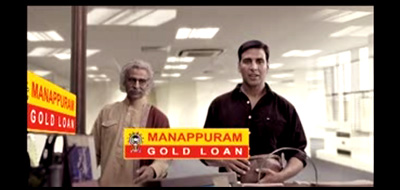
    Other than this, communication has played a crucial role in Manappuram’s success. The company has splashed out on getting top film stars as brand ambassadors. Mr Unnikrishnan explained, “We have got not one but multiple brand ambassadors to reach out to people in various regions. When you enter a new geography, the need is to create a trust among consumers on your brand especially in our trade where we are asking them to part with their gold which is something precious to them. There is a need to build credibility in the lending business. We decided to go with the popular film actors as these are names people trust.  The idea to have so many film stars helps as each actor is trusted by people especially in their region.”


    They have roped in Mohanlal who is leading actor in Kerala, Puneet Rajkumar from Karnataka, Vikram who rules Tamil cinema, Akshay Kumar who has pan India appeal as well as actors Venkatesh and Mithun Chakraborty.


    More than anything as Mr Unnikrishnan says, they have managed to create awareness about gold loans and brought about a perceptual revolution. Earlier pawning of gold was seen in a poor light and there was a negative impression that people sell gold when they are in distress. “We have positioned gold loan as something that is handy and that is where our well crafted advertising has helped. It has required a commitment to convince the customer that gold loan is a feasible and quicker way of getting cash and not just in distress. I think this strategy has paid off and not just for Manappuram but also for the gold lending business.”


    The communication shows that gold loan can help one scale up their business or fulfill a long awaited dream. So gold which Indians have a tendency to hoard and keep in lockers can actually fetch you money to realize your dreams.


    After having a good run in the South, now Manappuram is experiencing growth from Gujarat, Maharashtra, Chhatisgarh , Orissa and West Bengal among others. In fact, Mr Unnikrishnan is bullish on the trade and estimates that the organized gold loan market is close to Rs 1 lakh crore and the unorganized as Rs 2 lakh crore. In fact, seeing the opportunity in gold loan besides the NBFCs like Manappuram and Muthoot who have gained success even banks have got into this area. He concludes, “The challenge is not the market as it is growing. The challenge is to train people who can understand and meet the need of customers.”

     

  • Walt Disney India MD Mahesh Samat resigns

    By Nandini Raghavendra


    Mahesh Samat, managing director of Walt Disney India, has put in his papers in the middle of the US entertainment company buying out its Indian partner, UTV, and a possible delisting from the stock exchanges.


    Both Disney and Mr Samat did not reply to emails inquiring about Mr Samat’s decision, but more than one person in the company, who did not want to be named, confirmed the development.


    Last July, Walt Disney made a $454-million offered to buy the Indian promoters, including UTV promoter Mr Ronnie Screwvala from UTV Software Communications. At that time, the company had said that Mr Screwvala would head Disney’s operations in India while Mr Samat would report to Mr Screwvala in the role of chief executive officer.


    Disney had originally invested $44.5 million in UTV more than five years ago for a 15% stake and subsequently increased its holdings to 50.4%.


    Mr Samat had joined Disney India in 2007 and rose from being a senior vice president to managing director in three years. An alumni of IIM-Calcutta, he came with over 20 years of experience across India, Asia-Pacific and Europe. He has had worked with Johnson & Johnson as managing director for southern Europe, based out of London.


    Prior to that, he worked with Kellogg’s in India, Warner Lambert/Parke-Davis and Boots India. At Disney, he reported to Mr Andy Bird, Disney’s president, and managed all divisions of Disney India except ESPN-Star.


    In the period, Mr Samat has been with Disney, the company made a foray into Hindi cinema with a first co-produced animation film with Yashraj called Roadside Romeo.


    Source: The Economic Times

    Copyright © 2012, Bennett, Coleman & Co. Ltd. All Rights Reserved


  • 3 EDs quit in 1.5 years… all well at Hindustan Unilever?

    By Kala Vijayraghavan & Chaitali Chakravarty


    Three of Hindustan Unilever’s top team of eight executive directors – Gopal Vittal, Shrijeet Mishra and Ashok Gupta – have quit in the past 18 months. There have also been more than a few exits in lower levels of the company.


    And sources within and outside the marquee employer say managers are feeling stifled by paucity of growth options. The FMCG giant, once considered an impregnable vault of top-notch talent, is now beginning to look vulnerable.


    What ails HUL? The cause for the simmering discontent among local managers can be traced back to a bunch of strategic changes CEO Paul Polman is rolling out to make Unilever more responsive globally, past and present HUL managers say.


    First, Mr Polman has consolidated the global business into four divisions – personal care, home care, food and refreshments (like Ice Cream). Secondly, he is centralising much of the decision-making globally, stifling the role of local managers.


    Thirdly, he is forcing the company to consider outside talent, upsetting growth aspirations of internal candidates. Mr Polman, who took over in January 2009, is the first outsider in 77 years to head Unilever.


    And lastly, global postings in the Unilever universe, once a big draw for Indian mangers, are no longer as attractive. “While the company has become bigger, roles have become fewer,” a top HUL official told ET. “Jobs at HUL are becoming more functional and narrow,” other top officials with an inside line to the company added.


    An insider points to Mr Pankaj Gupta, who quit Unilever recently to join Reckitt Benckiser as supply chain head for South East Asia. He is now managing many factories across countries. He has the freedom to strategise, change and make the system more efficient. But as category VP, supply excellence for Unilever in Singapore, he had limited operational freedom.


    Insiders say HUL will not miss exits like Mr Gupta as they have an excellent knowledge management system which means managers are told how things are to be done. There is little room for initiative.


    Mr Polman is also mandating longer tenures at each position for its top management including the CEO. He is doing this to ensure business accountability and continuity in the face of growing competition and volatility. But at HUL, which is used to quicker job rotations and promotions, this too, is being viewed as a disadvantage by internal staffers.


    Moreover, Mr Polman’s view that outside candidates should also be considered for every senior management role to ensure diversity, is another reason for angst among internal candidates used to netting such roles, sources say.


    “It is highly speculative and incorrect to draw such conclusions,” a HUL spokesperson said in an email response to an ET questionnaire. “The average age of our Management Committee is around 45 years. This is a reflection of our focus on identifying high potential talent and investing in them through exposure to big and challenging jobs early in their career.”


    A young management committee could be another reason making the second rung of managers restless, an FMCG expert, who has worked in HUL for several years in the past, said. “The so-called number two gets impatient,” he said.


    Sources point to examples like Mr Samir Jain, vice-president, laundry at HUL, who quit to join Bungee, an agro-trading company, as it’s second in charge. He has a better and quicker shot at becoming CEO, they point out.


    “HUL has over 1,500 managers and attrition is significantly below industry level at 5% per annum for the past four years. Our approach for identifying and grooming top talent has established the company as a source of leadership talent,” the HUL spokesperson said in the email response.


    Moreover, global posting, once an attractive carrot, is no longer effective. Highly placed sources say that both Mr Gopal Vittal and Mr Shrijeet Mishra (currently the chief operating officer of Bennett, Coleman and Co Ltd, the publisher of The Economic Times) were offered global postings, but found them unattractive.


    There are more such instances even at lower levels, they added. “India is where the action is. Why would I want to move to Moscow or Poland,” a former HUL executive, who was offered one such posting, quipped.


    Source:The Economic Times

    Copyright © 2012, Bennett, Coleman & Co. Ltd. All Rights Reserved


  • What’s-On-India launchesTV streetmaps

    By A Correspondent


    What’s-On-India, India’s premier TV guidance company has launched a new business vertical – ‘television street maps’ – to monitor day-to-day changes to TV Channel availability and placement across Cable and Satellite households. The service has already gone live and has attracted a host of customers from the TV sector.


    The move to launchTV streetmaps by What’s-On-India is considered very strategic, especially in the context of dramatic changes expected in the distribution side of the TV business over the next couple of years due to digitalization being introduced by the government.


    What’s-On-India has already expanded this system nationwide to cover 700+ Analogue and Digital head ends across almost 300 towns and cities making it the largest ground coverage in the business.


    “Our plans are to expand the system to 1000+ head ends over the next 3 months, besides providing insightful value added services in this space to stakeholders,” said Joydip Kapadia, Executive Vice President, What’s-On-India.


    This new vertical has added a series of new customers which include One-Alliance, MSM Network, UTV Network, Viacom-18 among a host of others.


    Atul Phadnis, Chief Executive, What’s-On-India said: “We are very excited to enter this space. Over the next few quarters, What’s-On-India will be investing in this vertical to expand its scope across the country as well as to bring in newer technologies and automation for faster information from the ground. We are also integrating TV Street Maps with our EPG Systems for certain breakthrough solutions within the Indian market!”


    What’s-On-India Media Private Limited isIndia’s Premier TV Guidance and EPG Company. The company’s technology vertical powers EPG Metadata content from 500+ TV channels into more than 35 million Set-Top-Boxes and devices across Cable, Direct-To-Home, IPTV, mobile TV, Smart-TVs and Tablets.


  • Simply talking rice with Ogilvy Delhi

    By A Correspondent


    How often does one talk about rice? Mostly during lunch, one would guess. In the last few weeks, though, the little white grains have become the talk of the town. Thanks to the “talkative” commercials that are currently on air for Best Foods International. In consumer-speak, they are a treat to watch. But what has gone behind cooking up these tasteful advertisements is another story.


    It all started when Dinesh Gupta, Managing Director, Best Foods Ltd decided to rope in Ogilvy & Mather, New Delhi to design its corporate brand identity. Complete, from stationery to new packaging design. The new pack was an instant rage in the market because of its fresh and ethnic Indian look. It was a sweet start to a new relationship and somewhere in this was hidden a big idea for the commercials.


    Best wanted their rice to be in everyone’s mouth and their brand name on everyone’s lips. In came the requirement to create TV commercials. Dr Aayushman Gupta, Business Director, Best Foods Ltd says, “We had an interesting challenge to reposition rice from an uninvolved product for the consumer to a desirable brand. The positioning and communication had to be out-of-the-box, clear, uncluttered and keeping with the times through its cues and presentation. The entire team at Ogilvy Delhi thought wonderfully to help us plan and execute the same.”


    Ajay Gahlaut, Executive Creative Director, Ogilvy, New Delhi elaborates on the idea, “There are various ways of bringing the thought of “The Perfect Match” alive and several were tried. But experience shows that consumers always warm up to human stories. Specially love stories, which is where we hit upon the idea of using different couples to make our idea talk. The chemistry between the couples brings charm to the commercials while effortlessly communicating the brand benefit.”


    Three scripts were devised for three strategic markets. Each commercial weaved a story about a perfect couple. Nitin Srivastava, Senior Creative Director, Ogilvy New Delhi recalls, “Cracking the idea was the hard part but fleshing it out was immense fun. We enjoyed writing stories after stories before we finally rested at three. Here, I would like to specially mention the efforts of Umesh Grover and Jonathan George who behaved like the perfect match on this project.”


    Amit Sharma of Chrome was a wise choice to shoot these scripts. His adept handling of emotions and dialogues comes out in full glory in the series. The films showed how couples from different age groups, mindsets and geographies have something in common – the flavour. Chrome Films did thorough planning and research for two months before finalising the casting. All films were shot in a single take to bring out natural reactions from the couples.


    Best Foods Ltd have already begun their plans for the coming year. Ogilvy, New Delhi is gearing up to lay out a brand new, sumptuous experience of films. The consumers too, are waiting eagerly for a fresh serving.


    Credits:

    Company: Best Foods Ltd.

    Product: Best Rice

    Production House- Chrome Pictures

    Director- Amit Sharma

    Creative team: Ajay Gahlaut, Nitin Srivastava, Umesh Grover & Jonathan George

    Client servicing team: Sharmista Dev, Vineet Kindra, Shivani Sharma & Lagun Sehgal


  • R-Day discounts see shoppers flock to malls

    By Sarah Jacob & Ratna Bhushan


    Indian shoppers are back in malls, buying everything from food and furnishings to crockery and winter wear to make the most of the Republic Day discounts and end-of-season sales, raising hopes among retailers that demand will pick up over the next six months.


    India’s largest retailer Future Group posted its highest weekly sales last week while others such as department store chain Lifestyle and footwear maker Woodland reported high sales growth as heavy discounts helped retailers bounce back after a sales slump in the past two months.


    “This has been the biggest week ever,” Future Group Chairman Mr Kishore Biyani said. “It has set the pace for the rest of the year and we are changing our outlook for the year to positive,” he added.


    Future Group reported national combined retail sales of Rs 650 crore between Monday and Sunday (January 23-29), 25-30% higher than last year, as its 210 Big Bazaar and Food Bazaar outlets ran the ‘Sabse Saste 5 Din’ promotion offer and apparel and home products chain Central offered a flat 50% discount on 100 brands. Mr Kabir Lumba, MD of Lifestyle International, which operates Lifestyle and Max department chains, said sales have grown both year-on-year and sequentially.


    “A large chunk of sales in the second half (of the financial year) has come from discounted merchandise because of the depressed trading conditions in November,” he said. Lifestyle increased discounts to 50% on the Republic Day weekend from 40% end-of-season sales.


    But analysts warn the jump in sales does not necessarily indicate a revival in consumer sentiment because it is driven by discounts. “The increase in sales is not yet an indicator of whether consumer sentiment is back. The right picture would emerge after the Budget and state elections,” Mr Purnendu Kumar, senior VP (retail) at management consultancy Technopak Advisors, said.


    He, however, added that retailers can continue to offer discounts as long as there is high demand. “Markdowns in margins are budgeted by retailers as they expect to balance it out with higher volumes,” Mr Kumar said. Retailers such as Future Group, Reliance Retail and Shoppers Stop have seen a slump of up to 30% in November and December.


    Retailers Ride on Discounts


    Slowing economic growth, high inflation of more than 9% until December and consistent increase in interest rates for almost two years have affected consumer sentiment.


    Republic Day sales are part of the end-of-season sales, and usually extend across four weekends starting from mid-January. This year, several retailers, including Lifestyle and Spencer’s Retail, advanced the sale to liquidate stocks.


    Food Bazaar and Big Bazaar stores contributed the largest chunk of 65% to the record sales of Future Group during the Republic Day week, whose clothing store Pantaloon and furniture and home furnishings chain Home Town too ran regular price-off schemes during the week. “Food sales exceeded our expectations; followed by sales of crockery, furnishings and luggage. Sales of durables were marginally lower than our expectations,” Mr Biyani said.


    He attributed the sales to aggressive prices and promotional offers by the retailer. While Big Bazaar and Food Bazaar did not extend the discount period compared to the previous years, Central, Home Town and Pantaloon have been running promotions for a week extra compared to last year. Footwear and adventure gear maker Woodland posted 22-25% growth in the end-of-season sales period.


    “Although winter started later, the cold got more severe this year, resulting in even high-value jackets and sweaters flying off shelves in the discount period,” Woodland VP (strategy & planning) Mr Amol Dhillon said. The company intends to derisk from seasonal changes next fiscal by breaking down its autumn winter range with lighter sweaters in November and heavy-duty jackets in January, he said. Organised retail accounts for close to 5% of the overall $450-billion market.


    Tough times


    Mr Thomas Varghese, MD and CEO of Aditya Birla Retail and chairman of the CII National Committee on Retail, last week told reporters that the retail sector was facing challenging times and the past two months had been very bad for the industry.


    He attributed the slowdown to inadequate funding, lack of sufficient space for expansion and talent crunch. The sector grew 25-30% last year. “If we are to look at the current trend, we are in a challenging situation and 2012-13 also does not look like a great period as of now. It is going to be a period of cautious optimism,” he had said. With the economy slowing down, several companies are expected to temper hiring and lower increment handouts, which could add to the caution.


    While sales of packaged consumer goods have not been hit, food and grocery retailers said sales had slowed around 5-10% since November. One such retailer, who did not wish to be named, said consumers had even started substituting pulses with vegetables, which have become cheaper. Also, several food and grocery chains broke off ties with meal coupon companies such as Sodexo, which hit sales as several companies offer their employees meal coupons as part of salaries.


    Better days ahead?


    The sector is banking on foreign investment in multi-brand retail and private equity funding to fuel growth. Ratings agency Fitch, meanwhile, has assigned a stable outlook to the retail sector for this year, riding on sales growth-driven expansion and efficient working capital management.


    “Retailers could be exposed to economic headwinds, leading to a decline in consumers’ discretionary spending because of higher inflation and interest rates… However, sales growth, stable margins, efficient working capital management and flexibility to defer or tone down expansion plans are expected to result in a stable credit profile for Fitchrated retail companies,” it said.


    Fitch said margin pressures created by extended discounting periods to push volumes growth could be mitigated by price hikes and lower prices of raw materials such as cotton.


    Source:The Economic Times

    Copyright © 2012, Bennett, Coleman & Co. Ltd. All Rights Reserved


  • The Anchor: 8 indications when you know it’s time to bid goodbye to your agency

    By Ajay Kakar

    These are the views of a person who has invested 15 years at the agency end. And for the last six years he has been at the client side.


    These are the views of a marketer who strongly believes that the role of an agency partner is invaluable to his success and the success of his brand.


    #1 When you have the frequent need to say all the best to exiting key members of the agency: A brand is built over years. Passion and consistency are two critical pillars in this journey. And if an agency loses/shifts your key team members frequently, that’s bad news.


    #2 When you have many people servicing your account but you do not remember the name of any: You do need mere hands and legs. To quote David Ogilvy, you need people who know more about the brand than even the client. People who leave an impression on you and make an impact on the brand. People you can’t afford to forget. Nothing less will do.


    # 3 When you have meetings only at times of a brief initiated by you: You need Brand Custodians and Brand Stewards. People who are thinking of your brand all the time. And not only when you have a felt need. Else you will always feel compromised.


    # 4 When your agency only discusses advertising or 30-seconders with you: In today’s world you need to surround and engage your fickle and distracted consumer at all times. And if your agency doesn’t help you with that they may be contributing to your losing your customer.


    # 5 When your agency does not meet you after a campaign to enquire about the results: A marketer does not need advertising. He needs advertising that sells. He is evaluated on results. If your agency is not helping you get there faster, cheaper or better, why will you value them?


    # 6 When your agency doesn’t ask for an annual hike with confidence and more so if your agency does not propose a performance-linked incentive plan: A true partnership must be a win-win for both parties. And if your agency is contributing to your success, why would they think twice before asking for your just rewards. Is it because they are not performing?


    # 7 When an agency doesn’t meet you at regular intervals to seek a structured

    feedback/evaluation: If your partner doesn’t have a road map with clearly defined milestones, there is a good chance that you are not headed in the right direction.


    # 8 When an agency does not aspire to win industry recognition/awards on your brand: In our business passion is everything. And if your partner is not excited to do pathbreaking work for your client work that gets noticed and talked about the brand is possibly not in safe hands.


    Ajay Kakar is CMO – Financial Services, Aditya Birla Group


  • Havas expands Ecselis in APAC with Rajeev Bala at helm

    By A Correspondent


    Havas Media announces the expansion of its specialist Performance and Quantitative marketing arm, Ecselis to Singapore, Kuala Lumpur and Sydney.


    Launched in India in 2009, Ecselis currently has a team of 55 performance experts based in the country with clients across SEA, India, Europe and Australia. Ecselis will complement Havas Media’s existing brands MPG, Media Contacts, Mobext and HS&E by providing specialised services including Conversion Rate Optimisation, Attribution Modelling, Quality Score Management in addition to data, search and analytics.


    To be headquartered in Singapore, Ecselis will be led by Rajeev Bala, who takes charge as Managing Director for Asia Pacific, reporting in to Vishnu Mohan, CEO of Havas Media Asia Pacific. Rajeev joined Media Contacts in 2008 to lead the Singapore operations and was subsequently promoted to the role of Regional Director of Media Contacts for Southeast Asia. In the last four years, Rajeev has been credited with infusing exceptional talent at the agency along with building an impressive client roster.


    Commenting on the expansion, Vishnu Mohan, said: “The need for advanced quantitative and performance orientated skill sets is growing rapidly. Rajeev has done a great job of building Media Contacts in the region, and has the deep domain and consultative expertise to grow Ecselis, as we expand our digital footprint across the region.”


    On his new role, Rajeev Bala, Regional Director of Media Contacts said “Ecselis is already an established organisation with very niche skills. I am excited by the opportunities and see Ecselis evolving into a deeply specialized company. We have aggressive plans for growing this across APAC over the next four quarters.”


    The agency is in the process of hiring senior executives for Kuala Lumpur and Sydney offices. The offices are likely to be fully functional by the end of second quarter.


  • Tata group firms to launch common loyalty plan

    By Sagar Malviya


    Tata Group’s consumer-centric firms including Taj Hotels, Croma and Westside will soon initiate cross-marketing activities such as promotions and campaigns by sharing customer database and insights.


    “What we plan to do is leverage different databases and provide more value to the customers,” says Akash Sahai, managing director, AIMIA India, a joint venture between Tata Capital and Canadian firm AIMIA (formerly Groupe Aeroplan) that will launch a common loyalty card for clients within and outside Tata Group.


    “For instance, we are using the database of Taj Hotels to give its customers additional promotions at Tata’s department store Westside,” he says. “Similarly, consumers could use Tata Capital card at Westside and Croma for added benefits and finance schemes.” Most Tata Group companies have been working together in legal, real estate sourcing and IT services among other administrative work, but the conglomerate so far did not have a common customer relationship management (CRM) programme for its half a dozen consumer-centric companies spanning retail, consumer goods, hospitality, financial services and telecom segments.


    AIMIA has started managing Taj Group’s customer relationships and will soon include other consumer firms of the group to create a unified CRM programme.


    Customer service is clearly emerging as a differentiator for consumer-centric companies as competition increases and consumers become more empowered.


    Several global multi-partner loyalty operators have set their sights on the Indian market, valued roughly around $1 billion.


    While Tatas roped in AIMIA last year, another Canadian firm, LoyaltyOne, has acquired a stake in local firm Directions. Kishore Biyani’s Future Group, the country’s largest retailer, is partnering German loyalty management firm Payback.


    Penetration of loyalty cards in India is just 42% of organized retail consumers with an average of 2.8 cards for each person compared to 74% penetration at an average of 3.8 cards for each consumer in the US.


    LoyaltyOne Chief Marketing Officer Rathin Lahiri says loyalty programmes will help marketers leverage consumer insights for developing customised programs. “That will not just impact the way that consumers respond to their brands, but also in the long term will shape their buying patterns,” he says.


    AIMIA will launch its multi-party loyalty card later this year. Apart from Tata Group firms, it is in talks with several non-competing brands in the aviation, petrol retailing and financial services space to launch a loyalty card to be used across companies.


    Source:The Economic Times

    Copyright © 2012, Bennett, Coleman & Co. Ltd. All Rights Reserved

  • Private labels of retailers Bharti Retail, Future Group outsell national brands in own stores

    By Sagar Malviya


    Private labels owned by retailers such as Bharti Retail, Future Group and Aditya Birla Retail outsold several national brands in home care and packaged food categories at their retail stores as value conscious consumers opted for best bargain in an uncertain economic condition and soaring headline inflation despite consumer goods companies aggressively betting on modern retail to drive future growth rate.


    For instance, Bharti Walmart’s private brand ‘Great Value’ tops the floor cleaner segment with 50 per cent share and are in the top three selling spot in terms of market share in categories such as tea, wheat flour, rice and branded snacks according to Nielsen latest retail index service during July-September 2011 period for the India FMCG Private Label market.


    Customers prefer private labels due to better quality, high food safety standards, international look and feel of products feels William Savage, chief merchandising officer, Bharti Walmart, which has private labels owned by retailers such as Bharti Retail, Future Group and Aditya Birla Retail outsell several national brands in certain home care and food categories at their retail stores even as big brands push more sales through modern retail.


    Coming at a time when national brands increasingly bet on modern retail to drive their future growth, analysts say even large manufacturers such as Hindustan Unilever and Reckitt Benckiser are impacted.


    “In short term, national companies will have to either go for promotions or discounting to fight back market share,” says Gautam Duggad, an analyst at brokerage Prabhudas Lilladhar. “But it also means losing margins and that’s a trade-off call the companies will have to take,” he adds.


    While retailers attribute the success of their own brands to value offers, good packaging and their increasing credibility, consumer product makers say private labels are gaining mostly in low-involvement categories.


    QUALITY AT LOW PRICE

    “Customers have begun to like private labels due to better quality, high food safety standards, international look and feel of products, customized packaging created after customer feedback and the credibility of the retailer,” said William Savage, chief merchandising officer, Bharti Walmart, which has over 35 per cent market share in wheat flour segment, close to 22 per cent in tea and 20 per cent in salty snacks, or namkeen.


    Private labels are mostly priced much lower that branded products because of substantial marketing and distribution savings. Retailers make up for lack of media marketing through in-store promotions and prominent display.


    In Big Bazaar stores, which started selling own brands four years ago, private labels are among the best sellers in at least a dozen product segments. Future Group Chairman Kishore Biyani believes its brands such as Tasty Treat and Clean Mate are now established. “Three years ago, our private label sales grew mainly because of experimentation and trials by consumers. But now, sales are driven by repeat purchases,” says Biyani.


    “We have quality products packed innovatively, priced attractively and placed strategically at our retail stores. So the success of private brands is a combination of all four Ps,” he adds.


    Aditya Birla Retail CEO Thomas Varghese says its More Value and More Choice brands have got good traction after the firm repositioned its private labels two years ago. Its private label pickles, with the widest range of regional variants, outsell the likes of Mother’s Recipe and Priya Pickles in More outlets. Hand wash, toilet and floor cleaners and disposable tissues are among the other segments More brands are among the best sellers.


    MARKETERS UNFAZED

    While companies such as Dabur, Emami and Parle acknowledge that private labels are gaining ground, they say it’s on segments where product differentiation is low and have relatively lower shopper involvement in purchase decisions, and that it will be tough for retailers to challenge national brands in high-involvement segments.


    “When it comes to foods or personal and beauty care products, consumers have been loyal to branded items and will continue to remain so,” said George Angelo, Dabur India Ltd Executive Director-Sales. He expects retailers to reduce product launches and rationalise range in this space.


    Emami CEO Krishna Mohan said it will be difficult to make strong private labels in personal care and over-the-counter health care segments because they require stronger consumer understanding and brands will need to innovate to provide extra benefit to consumers. But he expects retailers to eventually get there. “We are sure they are working on the same and eventually will venture into these categories which are huge.”


    Private brands already account for close to 7 per cent of modern trade sales in India, compared to 1 per cent in China, according to a Nielsen survey that covered more than 50 countries last year.


    And the scope is huge. Private brands account for more than 40 per cent of the total sales of the world’s largest retailer Walmart. The rise of private labels comes at a time when modern retail is increasing its contribution to the top line of most consumer goods firms.


    For instance, the country’s largest consumer goods company HUL gets around 12 per cent of its Rs20,000-crore annual sales by selling goods at modern retail stores compared with just 5 per cent four years ago.


    Source:The Economic Times

    Copyright © 2012, Bennett, Coleman & Co. Ltd. All Rights Reserved


  • Double-digit growth in Jan for consumer electronics, cars & lifestyle retail chains

    By Sarah Jacob, Writankar Mukherjee & Neha Dewan


    Sales of consumer electronics, cars and lifestyle products bounced back in January after a tough quarter, raising hopes of a revival in consumer sentiment in 2012.


    Companies, including Samsung, Nokia, Hyundai Motors and Reliance Retail, have reported up to double-digit sales growth in products such as flat-panel televisions, smartphones, cars and fashion garments in January, as aggressive discount offers on the back of a recovering stock market and appreciating rupee lured shoppers back to the main street.


    “Not just consumer but overall economic confidence has also picked up in January due to a host of factors such as rupee appreciation, stock market and some policy-level changes like single-brand FDI,” said Adi Godrej, Godrej Group Chairman.


    “So the fear of declining stock market and rupee depreciation has been replaced by positive consumer sentiment, which is interlinked and is reflecting in healthy consumption,” he added.


    Shantanu DasGupta, durable maker Whirlpool’s VP (corporate affairs & strategy-South Asia), stated that sales increased across product categories in January. “While demand has been bullish across the country, certain pockets in the north and west performed exceptionally well. The summer looks positive,” he said.


    Carmakers too are upbeat after a tough 2011 when sales rose just 4.24 per cent. Companies are optimistic that new models and stable interest rates on loans could bring back the boom.


    “The new year seems to have started on a positive note,” said Arvind Saxena, Hyundai Motor India Director (marketing and sales). Hyundai saw a 12 per cent jump in sales to 33,900 cars in January.


    But marketers are still cautious. Several segments are still growing on the back of heavy discounts and end-of-season sales. Consumer sentiment not clear ye


    Analysts say consumer sentiment is not clear despite the positive signs. “The environment is still challenging. Interest rates are high and consumer sentiment remains uncertain,” said Anand Ramanathan, associate director at management consultancy KPMG.


    Sandeep Kulhalli, VP-retail and marketing at Titan Industries’ jewellery chain Tanishq, said: “Much of the positiveness is because the whole market is on discount offers.” In January, Finance Minister Pranab Mukherjee said this fiscal would be challenging.


    With GDP growth forecast being tempered to 7.2 per cent from 8.6 per cent, the economy had been wrestling with high commodity prices, sharp increases in interest rates and the Euro zone crisis, which dampened consumer confidence in the third quarter.


    All eyes are now on the Union Budget over whether the growth momentum in January will sustain over the next quarter by increasing disposable incomes or moves to boost demand.

    Rupee impact

    The rupee’s gain in January after a downward spiral in the second half of 2011 helped stabilise prices of consumer durables and electronics products, which require imported raw materials, and boost demand.

    Korean electronics maker Samsung’s flat-panel television sales grew 50 per cent over last January and more than 85 per cent compared with December 2011. “The rupee stabilising against the dollar is one factor for higher sales,” said Mahesh Krishnan, Samsung India VP-home appliances.

    Rupee depreciation had prompted several companies to increase prices by 5-10 per cent in several tranches late last year. The personal computer market bounced back to low double-digit growth in January compared with November-December when it shrunk around 15 per cent.

    Several brands also reduced prices that brought back the market into shape, said S Rajendran, Acer India chief marketing officer. New launches too helped boost demand. The country’s largest phone maker, Nokia India, launched five new devices under Lumia and Asha series that boosted sales in January, both over last year and compared with November-December.

    Sunil Dutt, MD of Research in Motion India, which makes BlackBerry smartphones, said smartphone sales increased 40-50 per cent since the second week of January compared with a flat November-December 2010. “The market is back to its natural growth momentum.”

    Bijou Kurien, president and CEO of Reliance Retail-lifestyle, said good performance of export and IT firms in the third quarter had a rub off on consumer confidence in terms of bonuses and increments. “This will help the upward trend continue through February and March,” he said.

    Reliance Retail’s lifestyle division posted an upswing in retail sales since January 7, reaching its peak over the Republic day weekend. J Suresh, MD and CEO of Arvind Brands and Retail, which makes Arrow, Flying Machine and US Polo in India, however, cautions that it would be best not to get carried away by performance in the end-of-season sales period just yet.

    Pushpa Bector, senior VP of another New Delhi-based mall, DLF Promenade, said: “People are getting far more conscious today. If they get a good deal, they tend to stock up.”

    – With inputs from Chanchal Pal Chauhan


    Source:The Economic Times

    Copyright © 2012, Bennett, Coleman & Co. Ltd. All Rights Reserved


  • Bright Future, Generali speaking

    By Shubhangi Mehta


    The overall slowdown has not spared the life insurance industry – a recent report by CNBC stated that overall de-growth has been in the region of 30-40 per cent, which effectively means the industry is at 2008-09 levels three full years later. Against this very challenging environment, Future Generali India Life Insurance has posted an overall business growth of 14 per cent on a year to date basis over last year.


    Future Generali is now increasingly looking at localised below the line activations and “reach out” programmes to promote the brand and reach out with advisory services to customer prospects. This includes school based programmes, park or recreation based programmes, mall/shopping programmes, health oriented programmes/camps, renewal camps etc. They are exploring various ways to reach out beyond the clutter and high costs of pure play advertising. Future Generali does approximately 200 such activities across the country per month.


    Abraham Alapatt, Senior Vice President & Head – Brand & Corporate Communications at Future Generali India Life Insurance Company & Future Generali India Insurance Company, said, “Our General Insurance business is doing very well and is well on track to possibly being among the fastest General Insurance companies in India to achieve operating break-even. We offer best in class ‘Total Insurance Solutions’ in the form of products and services across Life and General Insurance, and top-notch post-sale experience. We also offer the convenience of dealing with our branches, agents, online via our portal futuregenerali.in to buy, service and renew your policies or even via our unique Mallassurance outlets at Big Bazaars across the country.”


    As per the marketing initiatives this year by Future Generali, there is an overall brand budget of Rs40 crore which is line with their budget of the last FY.


    Among the various marketing initiatives by Future Generali is a ‘Financial Planning Tool’ which is a simple interactive tool they ask their advisors or FPAs to complete with customers/prospects. This is a 10-minute exercise, that helps one understand where one stands by comparing short-term financial needs with short-term income streams and then helps one check if he/she is prepared to meet their medium- to long-term goals.


    Another initiative is the FG Game of Life, a simple Facebook game which allows one to journey through the perils of everyday life and collect ‘shaguns’ along the way for protection. This game was launched in December, and a contest for higher scorers was launched 10 days ago. Since then there have been a large number of new followers, and now there are close to 18,000 followers with over 20 per cent people “talking” about it.


    Future Generali has also just launched the Online Video Bank which is an intuitive service, allowing a person who has bought their Online term Plan ‘Future Generali Smart Life’ to upload a short video message to his family/loved ones. This video will be stored against his policy data and at the time of claim settlement, they undertake to retrieve and deliver this message on a CD to the nominee/nominees of the policy. He/she can change/replace the video as often as they want during their lifetime as long as they are existing/registered customers.


    Mr Alapatt adds, “We have a five-year strategic plan towards break-even and growth and we are doing what it takes to stay true to that. I am particularly excited about Video Bank this because it delivers a huge emotional payoff to the customer (in absentia) and his/her family at the real ‘moment of truth’. Our plan is minimising cost while maximising ROI in printing and production, innovation in idea and execution for ATL, more localised reach programs in BTL and aggressive online and social media initiatives and investments.We have a five-year strategic plan towards break-even and growth and we are doing what it takes to stay true to that.”


    The continuous balloon chain formed of the balloons signed by people during FGIW were strung together on February 9, 2011 at Mumbai to form a 20+km-long chain – adjudicated by a Guinness World Records representative as the world’s longest balloon chain.


    The FGIW campaign also went on to win Indian Marketing & Advertising’s highest recognition of effectiveness, by wining an Effie award at the Advertising Club of Mumbai in the Financial Services category in December 2011.