
Category: SHAILESH KAPOOR

  • Colors: Ten Years of a Glorious Journey


    By Shailesh Kapoor


    It will be 10 years, to the day, tomorrow (July 21, 2018) from the launch of Colors in India. To say that the launch of Colors has been the most significant TV channel launch in India since satellite TV came in would be stating the obvious. The launch was that and a lot more. Let’s rewind.


    The 90s were the fledging decade for Hindi GECs, with a low consumer base restricted to the top urban centres. In 2000, when Star Plus brought in Kaun Banega Crorepati and (what came to be known as) the K-serials, they ‘massified’ television, making it relevant to a wider audience set pan India. By 2005, however, fatigue was setting in fast. Audiences K-serials of the times were fueling negativity in the name of drama. Incidents of marital tension in real-life couples because of what they saw in these serials were not uncommon. Neither were stories about broken remotes.


    In 2006, K-serials (and non-K ones of their ilk) widened their net to Zee TV, but it was still more of the same. The ground was getting prepared for a change that will shake up the category. Ideally, one of the top existing players of the time should have done it. But they didn’t, paving way for a new entrant to disrupt and rule.


    There was a lot to like about Colors when it launched. The first, and the most memorable, visuals in my mind are from the first week of Balika Vadhu. The show looked nothing like the K-serials. K-serials were generally red-hued and ornate, set indoors, and had a lavish but claustrophobic feel to them. Balika Vadhu was earthy in its tone and hue, its characters spoke a language that was authentic, and unlike anything you saw in the K-serials, its visuals were open and refreshing, even in the indoor scenes. That the protagonist was a child multiplied the differentiating factor further.


    Khatron Ke Khiladi (KKK), the tentpole launch vehicle, did its job. In the four weeks it was on air, it set the ground for viewers to sample Balika Vadhu and Jai Shri Krishna, aired back-to-back in the 8-9 PM slot, creating a base of loyal fiction audiences very early in the channel’s life.


    But KKK was only the start of the channel’s long and successful journey with non-fiction content. The channel quickly launched Bigg Boss to follow it up. Over this decade, Bigg Boss has emerged as the channel’s flagship non-fiction show. If it was not for Colors, one may have never seen Bigg Boss on Indian television again after the first season on Sony in 2006-07.


    With Balika Vadhu, the channel found a content space that it could bank on. It was a curious mix of social issues and child protagonists. Uttaran was the next big success, with some of the episodes touching 7-8% TVR, an unreal number even in those times. While there were other successes too, like NaaAanaIss Des Laado, the channel went a little overboard in trying to replicate its success formula in the 2009-10 period, after it had become a clear No 1 in early 2009. So, when Star Plus came up with its ‘RishtaWohi, SochNayi’ proposition in late 2010, it managed to cease the initiative back.


    But Colors was not a fad that would go away. Through the eight years since then, the channel has managed to keep the category leaders Star Plus and Zee TV on their toes, topping them on viewership in several weeks, including currently. This performance has largely come on the back of content outside the traditional fiction space, driven by reality shows and weekend series like Naagin, now in its third season. The channel has never shied away from innovating, and the launch of a live prime-time format Rising Star in 2017 is a testimony of that.


    The Colors’ journey is one of many glorious achievement, though there have been the odd disappointment here and there too. I often wonder how this category would have shaped up if this channel had not launched. The answer is that the category would have poorer without Colors. Less differentiated, less vibrant.


    Congratulations to everyone at Viacom18 and Colors, who has been a part of this journey, including the founding team, that has moved on since. Hope the next decade is even more remarkable, even more colorful.


  • Naagin Nazar…


    By Shailesh Kapoor


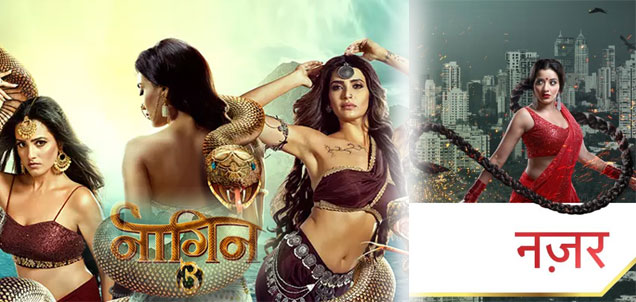
    The season of supernatural fantasy thrillers is back. Naagin’s third season has blossomed since its launch a few weeks ago. Last week, Star Plus launched its daily Nazar, which opened to very good response, rating at near-breakout levels for its daily 11pm slot, contributing to the channel’s top position in Urban HSM for the week. There are other weekend shows in the category too, like Qayamat Ki Raat (Star Plus), Kaun Hai (Colors) and Fear Files (Zee TV).


    In a case of glaring over-simplification, many media observers consider all fiction, including these supernatural shows, as one monolithic mass. Naagin and ‘saas-bahu’ serials are spoken of as a unit, often in the context of describing what plagues Indian television.


    Daily soaps of the family drama variety have had their fair share of issues over the last 3-4 years, and enough and more has been written about them here. But the clubbing of finite-length, fast-paced supernatural fantasy thrillers with family dramas that are supposed to be based on ‘real’ characters is a deeply uninformed view. It also has an element of inbuilt bias, whereby snakes and supernatural creatures are considered too regressive to deserve a place on national television in today’s day and age.


    I find these arguments flawed, even bizarre. Questioning the legitimacy of a show like Naagin or Nazar is questioning the entire fantasy genre itself. A genre that’s hugely popular worldwide, including in Hollywood, is branded regressive here, because the constituting elements are based on Indian mythology, which almost definitionally has elements of faith, even superstition, built in.


    A force-fitted fantasy track in a well-meaning family drama deserves this accusation. Inclusion of naagins, daayansand makkhisin serials that promised real, emotional relationships are gimmicks that may have given short-term results, but have unquestionably damaged the viewer reputation of the shows and the channels in question over time.


    But when you make a supernatural show, you make a supernatural show. You are not promising deep emotional layering, social change or mature handling of relationships. You are promising some unadulterated fun that’s based on the sound principle that a lot of entertainment is meant to serve one primary purpose: to help the audience destress and escape away from the drudgery of his/ her reality.


    Each genre comes with its own sets of rules and viewer norms. It’s the context that determines what’s regressive and what’s not. To apply the rules of contemporary social construct to supernatural fantasy thrillers is like burdening Virat Kohli with the job crisis in the country.


    The same fallacy was on display after the release of Sanjay Leela Bhansali’sPadmaavat earlier this year, where the jauhar act in the finale was criticized for its glorification of a custom that rightly had no place in modern society. But Padmaavat is not based in 2018. It’s a (questionable) tale from our history, based on an epic poem. Strip the film of its context and a jauhar sequence, glorified or not, will be hugely problematic. But ignore the context and you will lose the idea itself.


    Supernatural fantasy thrillers offer a dose of entertainment that GEC viewers have been robbed of over the last couple of years, when they had to rely on non-fiction shows to do the job. If this is what the category needs to make a slow comeback, so be it. Of course, there’s the danger of me-too versions popping up every other week, but the audiences will take care of that, by rejecting the ones that have nothing original to say.


    Let it be said again. Snakes and daayans are not regressive, till they are shown in a believable context and propped up as superstitions. In a fantasy world, they have only one purpose of existence. Entertainment.


  • Shailesh Kapoor: Asian Games: Indian Sport is Finding its Feet

    By Shailesh Kapoor


    It’s been two weeks of exciting sporting action of television, with the Asian Games and the India-England Test series. Both have seen India emerge stronger than expected. After losing the first two Tests, many would have resigned to fate that this is going to be another one of those 0-5, 0-4 or 1-4 overseas losses. But with their emphatic performance in the third Test, and then on the first day of the fourth yesterday, the Indian team, especially their fast bowlers, have stamped their authority on the series. The definitive assertion of India as a force to reckon with in pace bowling is the biggest plus from this series, irrespective of its final outcome.

    The Asian Games started off slowly for India, with a series of close calls and misses, including the shocker of not being able to win the Kabaddi Gold in either the men’s or the women’s discipline. But over the last six days, with the Athletics discipline kicking off, India has come into its own. With 7 Gold, 10 Silver and 2 Bronze medals, India’s was the best Athletics performance after China’s. Some of these Gold medals came in the most unlikely disciplines, none less than the women’s Heptathlon, where the performance of the feisty Swapna Burman is a story waiting to be told some day.

    Asia is not the dominant force in Athletics, so one cannot call this performance ‘world class’ in that sense of the term. But compared to the past, there has been a significant surge. So, something must be going right in the background, in a country where sports administration is always at the receiving end of criticism.

    The telecast of the Asian Games on television has been a mixed bag. Sony dedicated three channels to the event, and managed the scheduling fairly well, in that none of the important Indian interests were missed out, an issue that has been my pet peeve with the broadcasters of Olympics, Asian Games and Commonwealth Games in the past.

    The commentary, though, ranged from very good to unintentionally funny and ridiculous. Indian commentators, especially in Hindi, are arguably a notch higher than their foreign counterparts when it comes to commenting on the sport of Hockey. And that, along with the Kabaddi commentary, was the best of the lot.

    But you move to the next line of sports, and things worsened very quickly. Indian commentators were on alien territory in sports like Shooting, Archery and Athletics. While no one expects nuances from part-time commentators, a basic understanding of rules is definitely expected. In the nail-biting Compound Archery encounters, where both the men’s and the women’s team settled for Silver medals in close finales, the commentator in charge kept using the Recurve Archery scoring system, even though the scoring on the screen was clear as glass. And then, we had comical moments like a foul triple jump attempt being called a ‘No Ball’.

    I understand that the Hindi feed needs Indian commentators, but why not use the source English feed for sports you don’t have knowledgeable commentators for? I often found myself switching to Sony Liv, which mercifully had dedicated feeds of some sports, with the original commentary, which was nothing short of top-class.

    But let those be minor irritants that don’t take away our attention from the larger story: Indian sport is growing in stature. Slowly, but surely.


  • September 2018: Kasautii GEC Ki


    By Shailesh Kapoor


    September 2018 promises to be a fairly eventful month for the Hindi GEC category. Using the word “eventful” for this category is unusual, giving the inertia we have seen it display over the last 3-4 years. But at least in relative terms, there’s a lot more happening this month than in any typical month.

    The big highlight is the return of the iconic Kasautii Zindagii Kay on Star Plus. The channel gave several hits in the 2000-2005 period, most of which were produced by Balaji Telefilms. This is the first franchise attempt at recreating that success, more than a decade later.

    The campaign has registered well so far, tracking higher than established non-fiction shows like KBC and Bigg Boss, which is a rare feat for a fiction show to achieve nowadays. The show is still more than two weeks away from its launch, but if it opens well and then goes on to sustain, we could see a barrage of franchise launches on GECs.

    But let the irony in Kasautii’s case not be lost. The K-serials were much-maligned by consumers in the late 2000s, paving way for Colors and forcing Star Plus to relook at their offering. A decade later, the second season of one of those much-maligned serials is the most looked-forward-to fiction launch. Clearly, what has happened in between, especially in the last three-four years, has to be very poor for this reversal of perception to happen.

    The other big highlight of this month is the launch of two big reality shows. KBC went on air this week, while Bigg Boss launches next weekend. There was not much I thought of this, till last night’s announcement by Colors that they have relooked at the Bigg Boss weekdays slot, and the show will now be aired at 9pm on all days, instead of the usual 10.30pm on weekdays and 9pm on weekends.

    Whatever thinking led to this after-thought is good thinking indeed. Fiction has been struggling across the board, and Colors’ recent fiction launches have been, at best, average in their performance. Putting a marquee property in the heart of the primetime is a confident move that only reinforces how Hindi GECs have started looking at non-fiction as stronger bets than fiction.

    Bigg Boss will take KBC head on. Two or three years ago, this would have been a no-contest, when KBC was a big family show and Bigg Boss a niche youth show. But times have changed. Acceptance for ‘edgier’ content has increased, be it in the kids’ category with shows like Shinchan finding morefavour, or in GECs, with Khatron KeKhiladi, Bigg Boss and their ilk growing into bigger versions of themselves. It will be a contest to watch out for.

    It would have been even more fun if Kasautii was being launched at 9 PM too. But that’s not the case, as the show gets a strong early-prime slot (8 PM). The channel has been proactively replacing its non-performing assets with new ideas over the last few weeks, and the results are beginning to show.

    Will Kasautii be that one elusive 4+ rating show that the category lacks today? We will know only over the next few months. Till then, let non-fiction sail the category through troubled times. Yet again.

  • Bahubali 2 & 2.0: Indian Cinema’s New-Age Flagbearers


    By Shailesh Kapoor


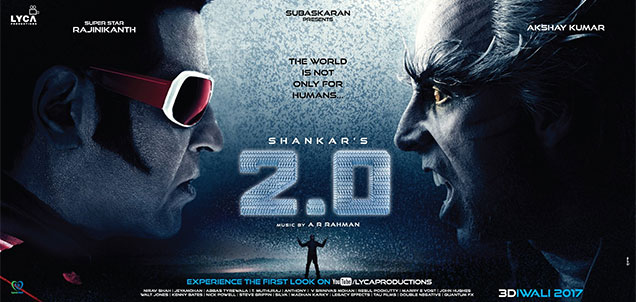
    The teaser promo of Shankar’s 2.0 was released last morning. The film, to be released in Tamil, Hindi and Telugu (besides other dubbed versions), is a sequel to the much-successful 2010 Tamil film Enthiran, which released in a dubbed Hindi version titled Robot.

    A lot seems to have changed in these eight years. 2.0, which has been an ambitious project in the making for a while now, has been conceived and shot as a Tamil-Hindi bilingual. One of Hindi cinema’s top stars, Akshay Kumar, plays the principal antagonist in 2.0. At a rumoured budget of Rs 500+ crore, 2.0 is touted to be the most expensive Indian film till date.

    And yet, 2.0 seems like a winning proposition at the outset itself. Like last year’s mega-success Bahubali 2, 2.0 will rely on its immense spectacle value, which will make it a compelling and unmissable big-screen experience. Bahubali 2 released in Hindi as a dubbed Telugu film, and had no Hindi starcast on its credentials. Yet, the Rajamouli film did nett business of more than Rs 500 crore in India from the Hindi version itself, a number higher than any regular Hindi film by a staggering Rs 130 crore.

    2.0 is more inclusive, because it’s not a dubbed film but a bilingual, and because of Akshay Kumar’s significant presence, adding star value in the Hindi markets. There’s also the additional 3D factor, which leads to higher ticket prices and higher box-office as a result. There is a high chance that the Hindi version of 2.0 may get close to, if not overtake, Bahubali 2’s Hindi collections. Even if it falls 100 crore short, the top two ‘Hindi’ films in India will be from the South of India.

    One way to look at this is to question whether all is right with the Hindi film industry. But that’s another topic for another day. There are two positive trends to spot here. The first one is about the rise of big-screen spectacles as the dominant form of theatrical content, and the second is about the language boundaries bridging.

    Both these trends find strong evidences in the story of Hollywood’s growth in India in recent years. Hollywood has moved towards big-screen spectacles as its primary genre of success worldwide. With digital content having come in, just a good story is not reason enough for audiences to visit the theatre. Yes, the odd film can run well in theatres based on the strength of its story alone, but the Top 10 grossers in Hollywood every year, for the last five years, have been big-screen spectacles, often in the superhero genre.

    In India too, it’s the superhero, fantasy and horror genre, aided by quality visual effects, and often a 3D experience, that has led to more than 20% year-on-year growth in Hollywood footfalls since 2013, even as Hindi footfalls have stagnated.

    It was generally believed that the costs at which such spectacles are produced makes the genre prohibitive for Indian cinema. But with Bahubali 2 and now 2.0, that assumption has been challenged. If you have a multi-lingual revenue model, the costs that a big-screen spectacle film needs can be truly justified, especially because these genres are immensely popular on satellite television too.

    Which is where the second trend becomes crucial. These films, while made by South Indian directors, are Indian films, than just South Indian films. This is especially true for 2.0, which was conceptualised as a multi-language project right from its inception. Spectacle films are not overtly dependent on nuances of language and culture, and hence, find it easier to travel across diverse markets in India, giving them unprecedented reach. After all, the collective size of audience base in India across various language is more than three times that of any single language.

    Multi-lingual big-screen spectacles are set to be growth drivers of Indian cinema. The question is: Do we have more directors with the imagination and creative vision of someone like a Rajamouli and a Shankar to make this happen on a more regular basis?


  • Four reasons why KBC has Aged so well


    By Shailesh Kapoor


    We have known for years that there’s no one like him. But how he keeps getting better at it is still a mystery of sorts

    In its 18th year and its 10th season, Kaun Banega Crorepati (KBC) got off to a solid starting, catapulting Sony to the No 1 position in HSM Urban in the process. In the second week too, the show and the channel maintained the momentum. It’s one thing to rate 2+ over a 30-minute daily show. But managing that over 90 minutes is thrice as hard, if not even more. Yet, KBC has done that. Last year, and now this year too, for the first two weeks anyway.

    The pioneering format has met with limited success internationally over the last decade. But in India, it is a runaway hit. Two out of the previous nine seasons performed at levels that can be termed below par. But every time there was talk about KBC being past its expiry date, it has bounced back.

    In a media environment where fatigue is an increasing issue and new things become passé before they even establish themselves firmly, how has KBC managed to age so well?

    Here are four reasons:

    4. Because the soaps have not aged so well

    While most credit for KBC’s success goes to the show itself, it has also benefited from the inert evolution (actually, the lack of it) of the daily soap genre over the last half a decade. When the staple fails to deliver, the alternative will become the staple. Daily soaps have struggled to keep pace with changing viewer expectations, leaving a yawning gap between the quality of entertainment expected from Hindi GECs and the actual quality being delivered. Every season of KBC, for the last few years at least, has cashed in on this opportunity.


    3. Evolution of the idea of ‘Entertainment’

    As tastes evolve and exposure to entertainment widens, aided by digital exposure in particular, the expectation from ‘Entertainment’ itself will evolve. Over the last few years, the dichotomy of frivolous entertainment versus meaningful content has melted away. You need not be all-masala-no-brains or all-brains-no-masala. Viewers are increasingly looking for the golden middle, where Entertainment and Meaning (call it Awareness or Inspiration or anything else on those lines) merge seamlessly. The film industry has understood this to some extent over the last few years. The biggest film director today is a master craftsman of this amalgamation. If Raju Hirani even made a reality show, it will be like KBC in its spirit. Meaningfully relevant, yet highly entertaining. Again, this is something daily soaps have missed (barring exceptions that you can count of the fingers of half your hand), making KBC’s presence even more striking.


    2. The family factor

    In a nation of 95%+ single-TV households, KBC offers that unifying quality that can connect members of a family across their age and gender. It’s the classic sit-together-and-watch show. It was always that since its launch in 2000, but as the need to sit together and watch goes up, so does KBC’s appeal. It helps, of course, that unlike daily soaps, KBC is not a 52-weeks-a-year show. The anticipation of an upcoming season works at a familial level today. Even the youth, who till a few years ago thought of KBC as the not-so-cool show for their parents, have warmed up to it nicely.


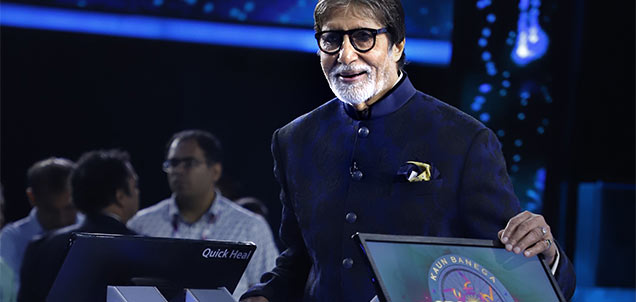
    1. Because Bachchan has aged so well!

    KBC without its host Amitabh Bachchan is unthinkable. With every passing season, he seems to find a subtle new way of engaging differently with the participants and the home viewers alike. Incredibly, even at his age, he is very aware of the emerging trends in the young generation today, and often makes fun of them, in a way that’s adorable and entertaining, but never condaescending. Watch him comment on the lyrics of new Bollywood songs whenever a question to that effect plays out. In context of entertainment, respect and awe often have a secondary connotation of boredom. In Bachchan’s case, he can entertain you and inspire you, while you look at him in awe of the sheer gift of gab, and the unmatched grace his personality exudes. We have known for years that there’s no one like him. But how he keeps getting better at it is still a mystery of sorts.

  • 2018: OTT’s Sacred Year?


    By Shailesh Kapoor


    Permanent Roommates, TVF’s 2014 romcom, is where it all started. There had been a few OTT originals (more popularly called ‘web-series’ in India) before it, but Permamnent Roommates initiated several members of the fledgling digital population in urban India to this new category. TVF followed it up with a classic for the ages, Pitchers. A new medium of storytelling had arrived.


    However, the OTT original content journey since then has been a frustrating one to track from the sidelines. Year after year, we saw launches by the dozen. But quantity ruled over quality, and except TVF’s Tripling (2016) and Y! Films’ Bang Baaja Baaraat (2015), nothing really stood out in a sea of evident mediocrity. An OTT production ecosystem was up and running, but what they were delivering left a lot to be desired.


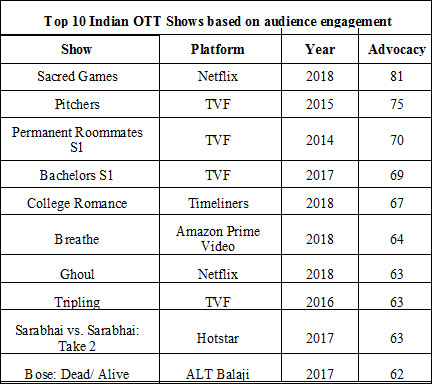
    It’s only since the second half of 2017 that the OTT original content movement has gathered some real steam. The list below indicates that. Out of the Top 10 shows based on Advocacy (a measure, on a 0-100 scale, of audience engagement leading to recommendation to peers), four are from 2018 and another three from 2017.


    Netflix’s Sacred Games broke the 80-point barrier this year, usurping Pitchers, which had held the distinction of being India’s most-loved OTT show for three years. Just six months ago, an Advocacy score of 56 was enough to get a show into the all-time top 10 list. Today, 21 shows stand at 56+.


    The willingness to pay (via subscribing to an SVOD platform) is a marketing challenge most platforms are trying to address. While SVOD and AVOD platforms cannot be compared on the size of their viewer pie, when it comes to engagement, any two pieces of content (even across media) can be compared. When there was a lot of talk about the SVOD boom in 2015-16, the engagement was lacking, outside three TVF shows. What has changed then, in 2017-18?


    The advent of Netflix and Amazon Prime Video seems to be an obvious factor. Till last year, there was an over-dependence on TVF (which still holds four of the top 10 slots in the list above, and another one on sibling brand Timeliners) to deliver quality. The new platforms have brought in more budgets, and hence been able to attract stronger talent, leading to better-produced, better-directed and better-acted content in general. Not all of it has worked, but at least the success ratios look better now.


    But some evident opportunities still remain untapped. Most of the top 10 shows are heavily metro-skewed, getting a dominant share of their viewership from the top 8 cities. While this may be understandable for the SVOD platforms in the short run, even the AVOD shows, including those on YouTube, exhibit this trend.


    Almost all shows outside those on TVF are dark and edgy, limiting their audience base to a specific palette. Variety in genres is evidently missing. For example, there hasn’t been a definitive love story on OTT yet in India. And music, which is core to a lot of our storytelling, hasn’t found a meaningful outlet on OTT yet.


    But at least, there’s been a start of some kind. Quality over quantity will always rule. And 2018 has reaffirmed that for the OTT original content category in India.


  • #MeToo: Time for Men to Shut Up and Listen


    By Shailesh Kapoor


    It’s been barely a week since the #MeToo campaign took off in India. Over the last week, accounts from various women have poured in, implicating senior members of the organisations or productions they worked in. While the initial accounts have largely come from the media and entertainment sector, including advertising and journalism, the flow of #MeToo posts from other sectors has gained some momentum in the last couple of days. We are nowhere close to saturation here. I believe this will go on for another week or two, if not more, and a lot more names, across diverse industries, will be out in the open.


    For those involved with the media & entertainment sector over the years, none of what has come out is even remotely surprising. One has grown in this industry hearing such accounts repeatedly. But thus far, they fell in the hearsay category. ‘Did you know that so-and-so did this to so-and-so’. The #MeToo campaign is significant because here, the victims are speaking up directly. So, the talk shifts from being ‘gossipy’ in nature to credible, and hence, a lot more purposeful.


    As a male member of the industry for almost 20 years now, I have read each such account with a sense of disappointment. Disappointment that this happened, and also at the fact that I’m not even surprised that this happened. I have repeatedly questioned over the last week if many of us, who have seen or heard about such incidents from close quarters, have encouraged it because of our silence over the years. Perhaps yes. But it’s also true that one needs to respect the victim’s choice of coming out in the open about what happened to her. It’s her prerogative, including the prerogative of choosing her timing. And I’m glad it’s happening now. That’s the silver lining on the disappointment. The feeling that something good will come out of this.


    In the first decade of my career (and I intentionally refrain from being specific about the exact year here), I witnessed (‘heard about’ will be more apt) sexual harassment at workplace first hand. At one of the organisations I was working for, a new batch of management trainees joined. A very senior resource in the organisation was known to make his choices. He picked on one (some said two) of the girls in the batch. One day, he walked past her desk and threw a chit of paper at her. The chit had his ‘Personal Mobile Number’ (it explicitly used the word ‘Personal’ I’m told, lest there should be any confusion). There was no communication, just the throw of the chit. But this happened in full public view apparently.


    The man was at least four levels upstream the girl in hierarchy. The girl apparently complained to her boss, who happened to be a woman. Helplessness seemed to be the dominant emotion. Everyone came to know of the incident, but no one quite knew what to do with it. Remember, this was in the decade of the 2000s. The courage to speak up was nowhere close to where it is today.


    The girl didn’t call the number. Thankfully, no second attempt was made. But the girl, probably disillusioned by this early tryst with unwanted male attention in her career, quit within six months to move on to another job. The story was buried and forgotten much before that anyway.


    But the stories that are coming out now won’t be buried. And that’s why, we men should shut up for a while and let the women do all the talking. It’s their moment. And they have waited for years for this.


  • Death By Elections?


    By Shailesh Kapoor


    Five states go to elections in November and December, immediately after the Diwali week. The festivities that characterise the months of October and November every year will give way to a long political festival. Starting November, till the end of the next General Elections, which could be anytime between February and May next year, we will witness India’s longest political festival – one that may last six long months, without any letup. There have been election seasons in the past, but this one promises to be so long-drawn and fierce that it will suck you in first, and eventually exhaust you by the end of it.


    The states of Madhya Pradesh and Rajasthan may see the Congress either coming back to power, or at least running BJP very close, if early opinion polls are anything to go by. This will set up the mood for the big 2019 elections. Because who wants a one-sided contest after all?


    Over the last few weeks, news channels have started launching their 2019 election shows. As we near December 11, which is the results day for the five states (and already a hashtag on a couple of channels), these shows will become bigger, both in terms of their air-time and their promotions. Once the 2019 elections schedule is announced, I suspect no other primetime programming will be left in the news category.


    The problem of plenty manifests in such a scenario. You have so much to choose from, with about 20 national (Hindi and English) news channels, more than a hundred news portals of some repute, and the many newspapers and magazines. How do you decide which ones to go for?


    There are three kind of audiences in this context. You could equate them to the three formats of cricket, in a simple but easy-to-understand analogy. The T20 type is not interested in the depth and the details. He would rather get his information quickly, while being entertained on the way. The count of political leaders they are aware of is in single digits. The Test connoisseurs, low in volume but very high on engagement, get into the smallest of details. They can name Chief Minsters of most states in India, understand the math behind how vote share does not always convert systematically into seat share, and know terms like Bellwether (some even spell it correctly). The ODI group is somewhere in between. They are more aware of the alliances and the leaders, but haven’t immersed themselves into the fascinating world of election numbers.


    These segments show similar age and gender skews as cricket. T20 is younger and the Test connoisseurs the oldest. Most women audiences who follow elections fall in the T20 category. While the exact sizing of these segments is not possible to share in a public column, suffice is to say that the choice is between volume and value, as one moves from T20 to Test connoisseurs. In TV, they call it Reach and Time Spent.


    Audiences tend to sub-consciously choose platforms that align well to their segment. Though, I suspect, the elections festival, and the media overkill around it, may convert some audiences from T20 to ODI, for a short period of time anyway.


    If you have the appetite for elections, like the Test connoisseurs, fasten your seatbelts for an intense season ahead. And if you are more the T20 type, be prepared. Because death by elections is round the corner.


  • Bollywood’s Big Festive Four


    By Shailesh Kapoor


    It’s been an exceptional year for Hindi theatrical business so far. The flow of hits has been consistent over the year. A series of seemingly ‘regular’ films, made in humble budgets, have cut through and become big, the latest being the delightful Badhaai Ho. As the year nears its end, it is set to be the watershed year that reverses the trend of declining footfalls and poor success ratio. How big will 2018 be over 2017 will, however, depend on the eight weeks that remain.


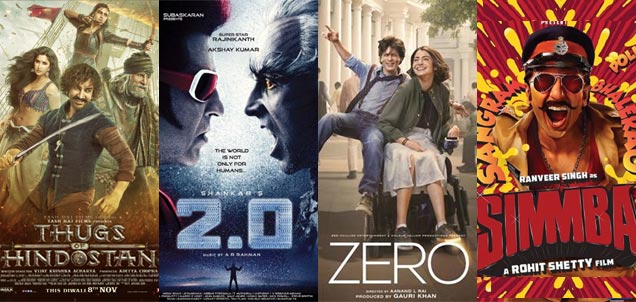
    The last two months of the year are packed with four big films, each with a mammoth potential of its own. If three or more of these films land where they can be expected to, given the credentials of the people involved, we may be looking at an exceptional 2018.


    Thugs Of Hindostan is first of the four, releasing next week on November 8. The film is set to be the widest release ever in India. It has many records to chase, especially in terms of a huge opening day and an opening weekend. The makers (Yash Raj Films) haven’t put out too much material, leaving a sense of intrigue around what anyway is a fairly unusual film for the Bollywood market in today’s times. Thugs Of Hindostan is incidentally Aamir Khan’s first Diwali release in 22 years, after the blockbuster Raja Hindustani in 1996.


    2.0, the next film from the Robot (Enthiran) franchise, is releasing on November 29. The trailer is out tomorrow (November 3). It’s a film that promises to give India a definitive leap in the genre of spectacle cinema. The numbers that can be expected, not just from India but globally, have the potential to make many other big films look very small in comparison. Shankar, like SS Rajamouli, is a director with great vision and storytelling skills. Great VFX are a given. But don’t be surprised if 2.0 has emotional depth too.


    The most intriguing film of the four is Aanand L. Rai’s Zero, whose trailer releases today on the birthday of its lead star Shahrukh Khan. Rai has forged a name for himself with the genuinely authentic Tanu Weds Manu films, especially the second one. He’s worked on this ambitious project since that film released in 2015. SRK hasn’t given a film that’s truly found audience appreciation for a while now. Very little is known about Zero, except SRK playing a dwarf, at the time of writing this. But if Rai can marry his world with SRK’s, we could be looking at something very special. Zero releases on December 21.


    Simmba, Rohit Shetty’s cop masala action flick with Ranveer Singh, will round up the year on December 28. Singh got accolades for playing Khilji in an all-out, no-holds-barred way, in Padmaavat earlier this year. But this is his big solo film, where everything rests of his shoulders. It’s his Singham. And we can expect him to make it his own. Simmba is more ‘routine’ that the other three films on this list. But never write the staple off.


    See you at the movies. Four times over.


  • Indian Women’s Cricketers: Stars in the Making


    By Shailesh Kapoor


    As I write this, I’m watching the Indian women’s cricket team bow out in the T20 World Cup, losing their semi-final game to England after a lacklustre performance. Thus far, it’s been an excellent World Cup for the team, where they won everything on offer, and fairly emphatically too.


    You can’t win everything. But the Indian women’s cricket team has been winning a lot more in recent times than ever before. The 2017 ODI World Cup in England is where the surge started. India reached the final and should have won it against the hosts, chasing. a modest total, but lost by nine runs in a tight finish. But the run of performances leading to that final made the media and the audiences sit up and take up notice. In particular, the semi-final performance against Australia, featuring a dream innings by Harmanpreet Kaur, where she scored an unbeaten 171, was the gamechanger in this regard. The rise of women’s cricket in India was covered in this column too at that time, which can be read here.


    Since then, the team has built on its strengths, and has now three clear stars headlining the unit. Mithali Raj is a veteran with many records to her name, while Harmanpreet Kaur and Smriti Mandhana are exciting, young batters who play a brand of cricket that’s immensely entertaining and new-age.


    During the ad breaks in today’s game, I saw Kaur endorsing a natural fruit juice brand. Raj has been endorsing brands too, and I’m sure Mandhana is beginning to get her share of credit on that front. This was unthinkable two years ago.


    Star Sports have done well to promote women’s cricket with all sincerity, well knowing that the ratings will take time to come. It’s too early to expect these games to show up on the top programme charts. But the rise in interest is definitive. When India’s men’s team lost the first T20 to Australia earlier in the week, an English news anchor covered it in the headlines, specifically prefixing “men’s” to avoid confusion. That tells you something about the progress that has been made.


    The women’s cricket team is on a fine journey, but it’s just the start. They will need to be consistent over the next couple of years to build a bigger fan base. That’s when the stars will come into their own, becoming sporting stars like Saina Nehwal, PV Sindhu or Sania Mirza.


    In the Ormax Sports Stars October 2018 report, four Indian sportswomen feature in the Top 25 most popular sportspersons in India (across sports, nations and gender), and these are Nehwal, Sindhu, Mirza and MC Mary Kom. Raj follows at no. 26, at less than 10% popularity share of Nehwal. So clearly, there’s a lot of fan base to still cover.


    The men’s team has done very well in the ODI and T20 formats in recent years, and now enter most series or tournaments as the favorites to win. That’s the next target for the women’s team. And it may not be too far away.


  • Hindi GECs: Mixing It Up… Finally!


    By Shailesh Kapoor


    While all eyes this year have been on the OTT/ digital space, the Hindi GEC category too is silently, but surely, going through a shift this year. One doesn’t need to look much beyond the evolution of the programming mix on the category to understand this.


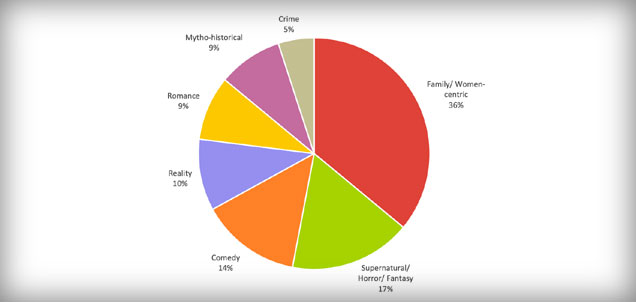
    After the launch of eight new shows currently in pre-launch promotional stage, the genre mix of the category, based on 64 primetime shows across the seven Hindi GECs targeting Urban HSM, will look something like the following:


    The family/ women-centric + romance combination, which has traditionally dominated the category since 2000, controlling at least 65-70% of the programming mix, and peaking at 80%+ at times, now stands at a modest 45%. The ‘alternative’ genres are no longer alternatives, with 55% contribution to the programming mix as a collective. This is the healthiest the Hindi GEC category’s programming mix has looked in a long time.


    This change, evidently, is a result of the distress the category has faced over the last two-three years. With category share (as a percentage of total TV viewership) dropping consistently, Hindi GECs were left with little choice but to question if conventional family dramas and love stories are the path to sustained viewership. The rise of the alternative has been evident through shows like Naagin, Kaun Banega Crorepati, Comedy Nights With Kapil/ The Kapil Sharma Show and the ilk putting up solid numbers over time, even as conventional family dramas failed to make an impact, barring a select few.


    This shift makes 2018 the best year for Hindi GECs in recent times. While we are still five weeks of data away from doing an annual analysis, it is safe to say that there has been no further attrition in the category’s share this year. While that’s a good start, a lot more needs to be done. After all, two years of damage needs to be undone.


    The sinking ship in this mix is still the family drama genre. Most shows that are doing well in this set are pre-2015 launches. Very little that has launched since then has managed to survive more than a few months. More importantly, it is this 36% (amounting to 23 shows out of 64) that brings a perception of mediocrity and lack of innovation to the genre in the viewers’ minds. This year’s launch Kullfi Kumarr Bajewala provided an exception, emerging as a fresh yet relevant show in this mix. But as it moves ahead and enters its second year, it will have to face similar challenges as other family dramas too, those related to viewer fatigue coming from a long-running show.


    The ‘overdose’ of supernatural, fantasy and horror shows in the category is a popular topic in the media, with Naagin being the flagbearer, albeit not in a flattering way. But if 11 shows (17% of the mix) can deliver more category freshness and entertainment than 23 conventional dramas, why should that be a problem of overdose?


    I’m glad there would be something to write about in the traditional end-of-the-year Hindi GEC round-up in this column. The last two years have been too inert to write much. This year is better. Can 2019 then be the year when some of the glory, from the pre-2012 days, is won back?