Category: COLUMNS

  • Ranjona Banerji: Shame on our journalism!

    By RanjonaBanerji


    Watching the stand taken by the US media against the rants and behaviour of US President Donald Trump and his aides, what can one do as a journalist but cringe at the way the Indian media behaved with an equally self-obsessed leader who has not only made extravagant promises (largely unfulfilled) but has drastically diminished the nation with his demonetisation scheme?


    Sadly, once again, the burden of bad journalism – or non-existent journalism – falls on our various news channels to bear. From the time that Mr Modi announced his prime ministerial ambitions in 2013, TV and this includes some of our best-known English news anchors, fell over itself in helping Mr Modi promote himself. Unlike print and web journalism, which at least kept the vestiges of journalistic self-respect intact.


    Fairy tales about the “Gujarat model” were spread far and wide so that they became fact. We were assured by our news anchors and their guests and friends that India would flourish under Modi. The Congress and other political parties were treated the way journalists should treat political parties. Every comment made by Rahul Gandhi which did not tick every box for perfection was held to scrutiny. Replace Rahul Gandhi with any other non-BJP leader.


    The AamAadmi Party has also been held up to a special standard where it has to perform beyond all reasonable levels. This is partly because the India Against Corruption movement and Arvind Kejriwal let TV journalists down, in spite of initial exaggerated media support. And partly because Kejriwal and his party waste no opportunity to attack Modi.


    The biggest failure of TV journalism – why do I even use this word? – today remains its stance on demonetisation. Even while reporters covered the ground situation of people dying, people suffering, businesses collapsing, anchors in the evening tried to pretend that things were not so bad, gave ample air time to guests who supported the scheme and in some cases, anchors themselves attempted to present the “good sides” of the scheme.


    How many English news channels have gone into detail about the claims made by this government, all of which have come a-cropper? How many star news anchors have said to some shameless supporters of demonetisation, “You have a point”, even when the supporter has declaimed, “Don’t go on and on about poor people suffering”?


    How many star anchors have spoken to their viewers about the lack of access granted to them by the Central government, about the fact that only three people in the Government know what’s going on?


    How many star anchors have taken the BJP’s communal agenda head on, without bringing Pakistan into the picture?


    How many star anchors have ever spoken about the threat to journalism itself? Not even, you may remind yourself, when the whole “intolerance” debates were going on. And who does the lack of freedom of expression affect the most if not journalists?


    Watching the responses of the American media to Donald Trump’s “war with the media” and to his various ordinances – particularly the ban on people from certain Muslim countries entering the US – you wonder if India’s much-awarded (mainly by themselves to be honest) TV anchors feel even a twinge of the need for self-analysis.


    I would suspect not: Because what most of television news now practices in India is not journalism, even if it ever was at some point. Look at it this way: through the day some people are sent out to the ground with microphones and cameras to get voices and videos on news events. What these poor people find out has seemingly absolutely no impact on decisions taken in the newsroom by senior staff – drastically unlike the way a traditional newspaper reacts to news. Instead, we have a series of talk show hosts whose main job is to either create a fight or give space and time to one point of view.


    All too often as we have seen recently, it is the government’s point of view that our news anchors like and everyone else is a traitor. Yes, not everyone is tainted by this brush but the few that stand against on TV are so few as to hardly count.


    In contrast, look at the reactions to Trump and to the recent visa ban. The idea of standing up for individual civil liberties is alien to the Indian idea of democracy and that is reflected in our mealy-mouthed responses compared to reactions in the US from the media, the general public, the judiciary and more. That is why we saw artists and writers returning awards as an affront to the Indian state rather than what it was – a protest against an attack on the idea of India and democracy.


    Shame. Shame on us. On our journalism. And our pretensions to democracy.

     

  • Alpana Parida: Why Sania Lost…

    By Alpana Parida


    When the lady commentator said of Sania Mirza during the Australian Open Mixed Doubles Finals that Indian players tend to be strong with their hands but not very dexterous with their feet, I had to bite back the typically defensive Indian anger and reaction to acknowledge the truth of her statement. From lazy fielders to slow on their feet players on courts, Indians are not as dexterous with their feet. Cricket is replete with stories of great batsmen who would hit big to avoid running between wickets. The newer generation is running and fielding better – and whenever they do, we recognise this as unusual behaviour that needs to be lauded as such.


    Our cultural mindset does not allow us to celebrate physical exertion of any kind, across society and demographics. Indians use a record number of wheelchairs (one mortifying flight from Mumbai on Emirates had a total of 62 wheelchair-bound passengers!), The Brahmins were the high caste of thinkers and the doers were lower down the order of castes. That has permeated our collective consciousness so deeply that I recently watched a strapping young man flying business class, using airline staff to carry his suitcase while he walked up the stairs in uncreased linen. Never mind that the porter was older and emaciated. And never mind that his bulging pectorals made evident his decision to be not one of inability but of iniquity.


    As I write this column, Roger Federer has just won the Australian Open, defeating an evenly matched Rafael Nadal. Winning is a lot of hard work. It cannot be simply a preference of clever shots and a strong backhand. Without picking and choosing what kind of work you will or will not do, doing whatever it takes to get there has to be a mindset. It is not just the training or the nutrition or the winning spirit or lack of. We simply do not have the mindset where hard work, particularly physical work, is seen as being necessary. I meet young people who say they are only interested in strategy. They have no interest in rolling up their sleeves and actually execute strategy as well as ensure intelligence in the execution. The checking of copy, the ensuring of accuracy and timeliness in delivery, and heaven forbid – the raising of an invoice and chasing up a payment that pays for our salaries and rent– are seen as the worst kind of jobs.Somewhere in that picking and choosing of work (“at this stage in my career, this is not the kind of work I should be doing”), we miss the whole. We compartmentalise and miss larger goals. We miss the opportunity to understand how things work. And why things fail. And what creates success and impact.


    I remember travelling to Bengaluru on work with a much younger colleague. We had gone for a day – and next morning, I was down with my overnighter checking out, with no signs of my young colleague half my age. When I finally called him – he explained that he was waiting for a porter to fetch his overnight handbag, and that was delaying him. It simply did not occur to him that he could bring it down himself.


    All our work comes attached with judgmental values and defines who’s who. Men can’t do laundry and cooks won’t clean the house, executives will not pack boxes with samples and while writing this paragraph -  our driver – sulking to be asked to clean the car interiors, objected to the cleaning cloth being given to him. It was not the yellow cloth that made the cleaning respectable. It was not his job anyways.


    The gap in India, between thinking and doing is wider than most other countries I have seen. I remember seeing a sign at a Social Security Office in Westchester, New York recognizing a clerk who found a way to reduce the length of a line. It is only when you bring intelligence to work that you can bring improvements and eventually impact outcomes.  For a country that has such a large intelligentsia, we have distinctly unintelligent processes for the most part. That is because, whoever thinks of a process, never engages enough on actually implementing it, and thus there are no process improvements. It is what it is. And we live with the sub-optimal, stupid and inefficient in most part.


    Hopefully, the startup generation will do things differently and bring more intelligence to our everyday and to our everything.


  • Sanjeev Kotnala: Have your SOPs lived their life?

    By Sanjeev Kotnala


    Every self-respecting department in a growing organisation has defined standard operating processes (SOP). The problem is simple. Most of the process were created when the organisation was of a different size, operating in a zone with market dynamics that may not be now relevant. However, like religious rituals and family traditions, they remain unchallenged. In fact, quite a few are really the new bottlenecks or barriers to streamlined efficiencies thus increasing the possibilities of error and delays.

    If you start scrutinising processes, it will not be surprising to find that many do need recalibrating.

    It could be the steps to be followed in generating a report, reminders built in for updating, the way to access and resolve consumer complaint or even manufacturing or indenting a product. Trust me, inefficient old traditional processes may actually be the cause and high contributor to business disadvantage, stress, missed deadlines and increased cost.

    It is recommended that businesses must evaluated and re-calibrate their processes at a regular frequency.

    Every team and department work with set documented procedures that are well-established and passed down the order. Advertising and marketing is no different. These are fondly called Standard Operating Procedures. They tell you what to do under which situation. They promise that if you did what they suggest, you can be absolved of any irresponsible behavior. You may, in fact, be branded an organisational man.

    Don’t take me otherwise, SOP are important and hugely critical when they deal with safety-related, legal or financial objectives.

    SOPs are designed to streamline the way people work. When everyone follows a well-tested set of steps, there are fewer errors and delays and there is less duplicated effort. With time, new set of SOPs get accumulated within the system. Naturally with time, redundancy does creeps-in unannounced. If you have been updating everything and techniques in life, why not the SOP’s.

    If and whenever you experience a problem of relevance with a SOP, it is review time. It is time to update or upgrade to something that  keeps the process relevant and result oriented. Or in some cases, you could be best adviced to drop the process.

    The process revival and re-engineering are an art in itself. Maybe, you could do with some preliminary steps.

    MAP THE PROCESS. Identify the process needing intervention. Document each step and sub processes. Use flow charts to capture every step. Detail out the phases and sub-steps with the help of regular users.

    ANALYSE THE PROCESS. Investigate the observed and felt problems in the processes. Check for redundancy duplication and technology intervention.

    One of the ways is to get answers to some simple questions. What makes the user frustrated in the process? Which steps are bottlenecks? Where is the delay happening? Is there a need to decrease interdependency? Which steps are no longer required and can be replaced? What are the areas which are impacting negatively the cost and quality?

    Check how other organisations handle a similar requirement. Remind yourself, you need to fix the problem and not just the symptoms.

    RE-ENGINEER THE PROCESS. Tweak or redesign to take care of identified issues and challenges. While doing so, you will be better served to speak and interact, include real SOP users in your re-engineering approach. They are the one who will know best and also be able to suggest new approaches. Explore multiple possible solutions to the issues. Choose the one which is best in the real-life context. Check – recheck time-effort-cost-risk -end customer experience and impact before taking it for final discussion.

    Once you are through with re-engineering the SOP with your team and there is a collective buy-in, formalise it with proper documentation and authority. Don’t wait for the processes to get irrelevant and users to raise their voice. Plan review of the new process and mark that date on the process document.

    IMPLEMENT. Implementing a process is a mini project in itself. Before pressing pedal, you must communicate the new process to every stakeholder and resources groups ( like UT/ HR/ Finance/ Documentation) that may need to intervene for its perfect implementation.

    Present the benefits to the users. Bring everyone to the same page. It is important for all stakeholders to understand the reason for change and how it impacts them and the organization. There may be a need to educate and involve external business associates for perfect implementation. Their systems may need to be re-calibrated to accept the new process.

    SUPPORT. Even after you have run a successful pilot, trust, the new processes will have its own bugs. You must have an FAQ designed to take care of minor issues and an empowered service team to take up major issues.

    Unfortunately, you only realise the issues post the process has been implemented. The first review is a pre-determined time for ironing out unexpected challenges. And it must be done ASAP. Allow an empowered user  team to retweak if necessary and finalise the new porcess. Cap this with a built-in review / expirey date. You will find that a small change like this expiry / review dates will suddenly make changes more acceptable.

    Don’t forget – PERFECTION is always WORK-IN-PROGRESS


  • Ranjona Banerji: Switching subjects when the Budget is a bore

    By RanjonaBanerji


    What do you do if you are a super-nationalistic journalist and the annual Budget presented by your favourite government in the whole universe turns out to be a lacklustre bore, full of half-truths, post-truths and dissembling?

    Why, you switch subjects of course.


    First option: Pakistan. Pakistan is the go-to place (no, no, we are not discussing where liberals and intellectuals belong for now) for TV journalists in search of a proper patriotic subject. The formula is simple: invite a few Indian handlebars, a few Pakistani handlebars, at least one fake R&AW agent and give the star anchor a whip. All the circus animals respond appropriately. They bluster and yell and take home fat attendance cheques at the end of it. The viewers also know what to expect, chief amongst which is to understand nothing but feel full of country-love zeal and fervour.

    Mission accomplished.


    Second option: Focus on “very important” issues like upcoming state elections. Conduct and/or get paid to telecast exit polls. Showcase these exit polls by much running around all over the studio brimming with excitement at your audacity at presenting something that may well be proved wrong but anyway the stupid viewer will never remember. Try as hard as you can to ensure that your favourite ruling party in the universe currently in power at the Centre is going to win “yuuuuge” like The Donald did.

    If by any chance the exit poll suggests otherwise, use your star anchor status to obfuscate the exit poll results and produce various options on how and why your favourite may well win because there are so many other factors that rule the world other than your exit polls. Do not actually ever say this but drop some hints.


    Third option: Discuss Donald Trump. There is enough fodder here for fun. But remember to give ample space to bigoted NRI organisations in the US to spread their prejudices. This is called being “objective” in TV-speak. Be careful not to mention Trump’s battle with the media. That is verboten territory for patriotic Indian TV journalists. After all, Trump called Prime Minister NarendraModi third or fourth or within the Top Ten of world leaders after becoming US President. Yaaay! We are so great!


    Fourth option: Try and discuss the Budget but freely use the standard star anchor trick – do not allow anyone who has a contrary opinion to be heard. If the irksome guest does not listen to you, call in the ruling party cavalry or at the very least, shout, plead, implore, beg him or her to try and at least see things from the finance minister’s point of view.


    Fifth option: Do not under any circumstances discuss demonetisation. It was not mentioned in the Budget, it was not mentioned by the chief economic adviser as a great achievement of the government and it has no bearing on life at all in India. Everyone is incredibly happy, even (or especially) the dead people and all is well. The prime minister said so, remember?


    Additional Tips: Forget about the Jallikattu protests and other stuff which you concentrated on for days. The Supreme Court has said something? What is the Supreme Court?


    Final Idea: When all else fails, try fancy dress. So Dr Prannoy Roy of NDTV runs around Amritsar in a red pagdi. Why? I mean, why?


  • Shailesh Kapoor: General Entertainment: A Sloppy Term We Have To Live With

    By Shailesh Kapoor

    The term ‘General Entertainment Channel’ (GEC) is unique to India. I don’t know who came up with it originally (could have been one of the ratings agencies in the ’90s), but the term has bad English written all over it. This article is a linguistic critique of this term (GEC). The viewer doesn’t even know this word and couldn’t care less. Hence, whatever you read here on has no business value. But if you care about the English language, read on.


    Let’s start with the first of the two contentious words: General. What kind of entertainment is “General”? For some reason, the word “General” was preferred over the word “Mass”, as is evident by a counterpart category being called “Niche Entertainment”, an equally odd articulation.


    If we go with “Mass Entertainment” as the meaning behind the term “General Entertainment”, we come to the next contentious word. What is “Entertainment” to the masses? Channels in the category would like to say it’s a mix of all that the mass audience want, and hence, the word “General” may have a meaning after all.


    But are the GECs delivering “a mix of everything”? If you go by a broad definition of the word “Entertainment”, it would include music, documentaries, Bollywood gossip, kids content (including animation), and some would say, even news. But the homogeneity of GEC content today is evident to all of us. They are offering only two types of content that covers more than 90% of their primetime: Serials and reality shows. Even films, earlier a GEC mainstay, have slowly moved to the movie channels.


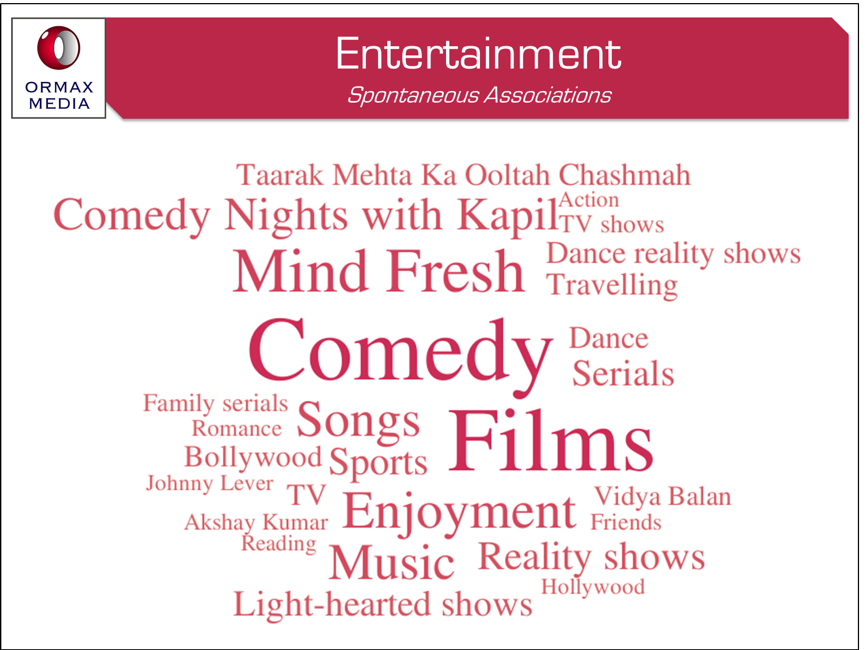
    The other definition of the word “Entertainment” is a consumer definition. The chart below is a ‘thought cloud’ made from the words that were spontaneously associated with the word “Entertainment” by a large group of consumers across the country (data collected end 2015).

    This is how India sees “Entertainment”. A large part of this thought cloud is not delivered by the GEC category (Hindi or regional). Is this consumer definition also a linguistic faux pas? Not really.

     

    The dictionary definition of “Entertainment” range from “the action of providing or being provided with amusement and enjoyment” to “something diverting or engaging, such as a public performance or a usually light comic or adventure novel.”


    Associations of “Entertainment” with de-stress, amusement and comedy are unmistakable across these and many other definitions available on the Internet. The thought cloud above mirrors these definitions in most part, though with an Indian contextualisation.


    Does it mean that the consumer understands English language better than those coined the term “GEC”? That would be tough to believe in a country where grammatically incorrect terms like “Mind Fresh” (also seen in the chart above; an Indian English term for relaxation and mood refresh) are rampant in their usage.


    In my understanding, when the term “GEC” was coined, it was coined with the right intention. There were no movie channels, kids’ channels or music channels then. Through the ’90s till the early 2000s, GECs used to air fiction programmes across genres, lots of films, had trailer and music slots during the day, and even animation bands in partnership with companies like Disney and Turner. Some even had news content.


    But as more and more channels launched, this “Entertainment” saw fragmentation. Each new category started getting its share of content. Film channels fought for the first right to air a big film, because ‘Why should a GEC air a film?’. Therein started the change in definition of what a GEC stands for.


    Today, almost all GECs, barring an odd exception like SAB TV, are more Drama Channels and less Entertainment Channels. Even the non-fiction content on these channels would fall under the generic definition of “Drama”: “An exciting, emotional, or unexpected event or circumstance.”


    BARC India had the opportunity to change some of this faulty nomenclature in 2015. I suspect this would have been too low on their priority list. But we have learnt to live with this mess of a term (GEC) anyway over two-and-a-half decades. Who needs a change only because the English language must be respected.


  • Ranjona Banerji: Those shameless American journalists doubting Trump’s credentials…

    By Ranjona Banerji


    The response of the international and American media to the new US President Donald Trump remains in stark contrast to a bulk of the Indian media’s response to the BJP-led government at the Centre and to Prime Minister NarendraModi. The German magazine Die Spiegel had a cover illustration where Trump was shown beheading the Statue of Liberty. Yes, there have been cries of outrage from Trump supporters and from Rightwing Coalition of the Permanently Outraged but that does not seem to have stopped the media.


    The president himself has continued with his Twitter war with the American media because apparently that is how you run the free world when you are its leader. And shockingly, there are no telecasts of prominent news anchors calling Trump a rock star or a tsunami wave or the greatest invention since tanning lotion.


    Where are the photographs of American journalists falling over themselves to take selfies with Trump? Where are the breathlessly excited journalists retweeting every Trump tweet, joyous that no president has ever tweeted before? Where are the senior journalists writing long columns headlined, “20 things Trump will do to make America great again”? Where are the faithful experienced well-known journalists retweeting for us, “Trump woke up today”, because, wow you shameless anti-Trump journalist, you always doubted that Trump did not sleep at night?


    Sounds familiar, my dear shameless faithful journalists?

    I would have expected by now some very angry tweets and columns from Indian journalists about how terrible the American media has behaved with Trump. And at least a series of tweets on how anti-national the American media is and Breitbart is the only appropriate news medium for Indian journalists to emulate.


    I am secretly hoping that they have at least sent loads of agarbatti and aartithalis to the Republican Hindu Coalition, so that they can add their blessings to the Trump presidency. In fact, I would have never heard of the Republican Hindu Coalition if it wasn’t for the Indian media and I am unsure that my life has improved from knowing them. Apart from the humour they provide of course. Though I wonder if that was the reason for highlighting them…


    In case you think I am an evil exaggerator, here is the Indian Express reporting on the earthquake in Uttarakhand on Monday night:

    “Soon after the quake, which took place at 10.33 pm, Prime Minister NarendraModi said in multiple tweets, “Spoke to officials & took stock of the situation in the wake of the earthquake felt in various parts of North India. PMO is in touch with officials in Uttarakhand, which is the epicentre of the quake. I pray for everyone’s safety & wellbeing.” ”http://indianexpress.com/article/india/5-8-on-richter-quake-rocks-uttarakhand-delhi-4511344/


    As any media person in India knows, when the Prime Minister tweets, the world gets validated.


    **


    Meanwhile, watching TV news after the earthquake – which was pretty scary for those of us who experienced it – was most amusing. There are several websites where you can get immediate information about earthquakes. The US Geological Survey website is one of the best. The ESMC website is very quick, especially with its tweets. So anyone with access to the internet was able to find out in a short time what had happened and where. The epicentre was near Rudraprayag and Joshimath, some 112 km east of Dehradun. Could our intrepid TVwallahs figure this out? Should I laugh or cry? Some told us about the tremors in Delhi where most of them are based. Wind chimes and light fittings shook in the National Capital Region. Some spoke to people in Pithoragarh. Some told us the epicentre was Pithoragarh. I had a lovely sense of déjà vu. Last year during the forest fires in Uttarakhand, people asked me if I could see fires in Nainital from Dehradun. Ah, well.


    I’m not going to insult your intelligence by telling you that Pithoragarh is not 112 km east of Dehradun. Perhaps you could just find a Prime Minister to retweet?


  • The Diminishing Social Impact of Television


    By Shailesh Kapoor


    That fiction content on Indian television is stuck in a rut of its own creation is no secret. In a recent attempt to familiarise myself with the content on regional GECs, most of which are in languages I do not understand, I started browsing the Hotstar, Voot and O-Zee apps and read the synopsis (headlines in case of Voot) of randomly selected episodes from the last four weeks, across their channels.


    Episode synopses of randomly-selected episodes of randomly-selected shows across seven different languages have been reproduced below. Character names have been replaced by their first letters to bring focus to the content.

    1.       F is told about N and D’s generosity but her arrogance leads her to ponder over N’s motives. While D is worried about N’s safety, F plans to take revenge against him!

    2.       R and I are shattered when the judge sends D to the juvenile remand home. Later, O slaps R when he blames I for D’s imprisonment.

    3.       P and K plan to abduct the children during the function. Meanwhile, S lays his eyes on K.

    4.       Preparations are in full swing at R’s house for the bridegroom’s arrival. Meanwhile, S and his mother decide to visit R’s house in order to somehow call off the wedding.

    5.       J takes a loan to return T’s money. Later, T humiliates J in front of M and P.

    6.       To save S from N’s ploy, A visits the temple in disguise to keep an eye on her. Will she be able to foil N’s plan?

    7.       S misleads Y and convinces him to marry L. H makes an unsuspecting N consume liquor, hoping that she will tell him the truth when drunk.


    These are all fiction shows currently on-air. What do we see here? Revenge, juvenile home, slap, imprisonment, abduction, humiliation, ploy, disguise, mislead, drunk… Barring No. 4 above to some extent (though a wedding is being called off there, which is not exactly a positive thing), everything else is in a similar space, driven by plotting and planningin circumstances that are neither relatable nor realistic. Worryingly, all the emotions expressed are negative, with little sign of positivity or hope.


    For years, I had been an advocate of our fiction television having contributed to a social change in India.It was the 2000-2013 period, in particular, when this happened. In 2012, Ormax Media had conducted a large-sample consumer research for the Indian Broadcasting Foundation on this subject, whose report, titled Posi-TV-ity, was released at FICCI Frames that year. It was about telling various stakeholders how under-rated the power to television to bring about socio-economic change is.


    Five years hence, I would be a lot less confident about the outcome if a similar research was commissioned now. The category has not been able to build on the momentum of the last decade. The last five years have seen an active shift from social exposure, awakening and personality development (three strong needs satisfied by TV, as identified in the 2012 report) to mindless entertainment, that’s not even rejuvenating anymore. And then, the Internet has started making an early impact, and taking over some of television’s roles.


    In the absence of new ideas, inertia will continue to generate some viewership. But the social significance of television is weakening considerably. Unless there’s a reversal in the near future, all the good work of the last decade may come undone.


  • Ranjona Banerji: Our Media, Their Media

    By Ranjona Banerji


    Am I putting too fine a point on it? Is the American media really thatsuperior to the Indian media? Am I being unfair in my comparisonsbetween the two? Am I giving American democracy too much credit while denigrating the Indian version?

    But even as I ask these questions, I remain horrified by a portion ofthe Indian media and impressed by the relentless assertion of rightsby a large proportion of the American media. The Prime Minister ofIndia, NarendraModi made an unsavoury reference to a former PrimeMinister in Parliament. It was gratuitous and beyond the normal realmof polite conversation – even keeping Parliamentary norms, rules anddecorum aside for now. Certainly, Modi had every right to criticiseManmohan Singh – as has anyone else in India. Certainly, he can pointout, question, attack Singh’s flaws, mistakes and misdemeanours.

    But it is easily argued that Modi crossed the line when he used themetaphor of Singh bathing in the bathroom with a raincoat on. This wasstreet language, maybe even election rally language but it isquestionable whether it is language befitting of an Indian PrimeMinister speaking in the Houses of Parliament.

    Naturally, as it has done with everything Modi has said and done, somesections of the media ignored Modi’s comments and others presented itwithout comment. Individual journalists took to social media to defendModi and blame the Congress for Modi’s remarks. I am not countingsenior journalists like SwapanDasgupta who are now part of theestablishment and are clear about their loyalties. They are not hiding
    behind a false mask of being neutral. But there were enough others tomake one cringe.

    Contrast this with US President Donald Trump and the American media.The fact that Trump tweeted in favour of his daughter and against adepartment store was discussed threadbare, with all the problems of
    protocol and conflict and interest the tweet implied. His adviserKellyanne Conway’s justification of Trump on this issue was dissected.

    The invented terrorist attack in Atlanta by White House presssecretary Sean Spicer was torn apart by most of the media and all itsversions. Even rightwing media has called Trump out when he has neededto be. There are several ongoing battles on Twitter between Americanjournalists and the Trump administration.

    As for comics and those shows which track the news, Trump has beenexcoriated. The fact that Trump blusters and bullies his way throughlife has not stopped these shows from attacking him or making fun of
    him.
    Now try another contrast. Look at the way the Indian media – in amajor part – has reacted to Modi’s defence of demonetisation and hislies about how his plan worked very well. How many have taken up theselies and countered them with facts? Instead, anodyne headlines andbland reporting has been our way.

    Of course, the dramatic and fast-moving events in Tamil Nadu havegiven our media some respite. And certainly every bit of this fightbetween two chief ministerial aspirants from the same party and onegovernor caught between the two, his duty and a Supreme Court judgmentnot to mention political wrangling, interference and popular anger hasbeen covered extensively by our English news channels.It is not often that South India gets so much attention from ourNorthward-looking channels so it is heartening when it happens. Thismay show up the general biases in Delhi-based newsrooms but it is goodto know that they make the effort sometimes. Am I damning them withfaint praise? Well, immediately evident was the lack of good Tamiltranslators available to the English channels. CNN-News18 had an
    in-house advantage with their top anchor Zakka Jacob but the otherswere shown up when OP Panneerselvam emerged from his dramaticmeditation at the late J Jayalalithaa’s memorial and started his
    revolt. Viewers who did not understand Tamil got no help at all fromthe anchors at the time. A sort of joint struggle to understand whatwas going on if you like!


  • Sanjeev Kotnala: Will you send a Valentine Gift to your agency?

    By Sanjeev Kotnala


    You haven’t heard a more stupid question than this.

    And then you would ask me, Do you really think I should be doing this? What gave you that idea?
    I know the first reactions the question would elicit.

    Ok, let’s look at the other side.
    Do you think your agency will send you a valentine gift?

    I know it sounds a lot worse than the first question. It is something you do not expect.
    After all, you are the man in this volatile relationship.
    And Valentine is still all red roses for you.

    However, if you were to pause for a moment and think. I am not asking anything impossible from your side. You do it every moment. So, look back at the dedicated, loyal, committed relationship that you and your agency are in. The love-hate experience will anyway put a couple to shame.

    If there was one relationship in the world, where the extension of love from romance to everyday situation and relationships be most apt, easily acceptable and hugely liked, it will be this complex, misguided and misunderstood relationship. Yes, the relationship between client and agency. Let me be politically correct, should I say agencies.

    Nevertheless, first the people in this relationship and the people with this not-so-innovative thought must themselves appreciate Valentine as a festival of caring, sharing and love. I know they are trying to de-romanticise the day and expand the market. Valentine’s Day has been coloured red and symbolised with pink teddy for ages, that thinking otherwise needs repeat reminders.

    Then they should seek whatever traces of love, care and share in the client-agency relationship. A bit of self-esteem and loads of mutual respect would not really hurt the case.

    Maybe at this stage, the eye may get wet. And the thought could strike you as novel, interesting and entertaining.

    Let me help you. Here is sharing a thought by CARAT LINE on Valentine’s gift for a thoughtful colleague. Oh, that could have been the client too.


    COMMERCIAL I

    And here is a wider subset, Valentine gift for a roommate. That could be your art partner or better the brand planner.


    COMMERCIAL II

    Though both the communication takes a Woman-2-Woman gifting storyline; it is easily palatable and understood. There is nothing to suggest that it could not have been a Man-2-Man storyline. What say, creatively it would not fire !.

    I agree completely with Azazul Haque, executive director, Ogilvy Bangalore, creative head, Ogilvy South, who in afaqs says: “encouraging people to recognise love in everyday relationships is expecting a bit much … . However, the stories (in Caratline) do clearly convey that in a simple and charming way”.

    I am confident if many clients were to see it this way and create the communication to spread the world, the de-red-alienation of Valentine’s Day can happen sooner than later. And gift solution, suggestions at a lower cost ( in case of Caratlane INR 3000) may do the trick.

    Dear Tanishq, Caratline, Famous Innovations and QED Films, are you giving Valentine gift to each other. Maybe the teams were working so hard to make things happen in the market, that such pious thought’s, to mirror the concept nearer home, easily escaped them.

    Meanwhile, think, think hard. There is a time. Does your canteen boy, your boss, your sister or even your parents deserve a valentine day gift? Just asking. Who all will you give a Valentine’s Da gift this year?


  • Ranjona Banerji: TV’s protectionism of the BJP and is the Nine O’Clock News back in fashion?

    By Ranjona Banerji


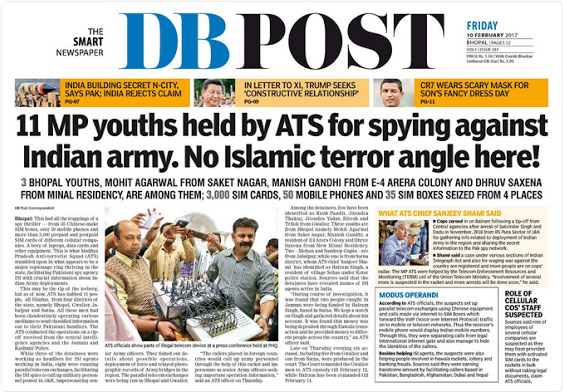
    February 10 had a story about 11 people arrested in Madhya Pradesh with suspected links to Pakistan’s dreaded Inter-Services Intelligence. One of those 11 arrested by the Anti-Terrorist Squad apparently has links to a BJP politician in MP. Another is supposed to have been part of the BJP’s IT cell in Madhya Pradesh


    So, here’s my question to you: How many TV debates have you seen on this subject on our English news channels? And, how many stories, editorials or columns have you read about this in our newspapers and magazines? Is this not a wee bit strange? After all, a political party is accused of having links to Indians who are spies for Pakistan. And not just any political party but the ruling party in both Madhya Pradesh and the Centre, as it happens; a ruling party which has been harping on sending anyone who disagrees with it, to “Pakistan”.


    But umm, a deafening silence falls around us. The DB Post headlined the article and India Today and Indiatimes have covered this on their websites. And yet, the group’s news channel which has the most patriotic news anchors ever, has not gone ballistic over it. Is it because the men arrested are Hindus? One has to ask this unsavoury question if only because of the BJP’s inherent hatred of religious minorities, particularly Muslims and Christians?


    Our news channels will hold a debate over any trivial subject that occurs to them at breakfast. And yet, members of the BJP being accused of having links to Pakistan’s spy agency? Never to be discussed apparently.


    Here’s a link to prove I haven’t made this up:
    http://indiatoday.intoday.in/story/isi-agents-arrested-in-madhya-pradesh-linked-to-bjp-party-leaders-privately-express-anguish-over-possible-infiltration/1/880043.html


    **


    Drastic job cuts have been seen in the media, especially in the Hindustan Times and the ABP group. Demonetisation has a clear role to play here with many newspaper managements warning that their businesses cannot handle both demonetisation and the requirements of the wage board. As ever, doings within the media are largely ignored, brushed aside or given scant attention.


    **


    The departure of NDTV’s star anchor Barkha Dutt has led to some interesting changes in the news channel’s evening line-up. And both are welcome. For one, Nidhi Razdan’s Left Right and Centre has moved back to its 8 pm slot. And more significantly, NDTV is now experimenting with a traditional 9 pm news broadcast. This is a rarity for Indian new channels at prime time. But what a relief! No yelling guests, no hysterical anchors, no absurd subjects – just the news of the day like a proper news channel. Am not holding my breath about how long this will last though…


    **


    Meanwhile, we wandered into Times Now by mistake on Sunday night. Someone from the DMK was asking why the BJP was not being questioned about the governor’s role in the ongoing political confusion in Tamil Nadu. It was very funny to see the anchor quickly stop this man from speaking and from questioning the BJP (blasphemy!). As the gentleman from DMK carried on, she tried to switch responsibility to the Congress and then moved superfast to another guest. I wonder what happens to these anchors when they watch Jon Oliver and Trevor Noah or Melissa McCarthy doing Sean Spicer on Saturday Night Live. Do they laugh or do they stop watching in disgust?


  • Alpana Parida: Extinction of Restaurants – A Looming Reality

    By AlpanaParida


    There are at least sux locations I have been to in Mumbai – in recent times – that have seen a new restaurant replace an old one. The same is true, I am told, across the globe.


    As people, we are changing. We don’t read a book consistently (if we read at all anymore) – we start several at the same time, we open multiple tabs across multiple screens, we become different people – as we have multiple usernames and handles, we like to experiment and get new experiences – we don’t travel to the same place again and seek newness each time – ticking of a list, we have fragmented attention spans – doing many different things peripherally rather than one in depth, we are showing behaviours that do not require commitment, rather that exemplify moving on.


    The rent v/s buy argument is increasingly gaining ground. More and more people are using mobile apps for transportation, rather than look at ownership – through models such as Uber, Ola on the one hand or the shared drive models of Zip cars on the other.


    We seek new experiences – and want to eat a different cuisine. We rarely go to the same restaurants – we seek new experiences each time. We don’t seek the comfort of familiarity – rather we seek the titillation of variety.


    Across life, we are no longer loyal consumers. The most loyal consumer in the world used to be the one for Colgate Dental Cream. Today, Colgate has 11 variants, and the consumer flirts with a basket of brands and variants. A wonderful BCG study tracked consumer behaviour at the shelf and found over 65% of consumers make decisions at the shelf.


    On the flipside, there was a never a time better than now for introducing innovations. Startups are emerging every day with a new concept or offering across products and services. Strangely, the older and established companies, who are better poised for innovations of product or format, are making tweaks in their portfolio by largely thinking of new variants at best. This is an opportunity lost and leadership at risk.


    Every time I see a new restaurant opening – I wonder why the promoters are not waking up to this new reality – and think new models. Perhaps one like a Multiplex – where the kitchen is the same – but new chefs come and go. Or QSR formats where the design builds in new skins and layouts to create visually different experiences and a constantly changing menu.


    Consumers are changing – and restaurants – to be profitable, must change too. All the time.


  • Sanjeev Kotnala: ‘One less decision to make….towards designed Customer Intimacy

    By Sanjeev Kotnala


    Oh, I know. I caught you there with the headline. As a brand/ product/ service, you and the customer are not married. On top of that there is no hint of an affair. Intimacy is a desire and dream but then that is where you stand.

    If I hear you right, you are committed to enhance the level of customer service and satisfaction. You have been readying to provide the wholesome experience and delight.

    Your boardroom silent monologues have their own sprinkling of fancy bars and pie charts, survey reports and awards that line the ego wall. You fabulously hide behind them. I never said it was wrong. However, if you are still busy doing that, maybe you are out-dated.

    Unfortunately, most of the brand are unsure of their customer relationship. Not clear if the experience ever went beyond the hygiene of building of trust.

    This sets me off on a different direction.

    You must have been minutely mining your understanding of customer expectations. Yeah, you always wanted to go beyond satisfaction and redefine it. You have been searching for an experience beyond delight and all the Aha’s. You wanted to go that extra mile.

    I will credit the brands to have invested in the experience, however, will it  help you differentiate in the era of customer infidelity? Really knowing the consumer up-close, creating the customer intimacy may be the solution.

    Having an affair and marriage is old-fashioned and complex enough, but customer intimacy is fought with same perils.


    Customer Intimacy, requires commitment of time, money and efforts.

    It requires every vertical, department, system and process to be aligned and synchronised to the need of making the intimacy a reality. You are anyway as strong as the weakest link.

    To be a customer-intimate organisation is very simple. All you need to do is to provide the customer, product and services that meet and exceed expectation.

    You have to be obsessed customer centric organisation, willing to invest in understanding the overt and covert needs and desires of the customer. Use your market intelligence and consumer insight into remaining a step ahead of the curve.

    Customer intimacy is not necessarily about product leadership, sustainable growth and profits or market share. They are the by-product not the foundation of it.


    Customer intimacy is not a master key.

    If the organisation is not performing at the basic level of service and is not taking care of all the hygiene issues, trying to be intimate will not only be a failure, it will lead to deeper frustration.

    It is like going too fast in a date.

    However, you may still want to consider it in certain situations. Once you know that the incremental gains from focusing on operational or product leadership have dwindled, and it is no longer enough, it may be time to shift your focus in becoming a customer intimate organisation.


    Customer Intimacy is not about higher customer satisfaction, though it is the foundation for it.

    Empowered teams with resources to give the customer what they want and when they want is the basic premises of customer intimacy. They must be charged enough to be passionate to deliver an exponentially superior experience. Maybe here hiring people who share the vision and the reason  is more important than hiring talent with skill set. Skill set can easily be enhanced.


    Decentralised empowered team having authority to act is an essential part of customer intimate organisation.

    Learn about your customers. Don’t get trapped in the width and the depth jargon. Sieve and filter your data. Talk with as many as you can. Visit them. Observe then as they buy or consume. Listen on social media about the effect and impact. Track their behaviour not only with the product and service, but go ahead and understand their lives and the role the brand / service plays in it. Regularly interpret, create the hypothesis, check to connect the dots. Create the capability of quickly sensing and understanding these shifting patterns. It is always work-in-progress.

    Do not get trapped in what the customer voices in the focus groups and in-depth interviews. Do not take for granted what you observe and note while deleting, distorting and generalising the experience. You should move and embrace the implicit research methods that will help you understand things that the customer may not be voicing or even be unaware of.

    Re-look at your segmentation. Understand the prosumers and the influencers. Determine the subsets that are happy with being satisfied and who are pushing you to a higher level of performance. Once, you are clear, focus on these segments. You will be better rewarded in skewing your budgets towards understanding them.


    Once you build an understanding, you need the organisation to be absolutely agile in its response to the shifting customer needs and desires.

    The new customer has no time to waste or invest. It is all about voicing and needing instant attention and gratification.

    It is not essential for you to develop solutions in-house. Put the customer interest and ease in the front. You then must analyse it and if need to outsource and link-up with other organisations that can help you deliver.

    While chasing the external customers, forgetting the internal customers can be suicidal. Co-working and co-creation are something you will have to learn and use.

    Knowing that the consumers have shifted their interaction on to a digital world, use it to your advantage. It is again not about having feedback surveys or having an all-encompassing app. You have eased their lives. Make their task easier.


    Customer Intimacy needs to be a philosophy and guiding force, then only it will be realised.

    You will know that you have arrived, when choosing your brand and service has a positive easing impact in the customer’s life. And, there is ‘one less decision for them to make’. This should drive the organisation across verticals, from product- service design- to manufacturing, from sales to service and marketing.

    Customer Intimacy is tough discipline to follow. Hence, the brand / service needs to choose the customer segment they would want to get intimate with. It could be prosumers, influencers, adapters or just plain simple one with the maximum life time revenue.

    Customer Intimacy leads to a long-term stable and strong customer loyalty. After all, you have stopped them from raising that one vital question, where your brand/ service was just one of the options.