Category: COLUMNS

  • Sanjeev Kotnala: The midway problem of giving up on yourself

    By Sanjeev Kotnala


    Happy New Year.

    It is the time when you have so many brilliant thoughts. When you are dedicated to change things and be more positive. In some time, these thoughts mellow down and practicality sets in. Like a stretched rubber band, you come back to your original self, as if nothing ever changed. That is the stage when you give up on yourself. Think again.

    We all are natural coaches. Check out your last three-month interactions and you will see moments where you have acted as a coach. Oh yes, you have been coached too. Here, I am focusing on a third dimension, YOU BEING YOUR OWN COACH.

    Coaching oneself is such a satisfying experience. You enjoy the success. You live and appreciate issues. You give your 100% and more. However, there are instances when motivation is lost and energy drops. The signs are there to see. You lose interest. One of the primary reasons is the goals set at the start. It may have shifted, no longer relevant, seem too distant or impractical.

    It is possible to enhance successful execution? Yes, if you understand the cause. If you can see what makes you give up their dreams? What stops you from self-improvement? Why do the resolution and the fire to succeed fizzles out? What is causing disappointment? Why are you not finding it effective? You will agree that the one person you completely understand and are in control of, is YOU.

    CHECK 1. While being your own coach setting up those lofty resolutions, you have missed at some critical elements. Have you at the time of Goal Setting, Progress Monitoring and sustenance been as charged and disciplined as you should be? Have you underestimated and erred in time estimation, dedication, distraction, result and sustenance efforts required?

    REMEMBER. It is you, who makes the change. It is not the plan and the dreams but the adherence, implementation and practicing that make the difference. Hence, every one of your effort is set to fail from the first day, unless you willingly subscribe to the idea, process and result. It is your responsibility to look inward than finding scapegoats and excuses outside.

    SELF-MOTIVATION is one of the prime pillars for you to succeed in your endeavor of coaching yourself. You need to commit yourself to act. You need to believe in the process. And you have to be patient with the results. You do not start any act as a possible test ride. If you ever enter in that frame of mind, you will see it as an experiment and a formality. Soon, you will find that you do not own your objective and process, and you will give up.

    SELF-COACHING is all about helping yourself. It is action oriented. It is aimed to achieve something that is inside driven. It is not something where you are imposing things. It has to be willful dedication to the cause, benefit and result. In case you find a flaw somewhere, it is better to redraw the path than to unwillingly drag yourself.

    OVERSTIMATING capabilities and UNDERESTIMATING the time required is a genuine human problem. It is true for anything that we attempt. It is always at a later stage when we realise it takes longer. We are forced to re-evaluate the time-effort-output benefit. And here we do so from a biased viewpoint.This is where we most likely give up.

    Take a VERY PRACTICAL VIEW of the possibilities and rightly estimate the time required to get the desired result and impact. It is essential that you take into account your own habits and work ethics, your behaviour and your decision-making process. Layer it with criticality and importance of the change you want and the result you are striving to get.

    YOU CAN’T WISH THINGS AWAY. It has taken you so long to be wired the way you are. There is no real switch that you can trip to change the way you think and act. It is never easy to overwrite the already smudged slate.

    We all also Like UNDERESTIMATE THE DIFFICULTY of the task, change and impact. Thinking wishfully, dreaming requires no efforts. Planning and execution are two different things. It may look too easy and simple while planning. However, it could be real tough to execute.

    YOU DO KNOW. How easy is to stop smoking? It is about keeping a smoke handy. It is simply about not lighting one and not bending your elbow or not taking the drag. However, it is tough to do. Results are always long term. Expecting instant gratification is a fallacy.

    EXECUTION NEEDS PASSION, COMMITMENT AND DISCIPLINE. Just the desire is never enough. Hence, you will do yourself a favor if you examine the difficulties at the start. Stop being casual in your efforts and taking too much on your agenda. Take delta steps but in the right direction.

    REMEMBER ANYTIME IS A GOOD TIME TO START. So what if you failed, and your conviction on self is hanging by hope. Regroup your energies, think again, evaluate of goal, process, impact, time-effort equation, layer it with your behavior traits and redesign the perfect plan. Real changes require real efforts.

    There are many DISTRACTIONS IN LIFE. There are changing priorities that will place that extra pressure in your capabilities, passion and time. Things will be there that will pull you away from the path that you so brilliantly designed and had every intention to follow. You are human and a social being with a personal and professional life. There is no way you can possibly think of all the crisis, challenges and distraction. Hence, it is impossible for you to plan for all of them. You can’t build all the downtime you will require in your schedule.

    You are aware if them. Maybe it is time that you do seek an FRIEND, COACH OR MENTOR, who in spite of your distractions will help you remain focused and committed to your plans. For this, downtime needs to be built-in the process. If you do so, you will realize coaches facilitate your efforts. They help you set up realistic timelines and ensure that you achieve the results.

    You are EXERIENCED. You know what the biggest challenge is. It is not to think, plan and start. It is to maintain the changed process, habit, behavior or relationship. You would most likely have friends who have left smoking for a long period and then started again. And that is a good demonstration of what it is all about.

    THERE IS NOTHING CALLED HALF-PREGNANCY. You have to remain focused and maintain the new desired planned process, habit and behavior. It is you, who has to be passionate and committed to it.

    ONLY YOU CAN HELP YOURSELF.

    Coaches have a definitive responsibility in telling their clients that it is they who have to do the work to get to the goals they have agreed. Coaches are just facilitator and nothing more.


    Sanjeev Kotnala with 28 years of corporate experience is the founder of Intradia World; a Brand, Marketing & Management Advisory. His focus area includes Ideation and Innovation; he also conducts specialized workshops like IDEAHarvest, Liberate and InNoWait. For soft skill training, he follows SHIFT (Specific High-Intensity Frequent training), a process of continuous training with frequent shorter sessions. Email sanjeev@intradia.in tweet @s_kotnala web: www.intradia.in www.sanjeevkotnala.com.

     

  • Shailesh Kapoor: Get Ready For A Deluge Of Singing Reality Shows

    By Shailesh Kapoor


    It’s an interesting new year for Hindi GECs. In an extended period when new fiction shows are failing to make a mark, the focus, temporarily at least, has shifted to non-fiction content. An immensely successful first season of Super Dancer ended on Sony last month. The Kapil Sharma Show (‘non-fiction’ that’s somewhere between non-scripted and scripted) is doing very well for the channel too, establishing Sony as a clear No 3 over the last few weeks.


    Season 10 of Colors’ Bigg Boss may not be a ratings blockbuster, but it has managed to sustain well over the last few weeks. In a bold and experimental move, commoners were used as a differentiating element this season. And the move has worked alright. The commoners are headlining the show, and this could set the template for Bigg Boss over the new few seasons. After all, it’s an option that’s a lot more commercially lucrative than a celebs-only show.


    But the big non-fiction highlight of the new year is going to be the sudden influx of shows in the singing reality genre. There are as many as five such shows around, at various stages, from promotions to post-launch.


    The second season of The Voice India launched on &TV early December. Indian Idol made a solid comeback on December 24, with the original jury helming the show this time. The show has opened to very encouraging ratings. The presence of SonuNiigam adds significantly to the franchise’s credibility. While a drop in ratings post the audition episodes is par for the course, the show is set to have a good run over the next quarter.


    This weekend, Star Plus will launch Dil Hai Hindustani, a singing reality show featuring NRI and foreign participants singing Bollywood songs. It’s an interesting differentiator, though it’s difficult to say how engaging the content can be, if centered only around this promotional premise. This weekend should tell us more.


    Colors is promoting the International format Rising Star, based on live audience voting, heavily. Zee TV will be banking on its pedigree show Sa Re Ga Ma Pa as a trump card to win back the No. 3 position. The show is currently in its auditions phase.


    That leaves only Sab TV and Life OK out as Hindi GECs that are currently not engaged in singing reality content. Sab TV doesn’t dwell much into non-fiction anyway, and Life OK is in a reboot phase with fiction being the focus currently.


    So, five singing reality shows will be on-air at the same time, a few weeks from now. All on the weekends, some head-on against each other in the same slot too. Even though they come with their individual strengths and differentiators, it wouldn’t take much to guess that some of these will outshine the others.


    Singing reality has been a genre that has gone through its fair share of fatigue in the 2000-2010 period. Multiple seasons of Sa Re Ga Ma Pa and Indian Idol were punctuated by several other attempts, many of which never even entered a second season. Unlike dance reality, which is a visual genre, singing reality tends to get technical and low on entertainment. The average viewer cannot distinguish good singing from average or bad singing, especially when these shows reach their gala stages. The inspirational backstories and the jury banter then take over as key hooks.


    Indian Idol’s strong opening suggests that the fatigue factor has eased out a bit. By March, we will know who the winners and the losers of this unique five-way battle are.


  • Sanjeev Kotnala: CELEBRATE Goafest & Abby: STOP ASKING DEAD QUESTIONS

    By Sanjeev Kotnala


    There is an industry and then there are people who for reasons best known to them make every attempt to break the fragile fabric of star events. It holds true for Goafest and the Abbys too.

    Are egos involved? The industry most likely will answer with a loud YES.

    I believe in a simpler truth. They are like that only.

    It is time we start valuing and accepting positive critique aimed at improvement and disregard all the static. It is not a MAdTech house of Bigg Boss we want here. MadTech, I like this word I read in WARC, it has the inclusiveness and reflects the growing importance of technology in advertising and marketing.

    Let us stop unnecessarily raising dead questions like ‘Who is boycotting’ or not taking part. Such agencies will have their valid reasons. Why debate their open-eyed conscious decisions. Let’s celebrate creativity and the 25% growth in the number of entries.

    Let’s also avoid questions like big v/s small jury. Who is and how are they nominated for jury duties?

    There is ample transparency. Agency heads-nominated people are on jury duty. There is wide representation. Respected names chair the jury. There is a third party audit of the process. Discussing this is not worth spilling the free beer at Goafest. I hope we are continuing with the free beer and no one has taken my suggestions of 2016.

    I appreciate Ramesh Narayan’s comment on ‘Bestmediainfo’ on this subject. He says: “I would urge all to look at last the year’s jury, which has the best people from the Indian advertising industry. If they are not fit to judge, then who are? If you have any names, then tell me.” I agree that the AGC is doing a great job. The jury selection ensures right representation. The process is transparent and fair. That’s what counts.

    Ramesh Narayan

    No doubt, there is enough transient damage and Ramesh Narayan is right on target when he says: “the biggest challenge for the Abby Committee is to preserve the equity of the Abby brand and grow it. It is something that has been nurtured over the years, and we owe it to the industry to enhance its cachet”.

    I think we have a good team of seniors in the industry just trying to do so. “Remember, Most of the work done for industry events is from very busy people who give of their time, energy and money only to feel a satisfaction of giving back to an industry from which they have received so much. This motivation to promote an industry initiative comes from the heart”. Ramesh Narayan is again bang-on with this observation.


    Ashish Bhasin

    Nevertheless, as everywhere else, we too have armchair stalwarts, who find fault in every possible agenda. So, I go yeah and punch air when Ashish Bhasin says: ‘We are doing a damn good festival with a damn good award show. Our sole motto is to put up the best award show in the best possible way for India’.

    We may have our own impressions of the fest. However, this is the time to leave those prejudices and celebrate the fact that, The ‘Abby’ is the only awards for the industry, by the industry and of the industry. It is also the only wholly original  “Indian” award. Judged by Indians for Indian work.

    ABBY CAMPAIGN. The current ABBY (print and digital) campaign is developed by Scarecrow. Remember it is all pro-bono work. So it makes sense when Manish Bhatt of Scarecrow says: ‘My attempt has always been to generate opportunities for everyone who work’s at Scarecrow to do the most meaningful work that they are proud of in their career, during their stint at Scarecrow. Doing something meaningful for our industry is noble. And it is very Scarecrow’.

    Unfortunately, the 2017 campaign is not really awe-inspiring. At a basic level, it tries to tick all the boxes. I doubt, if it wins an award for creativity, even if there was an award for such work. Manish defends the current campaign with: “Abby 2017 campaign focuses on functional / tactical aspects of Abby… it re-introduces the award in its true glory… the campaign has allowed us to highlight great people this industry gave birth to, some really important topical things or some really memorable creative work… we feel it is a unique way of paying tribute to the industry”.

    Manish Bhatt

    I find the campaign purely functional and not sure whether it will push entries. Manish Bhatt believes: “We need to make every piece of work hardworking but not at the cost of creativity. After all, it is for the hard-to -please creative fraternity of our industry too”. He adds: “Working with Raj Nayak and Ramesh Narayan is really inspiring… they are dynamic, sharp, fast decision makers. I cherish the liberty to bounce off ideas as soon we conceive them. And I get their reactions immediately… that helps the momentum going for the team.”

    Though I am not privy to the media plan, AGC ascertains that the campaign media reach permeates into all areas where adverting emanates from. I doubt, but will play along on. Hopefully, the net is wide enough to reach Tier-II and III towns like Ahmedabad, Kochi, Madurai, Indore, Lucknow, etc

    ABBY AWARDS. I have always wondered if there is a protocol on adding and deleting award categories. I am not sure, not that I really tried finding out. However, I understand that AGC reviews it every year. My point is to have clear transparent policies in addition to the review by AGC. It really offends when you hear a comment like ‘Creative awards are like cricket statistics, tomorrow you could win for launching toilet cleaner between 8 and 10 pm on TV in May’. A wide one that Ramesh Narayan rightly refused to comment upon.

    Publisher ABBY is one of the such categories. Initiated in 2014, it has seen limited participation. The quality of entries has been good but can’t say that same about the number of entries. They have remained low. I have no doubt, there is good work done by many media houses and standalone publishers. Unfortunately, for some inane unknown logic, they do not enter. I hope, this year the story will be different. Otherwise, AGC should rethink.

    NEW AWARDS. I welcome AGC, initiating Abby for ‘Gender-Sensitive advertising’ and the ‘Young Abby’ in 2016. This year we will see digital being split between Digital and Mobile, which makes sense. Also a relevant and deserving award: ‘CHAMPIONSHIPS OF EXCELLENCE’, established by the Advertising Club to honor clients who support great creative work, will make its mark.

    Like the last year, there will be no ‘Best Agency Award’.

    No bronzes will be awarded on stage, and that’s a promise Ramesh Narayan has made. I have raised this subject in the past. I am excited, as it will stop the discriminatory treatment in the last two years, where in for a few categories, bronzes were delivered in stage.

    ON THE SIDE. Yes, I miss the BEACH part of the Goafest. And I know of the constraints. Not sure, what is the venue this year, but just dream that we have it indoor in a property that has a beach worth strolling? Bring in that GOANESS back in.

    TRIVIA. Manish Bhatt, while he was at Contract did the Goafest 2008 campaign, including the Goafest logo and font. In 2016, he worked with AGC to sharpen the positioning to ‘For the industry/ by the industry/ of the industry…. Truly Indian Advertising Award’ and the #ThatsWhyAbby.


    DISCLOSURE: I have been an ardent supporter of Goafest and Abby. And I have attended Goafest since inception. I have been there as a delegate, sponsor, gurilla marketer, enterant, winner, jury and media. I have enjoyed every moment.  I will be there this round too. Though most of my wishlist remain unfulfilled. The article draws from e-mail conversation with Ramesh Narayan (Chairperson, Abby) and Manish Bhatt of Scarecrow, the creator of Abby 2017 campaign. And few snippets from remarks that appeared in BestInfoMedia interviews of Ramesh Narayan and Ashish Bhasin (Chairperson, Goafest 2017) find their way.

    Sanjeev Kotnala with 30 years of corporate experience is the founder of Intradia World; a Brand, Marketing & Management Advisory. His focus area includes Ideation and Innovation; he also conducts specialized workshops like IDEAHarvest, Liberate and InNoWait. For soft skill training, he follows SHIFT (Specific High-Intensity Frequent training), a process of continuous training with frequent shorter sessions. Email sanjeev@intradia.in tweet @s_kotnala web: www.intradia.in www.sanjeevkotnala.com. The views expressed here are his own.


  • Siddhartha Mukherjee: FMCG can lead the change in PR Industry

    By Siddhartha Mukherjee


    The FMCG sector hasbeen a key trendsetter for our economy. So much so that given its muscle power, the jugaad normsof media management – paid, earned and owned – has, to a great extent, also been shaped by this Industry vertical.


    There are many examples around us of FMCG bred marketing and brand professionals who, after migrating to new industry vertical or sector, such as Automobiles, TV Broadcast, Telecom, etc., have ensured that the FMCG mantra of media management gets imbibed by their new employer.


    No wonder, our Public Relations Industry, over decades, has also been shaped by this very proactively aggressive behemoth. Which is why, I believe, that this industry vertical, in the coming times, does have the potential to change the future dynamics and growth pattern of PR industry for the better.


    Below is a quick take on what FMCG sectorhas established so effectively Vs what they can change goingforward:

    1. Over emphasis on Paid route and belittling the importance of Earned:Moolah power is synonymous with FMCG sector. Buy everything (buyable) that can influence Communication Techniques and Brand Recall has been mainstay of this sector. No wonder, rather than patiently studying the dynamics and value of Earned media, they have been known to carpet bomb through the paid route – advertising, sponsorships, etc.


    On what they can do, well, is first evaluate is why they need or do PR? What is the objective of appointing a Corporate Communications Head and why appoint a PR Agency? If they want to use it only for the a mix of the following, well, then they might as well use someone or an outfit from the paid part of the marketing/advertising world:

    – Kill negative stories

    – Accrue & Self Gratify on Advertising Value Equivalent (AVEs) for every product launch news

    – Use It for Activation/BTL push


    2. PR is equated through Advertising value:EAVs or AVEs forms the cynosure of this Industry. CEO, CMOs, Brand Heads believe in this genetically and therefore the serving Corporate Communication Head has no other option but to believe and fall under the same mould. For some, it can be very depressing!

    While on one hand, this industry is credited with establishing the showcasing of the basic science of Advertising Communications through the scientific blocks of Exposure, Engagement and Conversion, however, when it comes to PR or Earned Media Communications, myopia sets in. Obsession with baseless targets of EAV or AVE values are chased making the internal Communications Team and its external PR Agency lose the basic communications planning &brand building focus.

    Going forward, to set an example by this industry, will be to force the PR Marketing machinery to ask a basic question of “Why are we doing PR?”. The first thing this will ensure is that it will throw the cancerous EAV/AVE out of the window. CorpComm and PR Agency will work scientifically and more importantly, speak the language of a marketer.


    3. High Emphasis on Marcomm and not Holistic Corporate Brand Reputation: If you look at an FMCG data on the monthly PR initiatives, if not more, almost 90% of the monthly effort only talks about product news. The concept of Corporate Brand building seems to be still relegated to the B-school books. No wonder, even the 90% PR effort, if given a free hand, would have been looked under the paid lens.

    Ideally, what could change or reshape this could be cut advertising (paid media) budgets and push the brand custodians to create same consumer pull by using the Earned Media/PR. This change can be mandated only by the CEO and CMO. Or else, brand custodians will keep using the old, expensive and relatively easy, paid route.

    If FMCG really wants to break the cliché, it can well reconsider the value that PR can bring to its brand and P&L. It is the best sector to set a trend and rest will fall under a domino effect. What they have set as a trend can be reset for the benefit of the Indian marketing and communications Industry at large.


  • Shailesh Kapoor: Award Shows: Moneybag for Bollywood, Ratings for TV

    By Shailesh Kapoor


    The “reality” of Bollywood award shows has been a subject of much discussion and ridicule over the last decade. Till the ’90s, there was a certain aura around these events, primarily Filmfare and Screen at that time. A new generation of stars started establishing its foothold in the industry from the mid ’90s, and therein started some straight talk on the topic.


    Aamir Khan shunned the awards show circuit after Rangeela. Salman Khan, Akshay Kumar and a few others followed suit over the years, attending award shows only as paid hosts or performers. Many stars openly discuss the “fakeness” of the winner selection process at award shows in their media interviews. Even an industry-insider show like KoffeeWith Karan has several references to it.


    It’s not as if awards don’t matter to Bollywood stars at all. The younger actors still see awards as aspirational, more like a certification that they have arrived. But with time, the charm fades away. The charm of winning the award, not the charm of the award show itself. Because there’s a crucial difference.


    The award show is a moneybag. It’s a TV event packaged with a sponsor who’s willing to pay the top dollar to be associated with the property. The organisers can afford to pay the stars handsomely to get them to host, perform or simply attend. Even a 10-minute appearance is enough, as it will take care of all the expressions required to be plastered across the three-hour length of the TV show.


    All the pretense around film awards being “genuine” was officially abandoned this season, when the Star Screen Awards ground event was held even before the release of Dangal, and the nominations and awards were still given out for the entire calendar year of 2016. It was an opportunity to get a strong TV property on New Year’s Eve. And since Aamir Khan doesn’t believe in awards anyway, why let Dangal come in the way of this opportunity!


    If you have watched the two awards aired so far this year (Screen and Stardust), you will notice that the TV event does not give more than 20-25% of its time to the actual awards part. The rest is for TRP generation – banter between the host and the co-host, banter between the host and the stars, dance performances, spoof acts, etc. Most technical awards are pushed out as a separate programming, mostly aired as a short capsule after the main event is over.


    And the ratings are coming. Since 2015-16, award shows have been outperforming some of the biggest films on TV. Award shows and events could be the new “world TV premieres” very soon, going by the way most films are underperforming on satellite television (more on that some other week).


    So, a prized Bollywood creation from years ago is now a TV property that Bollywood too earns off.


    Let the irony not be lost!


  • Sanjeev Kotnala: Bigg Boss Season 10: What worked & What didn’t

    By Sanjeev Kotnal


    Okay, now that I have done my annual pilgrimage to the Bigg Boss house at Lonavala for the third year, and we are in the final leg, it is time for me to reflect on the season. I have been an ardent and compulsive viewer of the show. I still harbour the dream of hitting the show as a contestant or a house visitor. May be, some day I will.


    Last year, when at the Bigg Boss 9 finale, the channel promised Aam Aadmi a chance to participate in Bigg Boss10, it raised many questions. Has the channel taken an undue risk for rejuvenating the show? Will the audience that loved the format for its voyeuristic peep into discomfort of celebrities, now lap it with the same fervour? How will they be selected? It also gave rise to many hopes and doubts…


    By now, some of these have been answered. To start with, in its restricted blinkered sense, it was a mixed bag of semi-celebrities and ‘Aam Aadmi’. They were branded in a very ‘racist’ way. The Aam Aadmi was christened ‘Indiawaale’. The divide was apparent. Bigg Boss had sown the first seeds of dissonance, which will pay the dividend throughout the season.


    The channel played safe. Real safe. The Aam Aadmi was really not the awam ka saksh, but people with idiosyncracies and past histories. They were clearly the one who could and would create the desired drama in the show. You cannot fault the channel for it. Moreover, the channel and the Bigg Boss always held the trump cards like wild card, eviction and tasks allowing it to control the participant mix as the show progresses.


    It is true that you need a mix of divergent, polarised, extroverted, expressive, explicit, scheming and smart set of contestants when creating a show like Bigg Boss. Raj Nayak of Colors said so in his interview with Indian Express. He said: ‘We take the contestant basis, their personalities and the contribution they can make to the show. BiggBoss is a show on human psychology. Whatever happens in real life, happens in BiggBoss. The only difference is that unless you have different kinds of people, it won’t be reality.”


    The early evictions of Aam Aadmi representatives like Priyanka, Navin, Swami Om, Akansha and Lokesh must have put doubts in the mind of channel controllers and viewers. The sudden injection of four non-aam aadmi into the show was a kneejerk reaction. The audience sensed and assumed for their valid reasons that the show has a possible bias and unstated support for the so-called minor celebrities.


    Something inevitable happened, the unceremonious exit of Elena, Shail and Jason. Yeh audience hai, yeh saab kuch jaanti hai, show banaati hai toh barbaad bhi kar sakti hai. This is the audience. It knows everything, if it can create a show, it can also break the show.


    The performance of Aam Aadmi and more so the non-performance of the mini-celebrities was apparent in every episode. The tide had to turn. The sequential eviction of Rahul and Gaurav showed audience was an answer to  real Aam Adami wishes.


    It was at this stage. Aadm Aadmi graduated to be a full Bigg Boss participant, but the divide had been inked hard. The camps and the lines were drawn. No efforts by the BiggBoss and the star host of the weekend, could change it.


    This season was no different than the rest. It was a bit higher on the decibel level and some record creating silly stupid acts of participants.


    Love and strong friendship have been a constant factor at the Bigg Boss House. Season 10 was no different but remained a bit low in it. Nitibha exited the show without getting her answer from Manveer. Bani and Gaurav friendship was headed nowhere. Manu Punjabi and Monalisa are very tenuous as they walk into the last phase. Poor Rohan does not know what to make of the makeup Queen Lopamudra. If you have been watching the show, you will realise how interesting the evolution of relationships is.


    No Indian drama can be without villains. Swami Onjee and Priyanka Jagga rewrote the definition. Swami Om would have made a record for the show of having been evicted or stepped out with regularity on Day 21, 48, 78 and 81. Priyanka Jagga first stay ended on Day 7 and the next which started on Day 42 just lasted until Day 69. Both were evicted without being nominated on ground of excessive bad behavior and attitude. Having them on the show was both, a source of fun and disgust.


    People may see it as a failure of the channel show in selecting the participants. I doubt it. Such polarised, vocal, drama queen and kings have been in every season. They are needed. Meethey ka swaad janney keay liyeh khatta khana zaroori hai (To taste and appreciate sweetness you need to taste the sour). This time, they just crossed the undefined line. In reality, If you remove Priyanaka Jagga and Swami Om, Bigg Boss 10 has been very low in its drama quotient too. And may not get the same following. They were the surprise packet. You never know to what level could they go.


    New meteorites took birth in the show. Manu and Manveer. Audience favourites are now celebrities in their own rights. One who could benefit a lot would be the Bhojpuri star, Monalisa ( Antara Biswas ) who found herself a miscast among the Mumbai mini-celebrities and has been riding the friendship wave to remain alive in the show. Lopamudra came across as a very sensible person though with her own quirks. Bani decided to be the pulsating stars. Nitibha was warming up to the game too late in the show, and her exit closed the chapter.

    Truth is rarely has someone gained long-term from the show. However, the show does give a new boost and wide familiarity to the engaging participants. This year is anyway the first with aam aadmi.

    The audience strongly sees Manu Punjabi and Manveer as the potential winner. Bani, audiences feel has an external support of channel and star host, as someone who could spoil Manu Manveer party. Lopamudra has been as deserving. Monalisa and Rohan are the two aberration, that the loyalist uses to demonstrate channel fair and just voting system. Whatever may be the doubts, the final five strongly reflect national choice.

    Bani has been a let-down to her fans. A section of audience still doubts that the channel manipulates the vote count. They believe Bani has some kind of understanding and support. The rumours will be fueled if she becomes the final winner.

    There is a huge time lag between what happens inside the house and when it is telecast. Today, with the news leaks in social media, it has taken away the mystery and charm of watching the daily telecast. The time lag is irritating. Ten years is too long a time for a reality show version to remain paralysed with its constraining format. It is something that channel, and the format owners need to rethink.

    When, I started writing this column, Color’s app was launched. It was primarily positioned and promoted as the live voting device for another singing reality show. Today, audience is unsatisfied without instant gratification. They demand not only greater participation and control but also greater transparency in vote counting which anyway remained a state secret. I was thinking, what if the channel used it in Bigg Boss.

    I was pleasantly surprised on that on Jan 14, when in an effort to extra boost the app downloads, Bigg Boss decided to go live on voting. A sensational moment in Indian reality show history was lost. The experience was bad. The live was just a question about ‘How many see a contestant to be in the final’.

    The app did not work well. I have many loyalists sharing their disappointment. If the picture wall in the show was any indication, it showed a poor response, someone from the channel could have better managed it.

    With such an experience, there is nothing wrong if the audience sincerely believe that LIVE was a farce, the in-show audience (like Jhalak) voted. Live to them in Bigg Boss would mean the changing bars as the votes come in. Possible!

    If at all the channel was doing a large-scale test run for ‘Rising Star’ which is dependent on this disruption, then it did not go well. This is purely based on the experience of my friends, family and me. Large enough sample size for me.

    As I write this column, it is 10 am on Sunday morning, and the app still shows Nitibha as a contestant nominated, where as she was evicted around 10 pm last night, which the show shot on Friday. The channel cannot afford to take such liberties. App = tool that is instant and updated.

    The host holds the show. The host has a very Counsellor – teacher – friend and parent kind of relationship with the participants. BiggBoss has a history of good hosts. I found, Arshad Warsi and Amitab Bachchan to be a great host. Shilpa Shetty managed to keep the tempo. Only Sanju Baba and Farah were minor aberration at the edge of being classified failures.

    Salman Khan is someone audiences love as the show host. There are moments where they do questions some of his antics and apparent bias in his addressing and supporting delegates. They even see it as channel interference. Salman finds appreciation for his more-than-vocal support for women dignity and his love for mother. He, in his own special way, continues to charm the audience over weekends.

    Brand association and sponsor’s interface is a business reality. This time at Bigg Boss it crossed the line. Are we just milking the star cow before it becomes non-performing asset?

    Tasks are an integral part of the show. They are interesting to watch. They are the fuel and the catalyst for the discussion and imbalance in the otherwise peaceful house. The show is being unimaginative and lacks innovation. Tasks have been repeated. Other than for the Iggolo and the Planet task, there was an utter lack of originality and newness. They need to InNoWait for the next season.

    The tasks seemed repetitive and mismanaged. They became interesting and if I can use the word entertaining only because of the sad influence and highly irritating TRP garnering influence of the ‘Entertainment Ke Liye Kuch Bhi Karunga’ Swamiji.

    Bigg Boss seems to be losing the command of the show. Or is it planned? The omnipresent Bigg Boss was impotent with participants challenging his authority. The discipline in the house found its own low. Participants did not think twice before taking a nap, found escape routes for every possibly conceived agenda and some of them used English as a dominant language. The participants gave no respect to Captain and hardly listened to the BiggBoss. This is a huge erosion to the concept and viewer expectation.

    These issues cited may seem trivial, but to an ardent fan, they are upsetting and alienating. They want newness. They want real people and a real representation of life. They want right entertainment.

    I hope and feel that Bigg Boss has few more seasons left in it to entertain us. And I am sure that the team at channel is aware that the TRP success is not the only yardstick of a reality show’s success and is deeply concerned about the real entertainment quotient.

    Long live, Bigg Boss! Note, I am taking no calls between 9 and 11 pm on January 28, 2016. All said and done, one cannot miss the finale of Bigg Boss Season 10.

    Sanjeev Kotnala is a senior marketing and media practitioner and consultant. The views expressed here are his own and do not necessarily represent those of MxMIndia.com


  • Enough! We will not be silent any more.

    A grab from the Cinthol ad


    By Alpana Parida

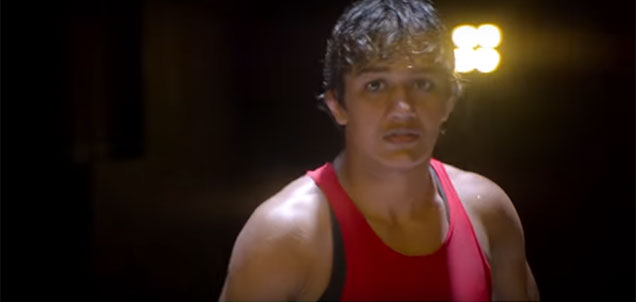
    The Cinthol ad follows Indian sportswomen who have braved odds and ridicule to simply follow their hearts and make a new destiny. The ad captures the new narrative about women (also portrayed very successfully in Dangal) who are no longer seeking empowerment. Empowerment implies someone else giving them power. Today – they are powered. Self-powered. The horrific video of a vile act on New Year’s eve in Bengaluru came to light only because the brave woman made it a point to seek out the CC TV footage and got the culprits nabbed.

    While the rest of the country is debating about the right and wrong of things, the inclusion and exclusion of women; women have wrested power beyond this dialogue to simply go ahead and do!

    Popular culture is capturing this sentiment – with movies like NH 10 or Pink, or a host of advertising that has such powered women. Even Piku has a single, attractive, career- and duty-driven woman as a protagonist. Gone are the days when single women were the maiden aunts – slightly desperate and worthy of ridicule – such as one in DDLJ.  Also, gone are the days when the strong shrew was simply asking to be tamed. Or she had an emasculated husband. NH 10 was remarkable that the female protagonist who leaves her husband’s party to go back to work for an upcoming product launch also has a husband capable of physical bravado.

    Whether it is brides-to-be calling on their greedy demanding in-laws to the wedding mandap, employees reporting their supervisors/ colleagues for sexual harassment, victims reporting rape and demanding justice or rebelling against parents and khaps to be with the men they love – women all across are saying:Enough! We will not be silent any more.

    What is equally heartening is that husbands, friends, brothers and fathers are supporting them in their stance, accompanying them to police stations and lauding their efforts. The transition from ‘shame’ to ‘anger’ seems well on its way and augurs well for the country.

    Utterly bewildering is the utter lack of support and a studied silence or downright stupidity from leaders in society. Politicians, godmen, film stars all largely seem resolutely quiet and unwilling to speak up at moments of national shame. If they do speak – it is to put their foot in the mouth and exhibit their regressive beliefs. The loss is theirs – as they are missing the opportunity of riding on a rising popular sentiment.

    Young women are also claiming power by having fun. By owning their place in the world,  by going out with friends, perhaps drinking, having a boyfriend, wearing clothes they would like.  Liberation is not as it used to be – a defiant stake in the ground. Today it is multicoloured, vibrant and euphoric. The age, which was weighed down with the old trappings of a hard-fought vehement struggle, is gone now. The dialogue of women seeking power is not a serious and deliberated action, it is simply a way of living. Coming back home alone after a party, in the wee hours, reveling with friends, living alone, the new normal is the unselfconscious woman who does not think twice about her choices. Having fun is her right. The oppressors can fight violence or aggression, but they suddenly lose imagination, and are weaponless before the mass appeal and nuanced logic of memes and social media movements such as the Pink Chaddi campaign.

    Young women across the board are powerful today. They live it, socially and financially. And nothing is going to keep them down.


  • Ranjona Banerji: Owners and managements to blame if & when newspapers die

    By Ranjona Banerji


    The past few weeks have been consumed by a family tragedy and no time to spend on news, news flow and traditional forms of the news media. Whatever news I have received is through the most traditional form of information-sharing — word of mouth. And most of that has come via other people’s mobile phones.


    I have not been able to delve into the nitty-gritty of news, I haven’t seen Barack Obama’s tearful farewell from the US presidency and I have not paid attention to Donald Trump’s ascension. And the effects of the Government of India’s various demonic demonetisation schemes I have felt deeply on a personal level as my mother battled an illness which ultimately killed her.


    Reading MXM editor-in-chief Pradyuman Maheshwari’s comments on the Indian newspaper industry’s bleating excuses laid bare in a Times of India editorial, one cannot but agree. The possible demise of the Indian newspaper industry may be imminent but the fault will lie with the newspaper owners and managements themselves. Demonetisation has after all set the Indian economy itself back, not just the newspaper industry. The lesson here is for newspaper managements to be careful about sucking up to governments in the future. The rank and abysmal prostration that we saw after the Modi government came to power has come back to bite everyone where it hurts.


    Meanwhile, the younger generation has moved on to other sources of news, all digital. This news may be immediate and current, but it is also carefully curated and aggregated, based on the lowest common denominator. Algorithms check your internet activity and then decide which news items best suit your interests.


    Wonderful as this sounds, it also makes you ignorant of other matters and instead of broadening your world as a newspaper in the traditional format might, it narrows you down to your immediate interests as reflected by your internet activity. Google is a wonderful browser and system but ultimately you are ruled by sets of numbers which read your emails and log your searches.


    “Because you have shown interest in the BJP,” many Google news items on my phone tell me. Google also gets it wrong. It sometimes says, “Because you have shown interest in Novak Djokovic,” which almost never happens because my interest is in tennis and Roger Federer. Ah well, I always knew that the worship of numbers alone would limit the human experience.


    I myself have no doubt however that the future of a newspaper printed on paper is limited and on its way out. I also agree that there is no such thing as a “print” journalist any more. There are journalists who write, journalists who speak and a small section who do both. The phrase used in the Times of India is “platform agnostic” which is ugly in the extreme but one can understand what they are trying to say.


    Meanwhile, one notices that newspaper owners are still upset that drivers and peons hired by them get fair wages. The Times of India especially has this problem since its senior management has long complained about it on its edit pages. Someone needs to tell them how much Uber drivers earn compared to drivers who work for companies or private citizens. The wage board as Pradyuman Maheshwari has pointed out is the creation of unfair newspaper managements and having let the government in themselves, who can ever get it out?


    The bigger challenge for journalists however is to deal with narrowly curated news, internet companies deciding on the importance of news events, the spread of fake news and the various schisms of the “post-truth” world. These problems are already upon us. Journalism itself can either be a broad spectrum of news from local council issues to space travel or it can be a narrow combination of celebrity events with some melodramatic political behaviour thrown in. The challenge also applies in a different way to television journalism which has also become predictable and set in its ways.


    If the internet is the answer, it is also the problem. Whining and sacking employees is the accountant’s view of life. In the long run, we need inspired thought.  Instead we are stuck in fear and moaning.


  • Ranjona Banerji: In the US, the press is calling Trump’s bluff. In India?

    By Ranjona Banerji


    It took one day of Donald Trump’s presidency for him and the American press to get involved in a stand-off. The writing was on the wall throughout Trump’s campaign. But to declare a “running war” with the media is extreme, even if not unexpected.


    Echoing his boss, Trump’s press secretary Sean Spicer summoned the Washington press corps to the White House and launched into a diatribe against the media. The media has not taken it kindly and has slammed Spicer for his attitude as well as for his lies.


    The lies themselves are also about what is the great gamechanger in a post-truth world – fantasy over reality and the trivial over the important. Trump is upset because he didn’t get the biggest crowds ever at his inauguration or, in his world, the fact that the press reported that he got less crowds than Barack Obama’s first inauguration. Spicer claimed that Trump got the biggest crowd ever, a claim that is easily disproved and that journalists have called a lie, a falsehood and other synonyms.


    Trump’s own advisers have a better name for their version of the world: alternative facts. That is a truly admirable phrase in its idiotic gumption and is certainly a forerunner of what is to come in abundance with from this White House.


    The American press is not having any of it. They will not boycott the White House press briefings. But they will pay greater attention to what the White House and Trump’s aides say. They will set up investigative teams to examine all claims made by the government. They will explain to their readers, viewers and listeners the difference between facts and lies masquerading as “alternative facts”. They will do their jobs as journalists, even if it upsets the powers that be.


    But have you missed any of the irony? Have you noticed how the American press are responding to a newly elected president? Have you paid attention to the fact that they are calling Trump and his team out for lies that they have told? Do I need to point out that Donald Trump won an election and became President of the United States?


    And now try and think back for a moment on how the Indian media responded to Narendra Modi becoming Prime Minister of India. Inspite of limited or no access, inspite of government departments being barred from open communication with the press, inspite of no press conferences from the Prime Minister, the Indian media, especially television news, remains supplicant and blind to the government’s faults. In many cases, some news anchors have confused themselves with government PR persons and spokespersons.


    Despite the lies told by this government, the overblown claims made on anything from money made from surrender of LPG subsidies to terrorist attacks on military bases, to GDP growth to old government schemes masquerading as new, much of the media has remained in cheerleader mode since 2014. Some from even earlier.


    The terrible impact of demonetisation has still not been fully and properly covered and analysed by some of the media. Notice how many news channels switched to the Jallikatu protests in Tamil Nadu as soon as the prime minister claimed that demonetisation had gone very well and everyone was happy on December 30, 2016.


    The tragedy is that this capitulation of Indian journalism to a political force is not seen for the dereliction of principles that it is by much of the news media. Many of today’s journalists believe that their personal ambitions far outweigh any professional ethics. Hence, they are happy to take selfies with the prime minister instead of asking him questions about his claims and policies.


    It has taken one speech and one lie about the size of a crowd to alter and anger the American press. What a harsh picture that paints of those of us who make a living justifying a government’s actions and behaviour.


  • Sanjeev Kotnala: How Coke InNoWait’s and Amplifies

    By Sanjeev Kotnala


    The world is fragmented more in its media space than in its like and dislikes. The consumer touchpoints have been multiplying exponentially. The attention span is decreasing at an alarming rate. However, the global village allows you to pace your activity. A delta movement (not momentum) can be amplified across the globe to the brand’s advantage. Scaling-up is not really a necessity and the business viability not a deterrent. The brand is more at ease with experimentation than ever before.

    Innovation opportunities not only exist in the manufacturing and delivery space but also in the experience, excitement and influencing.

    Beverage giant Coca-Cola has been one such company that has been playing with a range innovation from small to large canvas. It is evident in the way they are interacting with the consumers, the design and communication. The basic module of Accessibility, Availability and Affordability is now expanded to Experience, Innovation and amplification.

    At first, the timeless contoured bottle created in 1915, seems more of a barrier than an opportunity to innovate. However, when innovation becomes a habit and a culture or business philosophy, then the brand starts seeing opportunities everywhere. It is the ‘InNoWait’ zone.

    The brand has been doing great exciting work. There has been numerous innovative outreach programmes, simple modifications, a different perspective in and around delivery and consumption process. In process, every unit has been broken to its last possible managing unit and then explored for opening happiness in its holistic understanding.

    Coke has been one company that seems to believe in ‘InNoWait’. That is no waiting for innovation. They have used  team work and challenging deadline projects to  forces innovative solutions. The best part is that such solutions  have neither remained on paper, nor have they found their way to the dustbin. The brand seems to be a compulsive experimenter, a necessity for following ‘InNoWait’ as a philosophy.

    The trick is to ‘Do it because you want to, not because you think you must. And most important, do it right and go crazy. You will do such experiments, when you truly believe that the world today is a chaotic always in flux place. Here the past success is no guarantee for future success’. (Coco-Cola Company)

    The consumer is more demanding and there is a more intangible than tangible association that make the brand gain the growth momentum.


    The Innovation thought is not only about thinking differently.

    It is also about being able to see the idea in its full-grown version and then supporting it with detailed defined execution.

    And the journey really starts by defining what you stand for and how o you see the brand-consumer relationship.

    Here are some of the NOT-SO-ADVERTISING innovations by Coke that speak about its intent. They reiterate the need to be innovative as a philosophy, ‘InNoWait’- not waiting, taking the idea, experimenting and scaling or amplifying in the global arena.


    TWIST CAP To open this cap, you must find another bottle. The specially designed cap does not open, unless it is rightly paired with another identical cap. So, to open your bottle and take that deserving sip, you must interact with other coke drinkers. The experience is shared on social media. Now this twist could have happened with any bottle with a screwed cap. A brilliant example of experiential consumer marketing that most likely would have been laughed at and shot down in many brand ideation sessions.


    2ND LIVES CAPS. Everyone laughs at this somewhat silly solution toward reducing the environmental challenge. However, Coke took this consumer inclusive idea forward. It asked the consumer to lend a helping hand in delaying the bottle journey to the landfill. Give the bottle a new 2nd life.

    In Vietnam, 40,000 caps were distributed free. These 16 special red screw-on-caps gave the used bottle a fresh utility. They converted it into the spray-bottle, Baby-rattle, dumbbell squirt gun, lamp, paintbrush, sharpener, etc. The campaign was rightly titled “What if empty Coke bottles were never thrown away?”


    PLANT BOTTLE. In 2009, Coke introduced the Plant Bottle. 100% recycleable. And it aims that by 2020 it will start making all its pet bottles with plant derivatives; simple crazy innovative thinking. It is touted to be the first-ever fully recyclable PET plastic beverage bottle made partially from plants, but has a lighter footprint on the planet and its limited dwindling resources. Being committed to the thought, coke has been sharing the technology with non-competing companies and products.


    PUSH THE THOUGHT. The 100th anniversary of the famed bottle was celebrated in 2015. Every brand looks forward to maximising such opportunities. Coke went a step further. The Coca-Cola Bottle: An American Icon at 100, an exhibit at the High Museum in Atlanta is an example of such leveraging.


    IDEA EXPANSION. Coke seems to be entirely a source neutral company for ideation, as far as time, process and ownership are concerned. As the story goes, Cannes Lion ad from Germany took birth as an idea with the Tom Farrell, global design director brushing his teeth and using his finger to trace on his bathroom mirror.

    It may be post-rationalisation, but as per Coke: “The connecting of hands from different people various socio-economic levels, races, religions and nationalities is a reflection inclusion and optimism, core brand values – all connected by Coca-Cola”. The simple, authentic and a somewhat unique idea grabbed attention is referred as the film titled “TOGETHER”


    JOURNEYXJOURNEY, OPPORTUNITY WITH CONSUMERS. Coke mobile publishing storytelling mission ‘JourneyXJourney’ is a three-week 20-plus stop 40-ft motor home with capabilities to create, and curate consumer generated content that should lead to high reader engagement.

    Since 2012 it has become a global platform social media channels with more than 3 million followers combined. The Coca-Cola Journey is one of the initial innovators in the area of brand content publishing and amplification.
    Doug Busk, global group director, social media and digital communications at coke reflect; JXJ allows us to get into the real world where the best stories – and the people and communities behind them – live. The stories aren’t coming to us… we’re going to the stories.


    ASAP: ‘Affordable Small Sparkling Package’, the 250 ml bottle addressing the issue of affordability and availability is driving growth in India. This bottle was designed with an aim to minimise gas loss. It took two years to develop. It not only maintains the original pleasing look but ensures that it remains fresh and the ‘biting taste’ is not lost due to loss of carbonation during transit.


    SHARE A COKE. In the United States, when the campaign broke with Coca-Cola, Diet Coke or Coke Zero carrying names, people rushed to find their names. Off course, all names could not be accommodated. Many fans were dejected. However, in its next edition, more names were featured. A site allowed you to search if your name was on a coke bottle. Additionally, you could customise and order with your name from the e-commerce site. To top it all, ‘Share a Coke’ went across the nation on a 600 stop tour allowing customisation of mini cans. Taking it further, the new edition also had more generic names and occasions specific association like “Mom”, “Dad”, “Grad”, “Soulmate” “Hero” “Class of 2015,” “Team” and “Family”.


    NO LABEL: On the one hand, you have customisation of the labels, and on the other hand, no label. In Middle East, Coke promoting is promoting the anti-prejudice, pro-tolerance message: “Labels are for cans, not people” during the holy month of Ramadan. Here, the limited-edition red cans had the white dynamic ribbon, but no logo. The brand believes that by urging everyone to remove stereotypes, happiness will be spread to a larger and wider community.


    NO TWO SAME CANS. No two packs are exactly the same: just like those who enjoy Diet Coke. Working with HP Indigo digital printing technology and 36 base designs, coke experimented in Canada with Millions of unique and colorful Diet Coke package designs. It gives the consumer a choice and an opportunity to find the one Diet Coke bottle that truly reflects him/her ‘One of a Kind’.


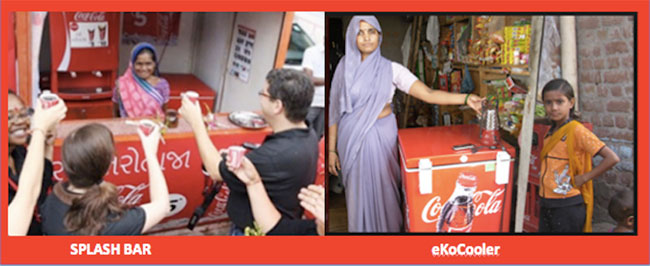
    SOLAR COOLER. Coca-Cola India developed “eKOCool” cooler, specifically for retailers in rural areas lacking regular electricity. The rooftop solar panels are linked to the chest-style coolers inside the shop, and as the sun goes up, the bottles start chilling. In addition, the “eKOCool” coolers are equipped with charging points fir lanterns and mobile phones, thus increasing traffic and allowing the shop to remain open after dark.


    SPLASH BAR. It is the new hotspot in some Indian villages. Here, from a simple kiosk vendor dispenses ice cold Coca-Cola into small cups at an affordable price. The women in the rural area get employment opportunity, and the brand expands soft drink culture to untouched markets giving an affordable authentic experience. From a 31 Splash Bars start in 2013, now there are more than 30,000 such units. Additionally, it opens new avenues for future choices for the women. The earning can help feed family and provide education.


    CHRISTMAS WRAPPING PAPER. So getting involved with the consumer. This time no catbonated drinks, But the paper to wrap the presents in. Not the best of innovation but yes true to its thought of open happiness.


    CALL HOME. Experiment at Middle East: spreading that happiness, where the workers could use the coke caps as token for calling home! What those smile are worth. And how simple and relevant  the innovation is.


    MUSIC FOR DEAF. This time the innovation was implemented in Pakistan after it was successfully tested at Bangkok. Coke studio helps hearing-impaired people to enjoy coke studio experience from a sofa embedded with tiny vibration engines and mood synchronised LED lights elevating the experience visibly. And the front screen displays the video. The ambience is completed with on-set guitars, keyboards and other musical instruments. Here is a connect by a deaf person who experienced it. “Whatever my body felt, whatever my brain thought, even though we can’t hear the music, we can feel it,”


    Innovation is breaking down the elements. Rearranging. Reconfiguring and seeing things a bit differently.

    Reiterating the thought that triggered it. InNoWait. ‘Do it because you want to, not because you think you must. And most important, do it right and go crazy. You will do such experiments, when you truly believe that the world today is a chaotic always in flux place. Here the past success is no guarantee for future success’.

    Details and pictures from the Coca-Cola Company website


    Sanjeev Kotnala with 28 years of corporate experience is the founder of Intradia World; a Brand, Marketing & Management Advisory. His focus area includes Ideation and Innovation; he also conducts specialised workshops like IDEAHarvest, Liberate and InNoWait. For soft skill training, he follows SHIFT (Specific High-Intensity Frequent training), a process of continuous training with frequent shorter sessions. Email sanjeev@intradia.in tweet @s_kotnala web: www.intradia.in www.sanjeevkotnala.com.


  • Ranjona Banerji: Will Arnab Goswami’s ‘Republic’ really be “independent”?

    By Ranjona Banerji


    So BarkhaDutt finally says goodbye to NDTV and where is ArnabGoswami’s Republic of I am the Nation?

    The NDTV website has posted a very generous goodbye to a journalist who has been with them from the beginning and in several ways defined and set the standard for television journalism in India. It is not necessary to always agree with Dutt’s style or choices to appreciate and acknowledge her impact on Indian journalism, especially television.

    Dutt apparently has many plans and we shall see how that develops.

    http://www.ndtv.com/communication/ndtv-statement-on-barkha-dutt-1649025

    And so we reach the champion of “independent media”, free of all corporate control, creating a “global” media platform, breaking the terrible hegemony of the BBC and CNN.

    Grand as all this sounds, the truth is that Goswami’s new venture is partly funded by Rajeev Chandrashekhar, who has been a BJP-supported Rajya Sabha Member of Parliament and by TV Mohandas Pai, ex-Infosys and current NarendraModi cheerleader on national TV. Therefore, the term “independent media” is to be taken with a several barrels of salt. Goswami’s diatribes when he was with Times Now often focused on evil liberals who were pro-Pakistan – often his main target was BarkhaDutt – and he also disliked Delhi-based journalists and various other categories who were not him.

    One cannot point fingers here since I also have my prejudices – but these are mainly against TV anchors who sing to His Master’s Voice regardless of the evidence and all journalistic ethics, and that includes Goswami and sometimes Dutt.

    However, to pretend to be “independent” when you are in fact fooling nobody may well be foolish in the long run. I emphasise long run because as we can see happening everywhere, the short-term at the moment is rife with incompetents masquerading as messiahs, whether in the media or in public life.

    This insistence on a new “independent” media also suggests that all was not well at all in Goswami’s last days at Times Now. This is in spite of the Times of India’s remarkable “we are a federal structure” defence (last February), of Goswami’s constant rants and tirades which directly contradicted the stand taken by the group’s newspapers.

    Goswami’s venture is to be called “Republic” and here he has found an unlikely opponent – the BJP’s SubramaniamSwamy, one of India’s most litigious politicians. Swamy has written to the Information and Broadcasting Ministry pointing out that the Emblems and Names (Prevention of Improper Use) Act 1950 disallows the use of the word “Republic” for anything professional and commercial. He has threatened legal action if nothing is done about it.

    As of now, according to a Business Standard article, the details of when and how this “independent” media platform will be operational are vague.

    http://www.business-standard.com/article/current-affairs/arnab-s-republic-hints-at-mainstreaming-right-wing-opinion-as-a-business-117012600235_1.html

    For Goswami’s many fans, one can only hope that this will not take too long, since both momentum and public memory are tricky things.


    **


    Meanwhile, it is heartening to see NDTV and NidhiRazdan taking up the cause of social activists and journalists who are being hounded in Chhatisgarh by the police and the government. It was not heartening to see India Today TV anchors almost wishing for a terrorist attack on Republic Day. It was heartening to hear the usual anodyne, cliché-filled commentary on Republic Day. It was not heartening to hear political parties using the media to try and elliptically defend the sexist comments made by Sharad Yadav and Vinay Katiyar.


    **


    And most of all, it is not heartening to see that television news has practically forgotten that demonetisation is still creating havoc in people’s lives. It is heartening to see that the print and web media are still working on this.

  • An ‘Uncommon’ Bigg Boss Season


    By Shailesh Kapoor


    For a decade, now, Bigg Boss has been the standout reality show in the Indian TV space, especially for its differentiation. Almost every other non-fiction show we have seen in India is about “talent” of some kind or the other, dominated by singing, dancing and comedy. Also, all such shows are aired on the weekend. Bigg Boss, when on air (about 15-16 weeks every year), has at least seven hours of original content every week, twice more than any other non-fiction show and more than any fiction show too.


    The Bigg Boss brand has huge traction in the online community and among the advertisers. It provides for product placements and integrations in a way that’s natural to the format. It also has immense talk value, fueling organic press coverage around it.


    Yet, the ratings have not been easy to come by. Colors, who have aired nine of the 10 seasons, have tried every possible slot. But there’s an evident upper limit to how much a show that is essentially metro-skewed and not exactly family-inclusive can deliver. The format has seen its own share of innovations over the years in the attempt to boost the ratings. While some of these have helped, the larger picture is that Bigg Boss has acquired the status of a “cult niche show” over time, with a relatively small but diehard fan base.


    This season, which culminates on Sunday, January 29, saw a bold attempt by the channel and the producers (Endemol Shine) to disrupt the format more significantly than ever before. The season featured commoners (called ‘Indiawaale’) along with celebrities. This well-thought decision (call-for-entries promos broke a year ago at the end of Season 9) was a brave gamble to play. If they lost even a part of a niche loyal audience base, it would have meant an abrupt spiral downwards.


    But that didn’t happen. The season started weak, and hovered around the rating levels of Season 9, which itself was not a high scorer, in the same 10.30pm slot, which faces a challenge given the abrupt drop in TV viewership in India 11pm onwards.


    But somewhere in the middle of this season, the numbers began to look up. The one week when host Salman Khan said he will not blame the audiences if they changed the channel during the show, because the way a particular housemate (one Priyanka Jagga) was conducting herself was repulsive, was ironically the start of the minor but significant upswing. Over the last month, the show has settled at a rating level that’s about 20% higher than Season 9.


    The presence of commoners did not provide the pull factor initially. But as the season progressed, some of them emerged stronger and more watchable than the celebrities in the house. The raw passion to give it their all seemed to be the point of difference. Over the last three-four seasons, celebrities in the show have played the guessing game, trying to out-think the producers on their next move. There has been too much “this will show on the cameras” talk, which can confuse, even disillusion, viewers.


    But most commoners did not bring any of that baggage, of maintain or nurturing an image, with them. Over the first six weeks of the show, Bani Judge (popular as VJ Bani) was the most popular housemate on the show on Ormax Characters India Loves. In the second half of the show, Manu Punjabi took that position from her briefly, before it passed on to another commoner, ManveerGurjar.


    This shift in popularity balance coincided with the increase in ratings. There is high chance that Gurjar could win this season, though Bani and he are close contenders for the title. But irrespective of whether he wins or finishes second best, he, along with Punjabi, have set the template for the show for the coming years. They have given the makers the confidence that it can be a show driven by the commoners. Some celebrities may be needed, at least for the next few years, but over time, it can even be a commoners-only show.


    This helps the production cost significantly. It also makes running the show easier, with celebrities, some of them merely so, bringing their own share of problems with them. And if these benefits come with additional ratings, it’s a masterstroke.


    Will Season 11 push the envelope even further? We will know in due course of time.