Category: COLUMNS

  • Ranjona Banerji: Kanhaiya Kumar proved in TV interviews the high worth of a PhD from JNU!

    By Ranjona Banerji


    Watching interviews of Kanhaiya Kumar on TV, JNU student and president of the Students’ Union, you understand why he is popular in his little world. What you cannot understand is the frankly shoddy quality of the interviewers on TV. Either they treated Kanhaiya like he was the next messiah with all the answers in the world or they tried to bamboozle and trip him up.


    In both cases, the young Kanhaiya got the better of seasoned TV journalists. He kept calm, sounded reasonable and put forward his views without decibel fluctuation and with a smile on his face. To put it simply, he played them. A good interview has to be carefully crafted and organised. You have to create a format and a flow. It can be linear or circular. If you are very good at your craft, it can even be progressive where one answer leads to the next question. But when an interview is false, stilted and staccato, it loses its essence.


    I understand that it is more difficult to do interviews as a TV journalist than as a print journalist. On TV, you are as much on air as the interviewee and although this makes you a star it also exposes your shortcomings. Your brilliance and your stupidity are both on display. In print, you are behind the camera, you are the questions in bold and you have time and you have editing skills at your disposal.


    From what I have understood of TV journalism in India, editing skills are only used when you want to doctor videos to trap Kanhaiya! Okay, was that below the belt? If I have to be kinder, why not use those editing skills a bit more?


    What happened with the Kanhaiya TV interviews is that the agendas and egos of the interviewers showed through. And also, at the risk of being lynched, perhaps there is some advantage to getting a PhD from JNU after all?!


    **


    Although prime time TV debates in India are usually abysmally painful on the eardrums and therefore unwatchable, watching all the outrage over industrialist Vijay Mallya was quite amusing. Every news channel played over and over images of Mallya at a party with a glass of something in his hand, Mallya surrounded by models and film stars and famous people, Mallya busy having a social life.


    While our TV anchors were very angry with Mallya for not paying former Kingfisher employees and for having so much fun on money he had taken by public sector banks, industrialists and businesspeople were quite sympathetic about Mallya’s predicament. For one, possibly none of them ever had so much fun on borrowed money and two, maybe they were thinking, “There, but for the grace of god, go I”.


    Although TV anchors and commentators were worried about the terrible state of Kingfisher employees, industrialists we could see were not quite that sympathetic. Everyone agreed though that Mallya should not have lived such a lifestyle on public sector bank money. Maybe they were all hiding their Kingfisher swimsuit calendars for all I know.


    The trigger was the debt tribunal refusing to let Mallya access his bye-bye deal from Diageo. The problem however is much older than that. Hopefully we have not heard the last of this.


    Also on some channels was the controversy over HRD minister Smriti Irani. Don’t groan, this is not my fault. Her cavalcade got involved in an accident. Or maybe it didn’t. Or maybe it did. Someone died. Irani claimed on Twitter that she had helped and organised help. The victim’s family said she didn’t. Twitter said Times Now blanked out the story. Is that true


    Other channels were preoccupied with saving the Yamuna from a massive Art of Living Sri Sri Ravi Shankar event. I have a simple point to make here. Whatever damage was being done to the Yamuna was happening over months. It would have been better journalism if the Delhi-based media had focused on this programme a little earlier.
     

  • Sanjeev Kotnala: The heady mix of Political Campaigns & Marketing

    By Sanjeev Kotnala


    It has been some time since advertising and marketing lingo has entrenched itself in political battles. They are used and abused in election discussion and debates. Politicians are now fairly comfortable with terms like brand, positioning, public relations etc. Has the reverse been happening?


    Not an original thought. It was planted by one of my client reacting to a news item last month. It said ‘Punjab Congress ropes in Nitish’s poll strategist for assembly election’.  It gave rise to a simple question. Should a poll strategist not be the marketing guy?


    My answer was as simple. It works both ways. Every poll strategist is a marketing guy and every marketing guy is a poll strategist. Then something clicked. A question: how will my aproach be affected if I treat brand marketing as an election in the marketplace.


    Marketing is all about brand politics (if I may borrow the term) within a consitituency of possible users. This constituency is cut many ways just like voter banks. Geograhically, demographically, pyschographically or any other way.  Potential users are equivalent to the Target Audience who are in the market to vote (buy) a particular brand. There are your loyal voters as well as non-voters and all you are looking is for to engineer the swing that will make you the leader.


    But there are three simple differences. The voter is busy voting in multiple elections at the same time. And a result any one of them may affect outcome of your election. The trip to grandparents or even a marriage plans can upset or delay buying of a two-wheeler.


    In fact each of the category has a set of candidates shouting for voters’ empathy. Each one of them tries to impress the potential voter (user) how they are best for his future. But in this on going election – it is the voter who decides when to cast the vote. Many times these voting sequences are a result of (winning  brand) candidate performance (usage) and life cycle.


    The election is a continuous one. Results at one stage are not a guarantee for any future position. The election subject and terms are affected by multiple external factors.


    Once we start cosnidering brand and consumer relationship as an election, we find a shift in our approach. In the market, all elections are running at the same time. The media and voter (consumer) mind is cluttered. Consumer can at any stage vote (spending power- need hierarchy) in limited number of votes. So, I as a candidate (brand ) use all the overlapping media with other elections and  candidates need to impress the voter. Impress in every cycle. And for that, my company (party  manifesto), brand (promise) and delivery ( experience) must be in sync.


    With the new media, perception has surely become the new reality. The like-dislike as well as rumours and virals are the new found focus. Is there a learning from political parties and their processes?


    The symbol and symbolism have a new found value in this highly cluttered environment. That is something political parties understand hence the three weapon of Party Manifesto, Party Symbol and the Face-of-the-Party  stares at you from every concieveable medium. The candidate meets you in every possible platform you may be interacting in.


    There are coalitions and seat sharing, just like non-competing brands shouting under bundled offerrings from hypermarket shelfs.


    A political candidate does the mistake of disappearing from consituencies post-election and resurface later. Something that the brands in real market can ill-afford to do. Hence, where in politics there is always an incumbency factor and pressure,  the real market seems to demonstrate incumbency pressure only when there is a new technology, promise , benefit or need emerging with the changes.


    In a commoditised market, voters sleepwalk through the election and is not affected by the possible candidate seeking attention.


    A brand that has suddenly taken the FMCG sector with storn is Patanjali. It seems to be the brand that has drawn from election campaigning and election marketing. The party name in this case  Patanjali and the face-of-the-party Baba Ramdev is all you get to see.


    Even on TV you see more of static uninturrupting reminder L-shaped ads or aston bands than real commercials. There is some programme sponsorship – but where ever you go Baba and Patanjali overpower the message.


    It will be wrong to over-simplyfy. They are not overpowering… they are the message. They are the promise. They are the seal and mascot. They are the goodwill of the company and a promise of delivery. Seeing them you do not have to rearticulate the benefits and promise- it is understood yoga, natural , affordable and healthy. And somewhere it reads in the subconcious mind. No after effects.If it is BABA- everything will be GOOD.  This simplifies life of the consumer. Baba has taken the decisions for him. Life nw is about ‘so many less decisions to make’.


    This happens when you buy into a political party’s idealogy. Then the candidate does not matter. The election does not matter. It is so simple- vote for the party. Patanjali is no different. It does not matter if it is Atta, Hney or detergent. It is Baba and patangali,


    The chain of shops across the country and tie-up with the retail chainis closing the loop of Familiarity and 3 A’s- Accessability, Availability and Affordability.


    The simple non-stylish ( may give headache to some design firms) packaging is like Khadi of politician. Seen as a signal of the brand ethos of cost saving and not investing into more-tha-desired styling.


    This is at is helping Patanjali win the battles. It has been following the political focussed approach of Single-face –single-promise. Leaving no space for any doubt or rethink.


    Do you think your voter segment and you are  absolutly clear ( not confused) about expectations and deliveries. Look at the trends ad changing expectation to catch and understad the SWING and the reason well in advance. Or a new category, process or service ( startsups) are going to make you redundant.


    It maybe a good idea to relook at the brand as if it was  fighting an election in the market pace. Deep dive and see if you have a relevant party / candidate manifesto that is current and relevant.


    ………………………………………………………..


    Sanjeev Kotnala with 28 years of corporate experience is the Founder of Intradia World. A Brand, Marketing & Management Advisor, he focuses on IDEATION (Harvest and Liberate) and INNOVATION (InNoWait) process and workshops. He is also a certified Life & ‘Mid life transition’ coach.Email sanjeev@intradia.in tweet @s_kotnala web: www.intradia.inwww.sanjeevkotnala.com.

    …………………………………………………………..


  • Shailesh Kapoor: Time For Cricket To Take Over… By Default

    By Shailesh Kapoor


    On all counts, 2016 has been a predictable year for Indian television so far. News coverage remained as shrill as ever, half a dozen channels claimed they were the most-watched on the Union Budget day, GECs continued to respect the idea of status quo and the awards season played out its annual routine.


    The only odd element disrupting this feeling of déjà vu has been T20 Cricket. India’s performance this year has been consistently strong, winning 10 of the 11 games played since the start of the year. India enters the T20 World Cup on home soil as firm favorites (not always a good thing).


    Within a week of the World Cup final on April 3, the IPL will kick-off. We are, by now, used to a long, never-ending season that becomes a part of the background noise for some, snack-in television for many others, and addicted viewing for a handful few. This year will be no different. IPL ends on May 29. By the time that happens, we will be five months down in 2016.


    Ratings from the India games in the Asia Cup have been very encouraging, setting new records in the short BARC India history. India’s strong performance and TV-friendly match schedules help. But cricket ratings have been, and will be, equally helped by lack of action and excitement in the rest of the television space.


    With the exception of Naagin, no Hindi programme launched since January 2015 has been a runaway success. There have been a few flash-in-the-pan performances, but nothing has sustained beyond 3-4 months. In such a scenario, viewers are left looking for ‘television events’, such as a big awards show, a big movie premiere or an India cricket match of some importance. This lack of excitement in mainstream television is also bound to help this year’s IPL, especially if it comes on the back of an India win in the T20 World Cup.


    Even as cricket prospers, news coverage of cricket suffers from the same shrillness and status quo as the rest of the news genre. Witty and entertaining cricket programming would be much in demand, but instead, all we get are talking heads, mostly cricketers from the days when cricketers were not paid enough to not need a day job, debating it out before and after every game.


    One’s earliest, and strongest, memories of television are from one’s teen days. I sometimes wonder what television memories those born in India in the new millennium will grow up with. And if they shun television for online content as they grow up, technology alone won’t explain why they did so.


    But that’s a thing of the future. For now, let the cricket take over from the sameness of things. For the next three weeks at least.


  • Ranjona Banerji: Vijay Mallya UnLtd.​

    By ​Ranjona Banerji​


    I start with an apology to The Times of India. I had put out a tweet a couple of days ago saying that the Doon edition of the newspaper had not carried any news on the current imbroglio over the Art of Living’s event on the banks of the Yamuna river in Delhi. The Art of Living has an old and long relationship with Bennett Coleman which does sometimes affect news choices. However, the paper has in fact given the subject front and inside page coverage since so perhaps the lack of may have been an oversight and not deliberate.


    News channels meanwhile gathered all their self-righteous zeal to the menu du jour. There was Sri Sri Ravi Shankar and the destruction of the Yamuna on one side and the “King of Good Times” Vijay Mallya’s exodus to the UK even as he owes banks over Rs 7000 crore on the other. What joy!


    Karan Thapar on India Today TV was very watchable, especially as he now loudly instructs the producer to lower the volume when someone misbehaves by screaming and trying to hijack the debate. This is the absolute best schoolmaster behaviour I have seen and quite frankly, TV guests usually deserve this sort of humiliation. A couple of weeks ago, the BJP’s Nalin Kohli apparently left because he was so offended but the Congress’s Sharmishtha Mukherjee did not bold when it was done to her during the Art of Living discussion.


    The BJP’s GVL Narasimha Rao was most amusing when he accused everyone opposing the Art of Living cultural event on environmental grounds of being anti Hindu, anti-national and even further, all objections being a giant plot by Congress president Sonia Gandhi to defame India’s image abroad. Thapar was so amazed and amused that he did not bother to turn down the volume. The guests, including evil environmentalists and Mukherjee also looked amused. A good journalist perhaps knows when to use the mute button and when to let someone’s grandstanding expose their quirks and beliefs. Bizarre was the word Thapar used and one cannot disagree.


    Then there’s the Mallya case. What outrage! How dare he leave! How dare he lead a lavish lifestyle! How dare he endlessly. In fact, Mallya is not the first businessperson to behave like this and he will not be the last. The same questions about how banks treat the poor and middle class compared to how they treat the rich and influential have been asked before.


    ​​TV journalists though need to do a little more bread-and-butter investigative journalism without any help to match their hysteria and they also need to read up a little history.


    For my money, the best investigation into stock market manipulation and bank and financial institution fraud was done by journalists like Sucheta Dalal and Debashis Basu into the Harshad Mehta scam of the 1990s. Neither TV nor the internet had been invented in those days. Okay, I’m kidding. But TV was mainly Doordarshan, so… Business journalists since then, sadly, have largely become press release rewriters.


    **


    The most idiotic thing for TV debates and TV anchors to do however is to allow the Mallya issue to become into a BJP versus Congress fight. Because once we get into that trap, nothing is achieved. Though of course, sometimes that is the point.


    **


    Meanwhile, to provide comic relief, a reporter for an Indian news channel stood outside Mallya’s bolthole in Tewin, Hertfordshire, United Kingdom and told us that Mallya is also famous in Tewin for his lavish lifestyle. Not only do people ride around in Lamborghinis – lavish, I grant you – but they also go to pubs! Can you imagine? Pubs? Shocking!


  • Ranjona Banerji: 25 years of BBC World Service

    By Ranjona Banerji


    In the mid-1980s, my parents lived in the factory town of Atul, near Valsad in southern Gujarat. Since Doordarshan’s reach was not “door” enough to give us “darshan”, the factory town installed a giant satellite dish. On this, we watched, yes, Doordarshan, CNN and a special broadcast for the United States Armed Forces in the Philippines.


    It wasn’t till January 1991 and the first Gulf War however that CNN became a household name in India and much of the world since it was the only 24-hour news channel. Many children dreamed of becoming journalists like Christiane Amanpour and reporting on wars from rooftops. Those of us who had access to satellite TV – soon run through the cable TV system in cities – became very familiar with scud missiles and Benjamin Netanyahu as he acted as Amanpour’s guide on various rooftops.


    Hard to imagine but newsrooms did not have televisions in those days. The editor of the magazine that I worked for at the time hired a room at a nearby hotel so that we could watch CNN and try to understand how TV journalism worked. As regular readers of this column will know, I still haven’t quite understood.


    The BBC World Service celebrated its 25th anniversary last week. In a country where independent media was limited to newspapers, the BBC’s radio service was a staple for many. In 1984, it was on the radio for instance that we learnt that Indira Gandhi had been assassinated by her Sikh bodyguards and that horrific riots had broken out in Delhi, where Sikhs were being slaughtered. Doordarshan and Akashwani only informed late in the day. The dangers of a state-run media were evident then.


    In 1992, live coverage of the demolition of the Babri Masjid was seen by many on BBC World Service. The authorities in those days were always very careful to hide everything that happened from the people. Reasons like law and order concerns, unrest or unhappiness were used as excuses given by a nanny state. The Emergency of course had demonstrated to the Indira Gandhi government that censorship was possible. The bigger lesson was that such actions can have terrible backlashes, which politicians in India have not yet fully learnt.


    From 1991 onwards, we started on the path of TV news taking over our lives. It was also television itself that invaded us or more correctly, we embraced it fully. Morning conversations were about the Australian soap Neighbours. The Bold and the Beautiful became a household regular until the stars were compelled to wish us “Happy Deewolly”. MTV deejays were discussed on trains.


    And then came Star News and all the rest which brings me to where I am today: changing channels when studio guests start yelling at each other on primetime news debates. And yet, it is important to acknowledge that too much news, annoying news, rubbish news, slanted news, incompetent news is better than no news at all and government-ruled news. We have choice and we have the ability to exercise it today. TV news has made newspaper journalists realise their worth and it has certainly changed salary structures across print newsrooms.


    And to be fair, Doordarshan and Akashwani weren’t that bad entertainment-wise either and believe it or not, some of their newsreaders became “stars” as well. Oldies will sometimes reminisce about shows like Hum Log, Buniyaad and Nukkad after the National Network started in 1984 because they were excellent.


    And before that, independent Doordarshan centres in different cities, managed to put together meaningful programming, with Bombay Doordarshan being among the best.


    My favourite newsreader remains one from Calcutta Doordarshan who once declared with great aplomb in his plummy accent, “To end the headlines, the news again”.


    Don’t you feel that that’s how it still works, sometimes?


  • Sanjeev Kotnala: Will there be a shift in the newspaper business model?

    By Sanjeev Kotnala


    I was at the Press Club. The drinks were taking time to be served. The talk around the table was fragmented. A lot of Saala, Tu Kya Sab Janta Hai? (Hey, you think you know it all?) was in the air.


    The Pitch Madison Media report has been out for a while. Print has once again beaten expectations. Everyone in the room has strategies to extend the life of the medium many have written off.


    The audience is not worried. They know nothing will happen to print before their term of gainful employment is over. I cannot but help overhearing the conversation on the table next to me. I recognise that hoarse accented tone interrupted by regular clearing of throat. Another voice belongs to a person from a large newspaper group, who had done his round of English and regional print.


    There was only one lady in the room. My friend sitting across me was surprised to see her walk in.


    The group was getting high and I know gyaan (knowledge) would soon flood the room. I did not have to wait long. Soon, they were touching every possible theory on print media.  If I was to cover all they said, it will run into pages. So, I am sharing what made sense and some that seemed totally nonsensical- but then who am I to judge.


    ‘Newspaper pricing, it never made sense to me’. I knew that voice; it was one of the Rare MBAs still In Print Media (RAMBA).  It is a joke, he continued.  Samosa prices have gone from 50 paise to Rs 10 but our paper is still priced low. As if we are inflation proof! The hawker margin keeps increasing with time. External inflation.  It kept decreasing the money that comes to publishers. And this mean a higher dependence on advertising revenue and constrained lower bottomline. Hence, investments went into Readership (real or fake) and copies (sold – this way or that). Meanwhile, our sales targets kept increasing. Everyone wants the growth that Bhaskar and Jagran manage.  Times is also losing’.


    It was now the Only Lady In The Hall (OLITH) and I seem to agree to what she said. ‘”The truth. You guys are morons.  You don’t see the reality. It is not as if the reader is unwilling to pay more. In fact the reader has been pleasantly surprised with prices defying every business sense. Prices really are entry barrier for fresh competition. It makes it tough for the new entrant to make money or sustain losses. This also has been proved wrong time and again. No territory is safe.”


    ‘She is right’ said the Fresh Emotional Voice That I Could Often Lose (FEVICOL) in such a place. The price point has been a barrier for a large media house or a person who wanted to be in media for reason other than journalism. And that could include whole of media in the country. It does not make sense.


    RAMBA: Publications should raise their price. I know they will not increase the price. They fear a loss of readers, but the readership has not shown any direct co-relation with the advertising rates. This is the time when collectively all newspapers should collectively move price northward by 25-50 paise a day.  In effect we are talking of some Rs 7-15 increase in one go.  No big shit. Yes the circulation may drop a bit. Trust me, returns will be far higher. And they should do this every six months till they get to at least INR 5 per copy. They may agree to keep the absolute gap between titles at the current position.


    This will never happen. Hum Bolta hai tumko! The Old Bengali Babu  (TOBB) was in no more mood to hear. “It will never happen not because a media cartel will be against the business rule but because they cannot trust each other. Ultimately it is about trust.


    OLITH: But, if they did so, they could decrease their dependence on advertising, which anyway is going to shrink in future. The column centimetres have increased far more than value. This will be like an anti-ageing formula. Newspapers will get more life.


    TOBB: Hobey Na1 This will never happen. You can keep drinking and discussing but this will never happen. Don’t you think they have considered and discussed this?


    RAMBA: This makes sense. Is this not so obvious a solution? Wonder, why they have not acted!  The circulation will fall, but it will save losses without affecting advertising rates. In fact 1 paisa per day per copy by the Top 10 can pay for the best of the Readership Surveys.  A new start like BARC!


    FEVICOL: The consumer is trained to expect price rise. It is the right time for us to strike. Make the consumer know that free lunch is over. Let him expect frequent price rises. They anyway expect it. That way we will have money to invest in technology and richer content . May be finally the annual conclave in Miami will be a reality. Right now all we hear is Pattaya and Goa.


    RAMBA:  And the print will have more legs to be disruptive. A longer life and less pressure.


    TOBB: Hobey na. Kichu Hobey Na. I realised that I agree with the Bengali dada more than anyone else. And he added as an after-thought: Sunny Leone video dekha kya? (OLITH) ‘Disgusting, you guys are disgusting’


    I was confused. Was she referring to Sunny Leone or the discussion. Both sounded pornographic to me. May be it was the answer to TOBB’s Hobey Na. And that had a sound of certainty


    Sanjeev Kotnala is Founder of Intradia World. A Brand, Marketing & Management Advisor with 28 years of corporate experience, he focuses on IDEATION (Harvest and Liberate) and INNOVATION (InNoWait) process and workshops. He is also a certified Life & ‘Mid life transition’ coach. Email sanjeev@intradia.in tweet @s_kotnala web: www.intradia.in  www.sanjeevkotnala.com.


  • Ranjona Banerji: So who in the media is now crawling when asked to bend?

    By Ranjona Banerji


    There is a demand on all Indians to declare their patriotism according to the methods deemed correct by elements of the Hindutva rightwing, which is currently the ruling dispensation at the Centre. However, these demands are also being countered from various angles of civil society. Where does the media fit in here?


    It was the BJP’s LK Advani who coined that most telling phrase about the media’s behaviour during the Emergency: when asked to bend, they crawled.


    One could well argue that parts of the media are doing exactly the same thing now – except that instead of bowing to Indira Gandhi and the Congress, they are bowing to the BJP government at the Centre and to Narendra Modi as prime minister. Even worse, some of them are bowing to the demands of those fringe elements of the Hindutva family which now seem more centre stage than fringe.


    Zee News is the channel which springs to mind here. Not only is it accused of “doctoring” the video which showed JNU students’ union president Kanhaiya Kumar shouting “anti-national” slogans, it has since accused a number of people who supported Kumar of being anti-national as well. That the Zee newsroom took the decision to change the video to make Kumar look guilty was revealed by a staffer.


    Two targets of the Zee News’s vilification campaign have been JNU professor Nivedita Menon and scientist and poet Gauhar Raza. This is unconscionable and unacceptable. In both cases, Zee News has fabricated evidence and twisted what they said to create a dangerous hate-filled atmosphere around the issue of “nationalism” as determined by the BJP and its supporters like actor Anupam Kher. Avid TV viewers, who think they know how journalism works by watching TV, put this down to “TRPs”. However, as any journalist knows, what Zee News is doing is not journalism. Although the fact that Zee owner Subhash Chandra made the surprise move of appearing on his own channel to claim that he is not a BJP supporter may prove that some criticism has stuck, that could have been a PR-driven or legal move. The only way Zee News can prove that it practices journalism is if it stops manufacturing stuff and starts reporting.


    The other two channels which are in the dock for showing the doctored video against Kumar are Times Now and NewsX. Times Now is of course India’s most nationalistic English news channel but has usually skirted on the correct side of journalistic practices if on the right side of the political spectrum. But on the JNU case, it veered straight into non-journalism territory by airing the doctored video and then pretending that it did not. NewsX on the other hand is a sort of “Mini Me” version of Times Now and follows whatever it does. If nothing else, it shows remarkable ability to wait until Times Now announces its evening debates and then putting together its own debate on the exact same subject. For the irony-free, I am being sarcastic.


    On Thursday night, I noticed that Arnab Goswami had changed tack and instead attacked the BJP for its stand on Shaktiman the horse that was injured in a political rally held by the BJP in Dehradun. It seemed that Goswami will side with horses and women against any political dispensation. That is, I suppose, good to know. The next debate, which I did not have the courage to watch, was about the arrest of students in Rajasthan over rumours that they were eating beef. This also appeared to be aimed at the BJP and its obsession with beef. Perhaps this is some rare meeting of minds in Bennett Coleman’s unique federal structure


    Ranjona Banerji is a senior journalist and commentator. She is Consulting Editor, MxMIndia. The views expressed here are personal.


  • Naagin: The Myths & The Truth

    ­­


    By Shailesh Kapoor


    On November 1, 2015, Colors launched Naagin as a bi-weekly weekend series. It was an experimental move, albeit a judicious one, not involving the budgets of some big-ticket reality shows that guzzle up the dollars and give little in return (18 new reality shows launched on Hindi GECs since 2012 never saw a second season, because they failed at the first instance).


    Now 19 weeks old, Naagin is an unqualified television blockbuster. It rates more than 30 per cent higher than the No 2 programme in most weeks, and has touched ratings that were believed to be impossible in today’s fragmented viewing environment. It is also a gender-unifier, age-unifier and market-unifier, rolled into one, a critical factor for the success of a weekend property.


    Evidently, Naagin has been the talk of the media industry as well, generating a mix of emotions, ranging from surprise, amazement and awe, in that chronological order. There has been considerable stereotyping as well. Not too many media executives (non-GEC broadcasters, planners, buyers and brand heads) have watched much of the show. Every now and then, I have heard remarks like: “If Naagin is the No 1 show, there is no hope for any change in Indian television” or “the Indian audience are getting the trash they deserve.”


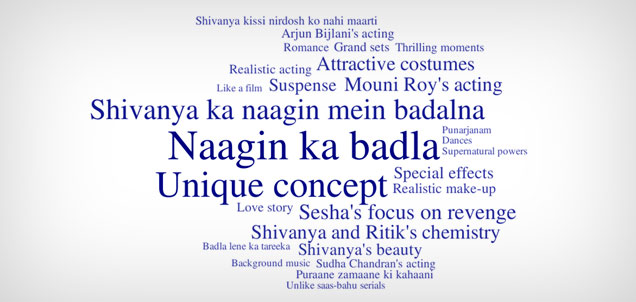
    This misplaced elitism amuses me. Truth be told, Naagin, in fact, captures a very significant “change” in Indian television. And that point is probably being missed across the board, even by many GECs. A first step to understanding this “change” is to understand why Naagin is doing so well. The thought cloud above captures the reasons why viewers love Naagin.


    The pace, treatment and presentation of Naagin is a cut above even the most successful fiction shows on Hindi GECs today. Designed as a finite series brings a sense of purpose to the show, and the story actually moves every episode, unlike many other serials where nothing really happens even over four long weeks.


    Its exciting pace creates the intrigue and suspense that a thriller needs, but often lacks. The visual presentation is top-notch. A quick glance at the cloud above and you will know that costumes, casting, make-up, sets and visual effects form an important element of Naagin’s success. These elements are considered merely hygiene in weekday fiction, never the differentiators.


    Importantly, the nature of the entertainment provided by Naagin is unequivocally escapist. It does not carry any burden of inspiring the Indian women audience and giving them the confidence or resilience to fight challenges in their own life. It is just pure entertainment, free of messaging of any sort.


    There have been other finite series in the recent past, none of which have delivered even 25 per cent of Naagin’s ratings. Many were questioning the merits of finite series after the high-budget experiments misfired. But Naagin has proven that if the concept selection is right, finite series, handled with a sense of pace and purpose, can be lucrative business.


    Since 2000, Hindi television has been largely reduced to daily fiction content, airing 5-7 days a week, where the pace is languid, the production at best serviceable, the treatment is very “afternoon soap-ish”. Naagin is unlike all of that, and in that, it fills the need gap that exists – of fast-paced, finite fiction content.


    Many have asked me if Naagin would have worked on weekdays too. I believe that if it was the exact same show that it is today, broken into four half-hours every week, it would have worked equally well. But if it were a daily, it may not have been this exact show after all. The tendency could have been to apply the daily-soap rules, slow down the pace, save on production budgets after the launch period, and go into assembly line mode sooner than later. And that’s why it would not have worked equally well.


    Far from being regressive, Naagin could be the start of some significant progress Hindi television could make, if it chooses to see Naagin beyond being a “snake show”. The real reasons of its success are a lot more interesting than that.


  • Ranjona Banerji: The perennial war for newsroom control

    By Ranjona Banerji


    The Marathi newspaper Loksatta was apparently forced to retract an edit that was critical of Mother Teresa, after news of her imminent sainthood became public. This perhaps represents everything that is wrong with newsrooms. But it is also curious. Criticism and some of it quite vicious of Mother Teresa is not new. In Kolkata, where she did most of her work, many fulminated against her work and her methods. The Left Front government disliked her intensely as it did all Christian missionaries in Bengal.


    Many others felt that she got more attention than she deserved and that other people who did similar work were neither glorified nor given as much money and attention. The most trenchant criticism came from the writer Christopher Hitchens who called her out for her hypocrisy because she took money from all sources and applied no moral code to her donors.


    The Loksatta editorial said no more than this. It is curious why the management would force the editor to retract. Mother Teresa died in 1997. Her achieving sainthood is of interest mainly to the Catholic Church and to Catholics.


    But we have a history in India of tiptoeing around “religious sentiments” and it seems apparent that this is what happened here. It also shows the dangers of management interference in newsrooms. Let us not pretend that it has never happened before. But usually, editors had the wherewithal to fight even if they did not win every battle. But what we see in some newsrooms today is editors who have already capitulated or editors who are unable to withstand the onslaught. Both cases do journalism no favours.


    Incidentally, for those crowing that they have proof of some evil Christian plot to destabilise Loksatta and the media, let us remember that representatives of every religion in India apply as much pressure as they can on media houses to censor criticism. Is there anyone here old enough to recall the hysterics in newsrooms when India Today (the magazine) ran a story that made allegations against Sathya Sai Baba of Puttaparthi? Never have so many journalists staved off calls from so many famous people they are usually dying to speak to!


    **


    This is a call to tennis journalists. After Maria Sharapova’s dramatic announcement earlier this month that she had tested positive for a newly banned drug in January this year during the Australian Open, we saw some fulminating, reporting and so on.  But since then, the news cycle appears to have moved on to routine match reports. Indeed, it is soon to be overtaken by the gender war brewing in tennis again, after irresponsible remarks by a CEO of the Indian Wells tournament and unfortunate remarks by ATP World Number One Novak Djokovic over equal money.


    However, the issues of match-fixing and doping need to remain at the forefront if the game is to be saved. On TV now is an excellent documentary on cyclist Lance Armstrong and how he lied and manipulated his way around drug charges while winning innumerable races and setting up his cancer foundation. It is an abject lesson on how to ignore clear signs. At the time, it was France’s L’Equipe magazine which made the charges against Armstrong and was attacked for being partisan and jealous. Take a look at the defences being raised now. That should give a journalist some hints.


    **


    Tired of being accused of being constantly anti-government by BJP fans, the Hindu’s Readers’ editor delved into history and this is what he found. The pointing finger? Hmm.

    http://www.thehindu.com/opinion/Readers-Editor/charges-of-bias-how-the-upa-regimes-were-covered/article8377808.ece


  • Sanjeev Kotnala: The Peephole Barrier

    By Sanjeev Kotnala


    The world outside is always full of opportunities. Between you and the glorious opportunities is a door. This is mostly a mental door, but sometimes it can be a physical door too. All you need to do is to open it and step outside.  Embrace the new world.


    If only it was that easy. Even when we are charged up and we boldly step forward to open the door, we stop. We seek additional information before we can venture into the world of uncertainties. We are cautious and that is the point at which the momentum is lost. The opportunity disappears and everything again starts looking like a mirage.


    We forget that no information can give us the fair degree of certainty we want. It is only on opening the door that the mysteries will be revealed. Will the door lead to expected opportunities, new challenges, unchartered paths, problems, solutions or something unknown? No one knows and no one can answer.


    But that is the very reason that anxiety takes over. New uncertainties create shadows that start looking threatening. Imaginary negativism raises its hood. The positive within self becomes doubtful.


    We want to be assured of probabilities! We want surety! We want to be prepared for future. A future no one has seen. A future that is always vague. A future that will take shape at (n-1)th moment.


    We satisfy ourselves looking through a one-way a peephole into future. We attempt to see what waits us on the other side of the closed door. Knowing fully well that such peepholes can at best look outward into past and that hindsight vision is always clearer than the foresight.  Because you are not trying to look out from the room (hindsight), you are trying to look inside the room (foresight). But it is a hint that we seek.


    Trust me, at times it is best to let the door remain closed, ignore the peephole, in fact cover it and enjoy the comfort of darkness. A new heightened awareness that comes with the decision to play as it comes.


    In our professional or personal life, we have peepholes mounted on many doors that surround us on every turn. We still expect to walk from that corridor of life into a room using a peephole that can only look the other way round. We are ok with vague future and seeing magnified pictures. The peepholes research is used to build up future understanding and create the lovely strategic scenario. We are always in the area of inferred future realities. At some stage with an element of risk we have to move forward and open the door.


    Truth remains that most of us are happy to live with collective failure than really to chase risky individual success.


    The peephole vision we see depends on the kind of peephole we invested in. But even the best cannot guarantee a 20:20 vision.


    A Simple peephole gives a straight tunnel vision. We upgrade with higher investments into one with wide-angle view. Hoping it will help us catch the hidden clues at the edges. We task many experts to interpret the images. Something the inherent cost-result expectation does not allow us the technology we want. Yet the closed door needs to be pushed open.


    Detailed vision depends on the height the peephole is mounted. How early in the process do we seek the interpretations of the vision projected through the peephole?


    We have experts to man and interpret these peephole visions. They are expert and hopefully are capable of making sense of the peephole vision. Remember they are not the one who has to finally push the door open and take that bold step.


    The peephole experts remain static in their place. Past visions blinding and biasing them. The shadows start having different meaning and they start reading clues that are not there, the experts are meant to do that.


    Inexperienced person with that uncorrupted mind only sees hazy pictures. He is willing to take the plunge with uncertainties. The experts Peephole Vision Holders and the old guard entrusted with the door opening stop them. In process building another crop of organisational cautious soldiers.


    Always expecting hostile environment and imaging things they move in to invest in a larger size peephole and adjusting the height for a better vision.


    There must be some merit in it as there could be some merit in being bold enough to close the peephole and killing the uncertainties. Just deciding which side of the door we really want to be.


    Or playing to inherent fear and over cautious approach, invest into installing a window where peephole was sufficient. Sometime, it makes no difference. Peephole or windows both remain ornamental.


    Or ignore the peephole, open the door, step outside and learn by experience.


    Or install multiple peepholes in search of elusive insight, mantra, wave, and transaction. And be paralysed with differential images that create a collage we cannot make sense of.


    Whatever is there, it is ultimately we who have to decide what to do with the peepholes we have mounted or the doors we face.


    We most likely are living with the peephole barrier that stops us to move forward. Maybe its time, that we closed a few of peepholes in our life ad open few more doors.

    The decision as they say is always yours.


    Sanjeev Kotnala with 28 years of corporate experience is Founder of Intradia World. A Brand, Marketing & Management Advisory, he focuses on IDEATION (Harvest and Liberate) and INNOVATION (InNoWait) process workshops and training.


    Email sanjeev@intradia.in tweet @s_kotnala web: www.intradia.in  www.sanjeevkotnala.com.


  • Ranjona Banerji: Should a journalist only praise the police & ignore the problems of the people?

    By Ranjona Banerji


    At the risk of upsetting every journalist in India who thinks that their sole purpose in life is to support the government in power, one has to point out that what is happening to journalists in Chhattisgarh is very, very scary. Malini Subramaniam, who contributed to scroll.in and was threatened, was forced to leave her home in Bastar because of intimidation from various quarters connected to the government and the police.


    Journalist Prabhat Singh was arrested by the police for making an anti-police joke on Whatsapp. Bastar-based reporters Santosh Yadav and Somaru Nag have been arrested for “Naxal” links.

    It is true that Chhattisgarh is a battleground between Naxal forces and the police. It is also true that the Naxal movement began because of real and perceived persecution and the utter neglect of local people by the police, by government and by corporate interests. It is also true that Naxals and those who support them are part of India. It is also true that Naxals are dangerous and violent. It is also true that security forces have suffered terrible damage because of Naxal violence. It is also true that civil militias like Salwa Judum, encouraged and formed by the government, have added to the problem.

    What, in such a complicated case, is a journalist to do? Be patriotic and nationalistic as the government demands and toe the government line alone? Ignore the problems of the people and only praise the police? Pretend that there is no persecution and abject poverty in the region? Sing hymns exalting the state government’s policies and actions? Never try and get both sides of the story?

    These are journalists who risk their lives to do their job. It is clear that they have upset the authorities who do not want the outside world – that is us, the rest of India – to know what is happening in Chhattisgarh. And this behaviour is not new. Nor is the charge of being anti-national. After all Dr Binayak Sen, who has dedicated his life to treating the neglected and the bereft of the region, was also tagged and arrested as a seditious anti-nationalist almost a decade ago.

    The situation in Chhattisgarh is full of grey areas. And yet, anyone who does not kowtow to the government is considered an anti-national who supports anti-national activities. If you want perspective, compare how journalists who cover Bastar are treated with journalists who manage to get interviews with underworld criminals and gangsters like Dawood Ibrahim or Ravi Pujari or Chhota Rajan. Talk to a gangster/terrorist and you are a hero. Talk to a Naxalite and you are a traitor. This despicable distinction is a direct result of all those shameless journalists who scream and shout about “nationalism” day and night on television, in print and on social media, wearing their fake plastic flags on their sleeves and basking in government adoration in their spare time.

    In a sense, these are government-embedded journalists who have sold their souls for government favours or recognition.

    It is heartening to see that journalists across India have come together in support of Chhattisgarh’s journalists and reports are being prepared by organisations like the Editors Guild. Civil rights organisations are also involved in helping these journalists who have been arrested on specious grounds. Senior editors and journalists in Chhattisgarh itself have met with government officials to try and help their colleagues and sort out the situation. Journalists in Chhattisgarh share some chilling realities of working there with their friends. Says Sunil Kumar, editor of Daily Chhattisgarh, “The police is trying its best to prove that no one is a journalist in Chhattisgarh so that it can arrest whoever is a discomfort to the police.” Kumar has been scathing in his criticism of the government and also filed a complaint against the arrest of Prabhat Singh. Like many others, he is willing to put his journalism on the line to protect the rights of journalists.

    One might argue that currently, Chhattisgarh is India’s most dangerous battleground for journalists. Especially those who really care for the tenets of their profession and for this country – the opposite of our plastic patriots you might say.


    Ranjona Banerji is a senior journalist and commentator. She is Consulting Editor, MxMIndia. The views expressed here are personal.


  • Sanjeev Kotnala: Will your insight fail the complete organisational test?

    By Sanjeev Kotnala


    Insight is one of the most misused words in the business of marketing and communication. They are loosely used to denote any not-so-obvious fact. At times the ability of it being commercially exploitable and being helpful in enhancing impact of a brand / process is treated as secondary. It primarily remains an inferred answer from observation of current trends in Human behaviour and expectations.


    It is the overlap between the provider and user interest. Example: consumer insight-  is derived from inferred learning in the intersection of consumer and brand interest.


    As per a WARC report, most marketers (some 33%) are happy with their insights function. On the other side, some 25% believe that the methodologies used for insight mining are too traditional, insights too obvious and difficult to put into action. These marketers also regard some of their insights colleagues as lacking in passion or real business understanding.


    In his article, the famed Scott Grey uses a great analogy to say ‘insights are to an idea what Blitz firelighters are to a fire…. If observations were the tip of the iceberg, the remaining two-thirds below the water, the part that is not immediately obvious, would be the insights’.


    While decentralisation and departmentalisation to get better efficiencies have their advantages, it has somewhere created few blocks. Organisations have Insight and Innovation departments. They have failed to understand that Insight and Innovation is everyone’s responsibility. Depending on specialised department for insight and innovation is suicidal and must be stopped.


    Insights are too important to be left for a bunch of people working in silos to discover. Insights require an attitude of relentless observation, questioning and synthesis. It requires a jeweller’s mind-set in evaluation and an adventurous attitude to experiment and challenge the current status. And that not just a stated attitude in successful organisations but the organisational culture.


    Most insights in discussion are Consumer and customer oriented.  And there is nothing wrong in it. People with myopic future vision see them from a singular lens of marketability.


    Unfortunately in most organisations, the discoverer, evaluator and the user of insight maybe different entities. Worse, the complete organisation is rarely involved in evaluation and hence amplification of the impact of the insight is never to its potential.


    The aim of an insight is to understand the underlying mindsets, moods, motivation, desires and aspirations that will trigger attitude and actions. It is a non-obvious understanding, which if acted upon, has the potential to change behaviour for mutual benefit.


    The way to initial scrutiny of an insight can use simple 4 filters defined by Paul Laughlin.  It is  “non-obvious”. It is discovered and not available with the current set of analysis and synthesis of information. They are  “action-able”. If it is non-implementable and remains theoretical it is not an insight.  It should be powerful enough. When acted upon, it should be able to  “change the behaviour”. It must lead to  “mutual benefit”. It must benefit the intended user (target Groups) and the implementer.


    In this respect, I personally like comment of Robert Dreblow, head of marketing capabilities at the WFA; he says, “Actionable insights are an essential part of great marketing. Firms that get their insights teams delivering new tools and insights that they can leverage across the business will be in a better position to deliver sustainable growth.”


    The critical action word here is ‘across’ department and functions. How will it help, create, sustain a change. What is the half-life of the insight on which we are banking to make the difference?


    To really qualify as an insight, it must positively impact the long-term interest of the implementer. It must pass the complete organisational filter.


    Once you are satisfied that the new discovery is good enough to be called an insight, it may be advisable to pass it through few more lenses.  It needs to be seen through individual and collective lenses of HR, production, sales, marketing, technology, consumer and trade. And when it passes the critical framework test at every stage of the organisation, or it is tweaks and mutates, rearticulated and recalibrated the insight becomes real game changer.


    This new version of insight will help prevent any nasty surprises at a later date, the complete organisational alignment and understanding of its importance. It thus will become a weapon with far higher potential.


    Oh, this is not a necessary condition for success. But it can enhance your chances of success or help amplify the results.


    The decision is always yours and only time has all the answers. But it is worthwhile to take a conscious open-eyed decision. After all only you can understand and fire your Ambitions.


    You remain within your rights to overlook the need of passing the newly discovered insight through the organisational filters. You can remain the king of your captive cocooned existence.


    Sanjeev Kotnala with 28 years of corporate experience is Founder of Intradia World. A Brand, Marketing & Management Advisory, he focuses on IDEATION (Harvest and Liberate) and INNOVATION (InNoWait) process workshops and training.

    Email sanjeev@intradia.in tweet @s_kotnala web: www.intradia.in  www.sanjeevkotnala.com.