Category: COLUMNS

  • Sanjeev Kotnala: CSR: the marketing tool to leverage internal force with a brand synergistic act

    By Sanjeev Kotnala


    Corporate Social Responsibility or CSR is not a new thing for Indian culture. It has been present in one form or another through ages. Remember how the Jodhpur Palace was created. It was made so that the proud Rajasthanis who would not take alms, could work during famine and earn from the king.


    CSR seems to be a buzzword today. No one asks ‘Should we do CSR’ but the question is direct and demanding  ‘What should be the CSR we should engage in’


    The definition that works for CSR is simple. ‘Corporate Social Responsibility refers to the practice of conducting business in a manner which links it to ethical values, compliance with legal requirements and most importantly, respect for people, communities and the environment. All on voluntary basis. The last part ‘Voluntary Basis’ is critical.


    Giving back to society and making desirable impact on people and Planet is as important as the third P- Profit. In fact lot of organisations have shifted on to the triple bottom line approach in measuring their impact.


    CSR is a strategic decision.


    Marketing and management both are slowly waking up to the fact that CSR can be the second brand experience and differentiate them. Yet we keep on seeing tactical philanthropic work and charity – the Cheque/fund CSR wasting organisational resources. These helping hand and slow removal of guilt of making money wrongly impacting people and planet is fine. Maybe it is the best that could do under present situation and that too is fine.


    We should use CSR as a tool. We should leverage it. We must identify a sustainable Brand synergistic CSR that will help us build strong brand associations over a period of time. CSR has a slow burner approach in association and benefit. It is like creating a temporal memory in heart and mind.  Remember we never believe that Tata will do anything illegal or something that is not good. Being Human has many advantages.


    Such brand synergistic CSR can be handled by the marketing department or a sub team within it.  The team sees opportunities, it makes the brand look good, it even gets peer appreciation and ultimately everyone feels good about it.


    A real brand synergistic CSR idea can morph into a brand campaign. And that is interesting when the differences merge. ‘Touch that Pickle’, ‘Share the load’, ‘Jaago Re’ can be seen as a perfect CSR and a perfect brand campaign. And it does not matter what is the perspective with which you see them. It matters what the impact on people and planet it is making. The audience is a lot smarter in information democratised digitally social world.


    CSR idea should be one of the core elements of the organisation, that no incoming CMO can change it easily like they do with the brand. For a real good initiative and impact, you even need to have a leadership that operates not necessarily in Brand or category level but on social impact level.


    This feeling of goodness can enhanced, if we use the internal work force in the process. Not just for implementation but even in the process of selecting the CSR for the organisation.


    Even after this, the brand may fail to break the final cultural barrier. A culture that has wrongly taught us – the left hand should not know what the right is doing. And for this many brands fail to get the rightful advantage of CSR. Get out of it. Do not shout, but one can always politely humbly make the current and potential customers know of our good work.


    In this digital and socially connected world, this is very much possible. And a great momentum can be by the employees, the internal teams. They will be more than willing and excited if they have been part of CSR idea. If they have co-created, co-owned, co-evaluated and co-nurtured it. In such case, passion levels are different and it reflects in the pride they associate with it.


    There are questions that have very polarised answers. It maybe a good idea to check your inner thought. So take a deep breath and think:

    1. Will a brand synergistic CSR always be more impactful?
    2. If CSR is adding to brand- then will it be more sustainable?
    3. Should one really create awareness about hype about CSR?
    4. Is marketing department best suited to implement and manage CSR?
    5. What are your organisations CSR and are they the best ideas that the organisation should be implementing?


    A word of caution, in case the CSR is not brand synergistic, it may be better to brand it differently. Then giving it to marketing will be unjustified. They will not be interested. They live for the brand and with the brand. In such case of a non-synergistic CSR their involvement is normally restricted to right placement and size of logo.


    Parking CSR with corporate affairs will lead to early corruption of the idea. If it is possible, it is better to create a separate CSR vertical/ team that reports to the chief executive and one who engages the internal and external stakeholders.


    Sanjeev Kotnala is Founder and Head Catalyst at Intradia. A Brand, Marketing and Management Advisor. He conducts specialised workshops in the area of IDEATION (Harvest and Liberate) and Innovation (InNoWait). His focus is to enhance client’s team potential and capabilities, as also CSR. In process decreasing their dependence on external resources. To contact email sanjeev@intradia.in or tweet at s_kotnala visit www.intradia.in  www.sanjeevkotnala.com.

  • Shailesh Kapoor: Should 30% Success Rate Still Be Acceptable?

    By Shailesh Kapoor


    Over the last decade, the entertainment business has started attracting more senior talent from outside than ever before. The industry has been able to match the pay packages offered by FMCG and telecom majors at senior levels, though a fairly wide gap remains at the entry level. Many have also moved because of their inherent passion for the media and entertainment business.


    Anyone who joins the entertainment business from a more traditional industry first observes the alarming difference in the product failure rates of the two industries. In the entertainment business, if you get even 30% of what you launch right (read: It doesn’t lose money), you are a champion. In any self-respecting FMCG company, that could mean you have to look for another job very soon.


    Several arguments, in the ‘apples-to-oranges’ domain, are given to justify why we should not compare failure rates in the two industries. In many ways, a myth has been propagated over the last two decades that the process of consuming entertainment is a lot more complex than that of consuming a conventional consumer product, and hence, it is difficult to ascertain what the entertainment consumers want and what will catch their fancy.


    I must mention that not all propagators of this myth are ‘old school’ in their thinking. Several are, in fact, fairly liberal in their thinking, making films and TV shows that challenge the status quo. But it’s the lack of an understanding of the other side (the classical marketing side, a la FMCG) that comes in the way.


    With ‘outside’ talent entering the industry, things have changed, albeit slowly. A simple way for us to assess that by knowing how many programme concepts, pilots, scripts and films are being tested with consumers before critical business decisions related to them (go or no-go, budgeting, slot, release scale, etc.) are taken.


    The number of television concepts tested using Ormax True Value, our content testing tool for broadcasters (predicts on-air performance, specifically the steady-state TSV), has been increasing by 50% year-on-year since 2009. Similarly, the number of films we test using Ormax Moviescope (predicts lifetime box-office)has been doubling year-on-year since 2011. Script-testing for films was non-existent till as recently as two years ago, but there is increasing interest in it today.


    Interestingly, many television concepts that do not test well are still being put on-air. Sometimes, this decision has already been taken, and the testing is done to validate the instinct that led to the commissioning decision. When the results are positive, it’s celebration time. But when they are not, it’s a case of hoping that the research is proven wrong. It’s what I like to call ‘The Hope Strategy’. Even a marketing intern will tell you it’s not the best strategy for a brand that aspires to be a leader in its category.


    But ‘The Hope Strategy’ is still better than the one that’s based on no consumer information at all (that’s the ‘Hopeless’ one). To that extent, we have made some progress. But there’s a while to go before we can match up to the best in the marketing world on product success rates. There’s a while to go before the acceptable success rate increases from 30% to at least 60%.


  • Ranjona Banerji: Time to stand together against despicable targeting of women journos

    By Ranjona Banerji


    There is a despicable Whatsapp forward doing the rounds about women journalists at NDTV, naming them and outlining how many times they have been married, how they have “trapped” men and how they are carrying on “illicit affairs”. The message ends with the “witticism”: Is this NDTV or Shaadi.com”, a reference to a popular marriage website.


    It does not matter whether the allegations or “facts” are correct or not. What is worrying is the snide venom that is behind this particular message and such messages in general. Women remain easy targets on social media and women in journalism even easier. The easiest way to attack is of course by sexual innuendo because then it reduces women to one aspect of their existence: their genitalia and/or their reproductive uses.

    This is a classic male, patriarchal response to successful women or women who appear to be successful. And NDTV is the particular target of a certain mindset. Although there are female editors, anchors and reporters in every television newsroom, across languages, in India, NDTV bears the brunt of social media anger.

    The most obvious reason is that the channel has long been perceived as pro-Congress Party. This apparently is reason enough for any amount of targeted viciousness. Interestingly, the men in the channel do not bear the brunt of this social media anger. In fact, NDTV founder Dr Prannoy Roy remains one of the most respected names in Indian television, as he well deserves to be. But the women he employs apparently all paid Congress agents and sexual predators. The anger against NDTV, especially amongst the Indian rightwing and supporters of the BJP-RSS, is so extreme that a few months ago Union finance minister Arun Jaitley was attacked just for being interviewed by Barkha Dutt. The irony of Jaitley being part of the BJP and a vital part of this government was completely lost on his attackers.

    But is Indian journalism’s worst sin the sexcapades of female journalists? Let’s see. We continue to deal with the problem of paid media, which specifically refers to media house managements selling editorial space to political parties with or without the knowledge of editors. Then we have the deals with businesses. Almost every newsroom has a list of industrialists who are untouchable. Media gossip says that Mumbai police commissioner Rakesh Maria had to be transferred out because he was getting too close to the Mukerjea-9X money trail. Then there is the problem of political affiliations impinging on free reporting and analysis.

    One of the biggest unspoken problem in newsrooms, regardless of the sexual harassment case against Tehelka founder Tarun Tejpal, is that of predatory male editors and junior staff, usually female. Most newsrooms have not followed the Supreme Court’s Vishakha guidelines or if they have implemented them, scant attention is paid to them. Innumerable horror stories continue to emerge. But do tell, how many Whatsapp messages have you seen about these incidents?

    Online trolling of women journalists, often by their male colleague or peers continues. Many of these trolls are well-known names hiding behind anonymous handles. Yet most women journalists would rather follow the law or are squeamish – which is why their names are not made public. Men, as we see everyday, have no such scruples.

    The torment that the women journalists of the Hindi newspaper Khabar Lahariya have suffered for most of 2015 by a persistent stalker and the apathy of the UP police was discussed in my last column. Apparently, some progress is being made in that case now that the problem has been made public.

    It is time for women and men in journalism to stand together. This sort of targeting of prominent women journalists needs outright condemnation. You do not have to be admirers of their journalistic skills. You just have to know that targeting them for being female is unacceptable.

  • Ranjona Banerji: Defending journalists’ right to live

    By Ranjona Banerji:


    There is a point of view, understandably er, Hindutva rightwing, that journalists, liberals, intellectuals, academics and “secular” individuals are just making too much of a fuss about the sudden voice found by “fringe elements” of the Sangh Parivar, after the Narendra Modi government came to power at the Centre.


    After all, and this is true, successive government, including and in some cases especially those of the Congress, have in the past tried to muffle critical voices. The sedition charges brought against cartoonist Aseem Trivedi by the Maharashtra government during the India Against Corruption is a very good example of that. Also the banning of Javier Moro’s book on Sonia Gandhi. You can add to the list the fact that rationalist Narendra Dabholkar was killed in Pune during Congress rule and the police drew a blank there. And that writer and scholar MM Kalburgi was killed in Karnataka which is a Congress-ruled state.


    However, there is no justification in copying someone else’s daft behaviour, having criticised it while you were in opposition. Also, there is the question of who threatened the lives of Dabholkar and Kalburgi and who has been arrested for the murder of Communist leader Govind Pansare. And then there is nowhere to run for supporters of the Hindutva rightwing. The space for intelligent or even reasoned discussion becomes limited when murder enters the equation. The Hindutva rightwing is fond of attacking Islamic fundamentalism and Islamists and Muslims in general all day and all night on social media but clearly are unable (or unwilling) to acknowledge that murdering those against their tenets is as reprehensible. Once that happens, we are fed the justifications. The Islamist terrorists who killed the cartoonists and employees of the French satirical magazine Charlie Hebdo were wrong but killing Pansare, Dabholkar and Kalburgi is correct?


    Their so-called crimes? Questioning the practice of idol worship, blind superstition and pushing forward a rationalist agenda. All of which are still legal in this nation.


    In the Pansare murder, the spotlight has fallen on the group Sanatan Sanstha. According to the police, the suspects had also threatened journalists Shyamsundar Sonnar and Nikhil Wagle. Sonnar for rationalist views and his interpretations of Sant Tukaram’s teachings and Wagle of course has long been a target for his refusal to be cowed down, in spite of all the vicious hatred he has been subjected to, with a lot of help it must sadly be said, from his colleagues. While Sonar has filed a police complaint and requested security, Wagle has refused anything that will hamper his journalistic activities.


    As media people, most will stand with both Sonnar and Wagle but there will always be some specimens, particularly within the Marathi journalism fraternity. There is a particular sort of venom here which I am unable to understand. You can disagree with someone’s values, with the way they practise their craft even. But secretly approving of harm and death seems a bit, well extreme. There are many journalists I myself don’t like much and some very prominent ones, but I will defend to the end their right to live!


    This article in Mumbai Mirror, by the way, explains the irrationality of the Hindutva supporter: http://www.mumbaimirror.com/mumbai/cover-story/We-had-requested-him-warned-him-but-he-didnt-stop/articleshow/49039957.cms


    **


    With sustained media, social media and public pressure the UP police managed to arrest the man who had been threatening the women journalists of Khabar Lahariya. Although this story from scroll.in says that the man is unrepentant, he is at least in jail by now. If only, though, police would take harassment charges more seriously. If this the way journalists, who have some influence, are treated, we all know how the common man or woman is dismissed by the police and government authorities…

    http://scroll.in/article/756664/man-who-harassed-up-women-journalists-for-months-is-finally-caught-and-hes-unrepentant


  • Ranjona Banerji: Change in gender mindset needed

    By Ranjona Banerji


    A friend and former colleague Soumyadipta Banerjee and his wife TV reporter Sonika Tewari have been fighting a long wrongful termination battle against Zee News. They have gone from the Labour Court to the Industrial Court to the Bombay High Court. All three have upheld their case. And yet, Tewari’s former employer Zee News, has gone in appeal every time. The Bombay High Court has made it very clear that a female employee cannot be dismissed from service while she is pregnant, which is what happened here.


    The Maternity Benefit Act of 1961 is a welfare law says the high court and if it is not upheld, it would have terrible repercussions on all female employees and women in the workplace. The high court quoted the Maternity Benefit Act of 1961. The high court order also said, “Strict implementation of the Act, which ensures health and stress-free working environment for a working woman cannot be emphasized enough. Arbitrary termination of service during the maternity period, such as the present one, not only affects the concerned woman employee but creates a sense of despair and disillusionment amongst the working women in general.”


    Here the court has reached the essence of the matter: making working women feel that they are safe from termination because of arbitrary reasoning by the employer. Although the media is quick to point fingers at every other industry or institution, it has been historically and criminally lax when it comes to transgressions within. Until the Tehelka case created a public furore, sexual assault cases were not taken seriously, although there are ample instances of sexual harassment and assault within newsrooms. In some commonly known cases, employees who sided with the complainant were threatened with termination.


    In fact, some newsrooms maintain pockets of sexism even though ironically, the media is a far more just employer of women than many other organisations and industries. There are several women in senior and top positions in the Indian media. And yet, several prejudices remain. Pregnancy of course is an easy subject of dispute. Some managers use it as an excuse not to hire women at all, arguing that training and money on women is wasted when they run off to get pregnant. Interestingly, few of these managers, especially the men, have sworn to have child-free homes because of the inconvenience it causes. Underlying this prejudice is that old dictum: dealing with children is a woman’s job. The changes in this mindset are still slow, across the spectrum of human existence and workplaces.


    It can only be hoped that this case acts as a wake-up call for the media and employers in general. Three courts in this case have made it clear that the Maternity Benefit Act cannot be flouted. It is also evident that sometimes, somewhere employers who try to use brute force or metaphorical bulldozers to get their way, will be questioned. It can only be hoped that the managers at Zee News will understand this case for what it is and open the eyes of those in the media to the importance of the law.


    No one doubts that a media job is full of stress. But compassion and a pleasant work environment do not have to be inimical to a newsroom.


    **


    On this note, congratulations to Mid-Day Publications for appointing Tinaz Nooshian as executive editor of Mid-Day. She takes over from Sachin Kalbag, who moves to The Hindu’s new venture in Mumbai. She was deputy editor of the paper since last July and is editor of Sunday Mid-Day as well. It’s always good to see an in-house promotion and one more woman on top!


    All the best to her and Mid-Day, a newspaper that remains very close to my heart.


    Ranjona Banerji is a senior journalist and columnist. She is Consulting Editor, MxMIndia.com. The views expressed here are her own.


  • Sanjeev Kotnala: Stop selling, media salespersons!

    By Sanjeev Kotnala


    The festival period is right here. It will decide the fortune of many media brands.

    There is nothing new in the system. Every trick has been experimented with. The relationship strengthening parties are over. The experiential engagements are on the high. The contest and rewards have slowly started lost their sheen.


    If you are in the plan, there is nothing much to worry about.

    The preferred media vehicle, the over-the-agency-commission commission, the slabs and all of them exist. They covertly work on an individual agency-client, agency- media or media – client combination. A true loyalty programme does not exist in media. Someday it will be launched. Till then, life will be different.


    The media plans are sealed or maybe there is a chance to get in.

    If you are not in by now, then you are not the natural choice. You are not even a choice governed by the unethical associations. That means you need to be sold.


    And here lies the issue. You must been at the wrong lamppost.

    You are a B2B media most likely selling to someone, who is not the final decision maker. It’s ritualistic for you to you to meet her/him. As per the guidelines you make yet another typical templatised presentations. A few cups of coffee and may be a few puffs are shared before you return to office. You are confident of now being in the plan.


    The agonising wait to hear the mobile ring or the RO on mail starts.

    So, the right question to ask is, why are you not in the plan in the first place? Forget you had the numbers or not. Forget if there were preferred associations between you-agency and/or the client. Forget how many rounds of mailers you have shared. Forget the Diwali gift that is still being wrapped.


    The answer is not complicated. It is simple and it stares at you.

    You have given it your best. You have tried selling your media. But, these have been wasted efforts. You have failed to create a passionate brand ambassador or an on-site salesperson within the agency and the client.


    If only there was a perfect clone.

    You need to create another salesperson, not in your organisation’s rolls. A person that best understand you and the media you represent. Someone, who believes in you, who has been primed up with insightful information. Who shares your enthusiasm and passion. Who is willing to question a plan without your media.


    Re-evaluate your job.

    You cannot get results by just selling the media you represent. If your media is a natural choice for some reason, then you are not contributing  enough. I have heard media owners say that 70% of the media business comes irrespective of the sales team and its efforts. Maybe they are being polite. The truth is that your contribution is required to raise this percentage and to bridge the gap.


    Increase efficiency of your efforts.

    To do so, you have just one alternative. Create clones of yourself at the media agency and the client’s office. Fire their imagination with possibilities. Pass on the passion, confidence and the aura of your media. Feed in information. Share all that will help your new onsite sales persons to look smarter. Help them promote your media as a recommended choice. And win arguments, if any.


    More importantly, live with the promise of fulfilling every promise you make. Ensure every promise made by your onsite sales person (in agency or clients’ office) while internally selling your media is respected.


    Is that not the easiest promotion you can earn?


    Sanjeev Kotnala is Founder at Intradia World. A Brand, Marketing & Management UnConsult Advisor. He conducts specialised workshops in the area of IDEATION (Harvest and Liberate) and Innovation (InNoWait). He focuses energy in enhancing client’s internal team’s potential and capabilities. In process decreasing their dependence  on external resources. To contact email sanjeev@intradia.in  or tweet at s_kotnala visit www.intradia.inwww.sanjeevkotnala.com.


  • Ranjona Banerji: Goodbye to Modi rah-rah!

    By Ranjona Banerji


    The prime minister of India’s second visit to the USA in his 16-month term was a slight reality check for a breathless media. Unlike last year, it was not blanket coverage of Narendra Modi’s every waking moment, there was a small realisation that NRI hysteria does not reflect the situation at home and there was, gasp, some small criticism even from the head honchos of Silicon Valley about India’s business-friendliness.


    There were a few other problems as well. Much of the world was also in the US and the main topics of discussion were IS, Syria, Ukraine, Russia and the US. The visit by the Pope overshadowed everything else. In fact, the rah-rah over India having been done last year, this year was business as usual and the US media as it happened barely registered the Indian prime minister’s visit. C’est la vie. Running a government is not the same as running a fan club and no matter how many cheerleaders you have, the world will move on. I am of course very clearly pointing fingers at TV news here for its jaw-dropping sycophancy of last year.


    And then there’s this video of Narendra Modi and Mark Zuckerbery and Shelly Sandberg of Facebook. A few months ago, it would have been shared on social media and that would have been it. But now it has made to the mainstream media. That’s the problem with democracy you see – sooner or later even a whom-are-we-here-for media realises that it is here for the people and not for politicians and prime ministers…


    **


    Since the subject is a matter of discussion from Silicon Valley to here, it would be extremely helpful if the mainstream media paid some more attention to the topics of net neutrality, Digital India and Facebook’s idea of a controlled internet. There have been columns and interviews across some newspapers but I would hazard a guess that more is necessary. At the best of times most of us are hapless consumers blundering through websites and apps. A little more help here, guys.


    **


    I have said this before but I feel I must mention it again. It is nothing short of appalling when members of the media are so blinded by their political leanings that they forget the basics of their profession. The political divisions in the Indian media – particularly between left, right, centre and objective – were made clear when LK Advani – started his Rath Yatra to build a Ram Temple in Ayodhya at the site of the Babri Masjid. This divide has become extremely bitter and even more fractious since the BJP-led government came to power at the Centre last year.


    I must reiterate that I am not talking about members of the public here. I am talking about working journalists and former journalists and journalists who understand very well how a newsroom functions. They bombard you on social media with vicious uncorroborated rubbish which would not pass muster even with a raw intern. When you question them, they dissemble and pretend like they’ve made a mistake. I am ashamed to say that I have even worked with some of these people now that I see their understanding of journalism is so shallow.


    Many of these are journalists who are younger than me but are still experienced enough to be at the top of the pile, running newsrooms. It makes you wonder how they ever manage to sieve through the information they receive at work, if they cannot in a casual sense, separate arrant nonsense from fact.


    If people like this are the future – and I see them everywhere – I shudder for the future of journalism. I see open upper caste superiority, hatred for minority communities, complete non-application of mind when it comes to internet cons and an inherent need to support this political dispensation or that.


    Sad.


  • Crossover Stars: Priyanka Chopra & Kapil Sharma


    By Shailesh Kapoor


    Crossover (definition): The process of achieving success in a different field or style, from the one in which success is already established.


    Crossover remains a much-used (and abused) word in the Indian entertainment business. But much talk on the subject has been fringe talk, whereby talent that’s not even successful in their own field has “crossed over” to another field, again to meet with limited or no success. In other cases, successful Indian film actors have crossed over to the West, but not made an impact, being reduced to fringe parts in Hollywood films or TV series.


    There have been only four true crossover successes so far. Amitabh Bachchan reinventing himself and taking up KBC at a fairly low point in his film career would be on the top of my list. Shah Rukh Khan is the shining example of the opposite – a TV star who made it big in the films. AR Rahman has crossed over comfortably to world cinema, and even has a fatwa to show. Irrfan has discovered his niche at the world stage, at times in small parts, at times in major ones. There may be several other examples, but how successful they have been can be debated.


    With just four case studies over all these decades, we could safely say that the crossovers are not our cup of tea. Until this week. As if to compensate for years of crossover failures, we had two huge success stories this week – Priyanka Chopra crossing over to the West with Quantico going on-air, and Kapil Sharma crossing over to films with the release of Kis Kisko Pyaar Karoon.


    Chopra’s achievement is towering in its impact, and has been written about earlier in this column too. The show is now on-air and early reviews are a mix of positivity and skepticism. But even in the not-so-positive reviews, Chopra has been hailed as an accomplished actor and her casting has been described as a big strength of the show. Her international acting career could be on the verge of acquiring very long legs.


    Sharma’s success is very different in nature. Kis Kisko Pyaar Karoon became the highest Bollywood opener for a debutant ever. It also registered higher weekend collections than many recent films featuring young stars. Importantly, the film achieved this by converting theatre non-goers to theatre-goers. Television is often seen as an “inferior” medium to films because it’s “free”. But when Sharma’s fans from television thronged the multiplexes to watch him on the big screen, that argument went out of the window.


    If Sharma sticks to clean family comedies and chooses his scripts carefully, he could have a huge film career ahead of him. Family comedy is the most popular genre in Bollywood, and one that’s hugely under-served too, with very few releases in the genre over the last 4-5 years.


    The future will determine the true degree of the crossover success achieved by Priyanka Chopra and Kapil Sharma, but my list has extended from four to six. And it looks a very powerful one too: Amitabh Bachchan, Shahrukh Khan, AR Rahman, Irrfan, Priyanka Chopra and Kapil Sharma.


  • Ranjona Banerji: Is the Indian media anti-Hindu?

    By Ranjona Banerji


    Bashing the media is a wonderful pastime, isn’t it? Even I do it, you can argue, twice a week on MxM. But blaming the media when society behaves in a despicable manner or beating up the media… well, that’s another story altogether. Fashionable (if a little old and idiotic) in some circles as it is to accuse the media in India of running some agenda set by the Vatican, the media is the messenger. It may be intrusive, annoying, inconvenient, but that is what it is.


    In Dadri in Uttar Pradesh, after a man was lynched and killed by a mob ostensibly for eating beef, the media faced some of the flak. People on social media told me that the media never responds when a Hindu is attacked (never, please note) and only responded to Dadri because the victim was a Muslim. Others, some journalists even, accused the media of “never” responding in case someone’s hands are cut off (the implication being that the perpetrator would be a Muslim following Sharia law). The media (this from journalists too) also did not condemn the Charlie Hedbo killers since they were Muslim and approved of the ban on Salman Rushdie’s Satanic Verses since the book upset Muslims.


    You can see therefore that media bashing, even within the media, can take on ludicrous and nonsensical proportions. I do recall a case of a teacher’s hands being chopped off in Kerala being extensively covered and condemned. As it happens, we do not have Sharia law in India. As for Charlie Hebdo, what can one say? To my obviously biased mind, there seemed to be global shock and opprobrium. If those Indian journalists who blame the media for “appeasing Muslims” feel so strongly about this, they should carry the Charlie Hebdo cartoons in their own publications rather than bleat on about liberals in the media. So also when it comes to Salman Rushdie and the fatwa against him, although India banned Satanic Verses, there was plenty of support for him. Also, it is unclear to me why exactly the Vatican would want the media companies it owns to be nice to Muslims. Or perhaps these are those media organisations which are owned by Saudi Arabia.


    (I have a complaint here though. Where was the total condemnation of the cruel and inhuman punishment meted out by Saudi Arabia to blogger Rauf Badawi by these same sanctimonious journalists? Instead, we had breathless coverage of the prime minister’s meeting with the Saudis… I rest my case.)


    It’s easy thought to turn the tables on such brainless and frankly tainted media criticism, even when it is from within the media. What happened in Dadri? A temple priest says he was forced into announcing that Mohammed Akhlak’s family had stored beef in their house and the family was eating it. An angry mob stormed into the house, beat Akhlak to death and injured his son, who is now in hospital. The UP government in some odd wisdom sent the meat in the house to a forensic lab (it turned out not to be beef).


    Politicians of all hues descended on Dadri. First they made the right noises of sympathy, blah blah. Then they took off on their set paths of finger-pointing and defensiveness. Members of the media, which also arrived in Dadri, were beaten up and blamed for only focusing on the victims and not on those who had been falsely accused, according to their families. So are we to look for media solidarity from these genius in-media critics? Or do they perhaps toe the Central government line and approve of this sort of media bashing?


    I’m not holding my breath on this one.


  • Sanjeev Kotnala: Say no to mediocre creativity. Amplify OOH experience

    By Sanjeev Kotnala


    There is too much of Out Of Home (OOH) advertising. It’s a space that is cluttered. It is tough to make a statement. It is tough to create an engaging experience.  It is tough to defend such an observation. Absolutely true for hoarding, bus shelter and other such traditional OOH still seeped in old technology that is inching forward at a pace slower than the Himalayan tectonic plate.


    Unfortunately, with the global distances shrinking and information becoming a democratic advantage, one gets enamoured by the global experimentation in this space. Creatively hungry teams in sync with the demands of a willing client are using cutting edge technology and digital interface to create experiences that stand out. Alas, all of this is miles away from Indian shores.


    It’s is definitely not the lack of technology. It is the dearth of clients with confidence willing to take the bite, willing to ride the OOH space. Indian clients want every bit of the enhanced experience and engagement but fail to appreciate the need of investment and commitment to make it a reality. The right results is more than a fault-free implementation, it banks on social media and the insights based creative capability. It banks on the implementation to generate waves in the unpaid media space.


    So, let me not ride in that painful and highly debateable zone. What comes first is the technology investment by media owners or the pathbreaking creative and commitment from a client.  Many questions, no answers. So after raising the subject, let me get back to reality, the basics. It helps to do so.


    Most of our bigger cities are full of potential. Let me take example of Mumbai city.  It is plastered with hoarding and sites. Are they legal or illegal is not the scope of this discussion.


    SV Road, Western and Eastern Highway, Mahim, Haji Ali, Peddar road, Sea Link approach… you name it and there is a junction with immense potential of creating a destination outdoor.  Such busy points of prime importance have a Cluster of hoardings. Unfortunately they are referred as Clutter by the misguided trade and media advisors.


    Let’s take a step back. Compared to print (an intended medium) where eyes narrow their vision to take in the news or ad, OOH is an incidental medium. I have never ventured out seeking a particular hoarding and I bet you have also not done the same. When you are moving, your angle of coverage is wide. Things keep getting in and out of your field of vision.


    You miss out the smaller things and details, unless they are dramatically different or critically important to you. In such a situation, a cluster stands out and becomes a prominent element in your vision and is tough to negate. Unfortunately, they can become blind spots due to inactive engagement. To stand out in this cluster all you need us a challenging creative.  But, what we do is to take the easy way out. We stay away from advantageous clusters. We try being isolated and independent. We do not leverage the possible amplification of a cluster. The mediocre creative that we are so emotionally attached to, pushes us to take such myopically safe actions. In process, all we do is to increase the chance of being missed. Live with lower efficiencies and effectiveness. Miss the chance of making an impact. We remain satiated with the Excel sheet 360-degree plans.


    Take the challenge, invest into technology, understand the audience and create some creatively appealing OOH work. Not the picture from print or a freeze frame from the latest TV commercial. Stop treating OOH as a support and reminder medium. Changing your attitude toward the medium may help you enhance the impact. In this era skewed toward digital, it’s time even OOH took advantage of new technology.


    Try approaching it differently. Say ‘No’ to the mundane non-engaging creative. Next time, think OOH as the lead medium. Next time, design a campaign as if no other medium was available. Next time, force yourself and your teams to push the limit.  And once you get your brilliant OOH answer, go ahead and create that statutory TV, Print and radio creative


    ………………………………..

    Sanjeev Kotnala is Founder of Intradia World. A Brand, Marketing &  Management UnConsult Advisory. He is a certified Life  and mid-life transition Coach. He  conducts specialised workshops in the area of IDEATION (Harvest and Liberate) and Innovation (InNoWait). He focuses his energy in enhancing client’s internal team’s potential and capabilities. In the process, decreasing their dependence  on external resources. To contact email sanjeev@intradia.in  or tweet at s_kotnala visit www.intradia.in  www.sanjeevkotnala.com.


  • Time for the media to wake up!


    By Ranjona Banerji


    The media in India has been getting flak from two very different quarters, heightened in the last two and a half years. One section thinks that the media is too Congress-oriented and too secular and liberal. The other section thinks that the media is too BJP-Sangh Parivar oriented and too communal.


    Am I exaggerating the case? Yes. But ever since this current BJP-led government swept into power, we have seen battle lines being more firmly drawn. Social media contributes to this division and news television “debates” are all about atmospherics and rising temperatures.
    However, two recent incidents appear to have made most the media realise that its primary role is adversarial when it comes to the government and that the excuses for brutality and assault run out of steam quite fast. The murder of Mohammed Akhlaq in Dadri, Uttar Pradesh, in September, on the basis of a rumour (false) emanating from a temple, that he had eaten beef (cow meat) did shock most of India. Most of the inhumane responses came from the RSS’s Hindutva supporters on social media, especially those who live in nations where cows are seen as no more than breakfast, lunch and dinner. So the less said about them and their cowardly hypocrisy the better.


    The media as a whole though did realise that the fear, hatred and violence instigated by a communal thought process had breached enough boundaries. The condemnation from most was swift. Commentators like Surjit Bhalla and Tavleen Singh who have been supporters of Prime Minister Narendra Modi, both in the Indian Express, wrote about their shock and horror. Even in cynical terms, incidents like this seriously affect India’s international image and the media realised it faster than the Prime Minister’s Office which is usually up and away on image-building and public relations.


    The “whatabout” arguments mainly came from the two patriotic stalwarts on India Today Television which is in some ways in deep competition with CNNIBN in the popularity-with-the-government stakes. Times Now dances to its own tune. NDTV attempts to be responsible. And NewsX gets inspired by a different competitor everyday.


    Journals and websites are a better indicator of media responsibility than TV and social media. They also have the chance to both report on news and editorialise and are able to maintain the distinction. This gives them the edge when we have a watershed event like the Dadri lynching and the murder of a man based on what he ate for dinner.


    And yet, it has to be said, that many in the media again either wilfully or mistakenly misunderstood why so many authors and writers returned their Sahitya Akademi awards and monies. As all of them stated, it was the murder of Kannada writer and scholar MM Kalburgi, killed it seems for his stand against superstition and idol worship that made them protest. The current climate where writers are threatened and murdered for holding unpopular or dissenting views has frightened them. The Dadri lynching cemented that fear. In a deep sense, what writers feel today is no different from what journalists who do not toe the majority line are made to feel. It is only that journalists are more used to abuse and threats.


    The nasty thought that occurs to one that some in the media who have themselves received government benefits and awards are the most scathing of writers who return their awards…
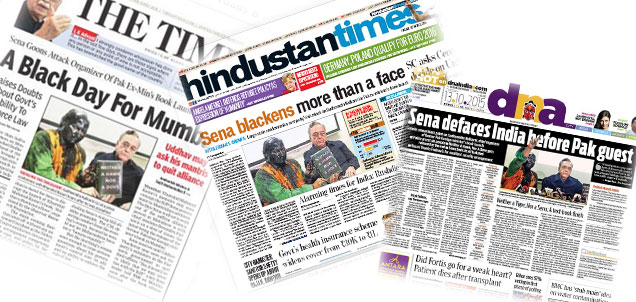
    The attack on Sudheendra Kulkarni, former speechwriter for LK Advani and member of the PMO under AB Vajpayee, has been the second event for the media to stand together. Here though the situation is more nuanced. Kulkarni was warned by the Shiv Sena not to hold an event to launch former Pakistan foreign minister Khurshid Kasuri’s book Neither a Hawk Nor a Dove at the Nehru Centre in Mumbai.


    The Shiv Sena has long had a tradition of objecting to and disrupting events which feature Pakistanis. There is nothing new in this. Only last week they got organisers to cancel a concert featuring Pakistani ghazal singer Ghulam Ali. Since Kulkarni and the Observer Research Foundation and Kulkarni decided to go ahead with the event, Shiv Sena activists acted in the way they know best: as hooligans.


    That the Shiv Sena is part of the BJP government in Maharashtra and an ally at the Centre is one more embarrassment which the media has been quick to pick up on. Condemnation however was universal, which is welcome.


    What the media may well come to realise – and I am not holding my breath here – is that its first role has to be to question the governments in power. Every time it has not done this, whether in the past or now, it has failed. The current government, it has to be understood, is no different from any other, regardless of the size of its mandate. When he became prime minister Rajiv Gandhi, who got the biggest mandate ever, soon realised that admiration can become criticism very quickly when large promises about changing the system vanish when the system hits back.


    Some of that is happening now and the media would be wise to wake up.


  • Sanjeev Kotnala: Oh, these morons!

    By Sanjeev Kotnala


    Media brands in the B2B space take their business communication and related messaging very seriously. While I do not expect them to evolve to H2H conversation anytime in the near future, the fact remains that they do consider their B2B initiatives a very important part of their selling process.


    Media trade magazines are already thick with peak season advertising from a variety of media houses (in addition to e-mailers that have been pouring in).  I couldn’t help but bemoan yet again about something that has always bothered me.  Media brands believe in simple messaging. Which is good in principle, but it’s the manner in which they go about it that gets my goat. Media advertising during seasons always reminds me of announcements blaring through loudspeakers at a village mela. Ads that have been created without ever taxing a single grey cell, spewing out advertising that is totally devoid of engagement or involvement.


    It begins just before the busy and decisive festival period. In your face. Almost every media house worth your rupee begins screaming its guts out about being No 1, superhero, superman, God’s gift to mankind and the world’s most powerful remedy for all the ills your brand may be suffering from. And, amazingly, all this just days before ROs will be printed. Just days before the year’s most important season for advertising. Like touts at a pilgrimage centre, crowding around to stake a last minute claim for business.


    Ironicallym these are usually the very same media houses that cry in despair at clients not being present in media through out the year. When it comes to their own brands they seem to be good with this last minute, repetitive, irritatingly loud messages delivered in bulk. Do these media houses really believe that these last-minute loud claims work? Or are these ads placed by media houses supposed to act as confidence boosters for their own sales force? If so, do these sales teams really believe a six-page gatefold in a leading trade magazine would miraculously force a revision in the year’s most important media plan of a client? At T-minus 3 days to release?


    Let’s take Hindustan, it asks a very pertinent question- Can you afford to miss me? And as an after-thought, it presents some data about exclusive readers and decision-makers (25-40?), female and male readership in comparison to Amar Ujala in Uttar Pradesh. It tells you in no uncertain terms, one-subject-at-a-time, the “exclusive readership”, of Hindustan in each category.


    Was there something that I was missing? Is Hindustan really being missed from the plans?  Is this ad a result of market intelligence that probably said Hindustan was out off many media plans because all planners decided (“very wrongly”) that Amar Ujala had more “exclusive readers”? Whatever the reasons may have been, the ad itself is rendered in such an unimaginative way that it is certain to fail in inducing any reaction in trade.


    Malayala Manorama has usually impressed me with their communication. But this time I simply had to do a face-palm! ‘The Champion just became the Overall Champion”. ‘’The Leader just became a Record-breaking Leader”. ‘The Winner just became a Winner by Knock-out”. ‘The Number 1 just became The Absolute Number No.1”. Duh? And then we expect brand planners and clients to take them seriously?


    Even if such advertising is simply intended as ammunition for their sales teams, should it not matter what the message or creative conveys? May be they think they are talking to morons and as long as these ads get some basic exposure the message will filter in. If at all there is exposure, it is the exposure of an extremely lazy media brand. Wonder what they smoke. Sadly the list of such lazy brands is a long and depressingly lengthy one.


    So are there absolutely no media brands that have caught my eye this year? A couple did indeed. My FM, for one. This Tier-II radio brand usually comes up with good brand and category-centric work. Not that they do superlative standout stuff, but there is always certain freshness to their work. This season they have used two creative leaders to make a media statement that is laced with possibilities. They could have done with better art direction, though. The brand stands out with a consistency in brand colours, tonality and voice that is becoming rare these days. The interview format is reader-friendly and relevant. It speaks to and simultaneously challenges the creative, media and marketing fraternities.


    (Taking the thought further, believe industry gains when Industry seniors share their take on media capabilities and potential. Media association like IBF, INS etc are better placed to act on it then a media brand.  These observations then could be amplified across stakeholders, including one’s not residing in metros. )


    Media brands need to stop shouting themselves hoarse with their claims. It is not going to win the battle of wallet-share.  Media brands put disproportionate focus on this shouting. They forget that the media brands are made in the area they service. Marketing in addition to the numeric advantages, need to amplify the brands interface, trust, and faith and fit with the audience. Thus giving planner, buyers and advertisers a reason to  evaluate their strategy. The  brands today must be rationally emotional and memorable for them to resonate with the  morons.


    Sanjeev Kotnala is Founder at Intradia World. A Brand, Marketing &  Management UnConsult Advisor. He conducts specialised workshops in the area of IDEATION (Harvest and Liberate) and Innovation (InNoWait). He focuses energy in enhancing client’s internal team’s potential and capabilities. In process decreasing their dependence  on external resources. To connect email sanjeev@intradia.in  or tweet at s_kotnala visit www.intradia.in  www.sanjeevkotnala.com. The views expressed here are his own.