Category: COLUMNS

  • Ranjona Banerji: No commentators beyond cricket in our country

    By Ranjona Banerji


    Sports coverage can be easily be one of those please-nobody pitfalls. It is extremely difficult for commentators for instance to say anything very much different about how someone hits a ball, whether with their feet, heads, bats and racquets innumerable times in the course of a few hours. Innovation therefore is sometimes called for. But to do that effectively, you have to understand your fans. Like the Olympic scoring system in events like figure skating and gymnastics, lop off the highest (uncritical) and lowest (never satisfied) scores and go with the rest.


    But if you really want to know how to get it wrong then Sony Six’s pre-match shows for the FIFA World Cup is the way to go. Having got the rights to this prestigious event, Sony Six obviously wanted to go all out. But it took the cricket or rather IPL route and decided that India’s football fans wanted nothing more than a bit of Bollywood glamour (John Abraham) and IPL sham (anchor Gaurav Kapoor). The show, called Cafe Rio, also had two former international footballers (just about), Peter Crouch and Mikael Silvestre as well a girl in designer togs and Keith Sequeira mispronouncing as many football names as he did tennis names on another sports channel.


    Fans were appalled from Day One. Football is not cricket – okay that sounds like a meaningless truism but in India at least, football has a small but dedicated following. The love for cricket has encompassed the tawdry glitter of the IPL as well as the intellectually challenging Test match. Football fans know their football and they know that they want. Pap and rubbish are not included in that list.


    Twitter led the campaign against the show and someone even started a petition to get Gaurav Kapoor (who was also joined by VJ Nikhil Chinappa) off the show. Eventually, Sony Six responded and changed the names around leading apparently to an uneasy compromise between fan feelings and available talent.


    The problem for Sony Six is easy to understand. India is not yet a sporting nation. This means that we do not have enough experts in enough fields except cricket. Getting commentators becomes extremely difficult when our expertise at the international level is so limited in possibly everything. As of now, we excel internationally – one uses the word liberally – in cricket, tennis and badminton. Our potential experts are still out there playing. Who then to commentate? Would a dedicated fan of any sport accept a player who has not even played internationally? Or a coach whose protégé has gone nowhere? Barring hockey – where our glorious past means we have several experts even Olympians around if we want them – or maybe snooker and billiards, where is our talent pool? And for football, possibly the world’s biggest sport? For viewers who are used year round to hear experts during the EPL, Champions League, La Liga and so on to be subjected to the bumbling rubbish of another fan who perhaps knows less than them during the sport’s biggest event? Unacceptable!


    Tennis fans for instance have been reduced to gales of laughter listening to Charu Sharma struggle to find the right terminology at the Chennai Open!


    Talking of tennis, one has to be grateful that Sony Six got the rights to the FIFA World Cup so that we can watch Wimbledon in peace on the Star Sports network, unlike four years ago. I have no idea why Vijay Amritraj and Alan Wilkins are not doing the commentary themselves this year. I for one am not disappointed but I know others who are. Contractual problems may be or someone decided that instead of commentary from a TV set, on court commentary was better? I for one am enjoying listening to John McEnroe, Martina Navratilova, Lindsey Davenport, Tracy Austen, Tim Henman and the rest.


    Ya, experts, you know.
     

  • Ranjona Banerji: CNN-IBN is feeling the pinch post Rajdeep Sardesai

    By Ranjona Banerji


    This week, Pradyuman Maheshwari’s inestimable Mediaah! column looked at whether and how CNN-IBN will survive the exit of Rajdeep Sardesai, one of Indian television’s most familiar faces, the cult following of Arnab Goswami notwithstanding. Sardesai quit – or had to quit – a channel he started after the Reliance takeover of Network18, for those who have spent the last few months in hibernation.


    The rumour mill suggested that both Arnab Goswami (Times Now) and Barkha Dutt (NDTV) – all products of the Prannoy Roy School of Television Journalism – were approached by Reliance and Dutt is the most likely replacement. Goswami, the gossips feel, is waiting for Rupert Murdoch’s re-entry into TV news in India and the launch of the Fox channels (via India TV) for which Goswami is seen as the best fit. A segue from the blondes who overrun Fox in the US, but we in India have our own preferences. All this is still pie in the sky (or is that Sky?) stuff.


    For now, however, CNN-IBN is feeling the pinch. The whole idea of primetime TV news in India is star anchors punching each other’s guts out across the airwaves and across channels. Take the debates on the Supreme Court judgment making fatwas from Sharia courts illegal on Monday night. Nidhi Razdan on NDTV had her usual well-controlled show with intelligent analyses of the issue. Just after that finished, CNN-IBN took on the subject just after at 9 pm, a Sardesai slot. Bhupendra Chaubey now anchors the show. However, whether his guests were badly chosen (half were the same as NDTV’s) or whether he himself was trying to squeeze water out of rock, he could not manage to create a controversy. All his guests agreed with the Supreme Court while he tried to twist every argument around to no avail.


    The next debate was going to be on the increasing number of people below the poverty line in India. CNN-IBN coined the term “An Indian poor”, which ran at the bottom of the screens and then Chaubey himself said it. I did not watch the debate but I hope they had both Indian “poors” and Indian “richs” on it. I have a feeling this line was a direct translation from Hindi and my guess also is that with the changes going on at the channel even the bare minimum quality control that TV uses has vanished.


    Sardesai meanwhile in his farewell letter hoped that the new management would put journalism first. Indeed. Those old enough may want to remember the Reliance experiment with the Observer. Those young enough can believe what they want.


    A quick run through TV however shows that they remain confused about how to treat the new government. The kid gloves are still on more or less and the desperation to search for other issues to debate is evident.


    **


    Meanwhile, here’s a worthwhile subject to debate not just on TV but in society as well: The problems relating to section 498A of the Indian Penal Code and the way it is misused against men http://www.livemint.com/Politics/V1SIYdZu2IJzHgxRiLNpEJ/The-problem-with-section-498A.html


    Plus, here’s the India the Great and all those boring things editors would rather bury under mounds of newsprint while re-examining the Preity Zinta Ness Wadia fight: http://m.thehindu.com/news/national/poverty-child-maternal-deaths-high-in-india-un-report/article6188227.ece/


    **


    And for proof that journalists really are powerful you only have to look at the internet wars that broke out after a journalist asked tennis star Maria Sharapova whether she knew who Sachin Tendulkar was…


  • Ranjona Banerji: Boring & Silly Budget coverage

    By Ranjona Banerji


    NDTV threw a party, Arnab Goswami gathered his friends and relations around him and Headlines Today showcased their owner Aroon Purie plus their newest star Shekhar Gupta. CNN-IBN and NewsX stuck to the usual format. Actually they all had the usual format but the first three tweaked it a bit while the last two made no such effort.


    To listen to Union Finance Minister Arun Jaitley’s first budget you had plenty of options. There was Lok Sabha TV with just the speech. Or there was every other channel which had the speech and 8 million boxes, pop ups, scrolls and anything else that a graphic designer on a bad acid trip could come up with.


    As for the Budget itself, it soon became clear that this was a “Rs 100 crore” budget. It was also clear that I was finding it hard to stay awake. And more importantly, the stock market was less than enthused.


    Many commentators on television felt that the budget was not so very different from the budgets presented by the UPA. Most UPA schemes – damned as populist sops at election time – were retained. TV news itself veered between its current cheerleader-for-the-Modi-government mode and some small vestiges of journalistic DNA which lead to small criticisms.


    Corporate guests at TV studios have no option but to be sort of nice and positive, especially to a new government which they hope will help them. So it is unlikely that they will be objective. Some however were mildly critical. Politicians of opposition parties will of course be extremely critical, so nothing surprising there either. Politicians of parties who were once friends with the ruling party and may hope to be friends will toe the middle line – like the Biju Janata Dal.


    At the end of all that, what do you get from watching endless television on a rather boring budget speech and a budget full of tiny details – millions of schemes which have been allocated Rs 100 crore each? You get rather boring budget coverage.


    There is once again a need for the media to examine this manufactured hysteria about the annual budget of the Central government. Budget Day showed just how difficult it is to sustain coverage over an entire day and night. Most people are not interested in tweaks in various schemes and cannot understand the fine print of taxation policies. And as we know from budgets over the years, you really forget when you go out to buy bindis or bobby pins whether the 0.6 per cent cut in excise duty really made a difference to your monthly beauty budget or not.


    Business papers obviously have a duty to their readers as do business channels. I did however find it a tad amusing that business channels which spend all day discussing the minutiae of stock market trends did not dedicate the whole of July 10 focused on the rather lacklustre stockmarket response.


    **


    Possibly the funniest front page is that of the Economic Times, with Prime Minister Narendra Modi as a footballer and Arun Jaitley in a supporting role. We have over the years seen some spectacular cartoons from ET as well as some really silly ones but this football-inspired front page perhaps tops the Super Silly list? The headline however hits the ground running: “Aiming for the goal, Modi hits the crossbar”. My guess is that they got the graphic done expecting the “Acche Din” budget but got stuck with this boring one so had to improvise with the headline.


    Swaminathan S Aiyar’s front page analysis in ET was even more damning, headlined “A Chidambaram budget with saffron lipstick”. He gave it 4.5 on 10. Now that’s really rubbing salt into it.


    In the Indian Express, Arnab Goswami’s go-to-guy for Modi Rah-rahs, Meghnad The Lord Desai, called this a “UPA budget from happier days”. A backhanded compliment or a sudden need to tell it like it is?


    The opinions of Modi supporters from Columbia University are not yet in evidence, unless Arvind Panagriya and Jagdish Bhagwati were part of the Budget team? Firstpost.com was obviously complimentary though a bit upset about all the “sops” which the tax payer would have to pay for. The Wall Street Journal bloggers will soon make up the rest of the Modi’s economic support triumvirate.


    **


    There were glimmers in this Budget coverage though that sooner rather than later some in the media will drop their pompoms and get back to be being nasty and cynical.


  • Shailesh Kapoor: Bade Achhe Lagte Thhe: A Goodbye

    By Shailesh Kapoor


    Circa May 2011. In a stressful television primetime, where most hit shows were either about “smart” women trying to adjust in a challenging household, or about social issues dominant in small-town and rural India, came Ekta Kapoor’s Bade Achhe Lagte Hain (BALH). Last night, three years and more than 600 episodes later, the show bid goodbye to its audiences.


    BALH’s premise, of late marriage between a couple as different as chalk and cheese, was only mildly unique. But as episodes unfolded, it was the treatment of the subject that captivated millions across India. The show provided a mix of ingredients that made for an irresistible offering: Imaginative lead casting, a well-etched out ensemble, assured performances, crackling chemistry between the leads, lavish yet tasteful production and a lightness of treatment that was striking in the middle of countless other shows that were beinghandled with a heavy hand.


    The results were instant. The show jumped to being one of the top shows on television within weeks of its launch, with blockbuster performance in the metropolitan markets. Audiences who had actively sworn off primetime Hindi fiction went back to it, and Ram-Priya, or RaYa as they are called on social media, were the talk of the town.


    In my book, BALH remains the most influential TV launch in the last decade, along with Balika Vadhu. (Co-incidentally, the title ‘Bade Achhe Lagte Hain’ is derived from a song from the film ‘Balika Badhu’!) Its impact on primetime television was evident in the way the proportion of ‘mind fresh’ (read light-hearted) content increased across channels. Happy moments and fun side-characters were incorporated even in serious subjects, to deliver to what was commonly referred to the industry in 2011-12 as ‘BALH audiences’.


    The show also did well for the careers of many of its cast, especially Ram Kapoor. He started getting important roles in films, though his latest and most significant outing (Humshakals) was an embarrassment on all counts. Sakshi Tanwar (Priya) has been the most prominent brand endorser from the television industry over the last three years. Sumona, who played Ram’s sister, bagged the prestigious role of ‘Kapil ki biwi’ in Comedy Nights With Kapil.


    Like many other successful shows, BALH overstayed its welcome. The first generation leap it took, in mid-2012, was the start of the descent, though the introduction of a new child character (Pihu) postponed the inevitable for a few weeks. But eventually, the show lost its audience, as it began to lose the very lightness of touch it initially won the audience’s hearts for. The farewell, hence, was only a foregone conclusion.The show ends to make way for Amitabh Bachchan’s Yudh.


    Yet, in its golden period that lasted about a year, BALH gave us many memorable moments, including a delightful honeymoon schedule in Australia. It also gave us the first real kiss on primetime television in India, an event that took the social media by storm, even as the audiences struggled to come to terms with the shock of seeing a lip-lock in the primetime.


    I can’t say I will miss Bade Achhe Lagte Hain, because that will need going back to 2012. But I hope we see more of its ilk – shows that can shape the future of primetime television in India for the better.


    Bade Achhe Lagte Thhe!


    TV Trails is a weekly column written by Shailesh Kapoor, founder and CEO of media insights firm Ormax Media. He spent nine years in the television industry before turning entrepreneur. The views expressed here are his own. He can be reached at his Twitter handle @shaileshkapoor


  • Ranjona Banerji: Inhouse ‘censors’ may police TV newsrooms

    By Ranjona Banerji


    The media world is now rife with rumours and most of them are frightening. The Adani group has apparently invested Rs 500 crore in NDTV. The Adani group is of course close to Prime Minister Narendra Modi. Reliance, which has now been placed firmly in the Modi camp by media watchers, already owns Network18. Now there are whispers in the wind that Reliance also wants to buy the newspaper DNA, which currently belongs to the Zee group, although that may not change the paper’s political affiliation much since it tilted to the right after Zee took over from the Agarwals of Dainik Bhaskar.


    CNN-IBN has, it is said, introduced a novel new designation in its newsroom – the “escalation editor”. This person will look at how news is covered and decided whether a story needs to be pushed further (escalated) or killed (de-escalated, presumably). This new designation is probably because we do not already have enough jargon in journalism. Or, no one in TV or Reliance has heard of a news editor. The first “escalation editor” is Umesh Upadhyaya, whose brother is a member of the Bharatiya Janata Party. Who knows if that is significant or not? In the old days, this sort of “escalation editor” spying and swanning about the newsroom was known as the “malik ka aadmi” and most journalists tried to give them a wide berth. I know nothing about Umesh Upadhayaya. The “malik ka aadmi”s I have met however were usually lacking in even basic journalistic skills but were very good at sucking up to the owners and throwing their weight around based on their proximity to said owners.


    However, any daft move in journalism in India and you can look to Bennett Coleman. Anyone remember the “brand managers” in the 1990s who would spy on editorial staff and pull rank over editors in the Times of India because they had the ear of the VC? Some of those even went on to become journalists…


    The story is that all TV newsrooms will or already have these in house “censors” whose job will be to ensure that the new government and the new PM are not targeted. Of course, it must be said that these are still rumours and that boring but necessary wait-and-watch course of action will have to suffice for now. The hope was when Reliance took over Network18 that the mistakes with the Business and Political Observer would not be repeated. The appointment of this “escalation editor” though raises more suspicion than hope.


    **


    Is all this just scare-mongering? Can we expect journalists and media houses to get over its early flirtation with the new dispensation and get back to work as usual again? The media’s job is to question and in spite of the large number of columnists who appear to support Narendra Modi and the BJP, there are still those who do not and those who have not yet taken sides. Certainly, Arun Jaitley’s lacklustre budget was criticised by many, even those who appeared to be supporters.


    It is not just about individuals though. It is the general trend which is frightening and certainly conversations with senior Delhi journalists increase these apprehensions. Anyone who knows Modi knows that he does not like dissent and does not like to be questioned. He has a massive ego and a massive desire to be seen as a “statesman”. How far this ambition will enter into conflict with his personality is what journalists have to look out for. As for those English-speaking journalists who have appointed themselves as his PR agents in print, on TV and in the social media, one fears that their hopes and dreams may not be fully realised…


  • Shailesh Kapoor: Yo Yo Honey Singh: TV’s Latest Superstar

    By Shailesh Kapoor


    Last week’s TV ratings released yesterday, saw Colors take the No 3 spot again. A quick look at the programme performance revealed that a key contributor to their small but significant growth was the Comedy Nights With Kapil episode telecast on July 6. That episode rated a cool 63% more than the average performance of the show over the last month. So who featured in this magic episode that broke all rules of momentum? Salman Khan? Shahrukh Khan?


    The answer is: Yo Yo Honey Singh.


    Yes, the singer-composer-performer, famous for his innovative (some may call them cheesy) rap numbers, and infamous for misogynistic lyrics from his past, is now a television star too. When you have 63% impact on TV ratings, you are a real mass star, someone who has the ability to influence audiences across markets and age groups.


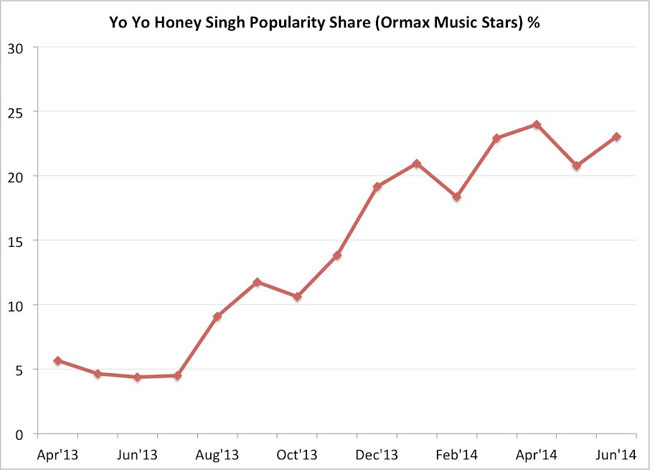
    Yo Yo Honey Singh’s popularity has grown dramatically over the last year, since the launch of Lungi Dance (Chennai Express) in end July 2013. The chart below, based on Ormax Music Stars, a popularity rating of singers, composers and lyricists, shows how his popularity share has grown from 4% before Lungi Dance to 23% today.


    The Comedy Nights episode in question (watch here) gives an insight into why the man is so popular. There is a natural ‘rockstar’ attitude he exudes, and when combined with his ability to use contemporary language in his lyrics, it makes for a heady combination.


    Often questioned about the use of ‘risqué’ lyrics in his songs, especially those involving liquor and ‘objectification’ of women, Honey Singh has been very forthcoming in his answers, be in Anupama Chopra’s show earlier this year or the Comedy Nights episode linked above. He maintains a consistent line of argument, suggesting that his lyrics are potentially no less controversial than some of the classic melodies of the past, but for their use of modern lingo making them come across as such.


    Criticism, especially from the media and the elite, has rarely affected mass stars. With his ever-growing popularity among kids, teenagers and youth, and a widening net extending to markets outside North India, Yo Yo Honey Singh probably considers the criticism an integral part of his image, and not necessarily a negative part.


    A quick visit to his Facebook page gives us a validation of his popularity. 22 million fans is no mean feat. But the mention of “business agents & contacts” on the masthead tells you that he’s still coming to terms with his stardom. Imagine Ranbir Kapoor or Alia Bhatt putting their agent details on the social media?


    But this element of ‘tackinesus’ may have worked in Honey Singh’s favor, finding him fans in the masses, even as most young stars, ranging from singers (Arijit Singh) and actors (Siddharth Malhotra) continue to be driven by the bigger cities.


    Star Plus is launching Raw Star with Honey Singh soon. Given their overall dominance, the channel’s non-fiction record in recent years has bordered on being embarrassing. But they now have solid ammunition at their disposal: The TV star who can give 63% jump in ratings of a long-running show. Ironically then, the Comedy Nights ratings would have probably led to more celebrations at Star than at Colors.


    I hope our media gives Yo Yo Honey Singh more coverage. Else, we may be missing out on some very insightful stories around the making of a superstar.


    TV Trails is a weekly column written by Shailesh Kapoor, founder and CEO of media insights firm Ormax Media. He spent nine years in the television industry before turning entrepreneur. The views expressed here are his own. He can be reached at his Twitter handle @shaileshkapoor


  • Ranjona Banerji: More scrutiny by the media

    By Ranjona Banerji


    Ever since the gangrape of a young woman in Delhi in December 2012, the Indian media has put the uncomfortable and often unpalatable topic of rape on primetime and on the frontpage. There is no sign that the incidence of rape has reduced in India. In fact, we hear more gruesome stories every day. But the relentless presence of the media – even in areas where the media used to scarce and it was easy to get away with murder and rape – has meant that we know more and more about the society we live in.


    The past few days have been full of horrific stories – a woman tortured and raped in UP, a six-year-old girl raped in a posh Bengaluru school by a teacher, a two-year-old girl raped by a 30-year-old man in Madhya Pradesh. In spite of all the other stories jostling for news space, none of these have been ignored.


    The media has to be commended on this. There is a lot of cynicism in newsrooms, an understandable by-product of the exigencies of the job. Horrors are a constant and decisions have to be made almost every five minutes about what to hold and what to play up. Rape, ignored perhaps for too long, is now top of the agenda. Is there any cynicism involved in focusing on rape? If there is, the end product is more worthwhile than the intentions. The constant media spotlight on rape has exposed the misogyny and the callousness of our police forces and our politicians.


    The media cannot find answers and cannot be expected to. But it can force society to take a closer look at itself and what it puts up with.


    **


    Markandey Katju, former justice of the Supreme Court and still (?) chairman of the Press Council of India, has been out of the news for a very long time. After a few initial grandstanding announcements about how he was going to sort out India’s media, we have been treated to silence and no action. Suddenly, however, he has captured media space by attacking the judiciary and the former UPA government with an account published in The Times of India of how an additional judge in Tamil Nadu kept his job thanks to political pressure in spite of a damning Intelligence Bureau report.


    Katju was questioned on his timing by several legal professionals and journalists and chose to pull out his ear piece and stalk off in high dudgeon when questioned by Nidhi Razdan of NDTV who is not aggressive or rude by any stretch of the imagination. So obviously a touchy point and touchy points make for good television.


    The lesson for the media here is perhaps more exacting scrutiny on our judicial system. Concepts of respect and worship do not belong in a newsroom. If systems are crumbling around us, then the media needs to be more not less alert.


    **


    Talking about crumbling, is that what is happening to the world around us? The international media is running hysterically between Ukraine-MH17, Israel-Gaza-Palestine and ISIS-Iraq. Biases are seen by all sides and all too often, the television that we see in India seems to be channels that subscribe to their government lines. War, conflict and foreign affairs seem to bring out the inner patriot in journalists all over the world.


    At times like this, it’s good to reference the British war poets of the First World War who were soldiers, slammed the war in some brilliant poetry and died fighting. We have brains, sometimes we should use them.


  • Ranjona Banerji: Right or not, Arnab Goswami?

    By Ranjona Banerji


    The jury was in when it came to Arnab Goswami’s political affiliations. And now it’s out again. For a good part of this week, Goswami and Times Now have taken great affront to the behaviour of the Shiv Sena MPs who forced a Muslim fasting for Ramzan to eat a chapati, then to BJP MP K Laxman’s comments on tennis star Sania Mirza being unfit to be brand ambassador for Telangana and finally Goa minister Deepak Dhavilkar of the BJP’s alliance partner Maharashtra Gomantak Party declaring that Narendra Modi will make India a Hindu state. Times Now and Goswami are tagging these comments “#RightWingFreeRun” and claiming that they go against the BJP/NDA promise of an inclusive India.


    Comments on social media are now asking whether Goswami was really as rightwing as he appeared to be when the BJP and Narendra Modi were sworn in to power. Perhaps he is behaving like a journalist again and attacking the establishment. Or perhaps he realised that hero worship can go so far and no further. Or perhaps he still tilts towards the BJP in his personal capacity but feels that this sectarian and divisive behaviour is unacceptable. Since nobody knows, perhaps Goswami as India’s best known TV journalist, needs to start writing a column so his fan club knows what he thinks?


    Alternatively, as I have long felt, he needs to give himself an hour-long programme where he and only he speaks. This could be a weekly affair like FDR’s fireside chats to the American nation. The prime minister doesn’t speak in spite of slamming the last prime minister for not speaking so it might as well be Goswami leading the nation. There is one more option: a nightly rant in front of a studio audience on the lines of Howard Beale in the brilliant 1976 classic media film, Network. We shall ignore for now the end of the movie.


    **


    The media has played the Shiv Sena MPs issue in two ways. Times Now has seen the Sena’s actions are being distinctly communal since the man who was fed the chapatti clearly says that he is a Muslim fasting for Ramzan, says the channel, and he also had a name tag reading “Arshad” on his uniform. Other channels like NDTV wondered whether we should not concentrate on the Sena’s hooligan-like behaviour: forcing anyone to eat as a protest shows not just disrespect to another human being but is also conduct unbecoming. Members of Parliament should deport themselves in a more dignified manner.


    It is possible however that both points of view are correct. MPs must behave properly and forcing a person fasting for religious reasons to eat is communal. If Arshad had been a Hindu fasting for some reason, forcefeeding him would also be communal.


    **


    Meanwhile, former Supreme Court justice Markandey Katju’s allegations against the UPA and three Supreme Court chief justices over the appointment of a judge accused of corruption by an IB report has gone off TV and towards edit page land. The issue will now be forgotten.


    Katju, who made great waves with his off the cuff remarks when he became chairman of the Press Council of India, has done absolutely nothing ever since and was therefore out of the news. He found a way to get back in but alas, events overtook him.


    What did happen though to all those changes he was going to bring to the Indian media?


    **


    The Hindu, from being India’s most venerable newspaper, has lately found itself in the news for all the wrong reasons. Family squabbles, high profile editorial sackings, strict vegetarian rules all over the premises and confusion over its political stance. The most recent fracas has been the removal of editors like P Sainath and Praveen Swamy. Working at The Hindu is like working for Pol Pot apparently said one resignation letter. The Hindu’s explanation: These two did not fit their roles. Indeed.


  • Shailesh Kapoor: Pro Kabaddi: A Giant Leap for a Dying Sport?

    By Shailesh Kapoor


    When I first learnt that Star Sports are investing in Kabaddi, I rubbed my eyes in disbelief. A wrestling league, or even a boxing league, would seem like a good idea, given the talk value around these sports in recent years, especially in the wake of India’s creditable performance at the global stage, including the 2012 London Olympics. But Kabaddi?


    India has monopolized the sport at the Asian Games, winning all seven golds since its introduction in the event in 1990. But the primarily sub-continental sport has not found many takers outside South Asia. Awareness of the sport is very low amongst young audiences, many of who confuse it with the traditional Indian (dying) sport of Kho Kho.


    Star’s decision to invest in Kabaddi, then, can be labeled as ‘high-risk’, a decision that would have to rely on exceptional execution to even find a critical audience in its first season. To their credit, having taken the decision, they have gone all guns blazing, with some good advertising and high media visibility. The simulcast on Star Sports and Star Gold will also help in widening the reach in the first year.


    But you can’t “buy” relevance and appeal for a media property. It needs to be intrinsic to the content. Hence, it was with great curiosity that I tuned into the first four games.


    My skepticism about the league has reduced considerably, say from 9/10 to 5/10, having watched the first two days of action. The last I watched Kabaddi was probably back in mid-90s. What I saw this time was strikingly different and several notches higher in entertainment than the sport I had imagined Kabaddi to be. Here’s why:


    1. Shifting from mud to mat makes the sport visually cleaner and colorful. It is far more appetizing for TV than the ‘brown sport’ I remember from the 90s.


    2. The rules have been changed to make the sport fast-moving and contemporary. There is less scope for time-wasting and the speed of action is higher than most other contact sports.


    3. Hindi and English commentary are both available. The quality of commentary is very acceptable, and there’s a lot of focus on explaining the rules in the early games, while maintaining the energy of the event.


    4. The celebrity quotient is present in good value. If it is only a function of the opening matches being in Mumbai, we will know soon. But if it sustains, the celebs would generate a lot of chatter around the league, a critical aspect in the first year.


    It’s difficult to say if these steps will be enough to make the league work. But they at least give it a chance. I believe there’s definite entertainment on offer in the league, but the ratings would tell us over the next few weeks if the young audiences across India connect with this form of entertainment.


    Even a moderately successful first year should encourage the organizers and Star to come back stronger in the second year. Other sporting leagues, including the much-hyped hockey league, have struggled to sustain themselves after a season or two. Star Sports Pro Kabaddi will hope to buck that trend.


    TV Trails is a weekly column written by Shailesh Kapoor, founder and CEO of media insights firm Ormax Media. He spent nine years in the television industry before turning entrepreneur. The views expressed here are his own. He can be reached at his Twitter handle @shaileshkapoor


  • Ranjona Banerji: Neil Harman’s tale of ‘unattributed’ content

    By Ranjona Banerji


    The story of Neil Harman, much respected tennis writer for The London Times, is a cautionary tale for all journalists. Harman has been a journalist for over 40 years and since 2002, was the chief tennis correspondent for that newspaper. Earlier, he was chief football writer for the Daily Mail. To many, he was known as “Mr Tennis”.


    Since 2004, Harman was contracted to write the official annual for Wimbledon, tennis’s most revered tournament. But in 2013, the magazine Private Eye revealed that the annual was full of whole-scale copying from the works of other writers. The matter was taken to a head by journalist Ben Rothenberg writing for Slate magazine who went through several annuals to find over 50 instances of direct lifts from other writers. The publications most targeted were Sports Illustrated, particularly articles by Jon Wertheim, the Guardian and The New York Times. These are by any stretch very well-known and much-read publications. Rothenberg lays bare the extent of the copying: “Of these 52 examples, 28 of the passages were lifted from the Guardian. Six were from the New York Times, five from either the Times of London or the Sunday Times, four from Sports Illustrated, four from the Telegraph, four from the Independent, and one from the New York Daily News.”


    Wimbledon only removed the 2013 annual from its shelves after Wertheim complained. Many writers said they did not know about copying because they had not read the annual. Harman admitted to the plagiarism in an email to the International Tennis Writers’ Association which he had co-founded. The wording however is distinctly odd: “It has been brought to my attention that I have severely compromised my position as a member, having used unattributed material to form part of my writing of the Wimbledon Yearbook. There can be no excuse for such shoddy work, which I deeply regret. I did it without malice aforethought, but that I did it at all is simply inexcusable.”


    The words “it has been brought to my attention” are a curious way of admitting fault… Many of Harman’s supporters feel that Harman himself was not to blame but an intern may have done the copying.


    This is a ready copout answer made by most senior journalists and writers who have been found guilty of plagiarism. Incompetent interns however are not a new phenomenon and nor is this a problem which cannot be foreseen. It is also a very convenient horse to flog. To Harman’s credit, he has not used this excuse – although we can here go back to the line “it has been brought to my attention… It is also not inconceivable that Harman himself did not do the actual lifting of so many paragraphs. But the final responsibility is his and since it is he who took the glory, he also has to take the muck.


    The Times has suspended Harman pending enquiries – but this was only after Rothenberg’s articles caused a storm in the tennis world and on twitter. The Guardian has since alleged that The Times is not taking the charges seriously as Harman’s writing is still being carried in the paper.


    Many American journalists have said that if they had been caught with their hands in someone else’s words, they would have got the sack immediately. Harman seems to have survived as far as his employer is concerned – so far at least – but he has done his reputation incalculable damage. With all such cases, it seems incredible that Harman did not just credit those whose words he was using. It would have taken nothing away from the annuals, would have enhanced his reputation and made him more friends.


    Instead, he has laid himself open to this: http://deadspin.com/respected-tennis-writer-cops-to-plagiarism-theres-like-1609661132/1609820603/+Tom_Ley


    And who can say that he does not deserve it?


  • Shailesh Kapoor: Too Much Oxytocin on TV? Try Adrenaline

    By Shailesh Kapoor


    If you have been watching Star Plus’ Mahabharat, you would know that the worthy show is nearing a worthy conclusion soon. The story is currently in the latter half of the epic Kurukshetra war, though the mindgames off the battlefield are equally, if not more, intriguing.


    The sudden and decisive jump in Mahabharat’s ratings over the last two weeks has been heartening to see. From averaging 3.1 TVR in Week 25-28, the show jumped to 4.4 TVR in Week 29, and has held onto that number in Week 30 too. This is the period when the battle has gathered steam, and stalwarts like Abhimanyu, Bhishma and Drona have been killed, but not before providing high drama and excitement.


    Conventional television wisdom may suggest that war scenes are not the most TV-friendly content, especially in the Indian context, where GEC viewing is still largely family-led. I’m not sure if Indian parents would want their children to see Bheem drinking Dushasana’s blood. Wars are essentially violent, and that female audiences have low thresholds for violence is a universally proven fact, both via research and science.


    Yet, war is working. Not just in Mahabharat, but recent war sequences in Jodha Akbar and Maharana Pratap too have managed to pull in new audiences, and engage the existing audiences better. There could be several reasons for this, but the one I find particularly strong resonance in is: Adrenaline.


    Several years ago, I heard a channel programming head remark: “Television is all about hormones”. The line has stayed with me ever since. It has eternal relevance, because it is based on how we, the human beings, are made.


    Some recent work made me read up more on various hormones and their functions. I was seeking correlation with their impact on television and film content. Essentially, almost all the explanation came down to three hormones – oxytocin (the love hormone), endorphins (stress-reducing or the happy hormone) and adrenaline.


    More than 90% of successful television and film content can be explained using one (or a combination) of these three hormones. Oxytocin gets its due when we speak of romance, chemistry and falling in love. Its impact extends to love that may not be “romantic” in nature, like a warm hug given by a mother to her child.


    Endorphins reduce stress, and the comedy genre is known to activate the release of this set of hormones. Indian audiences have even coined a phrase for it, something that everyone who works with us is familiar with: Mind Fresh.


    But adrenaline has been generally ignored. Being more “outdoorsy” in nature, this hormone tends to link closely to male content preferences, than those of female audiences in India. But increasingly, its impact is being observed in our work. This impact was strong enough for us to include the impact of adrenaline as a separate parameter in our content testing tool Ormax True Value earlier this year.


    If you have been following the Commonwealth Games closely, you would have noticed that weightlifters are given a sniff of adrenaline by their coaches just before they step forward to make their lift. A battle scene, if executed well, can provide a milder form of that rush to the audience at home. (I have never sniffed that adrenaline, so not quite sure of the comparison. Wonder why it is even legal for lifters to do that!)


    Indian content makers and analysts have ignored adrenaline for a while now, probably because execution capabilities to deliver the rush were missing in this marketplace. But that may be changing fast.


    It’s time the ‘josh’ hormone got its due!


    TV Trails is a weekly column written by Shailesh Kapoor, founder and CEO of media insights firm Ormax Media. He spent nine years in the television industry before turning entrepreneur. The views expressed here are his own. He can be reached at his Twitter handle @shaileshkapoor


  • Ranjona Banerji: The Curious Tweets of Gaurav Sawant

    By Ranjona Banerji


    The curious case of Gaurav Sawant, strategic affairs editor at Headlines Today and his tweets about rioting Muslims continues to outrage two sections of the twitterati and leave the media itself indifferent.


    Sawant put out a series of tweets about the riots in Saharanpur claiming that “secular silence” had influenced the media not to mention that Muslims had attacked Sikhs and a Gurudwara in Saharanpur and some Muslims had indeed been arrested: “Secular silence as dangerous as communal violence! Covering up sins of one & highlighting crimes of other by ‘seculars’ is playing with fire 11:23 AM – 27 Jul 2014”


    He went on to say: “When an IT professional was killed in Pune we screamed about his religion. Why is religion of those killed in Saharanpur a state secret?”


    And then, “National crisis when a roze-dar is force fed a roti but no issue when Roze-dars gather outside a place of religious worship & riots start?”


    Plus: “That explains the secular silence on Saharanpur riots. Roze par roti becomes headlines but Roze par riots does not.”


    These tweets led to massive outrage from what is called the “secular” brigade on social media which felt that Sawant was demonstrating a Hindu rightwing bias and even went as far as to say he should be sacked. At the same time there was a counter swell of support from those who felt that Sawant had been brave enough to tell the truth and that he was being targeted as a result by said seculars who only care about the rights of Muslims. Many Hindutva rightwing blogs discussed Sawant’s situation with sympathy.


    Sawant later deleted some of these tweets. Gossip among the Hindutva blogs and among some media professionals said that Shekhar Gupta, who has just taken over as vice-chairman of the India Today group which includes Headlines Today, forced Sawant to delete his tweets. Sawant has also apparently not been seen on TV since. The “secular” side got together a petition asking that Sawant be shown the door.


    Whether Sawant has been on air or not (I do know this firsthand), he continues to tweet, some of which are promos for shows on Headlines Today.


    Rajdeep Sardesai, lately editor-in-chief of CNNIBN, was one prominent journalist who took issue with the tenor of Sawant’s tweets. Rupa Subramanya, a very popular tweeter (am unclear whether she is a journalist but she is a writer) found that Sawant was exactly the kind of journalist India needed.


    The Times of India did a story on the outrage over Sawant’s tweets (warning, I am quoted) http://epaperbeta.timesofindia.com/Article.aspx?eid=31804&articlexml=Outrage-over-TV-anchors-tweets-31072014009037


    and http://epaperbeta.timesofindia.com/Gallery.aspx?id=31_07_2014_009_037_007&type=P&artUrl=Outrage-over-TV-anchors-tweets-31072014009037&eid=3180


    While Newslaundry had this: http://www.newslaundry.com/2014/07/28/the-secular-compulsions-of-reporting-communal-clashes/


    There are number of different issues floating around here, all fighting for attention. The first is the most obvious. Sawant has every right to express his opinion, no matter whether other people find it offensive. The second is that right to object is also inarguable but petitioning to attack someone’s livelihood based on a series of tweets is unacceptable.


    Then we reach the murky area of “secularism”. The tragedy is that that the word in India is often interpreted to mean “pro Muslim” especially by the rightwing thus making a travesty of secularism.


    Left-leaning liberals are seen as the worst offenders by the Hindutva-led rightwing, as they apparently refuse to criticise anything that Muslims – and sometimes other minorities too – and only attack Hindus.


    Most of the anger with Sawant however was not that he slammed “secular silence” but that he connected two or three unrelated events and decided that there was a media conspiracy concocted by evil “seculars” to keep quiet about Saharanpur where Muslims were the perpetrators but play up the murder of a Muslim man in Pune (for being a Muslim) and the assault on a canteen manager (A Muslim fasting for Ramzan) by a politician (from a party known for its er, ambivalent attitude to Muslims).


    However, Sawant still has a right to his views and it is unfortunate that he deleted his tweets and even more unfortunate if it was done under pressure. No official word on that so far, not least from Sawant.


    It is odd though why the Strategic Affairs editor (sounds impressive) of a prominent English news channel could not get his newsroom to spin the news anyway he wanted? If Sawant felt that there was “secular silence” on the Saharanpur riots, Headlines Today could have been the beacon showing the way to the rest of the evil “pro Muslim” media.


    The newspapers that I read on the issue did mention that Muslims had started the problem in Saharanpur and that some had been arrested. Did Sawant miss those? Or did he want hysterical prime time discussions on TV? Were his tweets a sign of frustration that he failed to convince the other editors of Headlines Today to showcase the news his way?


    Once more therefore we find the Indian media in the midst of a “seculars” versus others fracas. And it is also true that for most of the Indian media, Sawant’s problems appear to be a non-issue. Perhaps we can wait for the book?