 By Sanjeev Kotnala  The International Advertising Association India Chapter’s Silver Jubilee Summit ended at Kochi with a bang. It was almost like a mini-AdAsia, but with much better content. All sessions were rich in content and context. They referred often to global examples, but the talks were tailored to the Indian experience and relevance.  The tempo was set on the inaugural day by a much-appreciated session by Amitabh Kant, on Branding India. The format — banking on keynote speakers to deliver precise and focussed content, rather than have a panel discussion — was a huge success. A 50:50 mix of Indian and foreign speakers delivered engaging messages on ‘What’s coming next’, which was the theme of the summit.  The presentations that brought the house to attention were ‘Make your own change- designing the future you want’ by Cindy Gallop, founder of MakeLoveNotPorn; ‘Technology as an Aggregator’, by Parminder Singh, MD Twitter (SE Asia/India/MENA); ‘How programmatic works’ by Michel de Rjik, CEO Xasis Asia pacific and ‘Meet the Champion Disruptor’, a conversation with Ritesh Agarwal, Founder of OYO Rooms.  One must make special mention of Ralph Simon, Chairman and CEO, Mobilium Global Group who incorporated local nuances and current Indian topics (even delivered in Hindi) while speaking on ‘What’s coming next to brands and products through Mobile’.  In India, three things work the best: Cinema, cricket and politics/religion. The summit had elements of all three with sessions by Shah Rukh Khan, Sachin Tendulkar and Sadguru Jaggi Vasudev.  Not to forget the mega-evening at Bolgatty Palace by Mathrabhumi. It was a provided a rich experience of Kerala culture, street cuisine and hospitality. Kudos to the IAA team for arranging lovely hotel packages and a reasonable delegation fee structure that ensured a lot of regular people – including students from Kerala — could attend. It was a pleasant surprise to find most of the sessions sticking to the time limit.  If I rank the summit a nine out of 10, rather than give it full marks, there are three reasons for it. First, because of the lack of effective Wifi access. Second, for cutting short many talks on Day 3 only to allow Arnab Goswami a lengthy session on ‘Why I chose to disrupt TV News’, which was already covered at Goafest. And third, for not inviting me to the Chill Room! 🙂  Sanjeev Kotnala is a senior media and marketing/brand strategy consultant. This article first appeared in dna of brands dated September 7, 2015
Category: SANJEEV KOTNALA
-
All sessions were rich in content and context, and were tailored to the Indian experience and relevance, writes Sanjeev Kotnala Sanjeev Kotnala: Mini-AdAsia, only much better!
-
While I don't have any issues with the current set of officebearers, my humble proposition is to ensure some succession plan for the legacy to bear fruits, writes Sanjeev Kotnala Sanjeev Kotnala: Think we need ‘Young Talent’ quota in industry associations
By Sanjeev Kotnala‘Quota’ is in the air and you can shout out the word loudly without being in a minority. It is time that we take this opportunity for pushing something selfless in our agenda.
Before you get me wrong, here is the disclaimer. My focus is to appreciate the relentless selfless industry service by a set of people in advertising and marketing industry bodies. These men and women of exceptional calibre have given their best years to it. They have magically been able to find time to do all this pro bono. They have sacrificed their family and at times professional life at the altar of the responsibilities they hold. They have time and again leveraged their personal network to add meaning to industry events. My head bows in deep respect. I sincerely appreciate their effort.
My humble proposition is to ensure some succession plan for the legacy to bear fruits. It’s vital to plan to groom and later hand over the baton to the next generation. Â Hopefully, it will truly reflect the industry’s growing youth composition. In the process we may get to invite new thoughts, ideas and energies and may redesign the whole agenda. I know this is a wishful thinking.
No, I do not have any issue with the current set of officebearers. In fact in last three years we have seen a lot more action and inclusiveness in the processes, events and working at all the main industry bodies. Three cheers to that! Yet, I don’t know why but it always seemed like a game of musical chairs is being played.
I am sure it is not a reflection of dearth of talent and potential leaders in the industry. There always are people with enough suicidal streaks to love to take on position that only brings in criticism. It takes a lot more of you than it can ever give you back.
Positions like chairman, president, treasurer and secretary need experience and proven performance. They magically remain uncontested. But even at the cost of reframing and expanding the base, industry bodies may look at a quota for Under-30 and 30-40 years of age for executive members. We may consider even years of relevant experience as qualifier. Which could works better. In fact the voyeuristic b*****d in me is panting to see elections fought for these positions.
The young leaders will get groomed and battle-scarred. They will learn by taking small opportunities and challenges providing for smooth change of guard at a later date.  There are not many young leaders who are interested in this call for selfless dedicated work. May be quotas will enthuse them to join in. Many after experiencing the brickbats and ‘no thanks’ that comes with that will drop out. The ones who stand by this test by fire shall be the ones who will help take the industry bodies further.
Sanjeev Kotnala is Founder and Head Catalyst at Intradia. A brand, marketing and management advisor, he conducts specialised workshops in the area of IDEATION (Harvest and Liberate) and Innovation (InNoWait). His focus energy in enhancing client’s internal team’s potential and capabilities and in the process, decreasing their dependence on external resources. To contact email sanjeev@intradia.in  or tweet at s_kotnala visit www.intradia.in www.sanjeevkotnala.com. The views expressed here are his own.
-
CSR idea should be one of the core elements of the organisation, that no incoming CMO can change it easily like they do with the brand, writes Sanjeev Kotnala Sanjeev Kotnala: CSR: the marketing tool to leverage internal force with a brand synergistic act
By Sanjeev KotnalaCorporate Social Responsibility or CSR is not a new thing for Indian culture. It has been present in one form or another through ages. Remember how the Jodhpur Palace was created. It was made so that the proud Rajasthanis who would not take alms, could work during famine and earn from the king.
CSR seems to be a buzzword today. No one asks ‘Should we do CSR’ but the question is direct and demanding ‘What should be the CSR we should engage in’
The definition that works for CSR is simple. ‘Corporate Social Responsibility refers to the practice of conducting business in a manner which links it to ethical values, compliance with legal requirements and most importantly, respect for people, communities and the environment. All on voluntary basis. The last part ‘Voluntary Basis’ is critical.
Giving back to society and making desirable impact on people and Planet is as important as the third P- Profit. In fact lot of organisations have shifted on to the triple bottom line approach in measuring their impact.
CSR is a strategic decision.
Marketing and management both are slowly waking up to the fact that CSR can be the second brand experience and differentiate them. Yet we keep on seeing tactical philanthropic work and charity – the Cheque/fund CSR wasting organisational resources. These helping hand and slow removal of guilt of making money wrongly impacting people and planet is fine. Maybe it is the best that could do under present situation and that too is fine.
We should use CSR as a tool. We should leverage it. We must identify a sustainable Brand synergistic CSR that will help us build strong brand associations over a period of time. CSR has a slow burner approach in association and benefit. It is like creating a temporal memory in heart and mind. Remember we never believe that Tata will do anything illegal or something that is not good. Being Human has many advantages.
Such brand synergistic CSR can be handled by the marketing department or a sub team within it. Â The team sees opportunities, it makes the brand look good, it even gets peer appreciation and ultimately everyone feels good about it.
A real brand synergistic CSR idea can morph into a brand campaign. And that is interesting when the differences merge. ‘Touch that Pickle’, ‘Share the load’, ‘Jaago Re’ can be seen as a perfect CSR and a perfect brand campaign. And it does not matter what is the perspective with which you see them. It matters what the impact on people and planet it is making. The audience is a lot smarter in information democratised digitally social world.
CSR idea should be one of the core elements of the organisation, that no incoming CMO can change it easily like they do with the brand. For a real good initiative and impact, you even need to have a leadership that operates not necessarily in Brand or category level but on social impact level.
This feeling of goodness can enhanced, if we use the internal work force in the process. Not just for implementation but even in the process of selecting the CSR for the organisation.
Even after this, the brand may fail to break the final cultural barrier. A culture that has wrongly taught us – the left hand should not know what the right is doing. And for this many brands fail to get the rightful advantage of CSR. Get out of it. Do not shout, but one can always politely humbly make the current and potential customers know of our good work.
In this digital and socially connected world, this is very much possible. And a great momentum can be by the employees, the internal teams. They will be more than willing and excited if they have been part of CSR idea. If they have co-created, co-owned, co-evaluated and co-nurtured it. In such case, passion levels are different and it reflects in the pride they associate with it.
There are questions that have very polarised answers. It maybe a good idea to check your inner thought. So take a deep breath and think:
1. Will a brand synergistic CSR always be more impactful?
2. If CSR is adding to brand- then will it be more sustainable?
3. Should one really create awareness about hype about CSR?
4. Is marketing department best suited to implement and manage CSR?
5. What are your organisations CSR and are they the best ideas that the organisation should be implementing?A word of caution, in case the CSR is not brand synergistic, it may be better to brand it differently. Then giving it to marketing will be unjustified. They will not be interested. They live for the brand and with the brand. In such case of a non-synergistic CSR their involvement is normally restricted to right placement and size of logo.
Parking CSR with corporate affairs will lead to early corruption of the idea. If it is possible, it is better to create a separate CSR vertical/ team that reports to the chief executive and one who engages the internal and external stakeholders.
Sanjeev Kotnala is Founder and Head Catalyst at Intradia. A Brand, Marketing and Management Advisor. He conducts specialised workshops in the area of IDEATION (Harvest and Liberate) and Innovation (InNoWait). His focus is to enhance client’s team potential and capabilities, as also CSR. In process decreasing their dependence on external resources. To contact email sanjeev@intradia.in or tweet at s_kotnala visit www.intradia.in www.sanjeevkotnala.com.
-
Create clones of yourself at the media agency and the client’s office. Fire their imagination with possibilities. Pass on the passion, confidence and the aura of your media Sanjeev Kotnala: Stop selling, media salespersons!
By Sanjeev KotnalaThe festival period is right here. It will decide the fortune of many media brands.
There is nothing new in the system. Every trick has been experimented with. The relationship strengthening parties are over. The experiential engagements are on the high. The contest and rewards have slowly started lost their sheen.
If you are in the plan, there is nothing much to worry about.
The preferred media vehicle, the over-the-agency-commission commission, the slabs and all of them exist. They covertly work on an individual agency-client, agency- media or media – client combination. A true loyalty programme does not exist in media. Someday it will be launched. Till then, life will be different.
The media plans are sealed or maybe there is a chance to get in.
If you are not in by now, then you are not the natural choice. You are not even a choice governed by the unethical associations. That means you need to be sold.
And here lies the issue. You must been at the wrong lamppost.
You are a B2B media most likely selling to someone, who is not the final decision maker. It’s ritualistic for you to you to meet her/him. As per the guidelines you make yet another typical templatised presentations. A few cups of coffee and may be a few puffs are shared before you return to office. You are confident of now being in the plan.
The agonising wait to hear the mobile ring or the RO on mail starts.
So, the right question to ask is, why are you not in the plan in the first place? Forget you had the numbers or not. Forget if there were preferred associations between you-agency and/or the client. Forget how many rounds of mailers you have shared. Forget the Diwali gift that is still being wrapped.
The answer is not complicated. It is simple and it stares at you.
You have given it your best. You have tried selling your media. But, these have been wasted efforts. You have failed to create a passionate brand ambassador or an on-site salesperson within the agency and the client.
If only there was a perfect clone.
You need to create another salesperson, not in your organisation’s rolls. A person that best understand you and the media you represent. Someone, who believes in you, who has been primed up with insightful information. Who shares your enthusiasm and passion. Who is willing to question a plan without your media.
Re-evaluate your job.
You cannot get results by just selling the media you represent. If your media is a natural choice for some reason, then you are not contributing  enough. I have heard media owners say that 70% of the media business comes irrespective of the sales team and its efforts. Maybe they are being polite. The truth is that your contribution is required to raise this percentage and to bridge the gap.
Increase efficiency of your efforts.
To do so, you have just one alternative. Create clones of yourself at the media agency and the client’s office. Fire their imagination with possibilities. Pass on the passion, confidence and the aura of your media. Feed in information. Share all that will help your new onsite sales persons to look smarter. Help them promote your media as a recommended choice. And win arguments, if any.
More importantly, live with the promise of fulfilling every promise you make. Ensure every promise made by your onsite sales person (in agency or clients’ office) while internally selling your media is respected.
Is that not the easiest promotion you can earn?
Sanjeev Kotnala is Founder at Intradia World. A Brand, Marketing & Management UnConsult Advisor. He conducts specialised workshops in the area of IDEATION (Harvest and Liberate) and Innovation (InNoWait). He focuses energy in enhancing client’s internal team’s potential and capabilities. In process decreasing their dependence on external resources. To contact email sanjeev@intradia.in  or tweet at s_kotnala visit www.intradia.inwww.sanjeevkotnala.com.
-
Compared to print (an intended medium) where eyes narrow their vision to take in the news or ad, OOH is an incidental medium, notes Sanjeev Kotnala Sanjeev Kotnala: Say no to mediocre creativity. Amplify OOH experience
By Sanjeev KotnalaThere is too much of Out Of Home (OOH) advertising. It’s a space that is cluttered. It is tough to make a statement. It is tough to create an engaging experience. It is tough to defend such an observation. Absolutely true for hoarding, bus shelter and other such traditional OOH still seeped in old technology that is inching forward at a pace slower than the Himalayan tectonic plate.
Unfortunately, with the global distances shrinking and information becoming a democratic advantage, one gets enamoured by the global experimentation in this space. Creatively hungry teams in sync with the demands of a willing client are using cutting edge technology and digital interface to create experiences that stand out. Alas, all of this is miles away from Indian shores.
It’s is definitely not the lack of technology. It is the dearth of clients with confidence willing to take the bite, willing to ride the OOH space. Indian clients want every bit of the enhanced experience and engagement but fail to appreciate the need of investment and commitment to make it a reality. The right results is more than a fault-free implementation, it banks on social media and the insights based creative capability. It banks on the implementation to generate waves in the unpaid media space.
So, let me not ride in that painful and highly debateable zone. What comes first is the technology investment by media owners or the pathbreaking creative and commitment from a client. Â Many questions, no answers. So after raising the subject, let me get back to reality, the basics. It helps to do so.
Most of our bigger cities are full of potential. Let me take example of Mumbai city. It is plastered with hoarding and sites. Are they legal or illegal is not the scope of this discussion.
SV Road, Western and Eastern Highway, Mahim, Haji Ali, Peddar road, Sea Link approach… you name it and there is a junction with immense potential of creating a destination outdoor. Such busy points of prime importance have a Cluster of hoardings. Unfortunately they are referred as Clutter by the misguided trade and media advisors.
Let’s take a step back. Compared to print (an intended medium) where eyes narrow their vision to take in the news or ad, OOH is an incidental medium. I have never ventured out seeking a particular hoarding and I bet you have also not done the same. When you are moving, your angle of coverage is wide. Things keep getting in and out of your field of vision.
You miss out the smaller things and details, unless they are dramatically different or critically important to you. In such a situation, a cluster stands out and becomes a prominent element in your vision and is tough to negate. Unfortunately, they can become blind spots due to inactive engagement. To stand out in this cluster all you need us a challenging creative. Â But, what we do is to take the easy way out. We stay away from advantageous clusters. We try being isolated and independent. We do not leverage the possible amplification of a cluster. The mediocre creative that we are so emotionally attached to, pushes us to take such myopically safe actions. In process, all we do is to increase the chance of being missed. Live with lower efficiencies and effectiveness. Miss the chance of making an impact. We remain satiated with the Excel sheet 360-degree plans.
Take the challenge, invest into technology, understand the audience and create some creatively appealing OOH work. Not the picture from print or a freeze frame from the latest TV commercial. Stop treating OOH as a support and reminder medium. Changing your attitude toward the medium may help you enhance the impact. In this era skewed toward digital, it’s time even OOH took advantage of new technology.
Try approaching it differently. Say ‘No’ to the mundane non-engaging creative. Next time, think OOH as the lead medium. Next time, design a campaign as if no other medium was available. Next time, force yourself and your teams to push the limit.  And once you get your brilliant OOH answer, go ahead and create that statutory TV, Print and radio creative
………………………………..
Sanjeev Kotnala is Founder of Intradia World. A Brand, Marketing & Management UnConsult Advisory. He is a certified Life and mid-life transition Coach. He conducts specialised workshops in the area of IDEATION (Harvest and Liberate) and Innovation (InNoWait). He focuses his energy in enhancing client’s internal team’s potential and capabilities. In the process, decreasing their dependence on external resources. To contact email sanjeev@intradia.in  or tweet at s_kotnala visit www.intradia.in www.sanjeevkotnala.com.
-
Lazy advertising by media brands show what they really think of planners and clients, writes Sanjeev Kotnala Sanjeev Kotnala: Oh, these morons!
By Sanjeev KotnalaMedia brands in the B2B space take their business communication and related messaging very seriously. While I do not expect them to evolve to H2H conversation anytime in the near future, the fact remains that they do consider their B2B initiatives a very important part of their selling process.
Media trade magazines are already thick with peak season advertising from a variety of media houses (in addition to e-mailers that have been pouring in).  I couldn’t help but bemoan yet again about something that has always bothered me. Media brands believe in simple messaging. Which is good in principle, but it’s the manner in which they go about it that gets my goat. Media advertising during seasons always reminds me of announcements blaring through loudspeakers at a village mela. Ads that have been created without ever taxing a single grey cell, spewing out advertising that is totally devoid of engagement or involvement.
It begins just before the busy and decisive festival period. In your face. Almost every media house worth your rupee begins screaming its guts out about being No 1, superhero, superman, God’s gift to mankind and the world’s most powerful remedy for all the ills your brand may be suffering from. And, amazingly, all this just days before ROs will be printed. Just days before the year’s most important season for advertising. Like touts at a pilgrimage centre, crowding around to stake a last minute claim for business.
Ironicallym these are usually the very same media houses that cry in despair at clients not being present in media through out the year. When it comes to their own brands they seem to be good with this last minute, repetitive, irritatingly loud messages delivered in bulk. Do these media houses really believe that these last-minute loud claims work? Or are these ads placed by media houses supposed to act as confidence boosters for their own sales force? If so, do these sales teams really believe a six-page gatefold in a leading trade magazine would miraculously force a revision in the year’s most important media plan of a client? At T-minus 3 days to release?
Let’s take Hindustan, it asks a very pertinent question- Can you afford to miss me? And as an after-thought, it presents some data about exclusive readers and decision-makers (25-40?), female and male readership in comparison to Amar Ujala in Uttar Pradesh. It tells you in no uncertain terms, one-subject-at-a-time, the “exclusive readershipâ€, of Hindustan in each category.
Was there something that I was missing? Is Hindustan really being missed from the plans? Is this ad a result of market intelligence that probably said Hindustan was out off many media plans because all planners decided (“very wronglyâ€) that Amar Ujala had more “exclusive readersâ€? Whatever the reasons may have been, the ad itself is rendered in such an unimaginative way that it is certain to fail in inducing any reaction in trade.
Malayala Manorama has usually impressed me with their communication. But this time I simply had to do a face-palm! ‘The Champion just became the Overall Championâ€. ‘’The Leader just became a Record-breaking Leaderâ€. ‘The Winner just became a Winner by Knock-outâ€. ‘The Number 1 just became The Absolute Number No.1â€. Duh? And then we expect brand planners and clients to take them seriously?
Even if such advertising is simply intended as ammunition for their sales teams, should it not matter what the message or creative conveys? May be they think they are talking to morons and as long as these ads get some basic exposure the message will filter in. If at all there is exposure, it is the exposure of an extremely lazy media brand. Wonder what they smoke. Sadly the list of such lazy brands is a long and depressingly lengthy one.
So are there absolutely no media brands that have caught my eye this year? A couple did indeed. My FM, for one. This Tier-II radio brand usually comes up with good brand and category-centric work. Not that they do superlative standout stuff, but there is always certain freshness to their work. This season they have used two creative leaders to make a media statement that is laced with possibilities. They could have done with better art direction, though. The brand stands out with a consistency in brand colours, tonality and voice that is becoming rare these days. The interview format is reader-friendly and relevant. It speaks to and simultaneously challenges the creative, media and marketing fraternities.
(Taking the thought further, believe industry gains when Industry seniors share their take on media capabilities and potential. Media association like IBF, INS etc are better placed to act on it then a media brand. These observations then could be amplified across stakeholders, including one’s not residing in metros. )
Media brands need to stop shouting themselves hoarse with their claims. It is not going to win the battle of wallet-share. Media brands put disproportionate focus on this shouting. They forget that the media brands are made in the area they service. Marketing in addition to the numeric advantages, need to amplify the brands interface, trust, and faith and fit with the audience. Thus giving planner, buyers and advertisers a reason to  evaluate their strategy. The  brands today must be rationally emotional and memorable for them to resonate with the morons.
Sanjeev Kotnala is Founder at Intradia World. A Brand, Marketing & Management UnConsult Advisor. He conducts specialised workshops in the area of IDEATION (Harvest and Liberate) and Innovation (InNoWait). He focuses energy in enhancing client’s internal team’s potential and capabilities. In process decreasing their dependence on external resources. To connect email sanjeev@intradia.in  or tweet at s_kotnala visit www.intradia.in www.sanjeevkotnala.com. The views expressed here are his own.
-
In addition to repeated consumer insight study, also study consumer immunity. It’s time to do a reality check, writes Sanjeev Kotnala Sanjeev Kotnala: Is the Consumer developing an Immunity to your Brand Messages
By Sanjeev KotnalaI hate it, when I am suffering from fever and my doctor refuses to prescribe painkillers or antibiotics. But his logic is simple. My body may develop immunity against prescribed chemicals and then I will need a higher dose. One day even the higher doses will stop working. A new prescription will be needed to treat the same problem. So an overdose and repeated prescription of same medicines is a sure trap. I will land  in a cycle for search of the next potent solution.
You also must have heard this story before. The story of a shepherd who would playfully shout ‘Sher Aya, Sher Aya’ (the tiger has come). Villagers would rush to help him, but find no tiger. Then one day finally the dreaded tiger came. The shepherd shouted. But the villagers did not come to his rescue. They were sure it was another false alarm. The villagers were immune to his cries.
The consumer is no different. S/he readily develops immunity to your repeated high dose of communication. Many times the brand remains blissfully unaware of it. It raises the dose and waits for it to be disappointed. All it needed was a new chemical to interface with the consumer. Find new messages, treatment or media to get him/ her to react.
Unfortunately, the number of truly caring brands is low. And the consumers have seen through the screen of brand’s disguise while eyeing their wallets.
It is a happy disruption when the brand custodians find a new trigger and insights. Soon the lazy category adapts the new mantra. It becomes the industry norm. As the consumer category DNA mutates, the new medicine impacts hurriedly moves on the curve of diminishing returns. None of the stakeholders is a winner in this case.
The immunity developed is always potent.  It affects not just the default category but cuts across other similar categories. The brand custodians find another chemical and happily provide symbolic relief. They forget to focus on the root cause. They treat the same problem forgetting to read the consumer’s real evolved need.
Immunity is the consumer’s AHA moment. It is when s/he says, I understand, I will no longer be affected by brands false pretentions. The earlier experiences are memories and I treasure them. You were useful to me in earlier life and avatar but I am a fast learner. Unfortunately you don’t think so. S/he no longer believes in the brand attitude. Nothing seems to move him/her. In this era of plenty consumers are not even looking at the brand for solutions.
The brand custodians do what they are taught to do. Fire another research. They collectively fail using the same old techniques. They tend to use the same methods to reach them. They fail faster when the consumer stops trusting the messenger.
For consumers, no news is good news. Even when their hearts are telling him to believe, their minds telling them to check for the catch. The believability and credibility is under scrutiny. Â This is a polite way to say that there is a loss of Credibility.
Let us take the case of multiple education awards and rankings. Each more unscientific in its approach and objective. Students don’t trust them anymore. They have their own sources. They tap into social media and connect with alumni. They connect with the current students to decide. The awards and rankings are more useless than ever before. I am willing to bet that the award organiser do not refer to their own results while deciding the institute for their child’s education. It does not mean that there is no scope for a really honest all encompassing ranking.
This is festive time and talk of discount and sales is in the air. The consumer is no longer happy with the 15-20% sale. ‘Buy 1 get 1 free’ is dead. In some categories ‘Buy 1, Get 7’ is not exciting enough. The consumer has been over exposed to the pornographic sales tactics. Earlier it was a way to liquidate stocks. Now it is a way of life. Consumers have their own MVP (Maximum Value Price). They think the brand has been cheating them for long. The perceived relative price of every item is dropping faster than irrelevant value adds being provided by the brands. Premium brands in the race have lost their license to charge premium. There is a new defined immunity against MRP. Consumer treats the discounted price as the MRP and equates it against MVP. He is no longer easily seduced.
The IVR system with ‘you are important’ was a breather. Now in its mutant version of ‘You are important to us, please wait’, it is helping accelerate immunity against the promise of service. The brands may find it better to deploy the ‘call back’ systems.
Bulk e-mail marketing even if personalised is losing its impact. There is too much of it. The consumer is tired of deleting and unsubscribing. The brands, which take blanket permission under the comfort of long-winded acceptance and then flood the inbox, will lose out. The consumer does not only mark their mail as spam but subconsciously would be making the brands as irrelevant.
The whitening and wrinkle-remedy creams are magical remedies that don’t work. The consumer distrust is high. Consumer is more confident of their dreams and comfortable with their identities. Here it is no longer a case of over or under delivery. The promise though based on a relevant insight is over exaggerated.
On the other hand, the deodorants ride a truly laughable execution underlining their highly improbable promise. Deodorants are fine. The consumer treats the category like AIB. Infact they are waiting for the new play that the category must soon discover.
Whereas, ‘under-promise over-delivery’ (the biblical truth) in product experience or service helps developing POSITIVE IMMUNITY. It is like getting vaccinated. ‘Fevicol’ is a great example of it. The consumer is positively immunized. S/he blocks the possible impact of any message by any other brand in the category. In his/her mind, no brand can bind as powerful as Fevicol. Fevicol in a consumer’s mind is an expert. An expert who understands his/her world. Pathar Ki Lakir.  Written on rock.
Positive immunity helps brands in case of crisis and reputation management. Nestle is a recent case. The amount of smiles and messages that greet the news of its revival is not funny. It has potential to brand December 15 (or the day of re-launch) as a date of Product Purity or brand resurgence.
Positively immunised consumer looks the other way and pardons your minor mistakes. In best-case scenario, they are willing to stand up for you and defend the brand.
Check if your Brand has Positive Immunity.
May be it is time you included this in your agenda. In addition to repeated consumer insight study, also study consumer immunity. Check the things the consumer is immune to as a brand and the category. Evaluate how far your messages are overloaded and over exposed.
Keep checking to time the introduction of the next chemical is needed. Do not think that every season or a pre-defined quarter is the time to introduce the new chemical in your interface with the consumer.
Devote your energies to think ways in which you can make your brand gain positive immunity.
Sanjeev Kotnala is Founder at Intradia World. A Brand, Marketing & Management UnConsult Advisor. He conducts specialised workshops in the area of IDEATION (Harvest and Liberate) and INNOVATION (InNoWait). He focuses energy in enhancing client’s team’s potential and capabilities and decreasing their dependence on external resources. Email sanjeev@intradia.in  or tweet at s_kotnala visit www.intradia.in www.sanjeevkotnala.com.
-
Brand custodians have to do the dirty work to help define the world the brand and thge consumer operates in, writes Sanjeev Kotnala Sanjeev Kotnala: Developing Positive Immunity
By Sanjeev KotnalaLast week, I proposed that brands must check the level of immunity its consumers have developed towards its message. And the brand should aim at developing positive immunity. A stage where consumers become impervious to messages from competing brands. Remaining unmoved by substitute category pokes. Examples: Fevicol, Maggi, Tata …
How does a brand develop such strong immunity? May be the book of ‘Best Practices’ will have the answers.
Be warned, the processes and practices that uniquely work for a brand with a set of target consumers in one category may not work for you. Brand custodians have to do the dirty work to help define the world the brand and consumers operates in.
There are no shortcuts but there are some guiding rules.
The first rule is simple. The brand must deliver the promise it makes. It should be able to surprise the consumer with a bit more than promised. No doubt, none of the telecom service provider have ever developed positive immunity.
Rule Two: Know your consumer and the brand. Understand brands physical and functional space. Understand both the covert and overt needs, wants and desires the brand fulfils. Understand and evaluate emerging trends and brand’s preparedness to handle it.
Rule Three: Do not let over-the-top analytics and big-data to slowlyskewconsumer understanding towards just right sounding numeric parameters. This overindulgence may break the last and the strongest bridge the brand, marketers and consumers have. The bridge of emotional empathy.
Rule Four: Know precisely where the brand is hitting and resonating with the consumer. It is to know the sweet spot in the unseen perceptual map consumer’s carry in their mind. An emotional understanding of consumer is the basic principle of all advertising. It comes from deeper understanding. It is not a race for the next insight. It is a synopsis of experience, observation and interactions at the point of purchase and consumption. The pre-purchase and post usage anxiety and confidence. It isabout understanding the pain points.
Oncethese are clear and you have been able to productively crystallise it, all you need is to be consistent in message and tonality. It must rejuvenate by at least tweaking or twisting the treatment while keeping the messageconsistent.
Fevicol has always been about the ‘Incomparable strong bond’. For Fevicol, the communication life revolved around this message. Everything else was secondary. In the Fevicol world, a bit of understated surprise and humour worked. No one raised silly questions like  Does Fevicol really work underwater? Can I really catch fish with it? They know, they can’t. No one was surprised when an egg becomes superstrong or when riders were glued during the jerky bus ride. Every one laughed but got the message right while the heroine is still hanging in one TV set and has slipped in the other one. That is the consistent edge and surprise the brand has been delivering, consistently. And when you do this you do not treat consumer as a moron.
Will it work in your brand’s world? You will know.
Maggi 2-Minute Noodles had its own history of resistance before family adapted it. Then it became a regular feature and strongly entrenched in the life of a mother and kid. The mother who was hesitantchanged to one who was proud to serve it to kid’s friends. 2-minute was just a reference to the speed and ease of preparation. The brand rode on the wave of positive immunity. It remained young and relevant with product enhancements, variations, promotions and contemporising its communication. But the centre of kids liking the taste, motherapproving of it and the ease remained centre to the messaging. The playfulness remained. And that is why consumers are eagerly waiting its comeback.
Will it work in your brand’s world? Youshould have the answer.
Ambuja Cement has always been about strength. So have been many othercement brands. The presentation of the message remains ominously similar and consistent it’s a trade trick for the category. From the Boman Irani funny brothers, Muskaan Anathashram, jailbreak and now Khali, the tonality is perfectly in sync with the brand. Meanwhile, Sehwag and others clutter consumer’s mind by delivering similar messages. That diffuses positive immunity created by  Ambujacement.
Will it work in your brand’s world? You will have to find out.
There are no magical remedies. There are only some directional cues. You have to find which one will help create positive immunity for your brand.
When the product delivers consistently. When the brand is available in all desired SKU’s and distribution points. When it understands the consumer. When it is part of the consumer’s world and speaks his language. When it sees the world from consumer’s point of view. When it remain true to the consumers and consistent to sub-cultures it addresses; the brand take a leap toward creating positive immunity for itself.
Will it work in your brand’s world?  You will have to find out.
But, for your brand’s survival and/ or growth, the brand interaction must vaccinate the consumer’s mindspace and help the brand develop positive immunity.
Sanjeev Kotnala is Founder at Intradia World. A Brand, Marketing & Management UnConsult Advisor. He conducts specialised workshops in the area of IDEATION (Harvest and Liberate) and INNOVATION (InNoWait). He focuses energy in enhancing client’s team’s potential and capabilities and decreasing their dependence on external resources. Email sanjeev@intradia.in  or tweet at s_kotnala visit www.intradia.in andwww.sanjeevkotnala.com.
-
The consumer can develop Brand Message Immunity (BMI) where The efforts are wasted with no impact and the consumer is neutral to them, writes Sanjeev Kotnala Sanjeev Kotnala: Simple ways to find out if a brand is developing Positive Immunity
By Sanjeev KotnalaIn the last two articles ‘Are consumers developing Immunity to your messages’ and ‘How to develop Positive Immunity’ we have discussed the concept of PBI (Positive Brand Immunity). For the brand custodian, it is important to know the impact of their messages.
There are three possible outcomes to such efforts. The consumer can develop Brand Message Immunity (BMI). The efforts are wasted with no impact; the consumer is neutral to them. Or result in brand developing PBI.
The aim is to use uncomplicated methods to determine the outcome.
The simplest of all methods is to ask consumers, their net take-out of the message. We look for the residual impression or perception in their mind. This helps in doing a simple directional Brand Character and strength analysis. It is like asking ‘Does Fevicol has the best bond?’.
If‘NU’ is the total number of respondents we connect with and ‘NE’ is the respondents exposed to the brand message. They will have an opinion or will have no opinion on the parameter.
‘NHO’is the number having an opinion on a set parameter on the brand. And ‘NNO’ (NE- NHO) is the set having no opinion.
The second level is to find what is that impression. It is positive or negative.
‘NP’= the number of respondents who are positively inclined on the brand and ‘NN’ have a negative opinion. NHO= NP + NN
In such a situation, we define Brand character ‘BC’ as NHO/N then
Positive Brand strength ‘BS’ as NP/NHO = PBI
Negative Brand impression NBI= NN/NHO
Neutral to message NM= NNO/N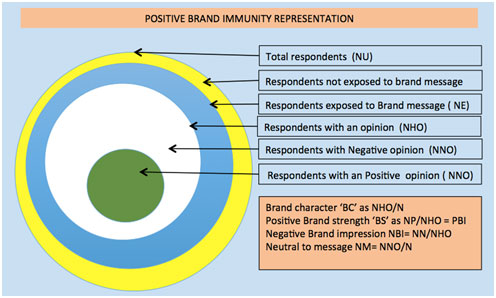
The above example is a simplified version, where we have considered that only audience who have been exposed to message have an opinion on the brand parameter. In real life, people who have not been exposed will also have perceptions. And the diagram and values can be suitably be modified Tracking these comparable numeric values across competition will help us in fine-tuning our efforts. If one can isolate these figures for media exposed or lead media, it may help us determine media effectiveness.
The brands aim should be to consciously focus on increasing the value of ‘NHO’ and ‘NP’. The high value of NNO is indicating creative inefficiencies.
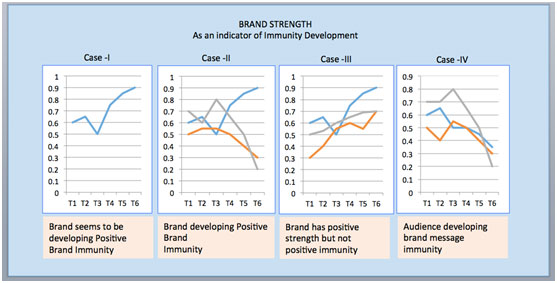
If the trending line BS (numeric value) on a set message parameter is moving upwards (Case-I), the brand is developing Positive Immunity. It is a strong case when the BS for the competitive brandsisdecreasing (Case-II).
If the BS value is climbing or high for all the brands (Case – III) then the consumer is developing immunity for the messages on that parameter, which is currently of high importance.
If the BS value for the all brands is all moving downwards (Case-IV) and is in low figure then the consumers has developing BRAND MESSAGE APATHY (BMA). It is the initial stage before immunity is developed.
Another simple way is to use the Net-Brand-score result on ‘always- never’ scale. How likely they are to recommend the brand to their family and friends? Use of ‘family and friends’ instead of ‘others’ is a stronger parameter. The respondents are forced to make a hard choice. They are clearly more accountable to friends and family than others in their circle.
Priya Lobo of Ormax suggests use of perceptual scale than discreet values. The respondent places their brands visualising their level of confidence. It accommodates fractional differences andis a better measure of skew and inclination.
But if there is no research planned, listening to chatter on social media can give directional inputs. Avoid using likes, shares and re-tweets as matrices for Positive Immunity. Positive Brand Immunity is a level before brand fanatics. Listen to find out if brand has succeeded in creating Brand influencers, ambassador and defenders?Use the tools to determine the size of Brand Bashers, which is reflection of Brand Immunity.
These are some of simple ways to get directional recommendations.It is worth the brands time, efforts and money to get a research agency to probe the brands immunity levels. Hopefully that will help you enhance the effectiveness of your communication.
Sanjeev Kotnala is Founder at Intradia World. A Brand, Marketing & Management UnConsult Advisor. He conducts specialised workshops in the area of IDEATION (Harvest and Liberate) and INNOVATION (InNoWait). He focuses energy in enhancing client’s team’s potential and capabilities and decreasing their dependence on external resources. Email sanjeev@intradia.in  or tweet at s_kotnala visit www.intradia.inwww.sanjeevkotnala.com.
-
Why print publishers must evangelise the medium, Sanjeev Kotnala writes as the two-day INMA South Asia conf takes off in Delhi Save Print. Now!
By Sanjeev Kotnala
The annual two-day INMA South Asia Conference commences in Delhi today. Like every year, delegates will join in, expecting to learn something new. However, by the evening, the corridor talks will as usual move towards mistrust and collective inertia in Print. The adventurous ones will start eulogising digital and once again sound the bell. The ring of the bell may be distant, but it’s there.This INMA session is immediately after the festive season of three months. Delegates will be high and intoxicated with the large format, big season ads. The mood will hopefully be upbeat. Unfortunately, a false sense of calmness will be appreciated in this unpredictable world.
After yielding some ground in metro markets, it is time for print owners to take concrete steps in non-metro towns to stem the tide. Otherwise eroding reader interest and advertiser’s heightened apathy to Tier-II and III towns will hurt.
Due to Accessibility, Affordability and Availability issues, the digital invasion has been a lot more timid than disruptive. But things are changing. There are more regional satellite beams, next generation media leaps, activation, experiential, potential and possibilities sketched by radio along with the excitement of OOH. On the other side, the sheer orgasmic pleasure of having a brand TVC continues to tempt businesses. Like an aphrodisiac for the uninitiated.
Apathy to print is transparently naked in creative for Metro markets. To paraphrase a line from Storyboard, it is as though “Print work in an Agency is done by people we don’t even know existâ€.
Unlike in the metros, clients and agencies in Tier-II and III towns continue to strongly believe in the efficacies of Print. Even without the art, craft and science of print creativity to leverage the medium, clients and the agencies know the impact it has and the loss they can suffer for not considering it.
It is holding as of now, but when the tsunami of alternate media impact vehicles build up, clients may willingly start focusing on alliances outside of print. We already know of government thrust toward Digital coupled with control guidelines on Print spends.
Print publishers can’t be blind. What are they waiting for? No one is going to stop ringing that bell. They need to act. They need to find plausible solutions. Or they can continue waiting for a miracle to happen. Should I suggest that we may soon need a ‘SAVE PRINT’ campaign much like the ones we conduct for our endangered species? This may sound exaggerated, but the situation is no longer rosy.
Instead of an ostrich approach, there is still time for print to work in NON-METRO business environments. The charm of print may be stretched. May be we can still revive (sounds as if it is in ICU) the lost glamour, impact, understanding and the surprising art of print creativity. Oh, such are the fantasies of print lovers made of.!
Print is happy with a short-range vision. In tea breaks, delegates may share success stories of how some of their clients have spent mini TV campaign budgets oncatalogue advertising with them. No one will question any of this. In fact, no one will have an answer to the question Anant Rangaswami raised: Why is it that clients who are so deeply involved in the development of a simple 10-seconder on TV,are completely immune to such waste in print
The excuse has been that agencies simply deliver what the client demands. If the client wants a Becchu ad, he gets one. It does not stimulate creative thoughts.
Print has done itself disservice by repeatedly projecting it as the best medium for announcement and tactical medium. Brand Building has been allowed to drift away to audio-video and the medium of clicks!
Print was famous for well-crafted and impactful advertising creatives. There was an engagement of a different order. The game of seductionwas on. It’s all been forgotten. Even print publisher’s stay away from using print for thematic brand communication. They do announcement and town howler ads in B2B further strengthening the myth. Only Digital, TV and experiential gives the client and creative a kick. Print is not sexy anymore.
The whole industry has been victim to this closed ecosystem. Everyone has a converging point of view. ‘Print is this and print is that’. There are no ideas of what it can do, but there exists a collective acceptance of what print cannot do. Print is projected as a tactical and medium of immediate impact. And thus is created the self-fulfilling prophecy?
There are continuous inputs and experimentation in other mediums. They have evolved in terms of art, science and craft. They are sexier and interesting. But print has royally remained static. The sales tactics and approach remain stagnant. The high cost of innovation prevents brands thinking to experiment. The news environment and ambience print provides is questionable. The position and placement of ads and content is ill managed.
There is no one advising the client. Sales teams find it below their dignity to close the loop. Afraid of possible reactions, they do not connect back post the campaign. The post coitus hug is definitely missing. Print publishers squarely fail to shoulder the responsibility of acting to enhance the understanding of the medium and its impact. Maybe collectively a BBDO ‘acts and not ads’ may work.
It will be foolish to even suggest that the medium no longer works. It is like saying that the car does not move because I do not have the key. I am sure that ads like ‘Nude Model wanted’ or ‘Animals came from cities’ or ‘Merawala blue’ or ‘Nothing official about it’ will work even today.
May be it is time for Print to take collective action. Maybe they could start with town wise minimum cover price. I know a question on this will be asked and will be underplayed by the panel facing it. Change in cover price even at the cost of some percentage of readers falling off is required to cover drops in ad revenue. Just a mere25 paisa increase in cover price across the nine brandsnot accepting IRS, can pay for better research many times over. Such a print cess when collated can make it possible for a medium to rejuvenate itself with acts that an individualPrint brand canonly fantasise about.
May be print can discount the non-discount ads. It will help promote brand building and thematic use of medium. It will be interesting to have special rates for ads that do not featurewords like “discountâ€, “announcement valueâ€, “inaugurationâ€, “limited periodâ€,“Saleâ€, etc. Essentially encourage non-topical, thematic advertising.
Print drastically needs fresh thinking and recharging. Will people secure withthe thought of their retirement plans survivein print to lead the way?
Print must work with selected print-inclined clients and co-create disruptive cases demonstratingprint powerbeyond tactical communication.
May be print can promote a real-life-real-brand print only campaign contest?I have always wondered why did print allowed ‘Think Print Contest’ to die. One can revive it.
Other than news, print should embrace social media. They must share good print. Suggest and engage the B2B community.
It is the responsibility of large print publishers tobring alive the print craft and educate the new creative generation in Tier-II and III towns. This can help reverse or at least slow down the debate on print effectiveness and investments.
Awards like the Ink Awards should be collectively owned by the print category. Work out ways to make it a coveted award to win. Print needs to find idols for the new generation. There is no Ivan Arthur in sight.
The Cannes TV showreel is an event. The Cannes print ad exhibition a dream.
Print cannot stop scam ads, but can large print houses refuse to collaborate and stop providing free space in the name of B2B relationship.
There is still time to control the game in tier-II and III towns. There are many possibilities and actions that print can take. Â But in the end, it is for print to decide to act or remain silent witness to its own slow death.
Sanjeev Kotnala is Founder at Intradia World. A Brand, Marketing & Management UnConsult Advisor. He conducts specialised workshops in the area of IDEATION (Harvest and Liberate) and INNOVATION (InNoWait). He focuses energy in enhancing client’s team’s potential and capabilities and decreasing their dependence on external resources. Email sanjeev@intradia.in  or tweet at s_kotnala visit www.intradia.inwww.sanjeevkotnala.com. The views here are his own. Kotmartial appears every Wednesday on MxMIndia.com
………………………………………………………
-
May be there is a need to enhance the workshop part and even live stream it to the paid audience, writes Sanjeev Kotnala Sanjeev Kotnala: Social Media Week: Brilliant sessions, but time to go completely online?
By Sanjeev KotnalaSOCIAL MEDIA WEEK is still the most happening event in its space. There is a definite growth in live stream watchers and a drop in the delegates physically attending sessions. Full houses were there but not that frequent. On the other side, SMW hit 2000+ people on the live feed. I was also one of them. I attended Day 2 at the venue and rest of the days I was enjoying a perfectly smooth webcast coming in live through April Broadcasting on my Hathway Internet plan. The tweet buzz was keeping me updated on other elements and few what’sapp calls told me of the situation.
The only shortcoming of the live feed was static camera positions and a pillar that physically divided audience in two sections. Thus on live feed you missed the audience feel. Even during the Q&A, you could hear the voice but could not see the person making the point.
This is what makes me ask for SMW being a complete online event. May be with two live streams. May be with setup that can give it a more holistic feel including audience view. It can still have 40-50 ticketed or invitees as audience. I am told that stakeholders discussed such possibilities.
Workshops were a huge success. May be there is an element of selfishness. Every delegate in workshop cherry picks workshops according to their interest. They are more focussed and with less gyanbazzi. Example ‘Come, Plan, Go – travel workshop’ and‘Think and Do Dum De Da’
May be there is a need to enhance the workshop part and even live-stream it to the paid audience.
I would believe that some of the organisation would want to live stream the workshops of their interested and if that can be organised in a non-pixelated projection, it could add another stream of delegates. It also saves the travel time what is of concern to all the delegates.
It was a pleasant experience to see that most of the SMW sessions were well-managed and they stuck to their timelines. Other than one or two sessions where few speakers joined late- all most all the speakers made to their sessions on time. It was a bit of shock to see that very few speakers stayed back for other sessions.
Keeping somewhat thinned delegate presence, the crowd engagements across sessions were very encouraging. I do believe that SMW could have asked questions to be tweeted and leave the moderator to pick the one to be answered. This pushed for focussed questioning and saves time from interactive and not-well-articulated questions. It also catches the online viewers.
One had to search out and seek event Wi-Fi password. In an event like the SMW, it should have been boldly flashed for people to use. Or may be there is some past experience that made them manages it differently.
Surprised to see some of the panel discussion engaging delegates far more than the single speaker sessions. It was surely a different experience. My feeling is that the panellists were honest, transparent; spoke more like a friend and a mentor which made it exciting. Most of them were so energetic that one had to re-calibrate the speaker volumein live stream.
In my scorecard, 5 out of 10 sessions were good. And 2 out of 10 were fantastic. It is a decent scorecard. Congratulations is due to the Rohit and whole of SMW team. The event ran smoothly without very few technical snags. Expectedly SMW was trending most of the time. Someone commented ‘SMW trending is as exciting as finding beer in a pub’. I am not sure how to interpret this.
There were many take-outs depending upon what was your area of interest. I am listing below some of the points that were pushed again and again.
Soon everything will be digital and you will not be able to any more avoid social media. There are three things that make Social Media (SM) work: it’s content, content and content. To succeed, your content must be searchable and shareable. There is a hot time to tweet- is a myth. In SM, you must not fake things and personalities. Audience is able to smell that. In SM, the best policy is to be you. There is space for multiple platforms. Tier-II and III are digitally ready. To connect with audience, brands must remain relevant. It is the time for traditional with the power of social not social versus traditional. Your medium defines the craft and not the craft defining the media. Brand ambassador must remain relevant to you audience for a long time. Creating acts is about creating platforms, not slogans. It’s about seizing cultural moment. Consumers are no longer just willing to receive the logical rational messages
And then there were some interesting revelations and pointers like Baroda has the highest number of women buying sex merchandise. Arnab Goswani confessed that he woke up to social media in December 2013, in the same breath that believe journalism should drive the conversation and not be driven by it. Consumers are happy when you are transparent and honest. Men tweet more than females. And the split gets skewed towards males as the evening mounts ( SMW data)
There were sessions that stood out with high attendence and level of engagement . I am listing a few here. The list is not in any order. Diffusing the taboo on sex, digitally. How #socialmedia is shaping Journalism!. How do you define and evaluate the ROI of trending or going viral?. Express, Impress and Progress – Social Media, Creative Up- starts and Intellectual Property. Digital Formats and Content. Cards Against Influencers – A hilarious game that will bring out the dirty secrets and grey shades of Influencer marketing.Let’s Get Real About Real Time Marketing. Digital video: Redefining long form content & brand stories
Interesting safe driving campaign used the SMW platform under #mysafetymylife. Delegates shot pictures with one or the other pledge placard and populated the message on SM. Tata Motors, the main sponsor, had its Shoot with Messi virtual reality both. It was interesting but not something that made you say wow. Disclaimer, I was one of the winner of #madeforgreat contest.
Sanjeev Kotnala is Founder at Intradia World. A Brand, Marketing & Management UnConsult Advisor. He conducts specialised workshops in the area of IDEATION (Harvest and Liberate) and INNOVATION (InNoWait). He focuses energy in enhancing client’s team’s potential and capabilities and decreasing their dependence on external resources. Email sanjeev@intradia.in  or tweet at s_kotnala visit www.intradia.inwww.sanjeevkotnala.com.
-
Will the Indian OOH trade take some proactive actions in making media planners re-evaluate the medium and constituent members to self-regulate, asks Sanjeev Kotnala Sanjeev Kotnala: Feel the Real – when will we see OOH in India taking such an action?
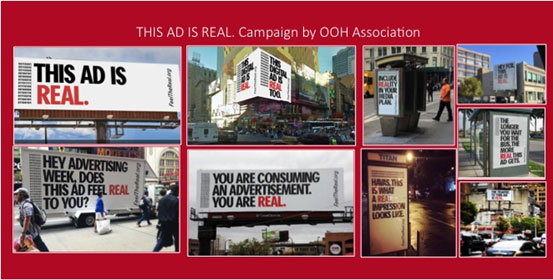
By Sanjeev KotnalaOOH as a medium has always been sandwiched between traditional and emerging media. The traditional media brigade and the digital prosumers raise critical questions on OOH efficiency and effectiveness. Taking the bull by the horn and to demonstrate Real Power of OOH in driving digital engagement, OAAA (Outdoor Advertising Association of America, representing 90% of the industry revenues) and PNYC (agency on record) launched “Feel the Realâ€, a huge campaign with more than 1600 OOH placements.
I know that nearer home the situation is a lot different. But just like US, we regularly question OOH efficiency and effectiveness. Much of it comes from our inability to assign numeric values to OOH exposure like we do for other media.
The campaign “Feel The Real†brings alive OOH as a REAL MEDIUM THAT REACHES REAL PEOPLE and helps drive significant digital engagement. Meanwhile, it takes a potshot at questioning the efficacy of digital; the new darling of media planners. It simply asks: How real is digital?
The campaign is simple. Rail posters say, “You are consuming an advertisement. You are real,†Telephone kiosks ask, “Media planners, do you have a reality problem?â€. Some signs close to media agencies call out the agency’s name or its executives.
Stephen Freitas, Chief Marketing Officer of the OAAA in his interaction points out that  “The ‘Feel the real’ campaign highlights conventional reasoning that nearly half of the money spent on digital has been lost due to fraud and misrepresentation. Digital is suffering a reality problem, and we want to show how OOH – a real, tangible and quantifiable medium – can drive consumers to digitally engage with brands,â€
The campaign aims at building awareness of OOH’s ability to track and increase digital effectiveness and encourage media planners to incorporate more OOH advertising into their plans. It aims to drive conversation about the significance of real versus digital and ensure OOH gets the credit it deserves and to encourage media planners to view OOH ads as a medium that can accelerate a campaign’s digital, social and mobile elements.
Now this may be in many ways be far ahead of the OOH-technology curve for India but we are fast getting there. There is a constant questioning of efficacy, effectiveness, clutter and avoidance of ads in other traditional and emerging media. It is the right time for OOH in India to take on the new technology by the horn and strike. To do so, it first needs to invest into technology and not be satisfied with stunts on sites.
The US campaign was timed with the New York City’s Advertising Week. The real B2B campaign targeted media agencies and planners while making a larger call to the public to engage with the real world. It used static and digital OOH placements near media agencies and on heavily travelled commuter routes.
The placements directed the viewers to www.feelthereal.org. The site playfully brings alive the fact how OOH can both complement and accelerate digital, social and mobile advertising.
It is world that is in flux out there. In digital, data is available for host of parameters, but in recent times it has been losing credibility.  The industry is divided and is unsure whether real people view the digital ads. Additionally, the ads can be tucked away in non-viewing corners and may be traffic figures are the result of computerised ‘Bots’ without any real human being ever seeing them.
OOH in the campaign “Feel the Real,†suggests that in a world where digital and its ability to deliver what it promises is under significant scrutiny, out-of-home has a unique and compelling point of view that having one foot grounded in the real world matters. Placements like billboards and transit shelters don’t suffer such issues.
The site www.feelthereal.org was interesting. When one lands at the site, a question is posed- if you had seen one of OOH ads. To make life easy, four playful options are provided from. “Yes, I saw it in the real worldâ€, “Yes, I saw it onlineâ€, “No, I heard about it†and finally the cheeky one “No, I’m a robot.â€
OAAA and PNYC are collecting the data on traffic and engagement with the campaign’s site to demonstrate OOH ability to drive digital effectiveness. One of the questions pointedly asks if the visitor is from advertising and media. If they can show the tribe being engaged they will make the results stick.
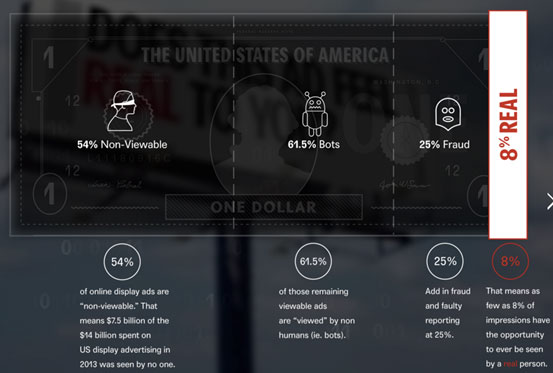
Once you are engaged, the site takes you through a visual build-up that points out wastage in digital spends making a point that only 8% spends are really seen and thus effective.
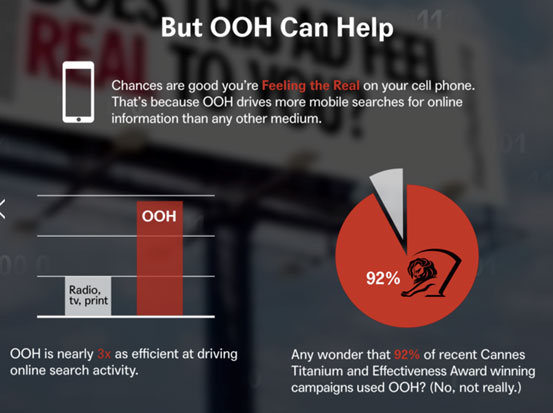
It then goes on to make an offer and tells you OOH can help
I enjoyed the cheeky ‘How Real Are You’ game at the site. It asked me which all of the listed 20 activities was I involved in the last 30 days. The activities listed included things like Held a baby, accidentally clicked on a banner ad, sang or played an instrument with others, had a good cry, read a book to created a hastag.Once I played the game it declared me to be 40% real and suggested a host of activities to enhance my REAL quotient. These included, make a fort in your room using blankets and cushions, Eat breakfast outside, pick your own fruit from the tree, Go look for more OOH advertising, walk barefoot, swim underwater etc.… GO CHECK HOW REAL YOU ARE at www.feelthereal.orgÂ
If you were not from media and advertising- it proposed that people are forgetting what it is to be a real person living in the real world. Then it shares some stark statistics. I am sure that maybe behind in OOH digital technology but these statistics maybe very much nearer to us. Things like-
- 56% of Social Media Users Suffer From FOMO (Fear Of Missing Out)
- 47 % of teens agree that they get uneasy or nervous when they learn through social media that some of their friends or peers are doing something that they are not.
- 50% prefer digital communication; half of all Americans say they prefer to communicate digitally than talk in person, according to a Time Inc. study.
- 24% have missed out on experiences: 24% of people say they’ve missed out on enjoying special moments in person because they were too busy trying to document their experiences for online sharing
The outdoor medium’s growth in US has been fuelled by new digital billboards that can be updated dynamically and its ability to reach mass audiences in transit. For a marketer, out-of-home ads are appealing because they can’t be skipped or fast-forwarded like TV ads recorded on a DVR. Unlike digital ads, ad fraud isn’t much of a concern when it comes to buying billboards.
In India, the OOH industry is still remains highly fragmented and unregulated. It can be argued that soon the OOH in India will also become a lot more digitally dominated where quick changes and time-share on the properties will be a reality. The integration with the digital platform is an eventuality. The process will hasten if the clients put money behind experimentation and technology.
So, will the OOH association in India wait for the problem to be identified or will it take some proactive actions in making media planners re-evaluate the medium and the constituent members to self-regulate.
Article based in initial write-up by Nathalie Tadena in Wall Street, The press release by OAAA and the experience at www.feelthereal.org
Sanjeev Kotnala is Founder at Intradia World. A Brand, Marketing & Management Advisor. He conducts specialised workshops in the area of IDEATION (Harvest and Liberate) and INNOVATION (InNoWait). He focuses energy in enhancing client’s team’s potential and capabilities and decreasing their dependence on external resources. Email sanjeev@intradia.in  or tweet @s_kotnala visit www.intradia.inwww.sanjeevkotnala.com. The views here are his own.