Category: SANJEEV KOTNALA

  • Sanjeev Kotnala: OTP Frauds – Banks should consider collective action

    Sanjeev KotnalaBy Sanjeev Kotnala


    OTP, short for One Time Password, is equally an advantage and a possible threat. Not a single day passes without a report of some or the other person being duped through digital payments, and where OTP is an essential part of the trail. No one wants to be a victim; however, the possibilities exist every time they interact and transact.


    Jamtara – Sabka Number Ayega on Netflix was an eyeopener for most banking and credit card users. However, its impact on controlling or reducing potential fraud was and is limiting.


    People are aware of the need not to share OTP and know how they can be trapped and lose money. Banks – including the central; bank- RBI has been relentlessly communicating and warning every account holder and digital wallet holder of the possibilities.


    The mail inbox is full of emailers from banks, and the SMS (now even WhatsApp) has the relevant warning flashing from time to time.


    So, what is happening? And some simple possibilities come to mind.


    Maybe we are not reaching the most venerable potential victims through our media choices.


    Maybe, people have become somewhat complacent knowing that they can and, in the case of credit cards, a bit protected against their own mistakes.


    Maybe the OTP is so much of an everyday process that it is shared between family members.


    Maybe the communication is not crafted well enough for the most venerable potential victims to understand.


    Maybe the fraudsters are always a step ahead of the banks and regulatory bodies.


    Maybe the communication by individual banks is defined by their own understanding, and the consumer gets too many different signals.


    Maybe at this stage of fragmented media- rising media cost and shortened attention span- the brands in digital payments and netbanking need to look at the situation afresh.


    Maybe it is time for a collective collaborative combined effort from the banks and digital wallets. Which can give them the advantage of a concentrated, focused media approach.


    As a brand collective, it will fuel safe usage, and the brands can fight the market war on functional benefits.


    Maybe it will help reduce the liability of banks for such frauds.


    Maybe it is an impractical wish in these competitive times. Perhaps someone will take the initiative and see merit in it.


    In the past, the Sunday Ya Monday, Roz Khaao Andey did tge magic. Motorola led the communication with multiple pager service providers and was hugely successful. Maybe there is some merit in thinking collective approach and addressing the problem. It will not solve it; however, it may help reduce the same.


  • Tiranga everywhere


    By Sanjeev Kotnala


    Sanjeev KotnalaAs I look outside, I can see that the density of Tiranga decorations is slowly decreasing. And am sure that in a few days, it will be tough to catch a sight of the tricolour in the near vicinity. Unlike other years, there was something different. The energy and public participation were like any other major community/ religious festival.


    Yes, there was the usual hoisting of the national flag, a march past and the patriotic songs blaring since morning.


    The permission to fly the Tiranga at home is not new. It was in 1995 that Navin Jindal approached the courts as the Flag Code prohibited flying the tricolour by private citizens. The Supreme Court’s 2004 judgment allowed every citizen to fly the national flag with respect, dignity and honour, thus making it a fundamental right. However, more changes were needed in the Flag Code before the Har Ghar Tiranga festival could be pushed. The Flag Code of India, 2002 was amended permitting national flags which were machine-made or made of polyester and earlier handmade khadi material. Further amendment on July 19 2022, allowed the flag during day and night, thus paving the way for the nationwide celebration.


    It is different that if one strictly followed the Flag Code, many citizens could be under scrutiny and penalised for Flag misuse. Understanding the passion and the festivity – many incidents have been overlooked as they confirmed flying the flag with respect and right intent.


    There was a marked difference in the level of respect and care demonstrated by the citizens. There was social media communication on how, when and where to fly the Tiranga. How to dispose of and what to do after the festival. Some brands sensing the opportunity, have come forward for the proper disposal of Tiranga with all respect and care. We need more of it.


    The government could be faulted for not using the opportunity to push educating citizens about the national flag and anthem. It could have been done by communicating it through media- and would have been a minor part of the overall cost. Maybe the media could have done it on their own.


    It is essential to impart this knowledge, respect, and care in the early stages of education- at the school level. In marketing and branding terms, this was a 75th year celebration, a window of opportunity to recharge the nation. A perfect window for a Har Ghar Tiranga campaign.


    Further, it may be noted that the government, as part of the Har Ghar Tiranga, urged the citizens to fly Tiranga at their homes. However, the citizens have the full freedom and fundamental right to fly Tiranga every day and night of the year.


    TIRANGA SHOULD UNITE, NOT DIVIDE.

    Tiranga is a national pride that every citizen respects and cares for. So, making it in any way associated with religious and regional symbolism is a waste. One was surprised that SRK and Aamir Khan flying Tiranga at their residence was news for all the wrong reasons. Flying Tiranga or not flying it is in no way a measure of someone’s Desh bhakti – patriotism or nationalistic sentiments. It should remain so.


    NET-NET

    I hope this does not remain a one-time campaign. I hope we use the two opportunities almost six months apart, Independence and Republic Day, to celebrate the nation. And for that to continue and be purposefully pushed, we need to be cautious, educated, and respectful in handling the nation’s pride- our Tiranga.

    I hope that in future, we do not have to make do with wrongly crafted, poorly printed and shoddily cut fabric as the tricolour. I wish that we get back to only hand-woven Khadi material Tiranga. Perhaps, it is time that we have a set window for the national anthem and hoisting of the flag across the nation on such a day.


  • Everyone has their Right to Individuality, but….


    By Sanjeev Kotnala


    Sanjeev KotnalaPeople look up to people in position of responsibility  as ideological icons and role models. They scrutinise their every action. Result, people in position of responsibility lose the freedom to live life as free individual. They are forced to wear mask. It usually is a question of time before the mask slips. In simple terms people in position of responsibility – don’t dance or drink.

    Should this be the case? Many would say yes.

    People are in position of responsibility everywhere; in politics, organisations, sports, courts, art, science, armed forces and even family set-up. Some of these positions have strict guidelines on how the person must behave and expectations of the stakeholders. Some have unwritten rules, norms, and past precedents to guide behaviour. And mostly they are  contextual and comparative. The expectation-experience gap irritates the stakeholders and frustrates the person at the position.


    THERE IS ALWAYS AN ALTERRNATIVE.

    So, the alternative is, to fight for the right to live life the way one wants or give in to the constraints. This leads to polarised views. Most people in the position of responsibility will fight for their privacy and right to live a modular life. And other people will want people in position of responsibility  to live life in a continuum of model behaviour. It is after all  easy to have higher expectations from others, and some will always consider it on case to case basis.


    THE YOUNGEST PM SHOWS THE RIGHT TO INDIVIDUAL LIFE

    Sanna Marin (36 years), the Prime Minister of Finland and the youngest PM in the world, was called irresponsible after a video of her partying and dancing with friends was leaked on social media.

    The youngest PM rightly defended herself. She said, “I have a family life, a work life and also my free time, and I spend time with my friends”, stating she has done nothing irresponsible or illegal. She took a drug test to kill the possible rumours, to legally protect herself and clear doubts about her taking drugs at the party. #SolidarityWithSanna trended with Finnish women sharing their partying videos.

    Many raise a question, would she have been at her logical, responsible best if there was some emergency where she may have been asked to take decisions? Now, that is not too much to ask or expect. But do we all who raise these questions live with the same standards?

    Sanna Marin also said that she had nothing “to conceal or hide” and was determined to continue to be “the same person as I have been until now … I have free time that I spend with my friends. I’m pretty sure that’s the same as many people my age”.

    It is okay till it is within the bounds of privacy and not shared. Once it is in a public space, it is open to different interpretations, and other expectations define the experience. The only irresponsible thing was her believing that the video taken would remain private.

    She has taken the other alternative and said that let the elections (whenever they happen) decide if she is right or wrong.

    This situation differed in an earlier episode when she partied after meeting a person diagnosed with Covid. But, she then apologised. She is perfectly right  in defining the boundaries and her right to freedom to live like an individual.


    THE BORIS CASE

    Boris Johnson attending a birthday party was a different case. It was a period of Covid-imposed restrictions. And the behaviour, by any stretch of the imagination, irresponsible. It is  a case of behaving wrongly.

    On the other side, Boris apologised to Queen Elizabeth after it became known that his staff partied in Downing Street on the eve of the queen’s husband, Prince Philip’s funeral in April 2021. It is a case of irresponsible official behaviour that somewhat overlaps with individual life.  So, things are contextual.


    CORPORATE LIFE.

    What is true for politicians is true for corporate leaders. The case of Ashneer Grover and the leaked phone call in which he allegedly threatened and abused Kotak Bank’s employee over Nykaa’s IPO. It was not expected from him, and the behaviour was improper for the position of responsibility as the founder of BharatPe.

    Paytm founder and CEO Vijay Shekhar Sharma’s arrest for rash driving is also such a case. Accidents happen, but people make up their minds quickly. Earlier his abusive speech at PayTm annual conference was shared and trolled for irresponsible improper behaviour and not meeting the expectations.


    WHERE DO YOU DRAW THE LINE?

    It raises the question, when does work, family and personal life start and end? Many would say that such jobs are  24X7, and the personal-professional lives overlap.  Does that mean that a  Judge,  PM, Ministers, Chief of staff, Bureaucrats and people in the position of responsibility should never dance, party or drink?  Sounds like too much of a punishment.


    NEARER HOME

    The concept of responsible behaviour in the position of responsibility does not seem to operate. And this holds for personal and professional life. If the past is the trendsetter or example the country has, expecting anything different is living in an illusion.

    Unfortunately, when it is about politicians, in a democracy, the voters should carry the blame for repeatedly electing people known for behaving irresponsibly.


    NET-NET

    I believe that the person in the position of responsibility has the right to have a personal life. It should not matter what the person does outside their work life unless they do something unethical and illegal.

    However, society expects different rules to apply to people in the position of responsibility. Their lives are under scrutiny in the new world of easy information access and availability. They are role models, and the positions come with expectations. Some of them may be tough for many to follow. But that is the price they must pay.

    Or, they can like Sanna Marin take such expectations head-on.

    I hope Sanna Marin pushes people to re-evaluate their expectations. Expecting people not to live life in a constrained, caged environment which could force them  to live a double life. Wear a mask, and masks do slip at times.

    And as citizen stakeholders, we should not make a mountain out of a molehill, and we must not take such a slight digression into a debate; maybe that will be best for all of us.


    Sanjeev Kotnala is a senior business strategist and educator. He writes on MxMIndia on Wednesdays, and sometimes on other days as well. His views here are personal.


  • Sanjeev Kotnala: Keep developing your Brand Katha 

    Sanjeev KotnalaBy Sanjeev Kotnala


    Ramayana, Mahabharata, Vishu Avatars, Rishi Munni Katha, Chandragupta, Chanakya and the Katha of many more Raja-Maharaja are some of the best examples of Brand Katha. In addition to being part of religion, mythology or history, they continue to deliver on their premises and promise, keeping the audience engaged, involved and in the discussion. Most retain relevance without a change as they were and are the only source. What you tend to get is some new interpretation. And that is where today’s brands need to relook at and re-evaluate their efforts in Brand Katha – Brand Storytelling.

    Today the access and availability of products, services and brand information are democratised, and the peer and consumer reviews are corrupted and cluttered. Result- the consumer is more aware and, at the same time, more confused than ever.

    Some call it the death of Branding and advertising, and I see it further asking brands to engage more in their branding and marketing efforts to influence consumers. These consumer decisions are not rational, logical decisions but more emotional.

    Brand story or Brand Katha can influence consumers to make a favourable decision. It can serve two primary purposes; making the brand the preferred brand in the choice set or/and allowing the brand to charge a premium.

    DIFFERENT LEVELS OF BRAND INTIMACY.

    We know some of the brands at a more intimate level than others. These brands interact with us by sharing their lineage, legacy, history, achievements, and failure. We know what they stand for, what we can expect from them, and how much we can trust them. These impressions are flavoured with our expectations and experience and our alignment with the brand Katha.

    WORKS FOR BOTH PERSONAL AND COMMERCIAL BRANDS.

    Consumers know a lot about Tata, Maruti, Amul, Times of India, AAJ TAK, Dainik Bhaskar, Reliance, Adani, OYO, shaadi.com, Jet-Airways, Paper-boat, and HERO. They also know personality brands like Narendra Modi, Mamta Banerjee, PV Sindhu, Sachin, Virat, SRK, Aamir khan, RJ and Kapil Sharma.

    Whether the brand operates in a commercial or personal space does not matter. The more the stakeholders, including the consumer’s current or potential, know, understand, and empathise with the brand, the better they are placed to decide and/or most likely to use, refer to, recommend, and prefer it.

    Hardik Pandya, the ace allrounder in the Indian team, is doing great for his brand. So good that no one now discusses the controversial episode of Koffee with Karan. He captained Gujarat Lions and won the IPL Trophy as a leader. The confident, almost understanding gesture before hitting the winning six in India Vs Pakistan Asia Cup Match is grand for the brand Hardik Pandya. No doubt reports suggest that his brand endorsement fee has risen by 30-40%, and he is expected to endorse some 20- brands in future.

    BRAND IMPRESSIONS

    Brand impressions, in addition to the brand experience, result from perceptions based on media inputs/exposures and selected vignettes the brand shares. This way, the brand helps consumers connect the dots and understand it.

    The trick is to treat the Brand Katha not as a one-time effort and output. See it as a continuum, where new chapters are being written and shared with the stakeholders on a regular frequency. Every brand communication is part of Brand Katha, working towards creating the desired brand image in the mind of current and potential users. Working in tandem with brand experiences, chapters of Brand Katha can help create prosumers.

    ADDRESS EXTERNAL AND INTERNAL AUDIENCES.

    Brand Katha can do wonders with the internal customer’s confidence and motivation, and it can help attract talents and even gain a better market presence.

    Brand Katha can help distil consumer expectations and decrease the extra noise and enhance positive feelings about the brand. And, in case of a crisis, it can help the brand recover fast. Remember the case of Maggi, Pepsi some years back or even the recent JJ baby Powder issue?

    BRAND KATHA.

    Brand Katha is not a placement PPT, corporate AV, or website. Multiple units collectively create the final masterpiece, where every communication is yet another relevant chapter in the coherent brand novel. Each with a start, middle, and end, creating a valid linkage with the brand’s past and future while staying in the present.

    The case of Dainik Bhaskar- Number 1 from Day 1- has been chronicled in media, taught in Management schools, and presented to many brand senior leadership. Dainik Bhaskar is known for its scale of thinking, speed of action, and questioning the current practices. And that is the essence of its brand Katha.

    Brands like TATA have books about their approach, and a rich number of anecdotal tales shared all over social media. The recent AMUL two-pager in TOI covering 75 years of India, as seen through Amul’s hoardings, is another chapter of a very focused Brand Katha. Amul has also told its story through a Movie, and its MD’s high-frequency media presence helps amplify the brand Katha.

    BRAND KATHA BASICS.

    The basics for a Brand Katha chapter are no different than what the brand should consider for every piece of communication. It must be authentic – reflect the true story, happening, objectives, vision and/or the culture. and true to your company’s story and culture. It should be exciting and engaging as a creative expression so that it can amplify the message. It must be well produced- as the quality would also reflect the brand approach. Don’t overload a communication with everything you want to communicate. Write individual chapters of Brand Katha with a focused plan. Ensure that the desired message is firmly embedded in the chapter and reaches the audience. And for a better impact- don’t state or say something- demonstrate with an example.

    The focus of Brand Katha is the consumers and defined audiences. Presenting things from their lens may not always be possible, but their viewpoint and desired reaction must always guide your efforts.

    And once again- Brand Katha needs to be treated as a living organism – an adaptive continuum to changing needs and situations, remaining entrenched in its basic philosophy and promise.

    NET-NET

    Brand custodians should re-evaluate their brand Katha’s understanding among the external and internal stakeholders. Please take action to strengthen their knowledge, understanding and brand experience.


  • Is Mr Sachin Khurana a headache for self-regulator ASCI?


    By Sanjeev Kotnala


    Sanjeev KotnalaLaw is always a step behind reality. And guidelines and regulations are a few steps behind. The victim suffers, and the perpetrator keeps finding new loopholes to exploit. But, when the perpetrator violating the ASCI guideline is a well-known big pharmaceutical company, we expect them to be totally aware of the guidelines and the loopholes. And when they act like this, it is time to rethink.


    Yes, the advertisement by GSK appeared in TOI. The publication’s internal quality cell could/ should have highlighted the issue and refused, but they did not. Karthik (@Beastoftraal) mentioned the objections on Twitter and I complained to ASCI. Hope they do see the problem. Karthik has also pointed out how toothpastes use unfamiliar faces and how celebrities act like people of influence in white coats.


    WHITE COAT= DOCTOR or SCIENTIST.

    It is as simple as ABC. The audience relates White Coat to a person of expertise and influence. Mainly as a doctor, pharmacist, scientist or at the least a lab attendant who knows what he or she is doing.


    There is no doubt that in this advertisement for Crocin, the brand wants the audience to infer it as someone who knows what he is recommending. But, then, the brand cannot have a doctor suggesting/ recommending Crocin, an OTC (Over Counter Drug) that is available without a prescription.


    FIND A WAY OUT.

    Enter the loophole. Feature a model wearing a white coat. And then identify the model with its name. Brilliant- as he is an actual model. No Dr. prefix. So, we have clearly shown that he is not a doctor, but he recommends Crocin. Problem solved.

    But why would a company like GSK, known for its pharmaceutical products, vaccines etc., have any Tom, Dick or Harry recommend the product? It does not make sense.


    MANY QUESTIONS.

    Hopefully, ASCI will ask the questions Karthik asks in his tweet.


    Why is the model named at all in this ad? Is that the company practice? Does the company do it every time there is a recommendation?


    Why add “Mr.” before ‘Sachin Khurana’? Is it to differentiate him from “Dr.”?


    Why is “Mr Sachin Khurana” wearing a white coat? Is he a doctor, lab attendant or scientist? Should we trust “Mr.” Sachin Khurana’s words about Crocin just because he’s dressed like a doctor?


    NET-NET.

    There is no denying that the brand tried to exploit some loophole and pass the model as a person of expertise. To most OTC drug buyers, Crocin would mean just that, and it is not expected of a large brand and company to do so.


    SELF REGULATION.

    ASCI is an industry body doing its best within its limitations. It has well-formatted guidelines.  It is ultimately the responsibility of the brand managers, creative agencies, and media partners to self-regulate. There are enough big companies and brands who instead of setting example do not follow the guidelines. It cannot happen if the industry representatives do not share the responsibility. Following ASCI guidelines will actually strengthen the industry.  Suppose self-regulation fails and is not followed in spirit. In that case, the industry should be put under government regulations, at least for the medical field. And the errant brands must be penalised for their discretion.


  • Special days need Special Effort. So how did we do with Teacher’s Day 2022?


    By Sanjeev Kotnala


    Sanjeev KotnalaOn special days we see brands releasing communication celebrating the specific day. People take to social media and flood it with messages. Some are relevant and thoughtful, but most of them are a rehash of some old thought. These special days are usually around religion, region, festivals, birth and death anniversaries, historical milestones, politics, events, sports, or anything else that is topical or tactical.

    In the case of certain special days, brands have the opportunity to present their point of view. For some categories, these days open a window of customisable unique advantage to relate to their wider audiences. Like Valentine’s Day for romance, love, care, and Chocolates. Father’s Day for all the relationships and cheeky messages from condom brands. Teachers’ Day for the education and coaching category.

    Unfortunately, most brands fail to exploit the opportunity and end up doing lip service. The stale jokes and the repeated unexplored strategic focussed messages make no sense.

    Yes, one understands but fails to accept the statement that after so many years of brands trying to explore these days, there is no new thought possible. Maybe it is true. Perhaps, all nuances around them have been explored, if not fully exploited. However, it tells us that to make a difference and impact, brands better roll up their sleeves and think deep, and even if it’s an old thought- freshen it in execution. Otherwise, the energy and resources are misdirected, and there is a colossal waste of effort and energy. It is, in fact, true about most special days.

    Here is what happened with Teacher’s Day.


    Navneet Education- #Trforteacher

    Navneet Education wants to roll out a petition so teachers could use Tr as a prefix identifier, just like a doctor uses Dr, Engineers use Er. And so on. Not a bad idea, but not the first time. Though the execution style of ”We asked few people is so jaded, it is not impactful. Though the brand did float it across Facebook, Instagram, and Twitter with all the possible hashtags, this was one of the best efforts of the day- it is itself making an example.


    Day in a teacher’s life.

    Teachmint showcased what a teacher’s day looks like and what keeps them going. Presenting Teachers as the heart of schools. The brand wants everyone to join in showing love for Teachers, and, yes, again, there was this hashtag barrage- as if the brand was unsure what would really work.


    CONTINUOUS LEARNING- BYJUS

    The biggest online and now hybrid coaching – created the not so unexpected – learn at every stage campaign. It had decent success with huge views. A simple thought of learning being a journey with multiple pit stops but no destination. Teachers learn something new at every turn, with the flip of every page, on a cold night or a tough day. Celebrating the biggest student through it all, the one that never stops learning – a teacher. It is not the best way- but at least in sync with their brand communication. Candid Teacher, the earlier communication by Byju’s, allowed students to ask questions. It was more fun and playful- maybe with more impact- however, the treatment left much to be desired. You expect a brand like Byju’s to do far better.


    CLASS PLUS

    In 2020, during the [andemic, Class Plus celebrating teachers’ efforts was a friendly communication- topical and relevant. How teachers shifted to online, sharing their wisdom and knowledge. And slowly inserted the message that they have helped more than 1 Lakh+ teachers to grow during the lockdown. #EmpoweringTeachers to grow. Earlier, Class Plus had also communicated about the hard work teachers put in. The sweetness they bring, the care they undertake and the conduct they display. This and more define how kids learn to view the world in their own right. They really make the world a better place to learn. Unfortunately, another good idea could have been far better executed.


    FILTER COFFEE TEACHERS

    Better in all this seriousness is the cheeky Filter Coffee communication- types of teachers you can relate to. There is fun and sincerity; the episode reminds you of some teachers and expands the audience range.


    OTHERS BRANDS

    Then other brands tried to take advantage and, according to their efforts and resource, hugely mismanaged the show. For example, Orchid International trying to communicate that Teaching is the profession that teaches all the other professions. Orchids wishes happy teachers’ day. Or the learnapp rehashing the ever-safe formula of teachers moulding the students. And Himalaya Baby Care with many views trying to exploit the overhyped and most basic thought of parents as a teacher. Extramarks, the leading teaching app for K-12, promotes its functionality. And even Bandhan Bank went into drive telling us we have teachers all over and the opportunity to learn. Maybe a wasted opportunity or a non-strategic move. And if you have to watch- do watch this from Naya Educator– very apt work on teachers’ day. It is functional, relevant and a tribute too.


    NET-NET

    Special days allow the brands an opportunity- to define or strengthen their relationship with the stakeholders in their ecosystem. However, to exploit the possibilities, brands need to believe in the strategic importance of the special days and not treat it as another item to be ticked.

    It is advisable for a brand to not waste time and resources on some poorly executed, half-baked communication.

    Indian culture and mythology are full of Guru Shishya parampara. There are rich anecdotes that the brands can use if they are willing to deep dive and really believe in the strategic importance of special days. Unfortunately, one has hardly seen any brand use this rich heritage.


    CHALTE-CHALTE

    Here is an ad from Raymond’s that seemed to me as one of the best functional synergistic Teacher’s Day ad.


  • #AnythingForTaste


    By Sanjeev Kotnala


    Sanjeev KotnalaEvery brand has brand stories— some real and some crafted. The brand’s strategic and creative teams must identify the ones that can be explored and exploited. KFC Cape-town, South Africa, picked one and ran with the urban legend of a fake quality control inspector. Watch the final communication, and then we get to the story. KFC’s official Twitter account posted- The Taste… it’s all about the Taste, and after 50 years of licking it off your fingers, we’ve realised that some of you will do #AnythingForTheTaste. Don’t believe us? Watch this story based on real events.


    First, KFC released a press note declaring they would get to the urban legends’ roots. Setting up a private investigation to find one who has been posing as a fake food inspector, getting free KFC items. The story goes back to 2019- though not fully substantiated. “KFC plans to track down an alleged fake food inspector soliciting free food from KFC stores across South Africa.” It also led people to attempt pranking KFC in real life- completing the cycle. For example, Foktv and JTube became fake health inspectors to try to get free food but also try shutting down a fried chicken restaurant.


    Here is news on SouthAfrican.com and many other South Africa-based digital sites like Capetown covering the Press release.


    Beckett Mathunzi is hired as the chief investigator. A hotline is set up for the public to share tips and information. This one led to three creative, the Brief, The chase and the verdict. One could follow the detective developments at KFC South Africa.


    Net-Net

    It is noteworthy to see how the brand has picked up an urban legend and taken it to its somewhat logical conclusion. It is simple and highly focussed creative, taking you on a ride with the detective and the fake inspector. And watch how #AnthingForTaste and the #Fingerlicking have been smoothly weaved in. I love such simple, focused communication and storytelling.


    Meanwhile, here is another brand doing the same. Focussed storytelling, and where they take one aspect and go the whole way. The client and the creative understand that it is better not to be greedy and overload the communication. Here Samsung exploits the one chink in the competition’s armour- just when the competition makes its annual ritualistic statement of new products.


  • Should repeat offenders of ASCI guidelines be debarred from awards & felicitations?


    By Sanjeev Kotnala


    Sanjeev KotnalaI have repeatedly written about the thankless self-regulation job ASCI has been doing by discussing, suggesting, recommending, and trying to make brands follow the guidelines. I sincerely believe that self-regulation as the name suggest is an individual and organisational call. No moral and ethical policing works.


    If one was to analyse the roaster of defaulting brands every quarter, they are a mixed lot. One could understand the fly-by-night operators and small businesses not really following the guidelines. However, the list of repeat offenders has large brands and companies working with well-known advertising agencies. It is tough to presume that these agencies and the brand team are unaware of the guidelines. Hence, when they fail to follow the guidelines, it is natural to assume that the act was voluntary and intentionally exploiting the loopholes for business. The brands were fully aware of ASCI procedures and prepared for the action.


    The answer to the question of who is responsible for this situation is simple. It is the brand owners and the agency leadership. Because they have decided to overlook their team’s work. It is a question of attitude, ethics, and morality. A question of the culture that permeates the teams. A business call is made knowing the pros and cons. And, if the seniors in the team turn a blind eye or do not guide the teams on proper systems and operations, no number of guidelines will help. Until those exploiting loopholes or not following the guidelines is no way a black mark on your resume or employability. Till it is seen as intelligent working, no set of guidelines will work. And if the industry keeps celebrating the seniors working on the brands and companies breaking the guidelines, no guideline will work.


    Why can’t brands and their teams repeatedly not following the guidelines be debarred from industry awards, individual felicitations, discussions and addressing, and holding a post in industry bodies? Can people reject a candidate knowing they were part of the team called for not following the guidelines? Can the CMOs and the agency heads ensure that every marketing, branding, and communication person is aware of the guidelines for the category they work on? Can an ASCI guideline certification be a minimum requirement for creative and strategic teams? Would it be too much to do?


    For self-regulation, you need self-discipline. It is as simple as that. It is just like you deciding to use a seat belt or not while driving, knowing fully well that by not wearing the seat belt, you are not violating a guideline but a law. And moreover, you are risking yourself and no one else. You do not wear it knowing that the traffic police cannot fully monitor it, and people are not shamed for not wearing the seat belt. You decide not to wear the seat belt despite its availability, and wearing it is as simple as clicking it in. You don’t wear it because you think you can get away with it and nothing will happen to you. The same approach is visible in people and organisations not following the ASCI guidelines. They think they can get away with it and lack something as basic as self-discipline.


    Checking if the brand is not violating guidelines should not be a Standard Operating Procedure (SOP) but a habit. It should happen naturally. And, if it does happen naturally, indeed, after some time, the teams may not even need to check as their internal working will weed out the wrongs. SOP reeks of checks to see we are within the framework and technically cannot be faulted for not following the guidelines. There is no question of exploiting the loopholes when it is a habit. It is not about technical grounds but more about realism and ethicality of action. As naturally as brushing your teeth.


    Guidelines keep evolving. Maybe some have lost their relevance. ASCI is always there to discuss and re-evaluate. Remember, all the guidelines have been developed in consultation with Industry experts and after they have been publicly open for discussion and input. The guidelines are not ASCI- the guidelines are of the industry. And by following them, no one does a favour to ASCI. We help the industry stay within the scope of self-regulation without governmental interference.


    Net-net

    So, decide, you want to be the smart one who exploited the guidelines under technical loophole. Or you were morally ethically correct to have followed the guideline. It is typically a business call that must be made individually. And it is finally all about – the culture and attitude promoted in the organisation. Think again about what you teach when you turn a blind eye or knowingly violate the guidelines on technical grounds.


    ASCI doing its part

    ASCI has been upfront and transparent in its dealing and communication, but it needs industry support. As per an ASCI report, It processed 52% more ads in 21-22 compared to 20-21. Digital contributed 29% of all complaints, and Education remained the largest violator of the guidelines followed by Healthcare and Personal Care. And 94% of all ads processed needed some modification. Important point- 21% of complaints originated from consumers, and 7%5 were Suo-moto action by ASCI. Both are good signs. Print and digital led with 47% and 48% of the complaints.

    As per ASCI’s sector report 21-22. For example, in the personal care category. There has been a 261% increase in ads, where 69% were informal resolutions not contested, and 31% were upheld. Most ads, 88%, came from digital space, Print contributed 4% and Tv 6% of the contested ads. 371 ads were found violating influencer disclosure guidelines, and 4 ads featuring celebrities were found misleading!


  • Sanjeev Kotnala: Khela Hobe! Bigg Boss 15 on the right track

    Sanjeev KotnalaBy Sanjeev Kotnala


    Many of you know I have been a huge Bigg Boss fan, and I even went for the audition in one of the seasons when the show was looking at commoners. I have attended a few weekend shoots with family and would love to do that again. This piece was written before the start of Bigg Boss on October 1 as ‘Unsolicited Advice To Big Boss’. However, after watching the first few episodes, it is clear that Bigg Boss 2022 is on the right path to rejuvenate my favourite reality show and make an impact.

    To me, the concept of Bigg Boss is interesting and exciting. There were so many things to look out for. And if someone was interested in understanding human psychology, group interplay and dynamics, the basics of ‘give and take’ and the ‘expectation v/s experience’ imbalance. Bigg Boss is a deadly social game worth watching. However, the 2020 season was not something that I liked watching. While my interest levels dipped in the last two seasons, many loyalists have complained that the show no longer had the same pull.

    Every show must evolve, outgrow the earlier audience, and pull in a new audience with higher lifetime value, but not at the cost of originality and the show’s basic format. Bigg Boss, for some time, has been avoiding changes. Reality shows must think about audience engagement and involvement, which may not even reflect in TRPs. In the current era of perceptions and viewpoints, social media interaction and engagement go a long way. Every year, for one or the other thing, we keep listening for boycotts and banning the show.


    Reality Shows

    Colors TV’s other big reality show, Khatron Ke Khiladi, also suffers from a ‘task repetitiveness’ syndrome. This stunt-based show is hosted by a director known for blowing cars. It is different that he only talks and never gets into the act… unlike the season, which was handled by the Khiladi star Akshay Kumar. Contestants know they will need to swim, interact with animals, and bear some amount of current. Yet, they walk in as zombies without preparation!. This year, the number of aborts in the KKK was unprecedented, and so was the number of proxies. Not something that the audience appreciated, and it did not leave a good taste.

    Reality shows on Indian television are well-established in dance, singing, talent and comedy. The judges sometimes show a bias in defining talent and a specific skillset. The audience does not want dance and singing to be considered in shows like India Got Talent, but channels have other thoughts.

    One of the reality shows I miss is  Iss Jungle Se Mujhe Bachao. Additionally, Indian Idol and Roadies with Saach Ka Samana and Emotional Atyachaar have had their own followings. As aside, my friends have a concept for another exciting reality show. But, currently, the channels are not biting at this hour.


    Back to Bigg Boss and the few factors that make the show. Or what the show should do. Thankfully, some action is already evident in the first few episodes.


    The Format

    The Bigg Boss format, an adaptation of Big Brother, keeps participants (housemates) in a controlled location (living space) without access to the outside world. Their life is controlled through tasks defined by an outsider, a proven format that has worked across countries. The participants are under 24-hour multiple-camera surveillance.

    The audience, who cannot think of being in the same situation as the participant, gets voyeuristic pleasure in seeing celebrities bear it out.

    There is ample space for demonstrating leadership, groupism and individuality. Participants negotiate, keep secrets and share revelations. Almost all possible human expressions and emotions are displayed, bringing variety and spice to the show. The participants know it is tough to keep the mask on under pressure, and their reality would emerge in the reality show.

    However, the show needs to innovate, keeping the basic format. Bigg Boss 2022 getting into Khela mood and controlling it tightly is the right thing to do. Remember, if you keep doing the same thing, you will get the same results. For a different result, you need to do things differently. Clearly Bigg Boss’s creative and production team have understood the situation.


    The Host

    Most Indian reality shows are strongly associated with the host. KKK with Rohit Shetty. KBC with Amitabh Bachchan and Bigg Boss with host Salman Khan. In the past, Bigg Boss has been hosted by Shilpa Shetty, Arshad Warsi, Amitabh Bachchan, Farah Khan and Sanjay Dutt. But Salman has been there for the longest. What matters is how he conducts the show on weekends. Most participants have respect/fear for Salman. He is also expected to guide them and does it wonderfully well, but at times the host and the creative team’s biases are on full display. There is a definite difference in how a celebrity and a non-celebrity are addressed on the weekend.


    The Discipline

    One of the most significant factors that made Bigg Boss a hit was the unknown voice – Bigg Boss Chahatey hain. And the strict discipline. Penalty and decisions were swift.

    The rules are simple. Use Hindi as a spoken language, do not tamper any electronic equipment, only sleep when lights are switched off, no physical violence, no personal attacks, don’t share any information from the outside and don’t leave the house unless evicted or there is a genuine emergency.

    Celebrity participants have tested Bigg Boss’s discipline in the last few seasons. They gamed the system and were surprised how far they could go without being reprimanded or penalised. Even physical violence was treated differently depending upon the instigator. The penalty for sleeping during the day or ignoring Bigg Boss commands was minor. It seemed that the control was of the participants, and Bigg Boss was just not interested.

    It is time for Bigg Boss to create an example, even if it means timely and justified eviction or jail. There must not be compromise on physical violence, personal attack and harmful gender stereotyping or racism, or class divide. This time (the 2022 edition), Bigg Boss has demonstrated that he is willing to bell the cat at the very start. That rules are rules, and they must be followed. This is good news for the show and the audience. The audinece mostly appreciated the newfound action in the recent episodes.


    Bigg Boss 2022 promises to be different

    The promos of Bigg Boss 2022 promise a definitive shift. Bigg Boss will play the game- aab Khela Hobe. Well, Bigg Boss was always playing games, but the discipline and control were missing in the last few seasons.

    Whatever one may say, this promise heightens the expectation- hope the experience matches; otherwise, the show would suffer. And the ball is set rolling in the first few episodes.


    The Participants

    BiggBoss no longer looks at the general masses, and the celebrity participants are religious, regional, or political players or, at the least, a person with a decent social media following.

    This season, the housemates are a volatile mix. It has an senior director, a pageant winner, a rapper, two friends from the TV industry with a huge following, a failed budding politician and a social media influencer and more. It makes for highly imbalanced interpersonal equations, which is good for the show. Polarity and skewed emotions help, and Bigg Boss has gone out of its way to nudge them into action. The new eviction format and the undefined tenure of the captain are some of the simple moves which will have a significant impact. All is good on this front.


    The Tasks

    Like KKK, the tasks in Bigg Boss for the captaincy or the weekly budget are routine and repetitive. The teams need to rekindle the interest by weaving in some innovative tasks. Salman Akahada is not something that interests the viewers. Still, the silly, playful question-answers and the penalty for wrong answering have been a hit. As is the balloon bursting of perceptions.

    One has to wait and watch to see what new innovative task Bigg Boss will bring to surprise the housemates and the audience. This is something that is very much needed. In addition to the tasks given by Bigg Boss, the house tasks and their allocation among the housemates always makes for an exciting watch.


    The Insider-Outsiders

    Like any other reality show, Bigg Boss has a set of earlier winners, participants, media, and celebrities, including fortune tellers and Panditji. The show banks on them for exciting interactions. However, they are too predictable, and the excitement is missing. No, don’t think they need to change them. They are fine, but their roles, interactions and expected deliveries need to be closely monitored. And, if need be, expand the list.


    Net-Net

    See Bigg Boss as a social experiment and can get many insights into human behaviour. The trade-offs, negotiation, partnerships, trust, faith, rebellion, isolation, group dynamics, and loneliness is all on display.

    The audience always questioned how the housemates lived in such a scenario and if they could survive it. The Covid-led pandemic and WFH have given audiences an insight into such an isolated situation. This may affect the way the audience interacts and consume the content. The cameras or participant-based live unedited feed could be interesting. And, if the channel works well, the Bigg Boss Camera Gully–set experience to interested viewers could be amplified.

    After some seasons Bigg Boss has woken up to actively controlling the game narrative. I worried that it had become an irritating concentration camp rather than an entertaining one. However, I believe that the creative-production team will do justice to the format and the audience in 2022. Long Live Bigg Boss!


    Sanjeev Kotnala is a senior marketing and business strategist and educator. He writes on MxMIndia on Wednesdays (and sometimes on other days as well). His views here are personal


     

  • Gift someone The Ramayan Map?!


    Sanjeev KotnalaBy Sanjeev Kotnala


    MapMyIndia has been at the forefront of digital mapping in India since 1995. I used MapMyIndia maps extensively before moving to the mobile-led Google maps, with better control and features.

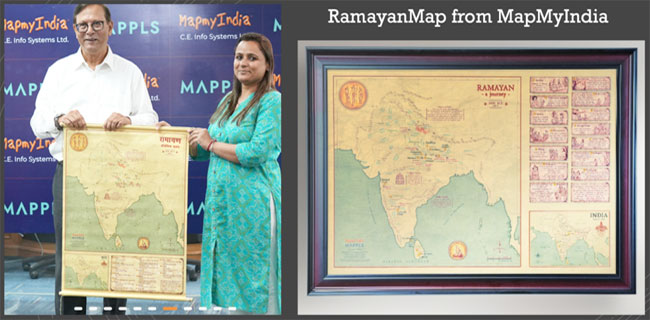
    Recently, MapMyIndia launched ‘Ramayan Map‘, a cartographical tribute representing ‘The Legend of Shri Ram’ on a vintage map canvas, right from his birth to the establishment of Ram Rajya.

    Gift Ramayan Map this Diwali

    Ramayan Map is something I wish people consider gifting during the festive season. By now, most orders for festival gifting may have been placed but do not see RamayanMap as a topical gift. I bought the Hanging Canvas RamayanMap as to gift. MapMyIndia also has the option for bulk Purchases for Institutions with a promise of free shipping all over India.

    It is available at INR 1990 for a roll-up Canvas print (25 inches X 33 inches) like the maps we hang. And also, a framed canvas (38.5 inches X 28 inches) is more suited for hanging on walls of corporate and institutions, and this one cost IR 7990


    Features of Ramayan Map

    There are some unique features claimed for the Ramayan Map

    It is India’s approximate map from 5000 BCE, i.e. 7000 years back. Shows locations with their original and current names, creating ease of relatability and building on historical relevance.

    It is printed and designed on a beautiful backdrop canvas with a lovely textured feel and antique-styled cartography.

    It gives a quick refresher course on the Ramayana story with location and descriptions of key events of Ramayana. This feature is fully appreciated by #IgnorantHindu.

    It is created using advanced geospatial technology to show scaled maps in kilometres and yojanas both. This is a silly claim as it is nothing more than showing the relationship between the two distance measurement units.

    Rakesh Verma, Co-Founder, Chairman & Managing Director of the company making it, says ‘the initiative is very close to his heart. It is a state of self-actualization, where life’s work meets spiritual being’.


    Reaction to Ramyan Map

    Many people on social media read too much in this statement and with MapMyIndia doing a Ramayan Map. To them, this is religionising and not secular in nature. MapMyIndia is a private business entity and fully in its right to create products which may have market demand. Suppose there are other such products with business possibilities. In that case, the company could consider Buddha’s travels and Shankaracharya’s movement. But then one can see how small the demand could be.

    I may want an interactive map of Maa Narmada Parikrama. Still, it may have very few wanting or buying into the service. The effort cost-benefit analysis may not work for the company.

    Are there more such region- religion- political theme-based opportunities, or is the Ramayan Map the only map in the making? Maybe the travels of Mahatma Gandhi could be considered. Still, one can see that it may be viable as a commissioned project from some sponsor but not a commercially viable product for direct marketing to potential buyers.


    Net-Net

    Take advantage of this initiative. Buy it for gifting and buy one for yourself. And #IgnorantHindu project supports this initiative. It is time that the next generation reads and understands their heritage.


  • Are Hindu rituals the favourite hunting ground of brands?


    By Sanjeev Kotnala


    Sanjeev KotnalaIt is festival time, and every brand is trying to make a difference. Some work with the functional advantage to create a preference and charge a premium. Many brands adapt to the new purpose-led communication to influence customers. And a few rare breeds of brands, in the name of change, question rituals and their understanding and relevance in today’s world. Invariably the questions are targeted at the majority – Hindu. To an unbiased observer, the need and scope for reconsideration and rethinking of customs, traditions and rituals that exist only for the Hindus and other predominantly minority religions are perfect. There is nothing to change or question.


    Recently, SC rejected a plea to ban firecrackers. It said you are an opportunity and are coming right before the festival and should have come early, asking why and what they were waiting for. And this is right. Festivals are for the celebration of tradition, culture and rituals; raising issues and objections and suggesting new ways to the concerned community is absolutely hitting below the belt. I do not appreciate any brand – service, or organisation raising issues with the traditions of any community. There are positive and negative ways to do things, and brands should consider what is better.


    Why just Hindu?

    Most likely, it is a result of four simple things.

    Every brand wants to connect with the largest possible base of customers. Hindus form the largest chunk of the population and hence the natural choice for the creative and brand team to deep dive into it whenever they have a brief about change or community.

    Second, the Hindus have repeatedly demonstrated their incapability of taking any such attack on their culture, ritual, religion, or mythology to its logical end. They just raise their voices in protest on social media, suggesting boycotting the brand, and that is where they stop.

    The Hindus are victims of their own brand imagery of being secular and tolerant. Sanatan Dharma, in existence from time immaterial, pushes for adapting and inclusiveness. It has survived repeated attacks through time and is expected to continue doing so.

    It is old with a rich tradition of oral continuity and learning. As a result, the people of today readily believe that many truths have become fictionalized or exaggerated through time. And everything is anecdotal mythology lacking historical evidence. And hence the revered gods and goddesses and their messengers are mere characters in a story, which makes them an easy pick for suggestions and remoulding as per the brand’s liking.


    Science v/s Belief?

    So, from time-to-time, brands stretch the boundaries taking potshots at Hindus. Not all such instances are bad or wrong, they are progressive, and the new generation would agree with the brand thinking. However, there is only one option against the regular onslaught by brands challenging Hindu religious practices and thinking – defend everything questioned. Don’t not critically re-examine them as an isolated case. The fear remains that if one did not object to any of these instances, it would open the floodgates of questioning. Hence, at every opportunity, the challenge must be defended.

    Unfortunately, Hindus get trapped and forget that the defence cannot be based on scientific reasoning. It should be based on belief. Belief kills every doubt and reason for questions. Belief is the tactic and the tool that the minority uses so effectively, making the argument short.

    At times, a regular counter-argument is raised by the so-called secular forces. Is the Hindu religion so weak that advertisements can threaten it? Well, the direct answer is NO. However, if the attempt is continuous and on multiple fronts, there is bound to be an increase in doubts and levels of questioning.


    Blame the Brand and the Creative Team

    It is futile for Hindus to question the actors and the celebrities enacting the stories of change in brand communication. It is a deep strategic initiative of the brand after considering possibilities and potential reactions. They are in the business and think through their strategy. And, If they cannot do this simple thing, some consultants and advisors can help them with the possible reaction with analysis like SMEAR.

    So, whatever brand communication is finally in the public domain, it is approved. It is the brand thinking; this is how the brand sees Sanatan dharma. Maybe the followers should forget what the religious leaders, facilitators and guardians tell them. The brand knows better how Hindu practices must be shaped to remain relevant in today’s world.

    This reminds me of a simple, strong line from the recent movie Goodbye, and the brands should think about it. Everything that you don’t understand is not wrong. Brands having differential self-regulation beyond the guidelines and legality is highly desirable.


    Every brand communication could not be wrong?

    The problem is simple: the majority and the minority cannot allow any brand to question religious practices. There is no room for error or negotiation. Hence, every communication should be evaluated in isolation. The brands often suggest a little rethinking and point-of-view without questioning the basics. They use elaborate storytelling to create a situation – while suggesting a change. Not everything is bad, but no single body can define what is good and bad, what is acceptable and what is a cause for concern. Everyone has to take their own call.


    AU Bank – Badlav Hum Se

    The AU Bank advertisement is a case in point. It presents the flip side of the coin. Here the groom is coming to the bride’s home as a ‘Ghar Jawai’ for some reason, like the wheelchair-bound bride’s father. Usually, the bride stepping into the groom’s home would walk through the plate with Alta leaving her foot marks and kick a pot of rice. However, here it is playfully suggested that as it is the groom who is coming to the house, he should take the first step. What’s wrong with it? And if we allow our insecurities to raise such flippant questions, we will kill the art of storytelling. How come we understand that the breed of new authors in mythology space create contemporary fiction and not question the beliefs. Still, we forget when it comes to advertising.


    BharatMatrimony #BeChoosy

    This is a different case by Bharat Matrimony , a provocative thought. Breaking of Karva Chauth fast. No married woman will think breaking the fast is for her husband’s long life. This is a celebration of the thought. It is collective working towards what is good for the family and adapting to the situation. This is the celebration of culture with a strong positive statement- if I can fast for your life, I can also break my fast for you. This also shows that a negative portrayal is not the only way to question tradition or culture.

    In the past, the Stayfree communication – touch the pickle was the right suggestion with new solutions. And every year, we find new brands getting caught in this trap of questioning- where the celebration would be a far better option. Earlier brands like Tanishq and Manyavar did face the Hindu music.


    Net-Net

    The change will happen- it is a natural process. Questions will be raised- and they will be full of agenda. Suggestions will be made even by the least interested and knowledgeable in trying to hasten the process. However, suppose the brands think through the initiatives and stop poking fun only at Hindus. In that case, life could be much more straightforward. Conversely, Hindus may be better off by not questioning every brand communication that even remotely suggests a different perspective. However, personally, I think and reiterate that these brands under their purpose and change have no right to raise finger on the rituals and traditions of any community. And if they start raising issues with traditions of other communities, it does not solve the purpose or address es the issue. Such changes have to come from the communities and start at a group level. Brands taking on position and using mass media is not the way. The time is over and the brands may encounter harsh reality and retaliation in the place it matters- the market place.


    Sanjeev Kotnala is a senior marketing and business strategist. And an educator. He writes on MxMIndia every Wednesday. His views here are personal


  • Brands like Dhara & Sabhyata show how to do it the right way


    By Sanjeev Kotnala


    Sanjeev KotnalaFestive times are the times to celebrate. Time to understand and appreciate the positivity of rituals and practices. Time for inclusive togetherness and not the time to point figures.

    There are enough issues, problems, and opportunities relevant to the brand category and promises that can be exploited. There is no need for brands to look at religious rituals and practices to question. This year we have seen fewer brands opting to question religious rituals and practices. It seems brands have understood that it does not make strategic sense to risk business for some fancy agenda of change.

    Some brands understand the subtle need and nuances to strengthen their positive connect with their audiences. They have a purpose, maybe even a real purpose. They remain sensitive to their ecosystem and do it the right way. Here are some examples.


    CADBURY

    Cadbury has used festival time and Diwali, in particular, to add freshness and smiles to people. The efforts are enormous, and the impact is measurable. They address real problems and provide real-time solutions within festival mood and ethos. There is a genuineness in creating inclusiveness in business and a consistency in approach through the years. The purpose here seems genuine. This year’s effort- Jinki Dukan Nahin Hoti– for people with no fixed place to set the shop is brilliant.


    DHARA.

    Dhara’s new ad in the series Khane Pe Kehna’ celebrates the festival. Dhara does not ask the audience to change; it asks them to return to the original ritual and practice of sharing and distributing handcrafted, homemade sweets. The family gets together and shares responsibility. In the process, the tradition and the art of making sweets get transferred through the generation.

    Maybe the older generation will remember it more. The current generation is happy sharing and delivering e-commerce goodies. The line ‘Tyohaar Ke Rivaj mai Zara Sa Badlav lana Hai. Apno Ko Ane Haath Se Khilana Hai’ is apt and well-presented in the ad. In fact, the way the daughter places the suggestion is full of grace and respect.


    SABHYATA DIWALI 

    Sabhyata’s Diwali ad is a simple story. It demonstrates an understanding of the new-age women’s aspirations and issues. And there is a different hiring ritual – that’s it. The leisurely build-up aligns with how it wants to steal your attention. Sabhyata, the ethnic wear brand, as something to wear to the interview connects. Though there are a few questions, is the message to hide the pregnancy the right message? Is that empowering, or is that re-instating the fear?

    I believe sometimes we should stop being too critical and stop debating every frame from a logical point of view. The communication must be seen in its totality. The only issue is that the advertisement may only work with people aware of the brand. The product does not really stand out and speaks to the potential future consumers- which it could have done to expand its base.

    Sabhyata has challenged the expected stereotype and practices in past. Here is another ad from the brand where mother-in-law and daughter-in-law team together to trap the husband into making tea.


    DABUR RED TOOTHPASTE

    Indian dental care market has seen everything. The concept of ingredients that help dental care has come a complete circle. People understand the Indian brand’s formulation and benefit outweighed the MNC-created products. The MNCs, which once denied and rejected Indian understanding of dental products, now outshout each other in telling the consumer they have it all, from Salt to charcoal.

    Dabur Lal Dant Manjan is one such product. The contemporised format Dabur Red Toothpaste promises the same results and uses modern-day science’s power to extract the best of Ayurveda.


    So, you have Amitabh Bachchan presenting the logical part of communication. And there is a song and dance version made on the 80th birthday. It uses the famed AB song- Ek Rahe Bir … They bring in three ‘gora’ and their dental issues while AB continues enjoying the fruits of strong teeth. It works. The song, ‘Eer Bir Phatte’ remade for Dabur Red Paste, nicely presents the story and the product benefit- maintaining problem-free healthy oral care.


    HP WORLD STORE.

    HP World Stores’ #ThodiSiJagahBanaLo (make a little space) calls for supporting the local Indian artisans to showcase their art and scale it up. It is a simple story but powerfully presented. The brand has taken the thought to the street with HP WORLD STORE across some cities bringing alive the idea in real life.


    REAL ‘ME’ DIWALI

    Primed with tradition and the meaning of the festival is the Real ‘ME’ Diwali advertisement. An overload of emotions and a story that may resonate with the new generation is a meaningful brand expression.


    And then there is BharatMatrimony  I discussed in the last blog, and Tasva– the Naya Nazariya– which was nothing new.


    NET NET

    The above are rich examples of change. They do not question religious practices but operate within the gamut of collective togetherness and the spirit of festivities celebrating the possibilities. The brands are sensitive to the business ecosystem, and the communication is powerful and relevant to the category.

    There are enough issues, problems, and opportunities relevant to the brand category and promises to be exploited impactfully. There is no need for brands to look at religious rituals and practices to question, and maybe the brands will understand it.