
Category: SANJEEV KOTNALA

  • Long live Advertising Awards


    By Sanjeev Kotnala


    Sanjeev KotnalaAs the trend goes, the agencies had stopped advertising their win at award events even before the pandemic. However, after Goafest 2022, one ad appeared in Brand Equity, in The Economic Times. And one started questioning the need for it. Why would someone advertise their win in print in the digital era? Not a tricky question, but the answers are vague. So, I did what I usually do, I reached out to my dear friend and a well-known brand and marketing consultant, Vermajee. I wanted an explanation for this anti-advertising posture of agencies? You win something good- so why not advertise?


    As I poured Vermajee his glass of preferred Single malt, I could see he was deep in thought. Today, the mystery would be resolved.


    Vermajee on award wins

    Like any good consultant, Vermajee placed the case details for agreement.

    Agencies enter awards to win. Entering awards is a costly ritual, and no agency enters awards to be counted as an also-ran. So, they enter their best work. A work they can be proud of and at least is internally considered award-worthy under peer group evaluation. In fact, the agency does not want anyone to know they entered the awards unless they make it to the finalist.

    The participants hate shortlists, but then it works for the event organisers.

    It all was making sense after two pegs.


    Who advertises the award win?

    There are only two possible outcomes: you win an award, or you don’t. The reaction and happiness on winning an award is a function of what metal the agency wins, the size of the business, who worked on the creative, if winning awards is a habit or if the award is a surprise.

    It holds true for most awards other than the Cannes Advertising award. There every win is worth celebrating.

    Vermajee explained the logic.

    If one win is a bronze or a silver or two, it is not worth advertising. And that is true for small as well as big creative powerhouses. Anyway, the winners will brag on social media about the win. Friends would congratulate, and the client might add their social media support to the win.

    On the other side, say one wins big. Like Grand Prix, the agency of the year type, it changes the perspective. It is a piece of huge news. It should naturally get covered by media partners and industry-specific media, including social media. Most likely, the people who matter would be following the event, and hence they would know. Seems logical.

    However, the agency may want to amplify the win by advertising and making the unaware target group know of their big win. It will happen only if the win counts in the eyes of the CMOs. The creative awards are okay for this, but they are no proof of efficiency and effectiveness. And then it costs money to advertise.

    Rather than advertising, doing personal communication to the few the agency wants to reach out and impress will be more effective.

    But, if the awards have lost their sheen. Suppose they are no longer considered the epitome of excellence and have lost their importance and relevance as a business development tool. In that case, there is no need to consider advertising the win.


    Vermajee seeks accountable award organisers

    Vermajee was playing with his glass and my thoughts. He smiled at my ignorance and continued. Award organisers for years have gone unchallenged. They go out of their way to amplify the call for entries; their moral duty is to amplify the wins in relevant media. Not as coverage, but as an ad.

    Vermajee adds it may not be possible to do justice to every winner. Prioritisation and award hierarchy need to be defined to communicate the top awards. Where media organisations are sponsors, the deal itself could include space for such an ad and special rates for the winners to advertise.


    What’s missing from the award ads

    The award ads tell you who won what. However, you are left guessing what they won it for. The ad cannot show every thumbnail, but it can carry a QR that loads a page where you can see all the relevant wins in their full glory and details. One can even link it to the agency’s pages featuring other work.

    The award organisers can easily create an award page as the entries now are digitised. In fact, it works for the awards. Is it too much to expect the myopic award organiser to look for stakeholders’ interests? Most even don’t allow the Jury to present their point of view as to why they awarded one entry over the other equally good entry.


    Net-net

    Vermajee closed the discussion with a bottom-up of his fifth drink.

    Advertising or not advertising is dependent upon a few simple answers. How creatively can you treat the award win ad? How strong is the need to commu8nicate the win? If there is an internal pressure to advertise? Do you want to reassure the existing clients with these wins or use them as a new business tool? And finally, What is the ROI you expect from the investment in an award advertisement.

    Vermajee dramatically raised the glass and shouted at the top of his voice, “To the last of the award ads. Go treasure the moment. Long live advertising- long live awards, Jab Tak Client Aur Agency Rahegi, Tab Tak  Awards Their Kaam Rahega“.  Award will remain  till there are clients and agencies.
     

  • Stumped by Cred Financials. Bowled over with Ravi Shastri Ad


    By Sanjeev Kotnala


    Sanjeev KotnalaCred, the Bengaluru-based fintech company (Dreamplug Technologies) for Credit card payment promises its nine million-plus members points that can be redeemed against rewards. In a way, the customer not only earn rewards while buying things on a Credit card, but also when making Credit Card payment through Cred.


    I have commented on Cred’s strategically quirky ads and clutter breaker creative devices. Personally, I was never a huge fan of Cred advertising and found it crazy. It did not really make sense, with hardly a real call for action and flogging the same message for too long.


    With time, the advertising started making some sense. Cred advertising is impressive enough on focussed consistency. The message format has changed yet it has retained its basic flow and quirkiness. I can now appreciate the structure and the advertising a bit better,  but am simply stumped with the scale and need.


    Cred advertising is still about the rewards on Credit card payments. Other features like Expose Hidden Charges. Track Spends. Clear Bills, Free Credit reports and scores, referral programmes, Get Rewarded, Peer-to-peer lending or pay Rent are not promoted.


    Cred – BOWLS OVER WITH RAVI SHASTRI


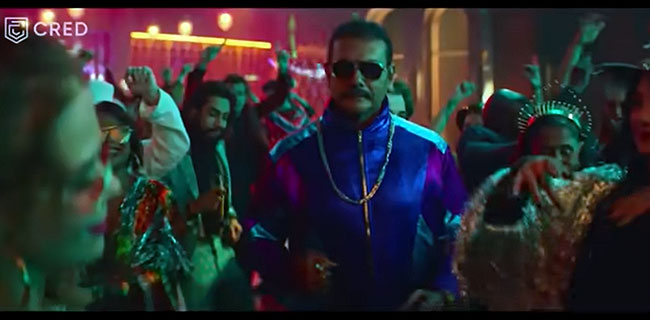
    With the  Ravi Shastri Cred ad, Cred seemed to have bridged a gap. The ad is all about the performer’s perception and image. Coming in towards the last leg of IPL, the timing is right. Being a country that focusses a lot on cricket,  viewers relate to the act as Ravi Shastri and his passion for drinks is a joke shared too often.


    https://youtube.com/watch?v=vLHpfulLcUE


    The ad is humorous. It exploits the media image of Ravi Shastri. It has dialogues that one may find crazy and cheesy, but they are on the dot. And then Cred promising more fun than what Shastri is having. That is the week link.


    ‘Sattar minute for happy hours’, ‘I used to be a batsman, but for you, I can be a keeper’, ‘Waste mat karo yaar’ are spot-on.  The timing perfect. Add to them my favourite:  the poker-faced answer at the press conference, ‘Hate Talking to sports journalists’.


    The Cred Ravi Shastri ad, like any other Cred quirky ad, is gaining views on YouTube. The small write-up under the ad on the Cred YouTube channel is equally interesting. Here it is.


    As Ravi Shastri, I want to make it very clear that all my parties are invite-only. But I admire our youth and their potential, so if you’re able to do all of the following, you’re automatically on the guest list: (1) Open beer bottles with a bat. If you ask how, you’re already out. (2) Analyse footage from the party to see where drinks were wasted (3) Bartend 24×7(4) Carry an extra case of cough syrup at all times (5) Parallel park the bar-counter

    If you make the cut, congratulations. You’re never going to remember another night in your life again. But if you don’t, cheer up: you can find an equally rewarding experience on Cred. All for paying your credit card bills. Believe me, I know what’s fun. To join me as a member, download the app


    What Next With Cred Ads


    If Cred remains true to its advertising SOP, we can expect a series of ads in the format where the Celebrity may project their unwarranted images. Maybe Shashi Tharoor, Kangana, Chetan Bhagat, and Salman Khan could be good extensions to the series. Maybe the next series can pick trends with social media influencers. Hope it remains away from the region, religion, sex and politics – the four pointers that tilt the Smear Index  for any communication.


    Cred Clutter Breaking Communication Recipe.


    Something must be right. Cred claims ( as of Oct 2021) a 700% increase in app downloads after the 2020 audition campaign featuring Madhuri DixitGovindaAlka Yagnik and Udit NarayanBappi Lahiri, and Anil Kapoor. And I was questioning – what the hell Cred was doing?


    The next lot of communication has celebrities portraying images that you don’t associate with.  The series featured Rahul DravidJackie ShroffKumar SanuVenkatesh PrasadNeeraj Chopraand Kapil Dev. These were fun, and everyone had their favourite, with the Dravid ad being the most loved.


    Then came the old era imagery with Karishma Kapoor in Nirma adZee Antakshari with Renuka Shahane and Annu KapoorSharma Ji-Gupta JiShaan-Sonu Nigam song. I thought Cred was becoming too constrained with its own format and boundaries. And then it surprised us with Ravi Shastri ad that pushed me to rethink. The Ravi Shastri ad is fresh and one of the most enjoyable- but if it does anything to the business is a question mark. I will any day have the fun Ravi is having then go for the Fun of earning rewards by making Credit card payment on Cred.


    Too Much Of Advertising!


    That’s too many films in the last two-three years with not much to show in revenue other than valuation. So many celebrities and four format mutations. I may be bowled over with Cred Ravi Shastri for its timing and content. Still, I am stumped at the need and purpose of this considerable advertising.

    Thanks to the advertising and some positive word of mouth, the brand enjoys a high recall and decent usage among Credit card users. However, the ad never made me want to check out or download the app. Maybe and hopefully, I am a minority. And perhaps the advertising is more cantered for VC, Investments and valuation.


    Cred Not-so-Cred-ible Performance!


    It is different when it comes to financials. Cred marketing spends outscore its revenue by huge multiples. It became a Unicorn within two years of launch, and the current expected valuation is around $6 Billion! And it behaved like one burning at a high rate.


    Reports tell that Cred had a 95 cr total income and 88.6 revenue from operations in FY 21 (against 18.1 cr and 0.5 cr in FY 20), with total expenses at 619.4 cr and a loss of 523 cr in FY 21 (( against the expense of 3979 Cr and a loss of 361 cr in FY20)! Additionally, the marketing expenses themselves are pegged at 418 cr in FY21.

    The brand seems to have launched or substantially grown products, including Cred Max, Cred Cash and Cred Travel which were not pushed aggressively with advertising.


    One would here like to believe the founder Kunal Shah, statement: “At Cred, we are constantly working to enhance members’ experience to make it more engaging, frictionless and rewarding. With new design philosophy, gamified rewards constructs, best offers and high value jackpots, we are consolidating our message of rewarding the right financial decisions and the privileges that come by being a member of the Cred community.”


    Will Cred Credibility get stronger in the future? We will have to wait and watch? Being Bowled by advertising is bad enough but getting stumped with financials is worse. 


  • Sanjeev Kotnala: The Magic Eye Peep Hole Barrier 

    Sanjeev KotnalaBy Sanjeev Kotnala


    The world is made up of Probortunities doors, and they can open both ways. They can be considered an opportunity or a problem as per the hue of the glasses. To know the truth, all one needs to do is open the door, step through it and embrace the new world.


    Sorry, It is not so simple even if you know the situation reasonably well. Even if one is supremely confident and charged enough to boldly open the door. There is always an element of doubt that stops us, and we hesitate and re-evaluate, leading to delays.


    Desiring Perfection And Certainties

    Magic Eye represents the desire for more information than available, thinking it will help make the right decisions and face uncertainties, some real and some assumed. In the cautious approach, one loses momentum, and the probortunity disappears. Everything seems to be a mirage. And no one knows what way the things would have moved.

    Remember, perfection is a myth, and there is never complete information or certainty in time, efforts and results. And hence, there cannot be a perfect decision. At best, it could be the best decision basis the information available and possible alternatives.

    The outside world is chaotic and in complete flux. At any given point if time, it is being pulled in multiple directions by the invested stakeholders while we stare at the door and think of the magic eye.


    Open The Door

    Mysteries are revealed when the door the opened. One will know if the door leads to opportunities, challenges, unchartered paths, problems, solutions, or something unknown only when the door is opened. The truth is that no one knows beyond the door unless one opens it.

    Naturally, anxiety takes over. Dark threatening clouds of uncertainties cast shadows of mistrust. Capability and compatibilities are questioned. Imaginary negativism raises its ugly hood making one doubt the potential and possibilities. In the process, the present gets overpowered and crippled by past experiences and future expectations. One forgets the task and the need to remain and live in the moment.

    Everyone wants to be sure, get guaranteed results, and be prepared for the future. The funny part is everyone knows that the future is vague, and no one has seen it. There is no way to predict, and the best experiences or education cannot guarantee it.

    Future is never in your hands. It takes shape at (n-1)th moment and dies immediately in the present. One gets so entangled in biases of past experiences that one stops living the moment. We forget that the future is a chase of uncertainties, and the past is a reservoir of experiences and learnings.


    Magic Eye

    Where there is a door, there is always a magic eye. Physical, metaphorical or imaginary. It facilitates a one-way vision into the possible future or past. It helps with what is there on the other side. But like every magic eye, it is a one-way window, and it can, at best, look back into the past. The magic eye does not help look at the future because the future does not exist in the present.

    Life’s magic eye is unlike what you find in the hotel rooms. It allows you to look back onto the corridor you walked before, and it does not allow the view to the inside of the room. Anyway, neither the vision nor the need for the vision is the same.


    We Seek Hints Of Possibilities

    Don’t get me wrong, but there are moments when keeping the door closed and ignoring the magic eye may be the best policy. Enjoying the comfort of dark uncertainties is more soothing. But, it will never last; it is not meant to last. A newly heightened awareness will surround with time, and one will hopefully act. One will start building own algorithms for the magic eye or absence of a magic eye.

    There are multiple doors of opportunities, problems, and challenges surrounding us in our professional and personal life. The magic eye is mounted on all these doors. So, expect to walk the corridor of life using a one-way magic eye. However, remember that your magic eye on the door of probortunities could be a senior, confidant, consultant, or colleague.

    Get comfortable with the vague future and amplified scenarios. Enjoy the beauty of inferred realities. At some stage and hopeful the right stage, one will move with a degree of uncertainty to open the door. Because stagnation is not life, movement is. So, the door will need to be opened at some stage, magic eye or not.


    Collective Push

    Most of us are happy to live with a collective failure than chase risky individual success. Hence we tend to democratically move and decide to look through a magic eye that cannot guarantee a 20:20 vision.

    A Simple magic eye gives a tunnelled vision. Some with experience can have a wide-angle view, hoping to catch the hidden clues at the edges. And, when it does not make sense, we ask experts to interpret the images.

    Detailed vision depends on many parameters. The height of the mounted magic eye. How early do we seek vision interpretations? How important is it to open the door and face uncertainties?


    Magic Eye Advisors

    People claim to interpret magic eye visions, and they can hopefully make sense of the magic-eye vision. However, they really don’t have skin in the game, and they don’t have to finally push the door open and take the step. They, too, suffer from the bias resulting from past vision interpretations, experiences, and expectations.

    The inexperienced person has an uncomplicated unbiased view, and they see hazy pictures. But, they are more open to taking the plunge with uncertainties. They know life to be uncertain, so they have a higher degree of acceptance of uncertainties.

    In corporate life, the magic eye promotes a cautious approach, collectivism of decision making and vision interpretations.

    Corporations expect a hostile competitive environment. And they want giant magic eyes or one with a better field of vision. This, in turn, gets reflected in risk-averse behaviour and procrastination, and the doors remain untested.


    Closing the Door

    There must be some merit in being bold and closing the magic eye, facing the uncertainties directly. In the process, defining and deciding which side of the door one wants to be. There are always multiple options.

    Playing to the inherent fear and being cautious, we try installing windows where the magic eye was. Sometimes, it does not makes any difference, and the magic eye and the windows remain ornamental.

    So trust me, it is more fun to ignore the magic eye, open the door, step outside and learn by experience than to be over cautious and try multiple magic eyes for the elusive insight. Multiple magic eyes could result in differential images combining to create a collage one may not be able to make sense of.


    Net-Net

    Ultimately, every one of us has to decide individually what to do with the magic eye mounted on our doors. Many are the victim of the magic-eye barrier. The magic eye-stopping them from moving forward. They know that it is time to close a few magic eyes in life and open a few more doors. But, then, as I said, knowledge and vision are not everything.

    The decision, as they say, is always yours.

    The magic eye is directional and a tool to help, not the crutches for you to ride.


  • If self-regulation fails…


    By Sanjeev Kotnala


    Sanjeev KotnalaGood news. ASCI acted fast. It is debatable who acted first to ban/ withdraw the controversial Layer’r Shot ad. Was it the government or the Advertising Standards Council of India (ASCI)? I am glad someone did. However, the story has died fast. Everyone is okay after the ad is withdrawn and a vague apology tendered. One does not know the mandatory approvals, who approved, and why there is no further action?


    Meanwhile, the government got into the act. The Central Consumer Protection Authority (CCPA) released new guidelines against misleading advertisements. It says surrogate advertising is now banned- was it allowed earlier? The celebrity must disclose association and do due diligence before endorsing – was that not the case?


    Meanwhile, ASCI released new guidelines on Harmful Gender-Stereotype in advertising. It aims to encourage advertisers to create progressive gender depictions. It is okay if the ground realities are different and do not reflect this expected holier-than-thou depiction in advertisements.


    This reminds me of Sunny Deol’s famous dialogue; Guideline pe Guideline pe guideline- nahi milte hai toh misleading advertisements se chutti.


    Minister Calls ASCI act

    I read the overdramatic comment of the Union Minister for Women and Child Development, Mrs Smriti Irani and I smiled. She said, “If women were valued enough, we wouldn’t need guidelines”. I believe she would know the reality.

    However, she made a relevant observation on ASCI members and their engagement. Of the 800 ASCI members, just three members (officebearers) were at the guideline event. That’s how integral ASCI is to the industry. That is how concerned, involved, and serious the industry is towards self-regulation?


    Intent does not Count

    The guidelines on Harmful Gender-Stereotype in advertising call for not including gender stereotypes likely to cause harm or serious or widespread offence. For ASCI, it is a strong step towards a more responsible and progressive narrative. Well, I am not so sure. We know how guidelines are exploited, played with, and not adhered to by advertisers.

    The truth is that most creative and client teams do not know the guidelines and don’t understand them. Brands simply don’t give a damn to ASCI, given that it only seeks a polite enquiry and request to withdraw the offending advertisement.


    Things have changed a bit 

    ASCI has streamlined the processes. There are quick processes to address the problem. But withdrawing the ad with no public apology shows ASCI has no bite. In most cases, the advertisement achieves its objective before ASCI request a withdrawal.  However, the ASCI service #GetItRight, get the creative pre-checked at the production stage, returns a 404 error!


    Different strokes

    Surprisingly, large brands and big advertisers regularly feature in the quarterly reports of offending work. ASCI guidelines have no say on advertorials, political and Government advertisements.


    Will ASCI guidelines restrict creativity?

    In today’s world of rapid information exchange, heightened point-of-views and hardened social voices help nudge the brands in the right direction. But storytellers must have creative licenses.

    Is ASCI not asking too much for brands to reinforce unrealistic and undesirable gender ideals or expectations. For example, expecting a woman to return from work may not be shown as solely responsible for doing household duties while others around her are at leisure. Remember Airtel.


    Should advertising worry about social reform?

    When the guidelines become constraining, they will be questioned.

    Should advertising stop reflecting the social and cultural realities?

    Will it not make them irrelevant, ineffective, and tough to relate to?

    Should advertising aim to nudge people towards the right desired way of life?

    Or should the ground realities change before advertising reflects it?

    Are we not giving advertising too much credit for possibly impacting human behaviour?

    Are guidelines not trying to dictate what should be controlled by the market forces?


    Net-net

    Advertising is becoming a tough maze with all the guidelines. There is too much of what not to do. Maybe creative teams see it as a decent challenge. But this forced wokeness is wrong.

    The brands should be free to tell the story how they want and ensure that no misinformation or false promise is being made. And that it does not hurt religious, regional, language or gender groups or objectify any gender.  And if there are guidelines there should be a robust way to implement them by Sham, Daam, Dand or Bhed. (Logic, cost, Penalty and differentiation/doubt).


    Let us understand, that ASCI cannot do much till the corporates, the marketing and the brand owners take the initiative. Self-regulation is all about knowing and doing things consciously as per the guidelines. Till the time ASCI does not have real teeth to penalise and persuade brands for breach of guidelines, they may just remain guidelines.


    Not against self-regulation

    I am not against self-regulation; it is crucial. As an industry we all owe to the society the right way of promotion. If the industry continues to fail at self-regulation. In that case, someone like government will have to regulate it, which will be a sad day for the industry.

    I am all for effective self-regulation, where there is one expectation from every stakeholder, and the regulating authority has the right to take action. Where every team member on the client and the agency side understands and appreciated the need for the guidelines, maybe then they will follow it better. Maybe I am asking for too much.


  • IPL Media Rights: Indian Streaming’s Watershed Moment is Here!


    By Shailesh Kapoor


    Shailesh KapoorIPL media rights went under the hammer this week, and the results are out. The overall value of rights has gone up by almost 200%, though the growth is a notch lesser if one looks at the per-match average, as there are more matches lined up in the coming years because of the addition of new franchises.


     

    The growing stature and commercial value of IPL is not surprising. It’s literally the only TV property in India that has “event value” today. Gone are the days when big-ticket reality shows rated 4%+. Gone are the days when a single TV show worked across the audience spectrum, amassing event-like numbers every night. In times of highly-fragmented viewership, IPL is the only TV property that has any sense of audience aggregation at all.


    What surprised me, albeit mildly, is the massive growth in the price of the digital rights. In September 2017, when the last auction was held (for IPL 2018-22), Star India won on a consolidated TV + Digital bid. But if you look at the highest bids for the TV and digital packages individually, they stood at INR 11,050 Cr for TV (Sony Pictures) and INR 3,900 for digital (Facebook). That’s a ratio of 2.83.


    This time, the main domestic rights (Package A & B) have gone for INR 23,575 Cr (TV) and INR 20,500 Cr (digital), i.e., a ratio of only 1.15. While TV rights have gone up significantly too (even if you look at the per-match average), it’s the change in the ratio that’s a sign of things to come: Digital is no longer niche. It’s as mainstream as TV. Even if the viewership numbers are still higher on TV, digital has the momentum, and the advertiser sentiment, on its side.


    If you also consider Package C, which is another digital package for non-exclusive rights (eventually taken by Viacom 18 itself, who also took Package B), the ratio of TV to digital is 0.99. In simple terms, from being almost a third of TV rights five years ago, digital rights of IPL have gone for a notch higher than the TV rights this time.


    The absence of an integrated measurement system will be felt more than ever before. Advertisers now have two equally-sizeable media to put their IPL moneys on. But they won’t have an integrated currency measurement to help them plan it well. This was a lesser issue so far, not only because digital was the smaller piece all these years, but also because the last five years had both rights under the same network, and the selling was often bundled. Both those factors have now changed, and we are in for some eventful times. Both Star India, who continue to hold the TV rights, and Viacom 18 will have to innovate out of their skins to monetise their prized grabs.


    IPL digital rights crossing TV rights in value is a watershed moment in the Indian entertainment business. Linear TV has lost its pole position this week. And streaming is a worthy successor.


  • Protests fuel a Backward march


    By Sanjeev Kotnala


    Sanjeev KotnalaAs a citizen of the nation burning with protest one or the other things, I am confused and undoubtedly disillusioned with the country and its capability or potential to move forward. We seem too agile and opportunist in finding reasons to violently protest for Region, Religion, Politics, Language or Government actions. And naturally, advertising is the farthest thing in my mind, though I believe that the communication could have been far better handled somewhere.

    Shaheen Bagh to farmer protest. CAA to Gyan Vyapi to Agnipath. We find windows of synchronised, well-orchestrated protests — not from an average citizen’s angst or observations. It is evident that behind such gross violent protests are bigger fishes with more significant stakeholders fuelling and funding them.


    Simple Questions

    The question that comes to mind is simple. How come, in each of these instances, the government has not been able to present them in a better form? Not necessarily more acceptable, but definitely where the reactions are controlled. How come no one in government could visualise the possible scenario? In the case of Agnipath, it was WIP for the last two years. And how come, if they did, they did not prepare for the reaction control?

    One may say that typically ill-informed and judgmental citizens do not have the intellectual width to pace counter argument on some schemes and policies. I am not fully aware of all the policies and the media biases. But I know they have a sound logic for being created and pushed for. Unfortunately, plans on paper are mere plans till they are executed.


    Protest Damage

    The damage these protests are doing is enormous to the country. It is disrupting the national fabric, which is already strained. It is pulling down the nation. It is raising questions about the government’s capability to run the country. A government that is in power with a decent majority. It faces the legacy and the after effect of the earlier appeasement policies that never tried to be disruptive.

    We live in a nation with multiple political agendas that are opportunistic and illogical. There is never a thought of the national future and well-being. And this is not true of the current opposition but also of other parties. The schemes launched are future-oriented and good for the nation. Yes, these policies or schemes rub some stakeholders wrongly and badly. But it is expected-there is no programme and policy that will always be good-good for everyone. However, our welfare state doesn’t talk the language.


    Ill-framed, Ill-informed

    There is always an afterthought. The points are not placed in their right spirit. The branding and the communication campaign still follow the basic governmental advertisement model of achievements. It rarely talks and concentrates on the possible impact on the consumers of the scheme. It is time for the government to consider using the best of the services for their campaigns. No guarantee it will solve every problem- but I think it will create a better climate.

    The government should also stop presenting everything as a scheme and a policy.

    The government in a welfare state with responsibility and accountability for laws and running of the nation: not necessarily, the businesses. It decides citizenship. But, because of myopic political promises, it is expected to be a job and job security provider. It has to create the climate for such a situation, not micro-manage it.


    Nothing Deters the Protestors.

    Protestors protest and burn public as well as private properties. They know nothing will happen to them. Every government has been unable to find a way and demonstrate a faster judicial process or an exemplary penalty to deter others from doing so. The police force is a puppet of the powers. It is highly ill-equipped. The surveillance camera doesn’t prevent the rioters. The riot blue dye is not available. Pellets bullets cannot be fired. Guns cannot be charged, and the lathies are nothing before the well-prepared protestors. The cases run for ages. Things are forgotten, cases withdrawn, and a new subject to protest keeps the nation on its toes.

    This is one area where the government- central or state has to think and, if need be, invest in them. Maybe even have fast courts for deciding the cases. Maybe bar the protestors from every government support- but only the protestor, neither the property nor the family. Unless the property is non-regularised and not approved! And these regularising of the encroachment on land, national ambition, and emotions should not be allowed.


    Net-net

    Till the government does not start doing a proper communication and the rioters of every reason are not summarily prosecuted, we should be ready for such protests. And if needs be, keep a tight check on what appears in the media. The nation does not just want to know. The country wants to see a positive, optimistic proactive government delivering. And if possible, the opposition join hands for issues of national interest and oppose those that are not.


    Sanjeev Kotnala is a senior business strategist and educator. He writes on MxMIndia on Wednesdays. His views here are personal


  • Aligning the Brand Chakras


    By Sanjeev Kotnala


    Sanjeev KotnalaDentsu Webchutney is the Creative Agency of the Year at Cannes Lions 2022. It makes all of us in the advertising and marketing industry feel proud. It deserves a round of applause for winning and raising the bar for others to follow. The creative for Vice Media’s ‘The Unfiltered History Tour’ that led the surge is all about an innovative solution where the thought and execution have a complete brand alignment. Such a creative solution needs the client and agency’s alignment across Brand Chakras and commitment.


    A Different Picture

    In the case of regional brands and owner-driven organisations, a consultant needs to make a lot more effort to educate the client. There is a gap in understanding the science, art and craft of communication. The consultants often have to innovate the processes or create shortcuts to drive home a point. We recently worked with two clients to make a point on Brand Alignment. This is that story.


    The Initial, Baby Steps

    The client finally agreed to do a project, an experiment without expectations. However, as the data started coming in, we realised we were on to something good despite the unscientific process. The inferences were directional and of tremendous value.

    It was an eyeopener for the client, who was wary of investing in extensive research. The exercise probed at Brand Archetype, Personification and Brand Alignment across critical stakeholders. The simple exercise helped top management rethink the brand image and the stakeholder perceptions.

    The brand is a dominant regional legacy player in the FMCG category. The rising input cost threatened margins, and active competition finally made the client sign for the experimental study of brand perception and imagery across stakeholder groups at the budget was challenging, if not impossible.


    Personification surprises the Brand Team

    A detailed brand personification exercise threw some interesting results. The exercise involved a wide section of groups, including Top Management, Employees (10 years+ Less than 2 Year and others) cutting across sales, accounts and manufacturing. Additional external segments like retailers, distributors, modern trade and customers were also probed.

    The personification cue card used Bollywood stars of the last 60 years, including actresses, villains, comedians, and character artists. Bollywood was used as respondents could easily associate with it.

    We expected the dominant well-established brand to have some degree of uniformity in personification. However, the results showed how fragmented and inconsistent the imagery was. The brand team and the consultant had enough arguments and explanations for the results.


    Brand Archetype

    This was directional. So, we expanded the scope with Brand Architype. The respondents were unaware of the purpose, thus helping decrease the possible bias and noise in the analysis.

    The team expected the brand to reflect one of the 12 archetypes as the dominant archetype in its core market. Surprisingly, the output showed two dominant archetypes and eight others registering their presence in stakeholders. Clearly, the imagery and understanding were not as sharply defined as the client believed till now.

    Important was the spread of associated brand archetypes across segments. There was no consistency even in the top management, and it took time to sink in. The new employees saw it quite differently than the old employees. The sales, retail, and distributors had different impressions reflecting polarised archetypes.


    Corrective Actions Need Time

    Clearly, the brand alignment and imagery were not consistent. A result of past tactical reactions to market situations. It was easy to hypothesise possible reasons for fragmented impressions and somewhat unwarranted perceptions.

    The brand team and management collective now focus on the brand to reflect the desired archetype through interaction, experience and communication. The management was willing to wait for results. Significantly, another client bought on to the idea and initiated the project to understand brand perception and imagery across internal and external audiences.


    Organisation Brand Alignment Chakra

    This experiment and the results were not unexpected. As the organisation grows, departments become independent silos of power, action and culture. Often, these are not aligned with each other, resulting in a defused image.


    Brand Chakra

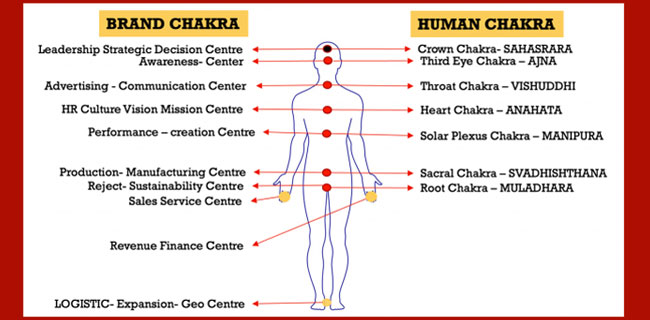
    Most readers would be familiar with the seven chakras. Now, using it as a foundation and treating the organisation as a human being, we can interpret Brand Chakra differently.

    1. CROWN CHAKRAor the Sahasrara Chakra is the Top management. It is the thinking area and area where strategic decisions are taken. Typically also, the head office with Lo and L1 leadership level in direct consultation with the owners.

    2. THIRD EYE CHAKRAor the Ajna Chakra is the research and awareness area. One that scans the market for the probortunies, analyses the situation and feeds to the Crown chakra. This is also the centre that looks inward into capability and capacity build-up and keeps the organisation future-ready. It is also the innovation and product development centre.

    3. THROAT CHAKRAor the Vishuddha Chakra is the Advertising and communication area. This develops campaigns and activities to help achieve the brand’s relevance and impressions.

    4. HEART CHAKRAor the Anahata Chakra is the HR-policy-vision-mission defining Chakra. It is also responsible for the organisation’s culture.

    5. SOLAR PLEXES CHARAor Manipura Chakra is the Power Chakra that comes on the performance of products and services and the financial stability area.

    6. SACRAL CHAKRAor the Svadhisthana Chakra is the place for excitement and creation, including sexuality. The area of manufacturing or production departments are part of it.

    7. ROOT CHAKRAor the Muladhara Chakra is about removing waste products. The power centre works on sustainability and the treatment of waste products.


    Additional Chakras

    In addition, there are three more Brand Chakras for the organisation.

    8. SALES CHAKRA. The right palm is the giver area. It represents the sales department responsible for the experience and expectation brand chakra.

    9. REVENUE CHAKRA. The left palm, receiving area. The accounts and finance department is responsible for the current or future brand revenue.

    10. MOVEMENT CHAKRA.The legs. The logistics and service brand delivery centre. Also responsible for geographical expansion of the markets.


    The Collective Brand Chakra Alignment

    The collective perception is the final summation of the impression on the external audience. It get primarily defined by the interaction of the brand centres with the stakeholders. The Crown Chakra interaction defines financial market impressions. The sales Chakra and third eye chakra determine the consumer reaction, and the retail or trade will be represented by sales and the Revenue Chakra.


    The Alignment Process

    We tried to be extensive and inclusive. In addition, to knowing the archetype and related brand personification at the Brand chakra level, we also looked at how the departments saw each other and the competition. This gave us a matrix of internal and external imagery across power centres – the brand chakras.

    Each department was taken through the findings along with the desired Brand Archetype and personification as agreed with the leadership team. It gives the team individual-level filters to evaluate their contribution toward Chakra alignment. The Idea Harvest workshop provided a platform for a detailed discussion and help determinen the  actionable.

    The brand team is now entrusted with the task of cultivating a dominant brand Archetype reflected across the segments internal and external.


    Net-net

    The Brand Archetype and brand personification exercises are simple, and it is something people can understand easily. Hence, it can always help to define and direct activities.

    A well-aligned active Brand Chakra ensures everyone works toward the same delivery and experience, thus streamlining/aligning their focus and being more efficient and effective.

    I am excited about this low-cost exercise to help the brand re-evaluate and focus on future action lines. Am open to suggestions and interaction with Brands interested in doing this simple exercise.


  • Is there a market for sex toys?


    By Sanjeev Kotnala


    Sanjeev KotnalaTTK Healthcare launched D2C sexual pleasure fulfilment sex toys e-superstore called Love Depot. The launch campaign #ThePleasureIsAllYours crafted by ‘The Glitch’ was released across select digital platforms. To watch the film, click here. It only plays on YouTube, as it is an age-restricted video (based on Community Guidelines).


    The film showcases the range of sex toys you can buy at Love Depot. It shows a spectrum of pleasure tactics amplified with sex toys. In the process, it highlights individual choices when it comes to sexual pleasure.


    Sexual Wellness Market

    As per earlier  estimates the global sexual wellness market was valued at $74 billion in 2019 and expected to be $108 billion in 2027  and expected to grow at CAGR 4.62% between 2021 to 2027. Sexual wellness includes products like Intimate Hygiene, female & make grooming, sexual wellness, delay sprays, sex enhancer supplements, sex toys  and pleasure products. Another report by Allied market Research places  the sexual wellness market to be $2.09 billion by 2030 this report pegged 2020 market in India at $1.15 billion.


    Lack of Sex Education

    One does not need research in the social and culturally constrained Indian environment where there is a lack of sex education. Even though it is the land of Kamasutra, it is the land of heightened, oppressed and unexpressed sexual fantasies. Forget access to sex toys. Anything other than typical traditional accepted positions and demands – everything else is abnormal, unaccepted and seen as unnatural.

    There is a massive chasm in the expectation and experience of sexual fulfilment. Understanding sex as a duty, a responsibility, and a way of giving birth to the next generation overpowers the need for sexual pleasure.


    Sexual Pleasure slowly getting its Due

    The current generation is slowly breaking these clutches. They are willing to express their individuality and choice and demand a new height of sexual pleasure, even if it includes using sex toys individually or with a partner.

    The TTK survey points out that over 81% of the women are dissatisfied with their sexual life, and 71 never experienced climax. Understandingly the range of products in the Vulva owner section is more. And no doubt there is an equal percentage on the male side that has other problems.

    In the Indian context, there is limited awareness of sex toys, which are considered more for personal use. The film does not miss the opportunity to break the misconception by pointing out that sex toys can even help couples reach a new level of pleasure. A visit to the site has me educated on the range and kind of toys that are available.

    I admire the head of the marketing  Vishal Vyas, TTK Healthcare, categorically introducing a few things while making the statement. He says, “Love Depot is built on one of the cornerstones of sexual wellness that we often let fall between the cracks: pleasure. … everyone deserves to seek and conquer the peaks of sexual fulfilment. It is structured to provide the shopper, regardless of gender identity or sexual preferences – an empowering experience, offering both choice and control. And it’s driven by a single-minded purpose – to close the pleasure deficit in the market”. One single statement that tells the story of the market.


    LoveDepot.com

    The site Lovedepot.com is well-designed. And as expected opens only after over 18 self-declaration. The copy like ‘we ship pleasure you manufacture it’, ‘Invite a little pleasure’, ‘Its official pleasure has an address’ and ‘Invite a little pleasure’ is to the mark.

    Interestingly and rightly, a small quiz helps you choose the right product. I like the way the site asks you a simple question. The choice is, Are you a penis owner or a Vulva owner, instead of the usual Male or Female. And the section Penis love- starts with a cliché- why should girls have all the fun?

    But choosing a sex toy until you have researched or know what you want is confusing. For example, the male section or the penis owners have multiple filters. So decide if you want a toy that is powered, non-powered or rechargeable. ABS plastic or silicon. Brands like Bathmatefifty shades of greySatisfier and Tenga and  Skore. And if you were looking for a masturbator or a penis pump.

    Each product has sections like product details, features, how to use, faqs and user review. I feel it is underplayed and needs more information. Some seem more complicated, and as the how-to-use does not come with graphic visual or illustrative details, it can hold people back.

    The user review seems a suspect, with the reviews’ names and dates looking like more of a copywriter job. And some of the text with Pheromone Activating Spray could be exaggerated and misleading product performance in case it was a press ad. Check it out; it is written well.


    Delivery of Sex Toys

    Love Depot promises attractively packaged products discretely delivered. But is silent on Pick-up space or time slots when the person can get them without worrying about others knowing. A long time back, some company (I don’t recall the name) tried marketing a limited range of sex toys but did not pick them up due to delivery issues. Maybe Love Depot has done the homework. Without a clear explanation of the process, the customer hesitancy will hold much back.
    One has seen some of the sexual wellness products prominently displayed in large medical stores, but that is just awareness build-up.  In a country where buying of sanitary napkins and condoms is still seen as a task, sexual wellness products have a long way to go. The digital platform for discovery- education and purchase will help the category. The  dependence on the street shops for these products will drop with the ease of purchase on e-commerce.


    Pricing is no Issue

    Price is something that will not work as a deterrent in the market. As such, Love Depot has many international brands and its own products offered across a wide range of price points. The brand has always been at the forefront of the male contraceptive brand like Skore– keeping the pleasure component high.


    Educating Prosumers and Consumers on Sex Toys

    There has to be a lot more to address the choice-control and awareness of the toys and their proper usage. The act of getting Dr Tanaya Narendra (@dr_cuterus) on social media to co-create educational content for the consumer is the right step. And the thought that the doctor amplifies is absolutely right, “We must leave shame behind and empower people with what they necessarily have to know about their sexual needs. I am quite excited to be partnering with Love Depot, which will not merely be a product marketplace but will also be a platform that makes all visitors aware of their entitlement to pleasure, and at the same time, educates them on the role of innovative and contemporary pleasure-providing products”.

    However, the prefix doctor educating the consumer makes it a problem. The brand may do itself and its customers good by extending the base and including an easy-to-relate character more like a confidant without a doctor prefix. Unfortunately, the best educator ambassador in this area- Sunny Leone, is with the competition- Manforce.

    The Indian masses are not fully aware of sec toy usage. They are a curious lot, and the curiosity could lead to some mishaps.


    Net-net

    TTK takes another step to be ahead in the business of sexual pleasure. They need a lot more to do to educate the consumer. Initially ensuring discreet deliveries and building on acceptance of the products. Maybe some more product placements in OTT could help. Possibly restricted videos could be of help. But much more must be done to make it gain wider acceptance and drop the stigma of talking about or using it.

    It might help to focus more on individual usage. As couple usage, in a way, hints at some lack of capabilities on the partner’s part to satisfy. Women feel inadequate to suggest, and the man is not inclined to offer anyway. So, it is. Catch-22 situation.


  • Humorously associating death and insurance


    By Sanjeev Kotnala


    Sanjeev KotnalaDeath fascinates me. It is the absolute and only truth in life. Everything else is probabilistic. As a social animal with traits of caring for the family, everyone is expected to plan for the future and insurance their well-being in their presence or absence. I wondered how Health Care and Insurance restrain themselves from touching on this subject and highlighting the possibilities. Insurance brands in the past sporadically tried leveraging death and associated trauma possibilities as a creative device and fear as the emotion. Somewhere, they missed the opportunity of leveraging humour – playfulness to amplify the message. One of the communications I love is the old Max Life insurance advertisement.


    Health Insurance has low penetration. People depend upon the health insurance benefit provided by their employers. Mostly unaware that in case of emergency, it is most likely not be enough. There is enough uninsured and underinsured population in the country.

    So, I love it when I see Policy Bazaar trying to bridge the gap by nudging the potential insurance holder for insurance using multiple messages. In addition to using all the four possibilities of Saam, Daaam, Dhand and Bhed (Logic, price/cost, penalty and doubt/differentiation). I love how the brand references death and post-death scenarios – making them an integral part of communication.

    The brand has used suddenness of needlow cost of insurance, and procrastination for signing to push Insurance subscriptions. And in all cases, humour is used as a creative device.

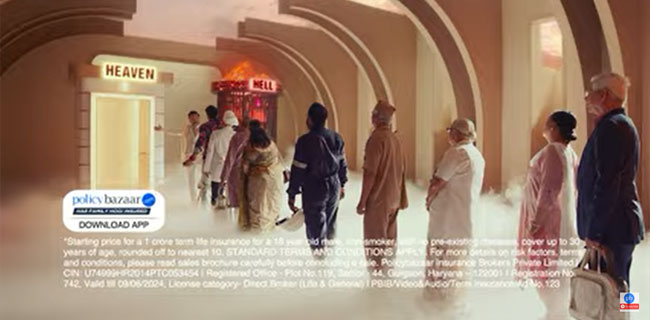
    The brand’s latest communication featuring Pankaj Tripathi leverages post-death possibilities. The eternal question: will you be sent to Heaven or hell. The brand points out that if you have the family under insurance, you are nothing but a Very Irresponsible person who should be thrown into hell. Because Under Insurance is Ghoor Paap– Big Sin.

    Policy Bazaar has been consistent in its appeal and thoughts, and it is reflected in its earlier communications.

    One of the earlier communication of Policy. Bazaar features Mr PolicyBazaar, Insurance Ka Superhero features Akshay Kumar. It focussed on quick and effective insurance approval and assistance, highlighting a 30-minute claim assistance promise.

    However, promises are promises. The common man is still in the era of using the agent. Customers who have experienced dealing with the TPA ( Third Party Associates) for approvals realise that a direct agent is still an essential link for timely and correct approvals.

    The digital space does not give this confidence in last-mile connectivity and interdependency.

    Policy Bazaar does speak of providing end-to-end assistance through the entire insurance journey, starting from comparing policies and premiums, best prices, ease and speed of buying online to what matters for the consumer more – the claims support; there are still barriers that the brand needs to address.


    And finally they even touched Tinder humorously.

  • Humour & Consistency in Advertising


    By Sanjeev Kotnala


    Sanjeev KotnalaI love brands that are consistent in their communication. And really appreciate brands using humour without missing the point and amplifying the proposition. The audience rarely consumes media for advertising. Hence, if the brand communication can deliver the message with humour, it may be better received.


    I remember the series of It’s Different  ad series by Maggi Hot and Sweet sauce way back in late 1980s and early 90s with Javed Jaffrey. It retained humour but did not pack the same punch when it was revived with Nawazuddin Siddiqui and Javed Jaffrey or with the Imli Pichkoo ad again with Jaffrey. Additionally the older generation would remember Doobara nahi ppoochna– Chloromint or the brilliant ads of HappyDent.


    In the recent past, Policy Bazaar using the Devdoot to decide who would go to hell or heaven was well-appreciated. And then there was Shetty OLX used car series. OLX leveraged the well-known and hugely followed act of Rohit Shetty blowing cars in movies. So, OLX offering the best price for a used, be it a ‘Ghoomti Hui Car; ‘Boombastic Car’, or any other, becomes so relatable. The casting of Sharman Joshi as the insurance salesman/agent adds to the impact. The proposition remains ‘best-price’ for pre-owned cars and the ease of selling. Time the confidence of buying a pre-owned vehicle from OLX is also addressed.


    https://youtu.be/Q3qV-jmJykc


    What3word 3×3 Matrix

    What3words is a location-based technology app dividing the whole world into a matrix of 3m x 3m squares. And thus provides a more accurate address. The brand uses Vijay Raaz as the person giving directions to the delivery boy in his overused style. We know how long and convoluted Indian addresses are and how difficult it is to provide the right direction. The conversation between Vijay Raaz and the delivery boy trying to follow is relatable. The problem is solved in the end with the use of what3words.


    Swiggy Rasogula Waale Uncle

    Swiggy has used the Rasogullawaale uncle smartly across the years. And the humour of the situation is not lost on people. The faster delivery, simple single item delivery and other messages are an integral part of the story. And then, in Swiggy Instamart, the delivery speed is amplified using humour- be it a soap or watching the match in peace.


    Flipkart Superwoman

    After a long time, Flipkart seems to have got their communication act right. And they hopefully have been able to get out of the overused creative device of Kids masquerading as an adult. It was losing steam. Alia Bhatt is the Flipkart superwoman helping the citizens and talking about 1-hour delivery for white goods! Though the idea is a bit stretched, it works.


    Cadbury Fuse Bhari Khali

    However, the Khali ad of Cadbury’s fuse is humorous. And the rationale of Bhari Bhook- Bhari Hath- and bhari– loaded Cadbury fuse is a bit stretched. The humour stops working when you have to explain the whole premise of your communication.


    Cred Takes The Cake

    While discussing these, I would include the Cred TVC across the years – and here, I am not referring to motivational severe, experiential or behavioural Cred videos. The Cred ad featuring Ravi Shastri was a class act.


    https://youtube.com/watch?v=vLHpfulLcUE


    Net-Net

    A humorous approach to brand message tends to keep it more relatable, engaged and maybe better remembered. If given a choice between a logical rationale full of brand support facts and a humorous, playful story around the brand- we know what the right choice is.


    Not-so-humourous – The creative burnout

    Some days back, an early morning WhatsApp message pushed me to watch Kill Your Darlings. It is a documentary film about the world of modern advertising and the creative talent defining it. Presented by ‘togetherr’, produced by Drive Studios and directed by Adam Bonke and Christian Bonke. It is a journey through the eyes of a young female creative and interviews with advertising legends, creative marketers and new talent in the creative industry. The voices were clear in their point of view on where modern advertising with the existing agency-client model is in problem. Almost all talked of the pressure, business, margin and the need to work freely as a team. The resulting suffocation due to demands where they end up almost like slaves! A few still believe it is the broken agency, not the model of providing creative solutions. That the networks are under pressure and hence it may not be the most fun with clothes on- is a result of it. Think everyone in advertising – marketing should watch this video.

  • G Pay: The Good, Bad and Ugly…


    By Sanjeev Kotnala


    Sanjeev KotnalaEveryone has an option for digital payments. BharatPe, BHIM, UPI, PAYTM, GPay and many more mobile wallets. However, one of them becomes the default option. For me, it is Google Pay. GPay, in short. And, it may be true for others, but here I will speak of GPay and my love-hate relationship with it.


    The Good

    Okay, honestly, I have no major crib about GPay as the app works fine.

    It allows me the liberty to scan any QR code and payment, and it works seamlessly.

    GPay perfectly documents every transaction and ensures sharing them is smooth.

    Rarely is there a problem with server busy or faulted payments.

    I am a GPay fan and need no further motivation. Everything is just fine.

    I am building homes at Indi-homes – collecting energies to complete the levels- not really interested in the first 2 Lakh home builders to earn anywhere between INR 11 to INR 111.

    However, many friends and family members voiced these concerns about GPay; After sharing the Good part, I amplify their reactions below.


    The Bad

    However, I am irritated and frustrated with GPay.

    I suppose they have the best of the listening and tracking ways of how I live and what I do. At least they have the financial transactions and intelligent algorithm other brands use.

    Then, why does GPay in rewards keep me giving free membership and trial opportunities across brands? Okay! The trial is free for new users and subscribers. And Google would /should/could know I am a member of these services.

    It keeps changing its picture capture games, from Diwali Cards to IPL to others. And I never get all the cards. GPay algorithms that deal me the cards ensure I get many cards but never the complete deck, which will allow me to go for the jackpot. G-pay then wants me to trade cards with my friends to complete the deck. Does GPay think I work for it or have time and energy for referring or inviting friends on the platform?

    Most optimistic brands: GPay knows I am not interested, and I have not reacted for the last 20 times they have sent the free three-month membership. Optimistic GPay believes the 21st time I will change. So, with punctual clinical consistency, it regularly serves these reminder awards. And it then follows up with a notification that the useless, irrelevant, irritatingly frustrating awards option may expire.

    GPay asks me to refer new possible customers. It also goads me to pay INR 1 to people in my contact list on joining the G-pay Brand Wagon. GPay knows I have never done that, and GPay knows none of my friends has ever given me the INTR 1 welcome gift. It knows it is futile to ask me again and again. But, the brand is optimistic that I will change first than its so-called personalised approach based on incredible self-learning algorithms?


    The Ugly

    I know I am not the luckiest guy on earth. But my luck is not so bad that I keep getting served ‘Better luck next time’ cards by GPay. Adding insult to injury, I must scratch the cards to uncover the message at every milestone. Every milestone promises a cashback up to INR 1000, and I thought Upto meant at least INR 1 to start with. However, the only thing it does is to ruin my day by telling me ‘Better Luck Next Time’. Or: Your Bad Luck is Kharraab!

    In some 427 transactions of more than 3 lakh, I have won 233 cashback and some 50 ‘Better Luck Next Time’ cards. Don’t give me cash back- but don’t make me scratch a coupon to read this silly luck line.


    Net-Net

    I have become so comfortable with GPay that it’s the default option. However, from time to time, GPay sends me those messages and notifications, including ‘Better Luck Next Time”. Frankly, I am not interested, and it only ends up spoiling my whole consumer experience.

    So, time for the platform to use its tech muscles to differentiate between consumers waiting, willing and wanting the freebee and who wants the app for its primary function- just to pay- nothing else.


  • Sanjeev Kotnala: Is Maharashtra Tourism missing out on something?

    By Sanjeev Kotnala


    Sanjeev KotnalaThe Maharashtra Tourism Development Corporation has developed a network of properties and destinations from beaches to forts, temples to yatras. However, it will be not unjustified to say that they have failed to connect the dots and create circuits. Even the Ashta Vinayak circuit is not developed to its potential. Forget the Sambhaji Raje circuit, surprisingly, in the  state there is no circuit on Chhatrapati Shivaji Maharaj for interested parties and the local population. Chhatrapati Shivaji Maharaj and Sambhaji Raje tourist circuits can help the population better know and appreciate the history and keep the pride high.


    This is a possibility with high potential. The book Sambhaji by Vishwas Patil brought me near to the history and the bravery of Sambhaji Raje. As a person it created enough curiosity and interest to visit few trademark geographical highpoints – but when one checks on the net there is no tourist circuit by private or Government operators fulfilling what can be a huge latent need.


    Super brilliant- Sambhaji – by Vishwas Patil – A Review

    The book Sambhaji by Vishwas Patil translated into English by Vikrant Pande was with me for long. @indicaacademy has delivered it under their 1000 Reviewer programme; the sheer length of the book- more than 500 pages and not knowing what to expect was the barrier. The interest was fuelled when the erstwhile Shiv Sena government in Maharashtra announced the renaming of Aurangabad as Sambhaji Nagar. It was one of their last decisions on June 29, 2022, before Chief Minister Uddhav Thackeray resigned.

    I have lived in Mumbai since 2004 and have often heard about Chhatrapati Shivaji Maharaj. I have hardly heard people referring much to Chhatrapati Sambhaji Maharaj, the Maratha king, who never lost a battle, never knelt before the Mughals and kept the Hindu Swaraj flag flying despite some who sold their souls for money.


    SAMBHAJI, THE BOOK

    Sambhaji Maharaj, the Second Maratha Chhatrapati, succeeded the great Shivaji Maharaj at a very young age. From the time of his coronation till his death, he fought the Mughals for eight consecutive years. During this period, none of the Maratha Fort was ever captured by the Mughals led by their king- Aurangzeb. He was just 32 when he was captured and assassinated.

    The book, as the name suggests, is about Chhatrapati Sambhaji, his life and his battles. His thinking and his passion for the Hindu Swaraj.

    It is a fictional biographical account of Sambhaji. It presents an observer’s point of view into his journey – from birth, love and care of parents to coronation battle to his death. It helps you  see through the mind of Sambhaji Maharaj and his life. His resolve to honour the dream of his father. His team of advisors, along with the traitors and the damage they inflicted.


    SAMBHAJI SIDE IMPACT.

    I have always planned but never been to Rajgarh Fort or the Janjira Fort, and I have made road trips coming down the steep slopes of Sahyadari at Mahad. Places that I now see in a different light. The book helps visualise these places, battles, and the lead characters.

    Now, soon I will visit Rajgarh Fort, and next time around won’t come back from a Kashid-Murd trip without visiting the famed Janjira Fort. History would have been different if Shivaji Raje or Sambhaji Raje had won this fort. I do hope that Maharashtra will build strong Shivaji and Sambhaji tourist circuits.


    UNPUTDOWNABLE 

    It is simply an unputdownable book. Worked into multiple standalone linear 22 episodic chapters for you to take breathers in between. However, while reading, I was so curious to know what happens next that this book of more than 500 pages took less than three days between my busy schedule to complete.

    I missed a representative map of Maharashtra in the book- a comparative map for the reader to visualise directions and action, spaces and the cities or the forts mentioned in the story.


    NET-NET

    Sambhaji – the book is exciting and engaging and brilliantly transcreated (I prefer that to a typical translator) by Vikrant Pande. The book has impressed me, and I plan to read the two other books by Vishwas Patil. Mahanayak- Netaji Subhas Chandra Bose, and Panipat – the Third Battle of Panipat.

    I must appreciate Vikrant Pande, the trans-creator for his excellent work. I can’t read Marathi (not that I can speak the language), and without Vikrant, I would have missed out on the brilliant work of Vishwas Patil.

    I recommend you to read this book. And I do hope that the English transcreation will widen the readers for Vishwas Patil’s work in Marathi and many more to experience the fabulous writing and efforts of Vikrant Pande.

    I rate Vishwas Patil as a better storyteller than Aish Tripathi, Ashwin Sanghi and Anand Neelakantan. If you are comfortable reading in Marathi, I will push you to read the Marathi original version.


    Triva Aurangabad And Sambhaji Nagar

    Aurangabad was founded in 1610 by Malik Ambar, the Siddi general of the Nizamshahi dynasty of Ahmadnagar. The city was named Khirki or Khadki at the time. In 1626, Malik’s son Fateh Khan changed the name to Fatehpur. In 1653, the Mughal Emperor Aurangzeb invaded Deccan and made Fatehpur his capital- and renamed it Aurangabad. On May 8, 1988, Sena head Balasaheb Thackeray announced the renaming of the city to Sambhaji Nagar after Sambhaji Maharaj. In 1995, the Aurangabad Corporation passed a resolution to do so. Just before resigning on June 29,2022, the Shiv Sena government decided to rename it Sambhaji Nagar. The current Eknath Shinde-Devendra Fadnavis government wants the name to Chhatrapati Sambhajinagar