
Category: SANJEEV KOTNALA

  • Expect the Unexpected, the China Air way


    By Sanjeev Kotnala


    In India, China Airline has a biweekly service between Delhi and Taipei. It accounts for some 0.1% of the total international air traffic in and out of India. Most likely that I would have missed seeing this brilliant communication from the airline, thanks for one of the updates from Campaign magazine.

    Brands usually associate with advantages, opportunities and positivity in life. They want the target audience to link these with their usage. They want to engage and involve the target audience, mostly good things. Many times all the brands start getting guided with the same category ethos and promises.

    It is no different in the case of airlines. Safety, Luxury, taste, entertainment systems, the gourmet serving, comfort and pleasing smile of the in-flight crew are hygiene for airline brands. It has long been so. Earlier in the year 1995 or even 2010, China Air spoke a language deeply soaked in category clues.

    Fortunately, China Air has moved on. It has broken free of the category expectations, the constraints and the blinkers.  Thankfully, unlike KLM, it is not another purpose-led #FlyResponsibly Campaign.

    China Air Is Seriously Taking On The Unexpected.

    Getting married or even pregnant, injured or cursed, love and hate- everything is an unexpected possibility. Flying takes you to different cities and countries, creating that window of uncertainty when you are in a new place and meet new people. China Airline “What Travel brings you,” Campaign is a beautifully crafted disruptive work by the agency Leo Burnett Taiwan that speaks to the new tribe of travellers.

    “What Travel brings you” is the celebration of the unexpected.  It is an insightful and engaging campaign. It speaks the language of a traveller and connects at multiple levels.

    Travel adds to the life of a traveller. With every journey, a traveller becomes richer with the knowledge and experience after every travel. Some of these are planned and expected, some really unexpected. Each of these experiences impacts the way the traveller shapes future decisions. Travel impacts our lives. Trust me, it is the unexpected that makes the journey worthwhile.

    A for the unexpected, “You never know what travel will bring into your life…. Let’s go find out”, is a powerful summation of the thought and an invitation to travel.

    The Unexpected – Unexpected China Air.

    The team has thoughtfully picked up brilliant examples of the unexpected. A campaign like this can remain as fresh as the list of unexpected consequences. As every city, community, tribe, nature and geography has something unique, the campaign also boosts the traveller seeking more than mere physical experience. I have a huge expectation from the unexpected. And wish that the China Air brand association with the thought were a lot stronger. Till now it seems to work for travel promotion, not necessary China Air promotion.

    It is a bold campaign. You do end up watching it a few times. It breaks free of the stereotyped over-exploited category clues and charts a new territory that the audience relates to. Here are some of the unexpected you encounter in the China Air campaign. Plastic surgery from Seoul, and now her face does not match the ID. The marriage certificate signed at Las Vegas’ instantaneous no-question asked weddings. The injuries one got at the Ski trip. Surprises win at a casino in Macao. The extra inches at the waist after the Bangkok trip. A tattoo that is no longer wanted. A statue that is spooky from Edinburgh. And even the unexpected pregnancy a souvenir from a Gold Coast trip.

    On first viewing, it seems the airline has purposely picked up the bad experiences. Slowly when you start looking back at your own experiences, you start appreciating the campaign more. It does add a smile to your face.

    On the side.

    I don’t know, but there are reports that China Air invited 60 women with an unexpected pregnancy and discussed the geographical origin of the pregnancy, ultimately awarding one of them with a three-week stay to revisit the destination.

    …………………………………….

    China Air’s earlier campaigns

    It is not that China Airline always talked this language.  This particular ad made me check and see their earlier communication “The Trip You Have Promised,” Wow, another gem. The guilt of postponing promised trips.  It was a great way to remind a large section of potential travellers of their own bucket list and promises.

    And way back in 1995, you really did not expect anyone breaking the category code. The campaign “We Blossom Every Day”.

    Earlier like everyone else in the 1980s, they were also busy Cherishing Every Encounter.

    ………………………………………………….

    PS.: AIR CHINA Vs. CHINA AIR. Air China (CA) was founded relatively recently in 1988 and is the national airline of China. It became a member of Star Alliance in December 2007. China Airlines (CI) was founded in 1959 and is both the flag carrier and the largest airline of Taiwan.
     

  • Sanjeev Kotnala: Are you Professional Enough?

    By Sanjeev Kotnala


    In 2018, VistaPrint released the TVC ‘Professional’. It uses a very myopic definition and understanding of the term Professional.

    Tailoring is a profession, and many tailors are professional. In the PrintVista TVC, the young tailor is rejected by his potential future father-in-law. The father of the would-be-bride wants his daughter to marry a professional.

    It is a cue for the prospective groom, the ‘Very Good Tailor’ to flash multiple branding items. He presents a visiting card. Then goes on to offer a branded pen, cap and T-shirt. The father is wonderstruck. He now speaks a different language. He wants to know the marriage date.

    The branded items flashed by the young tailor does magic. It changes him from a mere smart tailor to a professional tailor. There is newfound respect.

    On the surface of it, VistaPrint is doing its job. There is nothing wrong or illegal. No point bothering ASCI with it.

    WHO IS A PROFESSIONAL?

    It raises a question. Who is a professional? Sometimes it is a question of impressions. A smartly dressed person at work easily qualifies as a professional. Though appropriate dressing for the job is a part of being professional, it is not the end of it.

    Professional and non-professional jobs are mostly differentiated by the need for a higher level of learning. It then tends to exclude people who are great at their work, learning the skills on the job or inheriting a vocation. It is restrictive in nature and leads to unnecessary polarisation.

    For some, Professional is equated to advanced degrees or certificates hung on the work area.

    PROFESSIONAL?

    Going by the dictionary, a professional is both an adjective and a noun.

    As an adjective, it defines that the person relates to or belongs to a profession. He or she is engaged in a specified activity as the main paid occupation rather than as an amateur. As a noun, it merely relates to a person engaged or qualified in a profession. And hence,  the tailor, bus driver, mechanic or anyone engaged or qualified in a profession is professional.

    The VistaPrint communication blatantly discards the definition.

    In our country, Rahul Bose’s two bananas, Viral Kohli’s squad picture without Rohit or the religion of a Zomato delivery person creates much buzz in the social media. However, the professionals have nothing to comment on Vistaprint commercial. Maybe, they don’t consider such communication diluting their tag.

    ARE YOU A TRUE PROFESSIONAL?

    Being professional is easy. ‘True Professional’ is a different ball game. It requires exceptional job performance and a distinctive attitude. The attitude called professionalism.

    PROFESSIONALISM IS AN ATTITUDE.

    On a superficial level, professionalism is about behaviour and delivery. It includes compassion for others, responding appropriately to the emotional response, demonstrating respect for others and being helpful to people in need.

    At the same time,  it is about being reliable, competent and ethical in work situations.

    There are simple traits that qualify professionalism. Ethical behaviour based on intrinsic knowledge. The capability to differentiate between what is right and wrong and the confidence to act on it. An altruistic attitude demonstrated by responsible conduct.  Knowledge and expertise in their roles. Continuous engagement aimed at intellectual development.

    ARE WE PROFESSIONAL AT WORK?

    Now, this is becoming tough. Many of us will fail the above definition. Most of us are okay as far as appropriately dressing for the role is concerned. However, it is different when it comes to respecting other people time. Are we on time for assignments and engagements? Do we really work efficiently? Do we deliver on promised timelines? Sorry to have touched a raw nerve.

    PROFESSIONALISM AT WORK?

    Here is a small test. Answer the questions and check how professional you are? More the Yeses, more professional you are. Now no one is asking you the score, so be as transparently naked and honest as possible.

    1. Do you have a positive attitude towards work and life?

    2. Are you reliable in your role?

    3. Do you always try to deliver above expectations?

    4. Do you engage and purposefully work towards developing your capability and skill?

    5. Do you regularly pause, reflect on your work, absorb the learnings and move on?

    6. Do you communicate clearly?

    7. Do you have the required written and oral communication skills?

    8. Do you speak up when you see something wrong happening? Ethically or morally or process-oriented.

    9. Are you open to critic?

    10. Do you willing to accept feedback?

    11. Are you respectful to your co-workers across levels?

    12. Do you discourage politics at work?

    13. Do you encourage or discourage work gossip and rumormongering?

    14. Do you promote gender equality?

    15. Do you raise voice against sexual harassment at work?

    16. Do you know the difference between being professionally friendly and friendly Professional?


    A score below 12 should make you think. As professionalism is not a percentage score. Just like there is no half-pregnancy or half-cancer, you are professional, or you are not!


  • Sanjeev Kotnala: Decoding the D-Code 2019

    By Sanjeev Kotnala


    The Advertising Club completed the trilogy of Media, Creative and Digital review by introducing ‘D-Code’ in 2018. ‘D-Code’ has a definitive promise.

    1. Industry experts expected to focus and share “One Best Work of Theirs”, the genesis, strategic intent, logic, and the result of the successful digital intervention.

    2. Share ‘3 Tips On How To Break The Digital Code’, like trends, expectations or tips to maximise outcome.

    3. As a bonus, the format promised dhtat industry experts will boldly walk into the not so comfortable arena outside their ecosystem. They will pick ‘One Best Work Of Another Brand’, and share their take on.

    The industry experts are expected to do justice to all this in 10 minutes each.


    D-Code 2018 Raised Expectations.

    2018 proved that the D-Code format was excellent. The speakers were engaging. It was a ‘Paisa Vasool’ event. The audience was hungry with expectations raised bt the   D-Code 2018 edition.

    D-Code promised to be a quickie with multiple orgasms. Who won’t fall for it?

    Unfortunately, D-Code 2019 edition did not raise the bar. It once again endorsed Content is King, and content more than the speakers is the secret ingredient essential to carry forward a successful format.


    D-Code 2019

    The organising team at the Advertising Club did an incredible work behind the scene. You cannot fault them as all speakers turned up and surprising them.  The audience was ready for a long session with 13 speakers. They expected the speakers to engage and weave magic with their content and the passion for sharing.

    Few speakers made futile attempts to test the Einstein Gravitational Time Dilation theory. In the process, they messed with the concept of relativity in time. It is a known fact that for the audience, time moves fast when the content is relevant and engaging. Sorry, there were hardly examples to talk about in the 2019 edition of D-Code.


    D-Code Format Needs Tweaking And Disicpline.

    No, the format was brilliant. What was needed is additional guidelines and strict adherence to the code of 2+4+3 format.

    1. Two minutes for the ‘Who Am I?’ plugin and the tips.

    2. Four minutes, for ‘One Great Work of Theirs’.

    3. Three minutes for ‘One Good Work From Other Brand’.

    More than a few speakers managed to bring in a superficial reference to the work outside their area of influence and control. The ‘One Good Work From Other Brand’ dissected to add to the audience knowledge. This is what an expert is required to do. Share the ‘Fly on the wall’, an outsider perspective not restricted to the title of the work title as ‘Inspiring’ and move on.


    No Decoding Digital Code.

    Maybe the ‘Tip’ business, decoding the digital code forced organisers to select the Speaker by name, brand and designation, not necessarily in that order. It placed additional pressure. Many came back with the most used escape route of ‘There is no code in digital’. Wow, so much for the experts and D-Code.

    Here, is a silly suggestion: Maybe the organising team can consider doing away with this Digital code-tips business.  It is anyway inferred and part of the other two subjects. Perhaps, we could have one speaker focussing and summarising all the tips and trends that other speakers contribute. It will surely save time and repetition.


    D-Code Speakers.

    We miss the truth that all industry experts are not best presenters. The Bell Curve is omnipresent. I bet the organising team knows it. What I may be suggesting could be highly impractical but worth considering. I know the names matter in such a format. Pre-select the work, which most likely been done. And then let the associated organisation ask their best presenters to be on the stage. Who may or may not be the CxO.

    D-Code is a colossal event. A speaker must respect the opportunity. It is silly for anyone to share working on the presentation until 2am last night. The audience sees that as a last-minute compiling of factsheets. No speaker should take the captive audience through their resume substantiating and justifying what they share and where they come from.

    More importantly, in digital, where a quarter is like a decade, stop presenting dated work or meandering and rumbling through the allotted time. These are digital experts. Having done scores of successful presentations, adhering to time should be least to expect. Yes, the speakers spoke of an alarming drop in attention span of consumers. However, they choose to ignore this vital truth while delivering the talk!


    The Digital Code Shared @ D-Code 2019.

    Everything is not lost. The industry experts and in the process D-Code did not let down the audience. There were some gems of collective wisdom shared in the event. Few presentations were right at the target. And if the gems from D-Code I share below seem cryptic and tough to understand, maybe you should have attended the event.

    1. Digital is not about the output; it’s about the outcome. It is valid for any and every initiative, engagement or interruption across media. It is a brilliant observation.

    2. Don’t expect the consumer to be perfect, do allow for and/or exploit the spelling errors and exploit it in the search business.

    3. Stop attempting to do ‘something cool’. This should guide or kill few discussions.

    4. ‘Authenticity’ is an essential ingredient. So is follow-through and amplification.

    5. Content needn’t be paid, or a minute long, or 10 seconds short. The idea and the message needs to resonate, and the story need to be told- if it’s a bad idea, 10 minutes isn’t enough. We all know but rarely follow it.

    6. Ideas can come from anywhere. Spirit of innovation and ideas must be fostered- whether internal creative, or creative agency / brand partner , or social agency. It is immaterial. Global truth-I.

    .Be comfortable with having a couple of ideas that don’t work. If you are not failing a all. You’re not pushing the boundares hard enough. Global truth-II.

    8. Brand relevance must be intrinsic to the idea.

    9. Organisations have been slow in embracing technology and digital into their core competencies. What was science fiction at a point of time has become a part of real life? Technology is powering our ecosystem. No one will dispute it.

    10. Every medium has its own grammar. Build the idea according to the grammar of the media. Do not cut-copy-paste or just make adaptations. It may be worthwhile to spend more on production than media. I seriously endorse it.

    11. No matter what the agencies tell you, there is no code for cracking viral communication. If it is timely, apt, relevant, innovative, engaging, and the audience is tempted to share, it becomes viral. Keep listening and latch on the opportunity as and when it comes.

    12. Mass marketing is essential to brand marketing and growth. Okay, go and debate it.

    13. Deep dive and use consumer data. Listen to the consumer.

    14. The biggest truth. The consumer is still a human being. Now we call it being analogue. There is no difference in ‘brand building’ in an offline and online environment. The most important learning.


    My Take From D-Code 2019.

    Thank god the industry still finds it reasonable to refer to the consumer as an analogue and not some AI-based algorithm.  Emotion and irrationality is still part of the package. Even with big-data and implicit research, consumer reaction cannot be easily predicted. Triggers and levers, as well as right positioning, still matters.

    The brand ownership is moving to consumers, and the brand teams now remain just the custodian like the bank manager where you have a locker. Meanwhile, the brands are dying to stay relevant by searching for the elusive cause.


    D-Code Special mention Kenny Sabastian.

    I suspect that the audience missed the seriousness in stand-up comedian Kenny Sabastian’s presentation. He used his tradecraft to deliver his insightful observations in the garb of humour.

    Kenny Sabastian almost single-handily raised the mood. His mantra had a deeper meaning and direction. Be authentic, consistent, intellegent and fearless. Stop boardroom masturbation when you discuss ideas, brands and executions. Stop seeking answers in the numeric led matrices for self-pleasure. Stop taking yourself too seriously. Just be alive, do your best and keep moving forward.

    His three wonderful tips for you to decode and imbibe.

    1. Learn to create before you sell.

    2. Technology chnages, people don’t.

    3. Make fun of yourself. ( Don’t take yourself seriously).


    D-Code 2020.

    D-Code also reintroduced me (and hopefully to a large section of audience) to few o campaigns I have otherwise missed taking note of. I personally loved revisiting Ask Nestle, HaggleBot, Kingfisher’s Instant Beer mix prank, Pepsi Swiggy Swag, Omnipresent Radhika by Netflix, Swiggy’s voice of hunger campaign and the pirated URI implant.

    I love the format and the efforts put in the advertising club team, moderator Vikram Sakuja, narrator Punitha Arumugam and the speakers. With minor tweaks and some more discipline, it is bound to a great event. I am in for D-Code 2020.


    ~~


    List Of ‘D-Code 2019’ Speakers In Alphabetical Order. (1) Amarjit Singh Batra, MD, Spotify (2) Jogesh Lulla, COO, Cornerstone Sport & Entertainment (3) Karan Bedi, CEO, MX Player (4) Mustafa Ghouse, COO, JSW Sports Pvt Ltd (5) Nirmal Pulickal, Head–Facebook Creative Shop (6) Partha Sinha, VC& MD, McCann Worldgroup (7) Rashi Goel, VP- Consumer Communication Media, CRM & NHW, Nestle (8) Sachin Sharma, Director – Sales & Partnerships; Bytedance (Tik Tok) (9) Sidharth Rao, CEO & Co-Founder, Dentsu Webchutney (10) Srivats TS, VP Marketing, Swiggy (11) Sumeet Narang, Vice-President – Marketing, Bajaj Auto (12) Vikas Agnihotri, Country Director, Google (13) Kenny Sabastian Standup Comedian


     Sanjeev Kotnala is a senior business strategy consultant and educator. His views here are personal


  • Sanjeev Kotnala: Review of V Chandrmouli’s ‘Get better at Getting better’

    By Sanjeev Kotnala


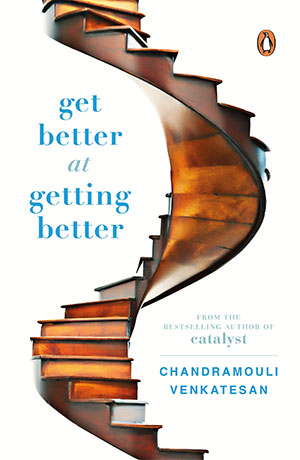
    I liked Chandramouli Venkatesan’s first book ‘Catalyst’.  The blurb  of his next book ‘Get better at getting better’  interested me.  It suggested some similarity in thinking. Getting better afterall is very evolutionary thought and the escape to survival from Darwinian time.

    Chandramouli Venkatesan identifies four ‘core abilities’ that we need to focus professionally.

    1. People skill / relationship / leadership / personal value system.

    2. Analytical skill/comfort with numbers / logical reasoning.

    3. Conceptualisation and intuitive skills / creativity / insightfulness.

    4. Organised / disciplined / planned / efficient.

    He says to get better in these ‘core capabilities’, one needs to develop the capability to succeed and continuously improving. He refers to it as ‘Get Better Model or GBM. This GBM seems to be the differentiator.

    GBM is all about:

    1. Getting better by yourself. Deliberately getting better from what you do on a daily basis by yourself, without external help.

    2. Getting better by leveraging others. Deliberately leveraging all external resources available to you to get better.

    3. Making others get better. Deliberately building an ecosystem around you that multiplies your efforts.

    4. Making and implementing a get-better plan. Deliberately making a plan and implementing it to get better in a few areas of focus.


    Read the book to know how to get better at getting better. It can help you unleash your potential at both personal and professional life.


    Venkatesan proposes a doable practical model. It is based on his own experience and experimentation through his career. It is ultimately a question of mindset and your approach and attitude toward being successful.

    What I find right with the book is the simple, easy to read and understand language. There is hardly any jargon. No heavy stuff. In fact, Chandramouli Venkatesan tries his best to simplify everything using some mathematical interpretations.

    On the other side, I find the thoughts too iterative, and an attempt to address all the possible stakeholders in one book dilutes the notion.

    In a nutshell, the simple thought is the process of always looking at trying to improve, not necessarily seeking and learning the answers but the process to arrive at the answers. This whole process has to be deliberate. Once you build the habit, once you build the discipline, it becomes quite easy, as it then becomes your default process.

    I recommend reading the book. However, if you have to pick between the two books by Chandramouli Venkatesan, I will recommend ‘Catalyst’ over  ‘Get better at getting better’.

    It is true that ‘Success is not about how good you are, it is about how powerful and effective a model you have to improve how good you are’. And in my Brand_i sessions, I add ‘ Success may not be completely a function of your skills and talent, but how well you are branded within the organisation’. GBM may actually help your Brand-I to be relevant and impact your career positively.

    Venkatesan nails it when he says ‘At work, the responsibility for each one of us getting better rest squarely on our own shoulders’. There is no point expecting help unless you demonstrate the hunger for getting better.

    Another thought that makes me back; this is the area of being selfish. This is what I endorse and share. I have been propagating that people must give more to their profession, Be-selfish in achieving what you aim for. And when Chandramouli Venkatesan says that ‘results are transitory and results belong to you, the team and the company. However, the extent to which you have got better solely belongs to you. The purpose of getting better is to be able to respond better to the future, if we get better, then our response will be better’. Well, it does echo well.

    One chapter that all professionals must-read is about raising the effectiveness of meetings. Chandramouli Venkatesan provides a practical solution of leveraging meetings and How do we get better at meetings?

    I will stop myself from sharing anything more in the book. This is a self-help book, which can only help if you read, Pause, Reflect, absorb, and move on to reflect again. Absorb, include the aspect of putting in to practice what you learn, without which nothing matters. Because knowing is not about embedding and changing and ‘Getting better is not an indulgence’.

    …………………………………………………….

    ‘Get Better At Getting Better’ by Chandramouli Venkatesan. Pages 231. INR 299. Penguin.


  • Bond like Fevicol!


    By Sanjeev Kotnala


    On its 60th anniversary, Fevicol has pleasantly surprised its audience with a gem of a  90-second TVC.


    Art Vs. Commercial Films

    Earlier there were art films of what was known as parallel cinema and commercial films. Then someone bridged the gap by making art films that were a commercial success. Films like Arth, Salaam Bombay, Chakra, Masoom, Saaransh, Ardhsatya, Akrosh, 36 Chowringhee Lane, Mirch Masala, Utsav, Newton and others defined a new paradigm by engaging the audience. Now, we no longer have the term art films, but we have a parallel cinema of a different order. Cinema with empathises on experimentation, sequels and bold differential storylines.


    Are We Seeing Birth Of BrandOperate Films.

    In the advertising world, there have been classical corporate films and brand films. They were all about corporate glory and not really meant to make the consumer react to increase revenue, and they had a shorter life and audience. On the other hand, there was the 30-second Brand TVC meant to work in the market. Some brand like Tata Steel, Tata Tea, Ambuja Cement,  Hamara Bajaj, Maruti were successful in bridging the gap to some extent.

    Come Fevicol, maybe the first real example of a BrandOperate Film. It has all the ingredient of a corporate film, including the occasion and subtle message and the power to engage the audience.


    What Makes Fevicol’s BrandOperate Communication Work?

    Here the client thoroughly trusts the agency. They have a DNA of experimentation. They understand that the team consistency, along with adherence to the brand tonality and a clear benefit/purpose/role/focus is a must for engaging the audience and strengthen the brand. Remember the old ads of illogical examples having a foundation in real-life understanding. Fevicol took you places. You met the fisherman, an overcrowded bus, Boatman,  a Mooch that gets stuck through generations, an egg that does not break and many more. These films stayed with well-defined film and brand grammar. Even in this 60th-year communication, the graph moves through locale, type of houses, people and growing affluence, as the colour pallet kept moving with the time.

    The team and client must be complimented in their belief and eye for detail, not that we expected any less from the team at Fevicol, Piyush Pandey, Prasoon Pandey and the name Ogilvy.


    Learning From Fevicol BrandOperate Communication.

    It does prove that no commercial is long if its story engages the consumer.  And when the brand has a focussed engaging and involving story, it does not need a celebrity to push the cause. If the brand idea is focussed, if it has been delivering the promise consistency through the ages, If it has adapted and evolved with the time and changes in the brand ecosystem, the brand name, logo or product shot tend to become immaterial to a large extent. It develops Positive Immunity.   Similar thoughts were expressed by Anant Rangaswami in his article ‘Five Reasons Why The New Fevicol Commercial Sucks’.


    Possibilities

    I believe, brands like AajTak, Amul, TataSteel, Bajaj, Mahindra, Makemytrip, Stayfree can attempt such BrandOperate communication successfully.


    Here are some other Fevicol films for watching again.


  • IRSwala Aaya, IRSwala Aaya, IRSwala Aaya Re


    By Sanjeev Kotnala


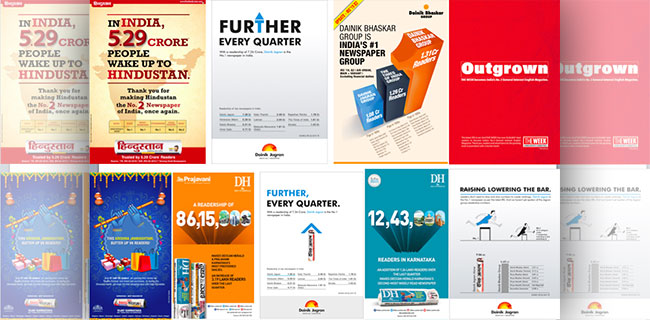
    The latest round of IRS report is out. The reported readership figures have given soulless Print Rudalies a chance to cry in mourning or smartly find ways to celebrate minor victories.

    The comparative game has begun. Everyone is flogging the tired horse. The fight to sliced the data continues. Everyone is wishing for that somewhat relevant claim which can help them fight the festive season battle. And there will be some lazy advertising for these claims. The biggest game in print is on.

    It reminds me of the Kabuliwala poem that one has read and sung many times. A bit of a twist and a tweak somewhere and the bhands in newspaper title get to sing a new IRS song.

    IRSwala, IRSwala, IRSwala,
    English Newspaper kyun kumhlaya tera mukhda pyara
    Hindi Paper kyun kumhlaya tera mukhda pyara
    Kya khoyi hai Readership teri ya kisi ne circulation me mara,
    Roonth gaya kya tera reader, toot gaya kya hawker,
    Roonth gaya kyat tera reader, toot gaya kya hawker,
    Ya phir tujhse bichhad gaya tera koyi advertiser,
    IRSwala ha ha, kya wo quarterly report wala,
    Abhi mila dey tumko use, dekho khel nirala,
    Chalo readership  ke paar jaha engagement ki hai war,
    Kabhi Number 1 boley koi innovative kahani,
    Chalo readership  ke paar jaha loyalty ki hai war,
    Kabhi Number 1 boley koi innovative kahani,
    Jaane sabka wo haal, usse sabka hi khayal,
    Badi sachchi hai, Readership ki badalti wo syani,

    Everyone wants just that slice of data to help claim a share of advertiser wallet. No one is bothered about its relevance. There is no question about how the numbers match? What do the numbers mean? Will they engage the uninterested advertisers and immune media buyers?

    No one in the print media is willing to change. Something inside has broken. The sales team soul is not into the business. Everyone is looking at the brightness towards the end of rainbow called digital. Is it time to give up? I am not sure.

    There is a strong inertia to change. No one wants to invest in understanding the root cause of the audience behaviour. Everyone has theories which have been strengthened by the multiple nods of heads inside boardroom presentations. Everything is directed towards boosting numbers. It’s different that IRS is a huge (scientific) extrapolation of a robust but limited data. Here is where the print industry has gone wrong. It cannot be the start and end of everything good or bad.

    They have explanations. They have scapegoats. The undeniable truth keeps circulating in the corridors of print powerhouses. The enhanced availability, accessibility and affordability of data. The decreasing concentration of audiences. The fragmentation or multicity of interest.

    In all of this the voice that calls spade a spade is ost. It is print’s inability to continue giving a differentiated, relevant and not necessarily impactful content. Play on its strength of Trust and Faith, which itself is under threat. However, there is high inertia in thinking and ideation. No one wants to move and take a call proactively. Everyone wants safety first. The choice of failing and falling is not acceptable to print stalwarts, and that is the reason they are failing their audience.

    Nothing will change. IRS report will keep coming out. The changes will stop surprising the inert advertisers, media planners/buyers and the print saviours. We will find the IRSWALA and sing the last part of the song.

    Tara rum, tara rum,
    Readers se punchhenge hum, kyu roota hai who
    Tara rum, tara rum,
    Advertiser se punchhenge hum, Kyu badti TV digital se uski doosti.
    Pal pal chhin chhin kum hota jaye,
    Social linkage tode jaye

    Pal pal chhin chhin involvement kum hota  jaye,
    change ke pankh lagaye,
    TV jhoome Digital ghoome, har dam chakkar chalta jaye,
    TV jhoome Digital ghoome, har dam chakkar chalta jaye,
    Pal pal chhin chhin reader segment jaye,
    samay hawa ke pankh lagaye,

    IRSwala aaya, IRSwala aaya, IRSwala aaya.


  • It’s not just about Gold at Tanishq


    By  Sanjeev Kotnala


    It is the festival and marriage season. And gold is crossing all known limits. It’s also Tanishq time.

    It is natural for the middle-income household to be doubting purity and buyback values of their gold that they are buying, exchanging, repairing or melting.

    Karat meters are working overtime across more than 280 Tanishq showroom across the nation are busy shaping dreams.

    Diamonds after Nirav Modi are failing to find favour among jewellery buyers. But at Tanishq, it’s a bit different. There is trust which gets amplified with the 100% buyback on them at current prices. Diamond start getting a new sparkle.

    TANISHQ HEARTFELT GOLD.

    I recently saw these three beautiful films on the Tanishq website. I have not seen them on TV, and not much is spoken about them on social media. Maybe I missed them. They seem to evoke the right emotion and reactions from consumers and people I could check. wit

    What I was interested was in seeing how far does the brand take what it promises on its site. And that took me to the showroom at Borivali and Oberoi Mall in Goregaon.

    I was suitably impressed by the near-templatised humanly perfected identical treatment. I can endorse what Tanishq says about their customer service. “We strive to ensure that every employee at Tanishq is welcomed into the folds of our protective family with their best interest being one of our main concerns. Our Karigars are provided with world-class facilities, a safe and supportive environment and are well taken care of with benefits like health care and financial aid. With the advancement of jewellery making equipment and technology, our workers also gain training and access to these top-of-the-line machines to aid in the creation process of their masterpieces.”

    TANISHQ JEWELLERY MAKING CHARGES.

    Tanishq has become a benchmark of purity and customer service in gold jewellery. People, after experiencing carat deviation between claimed and actual on their old jewellery, have shifted. They are now willing to pay a premium on making charges once they are assured of the purity and carat of the gold they are buying. Though Tanishq talks of every jewellery piece being crafted to give it a signature finish and the availability of a wide range of gold jewellery where the making charge start at 8% only. Now, this is the standard ploy; you hardly find much jewellery at 8% making charges. Mostly it is around 18-20%. Maybe a Tata brand could be a bit more transparent than starting at 8% gimmick.

    PUSHING THE PURCHASE VALUE.

    The team of salesperson take good care and keeps you engaged. It is their role to push the value of the purchase. Hence if you say you want a jewellery costing Rs 1  lakh, they will show something starting at 1.5 lakh. This strains customers from the middle-income household who walk in after doing their complete maths.

    The customers finds themselves constrained in the ambience of the showroom. They feel hesitant voicing their concern. Their body language closes out. There would be a feeling and a question if they were better at the family jeweller.

    The joy of buying gets threatened. Maybe it is nice to show 1.5 lakh but please show then the lakh piece too.

    THE KARAT METER MAGIC AND ISSUES.

    The state-of-the-art Karatmeter present in every Tanishq store is a very accurate way of measuring the purity of Gold. I have personally experienced the trust it evokes and has seen it tilt discussion in favour of Tanishq.

    THE MELT BEFORE YOUR EYES MAGIC.

    When a customer brings old gold for exchange at Tanishq, he or she sees the old gold melt in front of their eyes. The pre-and-post melt weighing is done right in front of you. The result, the weight and the karat reading are always right.

    THE MATHEMATICAL CHALLENGE CUSTOMER.

    Here is what I witnessed at one of the Tanishq showrooms. The Tanishq team takes the pain to explain to mathematically inclined jewellery exchange couple how a 40 gram 23-Karat and a 10 gram 20-Karat gold after melting can become 50 gram of 18.3-Karat. They are convinced only when another customer who is watching the argument and steps in to explain. It is all about soldering – tanka in the old jewellery.

    The couple understands and compliments, saying they have got their old jewellery checked in two towns across three Tanishq showroom getting precisely the same reading. Maybe some amount of pre-explanation is required.

    THE GOLD HARVEST SCHEME.

    You should see how the salesman, while selling a small piece, is busy upselling dreams. He is pushing the Gold Harvest Scheme. Where one can accumulate money over a period of time and at the end of the period, buy the jewellery they want. With the Tata brand, the security of money is guaranteed. I would presume Tanishq showroom at least the one I visited on that particular day was showing a minimum of 50% GHS subscription.

    BIG HEARTED RELATIONSHIP.

    Tanishq is taking personalisation and emotional touch to a new level. When you unsubscribe to their mail, what you read before you say click is so endearing. “We’d be terribly sad if we can’t send you emails any more. But if you’ve had enough, with a heavy heart, we say this. Click here to unsubscribe.”

    This service standard is apparent across Tanishq, Zoya, Mia, Caratline, Helios World Of Titan, Fastrack, Titan eye plus Skinn. It is how the complete brand trust is retained and strengthened.

    TANISHQ, BEYOND GOLD AND SELLING.

    It feels good to know some more facts about Tanishq sincerity. So, what if my source is just its website. I will trust the brand to tell me the truth.

    • Over 70% of the water used in manufacturing is recycled.
    • 30% of the energy used in manufacturing is renewable.
    • 40% of the Gold used comes from recycled sources.
    • The Titan Kanya Initiative helping educate more than 34,000 girls.

    It’s a Tata brand- is there anything more to say.


  • Sanjeev Kotnala: What Next – Dream Dominating Advertising

    By Sanjeev Kotnala


    What do dreams have got to do with brands? Maybe nothing. Maybe it was always about dreams. Perhaps, it is we who have never understood the art of creating real dreams.

    Brands have moved from a functional USP to emotional dividends to being purpose-led. Whatever may be the format and trigger, differentiation was always there to help the audience decide favourably. A purpose-led brand is also a differentiation of a different order. Not necessarily, differentiation of a higher order.

    Advertising has always been aspirational. It has played with emotions and impression while the person been awake. It has attempted to manage the five senses. Dreams are aspirational too. However, no brand aimed to dominate reality in the dreams of its target group.

    DREAMS MEAN A LOT.

    Dreams hold important memories and impressions. They express what the person wants or desires or what has been in mind, something that the person may have learnt, experienced or wishes to experiment.

    Dreams ate calibrated experience helping to get rid of unimportant memories. It is said that dreams reflect the true nature of emotions and relationships with people, objects or experiences. They unconsciously conditionally push for a stronger craving or desire to own or experience.

    MEMORABLE DREAMS.

    I remember some of my dreams. The dreams about travelling Business Class, sitting in a Jaguar, owning a Sheaffer, a suit by Reid & Tailor, talking to Ms Hoss; the prettiest girl in the class, meeting English teacher after school and Ms Bhatt agreeing to have a coffee. Some of these drams have relentlessly raided my sleep cycle with high frequency.

    In a wired way, the dreams present an opportunity to explore and experience what is forbidden or out of range. We all have dreams. Moreover, to realise the dream, we must first have them.

    DREAMS INDUCED BY EXPERIENCE.

    I bet books and movies have given each of us dreams that we loved or hated. Stephen King showed me the power of storytelling and how someone can intrude uninvited into dreams. I have dedicated many sleepless nights to Cujo and Pet Cemetary. At that time, if and when I closed my eyes, Cujo would be waiting for me. It was in my dream that I took my first flight or travelled first class on a train.

    DREAMS AND ADVERTISING.

    Now, that leads me to an interesting question.

    Can we create compelling advertising and deliver the message or experience strong enough to get into our target group’s mind space as a recurring dream?

    Can Big Data, Artificial and Alternate intelligence coupled with Machine learning, help us?

    Can self-generating algorithms give us clues to infiltrate dreams our target group has? Alternatively, is the real intuitive emotional creative the only solution?

    THE BUSINESS OF DREAMS. 

    It is said, dreams help us retain the mental, physical and emotional balance. They are uncontrolled random thoughts and images from our memory. How deep is the memory? or what level of the archive is accessed for it is again debatable.

    So if the dreams are random, why few selective images and experiences tend to visit us repeatedly?

    We also know that dreams can be controlled, just like a video game. One can learn Lucid dreaming.

    I do not question the possibilities.

    Can we purposely exploit and commercially leverage dreams? I believe we can. However, we have not graduated to a stage, where we understand how to manage dreams.

    Can we develop the capability to manage the dreams of a target group?

    I believe without reason that soon, we will be able to create compelling communication that will trigger the right nerves and deliver the dream we want to an identified target group. We will be able to do so commercially for the brand, product or service. Imagine how powerful advertising will be!

    DREAMS, SUBCONSCIOUS IMPLANTS.

    Aha! Most people do not remember their dreams. Many people create stories to make sense of unrelated non-sequenced series of images that they partially remember from their dreams. However, the message undoubtedly remains on a subconscious level.

    The way forward will be to graduate to managing augmented lucid dreams. Dreamers will identify and remember the Dream. Moreover, while dreaming, they will know they are dreaming. Does it make sense?

    Technology will advance to add fun to lucid dreams. The choice of exploring and managing or controlling the dreams will be available to the dreamer. Competitive brands will want to disrupt other implanted dreams and dominate the dreams target group sees.

    HOW TO CREATE DOMINATE DREAM?

    Do not ask me how will this happen? What is needed to make it a reality? What will help us do it? How will we know it is happening? How will it be monetised and researched?

    I write because I see a possibility. I write as I do have recurring dreams.

    A simple answer could be misleading. Maybe there will be apps that will ensure intended dreams get served to the target group. Service providers will programmatically insert dreams. The dreamer target group will be paid an access fee for allowing the advertiser to invade their dream space. The dreamers will have the power to decide if they wish to remember or to forget their dreams.

    I SEE FUTURE IN DREAMS.

    Once inserting and managing dreams becomes the mainstream, the dream app will become the most sought after media. In its logical evolution, the dream space will get cluttered. Undoubtedly, we will witness mushrooming of training institutes and hospitals providing a cure for remembering or erasing dreams.

    DREAMS MANAGED OVER WAVES.

    No, I do not think an app will be required, or the app will manage dreams.

    What I think will happen. From central antenna, dreams will be sent out seeking pre-identified dream subscribers. Rouge brands will send disguised nightmare message warning the dreamers what they risk with the competition?

    Dreams dominating advertising will work wonders.

    Then there will be some self-erasing dreams. Just like cleaning the browser history, the dreamer will have no recollection of the dreams.

    New innovative delivery and control mechanism will be pushed in the market. Education will take place when one is asleep. All the waking hours will be available to realise the dreams.

    Self-governing norms will define the limits and the type and quantum of dreams that can be served. The government will announce new rules. You may have to buy a license to watch adult dreams. New standards in travel tourism and pornography will emerge.

    DREAMS AND DÉJÀ VU.

    The dreamer, when awake, will have a feeling of déjà vu whenever they manage to experience the product, brand or service in real terms.

    There will be service recovery systems like PDDMS ( Post Dream Dissonance Management System) and managing Cryptomnesia to manage these repeated instances.

    Cryptomnesia is a state where information learned is forgotten but remains stored in the brain. A similar event or experience or a visual then invokes the earlier trapped knowledge to resurface.

    I AM DREAMING.

    I have been trying to understand the dream business. I am crystal grazing the possibilities. Martin Lindstrom work has always interested me and has accentuated the thoughts.

    I read and interpret dreams. I believe they have a logic and a reason to exist.

    There has to be some sense in dreams and dreaming. Moreover, maybe the state we call as awake is the dream stage and dreams, in reality, THE REALITY.

    I AM NOT HALLUCINATING. e

    I share the Dream I have seen frequently. As I said, I am a lucid dreamer. I remember details of dreams. They are imprinted and readily available to interpret when I wakeup. I can even wake between dreams go to the washroom, have water and join the same Dream.

    So, this Dream is about winning an award for innovative research in Dream Dominating Advertising. It is for the first ever validated case of creating and inplanting dreams. There must be a reason for such a dream. I am trying to find out what and who has been triggering it.

    Maybe technology masters will realise the potential and work to ‘Dream Dominating Advertising’ as a possible business.

    ……………………………………………

    As dictated in my dreams and not written under the influence of Marijuana, which I do think should be legalised.


  • Sanjeev Kotnala: Paulo Coelho disappoints in The Spy

    By Sanjeev Kotnala


    I am a big fan of Paulo Coelho. In fact, two of his books ‘Veronika Decides to die’ and ‘Eleven Minutes’ are in my list of books I wish everyone would read.

    I picked up ‘The Spy’ as much for Paulo Coelho as for ‘Mata Hari’(Margarethe Zelle) the Dutch courtesan and her intriguing image of a double agent during World War-1.

    I must confess Paulo Coelho has desperately tried telling the story of Mata Hari in his style. It just does not fit in. It does not feel a Paulo Coelho book. It’s like ‘Painted House’ by John Grisham. Not a John Grasim novel.

    No one is sure if Mata Hari was a spy. The truth remains buried in some unmarked grave in France. The weak circumstantial evidence produced during her trial could not prove her spying for the enemy. Maybe, France needed a scapegoat, and a well-known figure being executed for spying could have been the most desirable signal to the masses. I have read so many articles on Mata Hari, that when I saw ‘The Spy’, it was natural for me to pick.

    The life of a dreamer, the brush with harsh realities, the transformation, the confidence of performance, the differential viewpoint of seeing her own act of courtesan along with the semi confessional letter fits Paulo Coelho style. The other part of the book has her lawyers presenting his version of the failed trial in letters written by him.

    There is high self pride, followed by collapsing of self-image and the willingness to stand for values and dreams. Paulo Coelho philosophy and point of views somewhere start sounding repetitive.

    At the very start of the book, there is a statement Mata Hari makes which describes and sets the trend for the narration. It is as powerful as any Coelhism.

    “At this moment, I look back at my life and realise that memory is a river, one that always runs backwards.”

    A few more powerful statements of Coelhism are tucked in between the chapters.

    “Everyone flirts with danger, so long as the danger does not really exist.”

    “When we don’t know where life is taking us, we are never lost.”

    I felt no connection while reading ‘The Spy’. His other works always appealed to the person within, took me on an emotional journey and feelings for the protagonist. One lived the life through their attempts, efforts, failure or success.

    ‘The Spy’ is flat. It lacks undercurrents that gave Paul Colheo novels an edge and engaged me as a reader.

    It is a fictional re-enactment of a lonely person’s life. It is not a biography. It lacks the detail that could hold you on the journey with Mata Hari. It does not add a new dimension to the characters.

    There is no Paulo Coelho taste or Mata Hari intrigue even as I finished reading and closed the book.

    Yet in between the pages, you do find Paulo Coelho buried in sparsely separated Coelhism. Here is the one that I picked as a good reference.

    Mata Hari mother gives her seeds and says

    “They’re tulip seeds, the symbol of our country. But, more than that, they represent a truth you must learn. These seeds will always be tulips, even if at the moment you cannot tell them apart from other flowers. They will never turn into roses or sunflowers, no matter how much they might desire to. And if they try to deny their own existence, they will live life bitter and die.”

    “So you must learn to follow your destiny, whatever it may be, with joy. As flowers grow, they show off their beauty and are appreciated by all; then, after they die, they leave their seeds so that others may continue God’s work.”

    “Flowers teach us nothing is permanent: not their beauty, not even the fact that they will inevitably wilt, because they will still give new seeds. Remember this when you feel joy, pain or sadness. Everything passes, grows old, dies, and is reborn.”

    I do think I will sometime in future pick up Femme Fatale: Love, Lies, and the Unknown Life of Mata Hari by Pat Shipman and try bridging the gap.

    Paulo Coelho, ‘The SPY’ is an okay read for a fan.

    Maybe it will be more liked by readers who are getting introduced to him with this book.


  • Amazon v/s Flipkart: The Big Sale Fight


    By Sanjeev Kotnala


    In all likelihood, over the next few days, you will buy some item on the ‘Amazon Great Indian Festival Sale’ or the ‘Flipkart Billion Days Sale’. And at the end of the sale period, one of them will claim some astronomical figure of realised sales.

    Through the years, Amazon and Flipkart have successfully redefined ‘the biggest sale’ in Indian festival calendar. It is now nearer to Dassera than Diwali, an attempt to sweep the market before the traditional sale period.

    Sales in India on a single day are nowhere close to the eye-popping record $30.8 Billion ‘Single’s day’ sale of Alibaba, which was more than the ‘Black Friday’ and ‘Cyber Monday’ sales combined. But we are getting there with growing e-commerce, better logistics, infrastructure and some help the banks and payment gateways.


    STRAIGHT FIGHT BETWEEN AMAZON AND FLIPKART.

    Ladies and Gentleman, the man/woman with a high-end mobile and slow connection and the laptop babu with a fast connection. The fight is opening soon. Guaranteed you will benefit in this ‘diwalia hone ko tayyar‘ (Ready to get bankrupt) sentiment associated with such sales.

    In the red corner of this ring of festival annual sale fight is the Amazon Great Indian Festival Sale with its very cultural centric motif that is scheduled for September 29 to October 4. Amazon Prime members can try it out from September 28 itself.

    In the blue corner is Flipkart, which has mastered the art of sale throughout the year. Its Big Billion Days Sale will start on September and 29 and end on October 4.


    This is a straight fight no consumer worth his or her last spending INR wants to miss.

    The banks are joining the fun with further cash backs and easy EMIs. Somewhere there is a hint of cashback within 72 hours of sale! Additionally, to keep the excitement, there is a promise of new additions on hourly sale, which is expected to boost repeat logins. And the exchange offers are not missing from the sale. Don’t have money, well, there is some 1,00,000 credit possibility with Flipkart.

    Both Amazon and Flipkart want you to keep your wishlist ready. No doubt this is the best sale one can aim at. But as per the earlier pattern, one can see additional Dassera sale, Electronic sales, Diwali sale online and offline. Maybe the only issue is too much option for the consumer that may delay decision-making.


    CONNECTING WITH THE CONSUMER.

    Now both the e-commerce sites have upgraded their systems and made arrangement to smoothen the consumer experience. But the campaigns by Flipkart seem heavy and lacking conviction. There has been a Billion Day Sale for production and media. It is overloaded.

    Deviating from ‘children acting like adults (adult kid)’ theme that predominates Flipkart as a brand, it seems to have gone back to the safety of celebrity advertising. Flipkart has cornered and employed every possible top celebrity interested in selling the idea of getting ready for the sale. Virat as a Cop and Deepika as a Lawyer, Amitabh as a Godown owner and Alia as a newsreader. Regional skew and for every region worth as a priority market, they have a regional star selling the Big Billion Day sale. Don’t know if the celebrities came in some sale.

    Meanwhile, Flipkart continued with the strongly associated Adult Kid format borrowing the characters of Circuit and Munnabhai for its Rewards Programme.

    Amazon is playing on the brand pull and the past experience of the family as the purchasing unit. And whoever I have spoken with, seems to have a strong perception that the discounts- delivery- experience at Amazon is far better than at Flipkart.

    This, in fact, will be a more significant factor in deciding which way the match swings. Because, people know in India that sale and discount is one thing, delivery, service and protection is something totally different.


    THE COMMUNICATIONS.

    AMAZON GREAT INDIAN FESTIVAL SALE


    FLIPKART BIG BILLION DAY SALE.


    In the past, Flipkart has used their strong Adult Kid format for the Big Billion Day Sale.. But for some reason, most likely it not giving then enough ROI, they have opted for the celebrity safety net.


    https://youtube.com/watch?v=FHD_yTkx9Dk

  • Sanjeev Kotnala: Bigg Boss 13 – No commoners, but still a great show

    By Sanjeev Kotnala


    My favourite programme Bigg Boss is back on Colors. The new format is the original format of celebrity guest without any commoner. I still believe it is a great show to watch, and there are many learnings.

    The inaugural episode on September 29 showed that the Colors team had got their act right. However, it is yet to be seen if the delayed telecast time of 10.30pm on weekdays is going to impact the audience size. Maybe this delayed telecast time will push Voot viewership and help develop a new set of followers. The options in Voot are exciting to get additional traction.

    However, the next two days have been party games being olayed by whatever of the house Amisha Patel. Bigg Boss may lose initial traction if this continues for long.

    There are lot of No’s in Bigg Boss and some of them can well make you say Yes to the show.


    NO MORE LONAVALA FOR BIGG BOSS.

    Does the location of the set matter? If one was to believe the followers of Bigg Boss, there is a lot to the location. Lonavala, away from Mumbai, had its mystic value.

    Film City brings it down to a set. May be there will be some added opportunity in term of BiggBoss tourism and visits, but that’s it. It is not going to do much about the travel time but could dilute the franchise. The contestants are in-house, the behind-the-scene team needs to camp-in. Only host Salman Khan is impacted with the travel issues. And it seems, he may have had some reservations about it.


    NO MORE COMMONERS IN THE HOUSE.

    The host, an integral part of the Bigg Boss franchise, says that there is no commoner and no celebrity –  every commoner is a celebrity. And every celebrity is a commoner. One knows the statement is far from the truth. Bigg Boss sufferred from perceived differential treatment for celebrity and commoner. Having no commoner is expected to be a plus, as all may start at an equal footing.


    NO HOST FATIGUE FOR THE ‘BIGG’ SHOWS

    Surprisingly the two shows KBC with Amitabh Bachchan and Bigg Boss with Salman Khan have not suffered a host fatigue. If you ask viewers, they somehow cannot imagine the show with anyone else.

    Bigg Boss has earlier experimented with a different host, but Salman Khan has been holding fort for the last 10 years. He has an excellent command on the format and his equations of idiosyncrasies that channel know well. Though he is senior in the industry and a powerhouse in many ways, the respect or fear he commands from the celebrities on the show is phenomenal.


    NO MORE LONG WAIT FOR THE TICKET TO FINALE IN BIGG BOSS 13.

    There is a quickie finale in just four weeks. That is something unheard of. But, trust Bigg Boss to have multiple twists and turns built in the process to keep the excitement on.


    NO PET POLICY NO MORE.

    Fluffy is in the show. It is a welcome move and will help the contestants. If the pet remains through the season, it will lead to additional responsibilities, which is going to add to the fun.

    The pets naturally will build polarised relationships with contestants. This itself can be fun to watch and pull in the generation that is pet-friendly. Additionally, I expect Fluffy to become a celebrity on social channels.

    Will the Bigg Boss team go as far as treating Fluffy as a contestant and get it nominated for eviction? I would love to see the votes pour in and have no doubt that it will survive.


    NO JALLAD. NO SINGLE BED.

    Most of us ardent viewers of the show will miss Jallad. There was that uniqueness in his character that made the viewers ultimately side with him. The audience will welcome the triple beds as it is going to be fun watching how the configurations roll out among the contestants.


    NO FIGHT OVER DUTIES.

    Well, as a change, Bigg Boss has taken some fun out of the game. Duties of the house are allotted in a planned manner. There is enough woman power in the house and men seem sensible enough. It led to enough good banter and polarised behaviour of contestants. It was fun to watch the strategies of contestants to negotiate them.

    The Bigg Boss game is on. And I am in. Hope the season lives to the expectations. I have full faith and trust in the Bigg Boss team to create those planned and forced interceptions that will liven up the show. Till that time, wait and watch.


  • Forwarding Festival Wishes Syndrome


    By Sanjeev Kotnala


    Is the Digital Termite disturbing your festivities? I would believe that just like my WhatsApp timelines your timeline was also overcrowded with Ashtami and Dassera wishes rendered in different ways and formats.

    Sending greetings to near and dear ones has been a tradition. Traditionally, calling your friends and relatives and meeting them has been a norm. I fear the coming generations may remember it as a useless ritual. And someday the ritual of forwarding greetings will die its early death. Darwin’s theory of evolution will strike again.

    Our numbness to the festival wishes and greeting delivered in the most non-personalised way is leading toward extinction of that excitement and collective euphoria during festivities.

    Why go when you can call.

    Why call when you can WhatsApp.

    Why send an individual message when you can broadcast to the list.

    Why even bother about creating when you can forward the greetings.

    In the process, we are merely loosing out the purpose and relevance of these festivals. We are getting slowly but surely desensitised to festivities, emotions and collective euphoria of celebrations. We are ourselves getting nearer to what we express and explain as the REAL ARTIFICIAL INTELLIGENCE WITH TEMPLATIED EMOTIONS.

    THEY COME IN EVERY SIZE.

    The greetings are carelessly forwarded. Some of the messages are simple and do their job of exchanging greetings.

    Some messages are evolved explanation and thematic nudge for you to understand the meaning and apply it in your life. Rest be assured the sender neither complies with the message or stand guarantee to the social reaction.

    Some then try to be witty. These are the one where the audience may get again involved with the message, forward it and not remember who sent it.

    Some of the forwarded messages try to be the Yellow Rose on Valentine’s Day. They try too hard to stand out. Unfortunately, in the process, they no longer remain a greeting and morph into some intellectual Gyaan on the platform.

    WHO IS RESPONSIBLE FOR THIS MESS?

    The era of cut-paste from various formats and platforms on the digital ecosystem is leading to forward with a lack of patience and engagement. We are busy playing fastest finger first, and yet we do not remember which group and the friends wished us and who did not.

    It does not matter.

    Because you still call people who matter.

    It would be reflective of the real network and touchpoints in your life.

    One can safely hide behind silly quotes like “People who matter don’t mind, and people who mind do not matter”. However, we feel disengaged and uninvolved with people who fail to enclose them in their ecosystem of information, greetings, sharing’s and invites.

    In the current era of non-evaluative forwards and cut-paste, people should not mind. Touch your heart and say, which side do you fall. You do mind, and you matter or You do not mind, and you do not matter.

    Remember we can not hold our so-called hectic busy overloaded lifestyle for this slowly creeping cultural numbness. Machines and platforms are not responsible for it. If there is anyone accountable, it is you. If there is someone who can still turn the tide- it is you.

    THE DASSERA GREETINGS FLOODING TIMELINES.

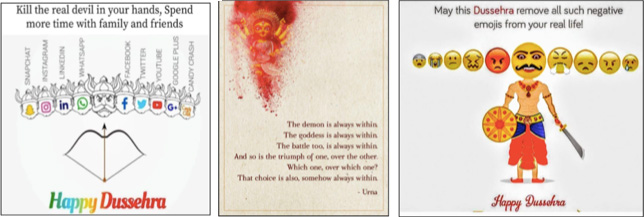
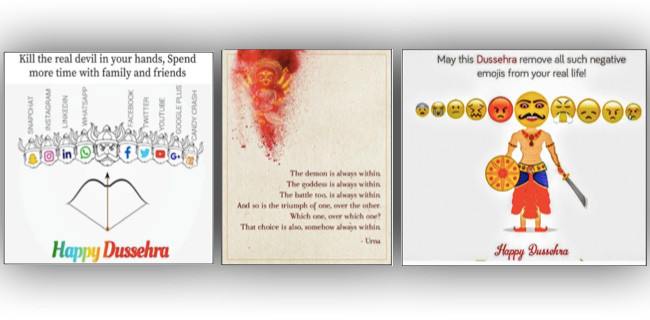
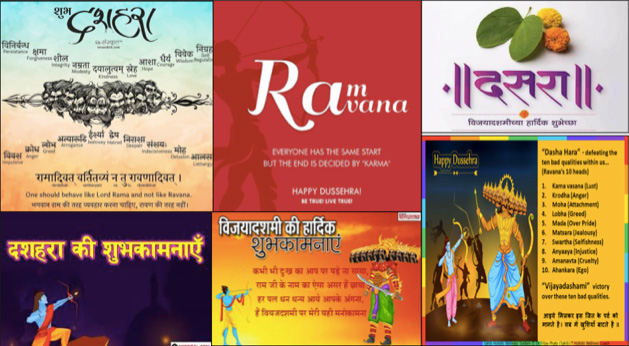
    Here are some of the Dassera greetings that landed in my WhatsApp timeline. Check how many greetings in your timelines are from the numerous bouncing boards across groups and individual well-wishers.

    Your numbness is increasing.

    Now you easily swipe/click/ignore greetings that do not engage you and have zero impact in your life.

    The sender is not expecting replies to every greeting.

    His dharma is to send/forward the greetings.

    The sender is in the game of just sending and ticking a box of having wished people who during the day will safely ignore or flick the greeting out. An excellent creative message will find engagement with the communication and not necessarily the sender. I presume that was not something you planned.

    I would like to know and see messages that someone took exceptional care and pain in crafting it, especially for you?