Category: ADVERTISING

  • After Bajaj Electricals, Soho Square wins Prism Cement

    By A Correspondent


    Close on the heels of the Bajaj Electricals win, Soho Square Mumbai has announced its appointment as brand custodians by Prism Cement Limited, a Rajan Raheja Group company for its Cement Division.


    Making the announcement, S Ramnath, Executive Director, Prism Cement said, “We considered a few agencies before zeroing on Soho Square, Mumbai. Besides the passion and understanding the team displayed, what really impressed us was the work they have been creating for our H & R Johnson (India) Division.”


    Samrat Bedi

    Prism Cement has a strong presence in Central India and the agency has been brought on to partner in the consolidation of its cement brands in these markets.


    Corroborating the news, Samrat Bedi, Head, Soho Square, Mumbai said, “This win makes it two in a row; this comes immediately after our Bajaj Electricals win. We are super excited and hope to keep this tempo going.”


    Mohit Ahuja

    Mohit Ahuja, Senior Vice President, Soho Square Mumbai, added: “Over the past few years, cements have been moving from a purely B2B communication model to a B2C one, so it is exciting to partner a major brand in this phase of the category. The win also cements our expertise in the homes segment, in a manner of speaking, as it adds to our current clients like Oberoi Realty, Pidilite’s Dr Fixit Raincoat and H&R Johnson’s floorings, bathrooms and kitchens.”


  • TBWA\India names R Venkatraman as Creative Director

    R Venkatraman
    Parixit Bhattacharya

    TBWA\India has announced the appointment of R Venkatraman (Venky) as Creative Director. In his new position,Venky will join the creative team in Mumbai,reporting to Parixit Bhattacharya, Chief Creative Officer of TBWA\ India.


    With eight years experience in advertising, Mr Venkatraman has worked at Grey Worldwide, Creativeland Asia and BBH India. His brand experience includes Appy Fizz, Mango Frooti, LMN, Johnnie Walker, Red Bull, Kinetic Honda, Café Coffee Day, Gili Jewellery, Movies Now, Vaseline Men and Google.


    Commenting on the appointment, Mr Bhattacharya said, “Venky has a stellar work ethic and a very matured head on his young shoulders. I am hoping that our rich roster of clients will nourish him with new opportunities to create an enviable body of work. Needless to say, by having him around, the laughter index of the agency will rise significantly too.”


    “My quest for work-type fun brings me to TBWA and I am very, very excited to be here,” Mr Venkatraman added.”Now it’s all about turning that excitement into work that will make a difference to the brands we nurture here.”


  • What makes P&G’s India head Shantanu Khosla outlive peers


    By Kala VijayaRaghavan & Sagar Malviya


    The company he heads is coming off its worst financial year. Yet, an unfazed Shantanu Khosla wants to look back longer at how Procter & Gamble’s Indian operations have come along in its 24 years in the country, creating spaces for itself while going head on against the might of fellow multinational offsprings like Hindustan Unilever and Colgate-Palmolive.


    Just as well for him, for Mr Khosla has been at the helm of P&G India for the last 11 of those 24 years. Seen through the prism of P&G’s global template, Mr Khosla’s tenure, since 2002, is standard stuff. Seen through the prism of what’s happening in his neighbourhood, Mr Khosla is an outliver.


    Hindustan Unilever-P&G’s rival number one in india and against whom it is measured the most-has seen a change of guard four times since 2002.


    As has Colgate-Palmolive. As has Nestle. “The comparison (with HUL) pleases me because I know we are winning,” says Mr Khosla, managing director of the operation that posted combined revenues of Rs 7,561 crore in 2012-13. “In every category we have competed with HUL, we have grown. Ten to eleven years back, they were 20 times our size; today, they are three to four times.” And then, he fires a salvo. “Reliance has grown faster than HUL in the same period. So, is there a comparison?” But growth is one thing, profitable growth another. P&G’s speedy expansion has come at the cost of margins, especially in the last three years, when the quantum of losses posted by it- Rs 1,167 crore-wiped off all the profits it had made till then.


    A lament among industry observers is it’s not clear what P&G wants to do in emerging markets like India. They say its growth could have been faster given its parent’s size and product portfolio, its board of directors in India is aging, and is low on ideas and risk appetite, its strategy to opt for fewer stockists is puzzling. “P&G’s strength is top-end, high margin,” says Amin Babwani, a former senior sales and marketing official at HUL and now an independent consultant. “Hence, even if they become big, say, in the mid-priced detergent segment with the success of Tide, it will not meet their margin aspiration. It should leverage its global portfolio and quickly launch some of its big global brands in India.”


    P&G is upping the stakes in India. Its US parent has invested about Rs 2,000 crore in the last two years in its Indian arm to ramp up production and distribution, especially in relation to, who else, HUL. What makes that narrative more interesting is that, on October 1, HUL completed one of its regular successions, with Sanjiv Mehta stepping into the rather big shoes left behind by Nitin Paranjpe.


    Barely half a km away in Mumbai, at P&G, the footprints, as far as one can see, are those of only the indefatigable Mr Khosla. “Shantanu is like Sachin Tendulkar in the P&G system,” quips a senior company official, not wanting to be named.


    The Man

    The 53-year-old Mr Khosla says this is where he wants to be. “I love the job, I am learning everyday,” says the 53-year-old. “The consumer base in India is still underserved. And we have this young talent and leadership pipeline the P&G system consistently works on.”


    Mr Khosla heads all three P&G companies in India. There’s P&G Hygiene and Health Care (which makes Whisper and Vicks), Procter & Gamble Home Products (Ariel and Tide) and Gillette India (shaving products of the same name). Mr Khosla became a part of P&G when the Cincinnati-based company acquired Richardson Hindustan in 1985, in 1985. After leading several business units for it around the globe, he took charge of India in 2002.


    In 11 years under Mr Khosla, P&G’s revenues have multiplied about six times at Rs 7,561 crore. That’s faster than Colgate-Palmolive, Nestle and HUL, though the last name on the list has a significantly larger base. Personally, for Mr Khosla, it’s an unusually long stay in a Gen Y environment, where boards and CEOs are getting younger.


    “There is nothing unusual about it in the P&G system,” he says. “Over its 175 years of existence, P&G has had only 10-11 CEOs.” In India, before him came Gurcharan Das, David Thomas and Helmut Meixner.


    According to a senior company official, who did not want to be named, Mr Khosla has been refusing global positions that come with promotions. At present, in P&G’s global hierarchy, Mr Khosla is a vice-president. He reportedly has clout and commands respect for his leadership skills. “He could have been president-level talent any day, but he has chosen to be in India by choice,” says this official. In P&G, the president is a notch below chairman & CEO position.


    Declining to answer questions about global roles and older boards, Mr Khosla insists leadership development and succession planning is core to P&G’s culture. “I know who my successor will be as, with all positions within the P&G system,” he says. “Nothing happens by chance here. These are all pre-planned career decisions done with what is good for business and what is good for the employee. I am no exception.”


    The Company

    Departures from that template happen, even at the highest level. This March, the US parent brought AG Lafley-credited with the $57 billion acquisition of Gillette in 2005 and all of 66 years-out of retirement to be its chairman and CEO and revive growth. On a visit to India three months later, Mr Lafley admitted that P&G in India had fared better in categories where established FMCG was not strong, like women care, baby care, hair care and skin care.


    Part of the reason, he said, was because HUL had a headstart and FMCG talent. “It wasn’t until we were there for a decade or two that we began to hire some really good people out of universities, and we did acquire some good people with Richardson-Vicks and Gillette and other acquisitions,” he said in July. “But it is very hard when you haven’t been there for 100 years and you don’t have the reputation of HUL to hire the best.”


    Gautam Duggad, FMCG analyst at Motilal Oswal Securities, a brokerage, says comparing P&G with HUL is unfair. “Both have different histories,” he says. “HUL is a 100-year plus organization in India compared with P&G’s 20-odd years, of which, it has been aggressive only for the last 10 years.”


    Mr Duggad feels P&G is putting many pieces in place. “The losses are not worrying. It is the result of its investments in critical areas,” he says. “It is focused on long-term growth. Now, it is investing in critical areas: brands, distribution and infrastructure. For FMCG companies, management roles have marginal impact.


    Once the critical parameters are addressed, it is on auto pilot.” Ashok Chhabra, former P&G general counsel for Asia-Pacific & Australia says the company is guided by the consumer, not the competitor. “And Shantanu is driven by data and facts,” he adds. “He understands issues on the ground and is an excellent leader to guide P&G.” Mr Khosla says he maintains a 9 to 6, clear every mail in less than a minute, schedule. Mr Khosla, who is fond of gadgets and cars, meets as many colleagues he can, often seeking them out.


    “We have an open office, flexible work hours and are more virtual,” he says. Independent marketing consultant Kamini Banga gives a thumbs up to Mr Khosla. “A new entrant combating a large entrenched player is no mean feat, and what is essential is continuity and stability,” she says. “And if things are working well, it would hardly be prudent to bring change at the top and experiment with new strategies. As a challenger, Shantanu has brought stability and continuity while putting it squarely on the path to growth.”


    Source:The Economic Times

    Copyright © 2013, Bennett, Coleman & Co. Ltd. All Rights Reserved

    Licensed to republish


  • Such an Enduring Endorser!


    By Hemant Kenkre


    It’s a no-brainer to identify the one name that ploughs through the diversity of India and gets the nation together – cutting the various barriers of religion, caste, creed and socio-economic backgrounds. Twenty-four years after making his international debut, Sachin Tendulkar still gets top billing as he says his final hurrah at Mumbai’s Wankhede Stadium today.


    Having known him and having watched him closely both on and off the field – I had the privilege of leading him, for the Cricket Club of India, in his first year in senior cricket tournaments in Bombay – one has seen his brand grow to an unmatched level from 1989 till date.


    One has only to read any newspaper, surf a website or switch on the television or radio to understand the impact that this shy man has had on a country bereft of ‘real’ heroes. Sachin mania has been rocking India from the day that he announced his intention to retire from all forms of cricket.


    What takes the best of Indian and international brands to invest in brand Sachin Tendulkar? Why do organizations pour millions of dollars on a 5-foot, 4-inch stocky man with a squeaky voice who came from a middle-class back ground? Why do parents lug their son’s cricket kitbags on the many maidans of India beseeching greedy coaches to make their ward the next Sachin? Brand Sachin connects across all demographics – from nine to ninety.


    There is something about Sachin that endears the heart and builds an emotional bond with people that follow him. India always had sporting heroes like Dhyan Chand, Milkha Singh, Vijay Amritraj, Prakash Padukone apart from cricket legends Sunil Gavaskar and Kapil Dev. The latter two had many endorsement deals but not at the maniacal level that is happening with Sachin – with brands sticking to their mascot in spite of him retiring from the game.


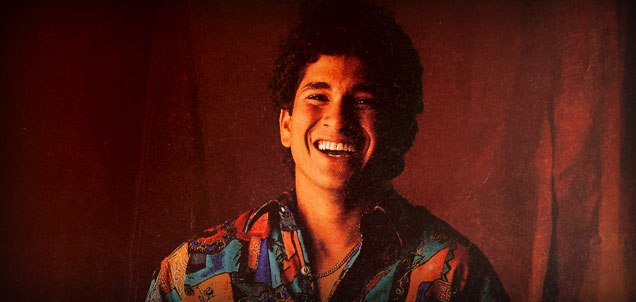
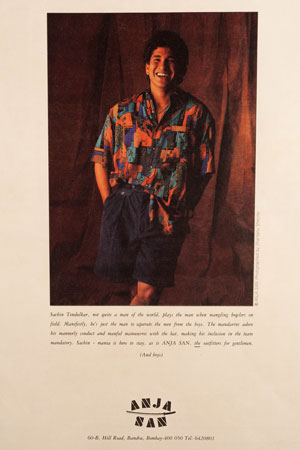
    In 1989-90, I was associated with an advertising campaign that featured Sachin. The brand, Anja San, a bespoke tailoring outfit had featured legendary ghazal maestro Jagjit Singh and table wizard Zakir Hussain as their models. The late Varsha Bhosle, the brains behind the campaign, had identified Sachin as the next model and it was my job to get him to endorse the brand. Sachin had not completed even a year in international cricket and had not even played an international match in India. When queried why she had shortlisted him, Varsha said: “Wait and watch; you will see why I want him to endorse the product. There are cricketers and there is Sachin…”


    The print campaign, one of Sachin’s first, was shot by noted photographer and ad-film maker Shantanu Sheorey who made me stand behind the camera and speak to Sachin so that he would be relaxed while facing the camera. The campaign created a stir when it was released in 1990 – after Sachin had scored his first century against England in Test cricket.


    When Coca-Cola re-entered the Indian market in 1995 their biggest threat was Sachin Tendulkar endorsing rival brand Pepsi and not some rabble-rousing organisation gunning after MNC’s in India. Sachin’s “Boost is the secret of my energy,” was the successor to Kapil Dev’s “Palmolive da jawab nahi,” and precursor to the “Sehwag ki Maa” campaign. All being rustic, honest and completely believable.


    Why have marketers preferred to bank on Sachin from 1990 till date? One remembers an incident that took place when the Indian selection committee sat down to pick the team for the Pakistan Tour in 1989. The panel knew Sachin was supremely talented and were worried to pick the 16-year old as he was bound to face baptism by fire with thunderbolts thrown at him by Imran Khan, Wasim Akram and Waqar Younis. “What if he fails?” was the question doing the rounds when the late Naren Tamhane, former India wicket keeper and part of the committee said: “Sachin never fails!” Wise words that marketers and brand managers believe in to date. 23-years on, one realises what Varsha meant…there are cricketers and there is Sachin!


    P. S. Sachin did not charge any fees for the Anja San campaign


    Hemant Kenkre, former cricketer, commentator and cricket-writer and communications practitioner, has captained Sachin Tendulkar for the Cricket Club of India (CCI).


  • What’s Next for Brand Tendulkar?

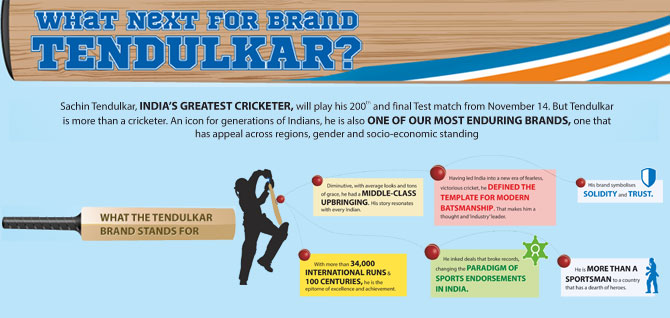
    Master blaster Sachin Tendulkar will play his 200th and final Test match from November 14 to 18. While he’s been captain of the Indian team and a run-machine having broken several records in the last 24 years, Tendulkar is more than a cricketer, he’s an icon. He’s also one of India’s most enduring brands, with appeal across gender, age, socio-economic standing and regions.


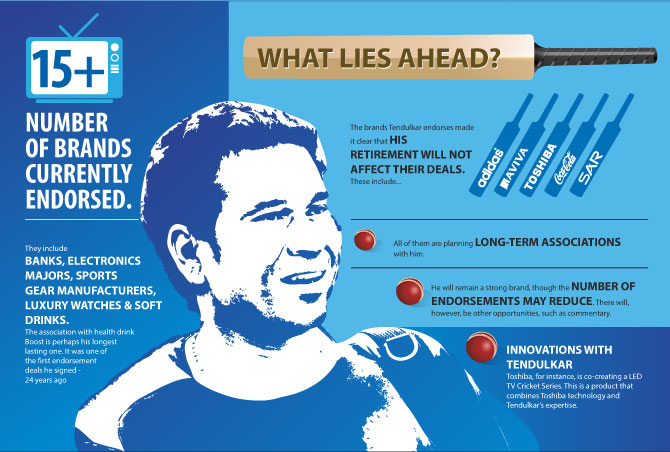
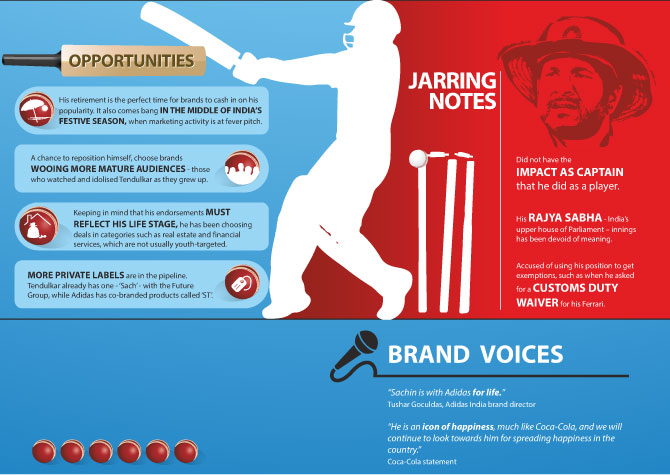
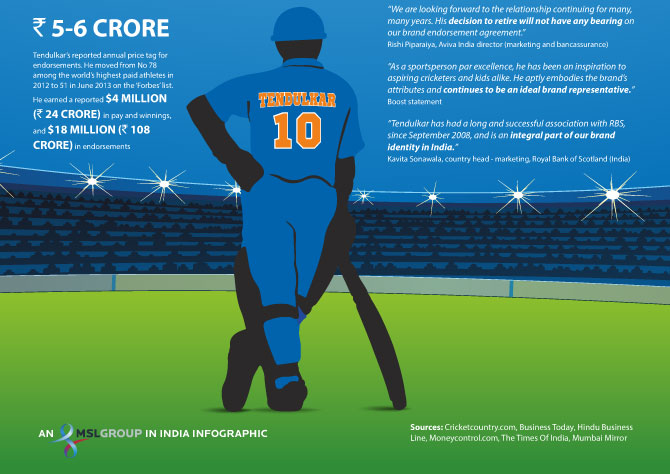
    MSLGroup has put together an infographic that analyses what’s next for Brand Tendulkar, the opportunities that lie before him and the changes in positioning that he may bring about.


  • 35 Days to Retirement Day | Sachin: The Original Sau Crore Man

    Sachin Tendulkar

    By A Correspondent


    He has, arguably, been one the biggest Indian sports celebrities and an intensely sought after brand ambassador for almost two decades now. It all goes back to the time when Sachin Tendulkar struck a never-heard-before Rs 100-crore deal with Mark Mascarenhas’s sports management firm WorldTel in 2001, which was the beginning of the phenomenon of Brand Sachin. Since then, the master blaster has been a top endorser for marquee brands including Pepsi, Boost, Adidas and MRF among many others.


    LITTLE MASTER’S BIG BUSINESS

    OCT 1995 |

    WorldTel signs Sachin Tendulkar - marketing agent Mark Mascarenhas is eventually credited with building the master blaster into a multi-million dollar brand


    2001 |

    Mascarenhas’s sport management firm WorldTel signs Tendulkar for a record 5-year contract worth 100cr


    2006 |

    Sachin signs on with the World Sport Group


    CURRENT ENDORSEMENTS

    Adidas, Toshiba, Aviva, Kaspersky Labs, Audemars  Piguet,Valuemart, Musafir.com, Amit, Luminous Enterprises, Livepure, Boost, Royal Bank of Scotland, Coca-Cola


    According to Forbes magazine, Tendulkar’s earnings from brand endorsements stood at $18m as of June 2013 and is ranked 51st on the highest paid athletes’ list in the world. Tendulkar charges Rs 5-8cr annually per brand


    SECOND INNINGS

    After retirement, Tendulkar is expected to align himself with sectors such as banking and insurance as active sporting brands may not find him relevant


    However, things are bound to change for the 40-year-old as he retires from all formats of the game soon and enters a new phase off the field. From charging anywhere between Rs 6 crore and Rs 8 crore annually as endorsement fee, his asking price after retirement is likely to plummet to Rs 2-3 crore, say industry experts. Brand marketers and sports agents say Sachin can live on as a brand to be reckoned with if he reinvents himself and cashes in on his fearless attitude instead of portraying himself as only an athlete.


    Over the past two years, due to the uncertainty around his retirement, a few brands like Canon and Castrol pulled the plug on him. Besides, he has not signed any mega deals in the recent past. The last major announcement came in 2011 when Coca-Cola signed him for Rs 12-15 crore. The Coke deal is up for renewal in the first quarter of next year. The cricketer is now managed by the World Sport Group and has 13 brands in his kitty.


    “Sachin has a compelling brand value since he is the first Indian sportsperson in the post-cable television era to have achieved unparalleled greatness. He embodies a certain kind of nostalgia for everyone who has grown up seeing him on TV in the ’90s. He will have opportunities going forward if he reinvents himself and leverages his iconic status,” says Anirban Das Blah, managing partner at celebrity management firm CAA Kwan.


    Many of Sachin’s existing contracts are ending over the next year and one of the brands that he endorses says his contract would be renewed if he slashes his fee. “The kind of brands he will endorse and his involvement and engagement with them will change going ahead,” says Bunty Sajdeh, CEO, Cornerstone Sport & Entertainment, the agency which manages younger crickets like Virat Kohli and Shikhar Dhawan.


    Recently, the German sports goods maker signed on 24-year-old Kohli for a record-breaking Rs 10 croreper-year deal, a sign of how some of the brands that Sachin endorses are looking at younger stars. However, Tushar Goculdas, brand director, Adidas India, says the brand’s association with Sachin will continue. “We will celebrate his final cricketing landmark with a campaign – #SRTforever. While he will play his final test match in the three-stripes , he will continue to guide and mentor team Adidas forever.”


    Toshiba, which went ahead and renewed Sachin’s contract this year, is looking to use the cricketing great to co-create its products. Says Abhishek Mehta, head of marketing at the Japanese electronics major, “We want to be seen doing big things with him as his association goes beyond just endorsing the brand for us.”


    Source:The Economic Times

    Copyright © 2013, Bennett, Coleman & Co. Ltd. All Rights Reserved

    Licensed to republish


  • Sach an opportunity!


    By Ravi Teja Sharma, Ratna Bhushan & Vijaya Rathore


    Sachin Tendulkar’s 200th Test match is set to become a mega marketing event with his sponsors planning special campaigns to celebrate the milestone in the hope of reaping rich dividends from all the hype and hoopla.


    That this Test could be played in the master blaster’s home town of Mumbai and might possibly be his last, make the match even more of an occasion.


    “This is a national event. I don’t think people have been able to gauge the importance of the event until now,” says Shailendra Singh, joint managing director of media agency Percept.


    Tendulkar, who will become the first cricket player in the history of the game to play 200 tests, has repeatedly refused to specify a date for his retirement from Test cricket. But the cricket’s board decision to invite West Indies to play a special two-Test match series in November, ahead of a scheduled South Africa tour has given rise to speculation that India’s greatest cricketer will bid farewell to the game at the end of this series. The decision to award a Test match to Mumbai, ahead of Ahmadabad which should have hosted a game in the series, as per the board’s policy of rotating Test centres, has added fuel to the fire.


    Sensing one last opportunity to drum up some visibility in these depressing times, brands such as Aviva, Coca-Cola, Adidas and Toshiba, which are associated with the master blaster, are planning strategic campaigns and initiatives, which could translate into incremental sales in the festive season.


    Pune-based real estate developer Amit Enterprises is working on launching Sachin branded 200-apartment projects in Mumbai, Pune and Nashik. “The real estate market is slow but Sachin will sell. We have also asked JWT to work on a brand campaign,” says Kishor Pate, managing director of the company, which had signed up with the right-handed batsman in 2010, when Sachin had played 175 Tests.


    Aviva Life, the life insurance company, is planning a digital media campaign featuring Sachin to connect with the Facebook and Twitter generation. “We are looking to celebrate the 200th test by launching an effective campaign in social media and digital media since he has a lot of following in that space too,” says Rishi Piparaiya, director marketing at Aviva Life.


    Television-maker Toshiba has created a special television series with the cricketer and will be launching it by mid-September. “The new product is especially created with Sachin’s contribution and will be dedicated to cricket fans,” says Sanjay Warke, country head for Toshiba India (DS Division).


    Sportswear maker Adidas was drawing up a marketing plan for January. “But there seems to be a change of schedule now,” says Tushar Goculdas, the company’s brand director. “The exact plan is being worked out, but we have a few things on mind like creating a memento for Tendulkar himself and roll out some product for fans commemorating his 200th.”


    Swiss watchmaker Audemars Piguet and Coca-Cola, whose brands Sachin endorses, are working on smaller initiatives. While the watchmaker plans to roll out a bunch of congratulatory messages if Tendulkar breaks or makes any new records, Coca-Cola, which had invested heavily in a campaign surrounding Sachin’s 100th century only to see it bomb, is playing it safe. A spokesperson of the beverage maker said the firm will leverage Tendulkar’s achievement to amplify its CSR activities and projects.


    Two years ago, sponsors had seen their marketing campaign fizzle as Tendulkar’s 100th century took much longer than anticipated. Coca-Cola had planned to release 6.5 million special ‘Sachin’ cans in the summer of 2011 to mark the occasion. But Tendulkar’s poor form meant that the company had to release most of these cans before he reached the landmark.


    Similarly, Aviva had planned to fly contest winners to London to meet Sachin as he was expected to score the 100th ton during India’s four match test series against England in 2011.


    This time however, barring a freak incident, the date and venue of the milestone will be known well in advance. Brands associated with Sachin would certainly use this opportunity to leverage their association with him,” says Ajit Varghese, managing director at media buying firm Maxus South Asia, a part of Group M. Adds ad filmmaker Prahlad Kakkar:”Today, all brands are suffering because of the slowdown. The smart ones will ride on Sachin and in the bargain push their products, keeping the post Diwali festivities going.”


    According to Forbes magazine, Tendulkar’s earnings, including his match fees and endorsement money, stood at $22 million as of June 2013. He has played 198 Tests has scored 15,837 runs and has 100 international centuries to his name, the most by any player so far.


    For the record, BCCI refuses to admit there is a plan to help Tendulkar go out on a high. “Who said he will play? We haven’t selected him as yet. No one is picked just because he is playing his 100th or 200th match,” was a terse response from Ratnakar Shetty, a top official of the cricket board.


    The joint secretary of the Mumbai Cricket Association, Nitin Dalal, however, says every effort is being made to get the match to Wankhede. “We will request the BCCI. He is a Mumbai boy and the crowd will be thrilled to watch him play on the home ground. The MCA management committee believes that it is going to be a big event and we will have to make it very special not only for the cricketer but also the public,” he says.


    After undergoing a surgery on his left palm, Tendulkar recently started practising and has confirmed that he will be available for the Champions League T20 later this month on behalf of Mumbai Indians.


    Source:The Economic Times

    Copyright © 2013, Bennett, Coleman & Co. Ltd. All Rights Reserved

    Licensed to republish


  • Guest Column by Hemant Jain: Opportunity knocks in mobile internet

    By Hemant Jain


    A Facebook status update recently by a college graduate student read: I may be able to live without Facebook, but not without WhatsApp. If status messages and typical buzzwords on various social media networks are a thing to go by, then we have the writing on the wall. Mobile internet in India has already shown signs that it is growing and is only going to get bigger and more powerful.


    A look around any hangout space and it is evident that mobiles in India have fundamentally altered the lifestyle of today’s consumers across age groups. And it is no more the top executives who find it convenient to do business from their phones. The scope has widened. It is impacting the way we work, play, interact and live.


    Even more recently, to tap the growing e-commerce market in India and increase its access to consumers, Coca-Cola floated an online store for home delivery of its products. Coca-Cola’s move is an industry and sector first in the fast moving consumer goods sector in the country to set up a standalone portal. This development coming from a giant like Coca-Cola sends very strong signal for marketers as well as agencies working in the digital – especially in the mobile advertising space.


    As the smartphone usage in India rises, the internet consumption, as a direct corollary shows an upward movement. The smartphone consumption brings along with it the platform to introduce differentiated mobile media offerings that offers massive reach, unique ad placement, and impactful ad formats which augurs well for the mobile advertising industry.


    India finds itself in a unique space as far as mobile internet opportunity is concerned, all the variables for a successful equation are in place for this to happen. Starting from the cost of network access and handsets is going down, wireless networks are going up, and Indian consumers already display an insatiable appetite for digital services.


    Further, bypassing the personal computer experience and moving straight to widespread mobile access-simply makes sense for a large chunk of Indian users. It would sidestep a host of hurdles associated with delivering affordable internet services to a population that is geographically dispersed and relatively poor, in a country where infrastructure development has been an issue and reach of internet a topic thoroughly contested and debated across various forums.


    The Indian mobile Internet consumer:

    Numerically speaking:

    With more than 900 million cellphone connections, India is the second largest mobile market in the world after China. A recent report by Boston Consulting Group stated that the total number of internet users in India is expected to increase from 125 million in 2011 to 330 million by 2016. The report noted that, at present, around 45% of online consumers in the nation use only the mobile to access the Internet. This is expected to increase to 60% over the next three years.


    Even though typical Indian consumers have limited Internet access, they have a remarkable appetite for digital content. In fact, they consume an average of 4.5 hours of it daily across offline channels such as television, DVDs, and CDs. And what is really remarkable in this growth story is the fact that use of mobile to access internet has been on a constant rise in the country. A whole segment of business has grown around retailers essentially operating as physical iTunes stores, charging fees to load music and other content onto mobile devices. The net result is that while India is a relatively poor country, more than 70 percent of its urban consumers already spend about $1 a month on content and services through offline, unorganized retail channels-a market estimated to be worth more than $4 billion annually (according to various industry reports)


    India has taken a giant leap when it comes to the issue of cost and ease of access to Internet services. The country has seen enough development in devices, networks, operating systems, and operator strategies. The average price of smartphones delivering much richer content, including video, has fallen rapidly over the past sometime. This price tag is significantly less than the cost of PCs.


    It has also been observed that mobile devices are considered easier to operate than PCs, and the ability to access websites with a single touch or a voice command. Indian operators have also fuelled this upswing as theyare innovatively offering innovative rate plans for mobile data use, addressing criticisms of the prices of data plans and their perceived opaqueness. Operators have played it smart by offering a very low ticket invitation plan to let the consumer taste the ease of mobile advertising.


    This is good news for advertising and marketing fraternity that we have a new medium that presents itself as a potent contender to expand and share the ad budget pie. Mobile advertising is becoming an essential component of the media mix with the digital advertising market in India was pegged at USD 300 million for FY 2011-12.


    Current Trends in Indian Market

    Without doubt, India is one of the most exciting markets for mobile adverting, and pushing it forward is the buoyant and increasing base of active mobile internet users. This base is growing and growing fast. According to various industry reports, the mobile userbase in India is all set to touch 200 million mark in a short time. But, the more interesting thing is that as much as 40 percent of these mobile internet users have a single access point, that is, their mobile screens. Since, the mobile penetration in the country still remains a bone of contention, apps are playing an important role in improving the numbers of these mobile internet users.


    Developers will find out innovative ways to marry in-app purchases and smart advertising:

    Internet access largely based on mobile apps presents a major window of opportunity for smart and non-intrusive monetisation. Developers will have to take urgent action to monetize their app user base by plugging into telecom-billing for transactions and to create better and stronger mobile advertising solutions. Companies need to up the game be it is though better editing, visual merchandising or marketing.


    India being a nation of multiplicity, regional content will do a lot of good for the future of mobile internet. It should be presented in new ways: voice and single-touch mobile-Internet access are essential. Language content will be particularly instrumental in overcoming illiteracy and a lack of familiarity with the Internet.


    Mapping consumer’s mobile lifestyle and targeting a better reach

    Mobile internet usage will throw up a mine of data that will allow the advertisers and marketers to become even more aware about the personality and choices of these mobile netizens and offer them better apps and bundled advertising and monetisation opportunities.


    This would also allow the producers of good and services to leverage the power of m-coupons merged with hyper categorised offers backed by solid data. This will allow the bringing together of advertising, monetary transaction and distribution platforms on a single hand held device.


    A more edgy and smarter brand planning

    Coming of the mobile platform into being will eventually force brand custodians to offer more engaging and custom made campaigns on mobile. The message will have to blend seamlessly with that on other media while still maintaining its ability to remain sleek. Agencies can adopt new approaches to developing concepts, pricing, and measurements of effectiveness specific to the medium


    Slicing the mobile ad pie finely:

    Coupled with more edgier brand planning and a robust measurement system, the mobile ad pie may be divided more smartly based on language preferences, region – mobile advertising has the opportunity to move beyond just subscription and service based model to a more localised and customised ad selling platform.


    Minting the mobile money

    Regulators and service providers will have to find out more acceptable and safer ways for people to carry out monetary transactions on their mobile phones. Things like shopping coupons coupled with apps may be able to deliver the next level of experience and comfort for the shopper on mobile. We can already see that a lot of smart e-commerce players have already redesigned their portals in a mobile friendly way.


    The concept of m-wallets really need to take up and offers a lot of space to manoeuvre for both the customer and the seller.


    Challenges:

    It is time advertisers moved invested in the medium

    While the hope of a mobile boom is still high, advertisers are still experimenting with the media and this devote a miniscule budget. The revenue from mobile advertising is not keeping pace with the mobile penetration levels in the country and that leads to a crippling effect on the initiatives and innovations that are required for the medium to grow bigger and better. Various industry estimates place the share of mobile advertising at a tenth of the overall digital advertising spend of $400 million (about Rs 2,180 crore ). For the dominant players this is a cause of worry.


    Where is the measurement:

    Since, the ad share is low, innovation and dedication of all the stakeholders is also low at present. Advertisers right now cannot figure out how effective a mobile internet campaign is.” Most of the top advertisers in the country devote nearly only 5% of their entire ad budgets for mobile ads.


    The pain of absence of any robust measurement in the mobile advertising space is further causing these low budget for the medium. These low budgets stem also from low conversion rates for mobile ads where the percentage of users who go beyond just clicking on an advertisement to completing a transaction is not growing.


    New medium demands newer ad formats:

    To make both the customers and brand custodians hooked to the mobile advertising, it is high time that agencies really rake their brains and offer better ad formats that are non-intrusive while being effective at the same time. The newer formats have to be in sync with the mobile browsing experience.


    Educate the customer:

    Another major issue is the need to continuously engage and educate the customer about the various possibilities that mobile internet can offer as India has a huge potential in terms of a growing customer experience. E-commerce is expected to be a major driver to further provide pace to Indian mobile internet story. Therefore, the need is to build customer trust. Indian consumers still need a lot of weaning away from cash transactions and need to learn to rely on the reliability of online payment options.


    That is the only way how the huge potential residing in the India’s hinterland can meaningfully contribute to the growth of India mobile internet story.


    Infrastructure still a challenge:

    Lack of infrastructure has often been touted as one of the major roadblocks in uptake of digital medium in the country and this issue still has been the case running it for digital advertising and advertising on mobile. Though mobile operators have a far better reach compared to the pure play broadband penetration. However, low uptake of 3G hasn’t helped the cause of digital advertising and impedes the growth of mobile advertising in India.


    Conclusion:

    With the introduction of low price and durable smartphones in the Indian market, internet access has got a higher penetration and a new meaning especially to the youth of the country. Still, a lot of ground needs to be covered by all the interested parties – the government, the developers, the agencies and the manufacturers of products and services have to constructively work on this opportunity that promises a lot.


    Hemant Jain is Senior Vice President and Head, Domestic Business at Hungama

     

  • Zee unveils all-new corporate brand film crafted by Scarecrow

    By A Correspondent


    Zee Entertainment Enterprises Ltd has unveiled a corporate brand film based on its brand positioning – “Vasudhaiva Kutumbakam – The World is My Family”. The brand film depicts the essence of Zee’s brand image, conveying that it has been a cultural ambassador of India, to millions of viewers across the globe for more than two decades.


    Speaking on the film, Roland Landers, Zee’s Head Corporate Brand said: “I am extremely glad to unveil the new brand film. ZEE’s brand positioning envisions its world as a unified family, without any caste, boundary or religion, which this film has beautifully brought to life showcasing a blend of multiple nationalities celebrating togetherness.”


    The 360 degree roll out of the film, scheduled to be aired on all ZEE channels, social media plarforms, newly launched corporate website and other key on ground properties, will certainly ensure that the film reaches all the key internal and external stakeholders of Zee.


    Manish Bhatt

    Manish Bhatt, Founder Director, Scarecrow Communications, which is the creative agency behind this brand film, mentioned “It was like an opportunity to create this one-of-its-kind world anthem. Creating communication for the brand that connects with more than 700 million viewers and over 169 Countries was a mammoth as well as a prestigious assignment for Scarecrow. We are confident that this communication will establish the perfect connect with the audience.”


  • 4 Indian entries win at 2013 Digital Asia Fest

    By A Correspondent


    Digital marketing agency bagged two silvers for Tata Docomo, Interactive Avenues won a Silver for eBay and PHD India bagged a Bronze for Hindustan Unilever.


    These were the four winning entries from India at the 2013 Digital Asia Festival Awards which honoured the best in Asia Pacific’s digital marketing.


    Led by jury president Jason Kuperman, Vice President of Omnicom Digital for Asia Pacific, India, Middle East & Africa, the jury awarded a total of 47 winners from a shortlisted 80 pieces of work. They have given one platinum, 13 gold, 14 silver and 19 bronze awards across 26 categories. The much sought after platinum award was given to DDB Group Sydney for ‘TrackMyMacca’s’, their iPhone App for McDonald’s Australia.


    Speaking about the entries and the standard of work, jury president Mr Kuperman said, “The work that won the platinum and even the gold winners were campaigns that represented digital at their heart and were able to solve a problem in a way that traditional communication cannot. The strongest work had really good craft, design, a good level of creativity and was able to solve a problem and deliver real value”.


    New Zealand took home the most awards (10), closely followed by Australia with 9 and China and Japan both with 6.


    The Digital Asia Awards 2013 Agency of the Year Award, given to the agency that has amassed the most points across all categories, was presented to Colenso BBDO New Zealand.


    Commenting on the awards, Terry Savage, Chairman of Lions Festivals says, “What has emerged from the awards is a sense of the regions’ ability and drive within the digital market. The winners are truly deserving of their awards for their stand-out pieces of digital marketing.”


    The winning work is now available to view on the website at www.digitalasiafestival.com.


    Category Award Agency Advertiser Campaign Title
    Search Silver Interactive Avenues eBay There’s always a first time with eBay
    Display, Banners etc Silver ibs Tata Docomo Hyper Personalisation – The World’s CRM Powered Personalised Web Banner
    Digital Media Innovation Silver ibs Tata Docomo Hyper Personalisation – The World’s CRM Powered Personalised Communication Platform
    Loyalty Campaign Bronze PHD, India Hindustan Unilever Good Life Club


    2013 Winners by Country:

    COUNTRY TOTAL
    New Zealand 10
    Australia 9
     China  6
     Japan 6 
     India 4 
     The Philippines  4
     Singapore 3 
     Malaysia 2 
     Thailand 2 
     Hong Kong  1


  • Taking Citi to #1 Bank Brand


    By Rahul Sachitanand


    Sanjeev Kapur followed the conventional marketer’s career path when he joined Hindustan Lever (now Hindustan Unilever) and quickly notched up his first career highlight by revitalising the sluggish Lux brand in the 90s.


    He helped reinvigorate the brand, adding as much as Rs 100 crore to the topline. Then, in 2007, he gave up the stability of consumer goods to move to financial services, specifically to work at Citibank. In 2010 Citibank India cards segment was ranked No 5 and the ‘Citibank’ brand No 3 within the Citibank Asia network across nine countries. Mr Kapur, 38, along with the various product teams at Citibank, has helped change this perception.


    Today Citibank India, despite having a relatively small footprint in the country, is the strongest brand in Asia and the third-strongest brand globally within the network, according to the monthly internal ‘brand track’ survey conducted by IMRB in India and other such research agencies elsewhere.


    “As a marketer, he took his brand from a challenging situation to success, based on specific interventions that he drove passionately,” says Anand Kripalu, managing director of United Spirits. “Sanjeev is a person who is intellectually and operationally agile, who challenges the status quo in whatever he does, taking the job and himself to the next level.”


    Mr Kapur was rewarded for his efforts a couple of months ago. From being just the marketing chief of Citibank in India (with a team of 20), he was made the head of customer franchise management. Not only does he now head a 60-member unit, but his role also goes beyond the confines of traditional marketing, he says. Now, he has been tasked with improving client experiences across all segments and products and expanding the use of analytics and big data to make business decisions.


    Punching above its weight (the bank has barely 40 branches in India compared with 16,000 for SBI, over 3,000 for HDFC and about 3,000 for ICICI) is becoming a habit for Citibank India.


    Restricted by banking norms from expanding the branch network, Mr Kapur has used other means to give the bank a disproportionate brand recall. “Sanjeev is a transformational marketer – under his guard brands move forward – and he combines data with intuition and is not afraid to take bold brand decisions,” says Vikram Sakhuja, CEO, Maxus Worldwide, a media planning and buying agency. Citibank has had to take the long route to becoming a well-recognised brand in India. Although it was the first bank to launch phone banking and text message alerts for transactions, its history is a mixed bag in India.


    Three years ago it was rocked by a 250-crore scam at one of its branches and it also struggled with Citi Financial, its NBFC, and indiscriminate personal loan lending and credit card issuance. Since then, it has rolled things back, focusing on building its own sales force (rather than rely on third parties) and picking its clientele carefully. At the end of the last financial year, Citibank India became the largest foreign bank in India ahead of Standard Chartered.


    Mr Kapur is looking beyond, hoping to build a very different perception for Citibank India and he’s discarded conventional marketing norms. “Consumers today are assimilating the same content across multiple platforms, making traditional concepts such as offline and online, as well as below-the-line and above-the-line less meaningful,” says Mr Kapur.


    Mr Kapur, who spent three years in eastern UP as a rookie manager with HUL, is looking beyond consumer goods for marketing insights. Citibank, for example, can better deliver marketing messages to constantly connected customers (via Twitter, Facebook or a mobile ad). “Citibank, has the ability to provide targeted marketing messages to its customers using the social, mobile and ATM platforms, allowing for a richer customer connect experience than most other consumer sectors,” he adds.


    For example, Citibank wants to help customers not only find Chinese restaurants in Bandra, but get directions also using My Privilege app’s mapmyindia application. Then there are discounts and freebies too to be availed of. Mr Kapur thinks technology can help sharpen marketing – pinpoint ads when you’re in an airport (for a Premier Miles card) or in a shopping mall, with tailored offers.


    “Location-based connected experiences are the future of marketing,” says Mr Kapur. Citibank has used social media to find the most convenient locations for its ATMs and devised an application to make social media-based dining and shopping recommendations.


    “The future of marketing lies in creating and delivering customized information to our consumers who are constantly on the move.” This content may be location or time based and displayed on multiple platforms including mobile phones and ATMs.


    An admirer of brands such as Nike, Starbucks, Apple and Ikea, this mechanical engineer by training is adding some new gears to Citi’s marketing engine. Citibank’s Dil v/s Bill campaign did not just crank out cookie cutter print ads, but ran an aggressive twitter promotion (15 tweets a day) and had it as the trending topic for 53 hours. As a marketer, Mr Kapur is clearly focused on the profile of his customers.


    “Over 60% of our banking transactions are online… We attract digitally savvy early adopters as customers and we have turned our distribution disadvantage (of a small branch network) into a technology advantage,” says Mr Kapur.


    Citibank’s ability to use the internet and mobile aggressively, he adds, demonstrates its ability to leverage technology efficiently across platforms, providing easy access, more control and a superior customer connect experience. Citibank India built on the success of its Dil v/s Bill campaign with the Happiest Diwali initiative. While the final results of this campaign will take a couple of more weeks to crystalise, Citibank has reached out to 1,500 merchants and is confident of making a splash in the market. Like its previous campaigns, Mr Kapur is focusing on converting purchases from heavily rationalised ones to those driven by the heart.


    Mr Kapur, a university level football player, is also changing the rules of the marketing game. So, the Dil v/s Bill campaign had someone else (for example, a consumer electronics firm) create the demand, while Citibank only cashed in on it later. “Consumers tend to splurge beyond their means during the festival season on their family and friends,” he says. “Our brand is about providing financial solutions to fulfil the individual aspirations of our customers responsibly.”


    Source:The Economic Times

    Copyright © 2013, Bennett, Coleman & Co. Ltd. All Rights Reserved

    Licensed to republish


  • SAP’s Rajesh Kumar to chair DMAi 2014 marketing convention

    By A Correspondent


    Rajesh Kumar

    Rajesh Kumar, Marketing Head, SAP, Indian subcontinent has been announced as the chair for the third edition of the Association for Data Driven Marketing & Advertising in India (DMAi) International Marketing Convention scheduled to be held in January 2014 in New Delhi.


    Said Umang Bedi, Managing Director – South Asia, Adobe and member of the DMAi Board of Governors: “I have seen the format of the show grow in the recent years to become a real power packed show that is of immense value to any traditional or digital marketer alike and we look forward to the change that Rajesh ushers in.”


    According to a communique, the convention aims to addresses the quest of CMO’s and agency professionals who want to leverage data and ‘Re-define customer understanding’ – due to richer context, stronger behavior insights beyond simple demographic construct. The agenda accent this year remains on harnessing data responsibly to ultra-segment our customers, hyper personalize marketing programmes through specific product, pricing & promotion actions resulting to innovation, delightful customer experience and improvement on marketing ROI.


    Speaking on his appointment, Mr Kumar said: “Organizations like the DMAi have the responsibility to orchestrate conversations amongst marketers to champion this change and harness innovation to drive growth. I am happy to be associated with DMAi and look forward to working with peers in the industry to bring together content, best practices and experiences that will drive this agenda and unravel together what future holds for us”.


    The three-day convention will host a strategic summit for the C-Suite, keynotes, debates, 15 dynamic conference streams, live certification and workshops, an expo and an awards programme. Noted Vatsal Asher, CEO, DMAi:  “Rajesh has been involved over several weeks on shaping the event. The format and experience of the show has been redesigned from scratch to encompass the needs of our attendees.”


    Details on DMAi and the convention are at www.dmai.co