Category: ADVERTISING

  • Winners List of Kyoorius Black, Blue and Red Elephants


    Winners of the Blue Elephant:

    CATEGORY NO AND NAME

    AWARD TITLE

    AGENCY NAME

    PROJECT NAME

           
    CATEGORY – 1 – IDENTITY Branding a Birthing Center NH1 Design Pvt. Ltd. Birthplace Healthcare Pvt. Ltd.
           
    CATEGORY – 2 – PACKAGING Good Paper Project Leo Burnett Mumbai Fresno & Bakersfield India Ltd.
      “Stories from Channapatna” Locopoco Design Studio (Entrant: Varnam) Varnam
           
    CATEGORY – 3 – COMMUNICATION Save Calligraphy O&M, New Delhi Qalamkari Creative Calligraphy Trust
      Getty Images Poster Leo Burnett Mumbai Getty Images
      Chaplin Chapters BBH India Movies Now
      Ish Watch Alok Nanda & Company Filter
           
    CATEGORY – 5 – SPACE Temple Pavilion Installation Abin Design Studio Kishor Sangha Community
           
    CATEGORY – 6 – BOOKS “Dekho : Conversations on Design in India” Codesign Brand Consultants Pvt. Ltd. Codesign Brand Consultants Pvt. Ltd.
      Gobble you Up! Minus9 Design Tara Books
      I Take this Train Too Alok Nanda & Company Filter Press
           
    CATEGORY – 8 – CRAFT “Stories from Channapatna” Locopoco Design Studio Varnam
      I Take this Train Too Alok Nanda & Company Filter Press
      Recycled Mechanics Umbrella Design Bennett, Coleman & Co. Ltd.
           
    CATEGORY – 9 – GOOD Save Calligraphy O&M, New Delhi Qalamkari Creative Calligraphy Trust
      Help Desk DDB Mudra Group Aarambh
      Hot Wheels Key Chain O&M, Mumbai Mattel Toys (India)
      Good Paper Project Leo Burnett Fresno & Bakersfield India Ltd.


    Winners of the Black Elephant:

    BEST OF SHOW AWARD TITLE AGENCY NAME PROJECT NAME
      Temple Pavilion Installation Abin Design Studio Kishor Sangha Community
      “Dekho : Conversations on Design in India” Codesign Brand Consultants Pvt. Ltd. Codesign Brand Consultants Pvt. Ltd.


    Winners of the Red Elephant:

    RED ELEPHANT FOR STUDENTS  
         
    CATEGORY STUDENT NAME INSTITUTE/COLLEGE
         
    CATEGORY 1 – IDENTITY Jenny Sheth, Pankti Anjaria, Shrishti Mhamunkar Shree BK Somani
         
    CATEGORY 2 – TYPOGRAPHY Amrita Jhaveri Shree BK Somani
         
    CATEGORY 3 – OPEN BRIEF Pankti Sheth Faculty of Fine Arts, MSU
         
    CATEGORY 4 – ILLUSTRATION Saachi Mehta L S Raheja School of Art
         
    CATEGORY 5 – PACKAGING Tehmul Kapadia, Nikhil Ratni, Tejas Kale, Rajdeep Vankadu MPVS College og Architecture & Centre for Design
  • Abin Design Studio & Gurgaon Codesign Brand Consultants win top honours at 2013 Kyoorius Awards


    By A Correspondent


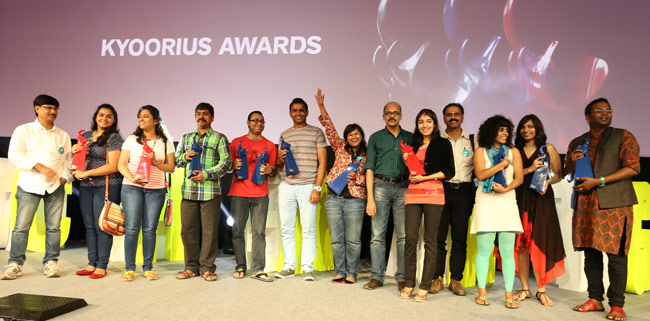
    Kolkata-based Abin Design Studio and Gurgaon’s Codesign Brand Consultants bagged the Black Elephant indicating the ‘best of show’ entries at the first edition of the 2013 Kyoorius Awards held in Goa on Thursday (Aug 29).


    These awards were held in partnership with D&AD and the International Advertising Association (India Chapter) and sponsored by Zee*.


    Laura Jordan Bambach, Deputy President and Member of the Board of Trustees at D&AD and Donal Keenan, Senior Awards Operations Manager, D&AD other than Rajesh Kejriwal, Founder-CEO, Kyoorius spoke on the occasion.


    Spanning over nine categories including print, packaging, retail and design for good, a six-member international jury comprising two members from India poured over the 437 professional entries vying for the Blue and Black Elephants and 113 student entries in the running for the Red Elephants.


    The jury members included Elsie Nanji, Gabor Schreier, Jeremy Leslie, Simon Sankarayya, Tanya Singh Khosla and Ton Van Bragt. The jury manager from D&AD was Donal Keenan.


    Said Mr Kejriwal, “We had conceptualized this with the aim of recognising exceptional work in the design industry.” The D&AD awards are recognised globally as the among the most prestigious amongst creative awards.  Tim Lindsay, CEO of D&AD said, “The Kyoorius Awards were conducted at par with international standards and the delegates and industry peers received an opportunity to view some excellent work done by the winners.”


    Meanwhile, buoyed by the success of the Awards, Kaushik Roy, Immediate Past President – IAA India Chapter said he was certain that there is a long association in store between Kyoorius, D&AD and the IAA- India Chapter. “Together, we have the vision to realize the power of design and it is crucial that we support and award the best creative minds in India, ” he said.


    *Disclosure: MxMIndia is Trade Partner of Kyoorius Designyatra 2013


    Category Title Entries Nominations Blue Black Red
    Identity

    7

    1

    2

    5

    Packaging

    9

    2

    Communication

    15

    4

    Digital

    4

    0

    Space

    3

    1

    Books

    5

    3

    Editorial

    3

    0

    Craft

    17

    3

    Good

    10

    4

    Total Nominations – Professionals

    437

    73

    Total Nominations – Students

    113

    12

    Total Wins

    18


  • India TV announces Salaam India awards

    By A Correspondent


    Leading news channel India TV has announced Officer’s Choice Salaam India Awards to salute the spirit of courage by the common man.


    The initiative will recognize exemplary acts of bravery and spirit of courage, notes a communiqué. These will be awarded to individuals who have stepped forward altruistically and with great determination to face challenges head-on, safeguarding someone else’s interest while risking their own lives, the release adds.


    India TV has invited nominations from all over the country. The Award will be given among four broad categories namely Bravery Awards, Gallantry Awards, Damini Awards and Special Awards. An eminent panel of jurors will select the final honorees.


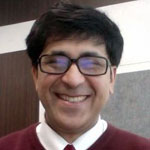
    Ritu Dhawan

    While announcing the awards, Ritu Dhawan MD & CEO, India TV, said: “Salaam India is a humble attempt to salute our real heroes, who inspire simply by their acts of exemplary courage. As a responsible news channel, it is indeed a matter of pride for us to attempt to bring to fore light the sense of true bravery, as an inspiration for the rest of the nation.”


    The awards will be presented at the Taj Palace hotel in New Delhi on September 28. Officer’s Choice packaged drinking water is the title sponsor of the initiative.


  • Devraj Basu to head Law & Kenneth’s Kolkata ops

    By A Correspondent


    Devraj Basu

    Devraj Basu joins Law & Kenneth as Senior VP and GM incharge of Kolkata operations. He brings with him an experience of more than 20 years in advertising and other forms of marketing, across India and Singapore. His past assignments have been with Bates, B E International, Lintas, JWT, Mudra.


    Anil S Nair

    Comment on the appointment, Anil S Nair, CEO & Managing Partner of Law & Kenneth, said: “We are extremely pleased to have someone like Devraj to take charge of one of our most significant operations. I’m sure Devraj will add tremendous value to both our clients and our talent based out of Kolkata.”


    Added Mr Basu: “The leaders of Law & Kenneth struck me as ones having high level of energy and trust with a rare simplicity and clarity of vision. With a meaningful roster of brands to work on, I found this combination quite compelling.”


  • Sonali Dhawan to take over as marketing director at P&G India

    By Kala Vijayaraghavan


    Kainaz Gazder, marketing director of consumer products company P&G India is relocating to China to head its baby-care business in markets such as Taiwan and Hong Kong.


    Best known for P&G’s signature CSR programme Shiksha and Gillette Shave India movement, 39-year-old Ms Gazder is credited with aggressively driving the growth of several P&G brands such as Pampers, Whisper and Vicks in India.


    She will be succeeded by Sonali Dhawan, who was previously marketing director for P&G’s Pet Care Business for Asia and ANZ. Her career spanning 15 years includes handling beauty and haircare business for India, South East Asia and Australia.


    Confirming the move, Sonali Roy Chowdhury, Head HR at P&G India, said “The move was part of the company’s philosophy to reward and recognise high performing P&G India leaders with challenging global leadership assignments.” P&G has a ‘promote from within’ policy, which focuses on giving early responsibility as well as global exposure.


    Also, given that 70% of P&G’s target audience is women, the company is understood to be backing the promotion of women executives as a real competitive advantage, company watchers said. At P&G India, roughly 30-35% of its senior leadership is made up of women.


    In recent years, P&G has moved away from the kind of aggressive advertising that saw it attack brands of arch rival Hindustan Unilever – such as the launches of Tide Naturals and Olay, during the tenure of Sumeet Vohra as marketing head.


    While there has not been any major launches during Ms Gazder’s India stint, the company spent substantially on manufacturing.


    Source:The Economic Times

    Copyright © 2013, Bennett, Coleman & Co. Ltd. All Rights Reserved

    Licensed to republish
     

  • ‘Find what you seek’ with Ogilvy’s Incredible India campaign

    By A Correspondent


    Ogilvy & Mather has released 17 executions of the creative idea – Find what you seek – for the Incredible India campaign. The Kolkata monsoon poster is part of this effort.


    In an attempt to take the ‘Incredible India’ brand forward, the Ministry of Tourism, briefed Ogilvy & Mather to delve a little deeper into what made India truly Incredible for the new campaign.  Discussions between the agency and client led to the articulation of the idea: ‘Find what you seek’, notes a communiqué. It was based on the insight that India can be what any traveller wants it to be. The campaign (a total of nearly thirty pieces includes press and outdoor advertising) covers a range of experiences in India through the eyes of the tourist, the release adds.


    CREDITS:

    Executive Creative Director : Ajay Gahlaut

    Creative Director: Jossy Raphael & Gaurav Nautiyal

    Art: Kanika Sethi

    Copy: Ajay Gahlaut, Jossy Raphael, Richa Jain

    Account Management: Pawan Bhatt, Faisal Mahfooz, Rupinder Singh


  • Publicis launches 360-deg campaign for Park Avenue beer shampoo

    By A Correspondent


    J K Helene Curtis Ltd has launched an advertising campaign for its Park Avenue Beer Shampoo Adding a twist of beer into the modern man’s life, the campaign focuses on the need of personalized hair care for men, notes a communiqué.


    Created by Publicis South Asia, the communication reveals that men’s hair is different from that of women, and needs specialized care to keep it shiny and bouncy.


    Said Anil Kulkarni, Director, J K Helene Curtis Limited: , said, “In our research, we have found that men do not invest in personal hair care products and instead use female shampoos. With Park Avenue Beer Shampoo, we wanted to give the man a shampoo created specifically to meet his hair care needs and it’s time to revel in the glory of making men conscious about personal grooming.”


    Bobby Pawar

    Commenting on the concept, Bobby Pawar, Director, Chief Creative Officer, Publicis South Asia, says “For years we’ve sold the feminine idea of hair care. Our idea was to create a male counter-point to that, one that puts a beery twist onto typical hair-care communication. We tried to capture the same as an outcry ‘Cheers to man hair’.”


    Credits:

    Creative agency: Publicis South Asia

    Creative team: Bobby Pawar, Zarwan Divecha

    Account Management team: Chandan Jha, Dharal Goshalia

    Production House: Fleet Entertainment

    Director: Kay Kienzler

    Producer: Jignesh Maru


  • Emvies on Friday, Sept 6

    The Advertising Club has announced the Emvies awards ceremony on Friday, September 6 at 6.15pm at Hotel Taj Lands End (the Ballroom), Bandra, Mumbai. Gold Members can get entry by paying Rs 1500, Silver Members at Rs 2800 and Senior Citizen Ad Club Members at Rs 750. Telephone: 022-23894091, 23810213. Email adclub@vsnl.com


  • Flipkart spoofs Arnab Goswami’s ‘India wants to know’ in new TVCs

    By A Correspondent


    For India’s leading ecommerce player Flipkart, the greatest stumbling block is convincing consumers of the safety, speed and ease of buying. Almost all of its commercials till date have helped drive home the message in an interesting way. “You have to say many things in the commercial,” reasons Kartik Iyer, Chief Executive Officer, Happy Creative Services which has created the new set of TVCs


    Continuing with using kids as adults in funny settings,  the new campaign attempts to do the same: educate the consumers about the benefits, ease and convenience of shopping on Flipkart.com. But zara hat ke. It uses a news channel discussion format with various people highlighting the benefits of the ecommerce provider’s service.


    Nothing unusual about it so far. Except that the campaign is titled ‘India Wants to Know’ and the anchor is an Arnab Goswami lookalike. The Times Now editor-in-chief and star anchor of the primetime show ‘Newshour’ has built a reputation of being tough on his guests and often uses the line “India wants to know” or “India wants the answers”.


    In the first commercial, one of the characters for instance is fashioned on adman-turned-lobbyist Suhel Seth who is a regular face on news channel discussions. And the anchor shakes his head quite like the reigning star of English news television does on his nightly show.


    “We’re pretty excited as it’s the first time a reflection of media content has been attempted in advertising, in the country,” said Mr Iyer, adding: “What needs to be said needs to be said without twisting things around too much. Hence the need for an entertaining format that will make the country sit up and notice.” Not getting drawn into a discussion on the comparisons with Mr Goswami, Mr Iyer said: “It’s not going behind an individual. We are using a sentiment of society and what’s all over social media.”


    On the new campaign, Ravi Vora, Vice President -Marketing, Flipkart, commented, “As the largest online shopping destination in India, we have managed to build the confidence of a large number of Indians to shop online. However, this is still very small compared to the number of Indians active online. Most of them are still reluctant to complete the transaction online. Hence this campaign is a continuation of our efforts to make people shop online by talking about benefits like large selection, competitive pricing and customer-friendly policies.”


    Mr Iyer added that the campaign will be seen across all the GECs since the brand intends to target people who are still apprehensive about online shopping. We would suggesting sponsoring Newshour on Times Now. And playing the commercial in the breaks. What say, Messrs Vora and Iyer?


  • ASCI launches new website and online complaints & monitoring system

    By A Correspondent


    The Advertising Standards Council of India (ASCI) has announced the launch of a newly designed website www.ascionline.org, which incorporates an Online Complaint & Monitoring Service (OCMS), which is key to delivering transparency and speedy resolution of complaints.


    With the introduction of the OCMS, consumers can now lodge complaints via the new ASCI website, the ASCI Facebook page, email, smartphones, toll-free telephone or regular post. Irrespective of how consumers complain, they will receive a Complaint Tracking number which will help them track the exact status of their complaint on the new ASCI website. Additionally, if they so choose, they can receive regular updates on the status of their complaints via email and/ or SMS.


    ASCI’s members will get an added advantage as they will be provided with a unique individual login id and password for their OCMS account. This will give them a single window to lodge regular and fast track complaints or seek advertising advice.


    Commenting on the new ASCI website & OCMS launch, Arvind Sharma, Chairman of ASCI, said: “The new website through its  attractive  yet simple  construct  makes it easier for consumers, activists, regulators and industry members to actively participate in ASCI’s advertising self- regulation process. We also hope that the new facility to track their complaints online will further drive all stakeholders’ confidence in ASCI.”


  • It’s Emvies 2013 tonight!


    As The Advertising Club hosts Emvies 2013 in Mumbai this evening (September 6), we bring you a curtain-raiser


    By Shephali Bhatt


    It’s interesting how you can draw parallels between Emvies shortlisted case studies presentation and video games. There are some levels of difficulty that you manage to overcome after repeated attempts, and yet others that you always fail to cross, which makes ‘Game Over’ a more likely scenario than ‘Game Won’.


    Last year, we highlighted the good and bad at the Emvies ’12 presentation and offered some tips to cross those tough levels. To our utter dismay, some of the hurdles remain intact.


    The AVs still pretty much parrot the points made in the preceding presentations. Only the production values are slightly slicker this time. And full points for the choice of music, guys.


    There were still some poetry recitals that had to be stopped midway yet again, because the agency didn’t time their presentation to the stipulated 10 minutes. But there were more levels won.


    Abdul Khan

    As noted by Abdul Khan, one of the judges and hub retail operations lead at Reliance, the presentations addressed a diversity of issues. One of the campaigns that ranked high on the popularity meter was Lodestar UM’s ‘Saridon – National Headache Reliever’, wherein the media agency used small segments on news channels and movie reviews as a medium to drive awareness for the “graveyard brand” in order to make it a currency to define degrees of headache.


    Movie critic Bhawana Somaaya was roped in to rate movies and replace her star ratings with how many Saridons a certain movie’s watching would require. For instance, if she gave a 2 Star rating to a movie, the viewer would need 3 Saridons. The initiative led to a 125 per cent increase in the brand’s preference score and revved up sales by 33 per cent as well.


    Then there was a potential winner that perhaps lagged behind on presentation skills but managed to impress the judges and some of the young presenters alike. This was IBS’s entry called Tata Docomo – Hyper Personalisation – World’s first CRM powered digital media campaign.


    The digital agency used Facebook’s sponsored feed to deliver personalised messages to its users based on their account details and usage. Outcome: Tata Docomo gained 3,50,000 lapsed users.


    Lubna Lanjekar, a young media planner from MEC, who handles online was impressed by how the study married technology with social media.


    Punitha Arumugam

    This time Emvies also had a few firsts to its credit, informs Punitha Arumugam, managing committee member, The Advertising Club. Judging sessions in New Delhi in addition to Mumbai was one such novel element. Introduction of new sub categories in ‘Best Media Innovation -TV and Print’, ‘Best Integrated Campaign’ and ‘Best Use of Research’, was another. Also, the category ‘Best Use of Sponsorship’ made a comeback this year.


    Creative and media agencies got closer on the Emvies platform. There were shortlists from Ogilvy India for Lifebuoy Roti Reminder and Akanksha Foundation – Joy of Teaching, both of which drove the message of social consciousness.


    Unlike strategy-heavy case studies that brought on ennui for participants from creative agencies, these presentations with mass appeal found a better connect with Pashyn Sethna, a young copywriter from DDB Mudra who was accompanying his colleagues from DDB Mudramax for the presentation on Birla Sun Life Insurance – Agent on Track.


    At the same time, some young media planners, like Mediacom’s Zarius Captain, felt that these, along with a few other case studies had a great insight and potential but were not presented very well.


    Most of the agency teams, involving at the most three to four members, had started working on these presentations only a week in advance even when they had two weeks between shortlists announcement and presentation. Perhaps that explains why some judges thought there was less meat and more gimmick in some of the case study presentations.


    Sanjay Tripathy

    On the other hand, Sanjay Tripathy, another jury member and senior executive vice president – marketing, product & direct channels, HDFC Life felt that this year, the quality of the work, as well as the presentations had gone up and there was some innovative work done on digital, be it search, social media, display or video. He adds though that more client participation during final presentations will definitely enhance credibility of the entries.


    Speaking of credibility of entries, some judges also raised issues on the awareness level scores and stated they would really prefer to hear more about how marketing drove business growth in real terms. To this, Ravi Rao, leader – South Asia at Mindshare, said, “They are right. Ad awareness or brand awareness doesn’t necessarily tell you about brand’s growth. But then how often do you get to know the story of which part of the medium pushed what?”


    Ravi Rao

    The presentation time is over now, the results will be out on September 6. One would only hope there will be newer mistakes next year. That the AVs will say something more than the PPTs that preceded them. And most of all, the poetry recitals, if any, won’t have to be stopped midway.


    Source:The Economic Times

    Copyright © 2013, Bennett, Coleman & Co. Ltd. All Rights Reserved

    Licensed to republish
  • When dhanda is manda, bring in the entrepreneurs!


    By Moinak Mitra


    In 2001, a 21-year-old spotted an opportunity in the US when he saw F&B franchisees losing out on consumers who got disgruntled after receiving excessive fizz in their fountain sodas.


    Upon showing the value of potential losses and seeing the helpless reaction of the franchisees, he created a fizz breaker to resolve the anomaly. “It seemed like a tough task as it dealt with food and I needed to understand FDA restrictions and compliance,” he says.


    That prompted him to spend time on learning about technologies that would be non-intrusive, compact, easy to use, “and something that could snap on and snap off to the fountain Pepsi and fountain Coke machines, plus obviously be accurate (especially with translucent fluids like Sprite)”.


    To top it all, he also tried to put a barrier to entry for future competitors by making it wireless (to beep into the franchise manager’s beeper). Not being an engineer, he got friends with industrial engineering backgrounds to join him.


    “I needed to make sure the people who were joining me have the same level of passion and so I spent time convincing them, joining me on customer visits, and walking through the concepts,” says the fizz-breaker-turned-India’s newest poster boy of the skies Mittu Chandilya, whom Air Asia promoter Tony Fernandes handpicked to run the low cost airlines’ India ops as CEO.


    For sure, Mr Chandilya’s courage and determination at a young age stood him in good stead as his career panned out. Prior to the top job with Air Asia India, it took him to head APAC for Ingersoll Rand and even a consulting function for search firm Egon Zehnder, based out of Singapore. In his current role, though, Mr Chandilya has to wear many hats, which obviously come in handy with the DNA of an entrepreneur already in place.


    According to research carried out by the London office of the Hay Group, the competencies required for successful entrepreneurs are different from those of CEOs. “It is either the environment or the situation the company is faced with,” says Gaurav Lahiri, MD, Hay Group India, who believes that entrepreneurial CEOs can either be good in a start-up or turnaround mould.


    While he emphasizes that good entrepreneurs are driven, ambitious, risk-takers and have a bias for action since their very survival depends on it, they are not necessarily very good at coaching, team-building and talent development since “they get their natural energy by fulfilling their own goals”.


    So why is India Inc. hiring a clutch of entrepreneurs as its CEOs? Mr Chandilya is not alone in a galaxy of shopkeepers-turned-ship runners. From Avinash Vashistha of Accenture India, Kavindra Mishra of Pepe and Pradeep Mukerjee of Mercer to Tiger Ramesh of CSS Corp and family businessman turned novelist Ashwin Sanghi – they all have had their share of running their own enterprise at one point or the other.


    And though a few like Mr Sanghi continue to do so even today, they’ve dabbled in things far different than what they are doing now. Perhaps, the bleak macro-economic map has something to do with it. Or, maybe, companies in startup mode, like Air Asia, feel the need for zeal even more in trying times such as these.


    Colleagues are clients

    For Accenture, it was a relationship that started back in the mid-2000s. Through the 90s, Avinash Vashistha worked in senior leadership roles for the then $30-billion Canadian telecom giant Nortel.


    At a time when Indian companies were learning to do outsourcing, Nortel was their biggest client and he had the experience of working with all the big Indian IT companies.


    In 1996, Mr Vashistha was an expat in India and was poised to return to the US when he realised the booming potential of the market. So he decided to start Neo IT, a company that would work with clients globally in business and technology. In 2006, Mr Vashistha’s company got into education and investment, which resulted in a name change to Tholons.


    In his entrepreneurial capacity, Mr Vashistha had worked with Accenture, and so it was in 2011 that the global giant offered him a position to head India and even bought the consulting part of his business.


    “It took me 6 months to decide,” says Mr Vashistha, admitting that the degree of freedom in his venture was more and the impact of that was huge across the organization. Neo IT and Tholons taught him diverse roles and connected him with Fortune 50 CEOs, CFOs and CIOs. “That connection with CXOs and the boardrooms of clients was an amazing experience,” he says.


    Mr Vashistha claims he knew all the verticals and the service provider landscape well since it was his venture. So working with an MNC like Accenture was not an issue as he had interacted in depth with the global top talent pool.


    “You should consider people inside the organization as clients, set aside your ego and look at the challenges that your peers and seniors face. It’s a solution-based approach since you have to feel convinced about what you’re doing. If you’re a leader, you can’t feel like a manager.”


    Roaring through serial ventures

    Like Mr Vashistha, another former Nortel leader Tiger Ramesh, dabbled in a variety of ventures before signing up with CSS Corp in 2011. But unlike Mr Vashistha, he ended up buying a part of the company along with the Switzerland-based Partners Group PE fund


    Rich Dividends

    In the last year of the millennium, Mr Ramesh was heading India ops for Nortel, which he terms as a “typical oldboy’s club”, as they got in someone else in his shoes.


    At that juncture, he teamed up with four others and started IT infrastructure management company, Bangalore Labs. But the unfolding tech crash fuelled by the telecom bubble bunged a spanner in the risk-taking appetite of customers, more so when it came to working with a startup. “We had to drop the second round of funding and sold it to a strategic buyer,” he says.


    The idea was not to get bogged down by such failure. Instead, Mr Ramesh drew up a ‘what-not-to-do’ list, which read like a breeze for any management tyro. If there were scribbles of how to keep a team motivated in a downturn by communicating more often with the employees, it also laid importance in having a budget that can dynamically alter the cost structure of a company, or for that matter, how to structure an investment with a VC, where most first-time entrepreneurs go with blinkers on.


    Armed with new learning, Mr Ramesh dove into Quintant, his next IT venture, along with Phaneesh Murthy, which soon after, got acquired by iGate. So while Mr Phaneesh became iGate CEO, Mr Ramesh was made President. Things kept rolling along as Ramesh gave vent to his true passion -wildlife -when he set up a chain of resorts in Karnataka called Cicada.


    “It was a great adrenaline shot with three-and-ahalf years of going into the forest every single week…It was fun but painful because for the first time, I had to work with multiple government agencies and NGOs since it was about the environment, and saw how red tape and bureaucracy stall things,” says Mr Ramesh, describing his passion venture before he sold it off to Coffee Day Resort Holdings, owners of Café Coffee Day, who’ve rebranded Cicada as Serai.


    Mr Ramesh didn’t stop there. He went on to help a friend set up an LED lighting business for corporate offices. It was called Clean Ray and was designed, patented and marketed in India, with a customer roll worth boasting of Microsoft, IBM, Qualcomm, Wipro, Infosys. Since Wipro had a Rs 400-crore lighting business, it ended up buying Clean Ray.


    In 2011, Mr Ramesh signed up with the Goldman Sachs and SAIF Partners-promoted company, CSS Corp. “I wanted to see if I could be a different kind of leader for this company with all the learning I had as an entrepreneur over the last 11 years. I came with no plans, only instincts. What do you do when you get lost in a forest? You see if those instincts can make an impact in a corporate job,” he says.


    Mr Ramesh’s instincts served him well. When he joined CSS, the company had a net loss, a few million dollars in debt and low-single digit EBITDA. After seven quarters, it is debt-free, has $30 million cash in the bank and a high double-digit EBITDA. His entrepreneurial streak struck back as he sought help from the Swiss PE fund Partners Group and bought out the company for $270 million.


    Through his tenure at CSS, Mr Ramesh took a magnifying glass to spot inefficiencies in the company. For instance, he looked at the delivery utilization and observed that almost 25% of the delivery folks were non-billable. So he converted 10% of them to billable entities and that proved to be a major source for profits.


    Again, he exited at least $15 million worth of business which were non-profitable owing to shrinking margins. “As an entrepreneur, it helped me to take such decisions quickly, which I wouldn’t have been able to do as a professional.”


    Cracking the people code

    Though Pradeep Mukerjee, the newly-appointed Country Head and CEO of Mercer too had his own venture to bank on after quitting Citi in 2007, which he served in various capacities for nearly two decades.


    That’s when he set up Confluence Coaching and Consulting, which dealt with organizational effectiveness, leadership development and coaching and working with organizations to define HR strategies.


    Mr Mukerjee believes all three helped in honing his career as a CEO. Apart from that, “entrepreneurship taught me to deal with uncertainties and exposed me to different people across verticals”. His venture gave Mr Mukerjee a deep insight into people business that was denied to him in a functional capacity as head of South Asia operations at Citi. It gave him the confidence to apply for the top job at Mercer India.


    Cloth maketh the man

    Away from the bean-counting and headcounting world of suits, Kavindra Mishra has taken charge of Pepe jeans in India as its CEO this July. But he does bring with him a strong entrepreneurial bug. When working as a commercial director for Benetton, he and his colleagues thought of launching a website that would offer affordable clothing as most products in that sphere could not penetrate Tier II and Tier III markets. Backed by SAIF Partners, they co-founded Zovi.com.


    “In 2011, we were working out of a Costa Coffee outlet in Gurgaon where we used to sit from 10 am to 1 pm to figure out how our day would pan out,” Mr Mishra recalls. For the remainder of the day, they would either make cold calls or go to vendors they knew from their Benetton days and more often than not, got better pricing than most of the MNC brands owing to their personal credibility.


    Mr Mishra donned many hats in the process. In fabric, normal offline supply chain takes nine months from order to production. Mishra & Co. reduced it to three months. Apart from the manufacturing process, he also learnt of a new way of connecting to consumers on an online platform.


    “The moment you go online, you get to know within two hours whether your product will succeed or fail,” says Mr Mishra, who would at a time, place 50-odd pieces on the website to gauge their efficacy in the market in two hours flat.


    All that paid rich dividends for the 38-year-old Pepe boss. Today, when he speaks to his team at Pepe, he can talk about social media with his marketing head, for instance. In his words, entrepreneurship takes away the fear of the unknown. He says he is lucky to be in Pepe since the company gives him similar autonomy as his venture: “I believe it will be very difficult for me (to survive) in structured organizations.”


    Author veda

    Talking of structured environments, Ashwin Sanghi, novelist and director of the Sanghi Group of companies, could have toed his family business line after returning from the US with an MBA at 23. But he chose the dotcom route, albeit in the auto sector, the core competence of the Mumbai-based Sanghi empire.


    In 1997-98, he set up Indiacar.com, to facilitate buying and selling of new and used cars. At the time of launch, it was the only website worth a dekko in the auto space, with 360-degree surround views of car interiors and exteriors.


    Though the venture went bust in 3-4 years, Mr Sanghi considers it his “most spectacular failure”. Like Tiger Ramesh, Mr Sanghi too drew up a what-not-to-do list after the debacle. “Though it is very easy to do valuations, eyeballs and brand prominence surveys, you should never allow any of them to influence the balancesheet,” was one of them. He began to value things like consistency and conscience over shortterm gains.


    “Today, I’ve realized the value of being conservative. It enables you to become more long-term in your approach,” says the 44-year-old. “Somewhere along the way, you have to understand the difference between the balance sheet of your business and the balance sheet of your life.”


    Pie in the sky

    Despite his failed attempt at entrepreneurship, Ashwin Sanghi painstakingly learnt from his mistakes, drew up a list and applied what-not-to-dos in his current role. After all, it takes loads of passion to take the plunge as an entrepreneur. Air Asia’s Mittu Chandilya says, “It set a street fighter mentality of never quitting and seeing possibilities when it might seem like there were none.”


    It helped the 33-year-old Mr Chandilya to understand how to bootstrap his business. After all, he had no funding till he won a national grant and even so, it was very easy to blow through the funding. “Learning how to make your one dollar go as far as possible was key.”


    In a slowdown, entrepreneur-turned-CEOs are finding new meaning and relevance perhaps because they are “constant evangelists” of their products and by the dint of their risk-taking abilities, have a self-driven purpose to creatively alter any situation. It all boils down to commitment, a valuable commodity when the chips are down.


    Source:The Economic Times

    Copyright © 2013, Bennett, Coleman & Co. Ltd. All Rights Reserved

    Licensed to republish