Category: ADVERTISING

  • dna on do-good mode, launches brand campaign

    By A Correspondent


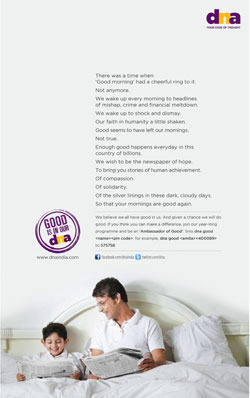
    English daily DNA (now written in lower-case – dna) has unveiled a new brand campaign – ‘Good is in our dna’.


    The attempt is to offer an all-year programme that will connect with good samaritans and provide citizens with a platform to contribute and spread the ‘good’ cheer. The campaign has been conceptualized and designed by Infectious, the ad agency set up in April this year by former Saatchi & Saatchi honchos Ramanuj Shastry and Nisha Singhania.


    Sorbojeet Chatterjee

    Said Sorbojeet Chatterjee, Senior Vice President – Marketing, dna: “This is a start to try and put the good back in the mornings. While, as a responsible newspaper we need to cover everything taking place around us, we plan to focus on the positive stories of human achievement and courage. The campaign has kickstarted with readers being able to sign up as Ambassadors of Good and the response has been overwhelming.”


    Ramanuj Shastry, Director – Infectious added: “In a day and age where we are surrounded by negative stories there is a desperate need for some good news. The people of our country need hope and something positive to start their day on. And who better than a media brand like dna who can not only give us the good news but also mobilise the people in our country to do some good.”


    The campaign will see an extensive use of print (naturally!), outdoor and radio. “Unlike a typical campaign that just looks at a spike, this is a year-round plan with a lot of editorial integration and reader engagement,” said Mr Chatterjee. And will we see any activations? “There will be one tent-pole activation every month which will see readers participate for a noble cause.”


    The first leg of the campaign has invited readers to sign up as “Ambassadors of Good”, and the response has been overwhelming, informed Mr Chatterjee.


    dna has been on an aggressive advertising campaign ever since its relaunch in April. The first two brand campaigns were done by the publication’s creative agency Genesis which continues to be the primary creative agency. A recent campaign for the graphic novel series that has been introduced in the paper was executed by an inhouse creative team.


  • Lodestar team wins Young Spikes Media Competition

    By A Correspondent


    The Advertising Agencies Association of India (AAAI) declared that the team of Lokita Rathod and Vivek Salunke of Lodestar UM, Mumbai, was winner of Young Spikes Media Competition 2013, India.


    This competition was organised by the Advertising Agencies Association of India (AAAI), and supported by The Times of India group to encourage young advertising professionals in the country and providing them with an opportunity for international exposure. This year the theme for the competition was “VOTE for a strong INDIA”.


    The winning team will  participate in the Spikes Asia’s Media Competition to be held in Singapore next month. This would be an all-expense-paid trip.


    The two-phased judging was with participation of senior industry members. Jury members for the final phase of judging were : Sam Balsara, Chairman & Managing Director, Madison World, CVL Srinivas, Chief Executive Officer – South Asia, GroupM; Jasmin Sohrabji, CEO – SouthEast Asia and Nandan Srinath, Director, Times group.


  • Laqshya integrates Neeru’s Emporio glamour to Hyderabad airport

    By A Correspondent


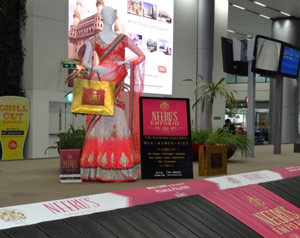
    Hyderabad’s Rajiv Gandhi International Airport has turned stylish with the Neeru’s Emporio campaign executed by outdoor major Laqshya. The concept has used is a mix of brand advertising and sensory marketing.


    Flyers at the Hyderabad airport are now being treated to ingenious advertising highlighting the three best features of Hyderabad – biryani, Nizams and Neeru’s. Real have been showcased on mannequins placed at the centre of the baggage conveyor belt. A clothing display has also been placed in the shopping centre of the airport.


    Commenting on the campaign, Avnish Kumar, Director, Neeru’s Emporio said, “We are delighted that Laqshya could exactly execute the idea to create a highly engaging brand interaction at Hyderabad Airport.” Elaborating on the thought behind the campaign for Neeru’s, Shashi Sinha, Senior Vice President, Revenue (Media Assets and Airports) at Laqshya, said: “The Neeru’s Emporio campaign blends brand advertising with suitable product placement. Besides enhancing brand value it also makes Neeru’s an aspirational brand for elite consumers. The airport is an ideal location to create this kind of brand immersion. Retailers will surely find the airport to be a fertile ground for sourcing customers.”


  • Ketchum Sampark launches Knowledge Studio

    Whoever thought you hire a public relations agency to get your plugs in the papers the following day or on television and online outlets like MxMIndia?! PR firm Ketchum Sampark has announced the launch of a ‘Knowledge Studio’ to provide research, content and thought leadership services for Indian and transnational corporates. The Knowledge Studio will complement Ketchum Sampark’s PR offerings to clients with thought leadership-led content and serve as an important growth driver especially in the ever-evolving online and digital reputation space, notes a communiqué.


    Jon Higgins, Senior Partner and CEO, International, Ketchum,said, “India is one of our most promising and key growth markets. We believe in continuously providing our customers solutions and offerings that significantly add value to their business. Knowledge Studio is a great example of that value-added service offering.”


    Announcing the launch, Bela Rajan, Founder and Director, Ketchum Sampark, said: “We see strategic synergy in offering our clients value-added services in the thought leadership and content space along with integrated design and software solutions. I believe the Knowledge Studio team will help us deliver new ideas and enhance client value in the new-age digital reputation arena.”


    Biswadeep Gupta, President, Knowledge Studio, and Partner, Ketchum Sampark, will drive the content business. Previously, he was the founder and CEO of Riteverses, a firm in a similar business as the Ketchum Sampark Knoweldge Studio. The Riteverses website now points to Mr Gupta and two others who are now part of the (Publicis) Omnicom group PR agency.


    Commenting on this move, Mr Gupta said: “Going ahead, content will be a key differentiator globally for consumer and other stakeholder outreach programmes, especially in the online space. We see a genuine opportunity to partner customers in building Thought Leadership content solutions for our clients at Ketchum Sampark and also continue to build and service existing and new customers.”


    It may be noted that the Publicis group’s MSLGroup in India already runs a similar division under the leadership of former Hindustan Times senior associate editor Ashraf Engineer. It will be interesting to see if post the merger of the Publicis and Omnicom groups, such services in the group’s PR agencies are turned into a common resource or stay as is to be value adds to the PR function.


  • Cadbury’s sweet interlude with Digital


    By Shephali Bhatt


    Hamilton Holt was right after all – nothing worthwhile comes easily. Which is why if you wanted a Cadbury Bournville back in 2008, you couldn’t just buy it, you had to ‘earn it’.


    It was the campaign that spurred the first big relaunch for the brand which had spent years as a niche product. Some even attributed its continued existence to sentimental reasons: Bournville is named after the site of the first large Cadbury factory and model village. In its revamped avatar, it aimed to appeal to sophisticated adults craving a premium dark chocolate experience. Set in an idyllic European milieu, the launch spot had a quintessentially British journalist bragging about owning a bar of Bournville who gets abducted by a giant bird because he hadn’t “earned” it. With 85% of the marketing spend on TV and the rest on print and OOH, the launch campaign ran for 15-16 weeks a year for three years until it was time to focus on the ingredients that went into making a Bournville.


    The focus of the campaign turned to all those cocoa beans that never became a Bournville, because that was a prerogative of ‘Original Ghana Cocoa beans’ only. “The idea was to build awareness and generate trials for the brand. These campaigns helped establish Bournville as a premium chocolate with an international appeal and a distinct proposition,” says Anil Viswanathan, VP – chocolates category, Cadbury India.


    It was around 2011-12 that the brand started exploring the digital platform and allocated 30% of its marketing budget to the medium. This was followed by a tie-up with Warner Bros around the release of The Dark Knight Rises. “While movie promotions don’t last more than 10 days, conversations around a movie start a month in advance,” notes Shekhar Banerjee, Senior VP and head of Pinnacle at Madison (the media agency that handles Cadbury). Capitalizing on the conversation around the biggest release of last year, the agency created an augmented reality based motion sensing game – The Bean Hunt. The winner won a free trip for two to Warner Bros Movie World in Australia. This was coupled with activity on YouTube (videos with trivia around the Batman franchise) and Facebook. It led to an addition of 6.5 lakh users on the social networking site within a month and the interaction figures soared by 4000%. It was enough to convince the brand to take a huge punt on the medium.


    Starting 2013, Bournville has set digital as its lead, accounting for 60% of its annual budget. TV remains the second with close to 30% with the rest allocated to OOH. Viswanathan explains that Bournville’s current TG (SEC A, between the age group of 19-30) is an audience that uses social media as the primary vehicle to maintain and extend their networks. The shift will help the brand by being present where its target audience is, and will help the brand building exercise by riding on leading trends.


    In March this year, Bournville launched a Cranberry variant, only on digital, and reached out to 26 million unique users. The campaign involved multiple videos created by Ogilvy India, the creative agency on the brand, which were only run online. “Today, Cranberry has a recall of 23% which is higher than the other variants of Bournville that existed in the market for years,” asserts Banerjee.


    Bournville’s current campaign ‘not so sweet’ (NSS) is an attempt to retire ‘have you earned it’. It’s tongue-in-cheek, it’s cheeky and aspires to align the brand with young adults who like their not so sweet dark chocolate. The exclusive launch of this campaign on digital media has led to an increase in brand conversation by 800%. Along with the ad film that shuns the overtly sweet, there’s a Twitter campaign called ‘Tape a Tweet’ that allows users to throw overtly sweet situations at the brand on Twitter where they promptly get converted into one minute videos. The 9-person strong digital team at Pinnacle has built analytics that quantify the ROI of social media on its two brand metrics for digital-engagement levels and conversation association of NSS. They like to call them social GRP.


    In addition, they’ve classified their target audience into digital clusters to help draft a better content strategy for the brand. Experts say that 60% of the brand’s marketing budget would be close to Rs 12 crore. “With that kind of money and a significant reach, Bournville will stand out,” Harshil Karia, co-founder and online strategist at Foxymoron points out. Since no other brand in the category is that prevalent in the medium, it gives Bournville the maximum share of voice, he adds. Normally, it takes a period of three years for advertising on this medium to reflect on sales. It will be interesting to see how Bournville’s transition from traditional to digital pays off in the long run.


    Source:The Economic Times

    Copyright © 2013, Bennett, Coleman & Co. Ltd. All Rights Reserved

    Licensed to republish


  • Havas strengthens India top deck for LG, MTS etc

    By A Correspondent


    Love Guglani
    Saurabh Bhatnagar

    In keeping with its growth and new business acquisitions since the beginning of 2013, Havas Media Group India has made some senior management appointments.


    Love Guglani joins as Vice President and Saurabh Bhatnagar as Group Account Director-Digital. Their main mandate is to manage the LG business in keeping with the philosophy of being ‘Digital at the core’.


    Besides this, the Delhi office has appointed Roopali Sharma as Vice President to manage key clients like MTS which are on their growth phase.


    Roopali Sharma
    Anita Nayyar

    Commenting on the appointments, Anita Nayyar, CEO, Havas Media Group India & South Asia said, “Our growth strategy needs the right people. All three have had illustrious careers and collectively bring in huge wealth of knowledge and experience.”


    Mr Guglani has 12+ years of experience across Carat, Starcom, Maxus and Loadstar Universal. He has worked on some of the big local brands (Tata, Hero Honda) as well as global brands (Intel, Sony). He has straddled across planning, buying and implementation roles. Mr Bhatnagar too comes with 12_ years of experience most of which have been with digital. He was previously Business Director, Dentsu Digital. He has also worked with Sapient Nitro, Quasar Media, BC Web Wise. Ms Sharma has over 13 years of experience which spans across strategy, planning and buying. She also had a stint on the client side when she worked with LG. and was previously VP Buying at Zenith Optimedia.


  • Upclose with Rajesh ‘Kyoorius’ Kejriwal


    First a disclaimer. MxMIndia is an active trade partner of the Kyoorius Designyatra and Digiyatra. But that’s not the reason why we are carrying this extra looooong interview. Even if we say it ourselves, the interview with Rajesh Kejriwal is a must-read as there’s nothing written between the lines. Mr Kejriwal talks about why his awards are not called the Yellow Pencil even though there is a tie-up with D&AD, on Goafest and how it’s different from his event and what according to him the Goafest organizers should do… and how he doesn’t allow his event sponors to have a say in the speaker line-up of the twin conference (to be held in Goa from August 29 to 31)

    Read on…


    How’s Design Yatra 2013 going to be different from the previous years?

    It’s not going to be very different from that of the previous years. As a format, we look at content and select an appropriate theme. Our theme defines who our speakers are going to be, what our content is going to be etc. So anything that is going to be different is the theme this year and that is: to create change. So everybody over there is going to be talking about how to create change… whether advertising can create change or can branding create a change or can digital create change…or if digital can create change then we will have some people who have created that changed by using the digital medium.


    Design or re-design is generally about change or is there more to it?

    Sometimes design in India is about change but mostly it is cosmetic. We are not talking about cosmetic changes here. One thing you’ll see is a lot of companies say that we have changed this logo to another one etc but in essence nothing much has changed. Change is more about what have you done internally; what have you done to connect or engage with your consumer or how transparent you have become with the digital age coming up etc. With the onset of digital, you could be saying you are the best but there are people out there who think you are not. What change can design help achieve or how can design help make a change in an organization should be the way forward.


    One of things people tell us about the Designyatra is that it more of branding and graphics and less of stuff like product design or architecture etc. Justified comment?

    When we started Design Yatra we were very clear that we are in the visual communication business where we look at branding, digital, packaging, graphic design etc. We were never what we call into product design or architecture or stuff like that. But over the years, it has been felt that one can’t be independent of the other. An architect can’t create a building and then call a designer and say hey, do the graphics. They have to work together because the times have changed today. Designyatra serves as a platform inspiration, innovation, ideas etc and for this we just can’t have visual communication designers. So we always have an installation designer. Most of the times we have an architect or one product designer. This year also we have a product designer but am I product heavy? No. I am still going to be visual heavy.


    And will that change at all or is it a conscious decision?

    It’s a conscious decision because the thing is that there is no infrastructure in India to give me space for more than 1300 people at a venue. I get that kind of crowd anywhere so am I going to add certain more things and get people from another segment and reduce the impact of the number of people coming from this segment? No. My thing has always been that we are essentially a platform. And I can’t say a platform and then deny an opportunity. We get a lot of enquiries from Italy, UK, Netherlands, Dubai, Sri Lanka, Singapore, Malaysia etc but we don’t entertain them so much because I only have capacity for 1300 people and 80 percent of them are repeat audiences who come for that one particular thing. So I don’t want to get too much into it but if I find something is interesting for this community I would bring that in.


    The other comment about Designyatra is that it is very rich in content. You’ve attended many other conferences. What is that you offer that others aren’t able to do?

    I think we were in the same space where others were in 2006. We look and say hey, we are a conference…we need to have 12 speakers for say two days so let’s get eight big names and six good names. Today, we have moved away from that and we have said let’s look at people who have made something different. So one, we never call a speaker out of the blue. We first set a theme for the conference then we do research on the basis of that theme like who the speaker should be and this research takes almost of three four months. That is I think what a lot of conference guys don’t do. They say, hey, let’s call her or him… send out invites, get confirmations etc. That’s not what we do.


    How much time in advance do you plan for this?

    As we speak we have already started planning for next year. We have six speakers confirmed for 2014.


    And are there any pulls and pressures? Are there any people who want to be there?

    We get about 20 requests every year.


    And how many do you accept?

    Two.


    Two out of twenty? Aren’t you being harsh?

    Doesn’t fit the theme sometimes, sometimes people want to come… lot of them want to come because they want a free ticket…


    Are there pressures from sponsors – people who are associated with them? Do you accept those?

    No, because where there is pressure we don’t take them on as sponsors.


    So you have that as a very clear part of your deal?

    Yes a very clear part, in black-and-white that we will not give any speaker slot to any sponsor. For example, we have had situations where we had to have a speaker because he is a good speaker so that year we do not take him as a sponsor. We tell them to come on as a sponsor next year, but not this year. So we are very clear that sponsors and speakers won’t happen simultaneously.


    While you have revived your awards this year, one of the worries is that awards take away from the conference. What’s your view on this?

    Two ways of looking at it. One is whether an award adds an element to the conference or whether it takes the thunder away from the conference. We are not like Cannes or other such events that have a lot of glamour attached to it. We are more about prestige and credentials. We are very serious about the awards and that is why we tied up with D&AD and the process that D&AD follows is very strict. For us it is just that if we have this community of 1300 people and if the right audience is present then why not have an evening of awards? And the awards are happening in the evening; it’s not disturbing the content of the conference in anyway. It’s just a single evening of the three days!


    The thing about awards is that while it makes a lot of people happy there are also many who are unhappy. Your views on awards being politicized or critiqued by an unhappy few?

    I think the politics of awards happens when there is a politics of judging and I feel that if you don’t have politics in judging then there won’t be politics of awards. People will be unhappy but I think it’s time India grows up and people should realize that if you have good work you get awarded and if you don’t have good work  then you don’t get awarded. And it’s not that they don’t have good work, it’s just that someone else has done better.


    You were also there at this year’s Goafest. How is Designyatra different from Goafest?

    I will start from the beginning. If you look at Goafest and us, we have D&AD as partners who I think are one of the most prestigious and the credible awards institution today. Also they have been the people who been doing the entire process control for the awards. Secondly, a lot of these award shows don’t have judges that come and sit down, debate, talk and judge on ground… most of them are done online where people are sitting in different parts of the world, giving some point system and then you also have the leeway for, as you said, the politics of judging.


    In our case we flew in international jury members and the D&AD people were there to monitor the entire judging session. Nobody else other than D&AD and jury were allowed…even I was kicked out of it from the first two days when the main thing happened. None of the Kyoorius team was allowed there and they sat, they nominated, they shortlisted first, they discussed the nominations… the D&AD people made sure that they discussed every entry in detail and that allows it to be very fair in its judging.


    What other difference do you see between the two events?

    I don’t think Goafest has a conference. It has 3000 people but only about 400 or 300 people attend the conference. I think that’s difference with us as we have more delegates at our conferences. I don’t think Goafest focuses so much on the tradition of conference as much as it does on the whole thing as a festival. And both have their own space. Goafest is about enjoying the festival and we are about serious content, innovation, inspiration, ideas… they are two different things. So should Goafest change completely and make its conference very serious, I am not sure because the fun element is also necessary. So it just depends on where you want to go.


    So then why do it in Goa? You could have done it in Mumbai or someplace else…

    In Mumbai you can’t have the fun element. I have tried it one year. But I think what was different was that when you tried it here, it didn’t work well on the networking front. I think the major part of the conference is about networking. People meet after a year, you meet so many of your friends, you meet new contacts, you have clients coming…we have 300 clients who are non-designers coming to the conference and this is a opportunity for networking. In Mumbai, the moment the conference ends everybody is like, ‘I have to go home’ or people go to meet up with friends. Once you come to Goa, you don’t have clients, you don’t have an office to badger you, you don’t have anywhere to go… so you are in the evening at the conference busy networking. In Goa, everybody is relaxed and stay concentrated on the conference and that I think is big. So that’s the reason we moved back to Goa.


    How would you assess your association with D&AD given that they have their own style of judging and running an awards show?

    I think they are great partners. There are two things to an award at a conference. First, I think over a period of time you either build yourself as very credible with good credentials…so if you win, for example, we have elephants as a trophy and if you win a blue elephant it means you have really done something worthwhile. We don’t have gold, bronze or silver. In some categories there has been no winner because the jury decided that none of the nominees qualified to reach the benchmark criteria that D&AD and Kyoorius together had set to be a winner. So in two categories there were no winners while in one category we have had four winners.


    One of the other things that a couple of the jury members told me some of the better design works from India haven’t entered the competition. How do you ensure this is taken care of going forward?

    I think this was the first year so there is always a learning curve when you do it the first time and lot of people especially design studios do not have faith in awards so they don’t necessarily participate. That is why I said D&AD and Kyoorius is about being credible is what will get these entries in…everybody wants to be recognized but everybody wants to be recognized as being credible and not being one among the many. And D&AD ensures that but I have met people who have said oh, I have won at Cannes and that’s it…they are happy that they have won in Cannes. And then they win a D&AD Pencil and they say wow, I won a Yellow Pencil and normally these people who take the Pencil home, leave the Cannes trophy in the agency. That’s the amount of pride one gets when winning a Yellow Pencil verses a Cannes…that’s where I think if you have something really credible along that good work will also come.


    Why didn’t you give the Yellow Pencil as the award for the Kyoorius Awards?

    We didn’t want to do that. You never know the partnership may not exist five years later, so we didn’t want to piggyback on them.


    Ufff, you are saying it on so many words.

    Why not be transparent?


    What if they read this and decided to drop you?

    They won’t because they know. They have come to us because we are transparent. I am not saying we are going to move away from the partnership but I also realized that they have a heritage, they have done so much good things…they have partnered with us and for us. That’s like an honour for me. This is the first partnership they have done globally. They have never partnered with anybody and that itself is good enough. Why would I want to piggyback on the Yellow Pencil and reduce it – I don’t want to do that; more for them than for us. I will be happy to have a Yellow Pencil; it automatically uplifts the whole experience…


    In a sense, you could have done the same thing without D&AD?

    We could have… we did it in 2007 where we had what we call Kyoorius Verdict. There is an experience then there is credibility and the whole process of jury selection etc which they have finetuned for 50 years. I would have to go through a 3-4 years learning curve to do it by myself…


    Have you been hit by slowdown in terms of delegate participation?

    Yes, we had about 430 entries whereas normally we would have expected about 800 entries. We were priced very reasonably even if we were compared to any other award. I think a single entry was Rs 4500 but if you had five entries the participation came down to Rs 3200 per entry. Again it comes back to the same thing: If I price it at Rs 7000 I still get entries but I get entries only from larger agencies but there is this small boutique design studios who do good work. The question is: can they afford Rs 7000? May be or may be not…may be for one entry then they would not be able to participate in two categories or three categories because they can’t afford it. So if I build a platform, I need to make sure that everybody has an opportunity to take part in it.


    One more observation is that there are lot of designers across agencies and a sizeable or a small section of it are not English-literate. But at the Kyoorius Designyatra, English is the medium. Is that something that you are conscious about?

    We are conscious but what can we do? India is a nation with so many different cultures and so many different languages and you are talking from perspective that there is a Marathi guy who could not converse well in English but there is a Bengali guy, a Tamilian, a Malayali…


    How do you transcend that because if you have to take Kyoorius Designyatra to the next level, you have to get people who are not known, who may not be good in English. How do you get them in?

    What we are planning to do at Kyoorius is that through this event, which happens once a year but we meet we talk to so many people during this one-and-half months of preparation and maybe three days at the conference but then nothing for the next one year. So we are launching what we call Kyoorius FI Day. FI stands for Foreign Information Day and it’s just an evening. We plan to do this across India on month-on-month basis. So we may do about 20-odd next year but this will happen maybe four in Mumbai, two in Chennai, one in Kolkata, one in Kochi, two in Pune, four in Delhi, three in Bengaluru, one in Hyderabad and across India. So this will be one particular subject and it could be editorial design, broadcast design, typography…it could be strategy within branding, it could be design within branding, it could be packaging just for the FMGC sector. So when we do it in Kochi we are expecting to have one international speaker and one speaker from that area in South India.


    Will you at any point of time look at a design discussion happening in an Indian language – a non-English Indian language?

    I don’t know because if you see the young generation, they don’t want it in a local language. So if you are talking about the difference between languages it is only in between generation of 35 and above .I have seen it as I travelled across private schools etc.


    But the Mumbai scene could possibly be different from that of Kolkata…

    No, I have been to Chitrakala Parisad in Bengaluru which is a very local school. DJMD in Coimbatore…they are all completely English-speaking institutes. Maybe some of them are a little bit here and there and all of them are on Facebook so it has changed…you know what I call the new India, if you ask me, I would be very happy to do a conference in Indian languages but content in multiple Indian languages are not available that much.


    Getting back to Designyatra, what are the numbers you are expecting, since the confererence is a few days from now?

    We expect to have about 1300 people. We had a good 1300 people earlier but as you know the capacity of the hall is a problem. We could even get 1600 people but there is no infrastructure in India that will allow me to host that big number. Also, we sponsor about 250 students – that does not change. We make sure we have participation from all the 18-20 design schools. We sponsor about 50 faculty members to the conference…so 300 would fall in that category, 100 would be special invitees, speakers, press etc. 900 are professionals. Out of it, this year I am very happy to say that there are 300 people who are coming that are non-designers and are from marketing and corporate teams – brand managers or product managers…for me that is like brilliant. We never had this before. Companies like  Himalaya, Godrej, Titan watches, TCS, Nestle, Unilever, Proctor & Gamble have been sending people…


    You have more people than in Goafest…

    Surprisingly!


    I think Goafest should have you in the organizing committee?

    (laughs) No, I think what Goafest needs to do and I am being a bit vocal about it, what it needs to do is over a period of three years curate the conference element much more. You cannot have a 2000 sq ft hall to fit in 2000 people; there is nothing that 2000 people could hear so it should be curated in such a way that every audience out there has something to look back to and take back from there. You have a lot of young crowd coming there, so maybe you can take 500 of those and do something in terms of a half-day session with three or four speakers. It should be so interesting that those 500 people will forget about going to the beach but attend the sessions. Also, I think the trick is that if you have beer on the beach with rain dance and conference happening side by side, you have to decide where the people will want to go.


    You do have beer at Designyatra, don’t you?

    Not during the conference time; between 10-6pm nothing but 6-10pm we are okay with. And that’s really because we want people to stay back and talk to each other, network with each other, get introduced, build a network etc.


    Do you making money from the Designyatra?

    Okay, I have a favourite line which I am going to quote here – a we are not-for-profit organization. Last year I said this and I saw there was a lot of glamour attached where I was going to people and saying not-for-profit and stuff but then I said, this has cost me a lot of money. So last year I made a mandate that we should be not-for-loss organization. Not-for-profit is nice but not-for-loss is better. We started working at every one of our initiatives and seeing if it is sustainable. We don’t care whether we make money or not but we do care whether we lose money or not. So we are making each of our initiatives sustainable and we are saying that not-for-profit does not mean you cannot make profit, you should make profit and then see if you can use that money for something else. This year we made some…last year we sustained ourselves. This year I think we will be having some profits and we will be using that profit to launch something called Kyoorius Grant, which we will be launching at Designyatra. I am not going to tell you any more about it now. But it is something which we are making as a Fund for the student community, which they are not able to get in India so far. We eventually expect more people to donate more money other than from what we generate from the event to build scholarships etc.


    So Kyoorius is not for profit…

    Not for loss now!


    I see you spending all your time in Kyoorius. How do you make money? I do know about your paper business, but do you spend time on it?

    Last three years I wasn’t and to be honest, the last three years we went through a huge turmoil in our paper business because we decided to launch our own paper brand rather than selling brands from overseas. Selling brands from overseas is always restricted by what they want to sell in India rather than what Indians wanted here and we were making foreign brands more famous in India than Indian brands in India. I think the time has changed where I think Indian brands need to do build themselves up and go global. So we misaligned from all the foreign brands which we were selling which took us two years of non-compete clause. So there wasn’t much of paper business happening. This year, we launched our own brand and we are spending more time on that now. And I hope that all this design-led activities that we do at Kyoorius, which is about building a platform for the design community, we will see an equal reciprocation on behalf of the design community.


    Do you think there could be some conflict sometimes between the design unit and the paper brand and also the media and events division that you have under your umbrella?

    No, both are two different companies actually. We are keeping Kyoorius neutral. If you see our magazine, I don’t know about this issue but one of the past issues we had the other paper merchants who are our competitors advertising in it. So we are neutral. Kyoorius is not-for-profit or not-for-loss and we are open to it. In fact this year at Kyoorius Design Yatra, we had two paper merchants asking for stall space and we gave them both.


    Hmmmm.

    I think we should see the larger picture and not be single-minded. One should look at growing the industry and then maybe look at how to get a larger part of the share. But if you are too narrow-minded and you don’t grow the industry then you yourself are the major loser. So you build a community then build the market expand the base and then see how your division can get a larger market share.


    Will you ever be doing something for the packaging community, printers and all the others you target?

    We are trying to do that; now the objective of Kyoorius has changed. We are going to be looking at building the platform. So it will be the print community, maybe packaging community… Also, the second step is to look at design as wholesome…we may do a separate activity for the design industry that we have not yet dealt with which is about architecture, interiors etc. This year we launched Digiyatra specifically for the digital community. Next year, we may add something else. At some point of time, I would be happy to go for a one-week-long festival at Goa where different streams come together and where some people could stay for one week or one day, four days, etc.
     

  • Anil Thakraney: Rape: News channels get it all wrong

    By Anil Thakraney


    In a frantic attempt to come up with a new ‘angle’ on the gangrape incident, some television channels have taken off on a wild tangent. All the debates about ‘Two Mumbais’, ‘Clash of the Haves and the Have-nots’, ‘Influx of Migrants’, etc, have been keeping me quite amused. All bollocks.


    The problem in this case is clear: It was a plain and simple case of policing failure. And all these bizarre arguments are serving only one purpose: Get the cops off the hook. What happened inside the abandoned Shakti Mills compound is this: A few criminals got lucky. They had discovered a secluded adda to conduct their nefarious deeds, and had found it to be a cool pad to obtain free sex, read, rape women who happened to be passing by. Mirror’s headline, which revealed the exchange between the rapists, says it all: ‘Mehmaan aaye hain, khatirdari karne aaja.’ While only further investigations will (hopefully) reveal the truth, it’s clear that the gang had assaulted women before, perhaps on several occasions. And these unfortunate victims could have been ragpickers, maids, college students, couples looking for a private dating spot… just about anybody. Because the woman who reported the incident happens to come from the middle class does not mean the dregs of this city were out to fix the rich city girl. She just happened to be at the wrong spot, it could have been anyone in her place.


    Instead, the media pressure should be on the bumbling cops. While they have done a good job post the rape, one has to ask why they aren’t patrolling such desolate spots that are located right in the center of the city, why they aren’t evicting all the squatters from out of there?  Surely their khabris would know that Shakti Mills has been taken over by anti-social elements. And this has nothing to do with shortage of police staff. Try parking your car in a Lokhandwala or Bandra or Colaba lane at 11pm, with your partner sitting beside you, and within minutes a patrol team will arrive to kick you out of there. Even if you are only chatting. This tells me the cops find it great fun to harass the aam aadmi, but getting after drug addicts who are happily chilling in lonely places is too much of a bother. And perhaps boring.


    In short, all these crazy debates are only ensuring the cops don’t take responsibility for what is very clearly their fault.


  • Godrej Aer crowdsources for ‘don’t smoke’ campaign

    By A Correspondent


    After having achieved much success with Hippo snacks some years back, Creativeland Asia has come up with another first exploiting the possibilities thrown up by the social media: crowdsource a communication message. Some 2704 tweets posted by people across India and filmed with 330 people are the hightlights of Godrej Aer’s #DontSmokeBecause song.


    #DontSmokeBecause was launched on the Twitter handle of @Godrejaer and asked people to write in their reasons to avoid or quit smoking, notes a communique. Within five days of the launch thousands of tweets came pouring in. Soon after this the video was filmed with the support of people including young college students, senior citizens, working professionals, singers, amongst others.


    Said Anu Joseph, Executive Creative Director, Creativeland Asia: “In the early days of Twitter we had created a successful twitter-based campaign to track inventory for Hippo. Since then we have continued to push ourselves to use social media properties for client partners to create value-based differentiation. #DontSmokeBecause is a step-towards using the 140-character platform inventively.” The project took two months to complete – from conceptualization to execution.


  • Maadar… Taproot crafts bold digital campaign for Hike

    By A Correspondent


    Hike, a free cross-platform messaging app from BSB rolled out a digital marketing initiative for India. Tag lined ‘Keep Close Friends Close’, the digital campagn is aimed at showcasing how Hike can enable today’s tech-savvy youth to ‘keep close friends close.’


    The new ads showcase the dynamics of an individual with their close friends and how Hike helps them stay connected. Through the month long activation, the campaign aims at driving awareness and encourages the Indian youth to download hike to stay connected to their close friends.


    Commenting on the campaign, Kavin Bharti Mittal, Head of Product and Strategy, BSB said: “With the Indian youth being online more than ever before, a pure digital strategy made sense to create a connect with our users.”


    Santosh Padhi

    Created by Taproot, the creative compliments the brand’s youthful appeal. Said Santosh ‘Paddy’ Padhi, Chief Creative Officer and Co-founder, Taproot India: “Though we are not one of the first ones in India to bring this service, we are very positive that with the youthful brand positioning of ‘Keep Close Friends Close’ and the quirky communication will make sure Hike Messenger becomes the youth’s close friend soon.”


    When asked whether the use of words like ‘maadar’ or ‘boobs’ in two of the films would pass with the self-regulators and moral police,  Paddy clarified that the ads are not meant for television, but digital only. “Even we decide to go for TV for some reason, it will be the water or bike films.”


    While the friendly banter in two of the films- the one on the bike and the other pouring water on the head – was clean and fine, why get into areas like ‘boobs’ and ‘maadar’, we asked Paddy. “It’s a mix of things we have portrayed through these digital films – right from abuse to fight to all sort of emotions which close friends share,” he explained adding that these are first set of digital films, there are few more lined post the launch.


  • Nothing curious about it: D&AD-powered Kyoorius Awards tonight


    As the Kyoorius Digiyatra and Designyatra take off today in Goa, the highlight of the day (and we guess the event) is the 2013 Kyoorius Awards which are being held in partnership with D&AD and IAA India Chapter*.


    But even as the awards are presented, as is in the case of most awards, it’s the culmination of many months of hectic activity. Last month, the judges went through each and every entry to pick the nominees and then the winners. The judges, under the supervision of D&AD’s operations manager Donal Keenan and Jury Foreman Sanky (Simon Sankarayya) went through the exercise with the rigour that a quality awards merits.


    The judges Elsie Nanji, Gabor Schreier, Jeremy Leslie, Simon Sankarayya (Sanky) (Jury Foreman), Tania Singh Khosla and Ton Van Bragt came together in Delhi to decide who should win with the Black and Blue Elephant and the Red Elephant for students. The Indian judges Elsie Nanji and Tania Singh Khosla helped the others in understanding the context and local nuances of various entries.


    MxMIndia engaged the jury members in a quick chat at the end of their meeting.


    Excerpts:


    Scam ads are a problem everywhere: Donal Keenan, D&AD
     

    Q&A with Donal Keenan, Senior Awards Operations Manager, D&AD who administered and supervised the 2013 Kyoorius Awards jury processAre you happy with the process that been followed..has it been easy?

    Oh, of course I am! That is why I am here. We are very much implementing D&AD’s process and judging coordination.


    Guess it was easy since some of the jury members have been on D&AD’s juries in the past?

    Not all of them, but some like Sanky and Jeremy have done it. But the judges really appreciate the process and the voting is completely impartial.


    We’ve had some issues with our own creative ad festival at Goafest. Issues of scams and plagiarism. How do you take care of these at D&AD?

    Scam ads are a problem everywhere. We have that in D&AD as well so certainly through the entry process… there is a client sign off for that entry as well. Of course that is not always reliable so the jury here too questioned the eligibility and status of certain entries. We acted on the spot and called the entrants or the clients to verify whether the work genuinely ran or if it was a poster, has it been display commercially. So we settled any kind of questions there and then.


    And how do you deal with plagiarism?

    There was one entry today that one of the judges brought up and said I have seen this before and I know people who have done something exactly like this. It that kind of balance of whether that you can respect that those people possibly did not know about this work and have done it on their own original thoughts or whether you think that they have actually think that they copied someone else and we need to get rid of this entry.


    Lastly, if the entries here were to be entered at D&AD internationally, do you think they would have stood a chance?

    Certainly the winners that we will see today they wouldn’t be out of place amongst the winners at D&AD. Part of the pact of the partnership with Kyoorius is that the winner will get a free entry and we will see them attending in next year for D&AD awards…for 2014 awards


    First off, how would you rate the standard of the entries that have been submitted at Design Yatra this year? Also, how does the jury process of this event compare vis-a-vis the other juries that you have been on elsewhere across the globe?

    [] The standard of work this year has been slightly high in terms of the fact that I thought we were fairly sure that we were going to have a high level of finished product but not sure about how the conceptual thinking would be compared to the finished product. But we found ourselves some really great ideas which were really well-delivered and also had great content and then the next task comes through. A couple of pieces were fairly iconic and the strongest categories were for stuff that was slightly more sustainable. This kind of illustrates a little bit about what’s going on in the country. That it is a place of change where people are recognizing that such needs have to be addressed; and also the design communities and the credit communities where a lot of such stuff can be answered. That is a really good message where you don’t just have to work for big brands and you don’t have to just work for yourself but that you can do great work by working with good briefs for clients not just with huge budgets but with more substance where the service is really effective.


    [] For those not familiar with the standard of judging in D&AD in London, it’s the one award worldwide which is of very high standard and the really keen creative people who are interested in very high standard of design work and advertising communication work, which is conceptual plus beautifully designed and executed work…it all sits in annals of D&AD. So that community of people in India, which is quite big, are very aware that D&AD is of very high standard and so they rate it as No 1. Everybody in India is almost scared to send in an entry to D&AD… apart from the fact that it is so expensive but so many people find it hard. Design companies are small compared to advertising companies who have big budgets to enter the awards while design companies are small and they don’t have the budget to find exactly what they think stands a chance to win an award in D&AD. Over here, the fees are so much less so maybe people don’t even know that even for that amount of money that you spend entering into Kyoorius, will give you the distinction that a D&AD can give you because this set of jury is almost dictated by choice from the D&AD and others. So that mix of jury who’s telling us and tempering the work, choosing with us… has maintained that standard of work.


    [] At Goafest and other festivals, everybody’s work is in that lot so everybody goes out of the room and sort of say to the others that these are my friends so I will give him one and the other one more etc…so it’s kind of incestuous. Over here, it’s really fair because nobody knows anybody. So fairness and that distinction that D&AD has has been transferred very well and you know partnered with Kyoorius has been the focal point.


    [] I also think that this will give Indian designers more confidence to actually apply to D&AD. I don’t know how many actually do we have from India that apply but because we have a selection from here, the winners get a free entry into D&AD which is a big thing. It is a really big thing because it is an expensive award to enter so you are going to have more entries from here going there and I think it will encourage them further. Also, the standards will go up which I think is great.


    What is your view on the works that have come in from India?

    [] I have always noticed that there are beautiful pockets of work but this time it’s coming from the design agencies. In the past I have seen it coming most of the times from advertising agencies. It has been my regret actually as to why is it that only advertising people enter Design Awards? It has been that way at Spikes, at Cannes, in D&AD and Goafest…all four places. I often ask people that how many of these entries come from advertising agencies and they say about 80%. So if you are going to judge that kind of work where so much of it is not real, so much of it is created for the awards – and we all know that…we never see it in print so we know that it has been created for the awards. All of that work is eliminated in this lot. This is all real work done by design companies.


    [] If there is some kind of issue or doubt in the works then we try and dig out some information about it and don’t take it lightly at all. We got a no-tolerance policy on scam work. We have been as rigorous as we possibly can to make sure that none of that gets through because it’s the easiest thing to do.


    [] It only works if it’s in reality; I mean its applied design so it stays in the field of conceptual ideas and I am very impressed with the work what we have seen and it’s very impressive. The difference that I found between most of the good and the really good work – the stretch is quite big. So we managed to really narrow it down and focus on really super good quality work.


    [] Not quite yet to what we expected but it could have gone either way. I am very pleased to see the works that have come through; there has been an impressive range of work from different spheres and it’s a really good mix of stuff.


    [] I think it’s very interesting for me as a foreigner to see how the local sensibilities, the design sensibilities are applied, visualized and executed.


    [] Yes, I found it encouraging to see variety in terms of not just creative but variety in terms of what is Indian, what is of more international etc. Also, the execution – the printing quality versus the not-so-good one. The learning from it is that there is still lot of difference that may have to do with the lack of education or that this is the pending work that needs to be done…education for people who want to get into that business and more than that education of clients. Clients need to understand what is the difference between advertising and branding. For example, where does packaging start, where does identity start, what is difference of an identity to provide a business cart and a holistic 360-degree project and we have seen a bit of everything sometimes in the same category it’s very difficult to judge…so how do you compare this with that but I have to say my expectations were sort of less but when I came here they exceeded and I am happy.


    If you were to decide the Indian entries vis-à-vis International ones that you have seen, how many of these would really match them in terms of quality?


    [] I would say definitely the top tier of work or the top 5 percent of work which we have seen is equal to anything we have seen be it D&AD, ADC or Cannes… or any other design that we have seen around the world. I have been to ADC and others and I saw a lot of stuff there and this could fit right with that without any problem. Actually to be fair this is from India, which you wouldn’t expect. It is very rare that you come across work from India compared to any other international works like the US etc. I mean you can compare the works from here to the other countries and when people will find that it is from India they will be pleasantly surprised. This means that people should know that it’s a work of caliber and could end up being more internationally recognized than the others.


    [] What is also interesting is the range of work that has finally made it through. I mean it’s not all big budget, it’s not all from the non-profit sector, it’s really all varied and it’s much big budget work. I think that is encouraging for the design community as well.


    Thoughts on how we could raise the quality next year?

    I think this year’s Annual will give everyone an awakening. I think all design companies should have this annual… it will really open one’s mind.


    There’s a wealth of talent across the country…

    [] In Delhi especially there are so many designers who are just lost by themselves in the small corners of the big city.


    [] But this would at least give people a single point of reference you know someone from South of India can talk to someone from elsewhere…we can have multiple conversations around design.


    [] Also, the Indian language, craft is so much celebrated…a person in Kerala can sit and say wow, this is a good design and there is a book that says that.


    [] Design makes for a very good conversation. I hope the outcome of this is that the levels designing will go up. Till now, there’s been absolutely no benchmark in the Indian context and the fact that you got D&AD coming in, we all know that they are by far the toughest awards. So when you get that kind of stamp with this then there will be a prestige attached with it…


    *MxMIndia is a Trade Partner of the 2013 Kyoorius Designyatra and Digiyatra


  • Indigo Consulting partners Bridgeline Digital Inc

    By A Correspondent


    Leading digital agency Indigo Consulting and Bridgeline Digital have announced a partnership enabling Indigo Consulting to offer digital marketing services on the iAPPS platform.  The agency has taken this move to further equip itself with the tools and support to deliver superior web-based marketing solutions to its clients.


    Said Vikas Tandon, Managing Director, Indigo Consulting, “The deeply integrated nature of the iAPPS platform will better position us in our journey towards offering future-ready marketing communication services to our clients, making our partnership with Bridgeline Digital the next logical step for us.”


    Since being introduced to the market in 2008, the iAPPS platform has provided thousands of customers with an integrated web solution that puts business context at the forefront of its core value proposition, notes a communique.


    Commenting on the company’s latest partnership, Mr. Titas Gupta, Vice President, APAC, Bridgeline Digital Inc., says, “Indigo’s proven track record as an industry leading digital marketing agency in the APAC marketplace will further establish iAPPS as a worldwide business solution helping businesses achieve digital engagement.”