Category: ADVERTISING

  • Debrief: Matrix: Shoddy job

    By Anil Thakraney


    An okayish commercial, but one that leaves you sniggering. Not at the situation, at the careless direction and post-prod.


    So there’s this nervous international traveller at the immigration desk. The clerk begins by talking tough with him but later goes all lovey-dovey when he discovers the chap originates from the same gaon, rather has a family connection out there. He prescribes regular calls to family back home, the clerk even guides the traveller to the Matrix phone card counter.


    It’s not a bad idea though they could have had so much fun with it. The conversation might interest you on the first exposure, after that it becomes a drag. The Youtube version has scored a decent number of hits, so perhaps a section of the junta likes this stuff. However, there are two howlers, and the director of this commercial should be given a rap on the knuckles. One, the chroma key job is spectacularly sloppy, the background looks like a joke. Perhaps there were budget issues, but this is unforgivable, ask any post production exec. Two, notice the direction in which the immigration clerk points to indicate the location of the Matrix counter, and then check the direction in which our traveller stares in response. They are exact opposite of each other! Funny that no one, not even the ad agency personnel, noticed this glaring goof up.


    Poor Matrix. Guess they operate on very low profit margins. Which explains why they had to hire amateurs to produce their ad.


    Rating: (On a scale of 1-5): 1. Mediocre script, clumsy treatment.


  • Deepak Singh joins TBWA\India as National Head of Art

    Deepak Singh

    TBWA\India has brought on board Deepak Singh as National Head of Art.  He will report to Parixit Bhattacharya, Chief Creative Officer, TBWA\ India Group.


    Commenting on the appointment, Mr Bhattacharya said, “Deepak is a rare talent. He has greatness tattooed into him.  He is insatiably hungry to get the most out of every brief.”


    Shiv Sethuraman, Chief Executive Officer of TBWA\India Group, said, “Deepak doesn’t need a certificate from me or anyone else. He has a room full of metal and an inspiring work ethic. I can only say I am delighted he chose to work with us.”


    Over a decade ago, Mr Singh decided to quit his job as a software engineer and follow his dream into advertising.  Since then he has worked with agencies such as McCann, Grey Worldwide, Leo Burnett, DDB Mudra and Dentsu Communications and won over 300 national and international awards including at Cannes, One Show, LIA, Adfest, Spikes, Young Guns, New York Festival, SOAA and Goafest.


    “TBWA has a great roster of clients that give me the opportunity to do some fantastic work. I’m looking forward to working with Parixit Bhattacharya who brings along with him a lot of international experience and awards,” said Mr Singh.


  • CIBIL launches its first TVC

    By A Correspondent


    Credit info company Credit Information Bureau (India) Limited (CIBIL) has launched its first ever television commercial focusing on the importance that the CIBIL TransUnion Score has for individuals when applying for loans and credit cards from banks and credit institutions.


    Commenting on the campaign, CIBIL MD Arun Thukral said: “The CIBIL TransUnion Score and credit report have been key criteria in lending decisions in India for a large part of the last decade. Our campaign carries a simple yet compelling message. It emphasizes the importance that the CIBIL TransUnion Score has in the lending process and hence, creates the possibility of providing consumers access to loans more easily.”


    While explaining the concept of the TVC, Harshala Chandorkar, Senior VP, Consumer Relations & Communications said: “The philosophy that we at CIBIL embrace is: you are a product of what you have created. Being diligent with payments builds “reputational collateral” and you no longer have to rely on family, connections or assistance from anybody as long as you have control of your own financial destiny.  This basic philosophy was weaved in with the focus of the TV Commercial which is the CIBIL”


    PostScript Advertising was the creative agency and the TVC was directed by Shivendra Singh of Dungarpur Films.


  • Social Access offers I-Day treat with tricolour film

    By A Correspondent


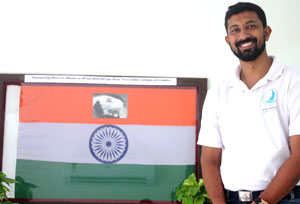
    Lt Cdr Tomy

    Earlier this year, on Republic Day 2013 to be precise, Lt Cdr Abhilash Tomy rounded the Mount Everest of sailing, Cape Horn, at the southernmost tip of South America, and hoisted the Indian national flag at sea, the farthest spot away from India. His extraordinary voyage was India’s first solo, non-stop, unassisted circumnavigation of the world’s oceans in a sailboat. The hoisting of the tricolour was a world first, and Lt Cdr Tomy had only the ocean and its creatures to sing the national anthem along with him.


    Lt Cdr Tomy’s historic video footage on this occasion was edited by Guruvayur Films to a special version of the national anthem with music rendered by Audiosynkrasy. Social Access Communications produced the film for cinema and television broadcast.


    The medium of cinema was chosen for the reach it delivers among young men aged 18 to 35. UFO Moviez arranged for the film to be screened from August 9 to 15. PVR-Cinemax also replaced the national anthem usually screened in Maharashtra with this special film. Over sixty national and regional television channels were engaged to broadcast this anthem.


    Speaking on the release of this film, Lt Cdr Tomy said, “Hoisting the national flag on a tumultuous sea at Cape Horn on Republic Day was an extremely proud moment for me as an Indian and a naval officer.”


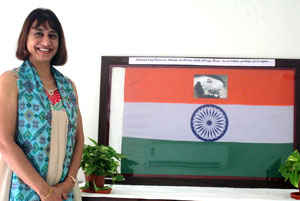
    Lynn de Souza

    Lynn de Souza, Founder, Social Access Communications added, “We want to inspire patriotism and courage in our youth and Abhilash is a role model and real icon of change to them.”


    Speaking on the occasion of the special screening of this film at its corporate office, UFO Moviez’ JMD Kapil Agarwal said, “UFO is extremely proud to be associated with this initiative and would like to congratulate Abhilash Tomy for his incredible achievements.”


    Said Santosh Menon, of Guruvayur films, “It’s a huge honour to be associated with our national anthem, and a complete pleasure to meet a real life hero, AbhilashTomy.” Biby Sam of Audiosynkrasy, who composed the music said, “Working on the Indian National Anthem was a first for me. As an Indian, I was thrilled to work on this project, and in keeping with the theme, I was moved to render the Anthem with an upbeat blend of Indian and western music styles, hopefully reflecting the pride of every one of us Indians.”


  • How can Mera Brand India be more Mahaan!?


    How brand India can make itself more attractive to investors?


    By Amit Bapna


    This is not a story about the great Indian investment potential, as that has been narrated an umpteen number of times. This one is about the role that marketing can play in enhancing and creating a sharp country brand – one that is robust, multi-layered and ready for the future. The recent announcement of 41-year-old Sameer Suneja taking over as global head of Perfetti, the Italian confectionary giant is one such move towards the global recognition of Indian talent. He is the first non-Italian to have reached the exalted position at the global HQ. In another instance, India has a much greater significance for Lenovo than just being among its fastest growing markets. It is also a global marketing communication hub that operates out of Bengaluru.


    According to Ajay Kaul, executive director, global brand communications, Lenovo; “The hub provides end-to-end transnational marketing solutions for Lenovo – right from planning and conceptualization of campaigns, to executing them and measuring and analysing their success.” This is done for more than 50 markets across the globe out of India. There are many more such success stories. But the recipe is far from being complete.


    What appears to be missing is a ‘grand strategy’ for India. A clear, and broadly shared notion of where the country is going, and what its role in the community of nations is really going to be in the decades and for the generations to come, according to Simon Anholt, UK based independent policy advisor. After all it is one of the largest and most rapidly growing markets in the world that is being looked at keenly by nations and marketers across the globe. Adds Abheek Singhi, partner and director, Asia Pacific leader – consumer and retail practice, The Boston Consulting Group (BCG), “An investment destination brand needs to have the right ‘functional’ attributes to appeal to the hard-nosed investors – and then as an ‘experiential’ brand to make sure that the investor keeps coming back.” Financial investment is also based on perception. However much the investment banker believes that the answer lies in some row or column of his spreadsheet, the truth is that people go by their feelings and opinions while investing.


    Agrees Partha Sinha, managing partner, BBH India and adds, “There’s a fundamental problem in the way India is positioned today by the marketing and branding efforts. It’s still ‘incredible’ – the romance of the exotic. For investment, people don’t want to hear about Incredible India – they want to know about credible India.” And that credibility is the composite function of the political environment, corporate governance and economic performance. The stories of how an earthquake ravaged Japan quickly picked and rebuilt itself or how the US became a security nightmare for all outsiders post the 9/11 have already become folklore. Both countries did not lose any time in reclaiming their leadership positions by mobilizing the entire machinery promptly and proactively and also creating the right storytelling.


    It may be a good idea to put the tourism hype to rest for a while and talk about a few other things that are right about India. Strengths which have long term potential – a thriving democracy, robust corporate sector, a young population, growing middle-class, increasing urbanization – are stories that have to be told and told well to create the right image of Brand India as an investment destination. India also needs to build new success stories and there are plenty of them, waiting to be chronicled. Rajeev Wagle, managing director, Kuoni India cites the instance of the Indian IT story, where Brand India has been leveraged very well. The fact that India is a nation and an economy ready for progress is the story to be told.


    Aparna Dutt Sharma, CEO, India Brand Equity Foundation (IBEF) lists down many more of such stories that include the world’s second largest pool of scientists and engineers; world’s largest rice exporter and producer of spices; largest manufacturer of tractors, second largest manufacturer of bicycles, largest exporter of generic formulations globally among many others. She says that these facts speak volumes about a nation on the move and it is these and more such touchpoints of Brand India that need to be better understood and communicated. This would require the twin tasks of creating a raised awareness of India in the business and economic context; and at the same time, conceptualizing and building sectoral campaigns for sectors or commodities that hold greater potential.


    Designing a well-crafted marketing campaign that turns negatives into challenges and targeting the campaign well are the two must-dos, says Poran Malani, president, Ogilvy India Worldwide. This would also include figuring out not just the core message but also the detailed channel mix – everything from the trade shows to the delegation meetings to the local merchant confederations. After all everyone knows the potential of India, it is the nitty-gritty that they want to know – the how, who and where of it.


    The principles of marketing and branding apply in equal measure to countries as they do to corporations. Like in the corporate world, marketing can only help a great product reach its audience faster and better. The product itself needs to have inherent strengths that can be mapped. India will have to work harder to manage certain myths and perceptions that the external world holds. According to Anil Nair, CEO and managing partner, Law & Kenneth; “Indian companies competing globally and global companies succeeding in India is the story to be told.” How about a marketing campaign where global companies who have experienced India successfully -Renault, Audi, Samsung, Lenovo, GE and many others -are the heroes?


    How India can make itself more attractive to global entertainment complex?


    By Apoorva Mehta


    Lights! Camera! Action! Three words that transport us into a world of dreams, hopes, joys and sorrow, and allow us to be touched by the magic of movies! This year, the Indian film industry celebrates 100 years of cinema.


    From its humble beginnings when the first silent black-and-white film Raja Harishchandra was made in 1913 to the high tech audio-visual colour extravaganzas that gross over Rs 100 crores in 2013, the Indian film industry has come a long way.


    We are today acclaimed as the biggest film industry in the world, producing over 1000 films annually (close to double Hollywood’s output) and selling nearly 3.7 billion tickets. Revenues are currently at approximately $22 billion, with the industry expected to grow at a CAGR of 11.5% to touch $30 billion by 2020.There are growth opportunities in our domestic markets, but it is globalization which is the exciting new frontier.


    Globalization has four aspects: the movement of goods and services, capital, technology and people across borders. And the Indian film industry is “globalizing” in each area. Our films reach several international markets with a large number of prints being distributed and exhibited with every big release. This business can be divided into traditional and non-traditional markets. Though business in most of the former (the UK, the US, Australia) is fairly mature, there is still opportunity for expansion. Hong Kong and Benelux, for example, which have seen a limited release (1- 2 prints), now have a much wider footprint. Yeh Jawani Hai Deewani saw a 10-fold increase in revenue in Hong Kong due to its wide release when compared with the collections from a single print for the diaspora.


    The big product growth in distribution, however, lies in exploiting new “non-traditional markets”. Recent examples include the first ever large scale release (30 to 70 prints) of Ek Tha Tiger in Japan, and Chennai Express in Peru. There are still many such countries that do not screen our films and offer new markets.


    Our film industry’s global ambitions have also been backed by huge capital. One of the biggest examples being Reliance Entertainment’s investment of $325 million for a 50% stake in Steven Spielberg’s Dreamworks. Reliance Entertainment has also made a significant investment in exhibition properties, owning more than 200 cinemas in North America.


    We are also witnessing the “export” of talented people, with actors and technicians working on impressive overseas projects, like Anil Kapoor in Slumdog Millionaire, Amitabh Bachchan in The Great Gatsby and most recently, Priyanka Chopra in Disney’s Planes and as a singer with her international song release. Indian technology is also going global as domestic VFX, animation and post-production companies are viable lower cost outsourcing options. Reliance and Prime Focus, leading Indian post-production houses have delivered some stunning special effects in the US blockbusters such as Harry Porter, Avatar, The Expendables 2 etc.


    The global pie is there for the eating, and it remains to be seen how quickly and how big a bite we are able to take. I am often asked if Indian entertainment will have to change its essential nature to become more global. When we refer to the content and the “Indianness” of our films, then yes, we will have to change their essential nature if we wish to cater to a larger international audience. The quintessential Bollywood film has a different syntax and ethos from Hollywood. Its longer duration (2.5 hours to 3 hours), the plot structure (requiring an intermission), the song and dance elements, the more overt display of emotions, the element of escapist fantasy fare, the inherently Indian values…all these ensure that our films are fundamentally different from Hollywood. And yet it’s these very same factors that lend them their uniqueness and success with diasporic and local audiences. Films are a reflection of the society people live in, hence culturally Indian films tend to appeal less to a global audience.


    In fact, today India itself is becoming more diverse, and the big challenge is to make films which appeal to all regions of our own country. Indians, here and overseas, love our movies. It is important for our filmmakers to continue making films that are true to our sensibilities. Just to garner appreciation or capture Western markets, we must not lose the very essence that differentiates us. There are, however, exceptions. The success of My Name Is Khan and 3 Idiots have shown us that films with universal themes that global audiences understand, backed by a strong starcast and worldwide distribution, can cross cultural and linguistic boundaries. My Name Is Khan found huge appreciation in all the middle eastern markets, due to its theme of Muslim discrimination after 9/11. Similarly 3 Idiots did spectacular business in all of South East Asia as audiences there identified with the societal and parental pressures on young students seeking success.


    Regardless of whether it’s Indian or otherwise, if a story touches a chord with people around the world, then the film will surely find its feet. India is a country of storytellers. It’s also a country of hardworking talented people with a lower cost base. I am going against common marketing mantras, but I strongly feel we can be both a niche player and a global mass entertainer. We don’t need to choose one or the either.


    We can provide “niche” breakthrough content globally (like Lunchbox) and “niche” outsourcing talent for animation and post production facilities; at the same time, we can be successful storytellers of universally accepted popular films.


    We need not dilute who we innately are, simply to cater to Western taste and markets. Let us be proud of our culture, our ethos, our films, our talent, “our Bollywood”… for we have come a long way from our humble origins. With our uniquely Indian passion and entrepreneurial grit, even the sky is not the limit!


    How India can make itself more attractive to tourists?


    By Delshad Irani


    As the bestselling cliché goes, you don’t visit India to discover the country, you visit India to discover yourself. And for many decades now this nation has helped wanderers and lost souls from distant lands washing up on its shores find their true selves. Or something of the sort. But perhaps that is so because India does not make it easy for one to discover her, throwing challenges at those who visit her right from the start. The first test would be navigating the gateway to this wondrous and mystical land – the Great Indian Airport.


    However, once the bags are off the carousel and in the boot, it’s not hard to see that India does indeed have everything going for her, as made clearly evident in the slick ‘Incredible India’ tourism campaigns over the years. From some of the world’s tallest mountains to deep blue oceans, from Bond’s Udaipur to Bourne’s Goa and a heritage that would provide enough footage to fill all of Discovery Channel’s programming for the year.


    Even her shanty towns have become tourist attractions providing big eyed visitors armed with copies of Shantaram and pint-sized bottles of hand sanitizer the favela experience in the heart of an Indian city. Add to that one of the world’s largest and friendliest English speaking populations and what one should have is the hottest of tourist spots. But that is not the case.


    According to the UNWTO, international tourist arrivals globally grew by 4% in 2012 to touch an incredible 1.035 billion, in spite of ongoing recessions plaguing the world economy. What was India’s share of 1.035 billion travellers? According to industry figures, inbound traffic stood at 6.5 million foreign tourists. Interestingly, the country supplies more tourists that it receives. 15 million Indians trotted around the globe taking their rupees to some old favourites in Europe and North America and new haunts from Tel Aviv to Tokyo.


    In fact, not one Indian destination features on a list of the Top 20 Global Destination Cities Index 2013 by MasterCard. Making matters more intriguing is the fact that this list of top cities by international visitor arrivals has been topped by an Asian destination: Bangkok. (Mumbai’s rank in the 2013 report is 29, but it has clocked in the fourth highest growth rate of international visitor arrivals in the period 2009 to 2013.)


    So what does Thailand have that India doesn’t?

    Santosh Desai, MD & CEO, Futurebrands India, believes, sometimes India’s size is a disadvantage. Even if size doesn’t matter, most of the top ranking destinations such as Bangkok, New York, London, Shanghai and Moscow have in common a very distinct product and experience on offer. “India, on the other hand, is messy. It’s like an over-filled sandwich that is hard to bite into,” says Desai. Of course, sometimes indecisive and ineffective governments, lack of support for a bourgeoning hospitality industry at the grass roots level, security concerns and poor infrastructure make India a very sloppy sandwich indeed. “Nonetheless, every nation has a narrative, sometimes multiple narratives. Marketing can help shape that story, but not control it,” says Desai.


    According to independent policy advisor Simon Anholt, tourism promotion can be a very useful way of helping to communicate the landscape, culture and people of a country to the rest of the world. And India’s significant expenditure on high-quality tourism promotion has certainly helped to raise understanding and admiration for the country. It can certainly make the brand more desirable but campaigns like ‘Incredible India’ can only do so much if the experience doesn’t live up to the hype.


    Piyush Pandey, executive chairman, Ogilvy India, who also made a brief appearance in a Gujarat tourism promotional video featuring actor Amitabh Bachchan a while ago, believes at the state level as well a lot of good work is happening to build long-term and sustainable tourism economies, for instance Kerala. But even combined these efforts aren’t enough to truly realise the immense potential of Brand India and its various avatars as a tourist attraction.


    However, Mr Pandey is hopeful and believes Brand India’s greatest strength lies in its vast population of youth, and missions like the National Skill Development Corporation whose objective is to train young Indians in everything from auto components to providing them with the necessary tools and skills to thrive in the hospitality industry. The problem is if the stream of tourists doesn’t turn into a flood over the next few years we’ll be left with more staff than guests in a crumbling manor.


    Source:The Economic Times

    Copyright © 2013, Bennett, Coleman & Co. Ltd. All Rights Reserved

    Licensed to republish


  • Anil Thakraney: Prison Break Diary

    By Anil Thakraney


    Okay, so I have finished four seasons of the American TV serial, Prison Break. It cost me a huge number of man hours, but I was intensely mesmerized and could not stop. Stuff like filing of tax returns and a routine heart check-up had to take a backseat. In a previous post, I have discussed in detail why Hindi GECs find it very difficult to match the standards of a Prison Break and yet, there are key learnings, and these can be useful for desi soap makers. So here goes:


    More than anything else, what got me hooked is a sense of bonding with the characters. Not only do you identify with their predicament, you want them to win and be happy. (This despite the fact that some of these guys are hardened criminals.) And, even more significantly, these are blokes you want to hang out with, to be pals with. Now this doesn’t cost a lot of money to achieve, what you need is a superlative casting director. Producers of Indian serials often don’t pay attention to this issue which is critical for television (more than movies) because serials run for a long period.


    The super fast pace is another thing, and again, it’s not costly to do, it has to do with the fertile imagination of the writers. Prison Break’s various plots and sub-plots move at a frenetic pace, things change suddenly and shockingly, so much so that you can’t afford to take your eyes off the screen even for a few seconds. This is what makes Prison Break addictive, the unpredictability factor. Haven’t seen much of this in desi soaps, you can not only predict what will happen in the next episode, you can correctly guess the story twenty episodes down the line. That really sucks.


    Attention to detail in terms of clothes, props and sets. Again, because US serial makers have access to more funds, life becomes easier. But not all of it needs big bucks, it’s simply a matter of someone keeping an eye. For example, I have seen bahus in our weepy serials wearing lipstick, and in the very next shot, it’s gone! This means there is a great deal of carelessness in production, and as a viewer, these sorts of bloopers put you off.


    Lastly, the background score. Captivating and brilliantly produced to embellish the situations and the pace. Prison Break’s music has its own fan following, key in ‘Prison Break Background Music’ on Google and you’ll land a staggering 1,670,000 results. Again, this isn’t about mega funds, Indian serial makers don’t necessarily need to sign up AR Rahman. It’s a question of briefing the music composers correctly, and then inspiring them to come up with their best.


    By the way, there is one deadly lesson they have learnt from us: Dead characters suddenly come alive! Ektaji should be proud. 🙂


    Anil Thakraney is a senior journalist and commentator. He is also Editor-at-Large, MxMIndia. The views expressed here are his own. He can be reached via Twitter at @anilthakraney


  • Anil Thakraney: Khans are misusing their charisma

    By Anil Thakraney


    I haven’t watched Chennai Express although everyone I know seems to have. Now, after reading the sad reviews, I am not sure I want to blow up three hundred bucks (plus popcorn). However, trade reports indicate that the film grossed a hundred crore plus rupees on the opening weekend, which means the junta is hitting the halls in hordes. Clearly, it has to do with Shah Rukh’s appeal, which shows no signs of waning.


    It is the same story with all those crappy Salman Khan flicks. These two Khans (and Akshay Kumar, to an extent) get the crowds in on the strength of star power and aggro marketing, and the producers make a lot of money even if the script sucks. While good movies with not-so-famous actors fare miserably at the box-office. And even if word gets out that the Khan film is a disaster, it’s too late in this age of multiplexes, satellite rights and brand tie-ups, the money has already been pocketed. I blame the masses for this blind idol worship; they seem to be okay with the two Khans acting themselves in every single film, no matter what the character demands. It’s quite a unique situation, this does not happen anywhere else in the world. Clooney, Pitt and Depp don’t carry their persona into the films, they get into the skin of the character.


    All this basically means a whole lot of moolah gets pumped into rubbish. And many Bollywood financers would give two hoots, they are here only to do dhandha. The onus then is on the two Khans. They need to evolve, hone their acting skills, and only agree to perform if the script is super-exciting. And they don’t need to tax their brains too much, the role model lives in their own backyard: Aamir Khan. AK has found the correct balance between star appeal and story. Despite the fact that a film from him gets a huge initial draw, he rejects most of the scripts. While the other two Khans continue with their hit-and-run strategy (er, in Salman’s case, that takes an entirely new meaning!).


    Bottomline: If Bollywood wants the world to take it a bit more seriously, its biggest stars need to get their act together. SRK and Salman must understand that movie-making is an art, a creative process, it’s not the same as selling cars and underwear. Which the two anyway do in the ads.


    PS: A collection of outstanding print work. A reminder for lazy Indian creative directors that you can have fun with press ads, that life does not begin and end with the TV commercial.


    Link: http://www.creativebloq.com/inspiration/print-ads-1233780


    Anil Thakraney is a senior journalist and commentator. He is also Editor-at-Large, MxMIndia. The views expressed here are his own. He can be reached via Twitter at @anilthakraney


  • Mumbai Police & Draftfcb+Ulka billboard to observe moment of silence for lost heroes

    By  A Correspondent


    Over the years, Mumbai Police and Mumbai Traffic Police along with Draftfcb+Ulka have spread the message of a ‘Safe Mumbai’ via a prominent hoarding spot at Babulnath in South Mumbai. This is the hoarding at the junction of the tail of Marine Drive/Girgaum Chowpatty with a road on the left leading to Raj Bhavan/Walkeshwar/Malabar Hill and to the right to Hughes Road/Peddar Road/Warden Road/North Mumbai.


    For the past 20 years this billboard has achieved an iconic status with some of the  most impactful & thought provoking messages on road-safety. Various campaigns created over the years have made motorists smile, sit up, take notice and buckle up/switch off their cell while driving, stick to their lanes etc. Basically encouraging citizens to be responsible when you are on the road.


    On the occasion of India’s 67th Independence Day, Mumbai Police and Mumbai Traffic Police in association with Draftfcb+Ulka has taken on a larger theme of paying tribute to India’s lost heroes. The hoarding urges fellow Indians to remember those who sacrificed their lives for our country by observing a moment of silence. But with a twist – asking people to send a blank tweet with the hashtag #AMomentOfSilenceForOurHeroes as a mark of respect for the brave heroes.


    K S Chakravarthy

    “We dedicate this Independence Day to our lost heroes. This is a brilliant initiative and we support it.”-  said VivekPhansalkar, Joint Commissioner of Police, Traffic K S ‘Chax’ Chakravarthy, National Creative Director, DraftfcbUlka Advertising said”I absolutely loved the idea the minute I saw it – it is simple, it asks for just a minute, and the novel idea of asking for a blank tweet as a symbolic ‘minute’s silence’ will, we hope, help to make people pause and reflect – for much longer than a minute – how much the nation owes those who went before.”


    MxMIndia View: Idea achcha hai, but too long a hashtag!


  • How will India be in 2061


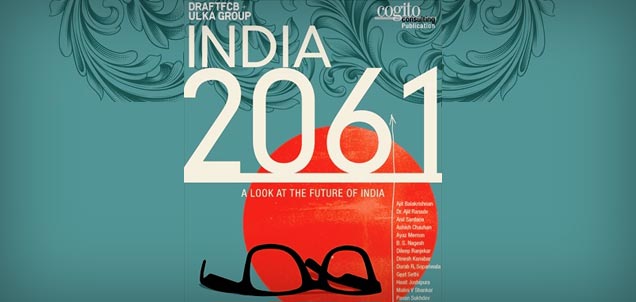
    Cogito Consulting, the brand and marketing consulting division of Draftfcb Ulka, released a book titled ‘India 2061 – A Look at the Future of India’ to coincide with India’s 67th Independence Day celebrated yesterday (August 15). The book is an attempt to predict how various sectors in India would look like around 50 years from today.


    The genesis of this book was the mark of the milestone year 2011 when Draftfcb’s Indian arm, Ulka Advertising completed 50 years. To celebrate this occasion, Cogito Consulting and the analytics team – Asterii Analytics set on a journey to quantitatively forecast India’s future in the year 2061 when Ulka would celebrate its 100th birthday. The projections covered areas like Population, Life Expectancy, Economy, Education, Infrastructure, Automobiles, Electricity, Internet, Media etc. The quantitative compilation of India’s future – ‘The India 2061 Report’ was released in 2012 as a white paper.


    The book India 2061 – A Look at the Future of Indiahas over 21 thought leaders sharing what they see are the challenges India will face as it gets ready to join the league of developed nations. The first section of the book includes articles from these renowned thought leaders covering infrastructure areas like Power, Water, School Education, Management Education, Healthcare; new age industries like Retail, Telecom, Television, Automotive, Mobile and Information Technology; financial sectors like Capital Markets, Taxation and Fiscal Management and Insurance; sports categories like Cricket and Olympics; and other key areas like Economy, Ecology, Political system, Dairy and Society.


    The second section encompasses the quantitative data projection of various sectors in India in the year 2061.


    The book – edited by Dr M G Parmeswaran and Kinjal Medh – features thought-provoking articles which in many ways drive home the point – what we do today will have a significant impact in 2061. “We see this book as our humble submission to the thinking that needs to be done if we have to make the India 2061 dream a reality”, says Dr. M.G. Parameswaran.


    The e-version of book is available at: http://www.draftfcbulka.in/knowledge/2061-book


    1. Ajit Balakrishnan

    The IIMs have evolved an organizational system that may be the prototype of post-Fordist organizations. Such organizations may be the norm in the Information Society that the world is gradually sliding into.


    2. Dr Ajit Ranade

    It is possible that India will be made up of fifty states, and may be eight hundred districts.


    3. Anil Sardana

    The power sector of 2061 will largely be determined by technology developments in the next 15-20 years.


    4. Ashish Chauhan

    Indian debt market, which has remained dormant for too long can get a new wind and follow the success achieved by similar products worldwide


    5. Ayaz Memon

    By 2061, IPL would become the most valued sports property in the world – bigger than the NFL, the NBA and World Series Basketball


    6. B S Nagesh

    The retail industry will understand us much better than ourselves.


    7. Dileep Ranjekar

    Education would be a highly collaborative process between the three pillars of society – the Government, business/corporate and parents/members of society.


    8. Dinesh Kanabar

    One needs to realistically look at rationalizing the production cost factors such as taxes and duties on procurement and imports, towards making Indian products globally competitive


    9. Dorab R Sopariwala

    All the large states that existed at the beginning of the century will be been cut down to size, Maharashtra will spawn into three new states – Vidarbha, Konkan and Marathwada.


    10. Geet Sethi

    We need to make sport a part of our life and social culture. Not just as spectators but as players, not just competitive sport at international level but recreational sport at every level


    11. Hasit Joshipura

    It will be possible to replace a faulty organ of the body pretty much the same way as a faulty car part is replaced


    12. Malini V Shankar

    A pronounced shift is required in the roles from that of a water engineer to being a water manager


    13. Pavan Sukhdev

    Sustainable productivity in small farms ought to become our single biggest policy target, as it brings together and potentially solves the connected problems of freshwater scarcity, ecosystem degradation, food shortages, and rural poverty.


    14. Punit Goenka

    A basic social media integration on the content distribution platform, will bring in a whole new perspective to the viewing experience.


    15. Ravi Kant

    Over the next 50 years, we can expect major breakthroughs which will enable technologies like batteries and fuel cells to become economically comparable to fossil fuels.


    16. R S Sodhi

    Urban population will be double that of rural population by 2061, implying that there will be fewer hands to produce food and more hungry mouths to consume food.


    17. S  Ramadorai

    Psychology will see the emergence of gene expression mapping that will help us understand more about how our genes and environment work together to make us think and behave in particular ways


    18. Sanjeev Aga

    Even before 2031, every human being in this world will have his or her unique number reserved before birth, and allocated upon birth, symbolically embedded under the skin.


    19. Shiv Visvanathan

    As government subsidizes and responds to urban realities, the decline of the rural politics would be an interesting scenario especially in electoral and ideological terms.


    20. Shivakumar

    In 2061, I feel that a digital framework will unite India like nothing else has done so far


    21. Thomas Mathew T

    Unless we plan well, India too may face what the world today calls ‘The Japan Syndrome – as the number of retired people grows, a declining band of workers having to support rising social-security payments.’


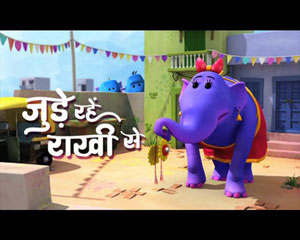
  • Fevicol launches new TVC, bonds on Raksha Bandhan

    By A Correspondent


    Adhesive brand leader Fevicol has rolled out a new ad campaign series on television to stay connected and strike an emotional cord around the festival season.

     

    In the new TVC developed by O&M, the communication is more than just functional, and has kept in line with product attribution especially with the use of Fevicol mascots – The Elephants. Fevicol has taken an interesting route of animation advertising and brought its elephants to life. The animated elephants have maintained the wit and humor quotient as in a Fevicol fashion way. The TVC reinforces the promise of a strong bond of togetherness on the festive occasion of Raksha Bandhan.


    [youtube width=”300″ height=”220″]http://www.youtube.com/watch?v=0CokBVtn73o[/youtube]

    Agency:  Ogilvy & Mather, Mumbai.

    Creative team : Piyush Pandey, Abhijit Avasthi, Amitabh Agnihotri, Sameer Sojwal, Mayank Yadav & Chirayu Palande.

    Account Management team: Vivek Verma, Vishal Bijlani, Ramanathan Sridhar.

    Director : Vaibhav Kumaresh


  • BBH India wins DSP Blackrock Mutual Fund

    By A Correspondent


    DSP BlackRock Mutual Fund has appointed BBH India to handle its creative mandate. The pitch was called for in June 2013 and involved six other agencies:  JWT, McCann, TBWA, Publicis, Ogilvy and Saints & Warriors.  BBH India will now be solely in-charge of developing the brand architecture and the brand positioning with DSP BlackRock, rolling out of the engagement modules across traditional and new age platforms that are consumer and distributor focused.


    On the win Aditi Kothari, Executive Vice President and Marketing Head at DSP BlackRock Mutual Fund said, “We believe that marketing can no longer remain a support function in the financial services world. It can truly bring differentiation and deliver business impact in the new world, if done the right way. BlackRock had recognized this last year and hence brought in a strong focus to build the brand globally. We at DSP BlackRock also understand this well and recognized the need to position ourselves the right way to the new, emerging India. Our pitch process was tough, since we knew that our new creative agencywill play an important role in laying down the foundation of a strong communication strategy. We are confident of achieving our objectives with our new partner BBH India”


    Subhash Kamath

    On the win, Subhash Kamath, CEO and Managing Partner BBH said, “We are absolutely delighted that DSP BlackRock has awarded us the account, it was a great pitch to win. In today’s economic situation, proper investment planning is becoming crucial for everyone and we are looking forward to partnering DSP BlackRock in meeting these challenges.”


    Russell Barrett, CCO and Managing Partner BBH said on the pitch: “All of us here at BBH had an absolute blast working on this pitch. That we had so much fun working on it, reflected in the work presented at the pitch itself. There’s nothing more satisfying than that. Now, we need to translate this win into great, creative, market moving work.”


    On the win Sanjay Sharma, Head Planning said, “Financial services communication is a sea of sameness. Despite a challenging regulatory framework we feel there is a definite opportunity to introduce new ideas, new conversations that capture people’s imagination and make them see the category differently. We are delighted to partner DSP BlackRock.”


  • AdStrat: Vodafone’s ‘Made For’ proposition

    Name of the campaign:

    Vodafone Network Campaign 2013


    The Brief:

    The brief to the agency was to develop a 360-degree campaign that creates perceptual superiority for the Vodafone network among users of other operators and get them to switch to Vodafone. Reinforce Vodafone’s network superiority through charming slice of life stories.


    Research insights:

    ‘Network’ is the single biggest driver of brand choice and the reason for customers exiting from a brand. Hence communicating ‘network credentials’ in an evocative and engaging manner, has been a constant endeavor of all telecom brands.


    In the initial phase of market development, Vodafone decided to focus its communication activities around Vodafone’s excellent network and connectivity. Hence the tagline: “Wherever you go, our network follows” for the campaign, wherein the pug represented Vodafone’s network. The campaign made the brand synonymous to an omnipresent network and gave it the stature of a constant companion.


    The next round of Network communication happened last year and the focus of the communication was shifted to ‘quality through connectivity and voice clarity’ which helped in building a stronger customer perception on network quality.


    Research helped identify the key parameters in the perception of a good quality network  – instant connectivity, voice clarity and call continuity (no call drops).


    Further, market research showed that post running the campaign there was a marked improvement in our Network perception.


    On customer experience, Vodafone rates higher than any other network.


    The challenge going forward is to translate the superiority of experience that we enjoy with our customers to be the perception across all telecom customers.


    The thought process behind the creative:

    Every day Vodafone users push the limits of our Vodafone network a little bit more.


    They are always trying to make phones calls from unlikely places like an underground metro or a basement disco; they have really long conversations with their girlfriends, they make phone calls from noisy places, they use mobile data for downloading or streaming heavy files etc. Some of these truly represent the strength of our network.


    Details of the Campaign:

    Keeping this insight in mind the ‘Made For’ proposition was zeroed in on. The Vodafone network is dependable, robust and made for living up to these torture tests. The television commercials capture everyday human stories which test the network.


    Media vehicles chosen:

    It will be an extensive 360-degree campaign that will be led by television. The ‘Made For’ proposition will also be extended contextually in print, outdoor, digital, radio and on-ground.


    What is the differentiating factor about the ad?

    The entire campaign has been conceptualized and developed on intuitively charming everyday human insights that an entire cross section of the audience can relate to.


    Credits:

    Agency: Ogilvy Mumbai & Team Ogilvy

    Production House: Nirvana Films