Category: ADVERTISING

  • Despite Omnicom-Publicis merger, WPP clear #1 in India

    By Samidha Sharma


    The $35-billion merger of American advertising and marketing group Omnicom with the Publicis Groupe will put the combined entity right on top of the global advertising industry in terms of revenues. But in India, Martin Sorrell’s WPP will maintain its No 1 position by far compared to its nearest competitor. Publicis Omnicom, the newly formed holding company, however, may narrowly topple the Interpublic group from its second spot in India, according to some industry estimates. These agency networks do not share their revenue numbers publicly in India.


    Most industry insiders said that the global merger will not have an immediate impact on the Indian market where the network’s agencies are expected to run independently. Both Publicis and Omnicom have upped their ante in the Indian market with acquisitions over the last couple of years to take on WPP head-on here.


    While Omnicom took full control of domestic biggie Mudra in 2011, Publicis has gone on to acquire smaller agencies like Convonix, Resultrix and iStrat, among others, in India. WPP, the clear No 1 locally with revenues topping Rs 1,500 crore, is still double the size of IPG and the newly formed Publicis-Omnicom here.

     

    Agnello Dias
    Agnello Dias

    “The combined entity will help in the Indian context when a global client of either Omnicom or Publicis decides to enter the local market. With a wider bouquet of offerings across creative and media agencies, the group will have higher chances of retaining these clients here,” said Agnello Dias, co-founder, Taproot, an independent agency which was acquired by Dentsu last year.


    Over the last few years, as traditional advertising mediums are being challenged by the likes of Google, the world’s largest online search firm, and social media platforms, consolidation has begun to take place rapidly across the advertising world. In 2012, Japanese ad network Dentsu acquired British media buying group Aegis to give it a much needed access to markets outside of its home country in a $4.9-billion buyout.


    The merger is unlikely to be a gamechanger in India until they get one head of the combined entity and cut flab which is not going to happen right away, said a CEO of an advertising firm who did not want to be named. Conflicting client interests – such as the one between Coke and Pepsi – is another issue which will be at the fore front for both the networks to handle going forward.

     

    Ashish Bhasin

    “The new entity has the potential of becoming a stronger player as well as a weaker one depending on how post the merger the group handles its clients and employees,” said Ashish Bhasin, chairman (India and CEO (South-East Asia) for Aegis Media.


    Source:The Economic Times

    Copyright © 2013, Bennett, Coleman & Co. Ltd. All Rights Reserved

    Licensed to republish

     

  • AdStrat: Bringing alive the ‘sethani’ with Amul Manthan campaign

    Name of the Campaign/Ad: Amul Manthan


    The Brief: The brief was to communicate the “Amul – A cooperative movement that empowered 35 lakh women farmers”


    Research insights: Today, women farmers are multitasking, handling more than just routine domestic work – from looking after cattle to  studying to  teaching in management colleges to even financing their children’s education abroad. The co-operative movement has created numerous women entrepreneurs empowering them to become equal contributors (financially) to the household.


    The thought process behind the creative: Village men were shown acknowledging the triumph of these empowered women and celebrating their new role as ‘sethani’ in the family. Placing the pagdi on the women’s head epitomizes this acceptance.


    Media vehicles chosen: TV and Digital.


    Key issues kept in mind while executing the ad: The challenge was to retain the earthy feeling and look of the earlier TVC, but simultaneously show how these women have taken the big leap from being self-reliant to a tech-savvy entrepreneur of today.


    RS Sodhi

    What is the differentiating factor about the ad: Manthan as a story is very unique to brand Amul and platform which no other brand can ever claim. The success stories of these women at the grassroot level truly denote the success of the brand.


    Client comment: Talking about the campaign, GCMMF’s Managing Director R S Sodhi says, “We are extremely proud of the Amul journey so far and the role played by women in managing the dairy cooperatives. This film is an attempt to celebrate their contribution and demonstrate their capabilities to the urban world.”


    Nitin Karkare

    Agency comment: “The new TVC is an extension of the earlier versions. While, the earlier ones were about the whole journey, right from the milk collection, processing to delivery to the urban homes, the latest TVC celebrates women empowerment. The idea is to showcase men acknowledging women as financially independent and celebrating their role as the sethani,” says Nitin Karkare, Chief Operating Officer, Draftfcb Ulka.


    Subodh Poddar

    Additional agency comment: Says Subodh Poddar, Creative Director, Films, Draftfcb Ulka: “The real challenge was to think of an idea depicting modernity while keeping all the colours  of  Gujarat/ India intact. The idea came after seeing a lady attending a board meeting of GCMMF, lady who started her work with just one buffalo. Now she owns a trail of cool trucks that brings milk from faraway places. And that she is a board member today stirred my thoughts. It was very inspiring and the sethani happened in my mind.”


  • Anil Thakraney: Brouhaha over potholes is silly

    By Anil Thakraney


    Every monsoon, newspapers go crazy over the issue of potholes, and then the news channels dutifully pick it up. Campaigns get launched, protests happen, municipal officers get interviewed, angry reader letters get printed and then… it’s back to the new year, a new monsoon and new potholes. It’s been no different this year, many newspapers in the metro towns have been raging over these lunar craters.


    Complete waste of time, money and most importantly, precious newsprint. What is the point in crying about potholes year after year when nothing changes on the road? And nothing will change because potholes, and we all know this damn well, are babies of corruption. Of course, our engineers know how to build good roads (after all, there are no potholes on roads where the so-called VIPs usually travel), so clearly there is a lot of money being made by a lot of people through the dirty holes. Which is why the media must go after the disease, not the symptom. To give you an example, is attacking boils on the body the method to treating chicken pox?


    The entire media effort should be on exposing, and naming and shaming the individuals and groups responsible for this mess. This would mean carrying out investigative stories and sting operations, going after municipal corporators and engineers who’ve earned monies way beyond their known sources of income, publishing large pictures of the culprits, in short, putting the fear of god in the system. And it’s only fear which will result in better roads, because it will help to control corruption. In fact, the word ‘Rain’ should put dread, not romance, into the hearts of the road maintenance authorities, because they will know the media will get cracking.


    So then why aren’t the newspapers doing the obvious? Because publishing pictures of potholes with angry captions alongside is easier and cheaper. Well, guys and gals, you know what, I call this lazy journalism. There are people dying on our roads because of the bloody potholes, they aren’t just an irritation anymore. Surely we can do better than screaming and whining.


    PS: The Japs have found a brand new medium for advertising. No, it has nothing to do with the digital space, they have gone for flesh and blood. Women in Tokyo now carry ads on their thighs. Superb idea, I say! This is one ‘spot’ that can’t be missed, it promises captive audiences. Welcome to thigh land. Hope desi advertisers are taking note.


    Anil Thakraney is a senior journalist and commentator. He is also Editor-at-Large, MxMIndia. The views expressed here are his own. He can be reached via Twitter at @anilthakraney


  • Anil Thakraney: Omnicom/Publicis merger: Nothing will change

    By Anil Thakraney


    I have been reading articles/posts in the trade press on ‘the ad world’s biggest merger’, and I find them half-amusing. Reporters/columnists have been scurrying around trying to find an interesting angle, and industry chiefs have been belting out the usual clichés.


    Well, here’s the thing: Life will go on as usual. The conflict of interest theory is bollocks, as has been proved by previous mergers, clients will continue to get serviced by their existing agencies. If advertisers sack their agencies, it’s mainly to do with the substandard work they might be doing (especially in the digital space where many traditional agencies continue to struggle), and not because of international shareholding changes.


    And no, there shan’t be any mass layoffs either, that’s not the reason advertising networks merge. In fact, both, Omnicom and Publicis leaders, would want as less disturbance as possible, they would desire status quo on all levels, so that clients don’t feel edgy and employees don’t feel insecure. In other words, as an employee, whether you are based in Kuala Lumpur or Chicago or Mumbai or Paris, your life will go on as always.


    Some people have alluded to the likely ‘clash of culture and values’ between an American and a French organization, and I say that’s nonsense. Politicians of the two nations may have an ideological conflict over the Iraq war but businessmen know only one currency, and that’s cash. As long as the money tree grows, ‘culture and value’ differences get sorted in double quick time.


    Reportedly, Sir Martin Sorrell has stated that the deal is bad for Omnicom’s shareholders. Well, it would be out of character for Sorrell to be a cheerleader for the merger, but yes, that’s the only real impact: It’s the shareholders of the two networks who need to study the fine print, it’s only their lives that get hugely impacted.


    So then why merge at all? For just one reason: To improve media buying efficiencies. Think about it as two families, who otherwise stay separately, joining hands to shop at the local fish market. They would get a better price for machhi, and having achieved that, the families return home to their routine lives, and cook the fish the way each likes it. Which is why nothing changes.


    However, there’s one problem with the deal: The big bosses of Omnicom and Publicis will run the show together, as equal partners, there’s no one single leader. This structure seldom works, there can never be two swords in one sheath. I guess in their hurry to raise the toast, Maurice Levy and John Wren forgot this age old maxim.


    PS: Haha, and I thought only Arnab babu does sensational television interviews like these. Clearly, there are Arnab clones all over the world media. This is the classic case of pakaoing the guest for the sake of pakaoing. Enjoy!


    Link: http://www.buzzfeed.com/andrewkaczynski/is-this-the-most-embarrassing-interview-fox-news-has-ever-do


    Anil Thakraney is a senior journalist and commentator. He is also Editor-at-Large, MxMIndia. The views expressed here are his own. He can be reached via Twitter at @anilthakraney


  • Effie Asia-Pacific launched with C4As

    As part of Effie’s global expansion, Mary Lee Keane, President of Effie Worldwide, announced the launch of the Effie Asia-Pacific programme, in partnership with the Confederation of Asian Advertising Agencies Association (C4As).


    Effie Worldwide’s signature initiative, the Effie Awards, is recognized throughout the industry as the global standard of marketing effectiveness excellence. With the addition  of the regional Asia-Pacific Effie programme, Effie Worldwide’s international network now expands to 40 programmes and four regional programmes.


    “Given rate of changes in media, technology, consumer behaviour, and even business models, there’s never been a more demanding or exciting time to be focused on delivering effectiveness in marketing,” said Carl Johnson, Chairman of the Board of Directors, Effie Worldwide and Co-Founder of Anomaly.


    The Effie APAC programme, organized by the C4As and managed by Tenasia Group, will recognize effective work that has run in the Asia-Pacific region.  The C4As is a non-profit organization dedicated to the marketing communications industry and has experience collaborating with organizations in many different countries throughout the region, including North, South and Southeast Asia.


    “The Effie Awards is the world’s most established and recognized award competition for marketing effectiveness and we are certainly delighted to partner Effie Worldwide in organizing the Asia-Pacific program,” said Anthony Kang, Chair of C4As. A pilot APAC Effies was previously awarded in 2008 in partnership with Effie Singapore partner, IAS.


    Finalists and winners in all Effie programs in the Asia-Pacific region will be included in the Effie Effectiveness Index (http://www.effieindex.com), which identifies and ranks the marketing communication industry’s most effective agencies, marketers and brands by analyzing finalist and winner data from worldwide Effie competitions.


    “Asia-Pacific is a key subject on every global marketer’s mind, along with the ever-important subject of effectiveness,” said Daryl Lee, Global Chief Executive Officer, UM and member of the Board of Directors, Effie Worldwide. “Effie is now more than ever, the global authority on marketing effectiveness.”


    Srinivasan K Swamy is the Immediate Past Chairman of the C4As and representing the AAAI, Nagesh Alai is Treasurer of the association.


  • Debrief: Verito Vibe: Where’s the Vibe?

    By Anil Thakraney


    In principle, I like what Mahindra Verito does in the advertising: Focus on the owner rather than the car itself, highlight the personality of the owner and thus build the brand’s image. In Verito’s case, it’s for the man who’s matured and wise. But as they extend this personality to a new product, things get complicated, and I will come to that shortly.


    The sedan Verito now has a hatchback sibling called Verito Vibe (though the carmaker chooses to call it a ‘compact sedan’), and the brand personality continues. So our wise lad does not jump signals, races with a scooter but deliberately allows the latter to ‘win’, etc, and of course, there’s a hot chick on standby to show appreciation. (Yes, whatever we men do is pointless unless a member of the fairer sex is impressed, or so our advertisers believe.)


    I have to say after a few exposures on television I assumed this is a new ad for Verito. The ‘Vibe’ part completely eluded me. It’s only after I took the ad up for review that I discovered this is a variant. Something for Mahindras to chew on, this is what happens when you simply extend the brand personality, the differential factor goes for a toss. My view: The Vibe should have come with its own attitude.


    Another thing: Our chap, who has a heart of gold, lets the scooty win because a child is riding pillion. This is very similar to the Salman Khan chaddi/baniyan ad currently on air, where the hunk allows the rival to win an arm-wrestling bout only because he (the rival) is accompanied by a handicapped child. Don’t think Verito Vibe’s brand manager would want us to equate his car with underwear.


    Rating: (On a scale of 1-5): 1. Personality extension confuses, branding gets hit.


    Anil Thakraney is a senior journalist and commentator. He is also Editor-at-Large, MxMIndia. The views of the writer are his own. He can be reached via Twitter at @anilthakraney


  • Debrief: Toyota U Trust: 100% empathy

    By Anil Thakraney


    Cool ad from Toyota for their used cars, and it’s mighty effective too. Because it strikes at the heart of the used car buyer’s fear: that he/she will end up with a third rate gaadi, which is often the case. You gotta be terribly lucky to get hold of a decent car in the second’s market, I can tell you that from my own research which I conducted along with a mechanic.


    Most of all, the TVC is highly entertaining. Our dude majestically walks out of his home in the direction of his car, looking pretty full of himself. Residents from the housing colony start disappearing as soon as they sight him, we soon find out why. The poor chap’s car won’t budge, and he badly needs a push. This evokes high empathy as many of us have been in this situation at some point or another. And naturally, the ad ends with the Toyota assurance.


    Good work. The commercial is single-minded and it doesn’t bore you on repeat exposure. The focus stays on the problem for most of the duration, and I am fine with that. They don’t need to harp too much on the solution in this case because it’s Toyota you are talking about, so the trust factor is already taken care of. Smart of Toyota not to insist on ‘better branding’, that would have killed the ad.


    Yes, I am certainly checking out Toyota’s used car shop the next time I need someone to (reluctantly) push my car.


    Rating: (On a scale of 1-5): 4. Funny and very effective.


    Anil Thakraney is a senior journalist and commentator. He is also Editor-at-Large, MxMIndia. The views of the writer are his own. He can be reached via Twitter at @anilthakraney


  • Tata tops Interbrand’s Best Indian Brands 2013

    By A Correspondent


    If you are reading this on MxMIndia a day late, that’s because Interbrand India has an exclusive publication arrangement with The Economic Times. The Omnicom arm for brand research and consultancy in India unveiled its maiden league table ‘Best Indian Brands 2013’, a guide to the country’s 30 Most Valuable Brands on Tuesday in Mumbai.


    Interbrand’s annual ranking of the world’s top 100 Brands by Brand Value, published as ‘Best Global Brands’, is rated as one of the Top 3 global league tables alongside ‘Fortune 500’ and ‘Great Places to work’, notes a communiqué.


    Jez Frampton

    Commenting on the launch of this property, Jez Frampton, Global CEO, Interbrand London, said, “In our view, the ultimate test for any brand, is the value it creates. We have seen time and again, that understanding how a brand creates value leads to strategic brand management, and that leads to better business results. Recognition of a brand as a strategic tool for business is a fundamental shift in thinking that we heartily encourage.”


    Speaking about the launch, Ashish Mishra, Managing Director, Interbrand India said, “With a majority of Indian

    Ashish Mishra

    businesses leading their brands we wanted to create a consciousness around the Value that can get created if Brands began to

    lead businesses.”


    Interbrand’s brand valuation methodology covers key areas of financial analysis, role of brand index and brand strength scores.


    Best Indian Brands 2013:

    Rank

    Brand

    2013 BV (USD millions)

    1

    Tata

    10907

    2

    Reliance Industries

    6247

    3

    Airtel

    6220

    4

    State Bank Of India

    3838

    5

    Infosys

    3797

    6

    HDFC

    3277

    7

    Mahindra

    2576

    8

    ICICI Bank

    2571

    9

    Godrej

    2456

    10

    Larsen & Toubro

    2320

    11

    Wipro

    2291

    12

    Bajaj Auto

    2132

    13

    Hero

    1738

    14

    ONGC

    1671

    15

    Maruti Suzuki

    1600

    16

    Axis Bank

    1481

    17

    ITC

    1354

    18

    Reliance ADAG

    988

    19

    HCL

    943

    20

    Bank Of Baroda

    841

    21

    Idea

    815

    22

    Asian Paints

    792

    23

    Punjab National Bank

    752

    24

    Adani

    731

    25

    Tanishq

    670

    26

    Ultratech

    668

    27

    Dabur

    621

    28

    Kotak

    519

    29

    Kingfisher

    444

    30

    Union Bank

    428


    Interestingly, while Tata is numero uno in the Best Indian Brands list, in the Best Global Brands 2012 rankings, it would’ve come in as #37 as per brand value (see link: http://www.interbrand.com/en/best-global-brands/2012/Best-Global-Brands-2012-Brand-View.aspx)


    The table was released at an exclusive event attended by representatives of the top Indian Brands. Jointly hosted by Keki Dadiseth, Chairman, Omnicom India and Jez Frampton, Global CEO, Interbrand, the event was attended by well-known corporates including Tanya Dubash from Godrej, Dr Mukund Rajan from Tata, N Rajaram from Airtel, Prakash Nedungadi from Aditya Birla, B Karthik from Mahindra and Kaushik Roy from Reliance.


  • Anil Thakraney: Lucky De

    By Anil Thakraney


    Fifteen years ago, I was a huge fan of Shobhaa De (hope that’s the spelling she uses these days), in fact, she used to write for the magazine I edited. That’s because De was both, brutally honest and relevant in her columns. Along the way, she misplaced her mojo for unknown reasons, her writing lost the punch, De started openly pandering to the rich and famous, and the only place she has been making a mark is at the Page 3 parties. I lost all interest in her.


    Well, she’s hit the headlines again and boy, De must be lurving it. Suddenly, politicians of Maharashtra have joined forces to get after her, even the CM (no less!) has found it necessary to react to her tweet. A tweet, which our busy lady might have written more out of boredom than a desire for change, a tweet which is not even a fresh thought, Mumbai as a separate territory is an idea that’s been floating around for decades. But De got lucky, her tweet got picked up. And the Maha netas would want to get involved with emotive stuff like this because most of them are incapable of doing any real work for the city and the state. Guess Ms De will soon throw a big party to celebrate her return to relevance.


    Speaking for myself, I felt happy that the writer had found the long lost attitude, but that feeling was quickly demolished when I watched the lady defend her tweet on television. Ma’am has chickened out, you see. De claims she stands by the thought, but then throws in defeated words like ‘satire’, ‘I didn’t mean it’, etc. What a shame! She ought to have walked the talk, and demanded that Mumbai must get separate statehood. That’s what many Mumbaikars would want because everyone knows that the Maharashtra netas have collectively milked Mumbai of its cash but have done nothing in return for the once great city. Here was a chance for De to stand up for the right thing, to be a leader for change, a feisty leader we badly need. But she got cold feet and ducked out. Nope, the mojo isn’t back, but the phokat publicity is. Good for the lady, she can get cracking on her next salacious book. And the next happening party. Cheers!


    PS: Giffgaff is a UK mobile phone operator. They are different, and they don’t want consumers to shy away because they are different. And to make that point, the funky advertiser has used zombies in the commercial. It’s a novel idea but risky too, I found the ad quite scary!


    Anil Thakraney is a senior journalist and commentator. He is also Editor-at-Large, MxMIndia. The views expressed here are his own. He can be reached via Twitter at @anilthakraney


  • Anil Thakraney: An open letter to Katrina Kaif

    By Anil Thakraney


    Katrinaji is quite pissed off these days. No, not because Salman Khan pooped another one of her parties, but because a filmy mag carried pictures of her in a bikini, as she holidayed with boyfriend Ranbir in Ibiza. The actress has shot off an open letter to the media, and it’s printed below. Within the letter, in brackets, is my open letter to Ms Kaif.


    I am writing this to say that I feel most upset, distressed and invaded at my pictures published in a film magazine and which were carried by other media. (Er, Kats, you should feel thrilled. You look hot, happening and desirable in the bikini, the only thing the pictures do is sex up your already sexy image. Enjoy them, in fact, thank the photographer and the magazine. Careers of female stars in Bollywood are short-lived, so make the most while the Ibiza sun shines on your sexy bod.)


    The pictures were taken while I was on holiday by someone who, in an act of cowardice, has shot without permission and then used the pictures for commercial gain. (Er, Kats, the photographer would be a fool AND a coward if he failed to click. Had he been working for me, I would have sacked him without notice. The chap’s done a super job and deserves a huge pat on the back. Permission? Would you and lover boy Kapoor have granted your happy consent? Confession: I would have shot even more ‘revealing’ pictures.)


    There is a breed of journalism that preys on celebrities in the worst possible manner crossing all lines of privacy and decency. Running these pictures shows support for this school of journalism. (Er, Kats, the breed of journalism that raises my blood pressure is the one that prints/broadcasts puff pieces on you and your films. And that, sadly, is happening in plenty. As for privacy, the pictures were shot in a public place, so you guys asked for it. Instead of canoodling with RK on a beach, you should have chosen one of the unused studio rooms inside RK Studios in Chembur. Lots of privacy there.)


    I request that all media running these pictures please refrain from doing so. I have a wonderful relationship with the media and have been accessible to the media at all times. There is no reason for this furtive and invasive behaviour. (Er, Kats, you make yourself ‘accessible’ to the media only when a movie release is coming up, otherwise the poor reporters have to run around in circles to get that piddly sound byte. And yes, if you have chosen to be a movie star, furtive and invasive journalism becomes par for course. Don’t like it? You can return to your quiet life back in London. As a bonus, Sallubhai won’t be able to poop your party there, poor guy can’t get himself a UK visa.)


    PS: Hehehe. So this is how creative agencies actually function. Must-read for all clients before they sign up one.


    Link: http://www.mcsweeneys.net/articles/we-are-a-creative-agency-specializing-in-all-your-branding-needs


    Anil Thakraney is a senior journalist and commentator. He is also Editor-at-Large, MxMIndia. The views expressed here are his own. He can be reached via Twitter at @anilthakraney


  • Guest column: Building brands through regimens

    By Ashita Sarin


    I was at the supermarket on a recent weekend, replenishing some of my skin care products when I came across products to cleanse, exfoliate, and scrub, moisture as well as serums, pore refiners, and masks. These were sold in a range with specific instructions to use them in sequential order of 1, 2 and 3.

     

    This got me thinking about the phenomenon of regimen. There has been an influx of products in the market, which seemed to be packaged as a combination deal, which will then provide optimum results.


    Regimen speaks to an outcome that is in fact tangible, but only if the process is followed or as defined, regulated. It helps one get positive results, quite a motivator, indeed.


    How has this come about?

    Quite simply it is owing to enhanced disposable income. Based on this marketers have invested in product development and launched products that cater to these “new needs. They get to package a number of products with the promise of greater efficiency if used in combination. L’Oreal, Estee Lauder, Kiehls, Clinique are just some of the  brands that boast a cleanser, a serum and a moisturizer to be used in combination to get the desired results of beautiful, glowing skin.


    Increased media exposure reinforces the focus on “glowing, flawless, youthful appearance” and consumers have a keen interest in additional products that will deliver. One cold cream doesn’t suffice. The consumer has access to and wants more for “perpetual youth”. Yesteryear’s cream has been replaced with serum, lotion, and sunscreen, and pore minimize or radiance boosters.


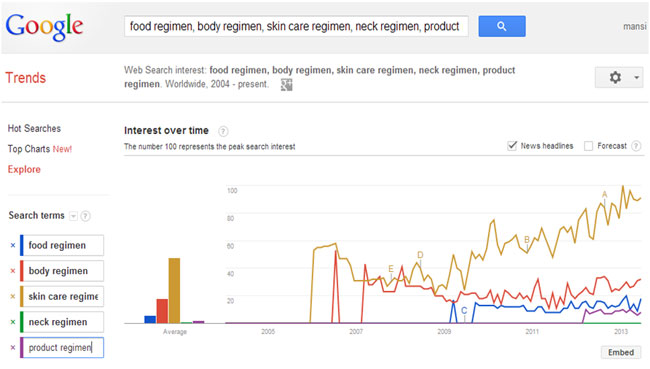
    Amongst categories wherein regimen is more prevalent, skin care pops up as a top runner.


    The study above shows that the online search is highest with regard to the skin care category.


    There is an influx of products and brands for hair and skin care. Brands like Garnier, Vaseline, Nivea Olay, Lakme, Sunsilk, L’Oreal have all infiltrated the market with regimen based product lines.


    With skin care as opposed to body care, the “visibility” factor is high hence willingness to invest is much higher.


    The space is now occupied with products that promise to cleanse, tone, exfoliate, hydrate, protect, moisturize,


    The primary focus is on anti aging care. The Indian consumer is not only aware of more than a cold cream, but she is concentrating on safeguarding her youth. Serums, creams, lotions and capsules together promise to arrest the clock.


    So what makes this promise believable? Why are women willing to believe that not one but a combination of six (somewhat expensive) products will give them the glow, radiance and plumpness associated with youth?


    A combination of high research molecules, naturals, exotic ingredients, high advertising expenditure and brand credibility elevates believability. Cosmetic companies spend millions every year on product research and marketing.


    Regimen based products do a few things very well.  They create a combination platform. It is difficult to be informed enough to chose one part from a brand and another from a different brand. This creates a preconceived platform in the consumers mind in terms of efficacy and the need to purchase all products to get the desired effect. Anti aging range from brands such as Ponds, Garnier, Olay, Kiehls, Body Shop all communicate the need for products to work in tandem,


    These products also carry tangible cues such as additives like amino acids, retinol, hyaluronic acid, sirutin technology, RX technology, antioxidants, more organic like narcissus, lavender, primrose oil, rose essence etc all of which are either patented or awaiting patenting. These terms lead consumers to believe that the regimen recommended products do in fact have the right ingredients to come together and create paramount benefits.


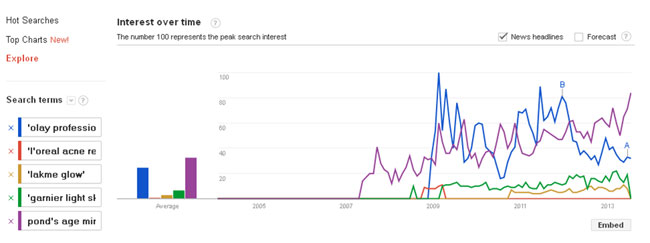
    Brands in India that have created a niche for themselves in the anti ageing regimen range are Olay and Ponds Age Miracle. Studies below show, that in terms of awareness as well as brand penetration, these two brands and their product lines are well received.


    So what are they doing differently to the other players in the market? Consistency and an established frequency of communication across media ensure that consumers get the same message at all times. The benefits attached to a regimen where step 1, 2 and 3 contribute to an overarching effect not achieved by any one product but all recommended is what helps create a convincing platform for consumers.


    But this has to be based in something deeper, something more in tune with who we are as human beings. Do we like regimen because we like order? As children we are taught – when to wash, brush, bathe, drink milk, go to school, do homework, play, go to bed, etc. Regimen seems to be established at an early age. Is the stage for 1, 2, 3 set very early in life and is this something that marketers are cashing in on?


    Would this move into other categories like oral care? Could we establish principles for brush, floss, gargle, whiten, brighten and create different products for these functions? Or even for fabric care. Detergent, softener, dryer sheets, black, stain remover.


    I guess it depends on product research that will establish a sequence for optimum benefit and then plug into our desire for regimen.


    For now I’m warding off old age, with my 1, 2, 3 step skin routine.


    Ashita Sarin, Senior GM – Marketing at DY Works


  • Adult brands patronize kiddie channels

    By Shambhavi Anand


    When Lata Diwan went shopping for the household, her 5-year-old daughter Tanya suggested her to choose a certain brand on mosquito repellent. “It will drive the mosquitoes out as well as leave a fragrance around,” the young scholar told her mother.


    Tanya’s knowledge about mosquito repellents comes from an advertisement she watches in between her favourite programmes on cartoon channels, where it’s no longer just toymakers and children’s product brands that advertise. An increasing number of nontraditional advertisers including Maruti Suzuki, Honda bikes and Samsung is advertising on kids’ channels as more children participate in their parents’ purchase decisions and more parents watch television with their children.


    “While traditional advertisers such as GlaxoSmithKline, Hindustan Unilever, Cadbury, Mattel, Kellogg, Perfetti and ITC are amongst our top spenders, close to 50% of our revenues now come from non-traditional advertisers,” says Juhi Ravindranath, ad sales vice-president for South Asia at Turner International India, which owns Pogo and Cartoon Network channels. Most houses in India have one television set and it’s common that children and adults watch it together, and often the younger ones hold the sceptre – the remote control – and decide what to watch.


    Rahul Johri

    So advertisers targeting parents too are turning to kids’ channels. “Advertisers do not want to miss any opportunity of reaching out to their target audience, whether it is mothers, fathers or grandparents,” says Rahul Johri, senior vice president and general manager, South Asia, at Discovery Networks Asia Pacific, which owns Discovery Kids. The maximum growth in terms of adspend on these channels has been observed in fast-moving consumer goods.


    A spokesperson of Pogo channel says unconventional advertisers on the channel include Maruti Suzuki, Honda bikes, Hero Moto-Corp, Micromax, LG, Samsung and Hitachi. “We expect the number of new categories and advertisers to only grow,” the person adds. That’s because it’s seen as a win-win. While the kids’ channel gains from the increased advertiser base, the non-traditional advertiser benefits from the huge secondary target audience of parents and grandparents.


    Santosh Desai, advertising veteran and MD and CEO of Futurebrands India, says, “For marketers there are a couple of advantages of being on kids’ channels. First there will be some spillover adult viewer and children’s role in decision-making for the household has also increased. Secondly, these channels are relatively cheaper in the overall media mix.”


    A study by Cartoon Network, ‘Cartoon Network New Generations 2012′, shows a majority of parents watch television with their kids. After serials, cartoons are the most preferred genre for parents, ranking above news channels.


    About 75% parents spend time watching TV at least 5-6 times a week with their kids. This number is even higher, close to 80%, for parents of younger children. Channels say that in spite of the decent growth, the kids’ genre is extremely under-monetised, with 7% viewership and just 3% of revenue share.


    Source:The Economic Times

    Copyright © 2013, Bennett, Coleman & Co. Ltd. All Rights Reserved

    Licensed to republish